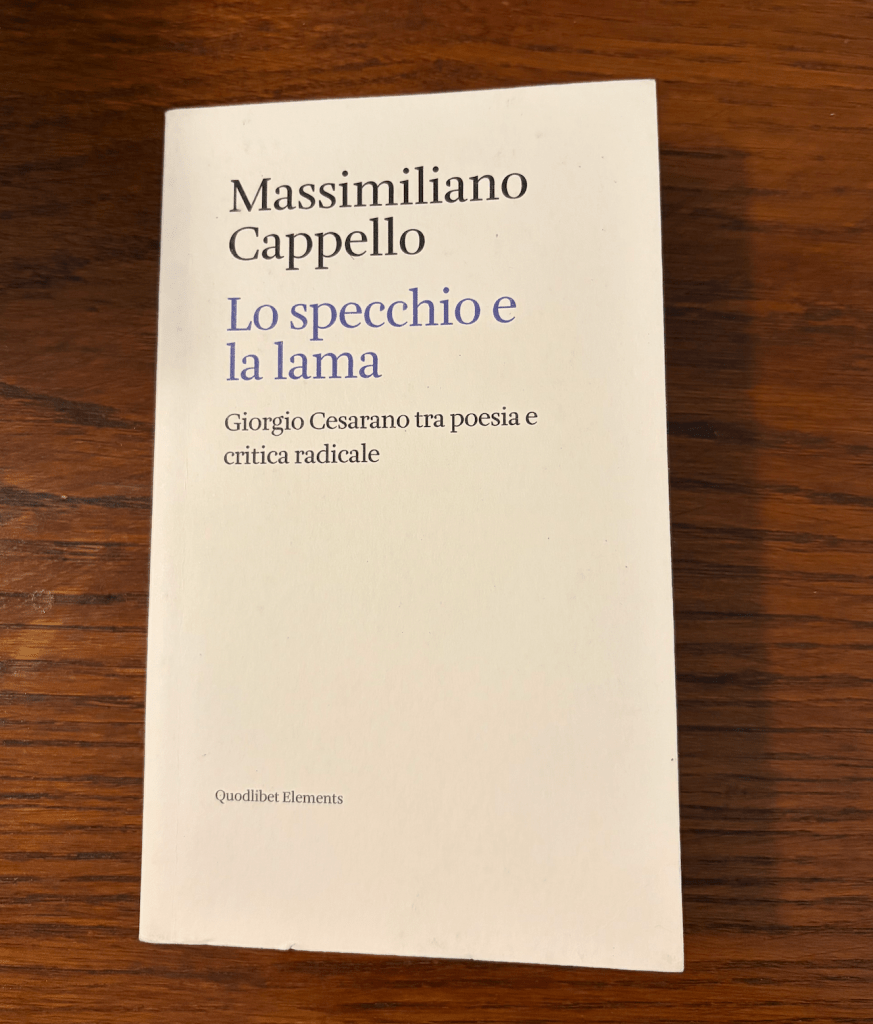
One has to begin by saluting Massimiliano Cappello’s Lo specchio e la lama: Giorgio Cesarano tra poesia e critica radicale (Quodlibet, 2026) for being the first book on the Italian thinker that takes an obvious point of departure that for too long it has been ignored: the well known fact that first and foremost Cesarano was a poet. At the heart of Cappello’s argument in his short monograph, however, is the thesis of continuity between his later philosophical thought, located under what has become known as ‘critica radicale’ of Italian 1970s, and that of his poetic laboratory. A poetic laboratory that Cappello magnificently documents in its genesis with post-war Italian poets and critics. The young Cesarano of the late fifties and early sixties was an avid interlocutor with figures such as Vittorio Sereni and Andrea Zanzotto and Eugenio Montale, and of course Franco Fortini, who introduced his first poetry collection L’erba bianca (1959).
In the milieu thematized by Cappello first chapters, it is evident that Cesarano the poet was a bit of an outsider, not really the man of letters of Italian postwar culture, as he was already looking for something like a renewal of a sensible experience that was becoming increasingly commodified and dead (Cappello 29). Albeit the mannerist tropology of the early L’erba bianca, Cappello notes that already in subsequent books, Cesarano’s preoccupation was that of mirroring of language in world that was oriented towards the highest stage of human alienation and emptiness. For Cesarano the history of human civilization was the successive stages of the reification of the human towards “survival”; a wound that was overtly present in the very texture of language. And poetic language as no exception; remaining oblivious to this totalization could only make the poet an harlequin among ruins of his present, always hungry for fictitious meaning and illusory transcendence.
Cappello tells us that already L’erba bianca staged the originary trauma of the impossibility of poetry, which shed lights unto his later transition into the prose of the ‘critica radicale’ – and in fact, one could only wish that Cappello would have said more about the transition between poetry and prose, which is also at the center of this intense autobiographical experience. In any case, the repression of the trauma starts to become more palpable in books such as La pura verità (1963) La tartaruga di Jastov (1966), and Romanzi naturali (1980), where the moribund plane of factical life not only becomes “apparent”, but it is situated at the very level of the fictitious appearance (some of the language is truly dreadful, and one can understand why Cesarano at some point could not longer follow that route without stepping into a vulgar expressionism, or, to that effect, the Lukacsian ‘naturalism’).
Cappello tells us that for Cesarano the evil of the experience of National Socialism and fascism, was not just a political system that took place at the heart of Europe; it was a phenomenon that extended into the totality of culture and life under total capital (Cappello 75). This is a bit like Pasolini’s position, except that for Cesarano there was no medium from which one could stay afloat and find an exit. Cappello cites these verses from La pura verità (1963): “…divorati dalla terre per / dal verme / che’sera / dal verme che s’era ricominciare” (Cappello 77). It does not come to a surprise, since for anyone that has read Cesarano & Camatte already in the stage of ‘critica radicale’ and ‘Invariance’, the only chance for the liberation of the generic human community (Gemeinwesen) was to start all over again, that is, from the point of view of the prehistoric inversion [1]. In the milieu of Italian literary culture, one has to agree with Cappello’s assessment: to start all over again means to start “dopo Fortini”, to leave behind the function of the critic and the writer, two beautiful soul functionaries (but functionaries nonetheless) mediating between the spheres of culture and politics in the public life. But to start again means to recoil to a hole in the temporality where the becoming of that social totality is no longer possible; even at the risk of losing the lyricism of modern poetry from Virgil to the present. This is most difficult task in a sense, because to “start all over again” seems to depart from somewhere else than language, but fundamentally we know that language is the event of every commencement. This is perhaps the aporia that runs through Cesarano’s own impossibility to effectively “finding a way out”, except a catastrophic one that we know all too well.
Can there be another resource in the face of the mounting pressure of the Spectacle and what Cesarano later called the “un-essence” (inessenza) of the Capitalist international and nihilism? In La tartaruga di Jastov (1966), Cesarano opts to still name this nothing through a giant turtle that Cappello tells us that it is a symbol of gigantomachy very much like Melville’s white whale. It is a very intelligent parallel that needs to be unpacked. Of course, Melville’s Moby Dick is the monster of the new American dominance over land and water; the monster of the incipient industrial division of labour through the whales’ oil business that sedimented United States’ nineteenth century economic growth. In contrast, Cesarano’s enormous turtle is the symbol of what takes place at the end of formal capitalist subsumption, once surplusvalue colonizes the totality of human temporality. A seamonster slowly creeps into the land signifying absolutely nothing, and yet dominating every directive of sensible reality. In the formless time of the turtle, there is no epic to be written nor a lyricism capable of offering emancipation from its images – as Cappello tells us, there is a state of infancy and innate failure (Cappello 101) . And if poetics is anything it stands alone in documenting that failure, the irreducible site of the nascent fragment, as in Schlegel’s dictum. Cappello reminds us that Cesano thought it was be infinitely worse: poetry had become a game and a publicist “operation” (Cappello 110). The autonomy of lyrical poetry could not deliver to the highest task; that is, to “recover another sensibility with the world at the heart of the epoch”, as Cappello puts it towards the end of the book (Cappello 115).
The interior of the world of un-essence (inessenza) for Cesarano will revolve around two competing figures of radical evil: the hitman (sicario) and the collector (entomologo). The first is the paid assassin that sees a price in anyone’s head, whereas the collector will be the administrator of corpses and moribund passing of beauty to be consumed. It is a world without possible evasion, because both living and dying have been rendered indistinguishable, and perhaps also unthinkable and unsingable (Cappello 127). This is Cesarano’s most extreme indictment to the late modern epoch, in which the hallucination of fictitious languages will still provide the illusion of actual living human beings. In this hellish world, it is not up for the poet to prepare a fresh start, and yet language still remains. Cappello concludes where our task begins: “Che il reale attenda una lingua non alienata per potersi esprimere compiutamente, può anche darsi. Questa lingua non sembra essere, in ogni caso, quella della poesia” (Cappello 138). And it might be the failure of language what awaits and invites the possibility of a different beginning.
.
.
Note
1. On the notion of “inversion” in Giorgio Cesrano in relation to Jacques Camatte’s thinking on the prehistoric, see my conversation with the thinker in my book Pensamiento insumiso: Coloquio con la teoría italiana (Irrupción Ediciones, 2024).

