That painting was an activity at the end of its long tradition – a tradition that perhaps coincides with the very genesis of anthropogenesis – appears explicitly in Cézanne’s late conversations with Joaquim Gasquet, which is full of rambling thoughts and anxieties. At some point in the dialogues, Cézanne says in context of the pictorial tradition: “Rubens…that is another age, all that. We are in the evening of the world. Painting, like everything else, is vanishing….” [1]. Cézanne’s work is already the painting of the evening of the world, which is the closure unto itself, not so much a deprived world of certain elements or things, but a privatized space of intelligence and logic. This structure is alien to the painter who only pledges alliance to what is seen and revealed: “The painting owes allegiance to that lone. Never to the logic of the brain…and if he abandons that logic, he is lost. Painting is first and foremost an optical affair” [2].
What the essence of technology enhances in its computational and logical capacities to make the world legible, it loses in the optical capacity for the thinking of vision, that flickering and always novice opening to the world. The calamity of the automation of the world resides in the blinding legibility where thinking-eyes, as in Cézanne’s expression, are rescinded and a thing of the past. Of course, in the name of the present legibility of blinding lights, the past will also be reduced to a pile of stuff that can be assembled and registered – as in the vulgar poet Carlos Argentino Daneri in Borges’ “The Aleph” – but in exchange for abandoning the truth and sensation.
Well before the argument of Veblen on the centrality of engineers in this new world, Cézanne was aware that the future belonged to the engineers of nature, who can both bend and straighten the crooked lines of the world, and whose final realization is the nuclear organization and the pacing of energy distribution. It does not take too much to see an overtly furious Cézanne around 1890s: “Nature abhors a strain line. And to hell with engineers! We are not road surveyors. A lot they care for color, whereas for me sensation is at the root of everything” [3]. The personal outcry ‘to hell with engineers!’ is still being heard today, although we are less convinced that such an imperative has any chance at halting the ongoing vanishing sensations of the world.
Michael Fried has argued that Fraggonard’s The Swing and Blind Man’s Bluff are two pictures that appear to us as also harbingers of an extinction of a world (the world previous to 1789 that is) [4]. Whether it is Fraggonard or Cézanne, there is an imperturbable core in painting in witnessing the moment that the world is vanishing, and retaining whatever remains of the “world” for generations capable of seeing and feeling. Borges’ aleph (a supreme optical affair) once again comes in handy when faced with the vision of the infinite: “Algo, sin embargo, recogeré”. In other words, something remains imperturbable at the end of the world. Is this what painting stood for in late Cézanne? To gather something from the world, to make it imperturbable appears as the supreme task of painting.
.
.
Notes
1. Joachim Gasquets. Cézanne: A Memoir with conversations (Thames & Hudson, 1991), 170.
2. Ibid., 161.
3. Ibid., 166
4. Michael Fried. Collected Writings, Volume II (Eris, 2026), 281.
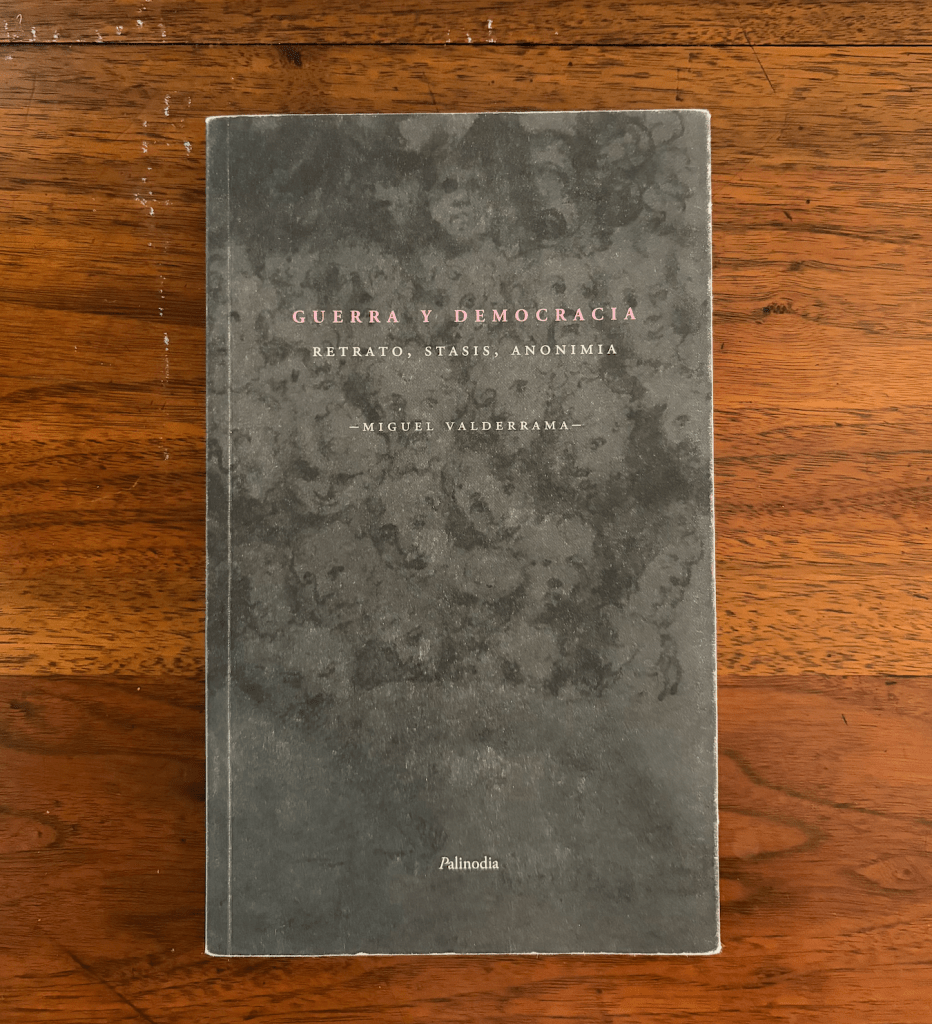
How to think through the stasis as a figure of thought in an epoch of transition and decline? This is the task of the historian – perhaps also of the philosopher and the critic – at the threshold, according to Miguel Valderrama in his book Guerra y Democracia: Retrato, Stasis, Anonimia (Palinodia, 2025), where stasis is extended beyond its categorial inscription in the grammar of political thought in order to capture its oscillatory movement. Dispersion is a word at the heart of Valderrama’s scene of writing; a scattering of sense that radicalizes the enterprise of the historian’s task that cannot remain alien to the problem of language. In fact, it is at the conjunction where Valderrama wants to situate the problem of stasis. As he writes early on in the book: “Pasión en la dispersión, sí, sí con esta frase se nombre en secreto lo que en la errancia del vocablo stasis evoca una escena traumatizante, una herida, una punzada la escenificación de un acontecimiento y el orificio de su representación, la memoria de una stasis y de la anonimia que le es más propia, impropia” (Valderrama 15).
For Valderrama the Greek term – which holds on to definitions of civil war but also conflict and internal stabilization – now welcomed in theoretical discussions, comes to name the errancy and wound of the endurance of war in the modern political project of representation and legibility. As a thinker of the local scene (and its counter-scenes), Valderrama perceives that in recent years the Chilean contemporary critical discussion, especially in the wake of the Chilean revolt of October 2019, has introduced the pulsating grammar of stasis to think this fissure in representation. Valderrama cites the essays by Rodrigo Karmy, and Alejandra Castillo, Juan Pablo Arancibia, Willy Thayer; but also publications like Escrituras Americanas and the now defunct Revista Disenseo, and the novelist Nona Fernández (Valderrama 31). Obviously, the list is not exhaustive. In the Chilean contemporary scene, stasis is removed from its hellenistic origins, in order to name the unmediated irruption of images, inscriptions, and languages as fragments in the interior of history (Valderrama 50). In post-dictatorship Chile these fragments gravitate around the impossible image of La Monada bombed in 1973, which is juxtaposed to the anonymous images of the revolt in Santiago in October 2019, where some are more monumental than others.
One of the novelties in Valderrama’s Guerra y Democracia (2025) is precisely the insistence to think the problem of stasis as radially bound to the regime of visibility and legibility that organize the artifact of political representation. In fact, and following the canonical studies of the Leviathan’s frontispiece and its relation to modern optics, we know that modern political representation has relied consistently on material technologies where representation and the homogeneity of the social body coincide (Valderrama 79). From Thomas Hobbes at the birth of political liberalism to Carl Schmitt’s political theology in Weimar, the visual artefact has been the infrastructure in the making of political authority and the unity of civil society. The repressed containment of stasis at the heart of the modern liberal state is granted only if the regime of public legibility has been constructed. In this sense, all modern politics is necessarily heliotropic, revolving around the sun of sovereignty that will later transform into the electric and atomic form of energy reserves.
By the same token, following Valderrama, we can then say that what stasis names is precisely the breakdown of the helitropic movement in an epoch of absolute exposure and blinding transparency. More than a century ago, in 1913 Malevich could speak of the “Victory over the Sun”, but this can only make sense if such victory can allow for a regime of nocturnal seeing and generic anonymity, which is always on the ‘other side’ of political dominium (be it techno-capitalism or communal administration) where all identifications fails, because there is no longer a common body or a name as energy reserve for social organization. It is because of this rupture that there cannot be a stasis within the social, but also against the closure of the spatial arraignment of the Social understood as the site that requires energy (production) in order to produce a certain degree of comprehensive idealization. Of course, Valderrama is not oblivious to this, as he writes in one of his most programmatic definition of the stasis:
“La revuelta, la stasis, se define contra esta dieta y contra este régimen de luz. Al bertillonismo que define los límites y la lógica del espacio público, la revuelta opone la multiplicación de máscaras, la suspensión del retrato, la proliferación de lo anónimo. El régimen diurno del aparecer opone la noche, las sombras y el humo de los enfrentamientos de cuerpos liberados del rostro y del retrato, de la ficha policial. La revuelta pone en movimiento una anonimia, un juego de máscaras que desata anónimos, pseudónimos, alonomios, sobrenombres, para nombres, antenombres….La anónimo guarda un secreto en la imagen, lo guarda como lagrima y caída de la imagen” (Valderrama 109-110).
But is it just a festive game of defacement and creative destruction that would resemble the spirit of carnival festivities, in which masks evoke, in an exceptional time of inversion, the supernatural powers and the dead as studied by Karl Meuli? Is not the carnival a compensatory act of the logistics of expenditure and realignment for any community of social exchange? If true, then the notion of stasis would need to break from the polarity of social identification and instance of mask, in the same way that already in the classical period the stasis emerged as a zone of indistinction between domestic and public spaces, an unbreachable black hole between the oikos and the polis that is well beyond the exception (Valderrama 119). In other words, stasis needs to be rethought as something other than an interruption in temporality, which is still the negative duration that feeds negatively into the course of temporal order of social domination and its ‘economy of violence’. Valderrama reminds that for the poet Armando Uribe, this economy of violence names the very engine of historical development. And poets tend to be better than political analysts at imagining other worlds.
Towards the end of Guerra y Democracia: Retrato, Stasis, Anonimia (2025), Valderrama briefly glosses Armando Uribe’s 2000 lecture “El fantasma Pinochet” in order to introduce not only the problem of violence, but also language; a language that he calls uncanny, “une inquietante étrangeté” (Valderrama 120). These words are glossing Uribe who is also commenting a speech by former President Eduardo Frei, but that can also be used to thematize the central problem that Guerra y Democracia introduces in its scene: how to traverse a destitution of language if stasis is the capacity to traverse the moribund language that metaphoric and cataphoric politics speaks, without any possibility of saying anything at all? As an initial promise of the book, Valderrama had called for ‘another lexis’ (“otra lexis”) against narrativity and the hallucination of language towards a ‘language as such’, which is the language of naming approaching the coasts of physis. It is tempting to say that the revolt only appears liberating when understood as a problem of inventing and making space for this other language that ceases to be a metaphor of this world.
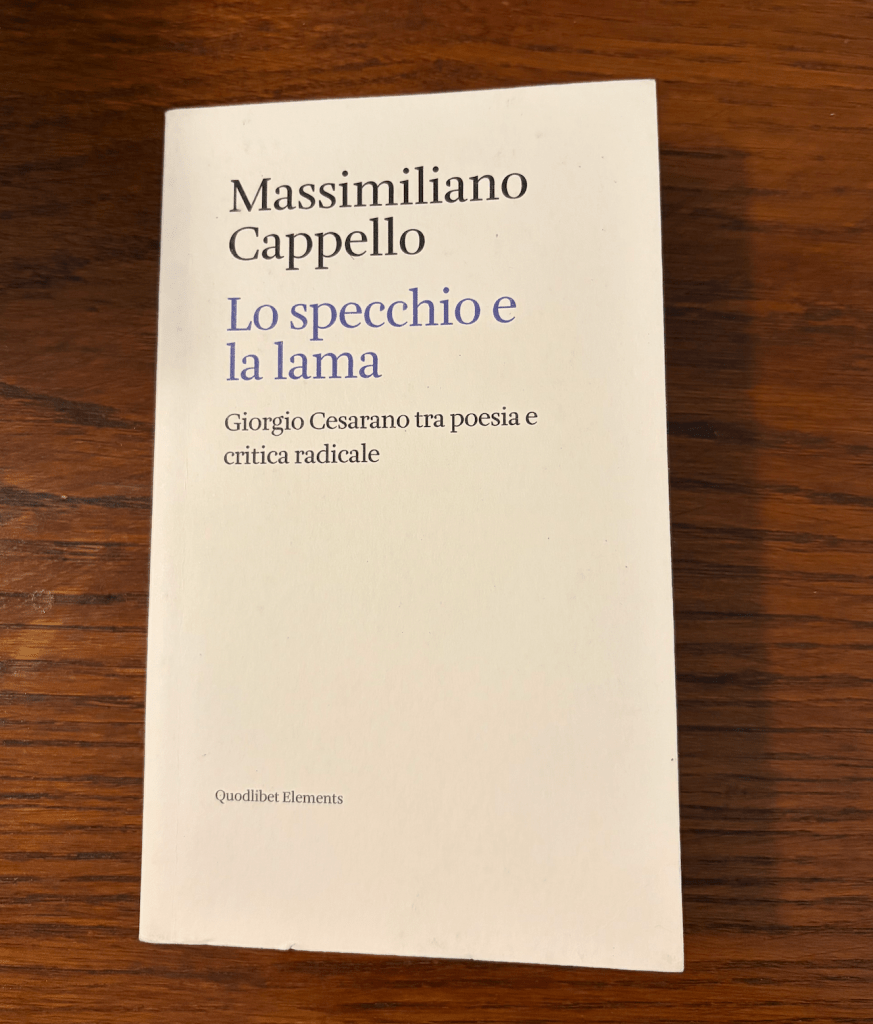
One has to begin by saluting Massimiliano Cappello’s Lo specchio e la lama: Giorgio Cesarano tra poesia e critica radicale (Quodlibet, 2026) for being the first book on the Italian thinker that takes an obvious point of departure that for too long it has been ignored: the well known fact that first and foremost Cesarano was a poet. At the heart of Cappello’s argument in his short monograph, however, is the thesis of continuity between his later philosophical thought, located under what has become known as ‘critica radicale’ of Italian 1970s, and that of his poetic laboratory. A poetic laboratory that Cappello magnificently documents in its genesis with post-war Italian poets and critics. The young Cesarano of the late fifties and early sixties was an avid interlocutor with figures such as Vittorio Sereni and Andrea Zanzotto and Eugenio Montale, and of course Franco Fortini, who introduced his first poetry collection L’erba bianca (1959).
In the milieu thematized by Cappello first chapters, it is evident that Cesarano the poet was a bit of an outsider, not really the man of letters of Italian postwar culture, as he was already looking for something like a renewal of a sensible experience that was becoming increasingly commodified and dead (Cappello 29). Albeit the mannerist tropology of the early L’erba bianca, Cappello notes that already in subsequent books, Cesarano’s preoccupation was that of mirroring of language in world that was oriented towards the highest stage of human alienation and emptiness. For Cesarano the history of human civilization was the successive stages of the reification of the human towards “survival”; a wound that was overtly present in the very texture of language. And poetic language as no exception; remaining oblivious to this totalization could only make the poet an harlequin among ruins of his present, always hungry for fictitious meaning and illusory transcendence.
Cappello tells us that already L’erba bianca staged the originary trauma of the impossibility of poetry, which shed lights unto his later transition into the prose of the ‘critica radicale’ – and in fact, one could only wish that Cappello would have said more about the transition between poetry and prose, which is also at the center of this intense autobiographical experience. In any case, the repression of the trauma starts to become more palpable in books such as La pura verità (1963) La tartaruga di Jastov (1966), and Romanzi naturali (1980), where the moribund plane of factical life not only becomes “apparent”, but it is situated at the very level of the fictitious appearance (some of the language is truly dreadful, and one can understand why Cesarano at some point could not longer follow that route without stepping into a vulgar expressionism, or, to that effect, the Lukacsian ‘naturalism’).
Cappello tells us that for Cesarano the evil of the experience of National Socialism and fascism, was not just a political system that took place at the heart of Europe; it was a phenomenon that extended into the totality of culture and life under total capital (Cappello 75). This is a bit like Pasolini’s position, except that for Cesarano there was no medium from which one could stay afloat and find an exit. Cappello cites these verses from La pura verità (1963): “…divorati dalla terre per / dal verme / che’sera / dal verme che s’era ricominciare” (Cappello 77). It does not come to a surprise, since for anyone that has read Cesarano & Camatte already in the stage of ‘critica radicale’ and ‘Invariance’, the only chance for the liberation of the generic human community (Gemeinwesen) was to start all over again, that is, from the point of view of the prehistoric inversion [1]. In the milieu of Italian literary culture, one has to agree with Cappello’s assessment: to start all over again means to start “dopo Fortini”, to leave behind the function of the critic and the writer, two beautiful soul functionaries (but functionaries nonetheless) mediating between the spheres of culture and politics in the public life. But to start again means to recoil to a hole in the temporality where the becoming of that social totality is no longer possible; even at the risk of losing the lyricism of modern poetry from Virgil to the present. This is most difficult task in a sense, because to “start all over again” seems to depart from somewhere else than language, but fundamentally we know that language is the event of every commencement. This is perhaps the aporia that runs through Cesarano’s own impossibility to effectively “finding a way out”, except a catastrophic one that we know all too well.
Can there be another resource in the face of the mounting pressure of the Spectacle and what Cesarano later called the “un-essence” (inessenza) of the Capitalist international and nihilism? In La tartaruga di Jastov (1966), Cesarano opts to still name this nothing through a giant turtle that Cappello tells us that it is a symbol of gigantomachy very much like Melville’s white whale. It is a very intelligent parallel that needs to be unpacked. Of course, Melville’s Moby Dick is the monster of the new American dominance over land and water; the monster of the incipient industrial division of labour through the whales’ oil business that sedimented United States’ nineteenth century economic growth. In contrast, Cesarano’s enormous turtle is the symbol of what takes place at the end of formal capitalist subsumption, once surplusvalue colonizes the totality of human temporality. A seamonster slowly creeps into the land signifying absolutely nothing, and yet dominating every directive of sensible reality. In the formless time of the turtle, there is no epic to be written nor a lyricism capable of offering emancipation from its images – as Cappello tells us, there is a state of infancy and innate failure (Cappello 101) . And if poetics is anything it stands alone in documenting that failure, the irreducible site of the nascent fragment, as in Schlegel’s dictum. Cappello reminds us that Cesano thought it was be infinitely worse: poetry had become a game and a publicist “operation” (Cappello 110). The autonomy of lyrical poetry could not deliver to the highest task; that is, to “recover another sensibility with the world at the heart of the epoch”, as Cappello puts it towards the end of the book (Cappello 115).
The interior of the world of un-essence (inessenza) for Cesarano will revolve around two competing figures of radical evil: the hitman (sicario) and the collector (entomologo). The first is the paid assassin that sees a price in anyone’s head, whereas the collector will be the administrator of corpses and moribund passing of beauty to be consumed. It is a world without possible evasion, because both living and dying have been rendered indistinguishable, and perhaps also unthinkable and unsingable (Cappello 127). This is Cesarano’s most extreme indictment to the late modern epoch, in which the hallucination of fictitious languages will still provide the illusion of actual living human beings. In this hellish world, it is not up for the poet to prepare a fresh start, and yet language still remains. Cappello concludes where our task begins: “Che il reale attenda una lingua non alienata per potersi esprimere compiutamente, può anche darsi. Questa lingua non sembra essere, in ogni caso, quella della poesia” (Cappello 138). And it might be the failure of language what awaits and invites the possibility of a different beginning.
.
.
Note
1. On the notion of “inversion” in Giorgio Cesrano in relation to Jacques Camatte’s thinking on the prehistoric, see my conversation with the thinker in my book Pensamiento insumiso: Coloquio con la teoría italiana (Irrupción Ediciones, 2024).