The life of a sage. On Jacques Guigou’s Capital et Devenir Humain: Correspondance avec Jacques Camatte (2026). by Gerardo Muñoz

Roughly extending a little over fifteen years (2000-2016), the epistolary exchange between Jacques Guigou and Jacques Camatte is made available in a short book entitled Capital et Devenir Humain: Correspondance avec Jacques Camatte (L’Harmattan, 2026). Truth to be told it is an uneven correspondence at times, where the sustained conversation in time seems to be interrupted around some specific years, and in other moments there is an abundance of certain editorial requests (the publication and translation of books by Giorgio Cesarano primarily) that interfere from a more thorough substantive correspondence. Be as it might, this correspondence does bring to bear the reflexive consistence of the thinker behind Invariance in his last phase of his work, most specifically in the wake of September 11 and the invasion of Iraq, which was already read by Camatte as symptomatic of the internal hostility of the human specifies embedded in the stasis of struggle as the central “engine of development of capital” (Guigou 20). 

Both autonomous capital and its regimes of representation (Politics) will only be sustained and driven by internal strife whose apocalyptic destiny has now become all too apparent; even more so than during the years when the Camatte & Guigou exchange was taking place. These historical mediations, however, are a bit of a misnomer, since the correspondence does show that Camatte’s undertaking of Hegel’s cunning of capital as the realization of the effective movement of historical accumulation was already part of the theoretical discoveries of the seventies in Invariance. The “effective end of Capital” seen through the mirror of Hegelianism meant that political reaction and its negation turned the essence of politics reactionary at its core. Later in the correspondence, in fact, we get a glimpse of the essence of “reactionary thinking” when Camatte tells his interlocutor that reaction can be understood as the continuation of a dynamic duality that is expressed in the very movement of autonomous Capital (Guigou 65-66). This is why Camatte’s horizon of reflection differed from the Debord’s situationism; it is not just because of a disbelief in the presumption of a remnant of the autonomy of art in their practices, but rather because their very dyad between art and life, public and private, contingency and necessity, language and the image expressed in many ways the insufficiency of an analytic expressed in the mystification of the commodity form. In other words, all reactionary posture amounts to a relational mode of the commodity form, but no commodity stripping and destruction can guide through a path that can exit the total transcendence of Capital towards life of the Gemeinwesen. We are left with refractory communities of belonging that find their necessary compensation in supplementary forms that allow for a distance to the fundamental question of exodus. 

Out of the many sequences of the correspondence the one dealing with the incapacities of poetry is of special interest. In one letter Camatte tells Guigou that he feels that poetry no longer is able to filter a moving tonality in the world, recalling how the end of the age of the poets (not a term expressly deployed by Camatte) has been understood by Amadeo Bordiga in a short text of 1953 that noted that the ancient power could sing in a voice of the community, whereas the modern poet in his solitude only amounts to the author of his work (Guigou 24). The correspondence exemplifies this by recalling Bruce Chatwin’s Songlines, where the poetic is not personal lyricism, but rather a tone that runs through the whole dispensation of the community in its errancy (Guigou 30). And one wonders immediately after reading this moment in the letter, where the very work of late Camatte is not disinhibited of the poetic tonality; or, on the contrary, this poetic tonality insofar as it is a pure voice can only remain opaque and absence from the scene of writing and public reflection. The challenge in this question is to be able to balance the problem beyond judgement, which always hides a form of pathetic condemnation. 

In these pages concerning poetry and the philosophical aspiration of the poem, other names are invited into the scene: Giorgio Cesarano, Domenico Ferla, and Andrea Zanzotto. These are three figures where the challenge of poetry was taken only to be radically abandoned (perhaps less so in Zanzotto where the trace of the voice is already embedded in the poetic form, and thus there was not a need to execute the radical gesture of fleeing from poetry). Although one is also surprised that the question of poetry is not extended as a problem of thought and existence, which would allow for the collapse of the very separation of poetic form and the life of the community, perhaps because the voice that is carried in poetry is more originary dwelling of human existence than the human community, because ultimately the human community (Gemeinwesen) is refractory of an irremediable loss that is recasted as original. And Gianni Carchia saw in his “Glossa sull’umanismo” (1977), Camatte’s insistence on the original community and its negation through the anthropomorphosis of Capitalist revolution will necessarily result in an inverted or transfigured humanism; or, at least, a humanism that is always longing for the image of an originary community that can only be posited with an assertive knowledge that we do not know possess except as contaminated subjectivity. But perhaps the solicitation of originary community will always fail because it will be a displacement from abyss of non-belonging that we already inhabit – what Carchia called in the same text as “uscir fuori” – into the site of proper belonging of the human species fails to account for the impropriety that always marks the experience of errancy of life. As Endnotes has noted in their recent essay “Time is an invention of men incapable of love”, Camatte was aware of the Jewish form of life as a concrete experience “seeking a solution outside this world”. But this means that it is not enough to counterpose the community and state form (Jewish form of life precisely is not exhausted in community belonging, or in the memory of a community), but something other than the closure of the community if one wants to go beyond the eternal metabolic stasis of human belonging. Ultimately, as Camatte tells Guigou at the end of the correspondence, only Capital claims immortality in its universalist extension (Guigou 68). 

Perhaps this is a task that requires another modality of thought, perhaps a non-philosophical practice beyond community and humanity, but suspicious of the claims to immortality of the capitalist revolution. In a letter from 2016, Camatte citing François Julien, confronts philosophical thinking with a notion of wisdom that retracts from hostility and agonistic dispute, because it retreats into serenity of a peaceful sage (Guigou 65). I take this to mean something akin to Kojeve’s ‘voyou désœuvré’, the sage that in the Sunday of history harbors a passion of life where happiness is received not as a consequence of actions, but as a supreme grace of the unexpected. It does seem that this was also Camatte’s longing in life that although wanting to abandon this world, refused to abandon the interlocution with others; touching as if it were, an unbreachable state of wisdom.
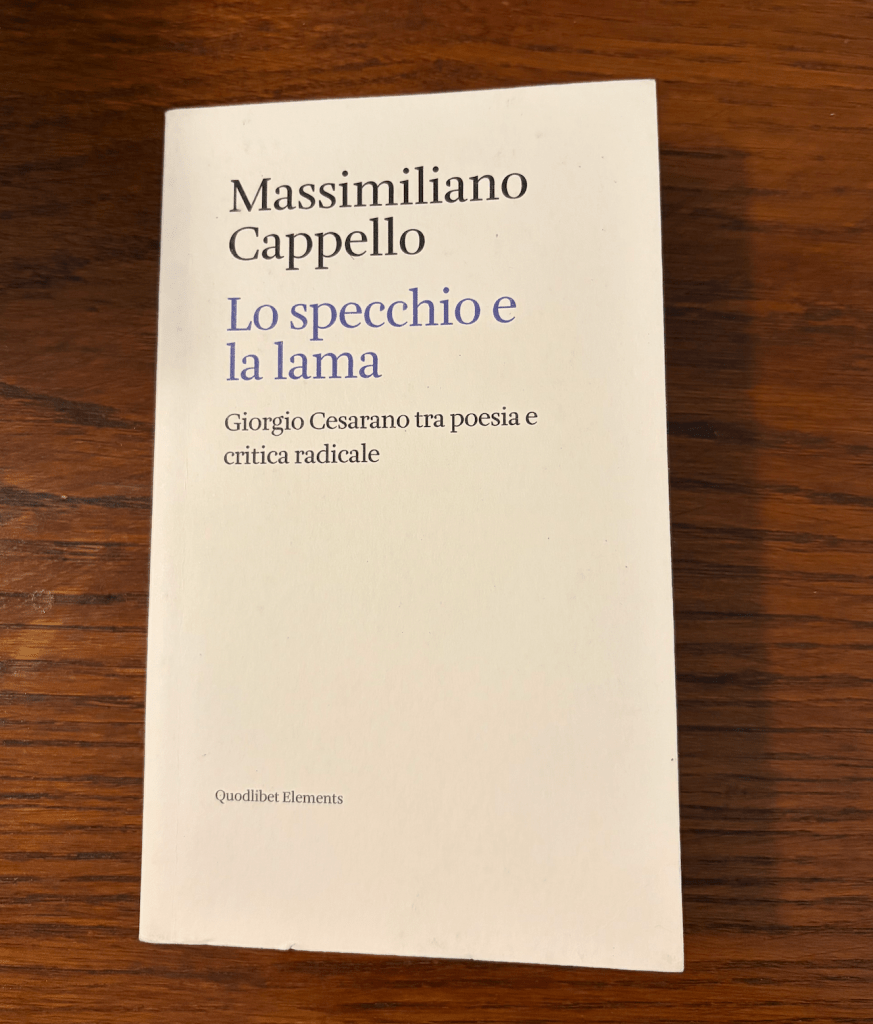
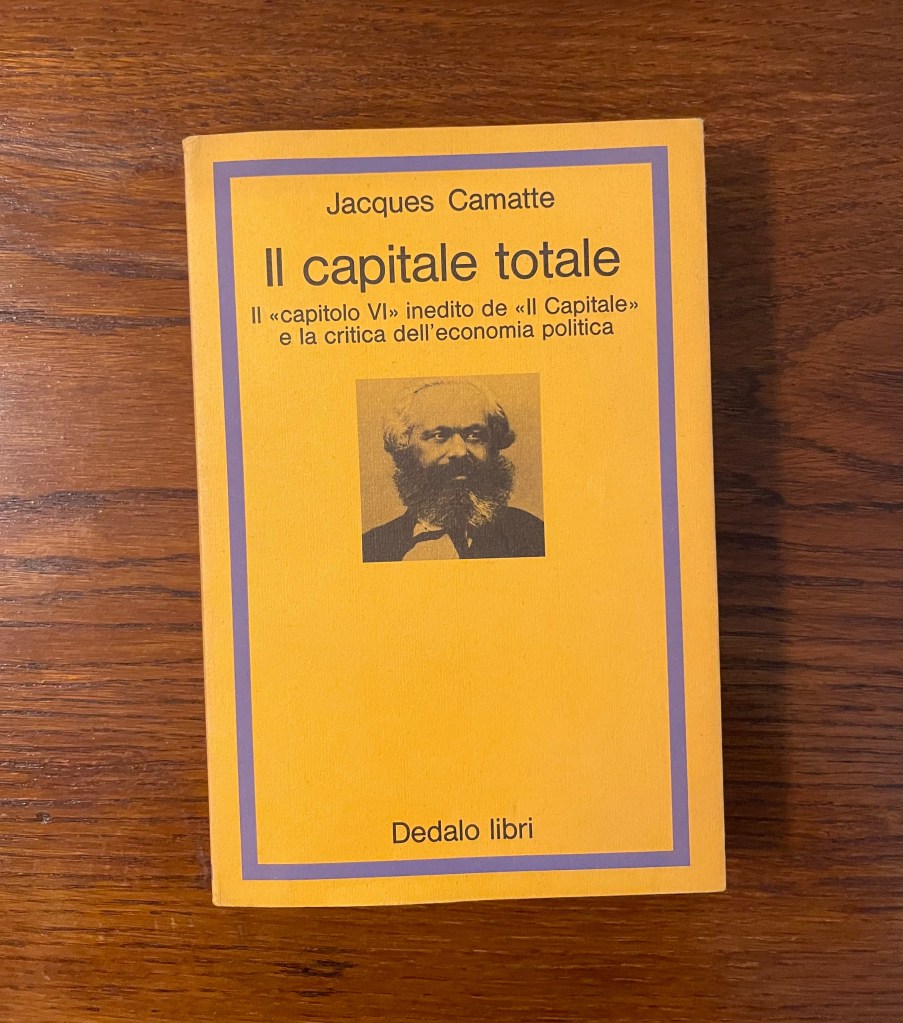
Starting all over again. On Massimiliano Cappello’s Lo specchio e la lama: Giorgio Cesarano tra poesia e critica radicale (2026). by Gerardo Muñoz

One has to begin by saluting Massimiliano Cappello’s Lo specchio e la lama: Giorgio Cesarano tra poesia e critica radicale (Quodlibet, 2026) for being the first book on the Italian thinker that takes an obvious point of departure that for too long it has been ignored: the well known fact that first and foremost Cesarano was a poet. At the heart of Cappello’s argument in his short monograph, however, is the thesis of continuity between his later philosophical thought, located under what has become known as ‘critica radicale’ of Italian 1970s, and that of his poetic laboratory. A poetic laboratory that Cappello magnificently documents in its genesis with post-war Italian poets and critics. The young Cesarano of the late fifties and early sixties was an avid interlocutor with figures such as Vittorio Sereni and Andrea Zanzotto and Eugenio Montale, and of course Franco Fortini, who introduced his first poetry collection L’erba bianca (1959).

 In the milieu thematized by Cappello first chapters, it is evident that Cesarano the poet was a bit of an outsider, not really the man of letters of Italian postwar culture, as he was already looking for something like a renewal of a sensible experience that was becoming increasingly commodified and dead (Cappello 29). Albeit the mannerist tropology of the early L’erba bianca, Cappello notes that already in subsequent books, Cesarano’s preoccupation was that of mirroring of language in world that was oriented towards the highest stage of human alienation and emptiness. For Cesarano the history of human civilization was the successive stages of the reification of the human towards “survival”; a wound that was overtly present in the very texture of language. And poetic language as no exception; remaining oblivious to this totalization could only make the poet an harlequin among ruins of his present, always hungry for fictitious meaning and illusory transcendence. 

Cappello tells us that already L’erba bianca staged the originary trauma of the impossibility of poetry, which shed lights unto his later transition into the prose of the ‘critica radicale’ – and in fact, one could only wish that Cappello would have said more about the transition between poetry and prose, which is also at the center of this intense autobiographical experience. In any case, the repression of the trauma starts to become more palpable in books such as La pura verità (1963) La tartaruga di Jastov (1966), and Romanzi naturali (1980), where the moribund plane of factical life not only becomes “apparent”, but it is situated at the very level of the fictitious appearance (some of the language is truly dreadful, and one can understand why Cesarano at some point could not longer follow that route without stepping into a vulgar expressionism, or, to that effect, the Lukacsian ‘naturalism’).

Cappello tells us that for Cesarano the evil of the experience of National Socialism and fascism, was not just a political system that took place at the heart of Europe; it was a phenomenon that extended into the totality of culture and life under total capital (Cappello 75). This is a bit like Pasolini’s position, except that for Cesarano there was no medium from which one could stay afloat and find an exit. Cappello cites these verses from La pura verità (1963): “…divorati dalla terre per / dal verme / che’sera / dal verme che s’era ricominciare” (Cappello 77). It does not come to a surprise, since for anyone that has read Cesarano & Camatte already in the stage of ‘critica radicale’ and ‘Invariance’, the only chance for the liberation of the generic human community (Gemeinwesen) was to start all over again, that is, from the point of view of the prehistoric inversion [1]. In the milieu of Italian literary culture, one has to agree with Cappello’s assessment: to start all over again means to start “dopo Fortini”, to leave behind the function of the critic and the writer, two beautiful soul functionaries (but functionaries nonetheless) mediating between the spheres of culture and politics in the public life. But to start again means to recoil to a hole in the temporality where the becoming of that social totality is no longer possible; even at the risk of losing the lyricism of modern poetry from Virgil to the present. This is most difficult task in a sense, because to “start all over again” seems to depart from somewhere else than language, but fundamentally we know that language is the event of every commencement. This is perhaps the aporia that runs through Cesarano’s own impossibility to effectively “finding a way out”, except a catastrophic one that we know all too well. 

Can there be another resource in the face of the mounting pressure of the Spectacle and what Cesarano later called the “un-essence” (inessenza) of the Capitalist international and nihilism? In La tartaruga di Jastov (1966), Cesarano opts to still name this nothing through a giant turtle that Cappello tells us that it is a symbol of gigantomachy very much like Melville’s white whale. It is a very intelligent parallel that needs to be unpacked. Of course, Melville’s Moby Dick is the monster of the new American dominance over land and water; the monster of the incipient industrial division of labour through the whales’ oil business that sedimented United States’ nineteenth century economic growth. In contrast, Cesarano’s enormous turtle is the symbol of what takes place at the end of formal capitalist subsumption, once surplusvalue colonizes the totality of human temporality. A seamonster slowly creeps into the land signifying absolutely nothing, and yet dominating every directive of sensible reality. In the formless time of the turtle, there is no epic to be written nor a lyricism capable of offering emancipation from its images – as Cappello tells us, there is a state of infancy and innate failure (Cappello 101) . And if poetics is anything it stands alone in documenting that failure, the irreducible site of the nascent fragment, as in Schlegel’s dictum. Cappello reminds us that Cesano thought it was be infinitely worse: poetry had become a game and a publicist “operation” (Cappello 110). The autonomy of lyrical poetry could not deliver to the highest task; that is, to “recover another sensibility with the world at the heart of the epoch”, as Cappello puts it towards the end of the book (Cappello 115). 

The interior of the world of un-essence (inessenza) for Cesarano will revolve around two competing figures of radical evil: the hitman (sicario) and the collector (entomologo). The first is the paid assassin that sees a price in anyone’s head, whereas the collector will be the administrator of corpses and moribund passing of beauty to be consumed. It is a world without possible evasion, because both living and dying have been rendered indistinguishable, and perhaps also unthinkable and unsingable (Cappello 127). This is Cesarano’s most extreme indictment to the late modern epoch, in which the hallucination of fictitious languages will still provide the illusion of actual living human beings. In this hellish world, it is not up for the poet to prepare a fresh start, and yet language still remains. Cappello concludes where our task begins: “Che il reale attenda una lingua non alienata per potersi esprimere compiutamente, può anche darsi. Questa lingua non sembra essere, in ogni caso, quella della poesia” (Cappello 138). And it might be the failure of language what awaits and invites the possibility of a different beginning. 

.

Note 

1. On the notion of “inversion” in Giorgio Cesrano in relation to Jacques Camatte’s thinking on the prehistoric, see my conversation with the thinker in my book Pensamiento insumiso: Coloquio con la teoría italiana (Irrupción Ediciones, 2024).

Dialogue with Jacques Camatte (1935-2025)

The passing of Jacques Camatte (1935-2025) a week ago from the writing of this text recalls a life that ostentatiously lingered in thought, and a thought that was entirely enmeshed and intertwined in the irreducibility of life. For some of us that had the good fortune to interact – however briefly and momentary, although every contact is always destinial and inescapable – Camatte transpired generosity and authenticity, and his voice evoked an almost Adanic happiness that has become rare among human beings. A common friend these days has recalled that somewhere in Camatte’s writing there is an endorsement of a capacious phrase from Chernyshevsky that could very well serve to remember his enduring ethical pursuit: ‘we have finally understood that the Earth is a place of life rather than judgement’. The opening the Earth as a dwelling place for life forms means that it is insufficient to conceive of domination as an organization of modes of production, since capital is first and foremost a spatial-temporal arrangement towards the future of the human species, and thus of a certain conquest of the world sensuous life. 

This was the outstanding triumph of real sumption: the modulated and ongoing alienation of the human community (Gemeinwesen) into a community of capital that has arrested time of life to the point of adjusting it to homogenized agony of historical time. Against the dynamic of revolution and counter-revolution that theologically exported the polarity of the eschaton and the ho katechon, already in the inception of 1970s Invariance Camatte called for an exteriority of any philosophy of history in order to rework of “a new relationship between human beings and nature”, and “breaking the lock that inhabits the creation of a new form of life”. The two citations in dialogue with each other come from “Against domestication” (1973) and the introduction to Urtext: frammento del testo originario di Critica dell’economia politica” (the 1977 Italian edition curated by Gianni Carchia), although these are variations from the depth of the emergence of the invariance of truth as a vantage point of the world. At the center is a form of life that renews the world that transitions beyond all forms of metaphysical logistics of appropriation, mere standing reserve, and the general arrangement for the mobilization of production. Any point of departure against domestication measures itself against the totality of this fluctuating dominion.

As it has been said of other great thinkers, Camatte’s ultimate passion was rooted in thinking one idea to the end and not of endorsing a system of concepts. For him it was the schism, that is, how to undo the historical process of domestication of a fictive community against the absorption of the increasing autonomization of fictive capital. The schism against the capitalist general equivalent also demands advancing a secondary schism against all humanism and its originary separation from nature. In schism, there is something of Gaunilo of Marmoutiers’ “thought of the word alone” that is receptive to the movement of the soul tries to account for the perceived voice. This precisely what Camatte carried as the lesson from Bordiga’s idiosyncratic original communist program: a movement against the historical benchmark of the development and political economy of growth, which will entail the exhaustion of the revolutionary horizon driven by an ideological political technification that tends to deepen the power towards the positionality of epochal nihilism expressed in the revitalization of strife and the ‘errancy of humanity’ (contrary to Martin Heidegger’s notion of errancy as a play between unconcealment and truth, for Camatte errancy is another name for the civilizational narrative that exemplifies the withering of the  human community into organized and protracted social reproduction and historical abstraction). Hence, as for Bordiga, Camatte conceived the ontology of communism as a world view (not as a political program oriented by concrete historical subject or distributive economic reproduction; not a soteriological dogma nor a transhistorical material idea); that is, broadly speaking, thinking the relationship between the human beings and the earth. A question more pressing than ever given the current planetary conflagration, which exposes the civilizational course that has lead to an inhospitable world where the survival of the human being has become the byproduct of an effective hostis of the community of capital integrated to the global surplus value accumulation.

In Camatte’s unrealized thought – but perhaps all forms of thinking are so – the bordigist gesture persists in locating the schism at the threshold of the force of real subsumption of the anthropomorphization of capital, where the notion of revolution itself is transfigured since, unlike Delacroix’s paradigmatic romantic painting, ‘liberty’ no longer guides the spirit of the “living”. Its redeeming voice also carries downwards unto the depth of the souls of the dead. Amadeo Bordiga himself in “Dialogato coi morti “(1956) writes that “The Revolution…it is always, in the course of an immense historical arc that will close as it opened and where it promised, where it has an appointment with many of the living, but certainly with the unborn, as with the dead: they knew that it never fails, never deceives”. True life can also take place with the nearness of that which seems remote (as Gustav Landauer once claimed: “For me, the dead also live”).

If both the collapse of the future and the increasing adaptation of social life has entered a gnostic dialectic of endless self-legitimation, it is paramount to capture not just the insurrectionary, but the resurrection flight in Camatte’s gesture that opens possibilities lodged in the dead as an emblem for the return to the world “full of joy and exuberant life”, as he wrote in an apostrophe in “Scatologie et résurrection” (1975): “I will draw from mother earth the vital and infinite power and I will resurface full of wisdom, joy and an exuberant life which will allow me to reach this human community…I will have left your world and been resurrected!” Does holding on to the unity of the Gemeinwesen require a theological undercurrent? Is not the passion for schism, and by the same token the stazion, the energy within the very dispensation withheld between mystery and revelation that has prompted the congenital forms of formal mediations and institutions for the political community? These are the questions that we are exposed to in the enduring task if we are to take seriously a continuous ‘dialogue with Camatte’, which carries the voices of the dead. Ultimately, any authentic conversation that dwells in thought does not have to invent anything new; we are depositories of an endless communication that is handed over, interrupted, and transmitted to anyone willing to hear and capable of being traversed by the shared word. 

In his last year of thinking, Camatte insisted on the notion of “inversion” in the wake of the civilizational phase of extinction, which would require deposing all forms of hostilities and bringing to an end the partisan positions invested in orienting technology and morality (nature) in their seditious defense of the real dominium over the passing of the world. For the current depressing (and depressed) times, writes Camattes in “Instauration du risque d’extinction” (2020), what could very well be a prelude to a return to the repressed allowing a return to the past to initiate an inversion that would allow liquidation of lall exhibition abandoning enmity. This is why, as he told me in an exchange that we undertook five years ago, “inversion cannot be a strategy, as it is totally outside of politics, which is the dynamic of organizing people, of controlling them”. A breakthrough, then, only as a mystical downwards leap into the past? Absolutely – but only insofar as the mystic is the ethical witness to his own openness to the word, and whose exodus from the social machination prepares a return to the world beyond the flattening and dominant language molded by rhetorical dishonesty or passive narcissism of the subjectivity.

This is why according to Carlo Michelstaedter to have courage in the world means to decide between two irreducible figures: the dishonest trickster, or the mystic in the desert. There are no third terms in between. And whereas the dishonest subject knows how to play the hand to his best outcome in each given moment; the mystic knows that his decisive moment is always commencing because the genesis of the human species has yet to take place. This beginning is always at the brink of an untimely auratic experience. And aura names the incommensurable distance from the rational containment of the world — unlike Teilhard de Chardin’s internal introspection in the noosphere that will bring the fullfilment of a spiritualized humanity upon Earth (realized in part by the unification of the sciences by cybernetics); in other words, an exodus from the temporal nominalism that inhabits another life attuned to its genesis: “devenu-devenant ce monde et sur cette vie autre au moment où s’effectue sa création”, he writes in “La séparation nécessaire et l’immense refus” (1979).

The visitation of Jacques Camatte in the world bears witness to that invisible freedom of the human species ready to jump and traverse the catastrophic trumpeting into the living and the dead, making possible the refractions of thinking as original texture of existence. From now on, the exodus from the immanence of this world will embrace a disempowered but perpetual dialogue with Camatte’s demure schism of the living. Indeed, we are always on the path to an earthly beginning.