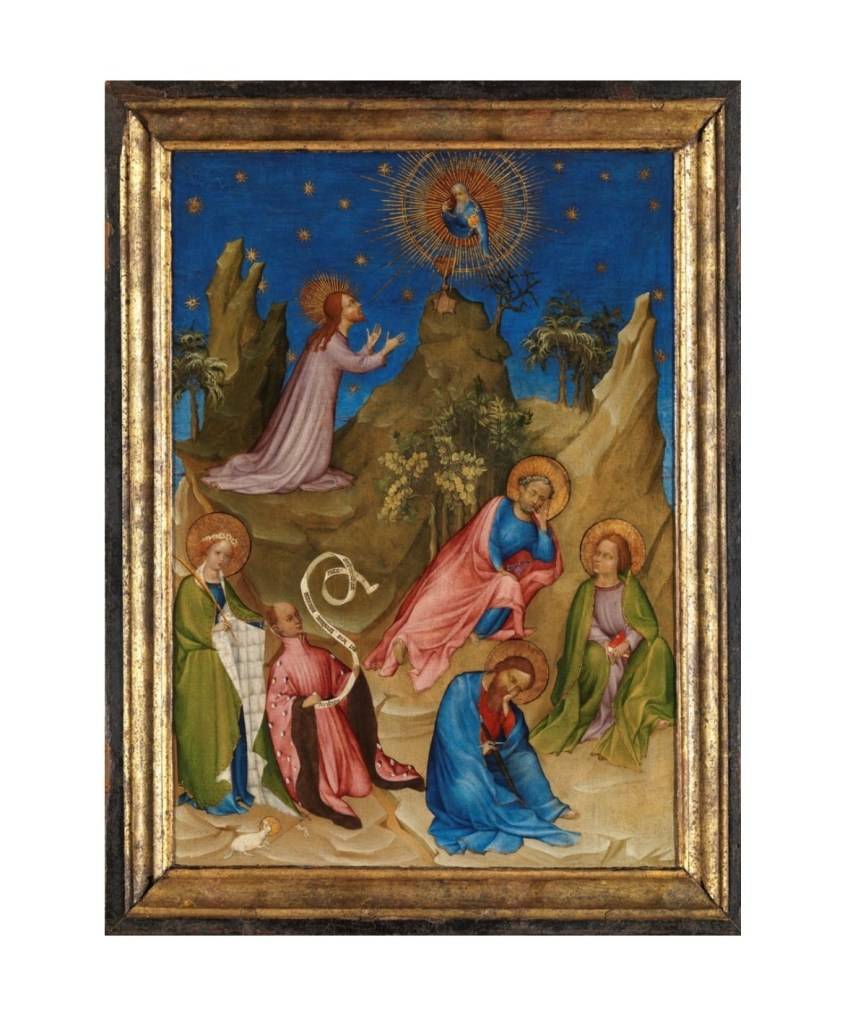
There is a panel in the Museo del Prado titled “Agony in the Garden”, attributed to the French painter Colart de Laon (1377) whose religious work barely survives (this panel is, in fact, one piece from an original triptych). The scene portrays the well known stay of Jesus in the Garden of Gethsamane on the Mount of Olives, where solitude and abandonment prepares the interval for the moment of transfiguration. If anything, Gethsamane is an experience of inwardness outside itself, which the painter has marvelously captured in the figure of Jesus raising his hands in supplication to the starry skies and god. Or so we think. The crisp blue tone of the sky immediately reminds the view of the vault of the Villa Farnesina that Fritz Saxl has interpreted as the transmission of a previous pagan astrological faith in the pictorial composition. The intense blue tone coupled with the emphatic stars arrest our imagination, but also that of the humane and worldly Christ.
What kind of experience is to look up into the firmament from man’s place on Earth and the cosmos? And what are we to make of the inability of the civilized human being to look into the blue depth not as a mirror of Nature, but of the non-totalizable and irreducible experience of solitude? It must be said that in a post-mythical world, the increasing loss of the opening of the sky goes hand in hand with the boundless loss of the Earth. And this is why we are tempted to read Colart de Laon’s picture as a gesture that renders legible the passage of the same movement: the Jesus that raises his hands outwards to the sky; and, simultaneously, the dozing Jesus that inhabits the contemplative state at the center bottom of the picture. To live in the world is defined neither by the experience of the time of arrival of the sky nor by the inward experience of the soul, but by the ability of transiting from one state to the other. And only there the worldly divine can be disclosed beyond the sclerosis of form.
This might also explain why Søren Kierkegaard following the German hymnist Gerhard Tersteegen could write in a gloss of his diaries that Jesus arises from the love feat into the path of Gethsemane: “It is always this way: Gethsemane lies closest to the highest bliss” [1]. The highest place is not the moment of absolute transcendence through faith; it is the secret that for Tersteegen expresses a kenotic hymn that empties life in the direction of poverty and death. In other words, the “highest bliss” is the experience of expropriation of every life; making life and death become indistinguishable in the vacillating night. A night beyond time and without god.
Perhaps not just the “religious experience”, but allexperience has as its central paradigm, the highest bliss in the face of death in which language can only account for it in its muteness and reverence. This is not an experience of vital teleology of humanity, but of a furtive relation. “Hacía sobre ella la experiencia”, as a Chilean writer once put it in the imperfect tense. But this can only mean to do an experience on the dissolution of oneself.
.
Notes
1. Søren Kierkegaard. Journals and Notebooks V.7 (Princeton University Press, 2014), 368.
“Symbolism and immortality”, was the title of a talk that a very young Boris Pasternak gave in 1913 to a group of students, although the paper was finalized around 1917. It has been known that the integral version was destroyed or misplaced, and only a synthesis was preserved in the author’s papers, which provides access to the thicket of the argument, which concerned ultimately the immortality of artistic creation and the transhistorical participation of the human species in the enduring process. Pasternak himself inscribes this lecture at the heights of his ars poetica: “My main purpose was to put forward the proposal that perhaps this maximally subjective and universally human corner or lot of the soul was art’s immemorial area of activity and its chief content. And, further, that although the artist is of course mortal like everybody else, the happiness of existence which he has felt is immortal and can be felt through his works by others centuries after him” [1]. Unlike the contentious positions about the creative genius and the orientation of the poet (dichter als Führer) that soon enough will inform the thick aura of European modernism in the age of dissonance, for Pasternak in the 1910s (the same decade as the early Lukacs and the youthful Michelstaedter), creation concerned a gathering of experience outside subjectivity; it was fundamentally the experience of the outside beyond the subject, which could only be cultivated by the poetic sensibility’s relation to that outside. It is not clear where there was a figural specificity to the notion of “poet” that Pasternak advances; but, what is essential, is that the poetic task was only possible through a spiritual formation and deployment of symbolization, that is, of the transfigurative use of language.
Pasternak does not distinguish between vulgar and crafted poetic language; rather he uses the term symbolism to account for the sensible immortal reservoir that is transmitted in the stratification of the genesis of the human race. It is not of minor importance that Pasternak is writing in the dawn of a concrete materialist revolution, in which possession is only registered, counted, and even “destroyed” as mere “stuff”, thus incapable of solving the crisis of the transmission of tradition and blind to the problem of sense. Indeed, perhaps the revolution can only deepen the epochal crisis of symbolization. Pastnark will write affirmatively: “Immortality takes possession of the contents of the soul…in pure form this is what symbolism teaches” [2]. In a conception that is strikingly similar to Warburg & Saxl’s conception of the symbol (and history now designed as a study of the coagulation of symbologies) as a surplus discharged of energy as the reservoir of human sensation and formulas of imagination (the pathos formulae); the attunement towards symbolization never amounts to an accumulation of meaning and narration, but rather it is what preserves the earliest and purest stages of human expression, as argued by Saxl [3].
This is why there is no immortality except in the beginning: the real process of the anthrogenesis is only accessible in those moments of passion and experience while “being observant and drawing from nature”, Pasternak will claim in his talk. The immortality to be retained, it seems now clear, is not that of a future and postponed soteriological communal “life”; it is rather a life that clings to the ordinary and intuitive symbolism that resists the monstrous numbing of fictitious life commanded by the blackmail of the reality principle required by orderability. In this light, perhaps Alfred Metraux is right in that going beyond the neolithic age marked a catastrophic wandering for human beings. (And is not the poetic instantiation a painful reminder of this?)
The stratification of symbolism was of a higher reality; a playful dance between the figure and the non-figural, between the visible and the invisible, between the countable and the non-countable. Pasternak situates this tendency under the sign of “theos“, a religious character in which the texture of the soul is able to find some breathing space as condition of possibility for the opening of symbolism. Modernity is many things at once, but for Pasternak what was being “withered away” at the altar of morality and politics, Church and State (his terms verbatim) was precisely the historical draught of the symbolic man: “The communion of mortals is immortal and that life is symbolic, because it is full of meaning” [4]. This means that there is no community of salvation that serves as the general economy transport between the two kingdoms; if there is a Kingdom it is only of the symbolization of the irreducibility of souls, that can only enjoy immortality in the renunciation of what the materialist and survivalist life is capable of offering in detriment of the experiential possibilities of creation and language when grasping the sense of deathlessness.
In the life of civil society you will live organized only unto death, without any experience of immortal death of any other, given that death has become mere transaction, a burdensome logistical ritual, a common spectacle. And this is why Pasternak, unlike the Cold War pawn that sometimes he was forced to embody, gradually became convinced that poetic existence could only take place outside the Social with no role or mission to subscribe to: “Do not reserve a poet’s position: it is a dangerous, if not empty” [5]. What was at stake was not a “new life” but a second birth (title of his own poetry collection, Vtoroe Roshdenie from 1934) to plunge into the depth of symbolization. The task is not to invent anything “new” (that modern fetishism), but to regain the life of the soul where the origin commences: “…and here art stops, And earth and fate breath in your face” [6]. It is a mysterious and impossible portrait of a face that reckons with the passing of the symbol and its absolute mystery. The very texture of expressivity that, against all odds, lingers on.
.
.
Notes
1. Boris Pasternak. An essay in Autobiography (Collins and Harvill Press, 1919), 69.
2. Boris Pasternak. “Symbolism and immortality”, in The Marsh of Gold: Pasternak’s Writing on Inspiration and Creation (2008), 40-41.
3. Fritz Saxl. “The expressive gestures of Fine Arts”, in Lectures V1-V2 (Warburg Institute, 1957).
4. Boris Pasternak. “Foreword”, in Selected Poems (Penguin Books, 1983), 14.
5. Boris Pasternak. “To a Friend”, in Selected Poems (Penguin Books, 1983), 100.
6. Boris Pasternak. “Second Birth”, in Selected Poems (Penguin Books, 1983), 109.
i. What is your name? Every time that I have watched John Cassavetes’ Shadows (1959) I end up facing the same question: what is taking place in this film? Perhaps it is the incorrect question insofar as Shadows (1959) is, first and foremost, a film about the event; about “what takes place”. Unlike Hollywood’s telic form over conflict, the whole premise of Cassavetes’ method of improvisation is a way to liberate the event in the moving image. This is what I would like to call here a photogenic event. The whole structure of Shadows is, to this effect, the bringing-fourth of appearing without narration or naming. Hence, what takes place is the way in which characters or figures emerge from light, retracting from the plunge unto theatricality. The photogenetic effect in Cassavetes is a way out of the logic of naming: remember “what is your name?”, as Bennie asks very early in the film (the café sequence). Indeed, the naming is always what emerges after the event, once boredom has kicked him and the separation from light and shadow, human and animal, theater and theatrically have taken place. The taking place in Shadows is a return to an abysmal site predating naming, faces, or intentions: it is absolute proximity.
ii. The vocation of the quotidian. The photogenetic image works through the texture of life: this is why in Shadows nothing truly happens in virtue that everything takes place. The difference between happening and taking place is an irreducible distinction; mainly, what happens is not provoked a mediation between subjects and objects, but rather at a moment when both subject and object coincide only to immediately suspend each other. What takes place is life’s destiny, which ultimately entails that we are figures of exposure before we are subjects of narrative and causality. As in a diary or a midnight party, what takes place is the clandestine life once it enters in relation with other bodies, languages, and gestures. In this sense, Shadows remains faithful to one and only one principle: how to transfigure the boredom of factical life into a vocation of a clandestine life. It is not too clear that Cassavetes arrives at a successful answer to this problem; almost as if, indeed, to remain clandestine is to insist on the “invisible” image that is always missing from every life. The promiscuity between shadows and light transpires the possibility of the living all the other invisible and nonexistent lives that are scarified within that which we call “life”.
iii. Under the glorious sky. If the task of vocation opens to the invisible in life, then this means that there is always a dimension that is exterior the anthropological determination. In the solitude of the nocturnal splendor of the late modern metropolis – as in the instance in which Lelia is outside of a Manhattan theater lost in thought or contemplating the shimmering lights above – the existence of the human shines along with the embers of the sky. This most definitely an inherence of paganism in the sense of the medium in life as a mode of appearance without judgement. As one can still contemplate it from the frescos at Villa Fernesina, the pagan gazing towards the sky is not a flight towards abstraction or transcendence, but rather a releasement of life’s destiny as affirmed in the terrestrial presence [1]. Paradoxically, at the moment of the total subsumption of life into the Spectacle, the medium frees the possibility of the deconstitution of life into the modes and resources of appearing. From the photogenic perspective, this entails full saturation on the horizon; from the pagan perspective, the onwards unfolding of existence becomes a fragment in the exploration of the common sky.
iv. Inharmonious tonality. Now, fragmentation opens a heterochronic disassociation between images and events. Indeed, all of Shadows unfolding bears witness to the way in which the tonality of life is always at odds with the attunement of the rhythms of the world. It is in this threshold where interiority of the self and exteriority of music point to the peak of prophecy. For one thing, because music is the medium through the residual mystery of the “inexpressive” becomes the process of traversing the ecstatic formlessness of the event [2]. This disharmony dislocates the homogenization vis-à-vis the sky of cinematography. Bresson says something very beautiful about this disharmony: the image of cinematography must be such that it puts in relation the voice and the steps of a person in a way that the protagonist themselves have not foreseen [3]. This nocturnal knowledge between image and sound, rhythm and tonality of life, becomes the triumph of the photogenic medium in which life dissolves in a kinetic outburst without recourse.
v. The invisible and intoxication. At a very superficial dimension, Shadows is about alcohol consumption; hence about what happens to a life under the stage of intoxication. The only knowledge is that of the oblique pedagogy in which the way of the flesh becomes a pathway for language, friendship, and violence among other bodies. There is no transgression as an intoxicated subject, since intoxication is already the violence against the substance of the subject. In other words – and this was suggested to me by the contemporary artist and designer Claudia Patricia – the logistics of errancy is being able to do otherwise from a site in which no other possibility could have emerged. This absolute necessity moves against reality and the future planning of the metropolis. And here I must return to the beginning: what takes place is what allows a relation with the invisible. Already in 1959, Cassavetes understood that intoxication redeems an ethical life against an epochal phase in which total anthropological exposure would become the concrete utopia of the socialization of capital.
.
.
Notes
1. Fritz Saxl. La fede astrologica di Agostino Chigi. Interpretazione dei dipinti di Baldassarre Peruzzi nella Sala di Galatea della Farnesina (Bardi Edizioni, 2017).
2. Gianni Carchia. “Dialettica dell’immagine: note sull’estetica biblica e cristiana”, in La legittimazione dell’arte: studi sull’intelligibile estetico (1982).
3. Bresson on Bresson: Interviews, 1943-1983 (NYRB, 2016).


 Infrapolitical Reflections