De Certeau’s untold night. by Gerardo Muñoz

The highest poetic moment in Michel De Certeau’s La culture au pluriel (1974) appears in the concluding pages where the historian resorts to a hunting image: “Culture is an untold night in which the revolutions of earlier times are dormant, invisible, folded into practices – but fireflies, and sometimes great nocturnal birds, cutting through it – as thrusts and creations that trace the promise of another day to come” [1]. This is De Certeau’s trope that stands for culture as opening of possibilities, the shoreline where administrators and technicians (his own terms) do not dare to cross and will probably never adventure. This is the site (the night, la noche oscura, which has a ringtone of the mystical tradition that the author knew perfectly well) where De Certeau wants to posit the possibilities of new struggles of cultural alterities [2]. A book in 1974 means many things, but for De Certeau it is an incursion into the collapse of his historical present, already showing full fledged signs of the crisis of legitimation, erosion of institutional trust, and the decomposition of social forms across Western symbolic realities. It is the nascent confirmation of the ascent of real subsumption, a term that does not appear in De Certeau’s book, although it informs it, even if negatively (the Italian Fiat wildstrikes makes a surprising cameo in the last paragraphs). Where to look, then?  

De Certeau’s answer read today does bring much naivete: cultural alterity. But this notion, which is reworked and contested in concrete fields of human activities (the university and schools, the new technological society and communication, social practices intertwined in popular and elite culture, power relations and post-statist configurations) do not appeal to the identitarian cosmopolitan horizon prima facie anchored in the diversity administration of a well integrated, albeit exploited planetary humanity. One senses that for De Certeau the nineteenth century “Social Question” has become the “cultural question” as the unit of the national sovereign state wanes and reacts. With the crisis of legitimation as backdrop, De Certeau sees the rise of a new subjectivity that he calls the new “militants without a cause”, a battalion of “exiles” that will only tacitly accept credible cultural imprints [3]. He wants to work with “culture” because at bottom De Certeau is both a historian and a realist. This new erosion of civil society-State relations entails a “new exile is in the works” [4]. And for De Certeau the exile, since biblical times, is seeking a new Earth where to “land”. 

In 1974, De Certeau’s invitation was to create the conditions for pluralist cultural landings that will foster, in the night of waiting, a new politics. But, could the same be said today even assuming concrete situations and the infuriating image of migration as a token for the workings of hegemonic politics? Does Gaia not alert us that we must “land” somewhere else on Earth? The anger and dissatisfaction that De Certeau cautiously predicated head on is already here in the form of what some of us have theorized as ongoing social stasis that is integrated in every social mediation. In the global metastasis of the 1970s De Certeau could claim that “behind anger there is the desire to create a polis and a politics; there is a desire to organize the conditions of life….” [5].

We are far removed from this desire, and even the most prominent cycle of revolts of the decade have refused in the solicitation of a new politics or a political horizon; and, even if, almost like weeds in cracks of piled urban ruins, we see again and again the last residues of the desire for hegemonic representation of the totality (the People, the Movement, the Class). In this light – now it is our own epoche – culture can only be compensatory, and still very much a symptom of the closure of exteriority. “Where there is no longer an imaginable outside we lose the possibility of an inside”, Moreiras wrote at the turn of the century against every form of culturalism [6]. Of course, De Certeau was well aware of it, which is why his proposal to cultural alterity retains zones of hermeneutical ambiguity many decades later [7]. For instance, he writes when commenting on neo-nationalist regional movements (Quebec, Catalonia, Occitania) that “cultural claims appear to be a reminder and a compensation” [8]. 

And recent events have proven De Certeau correct: what is Catalan nationalism – whether left or right, although ideological division is not a substantive difference – if not a compensatory rhetorical ruse to mobilize regional political elites to feed off the stagnant resources of a waning state form? The rhetoric of “political foundation” in the Catalan case created an “cultural alterity” that depended on the high illusion of hegemonic politics; a politics solely based on the “bad faith” of escalating and superposing values (“Spanish” v. “Catalan”) as the combustion of a fractured political social contract that ultimately deepens its fragmentation. De Certeau noted – cited with the long Augustunian tradition of political liberalism – that politics cannot bring happiness, but only create its conditions. However, today even this liberal ideal fails to account for its true source: our metapolitical collapse at the twilight of secularization means that the revival of the “social bond” is not to be found in the demand of new political principles, however narrowly or broadly defined. De Certeau in 1974 aspired at giving politics one more chance pulling it to the facticial heterogeneity of culture: “a politics that discovers in the diversity of the sky a generical….linked to the ambition of beginning over again, that is, of living” [9].

And indeed, we must begin all over again, but is really the only possibility? I believe that there are symptoms elsewhere in La culture au pluriel, and these concern language. In the second chapter, referring to the crisis of speech, De Certeau refers to the “denaturing act” of speech, as communication enters the regimen of commercial language and new computational masteries (what Jaime Semprún called neo-language) [10]. The crisis of language in the ascent of a new expressivity renders communication obsolete and obtuse; parasitic, or mushroom-like, as Hugo Von Hofmenthal had already noted in his Letter to Lord Chandos. Speech becomes a new form of blasphemy, something confirmed in recent years in the United States, which takes itself also as the homeland of “Free Speech” is increasingly under heavy surveillance by constitutionalism of codified parameters of “time, place, and manner”.

De Certeau shows himself highly consternated about blasphemous language, which is also conspiratorial language; the language that dwells on the reverse of social normativity and legal codification. But this perhaps the only language today can properly speak of pain without recurring to the transactions of violence; especially of the numbing violence of a neo-language that can communicate “everything” insofar as it ceases to communicate to no one. Could the “untold night”, that is also the night of the “unthought”, be the site of the preservation of another use of language, of nurturing language, descending into the hymnic sources of the sayable – thus, inverting the denaturing of historical severability – a language embedded in silence, in the protofigure of the mystic, assuming “the immediacy of nature and experience, to contact of things, one by one, in their primal disorder”? [11]. Ultimately, whatever the night will tell will only be possible through and in language. 

Notes 

1. Michel De Certeau. Culture in the Plural (University of Minnesota Press, 1997), 138.

2. Ibid., 11.

3. Ibid., 7.

4. Ibid., 8.

5. Ibid., 11.

6.  Alberto Moreiras. The Exhaustion of Difference: The Politics of Latin American Cultural Studies (Duke U Press, 2001), 21. 

7. Michel De Certeau. Culture in the Plural (University of Minnesota Press, 1997), 78.

8. Ibid., 70. 

9. Michel De Certeau. Culture in the Plural (University of Minnesota Press, 1997), 100.

10. Jaime Semprún. Defensa e ilustración de la neolengua (Ediciones El Salmón, 2018). 

11. Nicola Chiaromonte. “An Age of Bad Faith”, in The Paradox of History (University of Pennsylvania Press, 1985), 148. On the hymnic dimension of human speech, see the study undertaken by Nicoletta Di Vita, Il nome e la voce. Per una filosofia dell’inno (Neri Pozza, 2022).

Movements at dusk. A note to a conversation. by Gerardo Muñoz

A recent roundtable entitled “American Constitutional Collapse”, organized at Red May, and now archived here, with Aziz Rana, Camila Vergara, and Michael Hardt should confront us with the limit of political form today. All the interventions were able to shed light on distinct angles of the current collapse of the American constitutional order, which has only intensified since the beginning of the new current administration, although its sedimentation, as it is well known, has deep historical legal-political itineraries. However, here I just want to register the question that I posed to the panel, which is one not alien to some of the chapters of La fisura posthegemónica (2025), and that concerns the exhaustion of constituent power. There are many ways of posing this question, but in the tradition of American republicanism, the most clearcut of the problem is to take seriously the end of historical social majorities as vehicles for enacting a ‘constitutional moment’ of democratic reformation.

Some of us remember that towards the end of the third volume of We The People: The Civil Rights Revolution (2014), Bruce Ackerman claims that in our epoch we might very well be entering into the dusk of social movements. Ackerman’s book is from 2014, that is, a couple of years before the landmark victory of Donald J. Trump’s first electoral victory of 2016, and written in the wake of the decision of Shelby County v. Holder (2013), which abolished substantive parts of the Voting Rights Act of 1965. The sequence of the last decade has only validated Ackerman’s intuition about the effective collapse of movements as the driving force of American ius reformandi within the constitutional order (in other countries is no different, take Chile for instance, which we discussed two years ago at Red May, and that is also the story of the the ills of transformative constitutionalism).

However, to anyone that has paid any attention to the political turmoil in the United States in the last decade, it is completely clear that the paralysis of the constitutional system is far from being a state rigidity or stability, but rather it has shown itself to measure every social pressure through an equal force of legal force, testing the durability, probing the reach, and outsourcing the validity of implicit norms and guardrails within the tripartite structure of powers through an enacted process that some American legal theorists have called “liquidation”; that is, the adjudication of fixing and enforcing textural legal provisions in historical time. This means that what animates the internal process of American law is no longer that axiological conditions of political republicanism – representation and minimalist judicial review, separation of powers and state authority, congressional representation and autonomy of the legislation – but rather a stasis, that is both paralysis with respect to the the formal aspiration of classical social representation; and, at the same time, total legal mobilization, in which social majorities are oriented under the nexus of the administrative presidency that can take (it has taken) priority over institutional mediation and process – if anything should be learned in the last decade is precisely the effects of Moore v. Harper (2023) on the doctrine of the independent state legislature (in spite of its ruling at the Supreme Court); and, most recently, the legal showdown regarding process (or lack thereof) and the suspension of habeas corpus for migrants residents and illegal aliens, which according to an American Federal Judge, could prefigure as a potential invasion.

We have good reasons to assume that mobilization and social movements from below can no longer stand as the source of constitutional change. They must be taken at face value in order to avoid rhetorical platitudes: mainly, that any movement today is a vector in the ongoing stasis and decomposition, that ultimately animates (even if against its own intentions, as the progressives seems to ignore) the verisimilitude of state form in the age of stagnation. But this is not very different from the inchoate promises of the new right-wing populism that projects new historical heights of economic growth in epochal decline (and now the progressive programmatic calls for technocratic abundance coextensive to the administrative state).

It is perhaps in demobilization and a de-socialization derives where other horizons might soon emerge. If the modern epochality was defined by the energetic transfer of total social movements, our epoch of collapse will be shaped by that of non-movements outside political hegemony. There is no doubt that it brings paralysis and distress to the political thinker looking for historical reiterations. But then again, the anxiety for mimesis before a breakthrough is always dreadfully sharp.

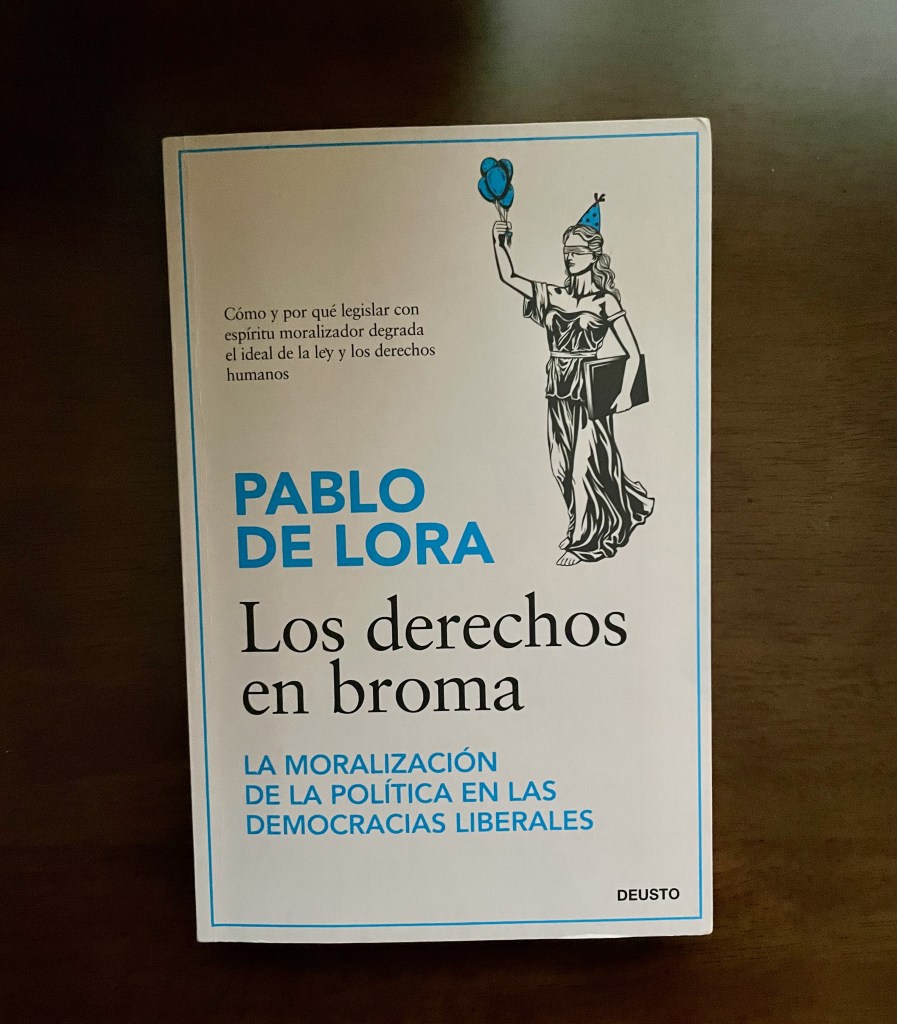
The nursery social state. On Pablo de Lora’s Los derechos en broma (2023). by Gerardo Muñoz

The crisis of the liberal legislative state is almost as old as the very project of the modern liberal state itself. And if we are to believe Carl Schmitt, the rise of the supreme values of the French revolution and ‘human rights’ (with its corollary of universal recognition within its normative system) also meant walking the fine line from the political theology of generative reform to the nihilism of ius revolutionis commanded by new discharges of individual will, political and technical movements, and immanent forces bringing the collapse of the separation between state and civil society. We are still living under its protracted shadow, albeit with a different intensity and intent. In his new book Los derechos en broma: la moralización de la política en las democracias liberales (Deusto, 2023), Pablo De Lora co-shares this point of departure, while daring to suggest a new sequence after the collapse of modern political form and legal order: we are currently living under a particular epochal transformation that is anti-legalist (sic) in nature – precisely because of its surplus of legal motorization – that erects a “nursery state” for the totality of the political community’s reasons and justification for action (De Lora 23). 

Although De Lora case studies shown are almost entirely derived from the Spanish and Latin American contemporary social contexts, I do think that his sharp diagnosis could be extended to the epoch itself without blurring the important nuances. This is an epoch of a reigning “emphatic constitutionalism” (Laporta) or the total Constitution (Loughlin), at the same time that it no longer takes too much effort to imagine a political community devoid of a legislative body, as one eminent constitutional scholar has said repeatedly [1]. We are already here. In other words, whether by excess or deficit, the overall purpose of moral driven legislation announces the internal transformation of modern politics as we know it, extending itself to a civilizational regression from the ideals and norms of the Enlightenment rooted in the fiction of the citizen, the binding of the social contract, and the invention of the principle of sovereign authority.

De Lora does not quite says it in this way, but I think I am not diverting too much of his cartography when extracting some of the central consequences of these internal moral substitutions that are palpable everywhere across the West: ecological legislation that increases social conductivity and expansion of natural destruction; ‘feminist’ anti-sexual aggression that leads to lowering of sentences for convicted sexual predators; the inflationary instrumental use of “Human Rights” for persons and things, but only defined narrowly by those that, under the thick haze of institutional hegemony, can deprive their political adversaries and enemies of the most basic legal guarantees of due process transforming them into non-persons. These ‘moral substitutions’ is part of the “ironic” and “futile” consequence of the sacralization of morality whose end is the management of the “social model” at all costs. According to Pablo De Lora, within the limits of confronting a social dilemma such as disability, the specificity of the “case” is turned on its head; what matters is the overall structural design of the social order and its infinite adaptive changes (De Lora 71-72).

This mutation generates all sorts of unintended consequences when the rhetoric of “social benefit” takes the lead. As De Lora writes: “No hay apoyo anticipado a la discapacidad mental sin reconocimiento de que el discapacitado mental no puede ejercer su autonomía en el futuro. Dicho de otro modo, la institución de las voluntades anticipada de la lógica desideratum de modelo “médico” de la discapacidad mental que se rehuye en beneficio del modelo social” (De Lora 85). And in spite of normative incoherence within an institutional system, the deflection to the “social model” requires ever-expanding commands, rules, principles, and hyper-amendments to guide the adverse proliferation of reasons for action within the social state (in the United States this is soften by the police powers of inter-agency statutes of the administrative state through cost&benefit balancing of discretionary principles under the supervision of the executive branch). This transformation entails the collapse of the internal mediation between the validity of norms and its foundation in social facts as in the classical construction. Thus, the expansion of value-driven legislation that also requires of specific adjudicative constitutional theories, such as legal interpretation and the theory of balancing of principles advocated by Robert Alexy, the sponsors of social neo-constitutionalism, but also the embedded dialogic ideological positions of constitutional scholars such as Roberto Gargarella (or in the United States context, the work of Mark Tushnet and the so-called anti-originalist ‘living constitutionalists’).

All things considered, the fundamental problem for De Lora is that this specific transformation enacts what he calls a “Estado parvulario” or ‘nursery state’ that he defines as: “El que denominado “Estado parvulario” da pábulo a que el poder público, en sus diversos instancias y encarnaciones, escamotee las realidades y consecuencias que conllevan algunas discapacidad per oa que lo haga de manera internamente inconsistente: tratando a los menores como adultos, pero sólo simbólicamente, y, en cambio, de manera efectiva, a todos los ciudada como menores, congénitamente desvalidos, incapaces de encarar la realidad” (De Lora 87). In the framework of the nursery state within its specific moral legislative apparatus, children become adults and the mature civil society regresses to an infantile stage. And like in a nursery setting, the democratic virtues pave the way for new dramatic effects where the function of rhetorical annunciation – so central for the any credentials of moral hegemony – forecloses the void between morality and politics in the wake of the unification that the social model requires to begin with (De Lora 89). 

This slippery slope can only lead straight to a sacralization of the political system that runs co-extensively with the infinite expansion of social rights; which, in turn, leads to an ever increasing conflict over the assumptions regarding its social facts (De Lora 151). In this narrow form, De Lora is audacious when citing Martin Loughlin’s recent indictment from his Against Constitutionalism (2022): “En la era de la Constitución total, el gobierno bajo el imperio de la ley ya no significa el gobierno sujeto a reglas formales independientemente pulgadas. Significa gobierno de acuerdo con principios abstractos de legalidad que adquieren significado sólo cuando son insuflados con valores…” (De Lora 188). And we know perhaps too well that values cannot be reasoned, but only weighted; values are commanded and taxed on the permanent devalorization of other values. This is why the rise of the value fabric of constitutionalism coincides with the ‘weighting’ proportionality of principles of law’s ideal social efficacy, to paraphrase Robert Alexy’s influential position as claim for “anti positivist legal justice” [2]. The nursery social state cannot be corrected merely from the position of the legislator; it can also be tracked as a triumph of moral jurisprudential theories of law that seek to overcome (and provide answers) to the overall crisis of institutional authority that characterized the so-called ordered liberty of the moderns. 

Is there anything to be done beyond a description? It is quite clear that Pablo De Lora’s ambition is not so much the proposition of a new political or legal philosophy as much as the sketch of the current epochal predicament in its current practice. This is already enough to welcome a robust analytical discussion of our predicament in Los derechos en broma (2023). However, there is a cobweb of affinities in De Lora’s own position towards the end of the book that, even if not fully developed, must be registered as a mode of conclusion. First, there is an affinity with John Hart Ely’s deferential conception of judicial power that aims at overseeing the procedural mechanism for the democratic deliberation and legislation over a hot-button issues. In this vein, De Lora shares Akhil Amar’s position regarding the overturning of Roe in the Dobbs’ decision; a conception that fully embodies judicial deference to diverse legislative majorities [3]. Secondly, De Lora favors a judicial minimalism associated with the doctrinal theory sponsored by James Bradley Thayer over the practice of judicial review of the Court (De Lora 233). And last, but not least, De Lora sees transformative potential in John Rawls’ assertion in his late Political Liberalism (1993) that the use of public reason is a comprehensive doctrine to deal with our fundamental disagreements and contentions over shared political values (De Lora 241).

I am not sure how deep or for how long does De Lora wants to go with Rawls; however, it is important to remember – and specially given the treatment of the ‘social model’ in the morality presented in Los derechos en broma (2023) – that insofar as social paternalism is concerned, Rawls’ late liberal political philosophy at the heart of the crisis of the secular liberal state amounts to a political conception that, as Eric Nelson has brilliantly shown, abandons the commitment of individual non-cooperation or refusal to cooperate with unjust moral legislative burdens, and thus making everyone stuck in the same ship [4]. This ship is the management and balancing of the totalization of the values being trafficked in the Social as ‘egalitarian’, although they are fully endowed as a seterological scheme of “election” (and who is elected) balanced by secondary compensations.

On a larger canvas, if the current political structure is defined as a nursery state of social rights, then this means that appealing to ideal positions of justified reasons, “diaphanous” deliberation, and well crafted citizen arguments belong to the age of maturity of the Enlightenment, but not to the stage of social infantile disorder. And demanding political qualifications to the contemporary citizen today is not only naif, but at odds with what what institutional thinking requires. In other words, the concrete transformation of the post-liberal state is one of permanent optimization of conflict, which is why John Gray has lucidly defined the (contemporary) ‘new Leviathans’ are “engineers of the soul” with broad and sweeping capacities to govern over every inch of the social space [5]. In the wake of these institutional mutations, the call endorse a “moral critique” might be taken as a post-enlightened lullaby that among the blasting and striding cries of infants of the nursery will most likely just pass unheard.

Notas 

1. Adrian Vermuele. “Imagine there is no Congress”, Washington Post, 2016: https://www.washingtonpost.com/news/in-theory/wp/2016/01/11/imagine-theres-no-congress/ 

2. Robert Alexy. “The Rationality of Balancing”, in Law’s Ideal Dimension (Oxford U Press, 2021), 122.

3. Akhil Reed Amar. “The end of Roe v. Wade”, The Wall Street Journal, 2022: https://www.wsj.com/articles/the-end-of-roe-v-wade-11652453609 

4. Eric Nelson. The Theology of Liberalism: Political Philosophy and the Justice of God (Harvard U Press, 2019), 164.

5. John Gray. The New Leviathans: Thoughts After Liberalism (Farrar, Straus, and Giroux, 2023), 5. 

The oath and the guardian of the constitution. by Gerardo Muñoz

The neutralization of an intense political movement tends to defy both institutional and implicit norms of the rule of law. The fact that former President Donald J. Trump has been charged with four different legal indictments – the hush money New York state case, the Mar-a-Lago Classified Documents case, the January 6th insurrection case, and the Giorgia election meddling case – have only boosted his cultish popularity among his followers who are now pushing for a second presidential term. On top of this, it is also important to note that none of the indictments truly bar Trump from reaching the executive office and engaging in a self-pardon. However, we have seen the emergence of a fifth possible venue to indict Trump elaborated in an important lengthy law review article co-written by jurists William Baude & Michael Stokes Paulsen that reclaims the sweeping and effective force of section three of the Fourteenth Amendment of the United States Constitution [1]. The letter of section 3 is straightforward, and it states that anyone that has previously taken an oath to defend the United States Constitution, and engages “in insurrection and rebellion” disqualifies him from future appointments in any public office, although Congress could remove said disability with a sufficient majority [2].

There are two central qualifying conditions in the section: having taken a prior oath to the Constitution, and engaging or avoiding insurrection and rebellion against the unity of the state, which assumes that the current political situation is one of either the threat of secession or civil war (this was Lincoln’s standard). The fact that this has been proposed by one of the foremost exponents of constitutional originalism should already indicate the juridical pressure that American lawyers are facing at the moment [3]. If there is room for disagreement about the “objectivity of the context”, the fact that the applicability of section 3, Am.14. presupposes the state of a full-fledged civil war that confirms the unprecedented controversy about the political context – regardless if considered an open civil war or an institutional political crisis – in which the enforcement of the constitutional provision will be executed[4].

The precondition for the effectivity of the sanction, however, hangs on something that has been taken for granted by most commentators: that is, the fact that the public official has taken an oath, becoming what Baude & Paulsen denominate an ‘oath-taking category of person’, which implies that the self-defense and the continuity of the constitution relies on the structure and form of the oath. Of course, we know from the great legal historian Paolo Prodi that one of the fundamental categories of political authority of the state was the absorption of the religious vow and the sacrament into the oath expressing the collective will and intra-institutional regulation of a normative system of the rule of law [5]. The oath achieves the unity of institutional authority, but this is only possible if there is a common collective faith in the constituted community of the oath-taking practice.

Under this consideration, it is almost redundant to note that the object of this collective and consensual faith (fides) is the oath as the nexus of public trust between the word and the instituted reasons for action. Oath and faith – and its immanent dialectic, since it also implies the faith in the oath – just like the polarity of religion and the rule of law, can only be sustained on stable conditions of a robust secularized equilibrium now broken. In fact, this is what paves the way for the indirect powers of civil war. This implies that the dependency on the oath is invalid without fides; and, mutatis mutandis, it is only once that fides is separated from the oath that its self-executing force becomes possible in the field of factional forces.

This is something that is definitely not a new problem, since one can read in “Federalist 18” how the implementation of oath during the Greek polis did not lessen the exacerbation of the fragmentation between the rise of different factions [6]. In the same vein, Carl Schmitt reminded how Hindenburg during the Weimar Republic felt comfortable taking an oath prima facie, only to find himself later hostage to the absolutization of internal political hostilities [7]. Given that the oath is predicated on the faith of a “promise of future behavior” (Baude & Paulsen dixit), an oath discharged from the presupposition of a faith in the concrete institutional order, tends to reproduce an adverse relation between perjurers, legal sanction, and pardons. In this circularity any political system will no longer depend on the internal categories of legitimate rule and social representation, but rather on the parallel tripartite structure of oath-taking, compelled oath, and acceleration of instrumental exchange of burdens, misdemeanors or infractions.

This tripartite structure – oath, perjury, politization – orients the force of fides after the collapse of modern secularization and the rise of legal constitutionalism [8]. Indeed, the energy of desecularization can only be expressed with the efficacy of moral principles dependent on a political will that fluctuates on the coagulation of legislative majorities that will see their “truths”, “public reasons”, and “social sensibilities” as permanent marching orders (let us not lose sight that the Congress can override the force of proscription). This does not mean that there is no such thing as having taken on “oath to the Constitution”, which is at the center of the American political system. Nor can one ignore the fact that section 3 enacts a clear threshold against public office holding if engaged in the context of insurrection or rebellion. Furthermore, one should not confuse the expediency of the unit of the political with the external question pertaining to social facts or public opinion [9]. Rather the point is much simpler and stark: if a constitution is a normative system of rules and principles, its free-standing application can not respond on the basis of having faith in the future promise compelled by the force of the oath. This can only deepen the conditions for civil war that neo-constitutionalism facilitates through its flexible and discretionary principles (the primacy of ius over lex). In the shadow of the oath, the archaic jingle of the sacramental enunciation is heard one more time [10].

The oath should not be reduced to a candid constitutional interpretation or federal jurisdiction: it is eminently a political question about the form, scope, and urgency of the guardian of the constitution and its nocturnal council. It is perhaps pertinent to conclude by recalling Plutarch’s old maxim: “Children are to be deceived with toys, men with oath”, which today could very well apply to generic constitutionalism and political militants alike, two fierce contenders in shaping and distributing the the energies of the legal stasis [11]. And if wrongs committed are no longer done to the gods as in Tacitus’s sacramental maxim ( deorum iniurias dis curae), but first and foremost against the authority of a concrete order; this means that political differentiation emerges against the quiet harbinger of the sacralization of politics – an anodyne time in which men with oaths, quite often, also behave and act like children with toys.

Notes 

1. William Baude & Michael Stokes Paulsen. “The Sweep and Force of Section Three”, U. PA. Law Review, forthcoming 2024: https://papers.ssrn.com/sol3/papers.cfm?abstract_id=4532751 

2. US Constitution, Article XIV, sec.3: “No person shall be a Senator or Representative in Congress, or elector of President and Vice President, or hold any office, civil or military, under the United States, or under any State, who, having previously taken an oath, as a member of Congress, or as an officer of the United States, or as a member of any State legislature, or as an executive or judicial officer of any State, to support the Constitution of the United States, shall have engaged in insurrection or rebellion against the same, or given aid or comfort to the enemies thereof. But Congress may by a vote of two-thirds of each House, remove such disability”.

3. Gerardo Muñoz. “El Originalismo y la Corte Suprema Norteamericana: un diálogo con William Baude”, January 2023, En Disidencia: https://endisidencia.com/2023/01/el-originalismo-y-la-corte-suprema-norteamericana-un-dialogo-con-william-baude/ 

4. “Prof. Michael McConnell, Responding About the Fourteenth Amendment, “Insurrection,” and Trump”, The Volokh Conspiracy, August 2023: https://reason.com/volokh/2023/08/12/prof-michael-mcconnell-responding-about-the-fourteenth-amendment-insurrection-and-trump/ 

5. Paolo Prodi. “Dalle Secolarizzazione alle Religioni Politiche”, in Storia moderna o genesi della modernità? (Il Mulino, 2012), 115–51.

6. Alexander Hamilton & James Madison & John Jay. The Federalist (Havard University Press, 2009), 107-108. 

7. Carl Schmitt. “The Legal World Revolution”, Telos, N.72, 1987, 82. 

8. Jack Goldsmith (Harvard Law) seems to hold this view in “The Prosecution of Trump May Have Terrible Consequences”, August 2023, New York Times: https://www.nytimes.com/2023/08/08/opinion/trump-indictment-cost-danger.html 

9. Martin Loughlin. Against Constitutionalism (Harvard University Press, 2022). 

10.  Émile Benveniste. “Ius and the Oath in Rome”, in Dictionary of Indo-European Concepts and Society (Hau Books, 2016), 401.11. Plutarch. Lives. Agesilaus and Pompey. Pelopidas and Marcellus. Volume V (Loeb, 1917), 12.

Von Balthasar and the eclipse of humor. by Gerardo Muñoz


Some will surely remember the figure of the painter Tirtorelli in Kafka’s The Trial who executes portraits of monotone and serious judges and magistrates on demand. The aura of these portraits is of absolute austereness and seriousness, as if Kafka wanted to capture the lackluster liturgy of the empire of judges and their repetitive exercise of legal adjudication. This seriousness, however, must be contrasted to the comic dimension of bureaucracy, that is known to anyone who might have glimpsed at the administrative processes that control even the tiniest details of daily life (the literary and cultural objects are too many to even reference them). The comic and the serious are also visual tones in the exhibition of modern public powers. If the empire of judges is gray and inexpressive, the bureaucratic agencies have been rendered as playful even if they repeatedly yield tragic effects on anyone entrapped in the legal construction of the “case”.

I recall this, because if today we are in the rise of an administrative state, this fundamentally entails a collapse of the bureaucratic comedy and the judge’s seriousness. The joining of the two spheres implies not only a transformation of the legal culture in the Anglo-Saxon tradition, but also a confusion regarding both the comic and serious that now form an integral techno-political unit. As humor eclipses, comedy becomes controlled, assessed, and weighted against what must be free-standing seriousness each and every time. This integralist institutional imagination, at first sight, could be taken as a return of theology of sorts; but, according to Hans Urs Von Balthasar, it is quite the contrary: the integralist suture is so alien to Catholic theology and the mystery that it only deserves to be taken as a distance from the divine. As Von Balthasar writes in Il Complesso antiromano (1974):

“For humor is a mysterious but unmistakable charism inseparable from Catholic faith, and neither the “progressives” nor the “integralists” seem to possess it—the latter even less than the former. Both of these tend to be faultfinders, malicious satirists, grumblers, carping critics, full of bitter scorn, know-it-alls who think they have the monopoly of infallible judgment; they are self-legitimizing prophets—in short, fanatics.” [1] 

And Von Balthsar reminds us that fanatic is a word that comes from fanum – “holy place” – which alludes to the site that the guardian must guard to keep the divinity at bay. In the same way today, the fanatic is the nexus that organizes the administrative process that covers all spheres of human activity and purpose. If this is the case, then one could say that our current society is “fanatical” not because of the new religious factions or outnumbering of social cults, but rather because new legal administrators exert their control in the guise of priests that speak the rhetoric of a social intelligible common good. This is, indeed, the ultimate comic aspiration of a very seriousness legal process (it impacts literally every living species) in which the precondition to safeguards the “good” must be exerted as to keep everyone away from the irreducibility of what is good, beautiful, and just.

The seriousness of the administrative agents is transformed into a perpetual laughter that secures a social bond where no transgression and sensation is possible. Against this backdrop, we see how Gianni Carchia was correct when suggesting that the passage from comedy to enjoyment (divertimento) renders impossible the laughter of redemption in a life that ceases to be eventful [2]. In this way, comedy mutates into a mere socialization of laughter. And the impossibility of entering in contact with the comic initiates the commencement of the social parody.

.

.

Notes 

1. Hars Von Balthasar. Il Complesso antiromano. Come integrare il papato nella chiesa universale (Queriniana, 1974), 304.

2. Gianni Carchia. “Lo cómico absoluto y lo sublime invertido”, en Retórica de lo sublime (Tecnos, 1990), 153.

The closure of the eon of the state. On Lo cóncavo y lo convexo: escritos filosóficos-político (2022) by Jorge E. Dotti. by Gerardo Muñoz.

The posthumous volume Lo cóncavo y lo convexo: escritos filosóficos-político (Guillermo Escolar, 2022) of essays by the late political theorist Jorge E. Dotti is a very much needed contribution that opens up a conversation about a theoretical corpus that witnessed the collapse of the modern state and the crisis of its political categories in times of postliberal forms of global domination. Although an astute observer of the key moments in modern Argentine political history (from Peronism to the dictatorship, from the return to democracy to the failure of the democratic socialist party experiment), Dotti’s intellectual stamina remained on the margins of political adventurism, while openly rejecting the organic intellectual political advisor to heads of state. As editor Damian Rosanovich writes in his introduction, Dotti refused to subordinate his political thinking to immedaite ideological projects; a rather unique position to undertake in a national context like the Argentine, historically inclined towards philosophia militants of the national popular type [1]. Complementary to this inclination, Dotti’s political thinking also had little to say (at least in a direct manner) to the Latin-Americanist disputes about state modernization, regionalism as supranational identity, or cultural formation hegemonies that dominated twentieth century discussions in the region.

Dotti’s theoretical ambitions had a more prudential wager: a confrontation against all kinds of abstract universalities, as well as its partner in crime, locational exceptionalism always ready to infuse doctrinal flavor unto nominal situations and practical problems. A modernist political thinker at heart, Dotti was also a keen observer of the the modern state genealogical crisis, which he read in a tripartite scheme that included the classics of modern political thought (Hobbes, Rousseau, Hegel, Kant), modern philosophy of positive law (infomed by his research years in the Italian context), and finally the work of Carl Schmitt on sovereignty, divisionism, the exception, and the difficulty of “revolution” as the esoteric form of political crises. As an heir to this modern tradition, for Dotti modernity is best defined not as predicated on contingency or anthropological reserves, but rather about a certain ethos, historical in nature and spatially grounded (in this way his vision was close to that of JGA Pocock and the Cambridge School, although less emphatic to the centrality of concepts), which claimed that the political thinking of the classics had to their disadvantage the idealization of every practical situational problems encountered in concrete determinations [2]. In this way, Modernity was best defined as a struggle against abstraction and the taming of indirect powers over the configuration of social stability and endurance.

The classics of political thought, while claiming the intrinsic political nature of man and the primacy of organic totality over every principle of differentiation, imposed a nomalist metaphysics that turned its back to discrete and discontinuous situations. For Dotti at the heart of modern politics – very much in line with Hobbes’s critique of Aristotelian critique of the virtuous politics – is rooted in a practice that is attentive to practical reasons for action and the normative foundation of a social order. Hence, the modern ethos was able to favor the primacy of authority (auctoritas non veritas facit legem) as a minimalist non-substantive framework of public law. In other words, prior to doctrinal and categorical arrangement of modern political theories (social contract, constituent power, or individual conscience), authority helped dissolve the anarchy over words and actions proper to the European civil wars. Needless to say, legal positivism had to walk along modern subjectivity (“Quiero, luego existo…”) inadvertently promoting, while neutralizing, the latency of civil war from its inception. As Dotti claims in an essay on Melville too long to be included in this volume: “Quien contrata se concede el derecho de desencadenar la guerra civil” [3]. The concrete situation of the modern ethos, in this sense, is never enough for containment; and its positive arrangements, being insufficient, will ultimately depend on direct police powers. The story of political modernity is that of legality trumpeting legitimacy for optimal reasons of political control. The insufficiency of the modern political order entails that politics and nihilism walked every step of the way too near each other.

This outlook towards political modernity renounces all nostalgia as it is a genealogical critique. This position speaks to Dotti’s systematic dialogue with Carl Schmitt’s juristic thinking regarding the polemic over secularization of the state and its political categories. Like very few political thinkers of modernity, Dotti accepts Schmitt’s lessons without prejudices and against the political black legends (Schmitt as the poisonous enemy of legal positivism, political liberalism, archaic Catholic, or ally of Nazism) that have been incapable to comprehend the German jurist lessons. If according to Raymond Aaron Schmitt was far from thinking like a Nazi, Dotti take this promises to more refined elaborations: the combination of decisionism and institutional rule of law coagulate an compossitum whose main aim is to regulate the internal functions of validity of the every political order [4]. The force of political theology, then, is neither doctrinal nor axiological, but rather attentive to situational stress of instances as to deter the indirect powers and the logistics of immanence [5]. Dotti understands Schmitt’s political theology as a decision that is only possible within a normative system in order to guarantee the authority of the state. The minimalist conception of political-theology stands as the antithesis of immanent factional ends, which, ultimately, reality will venge in the worst possible ways [6]. Adjacent to the modernist ethos against indirect powers, Dotti’s stages the copernican discovery’ of Schmittian thought: the autonomy of the political as the only category capable of defending the sovereignty of the state in an energetic manner without stepping into either a hyperpolitical or an apolitical vectors common to messianic and subjectivist positions. If for Schmitt there were few things more modern than the battle against the political, for Dotti the consecration of global postmodern time opened a crisis of the political and the expansion of the field of immanence which freely drives “por la autopista preferential de la corriente antipolítica” in which all politics is exception and all exceptions are treated as antagonism for the political [7]. The epochal dispensation of total immanence of power means a liquidation of the regulatory conception of the political as well as the formal recognition of enmity within the modern state now vested into the global fabric of Empire.

Dotti’s scene of writing is that of the closure of the eon of the liberal secular state from its very conditions that made possible the development of its genesis. It is in this specific sense that Dotti’s prognosis is similar to that of Ernst W. Böckenförde’s famous theorem: the liberal secular state survives by conditions that it can no longer guarantee [8]. For both Böckenförde and Dotti the epigonal process of secularization meant the end of state authority and the exhaustion of the separation of state legitimacy and the internal legal rules for social action. Dotti, however, introduces a minimal although fundamental nuance to Böckenförde’s theorem: the liberal state collapses not at the apex of the compilation of secularization, but rather at its very origins in the notion of revolution. This is a lesson extracted from Political Theology II: the ius reformandi of the ecclastical powers soon became an unlimited ius revolutionis of subjective domination during the nineteenth century. [9]. It is to this transformation that political theology effectively looks to respond to. In fact Dotti suggests that the category of revolution is the strongest force to be secularized, which entails that what paved the way for the modern liberal state becomes an open ended indirect force against all mediations of legitimate rule. As Dotti writes in his late essay “Incursus teológico político”: “Estado y revolución son inseparables en su complementación y en su simultánea oposición inconciliable. Esta relación es el cogollo mismo de la legitimación de todo orden político moderno: está en el origen y la muerte de la era de la estatalidad.” [10] The immanent force of revolution has no single figure: it is the movement against state sovereignty, the emergence of the total state in the twentieth century, as well the legal interpretation of statutes as idealistic forms (as in the jurisprudence of Robert Alexy) that intensifies a permanent state of exception whose real end is now a power for “definition, differentiation, regulation” as the tripartite form of political struggle. In this framework, the revolutionary spirit against formal mediation and authority can only take the form of an uninterrupted holy war against its enemies without end [11].

To the extent that revolution does not disappear but becomes unmatched immanent power, it becomes possible to understand Dotti’s central theorem in its proper light: “the problem with the revolution is not how to make it, but rather how to bring it to a close” [12]. There are at least two things we can say regarding the theorem: first, political modernity was fundamentally understood as the making of the revolution without any attention to formal mediation and the autonomy of the political; secondly, even the exponents of political liberalism during the second half of the twentieth century did not think of a revolution as closure, but rather they continued to foment an aperture based on a necessary retheologizaiton. It is in this way that John Rawls’ social state depends on a specific conception of original sin for equity; while Ronald Dworkin’s defense of principles and moral interpretative constitutionalism reintroduces a secularized form of the old iusnaturalist model. The socialization of the modern state at the historical instance of its eclipse had to pay the price of abandoning its commitments to both Pelagianism and positive law on behalf of a permanent exceptionality now dressed as the balancing of social equity. It is an irony that the two strongest attempts at the secularization of the concept of the revolution provided, in turn, a restitution of theological hidden subtleties that are ultimately optimal for the transformation of the rule of law into an instrument of world legal revolution. And, it is no coincidence that the closure of the eon of the state meant the end of exclusive legal positivism, while socializing the state police powers as compensatory for the collapse of the modern transcendental authority. The alleged neo-liberal state now subsists as an all encompassing administrative rule that mimics the practice of the confessional state. This could explain why today some jurists continue to understand the practical function of the administrative state as the concrete instance to constitute an uninterrupted iustitium. Dotti’s comprehensive and panoramic view of the modern tradition and its conceptual fulmination leaves open a task for future political thought: how would the closure of revolution might look like? This is no optimist question, as the only honest answer must depart from the farewell of the modern state, while also rejecting the substantive, doctrinal, and militant reallocations of power that steer, but never bring to an end, the violence of a planetary unity devoid of separation or enmity.

.

.

Notes 

1. Jorge Dotti. Lo cóncavo y lo convexo: los escritos filosoficos-polilicos (Guillermo Escolar, 2022)

2. Ibid., 133.

3. Ibid., 28.

4. Ibid., 174.

5. Ibid., 176.

6. Ibid., 26. 

7. Ibid., 79. 

8. Ernst W. Böckenförde. “The Rise of the State as a Process of Secularization”, en Religion, Law, and Democracy: Selected Writings (Oxford U Press, 2022). 167.

9. Carl Schmitt. Political Theology II (Polity, 2008  ), 101. 

10. Ibid., 434.

11. Ibid., 424.

12. Ibid., 421.

The Independent State Legislature Doctrine as indirect power. by Gerardo Muñoz

This Wednesday the Supreme Court of the United States will consider arguments in Moore v. Harper, coming out of the North Carolina State Legislature, which revolves around a specific doctrine: the Independent State Legislature. When the legislature of North Carolina tried to pass a new redrawing district boundaries for electoral purposes, the state supreme court decided against it, concluding that the map violated provisions of the constitution affecting free elections and the equal protection clause of the federal constitution. On other hand, the sponsors of the Independent State doctrine claim that state legislatures enjoy unsubordinated independence from the state supreme court, acting freely from the structure of state constitutions. The defenders of ISL doctrine “interpret” the term legislature as free-floating affirmation of constituent power when it comes to matters of voting under Election Clause of Article I in which legislatures decide on “the times, places, and manner of holding elections for senators and representatives”. Hence, ISL doctrine is fundamentally about political-theological question of ‘who decides?’ (quis judicabit) in the structure of federalism. But insofar as it is the question of ‘who decides’ it is also about what orients application today: ‘who interprets?’

When legal practice becomes open to interpretation each word immediately becomes a door. Each term becomes contested meaning as a free-floating signifier where balancing will ultimately serve particular political purposes. It is no coincide this ISL doctrine has come to the surface at this precise moment – after the 2020 election results – when, in fact, for most of the history it has been rarely used [1]. What does a floating and independent legislature power entail for electoral ends? What is of interest here is precisely how, in the name of a direct justification of constituent power (‘The People’), ISL represents a truly indirect power within the structure of federalism and state-constitutions. By name and function, indirect powers are understood as external interreference within a structure of stable organized powers. Now, the novelty of the ISL doctrine is that this indirect power emerges from within as it were, capable of upending judicial review and constitutional authority. The stability of ‘who will decide’ becomes an indirect power that, potentially, could even override state elections wherever political asymmetries exist between the legislature, governorship, and judges at the courts.

We know from the history of political thought that indirect powers (the undecidability of who will decide) leads to a stasiazon or internal civil war between the constituted powers. In other words, it is with the ISL doctrine that we can now see the true nature of what I called in the beginning of 2021 a legal civil war in Trump’s efforts to overturn the election results. A legal civil war is far more intense than the political partisan struggle of the movement – even if, at times, they can both cooperate as joint partners – since indirect force tries to ambush the constitutional organization of powers. The legal civil war of direct democracy comes full circle: unmitigated legislative force will constitute itself as the unstrained guardian of the question ‘who will decide’. For the champions of ISL doctrine legislature has no penumbra: it is always “We”. And it is no coincide that, as it has been shown by one of the great scholars of American federalism, a legislative supremacy once defended by Madison could allow for the “raising of every conflict to a constitutional crisis and civil war” [2].

In other words, what at first sight appears as total independence at state level actually facilitates its oppositum: the production of “standing” for higher courts litigation. Contrary to common opinion, the function of constitutional interpretation is full of cracks due to its brittle fabric: it allows for the indirect powers to be justified vis-à-vis the naturalism of the People as ‘original electors’ without mediations [3]. The historical irony cannot escape us at this point, since the American Revolution was waged against a legislature (the British Parliament) and legitimized through broad voting. This was the great innovation of Atlantic republican political theory. The question is whether a constitutional ‘interpretation’ could wage a battle against indirect powers facilitated by the revolutionary penumbra of ‘who will decide?’.

.

.

Notes 

1. “Brief of Amici Curiae Professors Akhil Amar, Vikram Amar, and Steven Calabresi in Support of Respondents”, October 24, 2022: https://www.supremecourt.gov/DocketPDF/21/21-1271/243761/20221024133404048_21-1271%20Amicus%20Brief.pdf  

2. Alison LaCroix. “What If Madison Had Won? Imagining a Constitutional World of Legislative Supremacy,” Indiana Law Review 45 (2012):

3. Carl Schmitt. The Value of the State and the Significance of the Individual, Vinx & Zeitlin eds, (Cambridge U Press, 2021), 231. 

Event and retreat: on the autonomy of the Cuban contemporary art scene. by Gerardo Muñoz

Event and the problem of sequence. According to Carlo Diano some historical epochs are prone to being inclined towards events rather than forms; that is, they allow the proliferation of states in the world rather than allocating forms to make sense of what has taken place [1]. Since 1959 – but also before this historical demarcation if one considers the failure of the bourgeois Republic and the apparatus of transculturation – the Cuban Revolution was poor in both form and events. Indeed, the institutionalization of the revolution has attempted at all costs to police the excess of both of these poles of world-making. On the one hand, the historical development of 59 secured an event that translated itself as historical and national necessity to legitimatize the production of a new “revolutionary subject” (el Hombre Nuevo); and, on the other, it assigned the supreme form of political unity in the charismatic authority of the Fidel Castro as the principle of a new political legitimacy [2]. It is against this historical frame that the event of 27N that gathered young artists, intellectuals, and writers at the doors of the Ministry of Culture should be measured up: the November gathering was an exodus from the total narrative of the revolution by insisting on the contingency of an event that affirmed a relative autonomy from the state as well as a separation between state and civil society. More than a set of clear demands at the level of objectives, political calculation, and cultural reabsorption to the logistics of the state; the 27N event in its outermost radiant potentiality was a breakthrough as a vital discontent of the youth that attuned itself to an experiential politics that have characterized the cycle of recent revolts of the past five years or so from Paris to Santiago de Chile and Quito, to the hinterlands of United States that no longer seek a modification of the social, but more fundamentally a thorough exodus from it.

I am not saying that they all recent revolts are homologous processes (or events of the same intensity or destructive vocation), but they do share the ecstatic vitality that posits experience over the technified and well-organized planning proper to the vanguard artist invested in mass conduction. Of course, giving primacy to the force of the event raises the question about both temporal and spatial sequence: in what way could those fragments, affects, and gestures transformed by the event mitigate their swerve without succumbing to the re-totalization of political recognition? There is no doubt that this has happened to the 27 Movement by virtue of the actualization of the phantasy of a movement. But a movement is the force that unifies political will, concentrates degrees of intentionality, and crafts a specific subjective discipline against any deviation from its rectilinear force [2]. We can call the phase of the “movement” a mediatized sequence that limits the possibilities of autonomous forms to effectively renounce the limits of totalization. Rather, given the experiential dimension of the contemporary events, it seems to me that the emphasis today should be placed at the level of genesis of forms, which implies connecting rhythmically the fragments within a sequence as a response to the metaphorical articulation of parts into a ‘movement’. In this sense, the sequence in the aftermath of an event must rethought against the grain of the category of ‘movement’, which in political modernity dialeticized the parts into in a temporal suspension unto the homogenous field of historical reabsorption. The force of the event, on the contrary, is what can render destitute the seduction of historical narrativization; or, for that matter, the assumption that political action still has transformative capacities within the set of developmental strategies of subjection, sacrifice, and voluntarism, all elements at the service of the metaphysical grid that constitutes the infrastructure of the philosophy of History. 

The hypothesis of the artistic legal turn. It should not come as a surprise that the limits of the movement demands that we raise questions about the functionalization of the militant in contemporary artistic practice. We should be willing and able to abandon the figure of the militant as always already positioned as a reactionary subject, which transfers military force to unified energies of the cause established by the movement [3]. It should be remembered here that the theoretical grounds of “activist” relational aesthetic was rooted in the transposition of the post-foundational theory of hegemony in Laclau & Mouffe’s theorization as a regulatory principle in the field of artistic practices [4]. But the price to be paid here is enormous, given that the artistic gesture and the possibilities of imagination are now folded unto the ground of “political action” recasting the old semblance of vanguard to achieve cultural domination. But since no cultural hegemony is ever fulfilled, it follows that political hegemony becomes a vector for the valorization of available strategies. It is no surprise, then, that artistic practice, once it turns to activism, becomes a pedagogical tool for and by militant subjects to stabilize the ascesis of self-consciousness. In sacrificing the autonomy of forms, militant subjectivity mirrors an intra-communitarian domination premised on policy and calculation to the idea. In other words, situating the set of strategies at the level of hegemony means necessarily that we have to accept the conditions already in place. What really changes is merely the site of subjection. It seems to me that this same issue is behind a nascent “legal turn” by which the artistic practice centers around drafting, contesting, and exercising pressure against the state by means of its own legal pathways. The problem with this strategy is that, as any jurist knows well, law is constituted of the pole of legality the pole of legitimacy. The turn towards legality becomes accepts the pragmatic conditions of norms and rules but leaves untouched the crisis of legitimacy that it seeks to transform.

In other words, whereas artistic imagination should be able to destitute the objective conditions of any given reality to new set of operations of transformation; the strife over legality ends up, at times counter-intentionally (and in a preserve way, generating unintended consequences), those very goals that it wants to endorse. In the Cuban case this is even more so, given that “fidelismo” far from being a set of original ideological principles or an unambiguous political philosophy guided by principles, has morphed into an all-encompassing institutional fabric that sustains the total state vis-à-vis a juristocratic operation of the legal order. Borrowing the terms from the discussions about the limits of constitutional transformation in Chile in the wake of the post-dictatorship transition to democracy, one could argue that the performance of the legal operation becomes the juristocratic tool to transform the relations between political life and imagination within the framework of given social relations [5]. Hence, if the artist pretends to incarnate a new version of the old paradigm of the “artist as jurist” soliciting the sovereignty of the creator over the vocation of the politician, one should expect the boundaries of the legal dominium of the state to expand, as it has happened with the reiterated executive administrative decrees deployed to normalize the rule of the state of exception. To break this cycle of legal administration, the artistic practice must affirm a disjointed zone between life and artistic autonomy over the excessive boundaries of the law. In fact, legality and policing should be understood as the two poles of the optimization of control once legitimacy no longer works to bind a political community. 

Retreat and obstruction. The minimal condition of any sequence in the aftermath of the event resides in how we protect the surround against the logistics of state policy, cultural administration, and political militancy [6]. These three vectors are the agents of hegemonic intervention against the unregulated proliferation of forms in the wake of the event. Recently, I have called this autonomous self-defense of forms a diagonal that moves against and outside the political demand [7]. The failure of not retreating from the foreclosure of subjective politics (of reducing a form of life to a subject of the political) entails that action will always be on the side of reaction. As Elena V. Molina has brought to attention on several occasions, the reactive action is so not because of ideological color or political affinity, but rather because it remains inscribed within the coordinates that the state has assigned it in order to generate responsive relays or bring to exhaustion the emergence of a new sequence. Rather, in the gesture of retreat (which can be read in the works of Camila Lobón’s infantile books, the opaque graphism of Esequiel Suarez, the sensible violence of Raychel Carrión’s drawings, or the youthful vitalism of the Mujercitos Collective), the possibilities lay on the side de-subjection against both the movement and the state in favor of an infinite practice of autonomy driven by the turbulence of the imagination. What is at stake is a radical abandonment of the historiographical machine that delimits and polices the mediations between culture and state in order to open up a new reservoir of existential gestures in order to break from the previous historical epoch.

The growing autonomy of the contemporary visual arts scene announces this oblique passage from willful political dissent across ideological lines proper of the Cold War to a play of gestures that unleash a new vitality capable of defictionalizing the historical process of the state and its moral demands. Contrary to the notion of action, the gesture does not seek mimetic repetition and reproduction, but rather the preparation of an experience here and now. In a society that is subsidiary on moral conducts and expectations; the gesture, in the words of contemporary Cuban artist Claudia Patricia Pérez, becomes a way to obstruct the efficacy of power relations [8]. There is no doubt that the force of the gesture is a nascent strategy for transforming contemporary Cuba, but the scene of the visual arts is the vital field where the storming of the imagination can unclutter a hastened path outside the ruins of the civilization of the state and the stagnant epochality of the revolutionary process.  

.

.

Notes

1. Carlo Diano. Form and Event: Principles for an Interpretation of the Greek World (Fordham University Press, 2020).

2. Nelson Valdés. “El contenido revolucionario y político de la autoridad carismática de Fidel Castro”, Revista Temas, N.55, 4-17, septiembre de 2008.

3. Giorgio Cesarano wrote in Chronicle of a masked ball (1975): “Neo-Leninists perceive the disintegration of the capitalist system as if they could anticipate, in their methods, their role as true inheritors of power…the distance between militants and militarists is only expressed as a transfer of force.”

4. This was Claire Bishop’s argument in her essay “Antagonism and Relational Aesthetics”, October, 110, Fall 2004, 51-79.

5. On the notion on the “crítica de la operación efectiva del derecho”, see my conversation with Chilean philosopher Sergio Villalobos-Ruminott, “Soberanía, acumulación, infrapolítica”, Lobo Suelto, 2015: http://anarquiacoronada.blogspot.com/2015/04/soberania-acumulacion-infrapolitica.html  

6. Stefano Harney & Fred Moten. The Undercommons: Fugitive Planning & Black Study (Autonomedia, 2013).

7. Gerardo Muñoz. “La diagonal que nos separa de la política”, Columna Cultural, mayo de 2021: https://in-cubadora.org/2021/06/02/gerardo-munoz-·la-diagonal-que-nos-separa-de-la-politica-un-comentario-a-la-conversacion-con-leandro-feal

8. Personal communication with the artist, June 2021.

  • This text was written as an intervention in the panel “The Art of Protest” organized by the Biennial of the Americas, Denver, June 24, 2021. Image: Collage by Claudia Patrica Pérez.