Longing for prose. Reflections on Gaëlle Le Calvez’s Escrituras sin rostro (2025). by Gerardo Muñoz

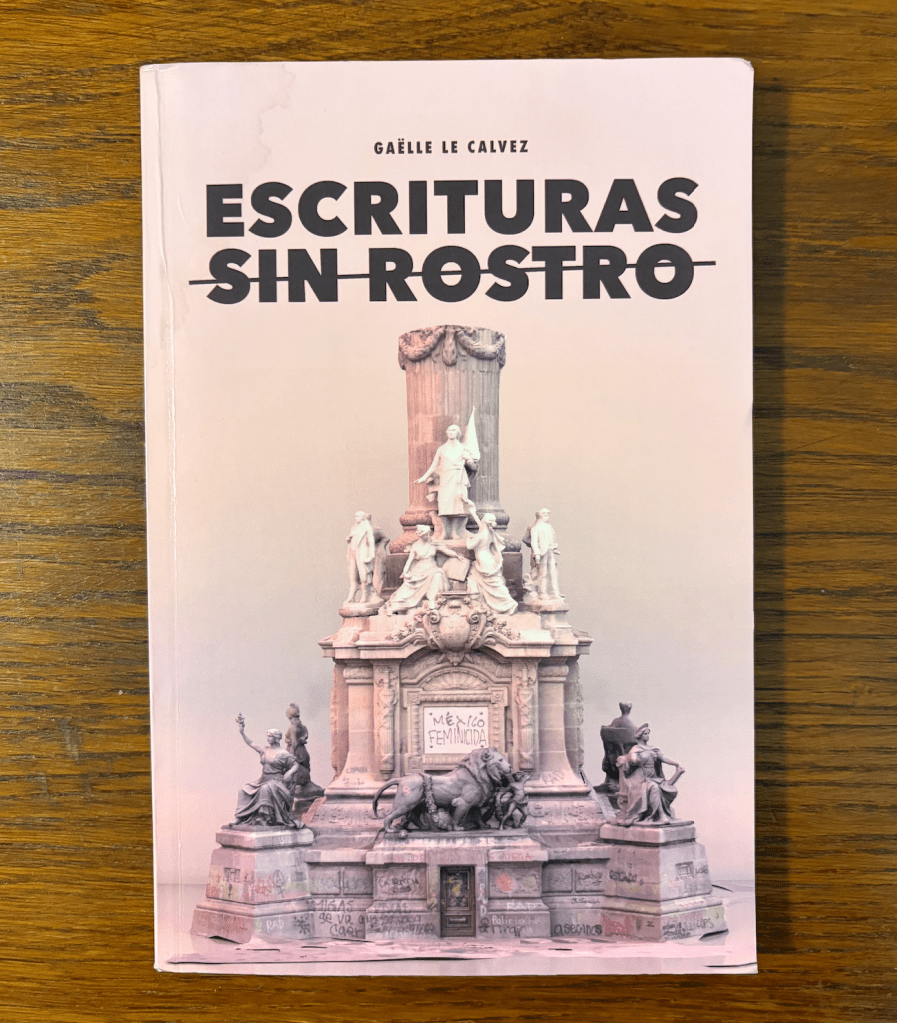
Every book has a history of its own, its subterranean itineraries, and oblique paths that are only disclosed when entering in contact with its future readers. There is no question that Gaëlle Le Calvez’s Escrituras sin rostro (University of North Carolina Press, 2025) has plenty of merits that we cannot begin to elucidate. For one, it is a monograph that should be of interest to students of Latin American studies, but also to any fellow travellers wanting to confront and think through the problem of writing at the wake of the epochal crisis of the state form and the exhaustion of the historical subject. Can thinking overcome the deficiencies proper to cultural studies and populist hegemony to understand the ongoing fragmentation visible everywhere?  One can start by saying that Le Calvez’s books points to a positive direction from this impasse, avoiding the shortcomings of sociological epistemology and the auratic reflexes of subaltern subjects as the master oppositional category to State form in the becoming of modernist development and global neoliberalism. In  Gaëlle Le Calvez’s Escrituras sin rostro (2025) the object of study is the irruption of EZLN or Zapatismo, and more specifically the scene of writing of the Zapatistas through the genealogy of their declarations, public letters, gestures, and signatures of all kinds that speak to the persistence of a writing of defacement; a scene of writing beyond the propriety of the social function of the author, and on the margins of the legitimacy of the “lettered city” of the Latin American criollo uneven modernism. In the space of this commentary, I would like to list three levels of Le Calvez’s arguments that hope will further contribute not just to the themes proper to her study, but more fundamentally to a constellation of problems that exceed Latin America as a region of studies. 

First, Gaëlle Le Calvez’s Escrituras sin rostro (2025) withdraws itself from understanding Zapatismo as a sociological political phenomenon of the late Mexican State, or a belated product of the shortcomings of the Mexican Revolution and its process of modernization. Unlike other studies of Zapatismo in Latin American studies Escrituras sin rostro (2025) is not invested in the restitution of new political subject of resistance in the face of global war and the anarchy of political action; rather, what is presented is the redrawing of a genealogical scene of writing subsumed by its excess and dislocation, stubbornly out of place that evidences the negativity of the collapse of the autonomous spheres of actions that once defined the apparatuses of historical development and legibility. As Le Calvez convincingly points out, the defaced and non-authored writings of the Zapataistas are neither literature nor political manifestos, and they also refuse the autonomy of literature and its incorporation into the objective ornaments of the Avant Garde projects. The defacement of writing for the Zapatistas is neither Avant Garde nor kitsch, because it is no longer interested in weighting itself on the rhetorical scale of social compartmentalization. In my terms, which are not those of Le Calvez, one could say that “escritura” or writing in this study is the vortex of flight from rhetorical submission; that is, what cuts through the enthymemes to refuse ossification and reproduction of language. The freedom of writing is always measured by the possibilities that is able to generate against rhetorical abstractions.

Secondly, because there is no justification in social or political principles, Le Calvez argues that Zapatista writing and negative gesture is a refusal of hegemony, and thus properly posthegemonic. If “escritura sin rostro” makes no demands, seeks no identification, and avoids the prefiguration of rhetorical subsumption, it means that Zapatismo openly rejects the articulatory nature of hegemony as the last avatar of the administration of identity at the end of metaphysics. As Le Calvez claims succinctly, the dispersal of writing cannot adequate itself to Laclau’s theory of hegemony and its “rhetorical foundations” of the social (Le Calvez 67-68). In this sense, posthegemony is not merely what interrupts the closure of politics in the neutralization of a new social consensus, but what transfigures language into its autographic, experiential, and faceless excess that overflows every identity and every place of enunciation. In very subtle and elegant ways, Le Calvez’s hermeneutics of the Zapatalistas’ Declaraciones confirm that the solicitation of hegemony in both discourse and political practice is an inversion, almost an hallucination in political form of the money form and the general equivalent in the historical process of real subsumption of capitalist value. If Zapatistas are indeed a “realist” political formation it is not because they parody of modern guerrillas or enact a new communal organization; the realism at its best is grounded in the capacity to discern that hegemony in the wake of end of the modern liberal state only serves to deepen the ongoing process of the capitalist utopia. 

Thirdly, and more surprisingly, is the fact that Gaëlle Le Calvez’s Escrituras sin rostro (2025) does not just reconstruct moments of the Zapatista inscription, it also considers its intensity to its very end. And to think something to the end means to reveal its limits, disclose its fissures, and open a site to move pass the object of reflection. This maximum point of reflection is when philological exploration outlives itself in the intensity of an uncharted path. Thus, the story that Le Calvez tells us about Zapatista writing concludes with a series of aporias and contradictions that announce a certain “decline” and eclipse of its poetic intensity. This is a moment where its poetic elevation begins to deflate; and, in its decline we are confronted a persistent drift to “civil society”, “self-critique”, the appeal to plurality of “indigenous people” (what Gareth Willimans once called “fictive ethnicity” as representational ruse), or an internationalist appeal in order to generate a “counterbalance” to global neoliberalism (Le Calvez, 106-108). And we are putting aside the nomination of Marichuy for the 2018 Mexican presidential election. Does not this recomposition of social recognition, both global and national, seek to replenish the void in representation as it appears in the third Declaración that evoked “para nosotros nada”? (Le Calvez, 93). The waning of the poetic moment of Zapatista appears to project a flickering shadow of its dependency to political movements.

Does this mean then that the “rise and fall” of Zapatismo ends in a tenuous archē embedded in the ‘movement’? In his Latinamericanism after 9/11 (2011), John Beverley projected his unfiltered Leninism towards antiquity and Ancient Christianity when stating that the central political question for our times in the face of Empire, is to find ‘who are the real Christians today’ [1]. But ideological Leninism distorts the past, since as we know well, the central question for the Christians of the Early Church of the desert, such as Origen, was not who was going to mobilize the masses in the material world, but rather in what way to retreat and avoid worldly political power [2]. Zapatistas as the new and last Christians, then? It is a tempting question, but one that will only contribute to the Leninist reduction of historical political fictions. Our times is not one for Leninism and the Vanguard Party to carry a breakthrough. But perhaps Zapatistas are residually Christians in another country way; that is; in the internal dynamics of its own language. I would like to suggest that this language can be understoodX especially in the last phase of the Declaraciones, a late rhetorical style of the sermo humilis. As Erich Auerbach has shown, the sermo humilis was the rhetorical innovation of the early Christian community at a moment of the political decadence of the Roman Empire, at the entrance of the interregnum. The sermo humilis appeals to a low or popular style, seeking legibility and pathetic understanding of the difficult mysteries of faith. The humilis also designates the ground level of the land, the humus, which elevates through the persuasion for the humble and the humiliated common men of this world [3].

In other words, the sermo humilis could be said to be a sublime of the everyday life that is refractory to the mystery. It is obvious that if we now turn to the Zapatista late writing, something like the sermo humilis codifies a symptom that is no longer the mystery of revelation, but rather in its secularized form of the revolution. Does not the sermo humilis functions as a secularized artifice to guard and elevates hopes (all too human, alas) on behalf of the “revolution” to come? However, it is precisely political revolution, just like hegemony, what cannot longer account to the effective revolutionary force of the autonomization of capital. If according to Le Calvez the formation of the Zapatista is analogous to an “artificial movement” (masa artificial) like the Church, then one could say that the rhetorical construction of the sermo humilis functions as a linguistic prayer for the revolution whose only certitude is the apophatic metaphorization in the name of the “people”, the “homeland” (la patria), or the antagonistic and oppositional “we” (nosotros), or any other compact grouping. Of course, this is the terrifying question for the sermo humilis in its secularized form: to what extend the communitarian and autonomous ideal, through its appeal to the humiliated and subaltern class, does not transform itself into an apotropeic instrument devoid of true redemption? [4]. 

Is writing, and witnessing through writing the practice where the possibility of redeeming human experience is lodged? This is the fundamental question that Le Calvez’s book puts forth to us as readers, without entirely coming to an effective resolution. And yet, in the last part of Escritos sin rostro (2025) seems to offer us another possibility through the writings of Cristina Rivera Garaza, Alejandra Pizarnik, and Sergio Gónzalez Rodríguez in the face of a fragmented and disarticulated social body and the night of history in which social protection and protracted civil war become indistinguishable (Le Calvez 186). This writing is no longer tailored in the Christian shops of the sermo humilis, but in an open plain where the voice becomes “un anhelo de prosa”, or a longing for prose, crossed by the finitude of being and the collapse of mediating forms of totality (Le Calvez 174).

This longing for prose as it appears in Cristina Rivera Garza’s work – in the Spanish anhelo one can also hear the echo of breathing that is constitutive of life’s exteriority with the world, to conspire – is not the letter of the law as in Hegel’s spiritual prose of the world (“in the slave prose begins”, we read in Aesthetics), but the clearing of a voice that can register the world because it speaks from the witnessing of the ruins of representaiton, and the conviction that there is no political mystery high above, but only the irreductibility of writing in spite of it all. In the shipwreck of perpetual global war, writing’s redeemable elevation is the caritas that puts us in a permanent exodus from the order of representation (Le Calvez, 186). Writing, escritura becomes the passage of the chiasmatic and breathable imagination that, because it has cleared a via poetica, it can name what can also be properly inhabited. 


Notes 

1. John Beverley. Latinamericanism After 9/11 (Duke University Press, 2011), 26.

2. David Nirenberg. Anti-Judaism: The Western Tradition (Norton, 2014), 108.

3. Erich Auerbach. “Sermo humilis”, in Literary Language  & Its Public in Late Latin Antiquity and in the Middle Ages (Princeton University Press, 1993), 39.

4. Gianni Carchia. “Eros y Logos: Peitho arcaica y retórica antigua”, in Retórica de lo sublime (Tecnos, 1990),  29.

The social efficacy of Thomism. By Gerardo Muñoz

One of the merits of Sandor Agócs’ The troubled origins of the Italian Catholic Labor Movement (1988) is located on the question of Thomism during the rise of a national industrialization and the new centrality of the worker. This is a question that informs the very genesis of modern political thought, so I want to zoom in to the specifics: in Agócs’ narrative, the reinvention of Thomism goes hand in hand with the ‘social question’; that is, not just as the substrate for state legitimacy, but also as a supplement in the very mediation between the state and social incorporation. After reading Agócs a question lingers: what to make of the success story of social Thomism in the long history of modernity, that includes episodes from the both the left and the right; from the Italian Catholic Social Movement to Corporate Francoism, from the Pinochet Constitution drafted by Jaime Guzman to the most recent articulations of an interpretative common good in the contemporary American postliberal constitutional and interpretative balancing? One easy way out of the explanation is to delegate the answer to the historical uses (and misuses, depending who is defending what) of Aquinas’ thought, but that hardly answers the question. A while ago, John Finnis made a claim that could point to an important destination: 

“This grand metaphysical overview of reality, and of our knowledge (‘theoretical’ in the first two kinds of order, ‘practical’ in the second two) of it, has been as fundamental to the new classical natural law theory from its beginnings as it was to Aquinas. It enables us to identify as illegitimately reductionist almost all the streams of social-theoretical thought, including political and legal, that have emerged since early modernity. It helps in identifying the errors of those would-be followers of Aquinas who reject the new-classical natural law theory on the ground that it neglects or subordinates nature and metaphysics; the misunderstanding of Aquinas, and of the relation between practical and theoretical thought” [1]. 

For Finnis, although writing for legal theorists, Aquinas’ thought properly understood possesses a ‘metaphysical view of reality’, a sort of plasticity interlocking practical reason for action and morality that serves socio-theoretical ends. In other words, the thomistic plasticity for social legitimation can be connected to what Martin Heidegger held as ‘adequatio’ as a fixed point in the problem of Medieval representation of beings. And this means that thomism is always already a theory of legitimate ground for governing that reality. As Finnis suggests in different moments of his work, the lesson of Thomism is construed in its emphasis on the rule of law as the source for justice and fairness, and in this sense it was never alien to modern social contract. Karl Barth’s rhetorical question -“Why did Hegel not become for the Protestant world something similar to what Thomas Aquinas was for Roman Catholicism? – can now be understood in its most consequential light. 

Now it makes sense that Agócs refers to early twentieth century Italian Catholic Neo-Thomism as a “counterrevolution”, although he does not denote that this would be a second instance of counterrevolution with social prospects that the post-French Revolution figures (De Maistre, Bonald, and Donoso) could not meet in their antimodern stance. And here the divide is sharpened: whereas the counterrevolution post-1789 had very limited and unstable sources in social facts, Neo-Thomism offered a theory of law that was consistent with modern class dynamics supported towards social cohesion and stabilization proper to the ideal of the community centered in urban centers. If one defining feature of political modernity is reversibility, it would then make sense that thomistic natural law could rise to the demands of any given historical time to offer a nexus informed by the onto-theological structure of adequatio and analogia entis, whose proper end is the stabilization of social pressure. The second order ideological uses of Thomism (left, right, revolutionary, moral conservative, traditionalist, pre-post Vatican councils) are contingent to its malleable adequation generated by its own claim to natural morality. Heidegger once pointed in this direction when he claimed that Aquinas’ philosophical horizon was fundamentally the inception of metaphysics over theology as faith (that is actio and efficiency unto subjection) [2]. If modernity is the realization of onto-theology, then it can only make sense that Thomism takes as many garments as necessary to prevent gazing towards the abyss, becoming a manifold phosphorescent theory of social morality.

Notes 

1. John Finnis. “Aquinas and Natural Law Jurisprudence”, in Duke & George, Natural Law and Jurisprudence (Cambridge University Press, 2017), 32.

2. Jean Beaufret. Dialogue with Heidegger (Indiana University Press, 2006), 106.

Movements at dusk. A note to a conversation. by Gerardo Muñoz

A recent roundtable entitled “American Constitutional Collapse”, organized at Red May, and now archived here, with Aziz Rana, Camila Vergara, and Michael Hardt should confront us with the limit of political form today. All the interventions were able to shed light on distinct angles of the current collapse of the American constitutional order, which has only intensified since the beginning of the new current administration, although its sedimentation, as it is well known, has deep historical legal-political itineraries. However, here I just want to register the question that I posed to the panel, which is one not alien to some of the chapters of La fisura posthegemónica (2025), and that concerns the exhaustion of constituent power. There are many ways of posing this question, but in the tradition of American republicanism, the most clearcut of the problem is to take seriously the end of historical social majorities as vehicles for enacting a ‘constitutional moment’ of democratic reformation.

Some of us remember that towards the end of the third volume of We The People: The Civil Rights Revolution (2014), Bruce Ackerman claims that in our epoch we might very well be entering into the dusk of social movements. Ackerman’s book is from 2014, that is, a couple of years before the landmark victory of Donald J. Trump’s first electoral victory of 2016, and written in the wake of the decision of Shelby County v. Holder (2013), which abolished substantive parts of the Voting Rights Act of 1965. The sequence of the last decade has only validated Ackerman’s intuition about the effective collapse of movements as the driving force of American ius reformandi within the constitutional order (in other countries is no different, take Chile for instance, which we discussed two years ago at Red May, and that is also the story of the the ills of transformative constitutionalism).

However, to anyone that has paid any attention to the political turmoil in the United States in the last decade, it is completely clear that the paralysis of the constitutional system is far from being a state rigidity or stability, but rather it has shown itself to measure every social pressure through an equal force of legal force, testing the durability, probing the reach, and outsourcing the validity of implicit norms and guardrails within the tripartite structure of powers through an enacted process that some American legal theorists have called “liquidation”; that is, the adjudication of fixing and enforcing textural legal provisions in historical time. This means that what animates the internal process of American law is no longer that axiological conditions of political republicanism – representation and minimalist judicial review, separation of powers and state authority, congressional representation and autonomy of the legislation – but rather a stasis, that is both paralysis with respect to the the formal aspiration of classical social representation; and, at the same time, total legal mobilization, in which social majorities are oriented under the nexus of the administrative presidency that can take (it has taken) priority over institutional mediation and process – if anything should be learned in the last decade is precisely the effects of Moore v. Harper (2023) on the doctrine of the independent state legislature (in spite of its ruling at the Supreme Court); and, most recently, the legal showdown regarding process (or lack thereof) and the suspension of habeas corpus for migrants residents and illegal aliens, which according to an American Federal Judge, could prefigure as a potential invasion.

We have good reasons to assume that mobilization and social movements from below can no longer stand as the source of constitutional change. They must be taken at face value in order to avoid rhetorical platitudes: mainly, that any movement today is a vector in the ongoing stasis and decomposition, that ultimately animates (even if against its own intentions, as the progressives seems to ignore) the verisimilitude of state form in the age of stagnation. But this is not very different from the inchoate promises of the new right-wing populism that projects new historical heights of economic growth in epochal decline (and now the progressive programmatic calls for technocratic abundance coextensive to the administrative state).

It is perhaps in demobilization and a de-socialization derives where other horizons might soon emerge. If the modern epochality was defined by the energetic transfer of total social movements, our epoch of collapse will be shaped by that of non-movements outside political hegemony. There is no doubt that it brings paralysis and distress to the political thinker looking for historical reiterations. But then again, the anxiety for mimesis before a breakthrough is always dreadfully sharp.

Commentary on Monica Ferrando & Michele Dantini’s dialogue on painting and theology. by Gerardo Muñoz

The fourth issue of the journal De Pictura (Quodlibet, 2024) has just been published, and among a dozen of illuminating articles there is a very substantive and rich conversation between Monica Ferrando and the art historian Michele Dantini on theology and painting that solicits required attention, and that I can only emphatically recommend. As the very title suggests, the conversation is about the unity (and posterior historical divorce?) between painting and theology in the Western tradition, but it is also about another problem that never goes out of fashion, if ever rarely attended by a handful of scholars: mainly,  the light of the genesis of modernity vis-à-vis the aesthetic mediation with Antiquity. (Is it fair to say that this is an undeveloped path in post-Nietzschean thought? For now this is a broad question that we can only bracket, and it is needless to say that Ferrando’s own work already amounts to an indispensable barrister to take up this very concern). Be it as it may, there are two problems that I want to flag from this conversation — these are idiosyncratic concerns, as perhaps all attempts to condense a vast area of study obviously are. 

First, there is an important moment in the exchange where the problem of “perfection” is discussed as a watershed schism between the politics of representation in the wake of post-Renaissance development of painting. A notion of “perfection” that derived from the theological sphere was unequivocally different from technical mastery; it was understood as a problem of distance and proximity of pathos inherited from the great tradition of Antiquity and its canons of beauty and virtue. How else to read Poussin’s one of a kind theory of the modes of the Ancient in his famous letter to Chantelou? Of course there is also Hölderlin’s gaze towards the Greeks and Pindaric poetry decades later in the dawn of the nineteenth century only to succumb into madness. The theology grounding distance is the condition of possibility of ‘aura’, but also what Ferrando, at the highest point in the conversation, superbly defines as: “…pura della differenze temendo di riconoscere e irriducibili” (137). The liquidation of perfection into mastery of the “work of art” (and perhaps work should be overly stressed, which is linked to all the metaphysical dispensations over creation) implied that “distance” would become standardized, homogeneous, autonomous to regulated form, and finally absorbed unto the objecthood of creator and spectator in the coupling the force of secularization. Whether it is the vicarious image of the Hollywood spectacle, or the factorization of the socialized art object in the Russian avant-garde, the movement towards absorption is one-directional and open to the validity of an external justification of truth. 

What I find interesting is that the emphasis on perfection allows us to say that painting clearly put into view the history of an error about representation and its negation. As it has been noted, in the outset of Protestantism – for instance in Noa Turell’s excellent Living Pictures: Jan van Eyck and Painting’s First Century (2020) – there took place a new struggle over representation of perfection oriented towards “bringing painting into life”. The Northern superiority hinges upon the effectual perfection of a new legibility of the world that suspends the distance between thought, hand and the idea of pictorial praxis. The valorization of justified truth in perfection is paid by the occlusion of the truth of unintentional appearance. And the consequences are catastrophic: Ferrando at one point claims that the painting is about retaining the invisible; an argument that she has also displayed in relation to Poussin’s landscapes in her L’oro e le ombre (2015). In other words, the development of the dialectical autonomization of the very unit of pictorial space is integrated only be rationalized as an obstacle to be wrestled with and eventually overcome (an endpoint being Jackson Pollock’s outpouring of the line into a vanishing mist over white space). Prometheus unbound. Indeed, über die linie.  The “farewell to modern painting” (so elegantly trumpeted by T.J.Clark at the turn of this century) remains right on track with the only caveat that it did not began in the “age of the machines”, but at the outset of the secularization polemic over the impasse of the responses to the crisis of transcendence and the eclipse of myth.

Now, the second point can be stated briefly: the extension of autonomization implied turning away from what the tradition has offered; especially a tradition that is “pre-historical”, according to Ferrando, since painting is previous to historical consciousness and not the other way around (painting is always without a grounding principle). In the words of Stevens, this tradition can be understood as the “love ascending the humane” that attests to the authenticity of what appears-there in the disclosure of the world. A definition of painting emerges here, although not pursued in the dialogue between Ferrando and Dantini. However, for Dantini this means that the whole history of art / pictorial representation needs to be rethought and reorganized and possibly returned to its proper theological sphere. Of course, it will depend on how we understand the vertical axis of theology converging with the horizontal axis of appearance.

A counterexample here comes to mind, a sort of historical false exit: the Baroque, as a post-Renaissance paradigm of response to the crisis of the erotic and pagan image of the Renaissance paid the price of its exuberance, elliptical contortion, expenditure, and ornamentation through a reified and excessive field of self-ordered theatricality. As shown by the exemplary study of the Jesuit discipline in light of the modern state, La política del cielo: clericalismo jesuita y estado moderno (1999) by Antonio Rivera, the ascesis of the counterreformation Company required the split between director and practitioner that already presupposed the modern autonomization of spheres of signification. The baroque supra-theology (imago naturans notwithstanding) was also a reified theology whose anxiety about annihilation and total absorption of the community of the faithful would further drain the invisible outlook of the theos. Or to use the image favored by Carlo Michelstaedter: “the lamp burns out by the insufficiency of oil, but it drowns by having too much oil”. It is no coincidence, then, that the polarity of absorption and theatrically, used to understand the revolution of French modern painting, can only bring to life anything and everything under the sun of pictorial representation except its own sense of distance between appearance and what always remains unfathomable in the world.

The irreducible in language: a note on Robert Antelme’s L’espèce humaine (1947). by Gerardo Muñoz

At the outset of L’espéce humaine (1947), Robert Antelme discloses the difficulty between language and experience that lays at the heart of the book, and which is never thoroughly assumed at the level of form in the novel. L’espèce humaine (1947) is ultimately not an account about the impossibility of describing what took place in the camps; from the banal physical violence to the desperate hunger, from the microaggressions to the slightest movements and carnage of bodies in space; from the joyful smiles in the most miserable of scenario where the ultimate goal was for the human life to slowly rot; the sequence of actions engage in no struggle to bring to a crisis the level of representation. And Antelme goes into painstaking efforts to give us a full picture of what took place, only to never talk about it again in writing or in personal conversations as Marguerite Duras tells us [1]. So, what to make of Antelme’s initial affirmation in the “Forword” where he states that: “…during the first days after our return, I think we were all prey to a genuine delirium. We wanted at last to speak, to be heard. We were told that by itself our physical appearance was eloquent enough; but we had only just returned, with us brought back our memory of our experience, an experience that was still very much alive and we felt a frantic desire to describe it as such as it had been…[..]. No sooner would we begin to tell our story than we would be checking over it. And then, even to us, what we had to tell would start to seem unimaginable” [2]. The unimaginable for Antelme is a sort of threshold of language; a limit for the unrestricted, that is, for what could allow for an experiment of language after the catastrophe, or in the wake of the civilizational catastrophe that is consummated in the camp. 

This delirium and anxiety over language – to tell it now and how it happened and to tell “the world”, only to immediately acknowledge the impossible task of doing so – does not take place at the order of the narrative; it is first and foremost something that we get a glimpse of at the end of the book as the liberating soldiers enter the rubbled towns only to encounter the incontinence of the survivors “talk and talk, and pretty soon he isn’t listening anymore” [3]. At that moment, the face to face between human beings will follow “to a kind of infinite, untransmittable knowledge”, Antelme tells us [4]. But what type of untransmittable and nocturnal knowledge is Antelme referring to here? It is not about some ethical exigency of the defacement of experience through linguistic construction; it is rather the torrential and densely weight of description and events, that numbs and deposes language in the very mediation of its effective sayability. The experience of human suffering and domination is untransmittable not because there is a deficit in language or the effacement of representation; but, on the contrary, precisely because there an excess of language that flattens irreducible suffering to an anaphoric socialization of speech that tacitly accepts inhumanity at face value. And that socialized distribution of speech underserves suffering, in virtue of equalizing an expansive chatter that neutralizes in survival the inherent pain of the irreducible human species within the imposible ordeal of total annihilation. 

Antelme’s L’espéce humaine  is stubbornly nominalistic in its thick descriptions of things and events, and it wants to avoid metaphoric transports. He prefers to call things as he sees it and get to the thicket of things in the most nauseating of repetitions. In a way, the hellish atmosphere of the concentration camp resides in the slow moving degradation of human life deprived of the world. However, there is one moment where Antelme resorts to calling a situation ‘hell’; that is, precisely, to an account of the transparent use of language, the raw incontinence and commanding force towards exteriority, as if there is no longer a caesura or separation between being and language once enunciation has been homogenized as commanding force. This is a language without a secret or unsaid, moving against the outside of consciousness in the same depretatory form as the same administrative machinery that has lifeless bodies as its target. In this way, language being turned into the force of speech will not only foreclose itself to the world, but it will signal the very intangibility by virtue of the flattening of verbal communication as an immediate and furious call to an annihilation of appearance. Antelme writes in this admirable moment – one of those instances where description of the state of things is incepted by the negation of the very conditions that allow for the narrative order: 

“Degradation, and flabbiness of language. Mouths whence nothing any longer ever came that was ordered, or strong enough to last. A weakly woven cloth fraying to bits. Stencens succeeded one another, contradicted one another, expressed a kind of belched up wrtnessness; a bile of words. They were all jumbled together: the son of a bitch who’d done it, the wife left on her own, food, drink, the old lady’s tear, the fuck in the ass, and so on; the same mouth could say it all, one thing after the other. It came forth all by itself; it would be empty. It only stopped at night. Hell must be like that, a place where everything that’s said, everythat’s expressed, comes forth equalized with everything else, homogenized, like a drunkard’s puke” [5]. 

The incontinence of language at the limit of what can be said is a secondary hell; that is, the last contortion that the inhumanity of the human can offer outwards in order to outlive in a moment of minimal pleasure, since the absolute pain of a glacial existence has been deprived of any real contact with the world and things. It is a linguistic hell – the looping language of the camp, will only mirror also the linguistic codification that around the same years will be elevated to the paradigm of cybernetics and the regime of information theory – will now appear as a unified block of application, enforcement and extraction. Hence, we should take Antelme at his word: language has become “flabby”, and it is a “puke”. It is circulation without sense, as in the looping mechanics of the furnaces charted by the Nazi engineers that appears in the recent sequence of the film Zone of interest (2023). It is not that sayability loses it claim to the autonomy of its form before an event; it is also that by virtue of its own degradation against the erasure of events, it can only be unified, packed, homogenized and rendered into equivalence in the wake of the absolute triumph of the historical project of alienation and external objectivity.  

The passage of the old hymnal texture of language as solace and lamentation could only entail the conservation of communication, which for Theodor Adorno writing during the same years as Antelme (1946-1947) will deduce as the “techniques of insolence enabling each individual to spread around him the glacial atmosphere whose shelter he can thrive” [6]. That the experience of the camp for Antelme ultimately meant that the “executioner can kill a man but cannot change him into something else”, must be placed in tension with the epochal transformation of a hellish experience of language at the service of the nihilistic service of equivalence that unveils its purest semblance at the camp [7]. The unitary reduction between the “socialized Man” and the “deportee” enters into a proper focus that Antelme was able to grasp with uttermost honesty: “…that there is no inherent difference between the “normal” system of man’s exploitation and that of the camps. That the camps are simply a shepherd image of the more or less hidden hell in which most people still live” [8]. At the risk of an overtly mannerist claim, it seems to me that the kernel of Antelme’s intellectual effort is to withdraw from the condition of hell that is condensed in the block of ice fixated in the ruinous material of language [9]. Memory, experience, friendship, truth, writing, the soul – these are all tools to chip against the brute reification of the glacial subjection at the price of ultimate solitude. Is there anything else worth a shot? In the last pages of L’espéce humaine, Antelme returns to the question of “freedom”, only to claim that “to be free” implies to “say no to everything” – and could we also refuse the language as it declines into flabbiness, equivalence, and its putrid decline, as overflowing mountain of trash that covers up the ongoing pain of the human species? [10].  

Sure thing, the hölderlinean enduring and difficult task of the “free use of one’s own” appears here with some urgency as the requirement of traversing the attunement to pain. Antelme seems to have wanted to offer a negative theology to “forever starting anew”, in which the irreducible of human sayability is posited as the condition of the “only transcendence between beings” [11]. “To speak, in a word, is to seek the source of meaning in the prefix that the words exile, exodus, existence, exteriority, and estrangement are committed to unfolding in various modes of experience;  a prefix that for us designates distance and separation” [12]. Aren’t distance and separation two conditional criteria for grounding the irreducible? The habitation of the speaking being can harbor the contours of the unfathomable expression on the reverse of social tribulations, which is always the primal nomos of equivalence. Allowing the expansion of the irreducible as a the site of an ordinary accumulation of freedom preserves a sensible region for what takes place (“whatever happens”and is not this taking place the opening of the non-site of the chorá?) in a language attuned to the relentless event that has forever touched us. This is already the site of the unimaginable beyond and away from the language of survival that permeates everything in both times of peace and of war. 

Notes 

1. Marguerite Duras. El dolor (Alianza editorial, 2019 ), 71.

2. Robert Antelme. The Human Race (The Malboro Press, 1998), 3.

3. Ibid., 289.

4.Ibid., 290.

5.  Ibid., 135. 

6.  Theodor Adorno. Minima Moralia: Reflections from the damaged life (Verso, 2020), 33

7. Robert Antelme. The Human Race (The Malboro Press, 1998), 220.

8. Robert Antelme. “Poor Man – Proletarian – Deportee”, in On Robert Antelme’s The Human Race Essays and Commentary (The Marlboro Press, 2003), 22. Dionys Mascolo makes more or less the same claim in Autour d’un effort de mémoire: sur une lettre de Robert Antelme (1987) when speaking about the stratification of species in the camps and the division of classes in society: “l’intuition aveuglante de tous les survivants est celle d’avoir fait quant à eux, sous une forme extrême, cette expérience: que l’organisation de la société en classes telle que nous la vivons est déjà une image de la division de cette société en espèces, comme dans les camps”, 87.

9. Robert Antelme. “Revenge?”, in On Robert Antelme’s The Human Race Essays and Commentary (The Marlboro Press, 2003), 15.

10.  Robert Antelme. The Human Race (The Malboro Press, 1998), 291..

11. Robert Antelme. “The Smiling Angel: Rheims Cathedral”, in On Robert Antelme’s The Human Race Essays and Commentary (The Marlboro Press, 2003), 10. 

12. Maurice Blanchot. “The Indestructible”, in The Infinite Conversation (University of Minnesota Press, 1992).