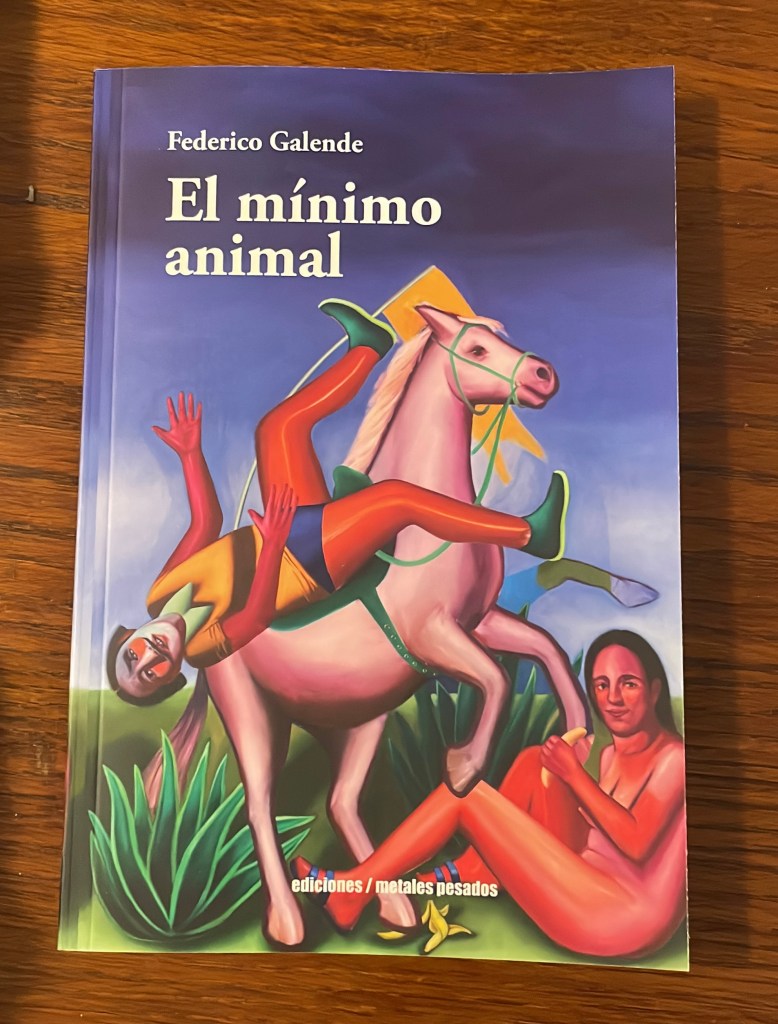
Federico Galende’s most recent essay El mínimo animal (ediciones metales pesados, 2025) is freestyle mediation on the singular animal that is the horse. When we say ‘horse’ we immediately dispense a bulky package: it is Pech Merle cave paintings and Franz Marc; it is Kafka’s parable of the racing red Indian, the agonizing horse in Picasso’s Guernica, as well as Juan José Saer’s mutilated horses in Nadie Nada Nunca (1980). Galende’s tiny mare, however, is first and foremost a memory of his childhood in the green grasslands of Córdoda that, we are told, had a big white spot in her muzzle. The first pages are spectacularly bucolic in a sedative language that retrieves a descriptive pollination of events and figures. But immediately the book gains depth and surprising detours. Galende notes that the relationship between humans and the horse differents slightly from that of pets, not as a question of scale, but primarily as complicity in language that shares the solitude between species: “…porque la del animal es una compania ofrecido a la soledad de lo humano en cuanto especie” (Galende 23). Avoiding the humanist temptation that makes the animal into a fantasy of the human, Galende’s situates the horse an experience beyond language. Is not this common solitude – that a few pages before Galende refers just in passing as ‘nocturnal communism’, in an esoteric allusion to his book on the cinema of Akis Kaurimakis – what has been usurped by the total domestication of species in a world that walks towards extinction? Galende’s El mínimo animal (2025) is an exercise in retrieving this innocence abode of man and animal in their reciprocal, and yet intransigent, mutation between worlds.
As a painterly writer, Galende is in full awareness that he must first interrupt the heraldic density of this animal. Because we know that the horse is an emblem of St. Paul’s way Damascus as much as it is one of modernity’s energy and mobilization. Galende is quite aware of it: the notion of “horse power” registers the unity of measurement of potential power for engines and motors. And just like the steamboat and gaslight, the horse stands a figure that unleashed a civilization defined by development and domestication of the world. The horse entered history through the main door of modern spiritualization (Galende does not elaborate on Napoleon’s famous horseback riding entrance in Germany, avoiding an image that is perhaps too obvious, already “manoseada”), allowing for social stabilization and homogenous time; the arrow of progress that underpins subjective historical consciousness. Galende writes, for instance: “De ser una masa abstracta que rodea la tierra, el espacio se convertía en una línea delgada, con la historia estirando un hilo la materia cósmica de la simultaneidad. Ahora, gracias al caballo, se tenía acceso a los lugares más retirados, solo que a causa de la velocidad de se los pasaba por alto de modo que lo que hasta allí había reinado de la imaginación comenzó a ser parte de lo accesorio, de lo circunstancial” (Galende 82).
The unification of the planet under the nomoi of depredation would not have been possible without the domestication of the horse to coerce the acceleration of time as the index over space. As a cypher of time, the horse started to pop up everywhere progress made a violent incursion. This is perhaps why Galende, in a poetic style that seeks no conceptual scaffolding for self-assertion, claims that in its mystery the horse is not embedded in an ideal of freedom – which will be the freedom already fallen prey to the tribulations of civilization and the political world – as being in the world as such, without the pretensions of overcoming it; remaining a witness to permanent discontent in the open distance of some meadows (Galende 61). Can a notion of freedom be rethought from the figure of the horse at the end of history? Galende does not provide an answer, and his muteness is an attempt to resist transforming the horse into an apodictic symbolon of human anthropology transpiring meaning where there is none. The horse – and perhaps all animals are – stands for muteness and companionship without the burden of proof.
Perhaps the ultimate meaning in El mínimo animal (2025) can only be grasped in those silences, in what remains unthought and unsaid, which is another way of saying that Galende has provided the essay not only of form but of a soul. All things considered, the mystery of horse is a passing memory of the modern: speed, total mobilization, energy dispensation, the unity of a compact and legible world. What remains of the horse after the watershed of modern times; literally its exhaustion? Ultimately, the horse as species recalls the “specio”, which means to see, and to have the visibility for discernment; to be able to see with a sensible eye that blushes at the world before it crumbles into despair and conflagration at the threshold of the Anthropocene. And in many ways we are already there. Galende’s musings speak to an abundance trimmed by a trotting horse that only reappears in a poetizing that is capable of thinking and loving what has passed, like the epoch of horses. For Galende the horse is thus always sub specie aeternitatis. Towards the end of the book, and condensing Gottfried Benn’s argument on style as ranking higher than truth, Galende makes an open apology for appearance, that is rigorously eternal because it is concrete and unforgettable (Galende 91).
Of course, the same can be said of Galende’s serpentine, courteous light prose – like a horse, that is, “una elegancia contenida” – that refuses the monumental and sterile retrievals of sedimented and dusty knowledge on the horse or any other animal (Galende 43). In this sense, Galende’s horse differs fundamentally from Blumenberg’s lion in its refusal to make of the species an anthropological metaphor, that is, a mere creed for the human bonum commune to stabilize social reality. Departing from the offerings of a meandering memory, Galende’s tiny animal is a vanishing horse that interrogates what it means to inhabit the space of non-relation that opens up when the modern scheme based on production, progress, and energy comes a halt. It is this “nothingness” what the vanishing horse reveals beyond itself, as Galende writes:
“Retirándose, el caballo le estaba advirtiendo a todo el siglo XX que la historia de retira con ellos y el mundo también, y todo lo que siguio 4 después de que por inercia ese siglo hiciera desfilar frente a sus narices las profecías más disparatadas…Pero no esperar nada no significa estar consciente de no esperar; puede ser al revés, que la nada sea una intersección invisible entre un sinfín de velocidades insustanciales. La aceleración de la vida – para decir lo con una expresión manoseada -…sirve para compensar este vacío que dura…” (Galende 87).
In the stretched historicity of boredom and nothingness, memory awaits and assaults like an incoming galloping horse. And when Galende speaks of the “nothingness” that mediates between the temporalities of human action he is indexing the fabric of life; since authentic life only happens, as Don Delillo claims at the opening lines of Point Omega (2011) not when words have been spoken or inventions patented, but in the self-awareness of microscopic fragments of facticity. It is at this moment, when history unravels as a farcical script of putative norms of human action, and imagination can begin to gather species outside itself; in this way, perhaps once and for all, leaving behind the atrophies of nihilism already deposited in a language of strange instruments and recyclable data.
Just like Marguerite Duras’ Little Horses of Tarquinia (1953), where the Etruscan sculpture of a winged horse fails to enter the plot of a community of friends at a beach-town; Galende’s horse also disappears in the concluding pages of the book. In fact, there are two disappearances: first, the equestrian statue of Baquedano in Plaza Italia after the October social revolt of 2019; and, more importantly, that of his childhood mare in the hills of Córdoba. The vanishing horse at the limit of prose recalls the reality of the living for which there is no tropology: “…nunca conocí a ese ser, así como no es possible – nunca jamás – conocer a los seres ni tampoco el fin de ninguna historia” (Galende 110). As the horse makes his exit, we can only be sure that life has taken place elsewhere. Only because it has been transfigured in thought, Galende is able to seize a glimpse of it; a glimpse that is imperceptible and diluted before vanishing forever.
 Infrapolitical Reflections