On Cézanne’s pink stripe tablecloth. by Gerardo Muñoz

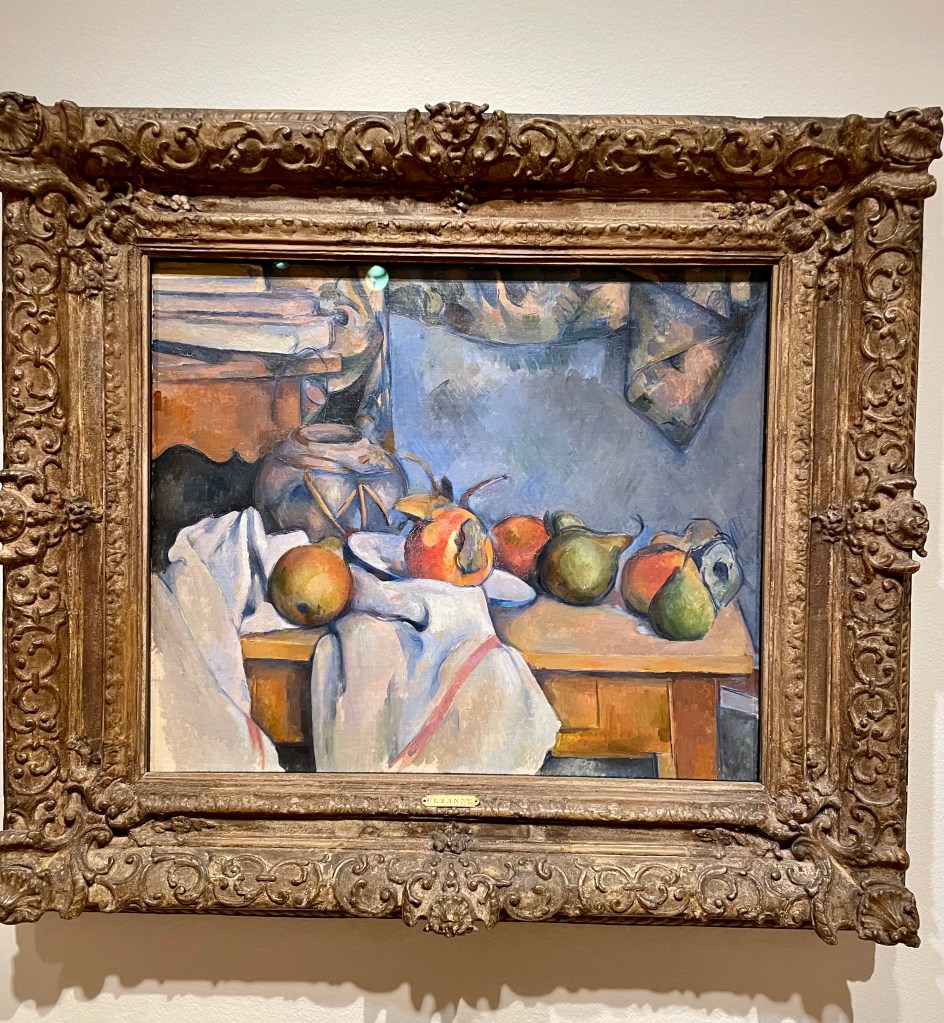
The title of the painting is “Still Life with Apples” (1894) housed at the Getty. Like many of Cézanne’s pictures of the 1890s we have a sense of immediately entering into an space warped by distance and nearness that lavishly seals the scene. We feel that something has taken place; after all these are pictures of an event, but only concealed to us. We are given the sense of that experience, which is the fundamental thing to depict for Cézanne. Now, if Clark is correct, then it is true that Cézanne’s still life painting was meant to annihilate the objectivity of the world through a study and stubborn simplicity; although simplicity never amounts to synthesis. On the contrary, what preserves sensation over absorption remains at a distance: this is the narrowing act of simplicity as a fact of style [1]. The depiction of appearance is a problem for Cézanne precisely because painting now stood (late nineteenth century), as Kurt Badt well observed, as the last metaphysical activity in the face of Western nihilism [2]. There is nihilism, an unbridled chaos – and thus painting aspired to accomplish a different form of order, a transfiguration through sense. A higher order subtracted from representation. Thus, the outpouring of sense was everything to Cézanne; nothingless than the attunement of the relationship between depiction and nature. Thus, nearness and distance stands a problem in the picture itself: what is most apparent is what Cézanne seeks to qualify through depth and singular brittle rigidity.

As he would write to his friend Émile Bernard: “In order to make progress in realization, there is only nature, and an eye educated by contact with it….I mean that in an oregon, an apple, a ball, a head, there is a culminating point, and this point is always the closet to our eye, the edges of objects recede towards a centre placed at eye level. With only a little bit of temperament one can be a lot of painter. All you need is an artistic sensibility. And doubtless this sensibility horrifies the bourgeois” [2]. This is Cézanne’s permanent struggle (a non-subjective position, that is, anti-Romantic) struggle: the impossibility to “realize” and to complete a picture as the heart of the mysterious vortex of the execution of depiction. This clears the entrypoint to the problem of the “last metaphysical activity in the wake of nihilism” that Badt consigns to the activity of painting: pictorial art can reveal the unrealizable in every work; but it is no less true that all works fundamentally have an asymptotic inclination to the potential of realizing the idea. The achievement of that impossible nearness attest to the achievement of painting (or to its consummated failure).

The unrealizable in Cézanne’s painting, however, is not merely indexing the unfinished gesture of the brush in a scene or a series of selected objects; rather it is the condition of possibility for entering into the world through a medial common existence between things, however fragmentary within the whole. The unrealizable dimension is never a conscious attempt for a spatial unity to be fulfilled; it is alienable by a stylistic reduction at the moment in which it ceases to belong to the painter’s cognition. This is why Cézanne’s pictorial project – more so than Pisarro’s anarchic affinities and political flirtations in the late nineteenth century – has radical consequences for an opening of freedom that is grounded on the senses (and what it means to be ‘free in the senses and the passion’, in each temperament), allowing experience to decompress the formalistic representational conditions of bourgeois civility. Indeed, Cézanne’s work – and the world it depicts, the opening towards things as a whole but through separation, having in common precisely alienability – does not aspire to be legible in the social, which is the ideal space of exchange and metaphorization, recognition and reification as image. The social is the limitless spatiality in which anything can enter, as anything can stand for any other thing. Or, to put it more concisely: painting seeks to let things be things in their interchangeable nature (without the anxiety over fixing an image of Nature).

Paul Cézanne. “Ginger Pot with Pomegranate and Pears” (1893), Phillips Collection, Washington DC.

Cézanne inadvertently knows that whatever fate in the wake of nihilism awaits “painting” (soon to be utterly destroyed and displaced by the conceptual and object driven monstrosity of the modern vanguard), the effort to “realize” in painting meant holding to experience of depth as the only guarantee of an existential freedom. Surface and depth will remain on the side of the insistence of an appearance without predicates proper to theatricality. Kurt Badt poignantly captures this in Cézanne’s “old age style”: “There is no longer anything in our sensory experience of seeing which corresponds to what thus becoming visible; what is shown nis rather the visible picture of the concept of freedom. For the thing common to all these forms of the “style of old age” is two-faced: negatively it is a ligeration from isolation and resistance, possibly a liberation to the serious gentleness of freedom” [4]. And gentleness means letting things be: the serene elevation to irreducibility, upholding them only in the proclivity of its contact; never fully absorbed by surrounding and revealing its state of harmonious composition. The task of depiction in painting is the impossible task- but the task nonetheless thoroughly achievable through the hands of the painter – of coming as close as possible to what has actually been experienced. Having affirmed (not necessarily achieved) something like a fate-like divine temporality in painting is able to ground worldliness as transcendent only to let it fall immediately after. And what fate is to character, for Cézanne ‘that which is preserved unchanged’ is the supreme tonality of the pictorial task realized by the restraint of the artist [5].

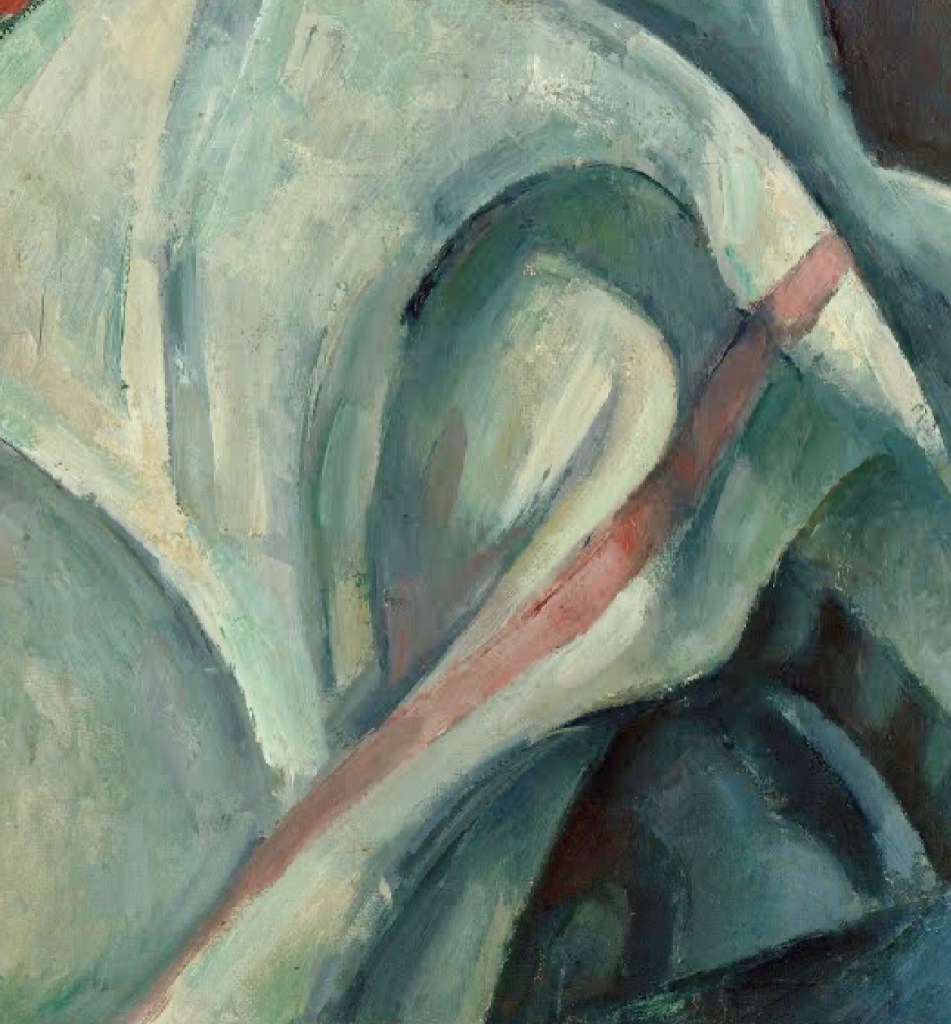
But precisely to depict immobility, the forever permanent, the befallen weight of the conatus essendi (what preserves itself as such), painting has to mobilize a minimum motion for the confluence of objects, planes, and emergence of depth. The pink stripe tablecloths that appear in several of the 1890s still life paintings with fruits can be very well taken as a multum in parvo of the declension in every realization. In a sense, then, the pink strip is a signature, as if were, of the gathering of things and depth at the price of unrealizing the closure of integral depiction. It is precisely the pink stripe in which it becomes realizable in a single brushstroke that the place of the line appears otherwise, crowning the mystery of painting as the clearest manifestation of a different musical order. It is the mysteriously nature of painting, which barely introduces itself as a line substitute for a color (the color of the tablecloth as a thing) that, while remaining visible to the viewer, cannot but reveal the invisible; that is, the temperament of the artist attuned to the muteness of painting, to say with Poussin. And perhaps this is the highest moment of depiction in the search for the “integrity” of “wholeness” that, in turn, grants the instance of the unconcealment of truth. A lace plotting what has already been validated in the irrevocable thereness of the most inapparent existence: an eternal state in the world.

.

.

Notes 

1. Maurice Denis. “Cézanne II”, The Burlington Magazine for Connoisseurs, Feb, 1910, 279.

2. Kurt Badt. The Art of Cézanne (University of California Press, 1965), 181.

3. The Letters of Paul Cézanne (Getty Museum, 2013), 342. 

4. Kurt Badt. The Art of Cézanne (University of California Press, 1965), 313-314.

5. Ibid., 161.

Bonnard (1910): painting and dissonance. by Gerardo Muñoz


Here is a little masterpiece by Pierre Bonnard at the Phillips Collection, “Interior with boy” (1910). Its simplicity does not shy away from the fact that it is a picture struggling with the problem of sensation as the highest task of painting. Bonnard is most definitely working on the threshold of Pissarro for whom the supreme mystery of a picture at the turn of the century is the act of wrestling with sensation as the world is coming to an eclipse. Or, to put it in a straightforward manner: departing from the objectivized world. If there is anything at the outset of the first decade of the twentieth century – from the stretch of 1890s to the 1910s – is the vibrant undertone of a conscious sense of what experience has become in the world. Painting, it would seem, takes up the challenge of this seeming aspect of life among things.

For Bonnard this means disclosing what appears for the first time: “to show what one sees when one enters a room all of a sudden”. And this is what “Interior with boy”(1910)  is showing us: peeking into a room with a boy sitting at a table quietly reading or going through something. The object is dissolved. We are not sure what the boy is doing. But, does it matter? The painting works around this silent vortex (although silent might not be the exact word). The figure does emphatically grows out the different color blocks of the interior (there is a solid black line that makes his body stand out). The effort of painting is achieving the seemingly weightless there-ness of the figure, blending itself to its surround, and gathering a strong sense of its appearance. 

As Bonnard would tell Matisse years later: “I see things differently every day, the sky, objects, everything changes continually; you can drown in it. But that is what brings life” [1]. For Bonnard it is not that painting gifts the events of the world with life; rather it brings the event of life away from the drowsiness of the temporal organization of its own elements. Painting is not disorganized for the sake of disorganization; it organizes life around its unmitigated appearance where form does not have the last word. Hence the insufficiency of the question “What is the boy really doing?”. The attempt to define it would ruin the experience of the painting – the subtle but well placed magenta hue connects a fragment of the back door with the boy’s downwards face, and finally to the left corner of the table. In a superficial sense the magenta is a schism of light coming through the picture, but it is also a diagonal that registers the dissonance of the painting, and thus, its ultimate mystery. Can painting integrate dissonance? The early Lúkacs seem to have thought against it. This is what he had to say in Soul and Form (1910): 

“In painting there cannot be dissonance— it would destroy the form of painting, whose realm lies beyond all categories of the temporal process; in painting, dissonance has to be resolved, as it were, ante rem, it has to form an indissoluble unity with its resolution. But a true resolution— one that was truly realized— would be condemned to remain an unresolved dissonance in all eternity; it would make the work incomplete and thrust it back into vulgar life.” [2].

But does painting need to find a resolution to dissonance, or is it quite the contrary? Bonnard’s search for the ante rem is not the sensorial apprehension to this dilemma; it is what refuses recoiling to “vulgar life”. But the passage from Soul and Form (1910) allows me to claim that the vulgarity of life begins when things start to tip towards the end of appearance; that is, when the soul disappears and the only thing remaining is the aggregation of allocated forms for sake of ‘originality’. If anything is achieved, then, in Bonnard’s “Interior with boy” (1910) is that it folds the question of dissonance to the task of painting while acknowledging that the taking place of life is always unattainable; as invisible as the boy’s inscrutable undertaking can be.

.

.

Notes 

1. Bonnard/Matisse Letters Between Friends: 1925-1946 (H.N. Abrams, 2007), 62.
2. Gyorgy Lukács. “Longing and Form”, in Soul and Form (Columbia University Press, 2010), 123.

Cowper Powys on catastrophic world-events. by Gerardo Muñoz

In the short epilogue “Historical Background to the year of grace A.D. 499” to his novel Porius (1951), John Cowper Powys lays out a remarkable prophetic evaluation of a world fallen into a permanent catastrophic condition. Powys’ return to the sixth century in his novel departed from the fascinating fact that during the mid-fifth century there appears to be “an absolute blank” page about the history and culture of its people. And the only historical record proves that the central element was the Arthur’s commanding political dominion over the English territories. In these blank pages of history there are no tormented voices or traces of everyday existence, but the most absolute compacted pressure of barbarism and grandiose “crafty personal diplomacy” oriented by political rule. For Powys, this is the movement of abstract historical force that raises up the mirror of civilization and barbarism in the West.

However , this mirror is completely alien to any notion of happiness, imagination, and sensibility between the surviving human species. A world war had just concluded and atomic menace was the strange tune of daily life. But, in contrast to the triumphalist and historical narrative of postwar diplomatic theaters, Cowper Powys directs his vision (like Hölderlin and Pound before him with Greece and the Latin Mediterranean poets) to a prehistoric strata where language and sensation still had a chance against the civilizational collapse of the West. Against both civilization and barbarism, Powys prepares himself to drift away from something major, perhaps more even more catastrophic, which he never names directly in the Porious prologue, although he can unravel its essence in the last paragraph:

“As we contemplate the historic background to the autumn of the last year of the fifth century, it is impossible not to think of the background of human life from which we watch the first half of the twentieth century dissolve into the second half. As the old gods were departing then, so the old gods are departing now. And as the future was dark with the terrifying possibilities of human disaster then, so, today, are we confronted by the possibility of catastrophic world events compared with which those that Arthur and his Counsellor and his Horsemen contented against seem, as the Hebrew poet said, a “very little thing” [1]”.

It is thanks to the genius of Cowper Powys that the coming of catastrophe is understood not as another phase in world-history, but rather, as the opening of endless catastrophic world-events. Even before Martin Heidegger would define the essence of cybernetics as the consummation of the calculation of world events, Powys had already suspected that a stealth rationality towards calculation of events was the catastrophe that crossed the very line of the polarity of barbarism and civilization. The catastrophe of world-event consummation was hinged upon the total convergence of machine and humanity that would liquidate the free relation of the living in the world. As Powys had written in The Meaning of Culture (1930) decades prior: “Money and machines between them dominate the civilized world. Between them, the power of money and the power of the machine have distracted the minds of our western nations from those eternal aspects of life and nature, the contemplation of which engenders all noble and subtle thoughts” [2].

The ascent of atomic existence and the absolute dependency on administrative infrastructure to contain the world, will validate Powys’ astute observation about the ongoing catastrophe at a moment when its development was barely beginning to gain traction. And against futile political fictions, Powys was aware that in a civilization of collapse, political chatter becomes the only legible foul discourse: “Among other aspects of our destiny in this modern regime, the rumor of politics makes itself only too audible” [3]. The seriousness of this rumor has only deepened almost a century after.

.

.

Notes 

1. John Cowper Powys. “Historical Background to the year of grace A.D. 499”, Porius (1952), xi.

2. John Cowper Powys. The Meaning of Culture (Jonathan Cape, 1932), 150. 

3. Ibid., 302-303.

The future of Saint Cassian. by Gerardo Muñoz

There is a painting from the early sixteenth century at the galleries of the University of Bologna that depicts the gruesome death of Saint Cassian of Imola at the hands of his own students. The story goes that Cassian was a fleeing Christian in the Roman Empire who found a teaching position in the town of Imola, until he was discovered and exposed. In the saints’ hagiographies, it is emphasized his passion concerning reading and writing for his students. This would confirm the high price of Cassian’s punishment: torture and death at the hands of young students (some allegedly even brought their sharpened styli). The Bologna painting is, in fact, a miniature of about five by seven inches, and it depicts eight young students striking at a naked and tied up Cassian. The anonymous painter has chosen carefully to have all of the figures turn away from the spectator, except for a student in the far right corner of the painting who seems to be holding a sort of bowl in the air. He seems disengaged from the frenzied mob. And yet, there are no wounds or bruises in Cassian’s body, which could be an allegorical statement by the painter about the martyrdom condition, or, more literally, the plain fact that the cruel feast has just begun. Cassian’s face is monotone, and one of disbelief, but not yet of someone consumed by the ecstasy of bodily suffering. He is definitely humiliated amidst such violent and naked act. This is highlighted by the stage-like setting of the assault, which does not seem to be taking place somewhere outside, but rather in a strange room whose only way out is a dark and ominous black counter to the left side of the painting.

This black square immediately recalls martyrdom. And yes, in modernity this means David’s Death of Marat (1793) floating figure who stands as the secularized martyr at the year zero of modern representation. In the early modern bolognese painting we are far from there, but the resources at the painter’s disposal (myth, depth, and figure) speak to a postreligiousity at the threshold of a new historical time. Strangely, the figure of Saint Cassian as represented here by the anonymous bolognese painter throws a shadow to our present, given that the teacher or professor has been sacrificed, not so much the literal violence of his students, but by the an even greater disposition towards a shameless nakedness driven by value and a complicit abandonment of its mission. In the United States at least, the long dispensation of the “closing of the American mind” – driven by competition, ranking, placement, mentorship, cultural wars, and identity politics – entails the uttermost collapse of the teacher into the administrator and facilitator of a rather unknown enterprise.

Even in 1983 Carl Schmitt could identify the martyrdom of Saint Cassian as an emblem of the professor betrayed by his former students: “I have also been stabbed by my students”, he will confess to Lanchester [1]. So, just four decades ago the teacher could still stand as an object of fidelity and betrayal. It would be hard to make the case for this hypothesis today, since the pain of the teacher is no longer of betrayal, but of indifference insofar as he can be disposed of. In this sense, only something that possesses a certain aura can be said to be betrayed; while something that can be discarded altogether is something that has seen better days and no longer has value. And if universities and schools today have become larger centers of monotony and alienation of the most basic activities (such as discussion, reading and writing), this is because both students and professors have been, for the most part, replaced by “mentors” and consumers” under the holy contract of hypocrisy, the true and last ethics of the enlightened metropolitan class.

Anyone that has ever had the good fortune to encounter a good teacher or professor will know that his example springs not from what he knows or professes to know, but rather from what he can transpire unto others: to search of a form of one’s own path. The ethos of a teacher has little do with specialization or success, and everything to the incarnation of a gestalt that is not accidental or transient, but perpetually springing from its myth, as Carchia suggested for the work of art [2]. And myth is the sensorial mediation that resists to be instrumentalized into the endless amassing of value by the powerful administrative subjects. This amounts to saying that the teacher finds self-legitimization in its capacity to inspire the shared sense of wonder of the inaccessible.

Or, at least, this has been the teacher at its most groundbreaking moments. The eradication of teaching – which like mostly every other area foreclosed by the crisis of the human experience was unveiled during the years of the pandemic – and its complete abdication to models of “leadership” and “training” (under the fictitious rubric of the syllabus as an economic contract) is the bleakest of the futures that Cassiano could have taken. A nihilist future that, it goes without saying, will be void of martyrs and myths.

.

.

Notes 

1. Carl Schmitt. “Un jurista frente a sí mismo: entrevista de Fulco Lanchester a Carl Schmitt”, CSS, 1, 2017, 220.  

2. Gianni Carchia. Il mito in pittura: la tradizione come critica (Celuc Libri, 1987), 155.