Painting and Paradise. by Gerardo Muñoz

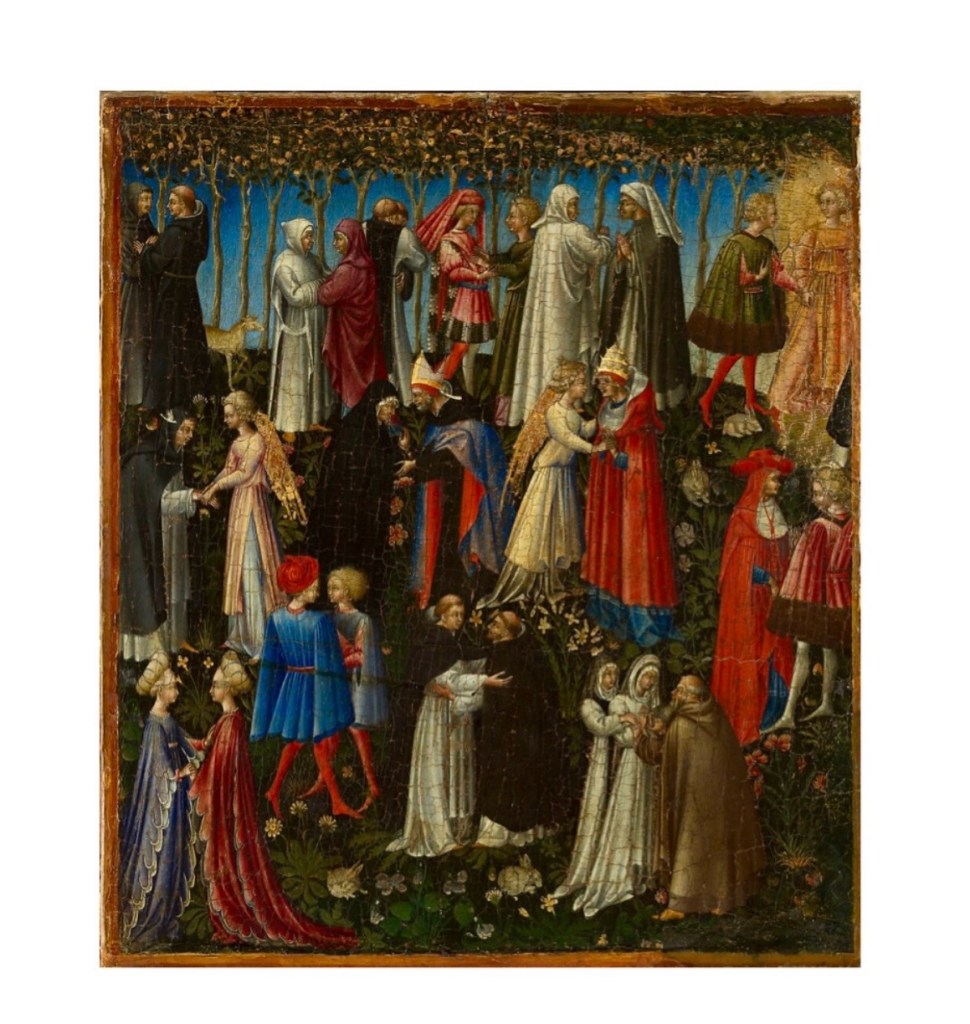
Giovanni di Paolo’s “Paradise” (1445) is a small scene once featured as a predella of an altarpiece from Siena’s San Dominica cathedral. Albeit its miniature proportions it is a striking image of Paradise that puts us in front of a choreography of encounters of the dead, as if the heaven was not a superior and separate stage of life in the cycle of salvation, but rather a continuous stretched territory that takes off where “this life” had left. In its rather simple and rhythmic composition, surrounded by citrus and vegetation, Di Paolo offers the viewer a state of paradise that is not about absolute bliss or bathed in irresistible enchantments, but rather something that in poverty reveals itself in proximity, literally face to face, with an other, perhaps a friend or lover. If we zigzag across the figures it is almost as if the picture would confirm Roberto Antelme’s intuition that “the only transcendence is the relation between beings”. And nothing else is the painterly texture of paradise. In this way, one can define the earthly paradise as a space where transcendence is dispensed because it primarily welcomes and senses otherness.

One of the striking details of the picture is precisely the positioning of the hands of each couple. Just take a second to gaze around them. These are hands that gesture towards a supreme affection; it is the hand that reciprocates and welcomes. It has been noted – for instance, in Berenson’s A Sienese Painter of the Franciscan Legend (1910), that Sienese painting of the fifteenth century introduced a new pictorial attention that manifested the coming to life of the spiritual. In Giovanni di Paolo’s Paradise the flickering hands, moving around the bodies, are perhaps signifying the initial touch of renewal between heaven and earth. In fact, it is almost as if the sliding of hands was the vehicle for the nongranular transition into the arrival of heaven. In a way of synthesis, one could say that paradise is always at the distance of the hand; which is why painting and happiness remain in an intimate dialogue regardless of themes or historical epochs.  

And one can ponder whether the absence of paradise from imagination in the wake of the absolute intrusion of hell in reality, is not precisely a world where the incommensurability between hand, nature, and language become indistinguishable; the transparency of sameness in an expansive totality well beyond reach. To be in nearness is not just an ethical transcendence between beings, but ultimately allowing a divine region to flourish for possible encounters. This is why Angelus Silesius says that “nothing exists except you and I, without both of us then god would not be god, and the heavens will cease to exist” [1]. Paradise is, as Di Paolo’s painting reveals, not the utopia to come in another time, but the  inconceivable place never fully detached from the experiences in this earth. As Karl Barth once wrote: “As the place of God in heaven is, of course, a place which is inconceivable to us. It cannot be compared with any other real or imaginary place. It is inaccessible. It cannot be explored or described or even indicated. All that can be affirmed concerning it is that it is a created place like earth itself and the accessible reality of earth which we can explore and describe or at least indicate; and that it is the place of God” [2].

This inconceivable place of God is the apocatastasis of what sorrounds us, of what has touched us, and of what we have touched; and this includes above all, the nexus of the living and the dead in a strenuous thought that gathers itself in what has loved. This space outlives the world of the living in order to express the divine that is, precisely, the unmediated appearance of each encounter. This means that painting paradise does not commission what a new life should look like as a way to overcome a previous existence of deficiencies and missed opportunities; what is recollected, and thus the only true apocatastasis, is a path to presence that knows neither end nor name. 

Notes 

1. Angelus Silesius. El peregrino querúbico (Ediciones Siruela, 2005), 2005.

2. Karl Barth. Church Dogmatics: The Doctrine of Creation, III (T&T Clark, 2010), 149.

*image. Giovanni di Paolo’s “Paradise” (1445), part of the Metropolitan Museum Collection.

A certain life. A note on Marguerite Duras’ La vie tranquille (1944). by Gerardo Muñoz


Let us imagine a person that in a short period of time finds himself haunted by successive deaths, abandonments, missed encounters, displacements, and lost possibilities – the list could go on. All of this amounts to a loss of world. This is obviously the narration of anyone’s life, and every moment of it would seem to imply an internal necessity of its unfolding as felt in the weight of its coming together in remembrance. Obviously factical life will continue on – and it always goes on – but the ultimate question will reside in the relationship between existence and the narrative order of that past. All of Duras’ narrative world is almost entirely a direct wrestling with the possibility of going against this specific weight of narrativization, because to narrate means to forget oneself from the experience of being in the world here and now. The demand of recollection imposes rhetorical limitations to the unfathomable present. Remembrance is the courtyard of historical and religious necessity where self-transformation takes a secondary role in a massive and alienated narrative of causes and reasons.

Duras’ first novel La vie tranquille (1944) reacts strongly against the burden of memory in the name of forgetting: “Once you lose the ability to forget you are deprived for a certain life” [1]. But what could a “certain life” amount to? Obviously, this forgetting here does not mean a neutralization of conflict in life (as in the status of a civil war in a political community); rather, it entails a sort of rebirth, in which the density of life refuses the crushing force of fictitious acceptance dispensed by the order of the past. That loosely defined “certain life” does not qualify nor situates “life” to the survival of “this life”; on the contrary, it seeks to open life to its open and self-evolving possibilities. In other words, there is “only one life” because there are only irruptions of the tragic possibilities that will always elicit a vita nova. The “certain life” that is always lacking allows the infinite possibilities of rebirth in the face of the eruption of the tragedy. And tragedy requires affirmation and exposition to the world in a strong sense. This could very well be the ultimate tone and color of the adventure for Duras.

Dionys Mascolo once wrote that Marguerite Duras’ literary and cinematic work is a transfigurative elaboration of the the tragic, and for this very reason the active undoing of the civilizational narrative at least since the humans of the neolithic that had resulted in the production of justifications and reasons to live “our life” [2]. And in a way the irruption of the tragic is the confirmation that civilization does not have the last word of absolute moral order. But life  – and this is the “mystery” coloring a good part of Duras’ imagination – is always about keep afloat the possibility of the certain life without the threats of self-absorption and destruction in the wake of nihilism and abstract political equality between beings in the world. A “certain life” (our certain life without qualifications other than being attuned to the object of our passions) is always elsewhere, and for this very same reason as a transfigured revelation outside of what appears as the enclosed necessities of ‘this life’. “A certain life” is a higher indented form of the theos unto life, whose transcendence is not regulated by an article of faith or the anthropological deficiency of sin (this is at bottom the difference between Christ and Saint Paul). In other words, the tranquil life that many readers have generally understood as wilful irony wrapping Duras’ narrative bears the truth to that life – the only one worth affirming as destiny – must always be outside itself. As the character of La vie tranquille (1944) confesses in one of the peak moments of the monologue in the second part of the novel:

“I’ve existed for twenty-five years. I was very little, then I grew and reached my size, the size I am now and that I’ll be forever. I could have died in one of the thousand ways people die, and yet I managed to cover twenty-five years of life, I am still alive, not yet dead. I breathe. From my nostrils emanates real breath, wet and warm. Without trying, I managed to die of nothing. It advances stubbornly, what seems halted, in this moment: my life. …My life: a fruit I must have eaten without tasting it, without realizing it, distractedly. I am not responsible for this age or for this image…” [3]. 

The bite into the fruit in this monologue differs from the metaphoric self-confession that ascertains the theological irreversibility of  original sin and felix culpa; it signals the passage of the narrative of life into denarrativization. Here a “certain life” might open against the fluvial current of the order of necessity that will make the subject into a bundle of legible and memorable infortunios. The passage to the tranquil or serene life, however, is not just grounded in the description of a trembling account of onself. In Duras, it has a proper name: thought. In fact, as we will find in the last part of the novel: “You must advance with the last of your powers;…with the power of thought” [4]. And following Mascolo to the letter, one could say that this ‘power’ is misplaced – it is not a power of the subject to force a will to do or act – it is rather a passion of thought (“la passion de la pensée”) that elevates itself against necessity and actualization through a “refusal” of any given historical order. 

This is to say, the breakthrough to the ‘certain life’ or the ‘serene life does not presuppose a counterpolitical strategy, as much as the movement of thought enacted in refusal as condition for any democratic requirement that no one can ultimately possess, as Duras a decade later will go on to write in the third issue of Le 14 Juillet [5]. The serene life is only possible as an infinite movement of denarrativization. The inhabitation of the world in La vie tranquille (1944) was already preparatory for the gesture of ‘refusal’ where a certain life follows a retreat from the hypsipolis apolis (superpolitical apolitical) into the existential xenikos of a contemplative life that is irreducible to both the principles of humanity and the normative regulations of social interaction. The serene life is only achieved when the separation of thought and life enters into the  incommunicable sense of persuasion (the ancient peitho) capable of decompressing the vector of force that has only produced a generic humanity of political depredation, acceptance, and excruciating tonality of boredom. Duras’ writing – at its best moments – is an intense search of this kind; a search does not end in neither politics nor literature, but on what remains outside of them.

Notes 

1. Marguerite Duras. The Easy Life (Bloomsbury Publishing, 2022), 90.

2. Dionys Mascolo. “Naissance de la tragédie”, in A la recherche d’un communisme de pensée (fourbis, 1993), 397.

3. Marguerite Duras. The Easy Life (Bloomsbury Publishing, 2022), 96-97.

4. Ibid., 114.

5. Marguerite Duras. “Responses à l’enquête auprès d’intelectuels français”, Le 14 Juillet, N.3., 1959, 5-6.