Hölderlin in Agamben. by Gerardo Muñoz

There is no question that Hölderlin occupies a central place in Giorgio Agamben’s work, although he always appears within a specific strategic deployment. Of course, it might be the case that Hölderlin is always present in instances where he is not directly cited or thematized, but in the following note I want to record four instances where Hölderlin appears in different phases of Agamben’s thinking. These notes are preliminary for a larger work in progress that looks at the status of the comic as a potential force for a transfigured politics, which is informed, although not limited by Hölderlin’s work. Hölderlin occupies, after all, the entry point to L’uso dei corpi (2014) in relation to the well-known maxim “the use of the proper”; the territory where the (modal) ontology will be measured. However, esoterically Agamben’s incorporation of the German poet suggest a ‘way out’ from the tragic politicity of modernity. It might useful here to recall Schmitt’s annotation in Glossarium about what Hölderlin symbolized in the larger picture of modern German thought: “Youth without Goethe (Max Kommerell), that was for us since 1910 in concrete youth with Hölderlin, i.e. the transition from optimistic-ironic-neutralizing genius (genialismus) to pessimistic-active-tragic genialism (genialismus). But it remained within the genialistic framework, yes, deepened it into infinite depths. Norbert von Hellingrath is more important than Stefan George and Rilke.” (18.5. 1948) [1]. To overturn Hölderlin as the figure of the tragic caesura and witness to the crisis of “distance” in modernity is most definitely at stake here in order to avoid (subjective) conditions for something like an Enlightenment renewal. More broadly, it could be productive to think of Hölderlin as the poetic site that grants Agamben a possibility of thinking the event beyond the dependency of messianism and history, now displaced by the relation between language and world. 

a) As early as in Stanzas (1977) Agamben writes about Hölderlin: “The name of Hölderlin – of a poet, that is, for whom poetry was above all problematic and whom often hoped that it could be raised to the level of the mēchane (mechanical instrumental) of the ancients so that its procedures could be calculate and taught – and the dialogue that with its utterance engages a thinker who no longer designs his own mediation with the name of “philosophy”, are invoked here to witness the urgency, for our culture, of rediscovering the unity of our own fragmented word” (xvii) [2]. Hölderlin occupies here the site of antiphilosophy, in which the event of language does not longer coincide with a structure of the subject, but of the potentiality of “saying”; a sayability in which fragmentation removes any commanding closure of language. The event of appearing and bring to conclusion (in the book on Paul, Agamben will associate it with the rhetorical figure of the enjambment in the poem) gains primacy over formalization. 

b) In another early book, L’uomo senza contenuto (1994) Agamben takes up the question of fragmentation of language in Hölderlin but this time provides a specific category: rhythm. On the chapter about the original structure of the work of art he writes: “Everything is rhythm, the entire destiny of man is one heavenly rhythm, must as every work of art is one rhythm, and everything swings from the poetizing lips of the god”. This statement was passed down to us by Hölderlin’s own hand. […]. What Hölderlin’s sentence says appears at first blush too obscure and general to tempt us to take into consideration in a philosophy query on the work of art. However, if we want to submit to its proper meaning, that is, if we want, in order to corrupt to it, to make it first of all into a problem for us, then the question that immediately arises is: what is rhythm, which Hölderlin attributes to the work of art as it original characteristic?” (94) [3]. So, the category of rhythm “holds men” epochally as a form of incommensurable distance with the world, which Agamben relates to an-archic original structure of dwelling. For Agamben this step-back to the “original site” vis-à-vis rhythm releases “art” as poesis from a productivist “destiny”. So, it would be obvious to say that rhythm, insofar it abolishes the production, it also thematizes the ethical life as the form of life (which is why Agamben also attaches Hölderlin as a counter-figure of the notion of “vocation”) [4]. There is no form of life without rhythm in nearness to the common ground. 

c) In Autoritratto nello studio (2017), Agamben glosses (a) and (b), that is, he recognizes the importance of Von Hellingrath reconstruction of the late Hölderlin of the Pindaric translations and the fragmentary syntax, but now situates him at the center of modernity. Agamben writes: “Walser noted, as Hölderlin before him, that the world had become simply unhabitable. And there was not even the possibility of amending it…I am convinced that Hölderlin in his last thirty years of this life was not unhappy, as some professors of literature tend to describe him. On the contrary, Hölderlin was able to dream at his house without worrying about duties. The Tubingen tower and the clinic of Herisau: these are two places that we should never cease to reflect upon. What took place behind these walls – the rejection of reason by these two poets [Walser and Hölderlin] – is the most powerful rejection against our civilization” (140-141) [5]. So here Hölderlin, like Walser, is an epochal gestalt capable of generating the separation between thinking and doing, world and experience, which became totalized in the legitimacy of the modern. What could be interpreted as ‘domestic interiority’ for the poet becomes a symptom of a radical form of dwelling at the end of reason subsumed by nihilism.

d) Finally, in a recent essay published this year entitled “Hölderlins antitragische Wendung”, Agamben goes a step further to qualify Hölderlin’s breakthrough, taking radical distance from his relation to the tragic and identifying him as a poet that must be read in a comic register. This is all the more surprising given that, as Agamben himself notes, there is almost no mention of comedy in Hölderlin’s prose, except in the review of Siegfried Schmid’s play The Heroine. And although it is true one could argue that Hölderlin undertook a destruction of the tragic poet in The death of Empedocles, as far as I am aware there has been no interpretation of Hölderlin as opening to the “comedy of life”, except for a brief mention, almost in passing, about his laughter by the Italian poet Andrea Zanzotto [6]. Agamben concludes his essay suggesting that: “With this concept of “ordinary life” I should like to conclude my reflections, at least for the time being. Isn’t it precisely this ordinary life, what in the thirty-six years in the tower, Hölderlin’s life and poetry – or his “poetry” – have persistently sought to carry it out in an exemplary and funny way? And isn’t “ordinary” life the same as the “living” life (to live according to habitus and habits), which is distant and perfect in the last tower poems: When people go into the distance, living life …?” In any case, if Hegel defines the idyll as “the half descriptive, half lyrical poems […] and mainly nature, the seasons, etc., the subject matter”; then the tower poems – this extreme, incomparable poetic legacy of the West – are an idyll of the genre” (40) [7]. And here Hölderlin appears not just as another figure in “the age of the poets” (and the genialismus‘ commanding force), but rather as the moment in which the problem of life opens to its inoperosità. The unity of humanity now navigates the fragmented reality not through the subject, but rather through the singular form of life. Comedy, then, in the idyll genre in which life is freed from both desire and liberty.

.

.

Notes 

1. Carl Schmitt. Glossarium: Aufzeichnungen aus den Jahren 1947 bis 1958 (Duncker & Humblot, 2015). 114.

2. Giorgio Agamben. Stanzas: Word and Phantasm in Western Culture (University of Minnesota Press, 1993).  

3. Giorgio Agamben. The Man without Content (Stanford U Press, 1999). 

4. Giorgio Agamben. “Vocazione e voce”, in La potenza del pensiero (Neri Pozza, 2005). 77-89.

5. Giorgio Agamben. Autoritratto nello studio (nottetempo, 2017). 

6. Andrea Zanzotto. “Con Hölderlin, una leggenda”, in Friedrich Hölderlin: Tutte le liriche (Mondadori, 2001). i-xxiv.

7. Giorgio Agamben. “Hölderlins antitragische Wendung”, Studi Germanici, 17, 2020. 27-40.

A few remarks about Giorgio Agamben’s theory of civil war. by Gerardo Muñoz

At the conference “The Undercommons & Destituent Power”, I was particularly interested in a suggestion made by Idris Robinson regarding the status of the theory of civil war in Giorgio Agamben’s work. I think Robinson’s position on this problem pushes thought forward, and it allows me say a little more about a possible transfiguration of politics, a sort of unsaid in many of the recent discussions. There are at least two levels that I would like to address: the first one is philological, and the second one is more speculative. The moment that I want to dwell upon specifically is when Robinson claimed that Giorgio Agamben at some point abandoned the question of “civil war”. Robinson is right. There is no mention about civil war, insurrectional politics, or even forms of direct political strategy in the endgame of L’uso dei corpi (Neri Pozza, 2014). Indeed, in this book it is as if the “concrete political” horizon is transformed by recasting a modal ontology, a theory of use, and an archeology of “form of life”. My hypothesis, however, is that the logistics of civil war never fully disappear, since it is explored through other regional quadrants of the tradition. In other words, one should understand civil war as fold within the signatura of potentiality. This is an important point of departure since, early in Homo Sacer, we thought that the vortex of the project was going to be the critique of sovereignty; but, on the contrary, it ended up being an archeology of the notion of potentiality. Thus, in a way, civil war is to war what potentiality (dunamis) is to actuality (energeia).

But the question of civil war never truly disappears. In a new gloss included in the Italian “integral edition” (Quodlibet, 2018) entitled “Nota sulla guerra, il gioco, e il nemico”, Agamben thematizes the concept of war in a way that sheds light to the problem of civil war. Agamben starts by pointing to the circularity of war and enmity in Schmitt’s theory of the political. For Schmitt – says Agamben – enmity “presupposes” [Voraussetzung] war, insofar as war is the condition for every enmity distinction [1]. Agamben continues to say that war and enmity converge in the same doctrine of the political: politics is always about war. However, the important metaphysical ingredient here is that war brings about a “serious” dimension to the political. So, state and politics, by means of seriousness (war), deters the influence of the “society of entertainment”, play, and the end of order. The legitimacy of war in Schmitt is weighted by a neo-Hobbesian maximization of “total war”. However, Agamben invites to take a step back. This is important, because at this point enters Johan Huizinga’s critique of Schmitt’s concept of the political, which reminds us war is constitutive of the ludic sphere that suspends all seriousness of politics rooted in enmity. So, it is war’s capacity to translate “political seriousness” what generates a politics of sacrifice proper to bare life. 

Unlike war, civil war would be a “zone of indetermination” (an event of human separation) that is more at home in play than in political action. Civil war is, each and every time, irreducible to war as the central conflict of human existence, since it stands for the free-playing interactions between forms of life as they come into inclination and divergence without ever being domesticated to a regulatory war. I take this also to be consistent with Agamben’s theory of comedy as an unthought site of Western metaphysics, which works against the tragic (constitutive to destiny), but also against war (constitutive of the political). This stasiological theory insofar as it expresses the movement of potentiality, it’s also an exodus from desire. This is why for Agamben the figure (gestalt) of the “coming politics” or a transfigured politics, is not the militant but a sort of puppet, as he writes in his book the character of Pulcinella. The comic texture of form of life leaves the epoch of tragic titanism behind. It is now expression or style what colors the outside to a politics of desire, which is always substantiated on a lack. Pulcinella does not desire anything, but only “seeks a way out”. The civil war, then, is the moment in which the comic destitutes the fiction of the subject into a form of life. This is why, as Julien Coupat has recently argued, that the role of the police is to watch and intervene at the moment when the game of civil war breaks out. The taskforce of the police become the exercise of the flattening of civil war into the grammar of war that regulates the very functioning of social order [2].

.

.

Notes

1. Giorgio Agamben. “Nota sulla guerra, il gioco e il nemico”, in Homo Sacer: Edizione Integrale (Quodlibet, 2018). 296-310.

2. Julien Coupat. “Engrenages, fiction policière”, in Police (La Fabrique, 2020). 

Como una pieza suelta: lecciones del constitucionalismo administrativo de Adrian Vermeule. por Gerardo Muñoz

El artículo de Adrian Vermeule “Common Good Constitutionalism”, publicado en The Atlantic el pasado marzo, señala un giro copernicano en el debate acerca del derecho público norteamericano. En los últimos meses, teólogos, historiadores y abogados constitucionales prominentes han tenido algo que decir sobre el llamado de Vermeule por un constitucionalismo sustantivo del bien común. No es necesario aquí traer a colación todos los desvíos y desacuerdos que se encuentran en estos argumentos. Lo que encuentro curioso es que una consideración concreta del derecho administrativo ha estado ausente en este debate, y precisamente la postura de Vermeule como jurista es una clave central. En esta nota me gustaría desarrollar algunas de las formas en las que creo que el área del derecho administrativo, en específico estadounidense, constituye el vórtice del pensamiento de Vermeule contra las abstracciones teológicas, políticas e historiográficas.

Mi premisa es que Vermeule habla ante todo como jurista, mientras que otros compromisos (teológicos, políticos o hermenéuticos) son secundarios en su práctica concreta. Ahora bien, no voy a reconstruir los argumentos de Adrian Vermeule acerca del paso del imperio de la ley a la legitimidad del estado administrativo, algo que argumenta magistralmente en Law’s Abnegation: from Law’s Empire to the administrative state (Harvard U Press, 2016). He escrito sobre eso en otra parte [1]. Para empezar, debo decir que no escribo como constitucionalista o abogado, sino como estudioso del agotamiento cierta herencia moderna de las formas políticas y de las teorías del contrato social. La tesis acerca del fin de las categorías efectivas de la política moderna (soberanía, forma-Estado, el Pueblo, “momentos constitucionales”, derechos, libertad individual, sociedad civil) no es solo una especulación de altura teórica, sino un marcador histórico de esta época. Este sentido de clausura fue incluso captado por el mismo Bruce Ackerman en el último capítulo del tercer volumen de su We the People III: The Civil Rights Revolution (2014) cuando hacía notar el agotamiento de un “legado constitucional popular” ligado a la fuerza de la movilización ciudadana [2]. El fin del activismo legal coincide con la renuncia, propia de esta época, de los tribunales y de los abogados, con el ascenso del Estado administrativo como un proceso interno del derecho estadounidense. Como observa Vermeule en su Law’s abnegation (Harvard U Press, 2016), el silencio de Ronald Dworkin acerca del estado administrativo ofrece una mirada realista de la eficacia material de la ley pública en la tradición angloamericana [3].

Este realismo no es de importancia menor, dado que todo el proyecto de la legitimidad moderna giraba en torno a mantener un “principio de realidad” capaz de producir condiciones para una autorreforma interna [4]. El liberalismo ha auto-renunciado a esto en su liturgia autopoiética, transformándose así en una teología oscura, fundada sobre un sistema de justificaciones arbitrarias y jerarquizaciones morales en disputa, dentro de un sistema indeterminado de valores. Por esto, la “flecha pártica” de los historiadores profesionales contra una “descripción perversa del liberalismo” es una reacción fútil, ya que el agotamiento del liberalismo no es una cuestión de la “historia intelectual interna y plural”, sino más bien de su efectiva legal en el presente. Huelga decir que esta dimensión concreta del liberalismo es algo que los guardianes del orden liberal deben compensar con posiciones suplementarias acerca de la “política”, la “ideología”, o la “pluralidad historiográfica” para justificar la intención [5]. Pero estas estrategias destilan un problema mayor. Ciertamente, esta es la tragedia del “federalismo progresivo”, que por décadas instrumentalizó, con orgullo, una especie de “activismo de retaguardia” a nivel estatal, solo para descubrir ahora, a la luz de la crisis del coronavirus, que la dimensión concreta del poder ejecutivo y del Estado administrativo es la energía de toda gran política. Esto me lleva a mi segundo punto acerca del Estado administrativo [6].

La teorización de Vermeule sobre la legitimidad del derecho administrativo se nutre de una comprensión completamente nueva del poder presidencial, más allá del descarte usual de las teorías de la “presidencia imperial”. En el libro The Executive Unbound (Oxford U Press, 2010), se nos presenta una descripción precisa del ascenso del poder ejecutivo en la tradición estadounidense como una narrativa de necesidad y equilibrio, y no una de traición o excepcionalismo. Es cierto, Vermeule es schmittiano, pero solo de manera contraria a la que describen sus críticos. En otras palabras, si para Carl Schmitt, escribiendo en los años 30, la crisis jurídica alemana era una consecuencia de un Estado administrativo técnico separado del poder constituyente, para Vermeule el mismo diseño de la fabricación constitucional en The Federalist (Publius) es el principio (arché) que provee de un ejecutivo fuerte dentro del diseño general de la constitución como una “pieza suelta”; esto es, un facilitador tanto de orden como de la energía política [7]. Esto es también consistente con los estudios historiográficos sobre el lugar de la “monarquía” en la realización de la revolución estadounidense [8].

Una vez más, el argumento acerca del poder ejecutivo es realista tanto en términos de diseño como de situación concreta: dirige la mirada al desarrollo histórico general del derecho estadounidense, por una parte; y, por otra parte, atiende a la toma de decisiones políticas con un sentido de realidad, y no con “fundamentos normativos” de cómo uno desearía que fueran para una res publica ideal. En discusiones académicas recientes, algunos colegas de teoría política comparativa han rechazado la tesis de Vermeule acerca del poder ejecutivo sobre la base de su insuficiente universalidad (“pero esto no funcionaría aquí, ¡podría llevar a una tiranía!”). Sin embargo, creo que, precisamente, ese es su mérito, ya que el sentido de la situación concreta siempre está por sobre la tarea de un poder político abstracto y universalizable. La centralidad del poder presidencial dentro del marco del Estado administrativo asigna una “energía de lo político” que aleja al pensamiento jurídico de Vermeule de cualquier clausura de la “tecnocracia” [9]. Como ha mostrado recientemente el filósofo político italiano Carlo Galli, solo la tecno-administración acéfala contribuye a la profunda despolitización de la Unión Europea, en un momento de decadencia de la soberanía [10]. Aquí uno podría decir perfectamente que Vermeule lleva las intuiciones de Schmitt al hilo del presente. Recordemos cómo, en su diario de prisión Ex captivitate salus, Carl Schmitt bosqueja un pequeño relato del declive del ius publicum Europaeum y escribe lo siguiente: 

“En su comienzo hay una consigna contra los teólogos, una llamada al silencio que un fundador del moderno derecho internacional digirió a los teólogos: Silente, theologi, in manure alieno!” Así les gritó Albertico Gentili con ocasión de la controversia sobre la guerra justa…ella evidenció con lógica inexorable donde está la ciencia jurídica como ciencia, es decir, entre teología y técnica, y sitúo a los juristas ante una dura elección, al envolverlos en la nueva objetividad de la pura tecnicidad. Ahora son los juristas quienes reciben una llamada al silencio. Los técnicos de los monopolizadores del poder y del Derecho – si se supiera aun tanto latín – podrían gritarles ahora: Silente jurisconsulti!” [11]. 

Podemos dejar de lado la cuestión de si Vermeule se ve a sí mismo en este umbral que Schmitt describe como “entre la teología y la técnica”. Pero lo que es más interesante es el hecho de que la razón política hoy -que es razón política de una voluntad de poder desnuda, de una hegemonía y un mandato en nombre del consenso comunitario- genera un nuevo grito: Silete technichae [¡Cállense, técnicos!], ya sea en nombre de una vuelta de los jueces o como una defensa de la sacralización mercantil, que en última instancia requiere del “sacrificio personal” sin mediación institucional. Yo considero que tal actitud surge de una mala comprensión del Estado administrativo y sus mecanismos intra-agenciales, que lleva una confusión acerca de la “forma-Estado” o la “tecnocracia” o un “nuevo Leviatán teocrático”. En un paradójico giro de los acontecimientos, el liberalismo (y aquí incluyo al “liberalismo moral progresista” y al “libertarianismo económico conservador”) se ha vuelto la fuerza que busca marginalizar la eficacia del Estado administrativo y su autoridad deferencial. Sin embargo, no me sorprende que, dentro de la única gramática hoy legible, en una época fascinada con la “política”, los desarrollos internos del derecho sean secundarios respecto a la voluntad política. El Estado administrativo pone todo en su lugar, y muestra la verdadera naturaleza de la racionalidad absoluta del liberalismo tardío.

Podría terminar perfectamente aquí y no decir nada acerca de los compromisos teológicos de Vermeule, que corren de forma paralela a su obra acerca del derecho administrativo. ¿Cómo es consistente el derecho administrativo con la teología política? Si Erik Peterson tiene razón, la interpretación católica de las instituciones mundanas (esto es, el Estado administrativo) clausura toda teología política [12]. En este sentido, Vermeule es (inconscientemente) más cercano al espíritu de Peterson que al de Schmitt. También estoy de acuerdo con Fr. Taylor Fulkerson en que el “constitucionalismo del bien común” más programático puede abrir un camino renovador frente al nihilismo político y la desigualdad económica dentro del contrato social roto [13]. Por otra parte, ¿es consistente con la filosofía jurídica tomista? También es interesante que el tomismo legal de Vermeule es bastante distinto de otras concepciones en jurisprudencia; principalmente, de la de Jaime Guzmán, el constitucionalista de la constitución pinochetista y piadoso enemigo de la legitimidad pública del Estado administrativo [14]. Ciertamente, para Guzmán el mecanismo subsidiario era un “katejon economicista” diseñado como una forma de neutralización del Estado para desplegar un ordoliberalismo doctrinal [15]. Aunque podemos estar en desacuerdo hasta qué punto el “integrismo católico” es hoy una forma posible de organización de la vida social en occidente, yo suscribiría a una posición tenuemente teológica (como he sugerido recientemente), para argumentar que, en un mundo integrado en la “cibernética”, la vuelta de la religión es más o menos inmanente [16]. La cuestión aquí, por supuesto, es ¿qué tipo de religión estamos intentando pensar dentro del ámbito del derecho público? ¿Repetiría este espíritu teológico las mismas condiciones que condujeron al declive que tanto Iván Illich como Benedicto XVI llamaron, en el sentido de San Pablo, el mysterium iniquitatis dentro de los mecanismos de la institucionalidad occidental? [17]. Esta cuestión es urgente en tiempos apocalípticos como los nuestros. Quizá se requiere un nuevo pensamiento acerca del “tiempo del fin” donde la cesura de los “dos reinos” vuelve a ser necesaria.

Pero el remanente teológico sobrevive a la fuerza de la maquinación y la tecnificación. En un ensayo temprano acerca del poeta alemán Theodor Däubler, Carl Schmitt captó esta deriva hacia la tecnicidad: la Tierra se vuelve una máquina de goteo y formas religiosas de pacificación organizada, en las que la guerra no termina porque han tomado la forma de la guerra civil [18]. La interminable cháchara de lo “político” hoy está completamente integrada dentro de esta imagen oblicua que el jurista alemán presenció en la noche polar de la República de Weimar. Pero la hipótesis teológica, en la tradición de los escritos de San Agustín, vuelve con la tonalidad misteriosa a dar sentido telúrico y concreto al mundo. En esta coyuntura, uno podría decir que el pensamiento jurídico de Vermeule ha tenido la habilidad de pensar la institucionalidad a contrapelo del liberalismo moral, que incesantemente busca hablar en nombre de la abstracción de la “Humanidad”.

.

.

.

Notas

1. Gerardo Muñoz. “A Constitutional Absolutism? On Philip Hamburger’s The Administrative Threat (2017):https://infrapolitica.com/2017/06/30/a-constitutional-absolutism-on-philip-hamburgers-the-administrative-threat-by-gerardo-munoz/

2. Bruce Ackerman. We The People III: The Civil Rights Revolution. Cambridge: Harvard University Press, 2014. 330.

3. Adrian Vermeule escribe en Law’s abnegation (Harvard U Press, 2016): “To situate and frame them, let me begin with a puzzle about Ronald Dworkin, one of the great legal theorists of the age. The puzzle is that Dworkin essentially ignored the administrative state, so thoroughly that one suspects it had to be a case of willful blindness. Reading Dworkin’s corpus one would hardly know that the administrative state existed.” 3

4. Hans Blumenberg.  The Legitimacy of the Modern Age (MIT Press, 1985). 

5. James Chappel. “Nudging Towards Theocracy: Adrian Vermeule’s War on Liberalism”, Spring 2020, Dissent: https://www.dissentmagazine.org/article/nudging-towards-theocracy

6. He analizado la crisis del federalismo progresista “Posthegemony and the crisis of constitutionalism”, in Interregnum: Between Biopolitics and Posthegemony (Mimesis Edizioni, 2020), ed. Giacomo Marramao. 

7. Adrian Vermeule. “The Publius Paradox” (2019). Es llamativo que Vermeule utilice el tropo de la vestimenta aproximándose a lo que Erik Peterson, en su conocido ensayo “La teología del vestir”, analiza en torno al pecado original. Hasta cierto punto, la ‘pieza suelta’ de la constitución es el vórtice genético de una deficiencia en la condición del hombre, que, por consecuencia, se abre al conflicto político y a la irreductibilidad entre hombre y mundo.

8. Eric Nelson. “Publius on Monarchy”, in The Cambridge Companion to The Federalist (2020), ed. Jack Rakove, 426-464

9. Adrian Vermeule, “Imagine there is no Congress”. January 2016, The Washington Posthttps://www.washingtonpost.com/news/in-theory/wp/2016/01/11/imagine-theres-no-congress/

10. Carlo Galli. Sovranitá (Il Mulino, 2019). 

11. Carl Schmitt. Ex captivate salus: experiencias de la época 1945-1947 (Trotta, 2010). 65-67.

12. Erik Peterson. El monoteísmo como problema político (Trotta, 1999). 

13. Fr. Taylor Fulkerson. “The Common Good and Coronavirus: Time to Re-Think Politics?”, Abril 20, 2020: https://thejesuitpost.org/2020/04/the-common-good-and-coronavirus-time-to-re-think-politics/

14. Renato Cristi. El pensamiento político de Jaime Guzmán (LOM, 2011).

15. Para la interpretación de Vermeule sobre el tomismo jurídico dentro del marco constitucional norteamericano ver, “The Relationship of Positive Law and Natural Law “, Thomistic Institute, 2018: https://soundcloud.com/thomisticinstitute/the-relationship-of-positive-law-and-natural-law-pt-1-prof-adrian-vermeule

16. Sobre el debate teológico entre protestantes y católicos a raíz de la crisis pandémica en Europa ver mi ensayo“L’économie espagnole post-coronavirus : une épreuve de force catholico-protestante?”, March 29, 2020, Le Grand Continenthttps://legrandcontinent.eu/fr/2020/03/29/leconomie-espagnole-post-coronavirus-une-epreuve-de-force-catholico-protestante/  

17. Benedicto XVI. “General Audience”, 2009: http://www.vatican.va/content/benedict-xvi/en/audiences/2009/documents/hf_ben-xvi_aud_20090422.html Sobre la noción de “mysterium iniquitatis” en Iván Illich, ver el capículo 2 de The Rivers North of the Future (House of Anansi Press, 2005).  

18. Carl Schmitt. Aurora boreale: tre studi sugli elementi, lo spirito e l’attualità dell’opera di Theodor Däubler (Edizione scientifiche italiane, 1995).

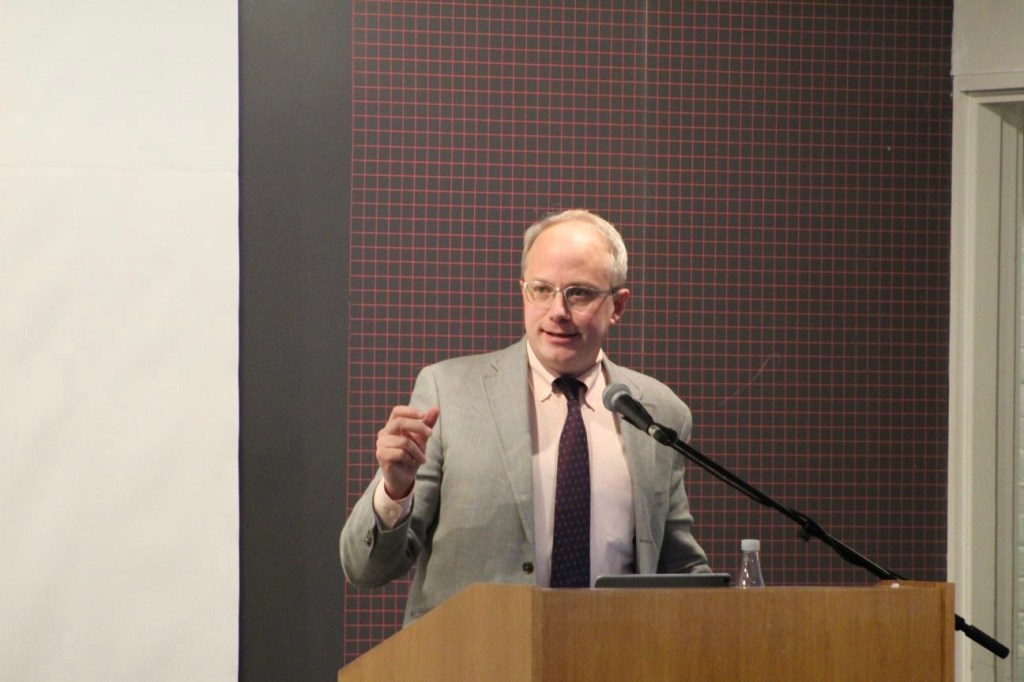
*Imagen: Adrian Vermeule en el marco de la conferencia “Christianity and Liberalism” en Harvard University, marzo de 2018. Fotografía de mi archivo personal.