
The unknown song. On Giorgio Agamben’s La voce umana (2023). by Gerardo Muñoz

Giorgio Agamben’s most recent La voce umana (Quodlibet, 2023) sets the scene with an elemental question: what is to call on something, and what is it to be called upon? The exploration around the notion of the voice (a sort of chorâ that falls between the different antinomies of human language, as we will soon learn) is far from new in Agamben’s work, who from the the early period of Il linguaggio e la morte (1982) directly confronted the negative foundation of phonê in relation to the closure of metaphysics. In a certain way, the perimeter of La voce umana (2023) is now deliberately limited to how the ‘mystery of the language’ is to be found in the unending event of the voice as the arcanum of anthropogenesis itself. At this stage of his investigations, the problem of the voice for Agamben designates a double movement of inflection and recapitulation: the voice proves the internal division of political life in the West; at the same time, it is also the most intense experience that a form of life can bestow the disclosure of the world. The attentive reader might recall the last pages of L’aperto: l’uomo e l’animale (2002) where the impasse of the anthropological machine was assigned by caesuras between human and animal, the semiotic and the semantic, the word and the name, redemption and the end of time, writing (gramma) and sound. But it is now with the voice that a clear way out becomes apparent. In the analytics of the voice klesis no longe stands as a political-theological category of the West; but, on the contrary, a call of language unto itself, the vocative that resists linguistic denomination and the free-standing outside the case and even language itself (“fuori lingua”) as suggested by Gustave Guillaume.

The vocative dimension of language is shown as pure means of the human experience: the apostrophe that calls something – as in Moby Dick’s majestic beginning “Call me Ishmael” – is already the call through the act of naming, and naming falling into the voice becomes the originary place of language in the denomination of speech (21). Irreductible to the antinomy of langue and parole, the semantic and the semiotic, the vocative texture of the voice emerges as the third figure that neither linguistics, philosophy of language, phonology, analytical linguistics, and biological cybernetics are capable of truly grasping. And this is so – Agamben does not says it in this brutish way – because there cannot be any theory of the voice and the vocative denomination; there can only be a poetics of the voice in which the transformative and self-generative experience with reality is staged: “Ma è possibile pensare il linguaggio prescindendo dal suo rifermenta lla realtà? La voce – il vocabolo – non designa soltanto un significant, chiama piuttosto un ente reale…non si limite a elencare segni in un lessico, ma annuncai ed encunia realtà” (36).

In my respects – and this is not the place to bring into focus Emile Benveniste’s last seminar on language and writing – Agamben’s treatment of the voice is nourished by pushing beyond the limits of the great twentieth century linguist who, for the most part, remained silent on the place of the voice. Not that there is a need for another substantive treatment of the vocative; in fact, one of the great achievements of La voce umana (2023) is precisely the archeological reconstruction of the Aristotelean “what is in the voice” (ta en té phonē) formula in which the classical metaphysical inception of language comes closest to the voice only to render it “articulate” and thus subordinated to the legibility of gramma or the written sign (42-44). And whatever one thinks of what constitutes the “primacy” of metaphysics in West (phone or gramma), what is important is the fact that domestication of language has been auxiliary by the “fundamental discipline of the West” (grammar) that sets off the immediate point of dialectical force between speech and the alphabetical inscription in the voice (45-46). Civilization is nothing more than the historical process of taming one’s voice.

At this point, it becomes clear that Agamben remains faithful to his old friend, the Spanish poet José Bergamín, whose bewildering essay from 1933 “La decadencia del analfabetismo” (“The decline of illiteracy”), argued precisely that the upwards movement of civilization of grammar and writing undermined the living voice and imagination of concrete and localized people (“pueblos minorías”) livelihood [1]. Indeed, it does not take much to see how the grammaticalization of human experience was a fundamental infrastructure for the consolidation of civil society grounded in the articulation of internal recognition of rules, normative directives, and binding statutory enforcement. The triumph of the order of grammar will only intensify the movement towards the total integration of every form of life into the fictive rhetorical space on behalf of what has already been stated without having to persuade, to put in Carlo Michaelstaedter’s terms that I do not think contradict the terms that Agamben extracts from his exegesis of the voice.

The political problems emerging from the confrontation with the voice are multiple. One can recall how in modernity, when “words have been liberated from their sacred denomination” (something pondered by Joseph De Maistre in his The Generative Principle of Political Constitutions as political revolution sets through universal recognition), the closure of the rhetoric embedded in “social life” captures the event of the voice into a stable communicative dimension of language (“suoni della lengua”), which for Agamben resembles the etymology of the word phònos: murder, that is, the self-conscious assassination of the voice at the altar of free-floating rhetoric and the order of discourse (50-51). By the same token, in our epoch every living being has the malleable equalizer and “amplifier” (a word used, indeed, by the Supreme Court of the United States when deciding the case that granted equity between finance campaign and ‘public use of language’) of words, but it is only rare to see anyone truly possessing a voice. If every entity in the world has been previously assigned and grammatically ordered, what is absent is precisely the chōra as the “invisible and formeless place” (‘invisibile e senza forma”) in which the intelligible pure state of the language in the voice. In this strict sense, whoever possesses a voice is one who dissolves the axiomatic arrangement of discourse only to transform the world as inhabited. This is why the voice remains not a threshold to semantic register or the written technology, but rather an unknown song (“canto ignoto”), as it was called by Benedictine monk Guido d’Arezzo. And this song, the voice, can be followed and deciphered but never truly mastered as absolute transparent knowledge (45).

And if music is an index of prophecy, as Gianni Carchia once suggested, then this means that the voice, like the mythic harmony of the spheres, is what exceeds the proper human as indivisible and non-exchangeable realized only here and now. The political consequences are immense, Agamben is right. This means that we need to restate the medial and geographical distances of the chorā over the orderly cultural exchange of the polis. As it has been noted, the rise of the city state is waged against the orphic poetic myth; in the same way that the Roman imperium was possible by the erasure of the Etruscan musical underworld. Agamben reminds us that the birth of biopolitics coincides with the historical invention of the science of language leading to the impoverishment of the intangible and expressive communication between souls. This is Agamben’s rendition that the task of philosophy – not historical benchmarks or epistemological categorizations – resides in the attunement to the highest hymn of expressive form as it has been studied by Nicoletta De Vita’s erudite monograph Il nome e la voce (2022). There is no philosophical or theological closure as long as the song remains.

We can say that wherever there is a chorā of the voice something like this minor transcendence of the original human being that retracts from the soteriological false exits that have devastated the anthropogenic event. And it occurs to me that we could thematize three areas of what this closure means for us today: first, the technification of politics in epoch has been reduced, precisely, to a discursive theory of articulation (of social demands) to craft the fictive totalization of hegemony; second, the collapse of the political representation within contemporary democracies has turned into the optimal organization of containing willful self-expression in light of the contingency of values of the dominant aesthetic regime; and finally, the very understanding of legal culture and constitutionalism in the West has shuffled different modalities of the written authorial intention to generate the internal rules of institutional and statutory norms only to expand police powers and codification of conducts. At the expense of the unknown song, all sorts of prosthetic contraptions have been erected to douse the prehistoric voice that nevertheless keeps overflowing and reemerging like the unnerving cracking squick of Kafka’s Josephine. It is this watershed mystery of the anthropogenesis with its philo-poetological density that calls on humanity by the highest superlative imaginable: its voice.
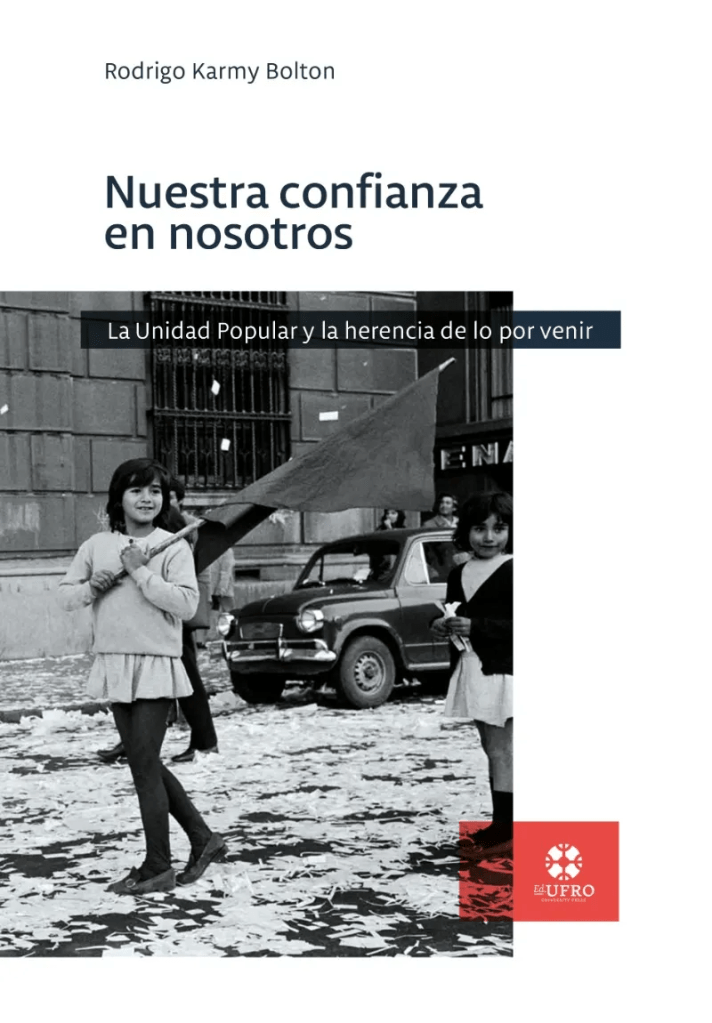
Three notes on Rodrigo Karmy’s Nuestra confianza en nosotros (2023). by Gerardo Muñoz

Transfiguration. Towards the end of Nuestra confianza en nosotros: la Unidad Popular y la herencia del por venir (Ufro, 2023), Rodrigo Karmy suggests that the experiential texture of Salvador Allende’s political years amounted to a sort of corporeal transfiguration of historical time, but also of the political subject within modern architectonics of the inter-state sovereign system. The death-martyrdom brought a new world into order, radically transforming the sense of historical assumptions and its immanent refutations and accelerations. For those of all that know Karmy’s philosophical investigations working through this intuition, it is impossible not to see that ‘transfiguration’ does not entail ‘sacrifice’, but rather it implies the figure of the martyr [1]. And we also know from Erik Peterson that martyrs are absolute witness to truth of an irrevocable event; in other words, those that transcend the core materiality of the mere opinions and matter-of-factness as to remain faithful to the unfathomable to a world brought to abrupt change (and at times, this means also despair). Karmy writes: 

“Se produce así una transfiguración radical de Allende que trastoca enteramente el juego de la teología política, tal como ha sido planteada bajo los avatares del fantasma portaliano: si en esta última, el cuerpo físico termina desmaterializado en un cuerpo institucional, tal como ocurrió con el devenir del general Pinochet,  en Allende termina desmaterializado en una potencia por venir (no en cuerpo institucional), aquello que Walter Benjamin llamaba lo «nunca sido»: «Siempre estaré junto a ustedes», dice el presidente usurpado por el golpismo esa triste mañana de septiembre” [2]. 

The truth of transfiguration – and in a sense every event of truth is always carried by the energy what is transfigured – marks the incommensurable distance between the eternal persistence of the word and the historical movement guided by the precepts of civilization. Whereas the political grammar organizes itself through an indiscriminate institutional corpus and a set of moral binding obligations upon its citizens; the truth of transfiguration is the keeper of the night of the soul that, like the myth of Er, signals the passage between the world of the living and the kingdom of the dead. When transfigured, the dead can become even more lively than those allegedly “alive”; where those alive become embodied and rigid statues or mummies. As such, the energy of transfiguration remains outside the cloisters of history and its memory sites, since its realization takes place whenever there is a drift outside and beyond the suturing of the world as mere stated and enclosed fact.

Voice.  The “we” (Nosotros) in Karmy’s thesis does not signal the constituent political unity of the People nor a partisan form that can exert force towards the inversion of the sedimented historical order. In his archeological endeavor, the ‘nosotros’ indexes a non-numerical instance through the vocative raises its own question to the past. This does not imply that there is a “collective voice” that must enact its point of annunciation through representation and mediated forms; the voice emerges as an exception to the grammaticalization of the constitutional order and its statuary production as expression of legislative will. The voice is the exteriority to every scheme of reproduction. But, what is a “voice”? Following Emilio Recabarren, Karmy connects the voice to the very act of creation: in other words, a voice to the truth implies the vocative of what has truly never been there before. Like the chorā, the voice is both at the reemergence of its origin and medium rather than substance; and this is why the voice, unlike the written language, cannot be subsumed to the reification of mimesis and generative substance [3]. The voice is what every time remains irreducible to the order of discourse difference, historiographical narrativity, and the original letter and spirit of the law. And even in traditions without “Constitutions”, law cannot escape its written and grammatical framework; this is why in Common Law, the Constitutional authority is supplanted by the historical absorption of habits, manners, and tradition into the force of legal codes and binding statutes. It is a high merit of Karmy’s Nuestra confianza (2023) to reminds us that the happiest moments (and perhaps the only moment worth saving, that infinitely returns against the grain of historical progress) of the revolutionary experiences of the twentieth century are to be found in the evocation of the voice and its popular music (something that can also be said of the Cuban Revolution, for instance). This esoteric orphic thread evidences the disjointed relation between the polis and the mythic transfiguration when facilitated by the prophetic overtones of the musical nomos in the genesis of the West [4]. Hence, whenever there is a voice, the suture of politics to the theology cannot amount to the continuous transaction upon the survival and agony of the living.

Freedom from revolution. Unlike the reverential or formalist accounts written for the fiftieth anniversary of the Chilean Unidad Popular, Karmy’s essay invites us to dwell about a political experience after its epochal exhaustion: the collapse of the horizon of the philosophy of history implies the internal implosion of the modern revolution’s infrastructure (constituent power, moral justice, militant subjectivity, sacrificial energy). For Karmy to arrive at a certain nearness to the well lighted tradition of the UP is to abandon once and for all the civilizational eon of sedentary political hegemony (“a revolution in world history” bringing about the age of the nomads to an end, claimed historian Edward Gibbon) that has now paved the way for the unlimited forms of planetary government exerted through the rationality of the management of population and the distribution of the economy [5].

The farewell to the revolution and its reverse – it is well known that De Maistre claimed in the wake of the French Revolution that the opposite of the revolution is not a counter-revolution, but what is all together contrarian to it – means to put a halt to the paradigm of force (positive and immanent hostility) that has oriented actions, expectations, passions, and even dreams taxed at the fictive illusions of an abstract Humanity devoid of any possibility of happiness in the world. It is only after we can leave behind the revolutionary metaphysical mimesis that a new sense of freedom could emerge away from the dominion of the land-surveyors of the Earth. Abandoning any clamors oriented towards the future, it is now for us to attune to the everlasting traditions that are unrelinquished to the endless rubble of time. 

Notes 

1. Rodrigo Karmy. “The Absolute Gift: Martyrdom as Destituent Power”, SAQ, 122, 2023, 157-170.

2. Rodrigo Karmy. Nuestra confianza en nosotros (Ufro, 2023), 183.

3. Ibid., 102.

4. Gianni Carchia. Orfismo e tragedia: Il mito trasfigurato (Quodlibet, 2019).

Erich Unger’s The Stateless formation of the Jewish People today. by Gerardo Muñoz

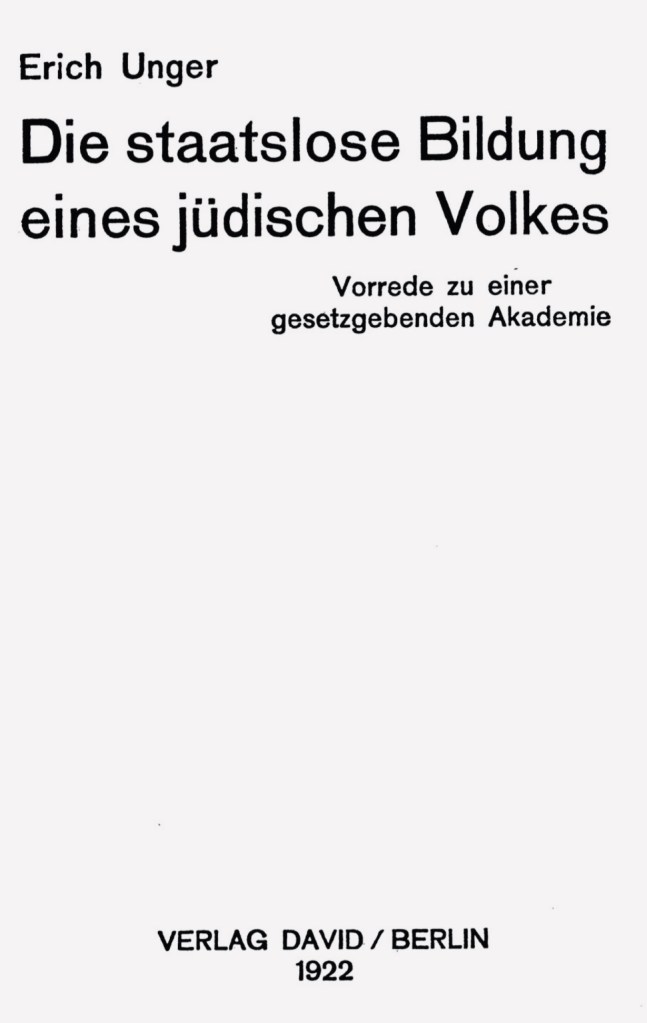
The same year that Carl Schmitt’s Political Theology (1922) appeared in the intellectual scene of the Weimar Republic defending the exceptional of the decision against immanentism, a short opuscule entitled Die staatenlose Bildung eines jüdischen Volkes (The stateless formation of the Jewish People, 1922) written by Jewish philosopher Erich Unger was published as an untimely response to the question of “Jewish identity” (Judentum) and its fate in the wake of civilizational collapse. The fact that this essay – as well as his 1921 book Politics and Metaphysics, which Walter Benjamin described as the most important political reflection of his time – has remained on the fringe of intellectual history, political theory, and the history of thought is something that anyone must seriously reflect upon. It should not come to a surprise that this text comes back today to attentive readers evidences how every creation, event of speech, or written word does not reside in the preventive invention of a specific audience; but, on the contrary, in the way that its words, images, and thought will generate the evanescence community of extemporal readers. The century that separates us in time from Unger’s essay bears witness to its ultimately proximity and prophetic calling. 

In 1922, for Unger, very much like for us today, thinking about politics meant finding a way out of a catastrophic politics [1]. If Politics and Metaphysics had suggested the necessity of an existential and energetic exodus for breakthrough against civilizational sedentary absorption and domestication, in The stateless formation of the Jewish People (1922) Unger argues critically against a state Zionist project that artificially, and through the anti-universalism paradigm of force (just as Weil would argue during her war writings about politics in the West) will attempt to “absolute Judaism, and all the manifestation of judaism that remain outside, hostile to the state trend” [2]. For Unger, Zionism as a political ideology and state program fails to come to terms with the concrete “outside the world historical power” that characterizes the universalism of the Hebrews as a theology marked by dispersal in the West; that is, outside the philosophy of history of sacrifice and soteriological incarnation of the Christian eon [3]. Hence, Zionism’s political form of the Jewish people was epochally insufficient – too empirical and thus trapped into the modern logic of racial and biological survival – to express the true conditions to enact as the “a priori” for the question of Judaism as a grounded redemptive universality. And insofar as Zionism presupposes something “outside of itself” (corporeal and spiritual Judaism), for Unger “the demand for an imperial state…must modify its demand, since it should express its underlying basis of the demand differently” [4]. The Hebrew ‘universality’ was metaphysical as much as “concrete”, based on modal ritual and myth, and for this reason at a distance from the discharge of formal logical statements [5].

What did the apriorist consideration of Judaism mean for Unger? The hypothesis in The stateless formation of the Jewish People (1922) was far from bring esoteric: Judaism is a exclusively a spiritual, immutable soul matter that hoevers the surface of the corporeal; and, more importantly, “it governs itself independently through the insubstantial for of a concrete existence” [6]. In other words, for Unger before the unity of the “People”, the articulation of the “movement”, and the erection of a positivist constitution based on Zionist nationalist principles, one should consider the sensible fabric of a people  – a dispersed, multiple, and metapolitical communities that have endured outside the geopolitical and sacrificial structuration of Christian history – that each and every time have insisted on the separation from the subsumption into a sphere of power and domination, into an ethnic-community validated by recognition and its claims to “consciousness” at the most empirical and material level. But this would amount to an effective liquidation – a surrogate for the acceleration of the dominant religion of historicity – of Judaism into yet another planetary religion, and an expression of power that integrates itself into the struggle for the nomoi of a contained and policed world. For Unger, “empirical Zionism” becomes the attempt to reduce Judaism to a “real self-executiving power” that will diminish the “supreme expression of existence” of Judaic spiritualism as “an inner experience that it is not historically given but that must precede it in order to make Judaism an endless and inevitable precondition of a truly world historical project” [7]. In this mold, Judaism will be dispensed into the theaters of the constitutive war of historical progress. 

As such, Judaism as theologically transcendent is not to be conflated into the corset of a political fictive ethnicity, but rather as an autonomous transmission that allows the communication from soul to soul that descends all the way from its metaphysical beginning. And at this beginning that has exerted itself against the whirlwind of historical fixation (the very structure of civilization after Cain according to his mentor, the Jewish theologian Oskar Goldberg) were metaphysical and errant fragments of encounters and communication, of psychological energy and dispersal of shared spiritual goals. If this is lacking, then no political form [for Judaism] will arise, but only a foolish copy of the already-existing, because the spirit cannot be skipped and left out without the rising danger” [8]. It is telling that for Unger this rising danger can emerge not only from indirect powers that exert pressure against the unity of authority – as Schmitt would have in his framework of his theory of sovereignty in Political Theology (1922) – but also, and more dramatically, from the suppression and alienation of the spiritual interiority by which a “people” never coinciding with itself can arrive at the “crystallization point” (sic) outside of the individual [9]. 

Circling back to the problem of “catastrophic politics” – that Schmitt wants to “contain” through decisionism, and that Unger wants to overbecome through an exodus from political thresholds – at the crux of Unger’s indictment of the arcana of Western politics is the “it has set everything in such a way so that the metaphysical or religious area, the internal direction, stands as a mere private thing”, sidestepping the fact that even reality and the constitution of the principle of reality depends on interiority for the possibility of an outside. And it is this outside what allows the a priori historicity that Oskar Goldberg had defended in his book The Reality of the Hebrews (1925). As the late Bruce Rosenstock lucidly argued, for Goldberg (who stands as the unnamed reference in Unger’s position about an experiential Judaism), the “a priori” takes place in an ur-time in which the physical world was closely connected to the transcendental presence of the gods, in which the people cease to be a cultural, ethnic, or identitarian unit in order to become a humanity capable of “overcoming the catastrophic history of wars sparked by competition over scarce resources” [10]. In endorsing the instrumentalized politico-theological reduction of state Zionism, Unger sees the abdication of the “Jews as the people who have driven the spirit the furthest…to cultivate the spirit deeper, more skillful, more subtle, to be the most deeply suitable through this tension” [11]. A true and vital reality was in the conspiracy between souls, wherever and whenever these meet as the ultimate manifestation of the fidelity to the unspeakable mediation between the true life and the divine. 

At the height of 1922, Unger did not suspend from a certain self-afflecting optimism, and towards the end of The stateless formation of the Jewish People (1922) he writes: “The Jews should not overlook their uniquely favorable situation; mainly, they have been materially unhistorical for two thousand years, and the only one that have not been beaten into a reality and into the shackles of the past or the empirical state that others have had to suffer” [12]. In Unger’s reading, Judaism and its errant communities (the ‘wandering Jew’ that Joseph Roth will narrate in these years, but that one must trace to the mythic texture from expulsion of Cain to the marrano) have shown the density to gather through spirit a resistance to the paradigm of force and the technicians in charge of dominating over materialism. As Unger states unequivocally: “the one who technically masters matter is ultimately defeated” [13].

This was Unger’s anti-promethean wager in 1922 skeptical of all political horizons oriented towards foreseeable catastrophes blinded to the underlying cyclical polarity of barbarism and civilization in the West.  The wayward asymptote of a non-catastrophic politics was not to be found in the abstraction of the political concept or the mechanical construction of a state form through assimilation and usurpation, but in what Unger termed, in the most intense poetic moment of his essay, the Hebrew “ increasing decipherability of its own origin”. And unlike Enlightenment historians such as Edward Gibbon who saw the state as the irreversible revolution in world history that brought the age of the nomads to an end; for Unger the twentieth century meant the fixation of the state degenerating in the worst of barbarisms. It was the existence of the unit that must generate the internal limit to the political, and not the political as the external threshold to what is inherited in the world. And yet, insofar the events of thought, language, and imagination take place, the origin (urgeschichte) will always escape what has been sedimented by rubble and wars that fuel planetary destruction and collapse. 

Notes 

1. Erich Unger. Die staatenlose Bildung eines jüdischen Volkes (Verlag David, 1922).

2. Ibid., 6.

3. Ibid., 10.

4. Ibid.,  15.

5. Erich Unger. “Universalism in Hebreism”, trans. Esther J. Ehrman, The Journal of Jewish Thought and Philosophy, Vol.4, 1995, 307.

6. Erich Unger. Die staatenlose Bildung eines jüdischen Volkes (Verlag David, 1922), 8.

7. Ibid., 19.

8. Ibid., 25.

9. Ibid., 24.

10. Ibid., 29.

11. Bruce Rosenstock. Transfinite Life: Oskar Goldberg and the Vitalist Imagination (Indiana University Press, 2017), 172.

12. Ibid., 31.

13. Ibid., 32.

Tacitus’ arcana and political wisdom. by Gerardo Muñoz

During the flourishing of Renaissance civic humanism, the tradition of Tacitism, as well as the work of Tacitus, was broadly understood as advisory to the problem of tyranny within the cycles of political power’s rise and decline, unmasking imperial rule’s debasement and cruel domination [1]. It is in Edward Gibbon’s erudite project where Tacitus’ political wisdom receives an integral treatment about the institutional dimension of power and its cohesive structure based on both facts and theoretical presuppositions. For Gibbon, the wisdom of Tacitus is not merely anchored in theoretical speculation; rather, the rhetorical construction takes its energy from the convergence between historical facts and the physics of a concrete political order. Tacitus’ wisdom is practical but also flexible, and this entails that political realism is not about the opportunist dimension of power (although this most certainly occurs in every political community), but about the deployment of analytical understanding regarding faults, fissures, and disequilibrium of institutions. Tacitus’ thought is about vision, and this means looking at the cracks, identifying the asymmetrical correspondences, and teasing out the nuances of a particular reality.

This presupposes that Tacitus’ enduring notion of the arcanum imperii, far from posing a ‘mystery of the state’ (its legitimacy, rule, and mystical reserve), allows for a strong narrative about the latent crisis internal to every political community. Tacitism is, insofar as it confronts the crisis and ruin of a political order, draws a negative reflection on the ongoing force of civil war as a historical and existential condition of domination. In other words, no politics can exist without the concrete legibility of the faults of conflict, which ultimately entails that civil war and political power are constantly in proximity. The arcana delimits the problem of civil war as the internal contradiction of every imperfect institutional design that cannot transcendent its own crisis through conceptual reordering.

At the center of Tacitus’ arcana in Rome is the death of Nero as well as the fault lines of civil war: “The was revealed that arcanum of state, the discovery that emperors might be made elsewhere than Rome” [2]. Of course, Rome as the glorious center of power was fundamental and indivisible; but for Tacitus the argument condensed in the arcana is precisely that the corruption of politics takes place when political representatives (power delegated at the provinces) and that of the center ceased being in coordination, losing the grip of institutional mediations. Thus, the ruin of politics is best expressed by the disjointment of formal procedures between authority and delegation, the vesting of the emperor and territorial monopoly, legitimate rule and predatory corruption. When this happens the arcana is transformed into a permanent revolution that dissolves checked political rule into the willful triumph of the uncontained and proliferated fragmentation (this is why Tacitus looked back with nostalgia to the unlived era of Roman republicanism).

For Gibbon to hold on to the Tacitan tradition of the arcana imperii meant, above all, to underscore the esoteric relationship between history and revolution as part of the desire to understand political energy, which he posed as a methodological concern: “In our larger experience of history the imagination is assisted by a perpetual series of causes and effects , to unite the most distant revolutions” [3]. The arcana is political wisdom of a secondary source; that is, it’s not a normatively established political premise or category, but an excess to description of political order. Hence, it is not that the arcana imperii is a monocausal and ultimate foundation of instability – and in this sense he was still faithful to his conception of plurality of causation in defense of the study of literature and the imagination – the emphasis is placed, on the contrary, in the way in which grasping the archeological and heterogeneous field of tension that will reveal, in turn, the historical specificity of the arcana [4].

In other words, the arcana grants access to the fundamental features of the epiphenomenon of civil strife without a recourse to abstraction and the closure of the concept. In this way, it could be said that the arcana (in part in the reading that Gibbon undertakes of Tacitus) is continuously operating in three distinct registers: a) it is a comprehensive analytic of the plurality of causation that impact political conflict and civil war, b) it reports to the center of authority, probing its direct and indirect meditations on the ground; its forms of delegation and adjudication, and its production of legality and dominium and implementation; c) it demands to design a description and a narrative of the political situation in order to properly respond to the paradox of tyranny and corruption within a specific polity.

Having sketched out the operational effect of the arcana, we can say that the notion is far from being reducible to a Renaissance “ragion di stato” scenario assisting in the consolidation of power in the hands of the price; the arcana seeks to elucidate the contours and limits of the intensification of war and its risks; a problem that becomes central to Hobbes notion of the state [5]. To claim that this political wisdom is something that merely emerges technically-placed in the Renaissance “great men”, and systematically blurred in modern liberalism is a thesis that will need further elaboration about the resources of the state and the underpinning of modern legitimacy through civil society and its late-modern mutation into planetary imperial spaces. In a certain sense “Tacitism” opens the possibility of sketching the political crisis of in each distinct epoch. It is perhaps in this sense that Carl Schmitt invites us to think the issue in an entry of his Glossarium:

“The beginning of Tacitus’ Histories has moved me. Is it just rhetoric, like Ortega told me?’ Isn’t it about the identity of the situation, that is, existential participation, participation in one and the same nuclear and ancestral situation of our eon? Every word of that chapter of Tacitus is absolutely current: «Magna ingenia cessere; opus adgredior optimum casibus, atrox proeliis, discors seditionibus, ipsa etiam pace saevum. Of course, “ipsa etiam pace sacvum, bella civilia et exterior plerumque permixta.” The relationship between international war and civil war, that is not rhetoric but the horrible reality recognized and expressed, the non-distinction between war and peace.” [6] 

The arcana never truly coincides with a philosophy of history or a rhetorical veneer of civil existence (social contract). The subversiveness of Tacitus plays out in thinking through the elaboration of a specific governmental organization [7]. And what is the “ancestral situation of the eon” if not the polar relationship between political order and stasis, the duality between civil war and the principle of authority, the nihilism of the will and the limits of a public rule of law, however ordered? Tacitus’ classical wisdom, invested in plotting legible facts with a singular narrative, far from raising itself to a “science of politics” or a set of “fundamental principles of order”, responds to potential fluctuations devoid of a universal grammar. In this way, politics remains closer to a physical experiment: an active self-evolving canvas in which the arcana is irremediably drawing upon the instituting and destituting of interconnected forces at play.

Notes 

1. Arnaldo Momigliano. “Tacitus and the Tacitist Tradition”, in The Classical Foundations of Modern Historiography (University of California Press, 1990), 120.

2. J. G. A. Pocock. Barbarism and Religion: The First Decline and Fall, Vol.III (Cambridge University Press, 2003), 25.

3. Ibid., 58. 

4. G.W. Bowersock. “Gibbon on Civil War and Rebellion in the Decline of the Roman Empire”, Daedalus, Summer, 1976.

5. Richard Tuck. “Hobbes and Tacitus”, in Hobbes and History (2000), eds. G. A. J. Rogers and Tom Sorell, 99–111.

6. Carl Schmitt. Glossarium: Anotaciones desde 1947 hasta 1958 (El Paseo, 2019), 7.

7. Ronald Syme. “Who was Tacitus?”, Harvard Library Bulletin XI, Spring 195, 185.