The life of a sage. On Jacques Guigou’s Capital et Devenir Humain: Correspondance avec Jacques Camatte (2026). by Gerardo Muñoz

Roughly extending a little over fifteen years (2000-2016), the epistolary exchange between Jacques Guigou and Jacques Camatte is made available in a short book entitled Capital et Devenir Humain: Correspondance avec Jacques Camatte (L’Harmattan, 2026). Truth to be told it is an uneven correspondence at times, where the sustained conversation in time seems to be interrupted around some specific years, and in other moments there is an abundance of certain editorial requests (the publication and translation of books by Giorgio Cesarano primarily) that interfere from a more thorough substantive correspondence. Be as it might, this correspondence does bring to bear the reflexive consistence of the thinker behind Invariance in his last phase of his work, most specifically in the wake of September 11 and the invasion of Iraq, which was already read by Camatte as symptomatic of the internal hostility of the human specifies embedded in the stasis of struggle as the central “engine of development of capital” (Guigou 20). 

Both autonomous capital and its regimes of representation (Politics) will only be sustained and driven by internal strife whose apocalyptic destiny has now become all too apparent; even more so than during the years when the Camatte & Guigou exchange was taking place. These historical mediations, however, are a bit of a misnomer, since the correspondence does show that Camatte’s undertaking of Hegel’s cunning of capital as the realization of the effective movement of historical accumulation was already part of the theoretical discoveries of the seventies in Invariance. The “effective end of Capital” seen through the mirror of Hegelianism meant that political reaction and its negation turned the essence of politics reactionary at its core. Later in the correspondence, in fact, we get a glimpse of the essence of “reactionary thinking” when Camatte tells his interlocutor that reaction can be understood as the continuation of a dynamic duality that is expressed in the very movement of autonomous Capital (Guigou 65-66). This is why Camatte’s horizon of reflection differed from the Debord’s situationism; it is not just because of a disbelief in the presumption of a remnant of the autonomy of art in their practices, but rather because their very dyad between art and life, public and private, contingency and necessity, language and the image expressed in many ways the insufficiency of an analytic expressed in the mystification of the commodity form. In other words, all reactionary posture amounts to a relational mode of the commodity form, but no commodity stripping and destruction can guide through a path that can exit the total transcendence of Capital towards life of the Gemeinwesen. We are left with refractory communities of belonging that find their necessary compensation in supplementary forms that allow for a distance to the fundamental question of exodus. 

Out of the many sequences of the correspondence the one dealing with the incapacities of poetry is of special interest. In one letter Camatte tells Guigou that he feels that poetry no longer is able to filter a moving tonality in the world, recalling how the end of the age of the poets (not a term expressly deployed by Camatte) has been understood by Amadeo Bordiga in a short text of 1953 that noted that the ancient power could sing in a voice of the community, whereas the modern poet in his solitude only amounts to the author of his work (Guigou 24). The correspondence exemplifies this by recalling Bruce Chatwin’s Songlines, where the poetic is not personal lyricism, but rather a tone that runs through the whole dispensation of the community in its errancy (Guigou 30). And one wonders immediately after reading this moment in the letter, where the very work of late Camatte is not disinhibited of the poetic tonality; or, on the contrary, this poetic tonality insofar as it is a pure voice can only remain opaque and absence from the scene of writing and public reflection. The challenge in this question is to be able to balance the problem beyond judgement, which always hides a form of pathetic condemnation. 

In these pages concerning poetry and the philosophical aspiration of the poem, other names are invited into the scene: Giorgio Cesarano, Domenico Ferla, and Andrea Zanzotto. These are three figures where the challenge of poetry was taken only to be radically abandoned (perhaps less so in Zanzotto where the trace of the voice is already embedded in the poetic form, and thus there was not a need to execute the radical gesture of fleeing from poetry). Although one is also surprised that the question of poetry is not extended as a problem of thought and existence, which would allow for the collapse of the very separation of poetic form and the life of the community, perhaps because the voice that is carried in poetry is more originary dwelling of human existence than the human community, because ultimately the human community (Gemeinwesen) is refractory of an irremediable loss that is recasted as original. And Gianni Carchia saw in his “Glossa sull’umanismo” (1977), Camatte’s insistence on the original community and its negation through the anthropomorphosis of Capitalist revolution will necessarily result in an inverted or transfigured humanism; or, at least, a humanism that is always longing for the image of an originary community that can only be posited with an assertive knowledge that we do not know possess except as contaminated subjectivity. But perhaps the solicitation of originary community will always fail because it will be a displacement from abyss of non-belonging that we already inhabit – what Carchia called in the same text as “uscir fuori” – into the site of proper belonging of the human species fails to account for the impropriety that always marks the experience of errancy of life. As Endnotes has noted in their recent essay “Time is an invention of men incapable of love”, Camatte was aware of the Jewish form of life as a concrete experience “seeking a solution outside this world”. But this means that it is not enough to counterpose the community and state form (Jewish form of life precisely is not exhausted in community belonging, or in the memory of a community), but something other than the closure of the community if one wants to go beyond the eternal metabolic stasis of human belonging. Ultimately, as Camatte tells Guigou at the end of the correspondence, only Capital claims immortality in its universalist extension (Guigou 68). 

Perhaps this is a task that requires another modality of thought, perhaps a non-philosophical practice beyond community and humanity, but suspicious of the claims to immortality of the capitalist revolution. In a letter from 2016, Camatte citing François Julien, confronts philosophical thinking with a notion of wisdom that retracts from hostility and agonistic dispute, because it retreats into serenity of a peaceful sage (Guigou 65). I take this to mean something akin to Kojeve’s ‘voyou désœuvré’, the sage that in the Sunday of history harbors a passion of life where happiness is received not as a consequence of actions, but as a supreme grace of the unexpected. It does seem that this was also Camatte’s longing in life that although wanting to abandon this world, refused to abandon the interlocution with others; touching as if it were, an unbreachable state of wisdom.

At the threshold. By Gerardo Muñoz

Just a few days ago there was an esoteric exchange between Giorgio Agamben and Alberto Moreiras on the difficulty of the ‘other beginning’ and the ‘via di uscita’, a propos of a recent meeting on desecularization and theology that took place in Granada, Spain. The notion has been in the air for some time now, since two years ago this was the central problem in a 2024 meeting in Berlin. That the exchange was esoteric is not in question, since it presupposes undertaking the conditions of the conversation and papers of the meeting as well as multiple books from both Moreiras and Agamben, and I do not think that the nuances have been taken into consideration. But it must be noted that there is an exoteric dimension to the contention as well: Giorgio Agamben has favored the ‘via di usicita’ in different figures (mainly Pulcinella, Pinocchio, Hölderlin; and we know that Agamben’s overbeckian urgeschichte is a clear cut rejection of an epochal beginning); and, from his end, Alberto Moreiras has also thematized the other beginning of thought and aleotropic excess in his most recent Tiempo Roto (2025), which cuts through Heidegger’s thought, and thus not limited to what is understood as heideggerianism. I want to reject the idea that these two notions – ‘via di uscita and other beginning – are just two forking paths in postheideggerianism, as complicated as it is to go beyond Heidegger’s end of Western metaphysics. And I think – and in fact I am convinced- that both Agamben and Moreiras are soliciting something that radically escapes Heidegger’s thought even when it emanates from it; a bit like what Derrida says that the chôra escapes the categorial order of Plato even though it emerges from the Timeus.

There is no doubt that at stake is a breakthrough in thought. Of course, stating this puts a finger into something fundamental; but, alas, the devil is always in the details. I am in no position to unravel the implications of the two options – new beginning and via of exodus – and to that extent I am still taken by Moreiras’ interpellation in the first day of the meeting about my own position regarding the new beginning, which I am in no way ready to respond. Of course, Nicolas Poussin comes to mind (I cite from memory his epistolary words to Chantelou): “I am in the profession of mute things”. A claim of silence that in no way refrains from language and writing. Yes, I am no painter, although I am interested in painting and what painting can offer and donate to thought and philosophy. And we live in an epoch at the end of painting, and yet painting outlives everything as in a metaphysical remnant, as Kurt Badt reminds us in his great work on Cézanne.

Giorgio Agamben notes in his little Il tempo del pensiero (2023) how Heideger declared his Le Thor seminared that he always thought that Cézanne was the other figure of the tradition that resembled his own path. It is a curious analogy to a painter and the painterly praxis in the age of technological subsumption. Or perhaps I am reading too much into it, since I am working on a small book on the communication between painting and thought, and I want to understand what painting has to offer.

As a preliminary response to the difficulty that emerged in the ‘new beginning’, I am left wondering if the threshold is an intermediary space to arrest the jump beyond nihilism, which is ultimately what is at stake. This has been my way- I am all for changing that – of reading Agamben’s work: to remain at the threshold in order not to force the overcoming of nihilism, even if that anti-nihilism takes the force of antiphilosophy or thought of the unthinkable (Moreiras). Can thought breathe from the rest and imperturable dwelling in the threshold, if understood as mediated by the hand and the eye at a distance? This is for me the problem of painting as the last activity at the end of metaphysics – a theological remnant that intercepts the reduction of a historical cosmos. A duration that escapes the regime of the ontic but that does not dare to point to transcendence nor does it accept the inevitability of anthropological struggle. Yet, duration is the condition of breathing in a landscape: if we face it, is there even the need to begin or retreat? 

Why is Nelly Richard afraid of infrapolitics? by Gerardo Muñoz

The dismissal of ‘infrapolitics’ as a notion to think the distance with respect to political subsumption and civil administration was there from its emergence. I remember that around 2015, Alberto Moreiras suggested that perhaps in ten years or so, given the total collapse of actual existing political frameworks in the West, there might emerge a sound moment for real and honest conversation. The wager was on the “might” at that moment. But it has already been a little more than a decade, and the apathy in many ways has only aggravated, almost in line with the increasing liquidation of politics everywhere and the undisputed swing to predatory nationalism that has made it impossible to say the big word from the previous political cycle: “populism”. In this scenario of paralysis we are a bit surprised by Nelly Richard’s strong words against ‘infrapolitics’ in her recent book Tiempos y modos (2014), in which she appears as a reasonable, at times enlightened intellectual mediator, against what she sees as the rampant philosophical “excesses” projected their categories to an otherwise expected horizon of social transformation announced by the Chilean revolt of October 2019. 

Against “infrapolitics” as a distance of thinking against political totalization, Richard claims that she wants to hold on politics and continues to call the futility of the notion: “me parece que no hay que regalarle esa palabra tan preciada a la política resevándose el prefijo infra. Me parece que es mejor preservar la política un tono que es en sí mismo el tono de una población que, eventualmente, como en el caso de lo que estamos tratando tiene, también sus continuados por otros medios, como la Convención Constitucional. En este aspecto no creo mucho en la infrapolítica. Veo en esas terminologías la paradoja de una grandilocuencia minotitaira, una especie de resta un poco suicida que complica el acceso y lacera los caminos dejando a los pobres afuera, por que no entiende bien de qué tratan esas palabras. Y entre restarse de una suma y sumarse a una resta, yo prefiero lo segundo” [1]. The overt populist intellectualism emanating from this assertion inadvertently results in the restitution of the Vanguard intellectual in full capacity to elucidate, transmit, and “accompany” the forward march of the People as a comprehensive moral totality. What today passes – and speaks in the name of – as “political realism” is short of twentieth century political pieties and belated fusionism (the Intellectual and the People), which is all too sad. 

Leaving aside for a moment the violence against the texture of language (its non-coincidence with communication), there is a deeper problem here, which is that that the contemporary affirmation of realist “politics” today is delivered with a side blackmail: the fear of remaining an outsider, of becoming an intruder, and thus, positing an “exteriority” is always inconvenient and necessarily despicable. It is antipolitical, and thus a mere abstraction of language. This is the gnostic position that must be suppressed in order for the mandarins of social articulation to stand another chance of reformulating the forms of the social contract as the telos of political reflection. In another moment of the text Richard is quite explicit of the necessity to reject ‘infrapolitics’ as merely parasitical to the “sophisticated and bibliophilic universitarian categories of contemporary theory” (she stopped short of saying of the “global north”): “Resulta más o menos obvio que no se puede abordar del mismo modo un registro de búsqueda intellectual (lo infrapolítico como ejercicio deconstructivo que puede darse el lujo de girar incesantemente sobre sí mismo en el régimen de la escritura y del pensamiento) que la formulación constitucional de un acuerdo de la comunidad sobre las formas políticas del contrato social” [2]. 

Is that all that contemporary thought can aspire, then? Another frozen and humorless, most definitely predictable instance of the social contract, the old faith in constitutionalism and normativity, inclusion and distributed abundance with its necessary communitarian anthropology and convinced that, alas, “this time” we will surely get it right? The noble ideal of Rousseauianism in Wallmapu for the twenty first century. In the declaration of updated political promises there always lurks an informant policeman that secures the any path of exit from the human park. And so we are obliged to play within the political vectors or be prepared to suffer in the isolation of the steppe. Across the aisle of the philosophers of the Social the blackmail is more or less the same. Politics or apocalypse, which remains completely oblivious to the deeply instrumentalized apocalyptic political ratio in the epoch of stagnation and polycrisis; always making demands on “lesser evils”, whether it is Mandamni in the metropolis, or the ecological transition in the EU. But we know that “politics is action, but action always invites the invention – the renewal – of a language…otherwise, it is the near-death of the left as voice, voice, provocation, unwelcome presence that remains the reality”, as a lucid art historian of our times has observed [3]. Infrapolitics is a modest step in that direction in an epoch in which the true illusion of a hegemonic politics suffices to submit and resist within social containment. 

The claims on behalf of absolute politicity explain the hatred against thought today, which is predicated on the introspective dogma that politics colors absolutely all aspects of life, and that life’s ultimate end is the stabilization of political community. Increasingly so, it is evident that the suppression of thought, in the strong sense of the word (thinking as noncalculation and poetizing), is rendered hostage to anthropological survival that does not see beyond domination and struggle, hostility and originary compensated violence, outsourcing social pressures to rhetorical inflation. In other words, on realist grounds, the assumption is that there is only politics because ultimately there has always been violence in the human experience. A hypothesis that fails to account for the interdependence of anthropological mutation for the abstract needs of social reproduction. 

This is why for the defenders of the closure of social mediations, there is no outside from it; indeed, there is literam no possibility of exodus at all, as Roberto Esposito claims in a recent book that resonates with Richard’s position: “From this point of view, human beings have no way out. Not because they run up against difficulties they cannot master but because any mastery is a subaltern expression of that which as always predominates. Thus. every avenue they take is barred by the very intention that moves them: ‘their not having a way out consists, instead, in the fact that they continually turn back on the path that they themselves have laid out; they get bogged down in their routes, get stuck in ruts, and by getting stuck they draw in the circle of their world’. Humanity cannot break the rifle of violence and find a way out – not due to the lack of strength because an outside, properly speaking, does not exist, given that violence occupies the entire field of existence” [4]. 

If violence occupies the entire “field of existence” for Esposito, for Richard it is politics what totalizes every relation into a cognizable order when it dares to speak in the name of the subaltern, the poor, or the slave under the shadow of the Master, masking its desire of inversion and thus becoming one itself. This is the narrative of constituent power and revolutionary dialectics at least since 1789. This is precisely what Christian Jambet & Guy Lardreau see in  L’Ange: Pour une cynégétique du semblant (1976); that is, the projected ideological revolution taking the manifold orienting principles of realist politicity (the historical proletariat, the People, Ecology, and even the revolution as the repetition of coming into semblance) that advances the plasticity of order [5]. Is a gnostic rupture possible against the realist discourses that hide their mastery? 

Infrapolitics has no programmatic blueprints or higher purposes in the interregnum, but at least it is committed with a certain stubbornness on the detachment of thinking and the irreducible ethics of language that is always more and always less than social domination; more originary and deeply existential than the scene of violence and its copious obsession with the readability of the public. Infrapolitics is always already in what we all do, and fugitivity is already under way on the other side of socialization. The “fear” that promotes its negation is, if anything, the symptomatic tenor that political forms take when what remains is a predictable rhetorical chatter. But on the side of opacity, we have already trespassed the blackmail of fear. It seems that we are already the outsiders: extranei a turbis aestimemur (Tertullian).

.

Notes 

1. Nelly Richard. Tiempos y modos (Paidós, 2024), 103.

2. Ibid., 99.

3. T. J. Clark. Those Passions: On Art and Politics (Thames&Hudson, 2025), 15.

4. Roberto Esposito. The Faces of the Adversary (Polity, 2026), 114-115.

5. Guy Lardreau & Christian Jambet. El Ángel: ontología de la revolución (Ucrania, 1979), 119.

Decline and renaissancing. by Gerardo Muñoz

There is something to be said about the facticity of epochal decline, and the reiterated attempts to call for its overcoming. But both decline and renewal are so interconnected in the Western dispensation of community and institutional organization that any attempt to surpass only deepens and pushes onwards the pendular movement between rise and fall towards generic equilibrium and social stabilization. Oswald Spengler understood well that decline situates civilization at the center of Western internal historical development just as birth presupposes death; thus, civilization is merely the coagulation of vital energies to overcome the emergence of decline. The genesis of civilization into final decline should at least elicit a question to break this ongoing circularity: what does it mean to hold to decline without converting its minimal energy into the orientation of a new horizontal epoch? The end of growth (economic stagnation) realized in real subsumption and the autonomization of value also allows us to formulate the question in the following terms: what does it mean to seize the fall of the rate of profit affirming demobilization and the inoperative nature of life beyond its conversion into the movement of energetic production that characterized the epoch of production through the historical figure of the worker? 

Ultimately, this is a question about how to represent (or how to avoid representation) an ethical orientation of life. At the turn of the twentieth century, it was noted that the ethical bourgeois form of life was conditioned by the sense of “community upon all men” around utility of life’s functions subsumed by work, and work as the sole purpose and meaning of life. The definite character of modern social life can be said to compensate for decline for giving up the incommensurability of life forms; that is, what Lukács also called the temporality of the “genius, in the sense that [the genius] can never be measured against anything, whether interior or exterior” [1]. Confronting this very question at the threshold of the crisis of the transmission of forms in Antiquity, Bernard Berenson in The Arch of Constantine: the Decline of Form (1954) offers a distinct position: the moment for seizing decline should be a deliberate prospect of gazing backwards; a facilis descensus that will disclose something entirely different deprived of the race towards “newness” promised by temporal futurity and its social spheres rhetorically organized. In a remarkable moment of his book, Berenson writes that: “Except in unique moments like the fifth century in Hellas or some three thousand years earlier in Egypt and Sumeria, conscious, deliberate, purposeful art is constantly looking backwards – renaissancing – if I may be allowed this uncouth but necessary verb-striving to recapture some phase of its choice in the art of the past, or at least to model itself or draw inspiration from it” [2].

In other words, there is only “renaissancingif one is able to traverse the decline of the past in the fullest sense of its inheritance of its formal stratification. The perpetual infantilism of the modern ethical outlook is that it tries to claim its definite character in irreversibility in order to exit the downwards path of decline through abundance and vulgarity (and we know from Ruskin that vulgarity is one of the forms that death takes unto the living).

For Berenson there seems to be authentic renaissancing at the level of life forms – of that incommensurable generality of human concrete and practical creation – by holding on to epochal decline, and not through state cultural policies that have sedimented the disappearance of forms of art legitimized by a “critic that will discover a deep meaning, a strange beauty, a revelaning newness in what you have done” [3]. The vicious modern liquidation of the free interplaying creation of forms of life and their external model of appearances is paid with the ascension of the rhetorical utility that will alleviate, at least momentarily, the sentiment of the decline proper to the transmission of dissolution. Whatever redemption creation can offer in the muddled waters of decline, the modern autonomy of reified forms, pushing upwards towards “newness”, will separate the sensorial transformation of life to the homogenous representation of communitarian representative order that puts an end to mood and solitude.

What Berenson calls “renaissancing” of factical experience nourishes the unrealized instances of the tradition not towards the breakthrough of a historical epoch (something like a virtuous mythic age of “Renaissance”) that can be posited by way of general background principles nor through the enforcement of a common social morality; rather the incorporated memory of the past is transformed to its very end because in its liquidation “true life” beyond measure reemerges. Berenson will state quite enigmatically that “style cannot be manufactured by taking thought” independently [4]. This is what Hölderlin had in mind when in a moment of “The Fatherland in Decline” from his theory of the tragic and its passage of dissolution: “The new life, which was to dissolve and did in fact dissolve, is not actually the ideally old, the dissolution of which was necessary, exhibiting its peculiar character between being and nonbeing…thus dissolution, as necessary, when seen from the point of view of ideal remembrance” [5]. It is this remembrance of dissolution that reveals decline as a felicitous fall without judgment that brings the appearance of life outside the irreversibility of the modern historical progress that has accumulated the oblivion of possible worlds.

This is why Hölderlin will also claim in his “The Perspective from which we look at Antiquity” (1799) that the ‘general decline of all peoples’ is due to the inheritance of forms of “an almost boundless prior world, which we internalize either through learning or experience and exerts pressure on us” [6]. To take up decline in a serious way means that we proceed from the formlessness of life, and not from the mimetic drive that expresses, in the name of ‘originality and autonomy’, the civilizational alienation towards the most distant (Antiquity) and the most near (ethos). We can then say that in decline the most distant and the irreducible becoming allows the ascension of ethical life. In this way, we can authoritatively say that there is only hope and redemption in decline because new life flourishes in a time of prudens futuri temporis exitum (“Prudently the god covers the outcome of the future in dark night”) that will transcend itself by becoming into what ceases and ultimately is.

Notes 

1. Georg Lukács. “The Bourgeois Way of Life and Art for Art’s Sake”, in Soul and Form (Columbia University Press, 2010), 76. 

2. Bernard Berenson. The Arch of Constantine: the Decline of Form (1954), 36.

3. Ibid., 64.

4. Ibid., 22.

5. Friedrich Hölderlin. “The Fatherland in Decline”, in The Death of Empedocles (Suny Press, 2008), 154.

6. Friedrich Hölderlin. “The Perspective from which We Have to Look at Antiquity”, in Essays and Letters on Theory (Suny Press, 1988), 39-40.

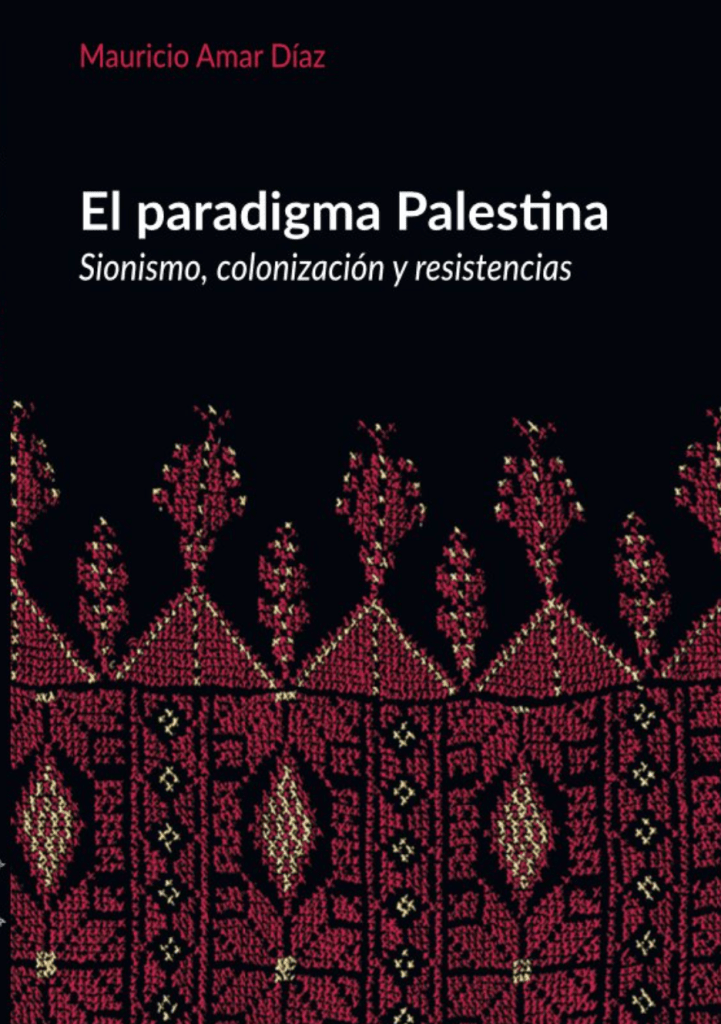
Of the destruction of worlds. On Mauricio Amar Díaz’s El Paradigma Palestina (2024). by Gerardo Muñoz

What does it take to destroy a world? It would seem that the question itself is too metaphoric and impertinent; perhaps also hyperbolic and presumptuous against the flight of the infinite embodied in worldling. But this is the question that we should direct ourselves to according to Mauricio Amar’s short and highly accessible book El Paradigma Palestina: Sionismo, Colonización, Resistencias (DobleaEditores, 2024), which is written in the wake of the ongoing war of annihilation in Gaza in order lay bare the paradigmatic abyss of social death in which humanity finds itself at the peak of its civilizational dominance. Amar does not use the term “paradigm” lightly, and nor is he interested, as recasted recently by none other than Steven Bannon citing Thomas Kuhn’s work about scientific revolutions, in posting a central conflict towards transformation; rather, one must situate this strategic conceptual deployment in light of the Chilean philosopher’s own work on imagination and use, which provides an irreducible and sensible texture to every emergence of a paradigm [1]. This means that if Palestine is, indeed, the paradigm of our epoch is precisely because it has no-space in the world – it is what can be infinitely be destroyed, as Maurce Blanchot famously said commenting Antelme’s work – and what illuminates the core and extension of the “integrated” planetary humanity oriented towards the administrative governmentality of contemporary Western democracies, and its corollary geopolitics of the total artificial spaces, as Bruno Maçaes has recently called it. Reading Amar one senses that under the name “Palestine” he is registering a limit to the Humanist force, where an existential claim reveals the maelstrom of an epoch that has resorted to a grotesque parody of the ancient homeric standards of domination and submission. It is the outlook that Simone Weil described as the paradigm of transforming the world into nonliving things.

If understood as a paradigm, Palestine reminds us that the homeric energy towards the aristocracy of equality through force and death among the human race never truly ceased, but only changed forms and cloaks throughout the ages. The post-mythic West seemed to have constructed itself through the repeated revolutions that accommodate justifications for usurpation and containment, self-deification and legibility of the territory at the service of a fictive ethnos. The belated nationalism of modern Zionism has had the paradoxical quality of being both a project of territorial usurpation after its illegalization in International Law (The Kellogg-Briand Pact of 1928); while, at the same time, a politico-theological configuration that, as Monica Ferrando has shown in L’elezione e la sua ombra: Il cantico tradito (2022), clings upon the manipulation of the theological election of “a People” in order to deploy the coterminous binding between community and territory justified through divine narration. The interdependence of the spiritual goal of Zion is only possible through the construction of a settler state, at the same time that the occupying state’s only legitimacy based on ‘one God, one People’ relies on the restitution of an instrumentalized form of the theological election. This is why for Amar the Zionist state building project is a the paradigm of a specific type of colonial governance whose end is not just to capture errant people into social subjects, but more fundamentally a translatio imperii that folds the Earth into a territorial nomoi of distinct multilevel functions: checkpoints, walls, vigilante control of movements, constructions and erasure of surfaces, administration of critical infrastructures, development of extractive resources, and finally the hunting down of humans that necessarily blurs the line between civil population and battlefield combatants. When Amar reminds us of Israel’s predominance in planetary security and warfare technology, one can immediately recall Emile Benveniste’s suggestion that “measurement” (med*-) and the proportional addition to produce objectivity, entails an efficacy of permanent dominance and governability whose main enterprise is the management of populations through the regime of accumulation. As Andreas Malm reminds us of the current cartography of Palestine: “The genocide is unfolding at a time when the state of Israel is more deeply integrated in the primitive accumulation of fossil capital than ever…This is the political economy of normalization: a sacralization of busines as usual that destroys first Palestine and then the earth” [2]. The ongoing devastation of Gaza is a window into the project as a whole: the necessary destruction of the worlds and the total artificiality of the life-worlds, always at the service of maintaining the needs of anthropological symbolizations.

For Amar this points to an epochal scenario of a people without world; and, following the lead of Sari Hanafi, he will claim that the paradigmatic mirroring of Palestine is also an spatial-cide, in which the living are deprived of a sense of inhabiting and roaming that brings to bear that the nakba is not something that has taken place in history once and for all, it is a catastrophic event that has not ceased from repeat itself, and whose ultimate intention is to suture the world and existence, the soul and the spirituality of the open atmosphere that is needed to sustain life. Reading Amar between the lines  – who towards the end of the book finds distant interlocutors in Darwish’s poetry, the philosophy of Gilles Deleuze, as well as in the glosses of Walter Benjamin on history and the prose of Edward Said – one learns that the true arcana of Palestinian resistance is also a secret promise for our apocalyptic times: to hold on to the world, so that we can all passionately land on the Earth and freely breath in its surroundings. The nexus of the Palestinian question and the intrusion of Gaia, although underdeveloped in Amar’s analysis, obliquely runs through a text that is also very much about the central question of ethics that never abandons thought: how to name what escapes without taking the world as such into an object to be possessed, destroyed, and remade anew as a hostile secular imago dei. The vindictive hyper-consciousness of the contemporary unmediated arcana imperii now reveals, as Amar says towards the end of he book, a mirror through which we can observe our own increasing domestication, in which the metropolis is just the luminescent and self-protected hub, but whole ultimate darkening shadow is the Gaza’s pile of rubbles resembling an open air necropolis (Amar 108-109). Through different arrangements of organized destruction, both the metropolis and the necropolis converge in their preeminent ‘struggle against space’ and its form of life for the sake of familiar pieties of enslaved survival of unworldly anomie (Amar 116). 

Does this mean that we are all “Palestinians”? Mauricio Amar’s El Paradigma Palestina (2024) rejects the all too well expected craft of solidarity and subjective identifications that can only work on the payroll of the gravediggers of the current civilizational project. On the contrary, if Palestine is our paradigm, and it remains so, it is because it can only refuse measurement and recognition in order to dwell in the only possible exteriority as embodied to Darwish’s poetry that Amar quotes towards to the end book: “Do not trust the poem / absent child / it is the throbbing of the abyss” (Amar 140). From the abyss we nourish the soul as the return to land on Earth prepares itself in order to no longer conquer a territory, an ancient tradition, or a “People” (ethnos), but to dwell on the nearness of a place that is an excess to every location or community of belonging (this is the false exit of the kibbutzim). We do not have political grammar to articulate what this integral freedom could mean, except that it is an exotic relation in Victor Segalen’s sense: a creation of a world alien from the compatible and petty one that currently drains us into its ongoing desperate destruction and passive enslavement [3]. Finally, like all authentic paradigms, it is worth noting that Paradigma Palestina (2024) teaches and preaches nothing; it only invites us into the swirling sensation that crosses over the imagination and the singing voice, from the world of the last remaining lives to the isles of the dead martyrs, and back. 

Notes 

1. Mauricio Amar. Ética de la imaginación: averroísmo, uso y orden de las cosas (Malamadre, 2018).

2. Andreas Malm. The Destruction of Palestine is the destruction of the Earth (Verso, 2025), 53.

3. Victor Segalen. Essay on Exoticism (Duke University Press, 2002), 24.

Erich Unger’s The Stateless formation of the Jewish People today. by Gerardo Muñoz

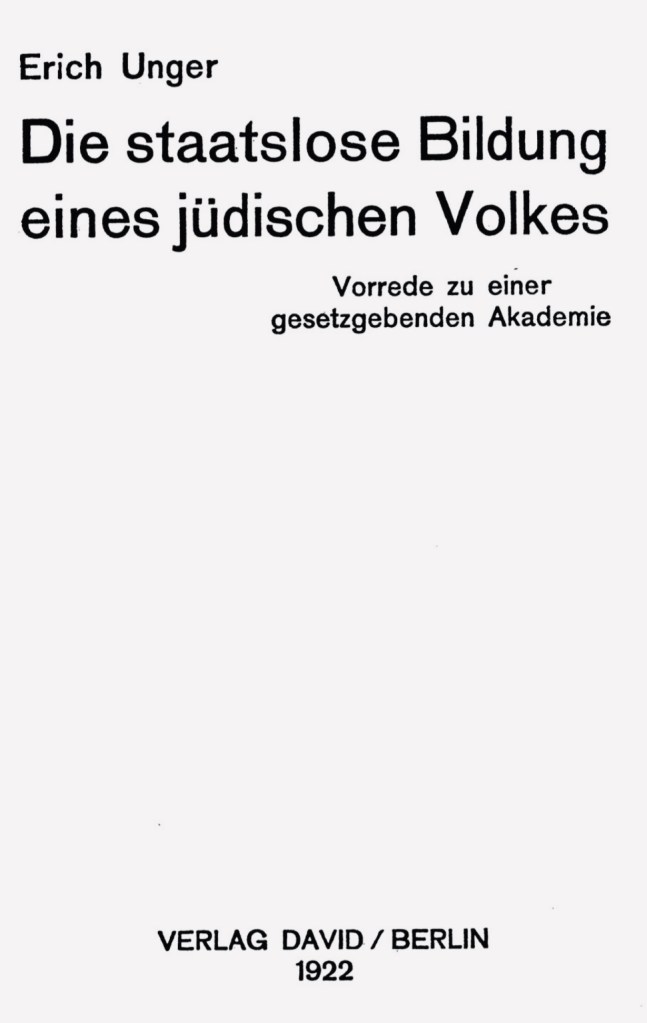
The same year that Carl Schmitt’s Political Theology (1922) appeared in the intellectual scene of the Weimar Republic defending the exceptional of the decision against immanentism, a short opuscule entitled Die staatenlose Bildung eines jüdischen Volkes (The stateless formation of the Jewish People, 1922) written by Jewish philosopher Erich Unger was published as an untimely response to the question of “Jewish identity” (Judentum) and its fate in the wake of civilizational collapse. The fact that this essay – as well as his 1921 book Politics and Metaphysics, which Walter Benjamin described as the most important political reflection of his time – has remained on the fringe of intellectual history, political theory, and the history of thought is something that anyone must seriously reflect upon. It should not come to a surprise that this text comes back today to attentive readers evidences how every creation, event of speech, or written word does not reside in the preventive invention of a specific audience; but, on the contrary, in the way that its words, images, and thought will generate the evanescence community of extemporal readers. The century that separates us in time from Unger’s essay bears witness to its ultimately proximity and prophetic calling. 

In 1922, for Unger, very much like for us today, thinking about politics meant finding a way out of a catastrophic politics [1]. If Politics and Metaphysics had suggested the necessity of an existential and energetic exodus for breakthrough against civilizational sedentary absorption and domestication, in The stateless formation of the Jewish People (1922) Unger argues critically against a state Zionist project that artificially, and through the anti-universalism paradigm of force (just as Weil would argue during her war writings about politics in the West) will attempt to “absolute Judaism, and all the manifestation of judaism that remain outside, hostile to the state trend” [2]. For Unger, Zionism as a political ideology and state program fails to come to terms with the concrete “outside the world historical power” that characterizes the universalism of the Hebrews as a theology marked by dispersal in the West; that is, outside the philosophy of history of sacrifice and soteriological incarnation of the Christian eon [3]. Hence, Zionism’s political form of the Jewish people was epochally insufficient – too empirical and thus trapped into the modern logic of racial and biological survival – to express the true conditions to enact as the “a priori” for the question of Judaism as a grounded redemptive universality. And insofar as Zionism presupposes something “outside of itself” (corporeal and spiritual Judaism), for Unger “the demand for an imperial state…must modify its demand, since it should express its underlying basis of the demand differently” [4]. The Hebrew ‘universality’ was metaphysical as much as “concrete”, based on modal ritual and myth, and for this reason at a distance from the discharge of formal logical statements [5].

What did the apriorist consideration of Judaism mean for Unger? The hypothesis in The stateless formation of the Jewish People (1922) was far from bring esoteric: Judaism is a exclusively a spiritual, immutable soul matter that hoevers the surface of the corporeal; and, more importantly, “it governs itself independently through the insubstantial for of a concrete existence” [6]. In other words, for Unger before the unity of the “People”, the articulation of the “movement”, and the erection of a positivist constitution based on Zionist nationalist principles, one should consider the sensible fabric of a people  – a dispersed, multiple, and metapolitical communities that have endured outside the geopolitical and sacrificial structuration of Christian history – that each and every time have insisted on the separation from the subsumption into a sphere of power and domination, into an ethnic-community validated by recognition and its claims to “consciousness” at the most empirical and material level. But this would amount to an effective liquidation – a surrogate for the acceleration of the dominant religion of historicity – of Judaism into yet another planetary religion, and an expression of power that integrates itself into the struggle for the nomoi of a contained and policed world. For Unger, “empirical Zionism” becomes the attempt to reduce Judaism to a “real self-executiving power” that will diminish the “supreme expression of existence” of Judaic spiritualism as “an inner experience that it is not historically given but that must precede it in order to make Judaism an endless and inevitable precondition of a truly world historical project” [7]. In this mold, Judaism will be dispensed into the theaters of the constitutive war of historical progress. 

As such, Judaism as theologically transcendent is not to be conflated into the corset of a political fictive ethnicity, but rather as an autonomous transmission that allows the communication from soul to soul that descends all the way from its metaphysical beginning. And at this beginning that has exerted itself against the whirlwind of historical fixation (the very structure of civilization after Cain according to his mentor, the Jewish theologian Oskar Goldberg) were metaphysical and errant fragments of encounters and communication, of psychological energy and dispersal of shared spiritual goals. If this is lacking, then no political form [for Judaism] will arise, but only a foolish copy of the already-existing, because the spirit cannot be skipped and left out without the rising danger” [8]. It is telling that for Unger this rising danger can emerge not only from indirect powers that exert pressure against the unity of authority – as Schmitt would have in his framework of his theory of sovereignty in Political Theology (1922) – but also, and more dramatically, from the suppression and alienation of the spiritual interiority by which a “people” never coinciding with itself can arrive at the “crystallization point” (sic) outside of the individual [9]. 

Circling back to the problem of “catastrophic politics” – that Schmitt wants to “contain” through decisionism, and that Unger wants to overbecome through an exodus from political thresholds – at the crux of Unger’s indictment of the arcana of Western politics is the “it has set everything in such a way so that the metaphysical or religious area, the internal direction, stands as a mere private thing”, sidestepping the fact that even reality and the constitution of the principle of reality depends on interiority for the possibility of an outside. And it is this outside what allows the a priori historicity that Oskar Goldberg had defended in his book The Reality of the Hebrews (1925). As the late Bruce Rosenstock lucidly argued, for Goldberg (who stands as the unnamed reference in Unger’s position about an experiential Judaism), the “a priori” takes place in an ur-time in which the physical world was closely connected to the transcendental presence of the gods, in which the people cease to be a cultural, ethnic, or identitarian unit in order to become a humanity capable of “overcoming the catastrophic history of wars sparked by competition over scarce resources” [10]. In endorsing the instrumentalized politico-theological reduction of state Zionism, Unger sees the abdication of the “Jews as the people who have driven the spirit the furthest…to cultivate the spirit deeper, more skillful, more subtle, to be the most deeply suitable through this tension” [11]. A true and vital reality was in the conspiracy between souls, wherever and whenever these meet as the ultimate manifestation of the fidelity to the unspeakable mediation between the true life and the divine. 

At the height of 1922, Unger did not suspend from a certain self-afflecting optimism, and towards the end of The stateless formation of the Jewish People (1922) he writes: “The Jews should not overlook their uniquely favorable situation; mainly, they have been materially unhistorical for two thousand years, and the only one that have not been beaten into a reality and into the shackles of the past or the empirical state that others have had to suffer” [12]. In Unger’s reading, Judaism and its errant communities (the ‘wandering Jew’ that Joseph Roth will narrate in these years, but that one must trace to the mythic texture from expulsion of Cain to the marrano) have shown the density to gather through spirit a resistance to the paradigm of force and the technicians in charge of dominating over materialism. As Unger states unequivocally: “the one who technically masters matter is ultimately defeated” [13].

This was Unger’s anti-promethean wager in 1922 skeptical of all political horizons oriented towards foreseeable catastrophes blinded to the underlying cyclical polarity of barbarism and civilization in the West.  The wayward asymptote of a non-catastrophic politics was not to be found in the abstraction of the political concept or the mechanical construction of a state form through assimilation and usurpation, but in what Unger termed, in the most intense poetic moment of his essay, the Hebrew “ increasing decipherability of its own origin”. And unlike Enlightenment historians such as Edward Gibbon who saw the state as the irreversible revolution in world history that brought the age of the nomads to an end; for Unger the twentieth century meant the fixation of the state degenerating in the worst of barbarisms. It was the existence of the unit that must generate the internal limit to the political, and not the political as the external threshold to what is inherited in the world. And yet, insofar the events of thought, language, and imagination take place, the origin (urgeschichte) will always escape what has been sedimented by rubble and wars that fuel planetary destruction and collapse. 

Notes 

1. Erich Unger. Die staatenlose Bildung eines jüdischen Volkes (Verlag David, 1922).

2. Ibid., 6.

3. Ibid., 10.

4. Ibid.,  15.

5. Erich Unger. “Universalism in Hebreism”, trans. Esther J. Ehrman, The Journal of Jewish Thought and Philosophy, Vol.4, 1995, 307.

6. Erich Unger. Die staatenlose Bildung eines jüdischen Volkes (Verlag David, 1922), 8.

7. Ibid., 19.

8. Ibid., 25.

9. Ibid., 24.

10. Ibid., 29.

11. Bruce Rosenstock. Transfinite Life: Oskar Goldberg and the Vitalist Imagination (Indiana University Press, 2017), 172.

12. Ibid., 31.

13. Ibid., 32.