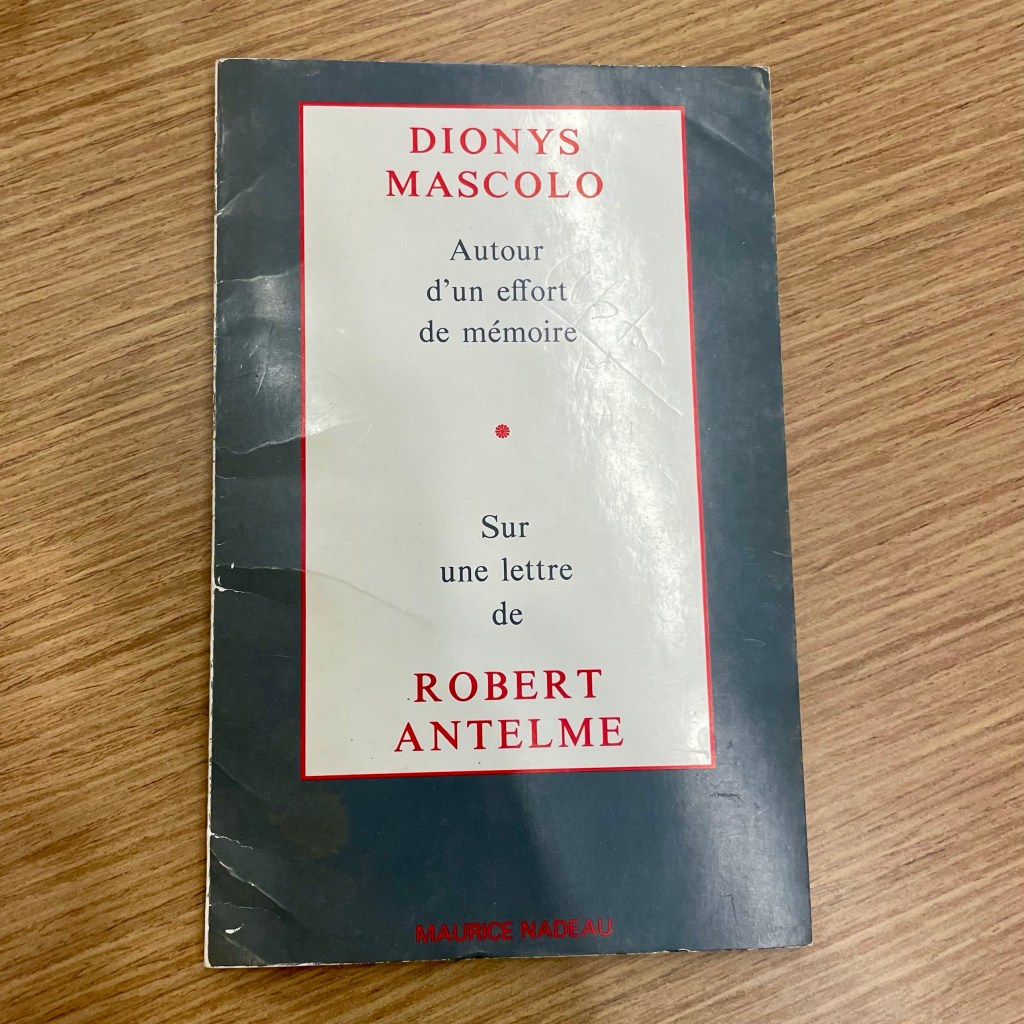
The missing word. A note on Dionys Mascolo’s Autour d’un effort de mémoire: sur une lettre de Robert Antelme (1987). by Gerardo Muñoz

Rereading Dionys Mascolo’s Autour d’un effort de mémoire: sur une lettre de Robert Antelme (1987) in preparation for an upcoming course with Philippe Theophanidis, one gets the sense of beginning backwards or at the very end, since this late essay is a recapitulation of what the Rue Saint-Benoît Group embodied and stood for. And it is so obvious that for Mascolo what is at stake in Antelme’s letter is not a particular practice of confession (and the coupling of secrecy and extraction), but rather an integral register of an experience that belongs to “friendship in thought without reserve” [1]. And that it would not have been possible without friends, as simple as that. Of course, the condition of possibility of this shared thought in friendship has less to do with general principles, norms, or creative acts, and more with what Mascolo does not hesitate to qualify as “a sensibility that was common to us”. 

What is this sensibility, and is it possible to describe it? This is a question that I do not think that is attempted to be resolved in Mascolo’s commentary nor in Antelme’s letter so consumed by its internal lacunae and effacement (I am definitely not capable of saying a word about it at the moment, and this might be one of the questions in the ongoing dialogue in the seminar). Mascolo does offer a little more when he states that this sensibility, however broad and partial, was always elevated against all totalitarianisms that were hegemonizing the political positions of the epoch. Obviously, it names the political totalitarianism (Fascist and state planned communism alike), but also the “the soul of the project” (‘est l’âme du projet  et sa forme aboutie’) that must retract from it [2]. The last pages of Mascolo’s reflection is a shallow-deep, an insinuation, into the possibility of saying something in relation to this difficult proximity. 

Hence, against total subsumption of life into political planning (whether on the right or left, whether ecclesiastical or in the name of the secularized forms of militant communist parties), Mascolo’s insistence on the ‘soul of the project’ is sustained by the “missing word” give that dispenses human necessities as infinite. He writes: “Et par mille et mille détours, il me (nous) fallait toujours en revenir au même point : Je suis ce qui me manque est la sentence que je porte (nous portons) inscrite à l’intérieur du front. La moindre des choses alors est de proposer que, sauf mensonge, elle vaut pour tout homme”. [3]. But what could it mean that “what I am” is always constituted by the missing word? It is definitely not a substantive attribute to a person (and thus what I can acquire), but a word that in its ideal absence and lack of epistemological validity stands as a form of seeking (zēteîn) that Nicoletta Di Vita has recently linked to the form of the ancient hymn [4]. The missing word is the passive and pure voice that calls out the rhetorical fiction of political totalitarianism. In other words, the missing word does not enact a present state of things, articulating the denomination in language with distinct objects of the world; it only has transformative weight when revealing what remains under the capes of morality.

This is why the experience of the camp constitutes a central threshold: on the one hand, it is an extreme and sharpened image of social alienation between classes; and, on the other, it is the experience that by depriving the human of its humanity it brings to an effective end the polarity between rich and poor that structured the economy of salvation and damnation of Western civilization. This is what Antelme describes in his essay “Poor Man – Proletarian – Deportee”, which according to Mascolo brings the rich to a psychotic night of desperation towards destruction and death of the specie. Hölderlin’s definition that “we have become poor in order to become rich” as a clement predicament in the face of the modern is here-forth suspended in the spiritual crisis generated by the social engineering whose most extreme case is the model of the camp.

And yet the missing word remains irreducible even after the corrupted stage of innocence and the impossibility of redemption. Mascolo, reader of Nietzsche, does not believe in the theos. This is why for him the missing word, far from being an apostrophe that offers consolation in the wake of the catastrophe, it remains concretely attached to the experience of the friend that no longer finds solace in abstract peace, but in the profound musicality of what remains inconsolable: “cette heureuse absence de paix qui est sa musique profonde, et que donne en partage l’être aimé, l’inconsolable qui console” [5]. This transfigured word – the unending capacity for hymn in the human, its nomoi mousikos – is both an excess to memory and appearance, and perhaps, more importantly, an excess to the experience of living and the dead. And is not this “seeking” passage of the missing word what the Rue Saint-Benoît Group was obsessively after?

Notes 

1. Dionys Mascolo. Autour d’un effort de mémoire: sur une lettre de Robert Antelme (Maurice Nadeau, 1987), 82.

2. Ibid., 83.

3. Dionys Mascolo. Autour d’un effort…,82.

4.  Nicoletta Di Vita, Il nome e la voce. Per una filosofia dell’inno (Neri Pozza, 2022), 27.

5. Dionys Mascolo. Autour d’un effort…, 89.
The Rue Saint-Benoît Group. Introduction for a 2024 seminar. by Gerardo Muñoz & Philippe Theophanidis.

The Rue Saint-Benoît Group, organized by Marguerite Duras, Robert Antelme, and Dionys Mascolo and other fellow-travelers of the interwar years can hardly be defined as a political movement, a literary school, nor an intellectual community with a direct orientation or aesthetic program. In fact, the Saint-Benoît Group (transnational in its composition) understood itself as a shared experience of thought that gravitated under the words of the German poet Friedrich Hölderlin: “The life of the mind among friends, thought is formed in the exchange of the written word and for those who seek”. It is also known that Hölderlin was the quintessential poet dwelling in the fracture between tradition and modernity, the flight of the gods and the eclipse of the poetic in the wake of a consummated technological Prometheism. To affirm Hölderlin’s words entails to confront the difficult questions of language and the voice as conditions for thought. How can we think of an intellectual experience in which friendship becomes inseparable from thought; and, at the same time, when thought becomes a condition for the endurance of friendship? And to what extent could this double register allow for a reinvention of the autonomy of politics in the wake of the crisis of Humanism? 

These are the enduring questions that the experiential setting of the Saint-Benoît Group bequeaths to us today. If the Saint-Benoît experience has remained opaque and invisible even within monumental historiographic narratives of twentieth-century ideas, it is because only seldom have these problems been rightly posed. Under the sign of a “friendship of thought” – a transfigurative plane that immediately resonates with the immaterial common intellect, the Heideggerian incursion on the task of thinking, and the revival of a sensible Platonism – the members of the Saint-Benoît Group witnessed the catastrophe of modern politics in real time; such as, although not limited to, the concentration camp, the postcolonial wars of liberation, communist totalitarianism, and the exhaustion of the fundamental categories of political Liberalism. Taking distance from the elaboration of a normative political theory, the Saint-Benoît Group favored the heterogeneity of stylistic endeavors and expressive acts in order to grapple with the crisis of experience. And it is to their specific scenes of writing that we must attend to in a systematic and careful way. 

In this eight-week course we will explore the diversity of the writings of the group, including figures such as Dionys Mascolo, Robert Antelme, Marguerite Duras, Maurice Blanchot, Elio Vittorini and other fellow-travelers to explore questions concerning the nexus between experience and creation (both of us have worked on some of these writers intermittently in the past couple of years). To the extent that we still live among the ruins of the legitimacy of modern politics, the contestatory style of Saint-Benoît Group still raises the question about the human species within our civilizational collapse.

What type of authority emerges from their writings, communication, and imagination of a fractured humanity? And how could the concept of ‘revolution’ be transformed from its moral and technical elaborations that hegemonized the twentieth century? We are aware that the Saint-Benoît Group has no “lesson” to be extracted and made “actual”; rather, we are interested in what we would call a “gesture of thinking” that prepares the condition for a life in freedom within and beyond the contours of the polis

*For those interested in registering for the eight week seminar beginning in February 2024, please consider signing up at 17/instituto de estudios críticos: https://17instituto.org, or by writing to extension@17edu.org.

Tum Otheos: on a detail in a Van Eyck’s painting. by Gerardo Muñoz

Jan Van Eyck’s 1432 Portrait of a Man has the Greek inscription, and rendered in transliteration, that reads “Tum Otheos” (ΤΥΜ ωΘΕΟς) that has baffled art historians and specialists on the painter for a very long time. It is well known that Van Eyck, the pioneer of oil painting, was fond of leaving all forms of writing in his pictures in Greek, Hebrew, and trilingual idioms that through the centuries have become incomprehensible jottings [1]. At a time when Van Eyck was painting in Northern Europe, the magical efficacy over names and naming was a dominant cultural and religious belief, and the expanded arts of the ‘names of god’ were used to heal and relieve pain, and protect against potential enemies and keep demons at bay [2]. Following Hermann Usener, one could see how the original act of the naming of the gods was no longer tied to ‘momentary divinities’ (Augenblicksgötter), but rather they were functionalized to specific anthropological needs for survival. Nonetheless, it is quite ashtonishing to witness how the painting at year zero that Van Eyck embodies – the very birth of oil painting and the “coming to life” of the figure in depiction – coincided with a divinization itself of the expanded field of the arts [2].  

In Erwin Panofksy’s early interpretation the inscription “Tum Otheos” should be read in light of the musical revolution that had taken place between 1420-1440 in the Netherlands, where the ars nova meant a thorough musical renovation towards a new expressive energy and “exquisite sensibility” nourished by the myth of Timotheos, who was taken as the ancient model of sublime harmony of the new arts and style of bringing life into depiction [3]. Overtly dependent on the transmission of the ancient figure of sound, for Panofsky the inscription “Tum Otheos” pays homage to the lyre Timotheus of Miletus as creator of the “new music”. But, could the same be transplanted into painting? Could painting at “year zero” be taken as precisely this new tonality of the arts? 

A second possible rendition of “Tum Otheos” is one what has been merely registered, although not elaborated, by art historian Alfred Acres, for whom “tum otheos” is not indexing the ancient musician but more importantly, it is registering an event or what is taking place [4]. Thus, for Acres “Tum Otheos” should be read as “and then God”; as if the relationship between painter, depiction, and spectator was the very taking place of a minor and invisible god of creation that painting facilitates. It is not difficult to recall here what Luca Giordano said of Velazquez’s painting: “this is the Theology of Painting” [5]. Although directed at Las Meninas, one could perceive that in the early stages of the secularization of the forms of the modern, the nexus between theology and painting becomes a clandestine partnership that resists its full integration into the autonomization of forms of representation. In other words, there is always a theos reminder in the act of depiction that is irreducible to the general economy of forms, as if the dissonance of the soul endured underneath at the nearness granted by the concrete realization of a picture. “And then God”, as proposed by Acres, should not be taken merely as the eruption of the divine in the symbolic structuration of the world, but rather as the very act of naming that allows divinization to continue in spite of the closure announced by the flight of the gods. 

Just one year after Van Eyck’s Portrait of a Man (1432) where the inscription “Tum Theos” appears, in Italy Alberti will write in his De Pictura that the gesture of painting “possess a truly divine power in that not only does it make the absent present (as they say of friendship), but it also represents the dead to the living many centuries later, so that they are recognized by spectators with please and deep admiration for the artist” [6]. And if Postel is right that Van Eyck’s Arnolfini masterpiece is one in which the picture reconvenes the dead bride and the rich merchant into pictorial space, then one could deduce that for the Flemish artist the divinity of painting is defined as the only passage left to the moderns to negate the world of the living and inhabit the invisible world of the dead against the coming of the monothematic world-image and its material crust of Gaia [7]. “Tum Otheos” – and then God – is literally registering the transfigured and expressive dimension of painting; that is, the taking place of depiction and its secret fidelity to what appears only to banish and become forever unfathomable. 

Notes 

1. Susan Frances Jones. “Jan van Eyck’s Greek, Hebrew and Trilingual Inscriptions”, in Van Eyck Studies, September 2012, 294.

2. Noa Turel. Living Pictures: Jan van Eyck and Painting’s First Century (Yale University Press, 2020).

3. Erwin Panofsky. “Who Is Jan van Eyck’s “Tymotheos”?, Journal of the Warburg Studies, 1949, 88-89. 

4. Alfred Acres. Jan van Eyck within His Art (Reaktion Books, 2023), 177.

5. Daniel Arasse. Take a Closer Look (Princeton U Press, 2013), 134.

6. Leon Battista Alberti. On Painting (Penguin Classics, 1991), 60.

7. Jean-Philippe Postel. El affaire Arnolfini: Investigación sobre un cuadro de Van Eyck (Acantilado, 2023).