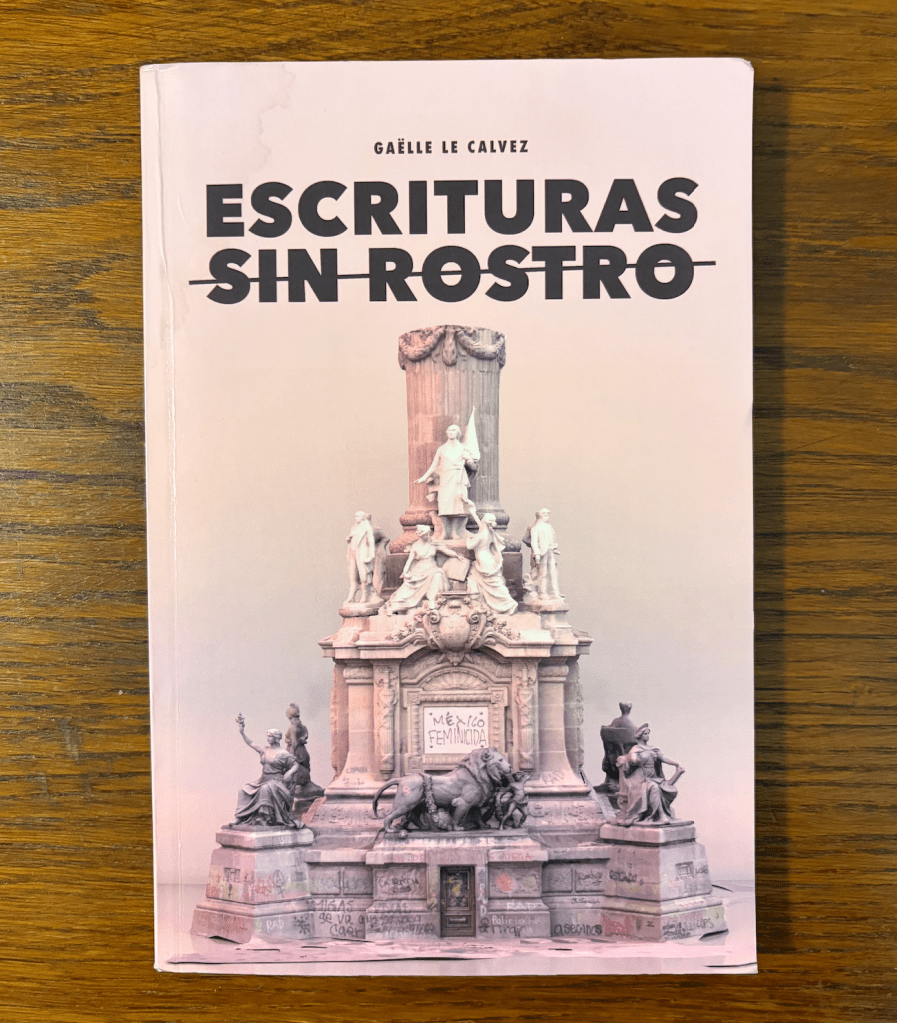
Every book has a history of its own, its subterranean itineraries, and oblique paths that are only disclosed when entering in contact with its future readers. There is no question that Gaëlle Le Calvez’s Escrituras sin rostro (University of North Carolina Press, 2025) has plenty of merits that we cannot begin to elucidate. For one, it is a monograph that should be of interest to students of Latin American studies, but also to any fellow travellers wanting to confront and think through the problem of writing at the wake of the epochal crisis of the state form and the exhaustion of the historical subject. Can thinking overcome the deficiencies proper to cultural studies and populist hegemony to understand the ongoing fragmentation visible everywhere? One can start by saying that Le Calvez’s books points to a positive direction from this impasse, avoiding the shortcomings of sociological epistemology and the auratic reflexes of subaltern subjects as the master oppositional category to State form in the becoming of modernist development and global neoliberalism. In Gaëlle Le Calvez’s Escrituras sin rostro (2025) the object of study is the irruption of EZLN or Zapatismo, and more specifically the scene of writing of the Zapatistas through the genealogy of their declarations, public letters, gestures, and signatures of all kinds that speak to the persistence of a writing of defacement; a scene of writing beyond the social function of the author, and on the margins of the legitimacy of the “lettered city” of the Latin American criollo uneven modernism. In the space of this commentary, I would like to list three levels of Le Calvez’s arguments that hope will further contribute not just to the themes proper to her study, but more fundamentally to a constellation of problems that exceed Latin America as a region of studies.
First, Gaëlle Le Calvez’s Escrituras sin rostro (2025) withdraws itself from understanding Zapatismo as a sociological political phenomenon of the late Mexican State, or a belated product of the shortcomings of the Mexican Revolution and its process of modernization. Unlike other studies of Zapatismo in Latin American studies Escrituras sin rostro (2025) is not invested in the restitution of new political subject of resistance in the face of global war and the anarchy of political action; rather, what is presented is the redrawing of a genealogical scene of writing subsumed by its excess and dislocation, stubbornly out of place that evidences the negativity of the collapse of the autonomous spheres of actions that once defined the apparatuses of historical development and legibility. As Le Calvez convincingly points out, the defaced and non-authored writings of the Zapataistas are neither literature nor political manifestos, and they also refuse the autonomy of literature and its incorporation into the objective ornaments of the Avant Garde projects. The defacement of writing for the Zapatistas is neither Avant Garde nor kitsch, because it is no longer interested in weighting itself on the rhetorical scale of social compartmentalization. In my terms, which are not those of Le Calvez, one could say that “escritura” or writing in this study is the vortex of flight from rhetorical submission; that is, what cuts through the enthymemes to refuse ossification and reproduction of language. The freedom of writing is always measured by the possibilities that is able to generate against rhetorical abstractions.
Secondly, because there is no justification in social or political principles, Le Calvez argues that Zapatista writing and negative gesture is a refusal of hegemony, and thus properly posthegemonic. If “escritura sin rostro” makes no demands, seeks no identification, and avoids the prefiguration of rhetorical subsumption, it means that Zapatismo openly rejects the articulatory nature of hegemony as the last avatar of the administration of identity at the end of metaphysics. As Le Calvez claims succinctly, the dispersal of writing cannot adequate itself to Laclau’s theory of hegemony and its “rhetorical foundations” of the social (Le Calvez 67-68). In this sense, posthegemony is not merely what interrupts the closure of politics in the neutralization of a new social consensus, but what transfigures language into its autographic, experiential, and faceless excess that overflows every identity and every place of enunciation. In very subtle and elegant ways, Le Calvez’s hermeneutics of the Zapatalistas’ Declaraciones confirm that the solicitation of hegemony in both discourse and political practice is an inversion, almost an hallucination in political form of the money form and the general equivalent in the historical process of real subsumption of capitalist value. If Zapatistas are indeed a “realist” political formation it is not because they parody of modern guerrillas or enact a new communal organization; the realism at its best is grounded in the capacity to discern that hegemony in the wake of end of the modern liberal state only serves to deepen the ongoing process of the capitalist utopia.
Thirdly, and more surprisingly, is the fact that Gaëlle Le Calvez’s Escrituras sin rostro (2025) does not just reconstruct moments of the Zapatista inscription, it also considers its intensity to its very end. And to think something to the end means to reveal its limits, disclose its fissures, and open a site to move pass the object of reflection. This maximum point of reflection is when philological exploration outlives itself in the intensity of an uncharted path. Thus, the story that Le Calvez tells us about Zapatista writing concludes with a series of aporias and contradictions that announce a certain “decline” and eclipse of its poetic intensity. This is a moment where its poetic elevation begins to deflate; and, in its decline we are confronted with a persistent drift to “civil society”, “self-critique”, the appeal to plurality of “indigenous people” (what Gareth Williams once called “fictive ethnicity” as master representational fiction), or an internationalist appeal in order to generate a “counterbalance” to global neoliberalism (Le Calvez, 106-108). And we are putting aside the nomination of Marichuy for the 2018 Mexican presidential election. Does not this recomposition of social recognition, both global and national, seek to replenish the void in representation as it appears in the third Declaración that evoked “para nosotros nada”? (Le Calvez, 93). The waning of the poetic moment of Zapatista appears to project a flickering shadow of its dependency to political movements.
Does this mean then that the “rise and fall” of Zapatismo ends in a tenuous archē embedded in the ‘movement’? In his Latinamericanism after 9/11 (2011), John Beverley projected his unfiltered Leninism towards antiquity and Ancient Christianity when stating that the central political question for our times in the face of Empire, is to find ‘who are the real Christians today’ [1]. But ideological Leninism distorts the past, since as we know well, the central question for the Christians of the Early Church of the desert, such as Origen, was not who was going to mobilize the masses in the material world, but rather in what way to retreat and avoid worldly political power [2]. Zapatistas as the new and last Christians, then? It is a tempting question, but one that will only contribute to the Leninist reduction of historical political fictions. Our times is not one for Leninism and the Vanguard Party to carry a breakthrough. But perhaps Zapatistas are residually Christians in another country way; that is; in the internal dynamics of its own language. I would like to suggest that this language can be understood especially in the last phase of the Declaraciones, a late rhetorical style of the sermo humilis. As Erich Auerbach has shown, the sermo humilis was the rhetorical innovation of the early Christian community at a moment of the political decadence of the Roman Empire, at the entrance of the interregnum. The sermo humilis appeals to a low or popular style, seeking legibility and pathetic understanding of the difficult mysteries of faith. The humilis also designates the ground level of the land, the humus, which elevates through the persuasion for the humble and the humiliated common men of this world [3].
In other words, the sermo humilis could be said to be a sublime of the everyday life that is refractory to the mystery. It is obvious that if we now turn to the Zapatista late writing, something like the sermo humilis codifies a symptom that is no longer the mystery of revelation, but rather in its secularized form of the revolution. Does not the sermo humilis functions as a secularized artifice to guard and elevates hopes (all too human, alas) on behalf of the “revolution” to come? However, it is precisely political revolution, just like hegemony, what cannot longer account to the effective revolutionary force of the autonomization of capital. If according to Le Calvez the formation of the Zapatista is analogous to an “artificial movement” (masa artificial) like the Church, then one could say that the rhetorical construction of the sermo humilis functions as a linguistic prayer for the revolution whose only certitude is the apophatic metaphorization in the name of the “people”, the “homeland” (la patria), or the antagonistic and oppositional “we” (nosotros), or any other compact grouping. Of course, this is the terrifying question for the sermo humilis in its secularized form: to what extend the communitarian and autonomous ideal, through its appeal to the humiliated and subaltern class, does not transform itself into an apotropeic instrument devoid of true redemption? [4].
Is writing, and witnessing through writing the practice where the possibility of redeeming human experience is lodged? This is the fundamental question that Le Calvez’s book puts forth to us as readers, without entirely coming to an effective resolution. And yet, in the last part of Escrituras sin rostro (2025) seems to offer us another possibility through the writings of Cristina Rivera Garza, Alejandra Pizarnik, and Sergio Gónzalez Rodríguez in the face of a fragmented and disarticulated social body and the night of history in which social protection and protracted civil war become indistinguishable (Le Calvez 186). This writing is no longer tailored in the Christian shops of the sermo humilis, but in an open plain where the voice becomes “un anhelo de prosa”, or a longing for prose, crossed by the finitude of being and the collapse of mediating forms of totality (Le Calvez 174).
This longing for prose as it appears in Cristina Rivera Garza’s work – in the Spanish anhelo one can also hear the echo of breathing that is constitutive of life’s exteriority with the world, to conspire – is not the letter of the law as in Hegel’s spiritual prose of the world (“in the slave prose begins”, we read in Aesthetics), but the clearing of a voice that can register the world because it speaks from the witnessing of the ruins of representation, and the conviction that there is no political mystery high above, but only the irreductibility of writing in spite of it all. In the shipwreck of perpetual global war, writing’s redeemable elevation is the caritas that puts us in a permanent exodus from the order of representation (Le Calvez, 186). Writing, escritura becomes the passage of the chiasmatic and breathable imagination that, because it has cleared a via poetica, it can name what can also be properly inhabited.
.
.
Notes
1. John Beverley. Latinamericanism After 9/11 (Duke University Press, 2011), 26.
2. David Nirenberg. Anti-Judaism: The Western Tradition (Norton, 2014), 108.
3. Erich Auerbach. “Sermo humilis”, in Literary Language & Its Public in Late Latin Antiquity and in the Middle Ages (Princeton University Press, 1993), 39.
4. Gianni Carchia. “Eros y Logos: Peitho arcaica y retórica antigua”, in Retórica de lo sublime (Tecnos, 1990), 29.