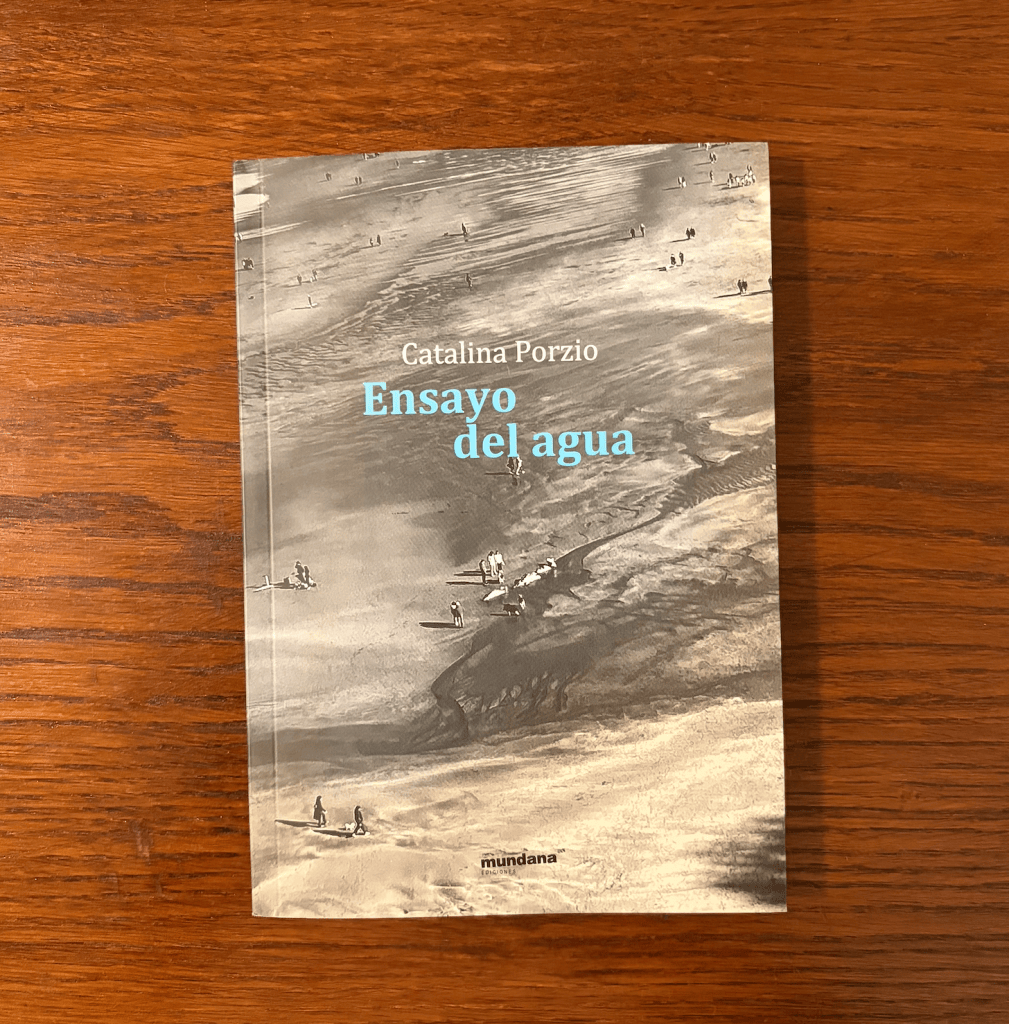
A hymn to the overflowing currents of water and language, Catalina Porzio’s Ensayo del agua (Mundana Ediciones, 2026) opens with a pindaric scene of celebration: “Una vez que la mano se ensambla a la copa olvida la autonomía que las rige….en esa comunión indisoluble, chocamos los cristales con estridencia y porfía por la satisfacción repetitiva de oírlos tintinear. Descontando que un exceso de entusiasmo haga estallar en mil pedazos la escena” (Porzio 12). Water is the pouring of wine and liquor; but it is also the mystery of oceans and the human necessity of quenching one’s thirst. It is all of this, sure, but a series will not do given that water is formless and defies the mimetic faculty that has allowed humans to draw associations high above in the sky. Porzio’s prose defies this temptation of crafting a topoi of water, opting for a dance of forms, descriptions, and enchantment brought together and dissolved by the sargasso sea of her own prose. To claim that writing is like swimming or paddling in water is a poor description to pin down what Porzio achieves in this essay. Her gesture is more versatile without stepping into an abyssal onanism, and this means that to begin to understand water, a certain levitation prose might be in order. A levitation that brings water both near and far. And this is because water escapes the metaphorical reduction of language, and it is always the event as such (just like the title insinuates it: it is not an essay about water, but the essay of water or a water essay).
I am tempted to write “splash!” but this brings to mind David Hockney’s visual world, which is always frozen and imperturbable, at times undisclosed; whereas Porzio’s prose is agile, elegant, and strangely inviting, and thus uninterested in the mute surroundings of the West Coast. Perhaps it is much better to enact Joyce’s lexicon: riverrun down by the waters forms of Viña del Mar, coastal central region of Chile, and into the fragments of infancy and balnearios, and finally making a turn at Tolousse-Lattrec’s La Toilette. As Porzio tells us while making a stop: “Parece imposible hablar del agua a secas, pues dada la fluidez de su naturaleza, cambiante y escurridiza, invita continuamente a la deriva, haciendo inevitable los desvíos, las disgregaciones” (Porzio 44). A riverrun from a certain attachment – uninterested in the play of signifiers and graphism – of writing, which means that Porzio’s poetic prose is highly engaged in vivid synesthetic imagery. In fact, this overflowing prose is accompanied by the light of painting, and most importantly of the hand that orients the voyage throughout the book.
The experience of the prose, in this sense, is not just an exercise in writing, but one of absorption, because it is only after being arrested that jubilation triumphs over reason (and one could also add: over grammar). “La algarabía desconoce la razón”, we read about halfway (Porzio 64). Of course, it is silly to say that good prose needs pictorial supplementation and artifice; what I am trying to say is that, while reading Porzio’s essay, absorption is the hand that discloses the world of sensorial celebration. The hand retains in the overflowing currents of riverrun downstream. Painting is both an instance of the light that absorbs and that renders imperturbable the errant topography of experiences. And this is why Porzio is right in reminding us that “y es que navegamos gracias al olvido” (Porzio 66). If there is a work of memory it is because we are deep in the waters of Lethe, and perhaps the unfathomable image of experience is what gives us a hand in the dangling spiral motion.
As we know, this is at the heart of Hölderlin’s “Andenken”, where the verse “But it is the sea that takes and gives remembrance” validates both memory and oblivion of a human experience that quenches its thirst in the mystery of time (ultimately only a letter separates “sed” from “ser” says Porzio towards the end of the book). At the risk of vulgarizing Porzio’s essay – although her writing is not fully disconnected from the handles of the present – I would claim that precisely the ongoing barbarism of our technological epoch is precisely that it has failed to endure its voyage to Lethe, which is why it is committed to untruth and permanent lies at the same time that forces the human species to permanent memorization, while drying up its once opulent rivers of the West. And if rivers have become a scarce resource in our times, it only makes sense that the same can be said of human language, which is increasingly devoid of dialogic interlocution and the possibility of naming now replaced by automatized coding (some scholars have noted that Finnegans Wake’s “riverrun” also lodges “-ren” might be referring to the name). What happens when riverrun, which is the speculum of human experience in both language and water, dries up? This is the central question that arises from Porzio’s beautiful experiential essay.
In the last pages of Ensayo del agua (2026), Porzio tells us that when an old man of her acquaintance was asked what he will miss most of this world he responded with great conviction: talking (Porzio 104). And as it is also quite obvious for Porzio that the necessity of conversation is not just an intrinsic institution of our social life; it is also the cave (to recall here Porphyry’s reading of the nymphs water caves in Homer) where the living and the dead enter into the purest of conversations, because “…ambos gesticulan, y en la fantasía de encontrarse, transporatados ilusoriamente en la cámara del tiempo, no cabe duda, se entenderían” (Porzo 105). If language is always downstream, at the riverrun outlet, it is because it is both the communicating vessel as well as the immaterial gesture that flourishes without beginning and beyond the imagination of the end times. Avoiding the self-assigned role of the doctor of civilizational decay, Catalina Porzio’s Ensayo del agua (2026) ultimately unfolds a unique choreography: a gesture of language that allows us to move throughout the epochs in order to feel at home anywhere.

