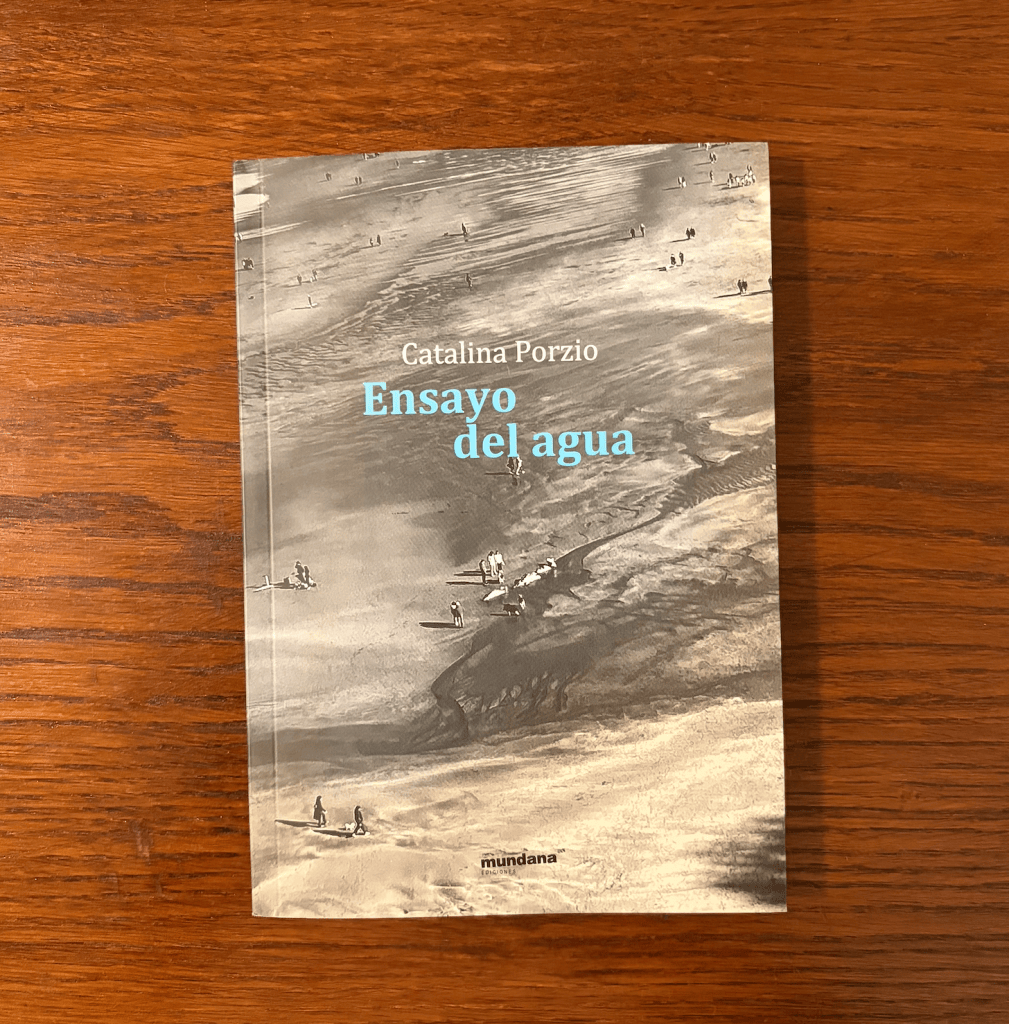
Riverrun. On Catalina Porzio’s Ensayo del agua (2026). by Gerardo Muñoz

A hymn to the overflowing currents of water and language, Catalina Porzio’s Ensayo del agua (Mundana Ediciones, 2026) opens with a pindaric scene of celebration: “Una vez que la mano se ensambla a la copa olvida la autonomía que las rige….en esa comunión indisoluble, chocamos los cristales con estridencia y porfía por la satisfacción repetitiva de oírlos tintinear. Descontando que un exceso de entusiasmo haga estallar en mil pedazos la escena” (Porzio 12). Water is the pouring of wine and liquor; but it is also the mystery of oceans and the human necessity of quenching one’s thirst. It is all of this, sure, but a series will not do given that water is formless and defies the mimetic faculty that has allowed humans to draw associations high above in the sky. Porzio’s prose defies this temptation of crafting a topoi of water, opting for a dance of forms, descriptions, and enchantment brought together and dissolved by the sargasso sea of her own prose. To claim that writing is like swimming or paddling in water is a poor description to pin down what Porzio achieves in this essay. Her gesture is more versatile without stepping into an abyssal onanism, and this means that to begin to understand water, a certain levitation prose might be in order. A levitation that brings water both near and far. And this is because water escapes the metaphorical reduction of language, and it is always the event as such (just like the title insinuates it: it is not an essay about water, but the essay of water or a water essay). 

I am tempted to write “splash!” but this brings to mind David Hockney’s visual world, which is always frozen and imperturbable, at times undisclosed; whereas Porzio’s prose is agile, elegant, and strangely inviting, and thus uninterested in the mute surroundings of the West Coast. Perhaps it is much better to enact Joyce’s lexicon: riverrun down by the waters forms of Viña del Mar, coastal central region of Chile, and into the fragments of infancy and balnearios, and finally making a turn at Tolousse-Lattrec’s La Toilette. As Porzio tells us while making a stop: “Parece imposible hablar del agua a secas, pues dada la fluidez de su naturaleza, cambiante y escurridiza, invita continuamente a la deriva, haciendo inevitable los desvíos, las disgregaciones” (Porzio 44). A riverrun from a certain attachment – uninterested in the play of signifiers and graphism – of writing, which means that Porzio’s poetic prose is highly engaged in vivid synesthetic imagery. In fact, this overflowing prose is accompanied by the light of painting, and most importantly of the hand that orients the voyage throughout the book. 

The experience of the prose, in this sense, is not just an exercise in writing, but one of absorption, because it is only after being arrested that jubilation triumphs over reason (and one could also add: over grammar). “La algarabía desconoce la razón”, we read about halfway (Porzio 64). Of course, it is silly to say that good prose needs pictorial supplementation and artifice; what I am trying to say is that, while reading Porzio’s essay, absorption is the hand that discloses the world of sensorial celebration. The hand retains in the overflowing currents of riverrun downstream. Painting is both an instance of the light that absorbs and that renders imperturbable the errant topography of experiences. And this is why Porzio is right in reminding us that “y es que navegamos gracias al olvido” (Porzio 66). If there is a work of memory it is because we are deep in the waters of Lethe, and perhaps the unfathomable image of experience is what gives us a hand in the dangling spiral motion. 

As we know, this is at the heart of Hölderlin’s “Andenken”, where the verse “But it is the sea that takes and gives remembrance” validates both memory and oblivion of a human experience that quenches its thirst in the mystery of time (ultimately only a letter separates “sed” from “ser” says Porzio towards the end of the book). At the risk of vulgarizing Porzio’s essay – although her writing is not fully disconnected from the handles of the present – I would claim that precisely the ongoing barbarism of our technological epoch is precisely that it has failed to endure its voyage to Lethe, which is why it is committed to untruth and permanent lies at the same time that forces the human species to permanent memorization, while drying up its once opulent rivers of the West. And if rivers have become a scarce resource in our times, it only makes sense that the same can be said of human language, which is increasingly devoid of dialogic interlocution and the possibility of naming now replaced by automatized coding (some scholars have noted that Finnegans Wake’s “riverrun” also lodges “-ren” might be referring to the name). What happens when riverrun, which is the speculum of human experience in both language and water, dries up? This is the central question that arises from Porzio’s beautiful experiential essay.  

In the last pages of Ensayo del agua (2026), Porzio tells us that when an old man of her acquaintance was asked what he will miss most of this world he responded with great conviction: talking (Porzio 104). And as it is also quite obvious for Porzio that the necessity of conversation is not just an intrinsic institution of our social life; it is also the cave (to recall here Porphyry’s reading of the nymphs water caves in Homer) where the living and the dead enter into the purest of conversations, because “…ambos gesticulan, y en la fantasía de encontrarse, transporatados ilusoriamente en la cámara del tiempo, no cabe duda, se entenderían” (Porzo 105). If  language is always downstream, at the riverrun outlet, it is because it is both the communicating vessel as well as the immaterial gesture that flourishes without beginning and beyond the imagination of the end times. Avoiding the self-assigned role of the doctor of civilizational decay, Catalina Porzio’s  Ensayo del agua (2026) ultimately unfolds a unique choreography: a gesture of language that allows us to move throughout the epochs in order to feel at home anywhere.

On techne conversationis. by Gerardo Muñoz

There is a wonderful poem titled “Midston House”, where the now forgotten American poet David Schubert defines the poetic task as the possibility of freeing a path through conversation capable of transposing both experience and language. The verses, also quoted in John Ashbery’s lectures on “minor poetic traditions”, taking the form of the imperative read as follow: “What is needed is a technique of conversation / but not the limited vocabulary of our experience, the surface irritations which pile up, accumulate a city, – but the expression, metamorphosed, of what they are the metaphor of– and their conversion into light” [1]. This technique of conversation and the living words should not be understood as a mere transposition or vehicle for the grounding of meaning that makes exchange possible; rather it is first and foremost an ethical mode rooted in experience that can enact the clearing, between sense and silence in order for something to appear. What emerges from the cloud of the phenomena is not the blinding light of truth; what is true can only be taken as the effortless coming in what has been cleared. This is why for Schubert the task of poetic speech is concerned with coming into “light” not as an exclusive effect of language, but as the distance between language and sensation that sparks the soul momentarily, to use an eckhartian figure. 

Conversation allows for the simplification between things through a detachment in a path where the possible supersedes that of the deficiencies and needs. This fleeting state of serenity is confirmed in further verses when Schubert endorses the possibility of the eternal place of concordia: “To a place where life is simple and decent, not too demanding …That man, whose handshake was happiness” [2]. This is not a sublimated state of bliss in a subject, but the crossing over, an event, which is usually at hand distance and yet ungraspable. In this way, it becomes pertinent to assume that what Shubert mysteriously solicits as a “technique of conversation” nourished in experience but always as excess to it,  never comes to fulfill the autonomy of poetry and life, corrupted by the exclusionary modalities of rhetorical dispensation.

But the technique of conversation is the coming of the poetic at the end of its tradition; a poeticity completely aligned with Osip Mandelstam’s revocation of the value of  “poetic work” in order to recover, as the only possibility of presence, the tension that the voice lends to the contemplation of thought. In his short poetological statement, Schubert seemed to have grasped this problem when writing that “this rather unimportant novelty [poetry] is sometimes a play of possibility and sometimes a genuinely new insight” [3]. The poetic task of conversation both proceeds and exceeds life, appearing as a form of nepsis, a workable vigilance of interiority, that run through every ethical intensity. And if the poetic conversation takes the form of light, it is because its verbal illumination is far from announcing a new world; it is merely the witness to the sensation in thought that has cleared a site for cohabitation.

If the task is to measure up to a techne conversationis of language it is because the poetic tradition guarded by the age of the poet is no longer viable, since it has run astray without any possibility of legitimate restitution. In her new biography of Paul Celan, Anna Arno comments that in the early years, in a poem titled “The Arrows of Artemis”, the poet considered the Arcadian topos with great skepticism in the wake of catastrophe and historical barbarism: “….not ponder that Artemis’ arrow still lurks in the forest and in the end will strike him?” [For Celan] mythical lands provided no shelter against the shockwaves of history. Celan was declaring a new path” [4]. What is the essence of this new path? Of course, it is the path of the meridian, which in its asymptotic drift towards conversation and alterity shatters the illusion of the self-sufficient and embellished order of discourse, whether as inflationary rhetoric or as absolute muteness atrophied by delegated systems of communication. The poetic word, on the contrary, is the moment when persuasion looks at the face of the homelessness for those “who speaks truly, who speaks the shade” [5]. It is in this capitulated assortment of clearing and shadows where one can locate what Schubert called the ‘fragment of life’.

Notes 

1. David Schubert. Works and Days (Quarterly Review of Literature, 1984), 56. 

2. Ibid., 57.

3. Ibid., “A Short Essay on Poetry”, 2.

4. Anna Arno. Paul Celan: A Life (Harvard University Press, 2026), 61. 

5. Ibid., 161. 

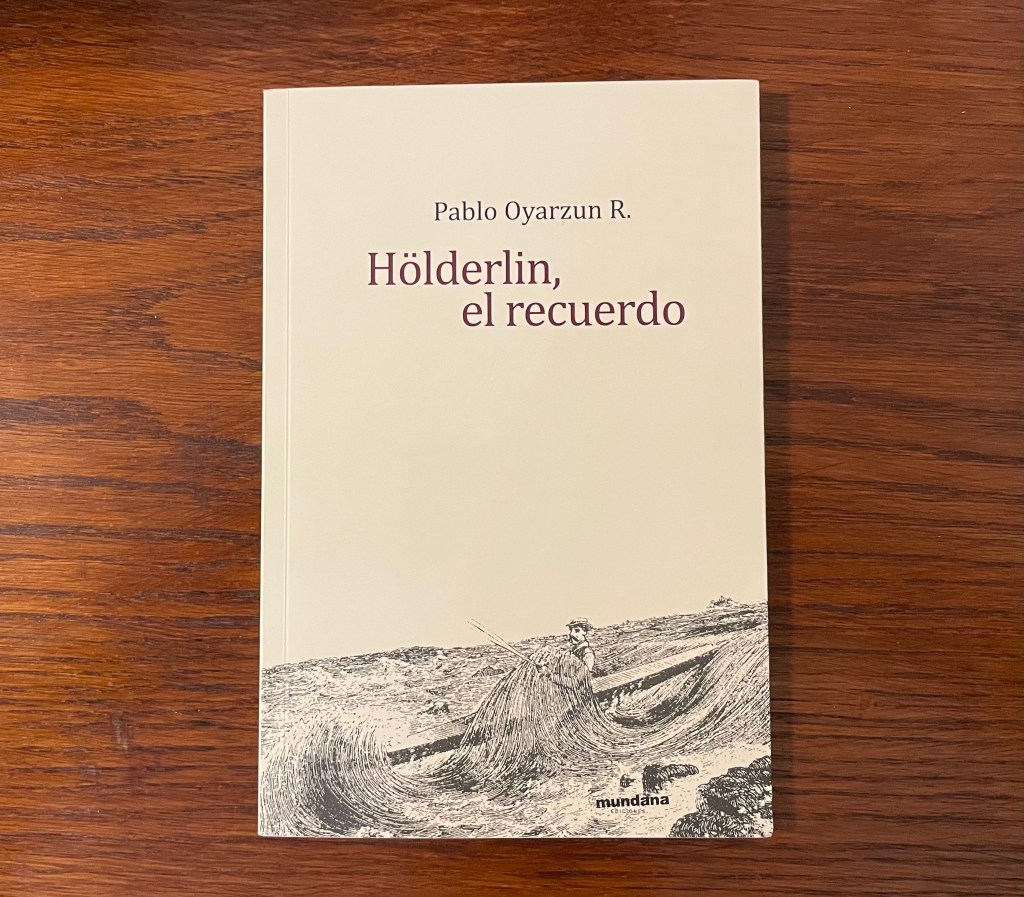
Enamoured psyche. On Pablo Oyarzun’s Hölderlin, el recuerdo (2025). by Gerardo Muñoz

The concluding verses of Hölderlin’s “Andenken” (“Rembrance” or “Memoria”), “Yet what remains, the poets found” stands as one of the preeminent testaments of modern poetry, and in Heidegger’s famous characterization, as a declaration of the task of the poet. At least since the time of Stefan George and Max Kommerell, the figure of poet or Dichter, a hyperbolic figure of illumination and guidance caught in the net of poetry and philosophy, was already dependent on Hölderlin’s mysterious words. What remains in what the poet remembers and clears for foundation? What is the relationship between remembrance and what is ‘found’ or ‘established’? “Andenken / Remembrance” is a hymn from the late period, which means that it must be read in consistency with Höderlin’s poetological framework as it reaches its maximum degree of intensity in its declaration and deliverance. Pablo Oyarzun’s most recent Hölderlin, el recuerdo (Mudana ediciones, 2025) is a powerful and subtle contribution to the understanding of this poem that measures up to the task in its attention to lexicon and structure, metaphysical condensation, and the vortex of ‘memory’ that discloses the poem. One of the merits of Oyarzun’s philosophical hermeneutics, if we can call it that, resides in its refusal to incorporate philosophical doctrines to inform the major questions of the hymn; rather, he favors the very unfolding of the poem ramping its internal structure for possibilities (Oyarzun 18-19). Rereading “Remembrance” opens a path between philosophy and poetry in the dawn of the realization of metaphysics, whose price was paid by crushing the possible and the voice of the poem. 

For Oyarzun the poet’s remembrance is that of appropriation of what is proper, and thus inappropriable, and to which the hymn can only ‘thank’ in the way of thinking as figure in the face of the unfathomable. Following Heidegger’s reading to a point, to give thanks is also to welcome and greet that lets humans and things be in their truth; since greeting always assumes otherness as foreign into presence (Oyarzun 29-30). And in presence life acquires texture, depth, singularization, but also conversation; a reminder that will control the rhythm of Hölderlin’s hymn. What is brought to presence, then, is neither a possession nor a legible inheritance, but the non-synthetizable modulation of what is proper in virtue of being absolutely alien (Oyarzun 34). What is recalled in this poem that remembers and thinks the unthinkable? Is it just a stage for Hölderlin to poetically transfigure his well known travels in Bordeaux? Oyarzun tells us that even if that is to be taken into account, the foreigner path is only essential as a way of homecoming, making the site (and song) into the hymn (Oyarzun 42). There is relation to the absolute other, but only as transitory to becoming and divine destiny in the world: “…el espíritu ama, porque precisamente así, ensa autoalienación puede transitar a lo otro que lo otro, es decir, apropiarse de lo propio […] el pensamiento del Ereignis está condicionado estructuralmente poesía ex-propiación, por ese retraimiento, distracción o retiro (Entzug), solo puede el cual se da lo propio (Oyarzun 54-55). Höderlin’s poem sings from the lacuna of its own expropriation of the abode. And that abode is ultimately the unworking of remembrance and memory that is defaced in being absolutely intimate and irreducible.

In order to elucidate the contours of this memory and its oblivion, Oyarzun follows Dieter Heinrich observation that: “este movimiento [of remembrance as transcendence] conocedor de su propio curso y a la vez desviado del mismo, aspirando a un conocimiento en que algo perdurable (lasting), con gratitud, reine aún en la superación – esto es remembranza” (Oyarzun 61). What is remembrance if not what unweaves time? It is not an actual faculty of human psychology, nor a spectral incorporation of a missing object; rather, it is the non-syntheizable partition between language and the wound of existence; a separation that is only redeemed in the way of remembrance that deposes an ideal recollection of missing facts in preparation for recomposition. Oyarzun’s reading will depend on clearing the notion of severability as a condition for remembering and forgetting as it makes an entry into the poem’s final verse about the “fixating eyes of love” (den Blick heften). Helena Cortés Gabaudán translates it as “y el amor también fija aplicadamente los ojos” [1]. “Y también”, “but also”, a conjunction of persistence that Oyarzun reads as an inexorable attachment to memory and separation, and the memory of separation (Oyarzun 68). Because there is no sliding towards remembrance without departure, coming into the presence welcomes the memory that, in that very moment, has transformed our souls. 

Ultimately, for Oyarzun the vortex of Hölderlin’s “Andenken” is love understood as the supreme citation that enacts the place of both thanking and remembering: “Amar es recordar, frecuentar con el recuerdo (el pensamiento), lo amado, incluso allí donde lo amado está presente, porque así lo resguarda de la mera posesión y agradece su presencia. Amar es pensar-en, un modo, tal vez el más entrañable, de Andenken, amor” (Oyarzun 73-74). And this means that what remains and endures, as Adorno observed in his well known essay on parataxis in Hölderlin’s late poetry, is neither of the logical nor of the temporal indexes, but the event of language as originary creation and donation without contestation (Oyarzun 77). This is the instance where Hölderlin’s strange case of the divinization of the word – and this is the particularity of the hymn form, an element that is never teased out by Oyarzun – becomes absolute and intransigent. It is Höderlin’s absolute proximity with the classical world, but also its radical separation in the post-mythical world of dissenchantment. It can be said that that what endures ‘thanks’ the love of remembrance in its persistence of the word that does not allow history and the crisis of tradition: “en nombre de la cosa que queda, en la fragilidad de su tiempo, que es ese mismo quedar” (Oyarzun 79). 

The poem becomes the verbal and sayable site where the poetizing resides, as well as the greeting and farewell of departure, just like the spectral sailors of the poem. What endures intimately can be called love as a form of the immemorial (Oyarzun 80). And that is because in inscribing, or holding on to the irreducible origin, poetics becomes the supreme form of love – the love in separation – of an expropriated language that welcomes us home in conversation with friends. This attests to the spirit of Hölderlin’s well known letter to his friend Böhlendorff in 1802: “A los artistas les hace falta la psyche entre amigos, el nacimiento del pensamiento en la conversación y la carta. De lo contrario, no gozamos de nada de esto para nosotros mismos” [2]. And this intoxicated love in language that departs from separation situates Hölderlin as radically different from the Chirstian agape and its bond of perfect unity for securing salvation (Colossians 3:14). A salvation that Hölderlin overcame in the drama of Empedocles, enacting the impossible incorporation of the aorgic physis through the writing of the tragic myth. 

Now we are also able to understand why Hölderlin transited to the hymn as the supreme form of the poem; not because because it is the origin or its last stage, but a suspension of language retrieved is gathered in the two moments of salutation and farewell, celebration and lamentation [3]. The hymnal dimension of the poem becomes language as such, which Oyarzun calls the immemorial without ever alluding to the notion of hymn. Indeed, the love of remembrance only becomes possible as a disjointed factum of experience anchored in its abyssal noncorrespondence  (Oyarzun 84). Thus, to remember is to love the caducity of life – “este ya no es la signatura indeleble del amor”, as beautifully expressed by Oyarzun – in a world in which the testament of language awaits no resurrection. 

Notes 

1. Friedrich Hölderlin. Poesía esencial (La Oficina, 2017), Trad. Helena Cortés, 129. 

2. Friedrich Hölderlin. Correspondencia completa (Ediciones Hiperión, 1990), trads. Helena Cortés & Arturo Leyte, 554. 

3. Nicoletta Di Vita, Il nome e la voce: Per una filosofia dell’inno (Neri Pozza, 2022), 246-247.

“An angel passed by”. by Gerardo Muñoz

In the Spanish language there is a wonderful idiom that has gone out of fashion in our times to express a sudden silence: “ha pasado un ángel”, or an angel passed by. The phrase is commonly used whenever a sudden silence imposes itself in the middle of a conversation, which leads to obvious discomfort and embarrassment among those engaged. It is almost as if the invisible angel reminds human beings that conversation rests as much in words as in silence; and that the shadow of silence sooner or later interrupts any communicative practice. According to historians and lexicographers, the inception of this idiom into Spanish remains a curious enigma, since although used in early modernity it does not have a Latinized version, and its origins can only be traced to classical Greek antiquity. In fact, Plutarch notes in his De garrulitate that whenever silence is introduced in a meeting it is said that Hermes has joined the company [1]. The angel thus stands for the nonpresence of language in language, just like an icon is the sublimation of presence in pictorial representation. 

We know that in Antiquity the angel as a minor divinity (angeloi) was a mediator between heaven and earth, only that in that moment that an ‘angel passed by’, it is not all clear on which side is there heaven and where earth [2]. In his beautiful book Angels & Saints (2020), Eliot Weinberger reminds us that for Saint Augustine the angels were first and foremost original gardeners of Paradise – given that they are free from felix culpa and sin – and that they are messengers between the living and the divine, as documented in the beggar Lazarous carried by angels to the bosom of Abraham [3]. Here it seems that the invisible inception of the angel relates fundamentally to the dead and conclusion, which also carries its aspiration in the lacunae of a conversation that reaches an impasse, and that for a moment effectively dies. 

The angel that accompanies the dead and the poor – and thus our structural poverty in language, being in the language that always lacks a grasping signifier – is also confirmed by lexicographer Alberto Buitrago, who in his entry on the idiom writes that the expression has its origins in the fact that in antiquity whenever a dead person was mentioned or brought up in conversation there was a silence held, because it was thought that his “spirit” (his angel) had become present in its nonpresence of language [4]. Although Buitrago does not provide any documentation for his assertion, it does bring to bear that whenever we are in communication, whether we like it or not, we are in the communion of angels that are expressing the soul of the dead through the litany of their names. 

This is why Antelme could suggest the similar enigmatic notion that being powerless and in poverty means to ‘have to forever be’ in a silence adjourned so that language can continue speaking. This is why perhaps the irruption of authentic silence has the effect of a certain petrification of the human expression, as masterfully captured in Velázquez’s Apollo in the Forge of Vulcan (1630). It is through silence that we encounter the divinity that for a moment places itself outside of language in order to contemplate it, letting the angel make his entrance. The language of computational machines is not only a language that has renounced its poetic and ethical instance; it is also a form of gated communication that has expelled itself from the angelic visitation of its own contemplation. 

Notes 

1. Plutarch. “Concerning Talkativeness” (De garrulitate), Moralia 6 (Loeb Classical Library, 1939 ) 502F.

2. Paula Fredriksen. Sin: The Early History of an Idea (Princeton University Press, 2012), 54.

3. Eliot Weinberger. Angels & Saints (New Directions, 2020), 30. 

4. Alberto Buitrago. Diccionario de dichos y frases hechas (Espasa, 2007), 333.