Language as a garbage heap. by Gerardo Muñoz

There is an extraordinary description in Jorge Luis Borges’ “Funes el memorioso” that depicts his state of absolute nominalism as literally a landfill, a pile of trash. We read the following: “Y también hacia el alba: mi memoria, señor, es como un vaciadero de basuras”, which James Irby translates as “My memory, sir, is like a garbage heap”. The absolutization of memory without oblivion and forgetting renders all the possible and imaginable names as already present, but also useless to the point that they cannot be voiced, let alone retained at a distance. The world of Funes is analogous to that of the advanced world of technology that we are currently experiencing at an accelerated pace: the so called Artificial Intelligence remembers every name and all entities as if it were picking up items from a landfill container. It does not really matter if the names picked are correctly or falsified; it is precisely that naming as such no longer has any enchantment that is only granted by the divinity of the voice. As language becomes contained as a “heap of garbage” any relation between remembrance and the human voice that for centuries had been the source of affection is eliminated. 

Exactly two decades after the publication of Ficciones (1944) in his Seminar of Le Thor, Heidegger will also take note of Heraclitus’ Fragment 124 in relation to a heap of garbage as a definition of the cosmos: “…in its complete appearing as fire, “the most beautiful ordering of all is surely comparable to a heap of randomly spilled garbage. This means that the innaparent joining together is superior to every visible ordering, even if it is the most beautiful possible (fragment 54)” [2]. The emphasis is placed on the order of the random that in its inappearance discloses appearance as order (κόσμος). Immediately Heidegger notes that the archaic notion of “world” in Heraclitus, his “heap of trash”, is radically different from the standard of the world today that secures all possible predictions and calculation, where there is room for everything insofar as every-thing is taken as an extension of energy. 

This garbage heap realizes itself through the force of “speaking” in the name of technological orderability, efficiency, and promises of economic growth. The new order of the world as trash is proportional to the slow erosion of language that in its accelerating caducity loses its capacity to remember and forget. It goes without saying that in our present, and especially in the United States, the educational and academic institutions have been at the helm in the process of facilitating this compulsive destruction of language and memory, which evidences the intimate liaison of the technician and the pedagogue in the configuration of the immonde

Borges’ Funes will ultimately die from a pulmonary congestion, which is a testament of death in spite of the horror of a language incapable of naming and letting go. And in his lecture, according to the transcription of one of his students, Heidegger concluded with this recommendation: “What remains essential is to continue along the same path without having concern for any of the publicness around us”. A hidden and conjured language would be the only last standing order, a keeper of truth and beauty, because unlike the machine it voices the names while also exposing itself to the possibility of forgetting them.

Notes 

1. Jorge Luis Borges. “Funes el memorioso”, in Ficciones (Emecé, 1958), 76.

2. Martin Heidegger. “Seminar in Le Thor 1966”, in Four Seminars (Indiana University Press, 2012), 8. 

On American language. by Gerardo Muñoz

Towards the fourth part of “A language of New York” included in This in Which (1965), George Oppen registers something like the ultimate struggle of the poet with its nemesis: language itself. Fully aware of the erosion of language of his time, Oppen writes in these verses both a warning and a strategy: “Possible to use / Words provided one treats them / As enemies. Not enemies – Ghosts Which have run mad / In the subways / And of course the institutions and the banks. If one captures them / one by one proceeding / Carefully they will restore / I hope to meaning / And to sense” [1]. The polemic against the darkening automation of language, the public consolidation of kallopismata orphne, is resolved through a possibility of use that is redirected elsewhere, at least away from the nihilism of vicarious denomination and exchange. 

This “possible use” is perhaps nothing else than the treatment that language receives in the voice, which becomes its ultimate speaking experience. If language is always outside and beyond itself, always exceeding its meaning and place, it is because its trembling tonality cuts through both meaning and sense. The construction of the concluding verse cannot be dismissed: “Carefully they will restore / I hope to meaning / And to sense”. Oppen fails to place hope as action towards a higher entity (meaning and sense); rather he sends the poetic voice to meaning and sense. The redemptive quality of language is to be found in this fall and trembling of the voice that, because it has interrupted both meaning and sense, it can inhabit a state of bliss or perpetual hope. In other words, hope is not just an affective state of human being, but a possible turn, a necessary one, in which language is appropriated in all of its impropriety. If words had to be treated as enemies it is precisely to be redirected to the swirling vocative current that divides meaning and sense as the ultimate region of the poetic being where there is no longer a struggle. 

The catastrophe of Americanism is not just a political or economic reality, one that runs through being in language insofar it is understood as the vision of the use of the voice. Oppen was fully aware of this calamity when writing to William Carlos Williams that “there will be no poetry in America only insofar as that lesson is learned. People who are afraid to talk will not produce much poetry” [2]. It goes without saying that Oppen was not thinking of a new renaissance of poetry and literary producers, but just of the poetic being as one that subsists in the chiasmatic relation of language and voice. 

And if American subjectivity today has given up entirely on the use of its language – a use that is increasingly delegated to machines and telematic automation  – it is precisely, because already historically they ceased moving into “hoping to meaning and sense”. This does not mean that we Americanism strives in absolute muteness; on the contrary, running away from sense means the plugging of meaning into sense and of sense into meaning, which is the definition of the construction of argumentation. And argumentation is the delivery of force in the interiority of language. When Adorno & Horkheimer once defined the United States as “the country of argument” they touched something profound [3]. It is only when language is ripped from argumentation that poetic possibilities are restored, and perhaps also redeemed.

Notes 

1. George Oppen. This in Which (New Directions, 1965), 25.

2. George Oppen. The Selected Letters of George Oppen (Duke University Press, 1990), 39.

3. Theodor Adorno & Max Horkheimer. Towards a New Manifesto (Verso, 2011), 51.

The love of painting. by Gerardo Muñoz

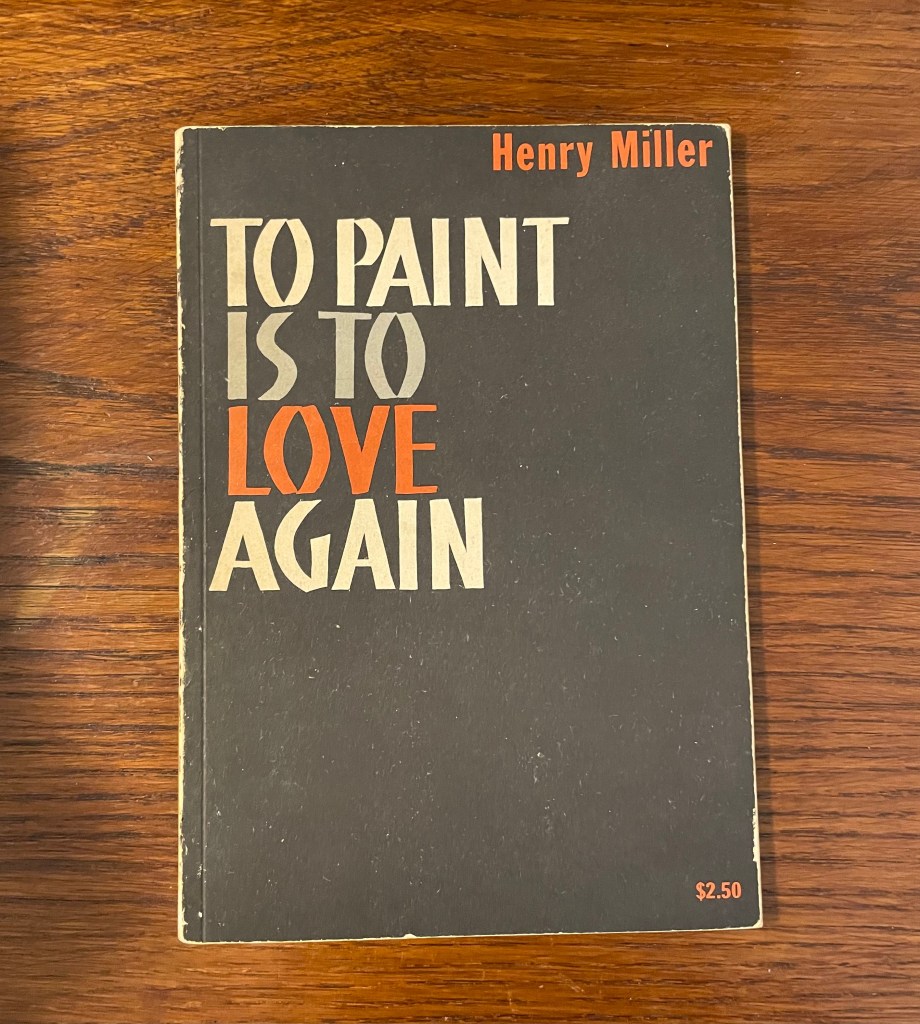
There might very well be an internal affinity between painting and love that at some point it becomes indistinguishable. A painterly picture can become love unquenched for that which remains persistently fixed and unrealizable. In one of the short essay books of his Big Sur period, Henry Miller asked this very question of painting. For him panting had a wondering origin that crosses the hand, undoing what we can easily enact. The erotic dimension of painting, thus, has nothing to do with the image or figure of the beloved, but rather with a specular limitation staged in the ability to allow the unseen to be incorporated in the visible scheme of the world. Only if we are able to see – and by the same token, only if there we are facing an event of painting – can something like use can be liberated from the constraints of mimetic compulsion. Miller writes in To Paint is to Love Again (1960): 

“To paint is to love again. It is only when we look with eyes of love that we see as the painter sees. His is a love, moreover, which is free of possessiveness. What the painter sees he is duty bound to share. Usually he makes us see and feel what ordinarily we ignore or are immune to a certain manner of approaching the world tells us, in effect, that nothing is vile or hideous, nothing is stale, flat or unpalatable unless it is our power of vision. To see is not merely to look. One must look-see .See into and around. Or, as John Marin, once put it – “art must show what goes on in the world” [1]. 

The place of painting for Miller is an imperturbable state that refuses to be fixated on objects, but in the invisible region (as in the figure of the chora) that allows for the thing in the world to be used. This is why Miller considered Japanese watercolor and prints an absolute primer of the pictorial: it taught him the appearance of worlds within the world, regionalizing the surroundings never logically stated unto itself, which in modernity it became the catastrophic horizon of autonomy towards its posterior liquidation. This is why Miller, very much like Carlo Levi, understood that the crisis of painting in the Western tradition ultimately signaled a general sense of social terror as a new phase of human desperation attenuated by the circulation of social fictions. 

At the height of the the closure of civilization, painting reemerged, if Kurt Badt’s axiom is correct, as the last metaphysical activity of human praxis. A metaphysical activity that holds on to the experience of belief in suspended appearance of originary anthropogenesis. For Miller, in painting as much as in love “one must be a true believer” [2]. And this assertion must be understood in the backdrop of Miller’s experiential retreat in the landscape of Big Sur: an experience away from the closure of American city life in research of a “feeling of aloness as spiritual achievement”, as a relation of oneself towards disclosure [3]. In this sense, the painter is a counter-social figure that, refusing to make stir in the world, turns to serenity, silence, and to the pressing contours of the unfathomable beyond any prefiguration. The believer in painting – who is a figure of belief in the desert, after the flight of the gods in the nocturnal vigil of history – is the thrust to the experience of things without barristers or shortcuts to what is revealed.

The age of automation in mid-century transformation of American industrial production serves as the historical backdrop of Miller’s indictment regarding the poverty and eventual disappearance of painting due to the autonomization of human praxis and the gigantic scale in spatial organization. Following Georges Duhamel’s prognosis in America: the menace (1931), he shared the intuition that the crisis of dexterity meant the impossibility of realizing painting, now situated beyond the grasp of human absorption [4]. A land without landscape that, as Adorno noted, bears no traces of the human hand. And this was seen already in the 1950s when the rise of abstract expressionism in North American announced not just the end of easel painting, but the funeral of the whole pictorial tradition. The barbarism of gigantic and unlimited Americanism would run counter to painting as a sensorial activity that embraced the vital limitations of its region. 

Miller’s insistence on painting was an eulogy to a life as experience – painting is indistinguishable from the hands and souls of the painters that he encountered and shared his life – and the value of poverty as absolute necessity for a life that regionalizes our contact with the world. It was through the love of painting that humanity could only restore its divine presence without rest.

Notes 

1. Henry Miller. To Paint is to Love Again (Cambria Books, 1960), 17. 

2. Ibid., 39

3. Henry Miller. Big Sur and the Oranges of Hieronymus Bosch (New Directions, 1957), 34.

4. Georges Duhamel. America: the menace (Houghton Mifflin, 1931), 85.