The ostrich as symbol. by Gerardo Muñoz


A couple of years ago I wrote the prologue to accompany the new edition of the almost forgotten novel Vendaval en los cañaverales (La Habana, 1937), by the reactionary writer Alberto Lamar Schweyer. I entitled the text “Avestruces en Niza”, since half of the novel, or almost all of it, takes place in the French riviera, where a bunch of decadent upper middle-class bourgeois couples live off the revenue of a transnational sugar-cane production and exports company based in the eastern part of Cuba. Written at the height of the convoluted years of the 1930s – as political turmoil intensified and the economy plummeted, putting an end to the recurrent developmentalist dream – it was not too difficult to read the ethos of this important work in light of the famous lecture “Cubano, avestruz del Trópico” (“The Cuban, an ostrich of the Tropics”, 1938) by eminent intellectual Enrique Gay Calbó, who deployed the figure of the bird to diagnose the obliviousness to economic reality and the short-term disposition (“cortoplacista”) of the national anthropological subject. The essay has been read, at times, under the framework of a pessimistic outlook towards the aspiration of amending a truly republic after independence, but at the same time, and all things considered, it should be also read as a metaphorical attempt to denote the ethos towards abstraction of the ruling criollo elite that would accelerate its compensations through direct coercion and acerbic pro patria mori rhetoric. Lamar, who belonged to this intellectual class, was able to provide a narrative form to these elements of the national interregnum, without introducing allegorically, the figure of the ostrich. And it is impossible for him to have known of Enrique Gay Calbó’s metaphoric resource, given that the lecture was delivered in April of 1938.

However, the ostrich was not accidental, and some of these details were unknown to me while writing the prologue to the edition (hence this sui generis addendum). Indeed, the ostrich was no exotic animal in the new minted Republic of Cuba, since as early as 1906 there were active ostrich farms in Marianao, Havana, financed by an American company from Arizona [1]. To my surprise, the mini report from The Cuban Review and Bulletin stated that half of the ostriches came from Nice, France. It would make sense, then, why Jean Vigo’s silent beach documentary À propos de Nice (1930) in truly natural fashion, featured a montaje of a fur-dressed lady with that of a strolling ostrich across the Promenade des Anglais, the same boardwalk used by the characters of Lamar’s novel. But what could Vigo’s momentaneous, and almost dream-like ostrich tries to tell us? Unlike Gay Calbó’s bird, the Promenade ostrich is no longer burying her head on the ground, but rather looking perplexed at modern bourgeois world, quite disoriented and visibly alienated among the frenzied crowd of strange and oblivious tourists. This is no world for an ostrich, and the moment she appears on the screen she is gone. Or at least this was Vigo’s playful cinematic gesture: the “new world” of the 1930s was soon going to be transformed into something radically different underneath the gaming, the sporting, and the consumerism.

Furthermore, the ostrich as a symbolic creature occupies a sort of threshold between transitional epochs. In a beautiful book dedicated to the arcanum of this animal in Raphael’s fresco at Sala di Costantino at the Vatican, Una Roman D’Elia reminds us that the idea of the ostrich as the cartoonist semblance of a bird sticking the head in the sand marked the new Renaissance mental structure that separated art and science in a new world now dependent on the self-assertion of anthropocentric conception [2]. However, what was enigmatic and attractive (and it continues to be) in Raphael’s ostrich is precisely an intermingling of the ostrich as arcana that converged mesopotamian, Egyptian, Hebrew and Roman bestiaries, and Christian religious history in a thick living creature that was both a myth and an animal of this world. A true symbol of imagination that brings to an end the modern conception of figurative expression and animal taxonomy. This is why even Saint Augustine could allude to the ostrich along with sirens – “Sirens daughters of ostriches, why should they bless me?” – who were called filae passerum by Plautus because they were imported from Africa, that is, from overseas [3]. The ostrich was the animal of passage between land and sea. In a clear parodic unfolding of symbolic meaning, what at some point cultivated imagination, myth, and the distance with the world was transformed into a large bird for farming, and converted into a metaphor of the deleterious effects if the constitution of reality is ignored.

In this forking of paths, it is true that Raphael’s ostrich is no longer a clear symbol to transmit a myth; on the contrary, it becomes a metaphor open to meaning (a meaning which will soon become extraction: feathers, egg production, zoology, and finally anthropological metaphor). For Roman D’Elia, the ostrich claimed a “higher mystery” in its own evasive force that resulted in the tensions between naturalism and meaning, symbol and representation, justice (iustitia) and the creations of the world. Was the ostrich a pagan incarnation of “Justice”, or perhaps the mannerist morphology of the all-encompassing judge’s majestum, that is both tender and imposing? Or is perhaps is the ostrich iustitia the last form of justice, at the eclipse of this world, that is, an messianic figuration towards the end of days and the banquet of the mythic primeval monsters (Leviathan, Behemoth, and Ziz)?

As Lois Drewer draws in her interpretation of the three mythic creations from the Talmud: “Once the egg of a Bar Yokani [an alternate name for Ziz] fell and its contents swamped sixteen cities and destroyed three hundred cedar trees. But does it actually throw the egg? Is it not written: ‘The wing of the ostrich beateth joyously’ [Job 39. 13]. The egg [which it smashed] was rotten” [4]. Could the ostrich be understood as the mythical Ziz, who unlike the monsters of the nomos of the Earth (Leviathan and Behemoth), refuses to engage in the depredatory game in order to save itself for the celestial messianic banquet of eternal life? And if this is so, then the ostrich, instead of a creature of this world, is the last animal of the world who takes under its wing the absolute accomplishment of Justice that coincides neither with the principle of the aequitas of nature nor with the constitution of reality, but rather with what is vanquished in the modern spirit: mainly, the erotic mystery of the separation of life and the world. The ostrich was not in itself mysterious, but perhaps more fundamentally a keeper of the eschatological mysterium.

.

.

Notes 

1. “Ostrich Farm in Marianao”, The Cuba Review and Bulletin, Vol.5, 1906, 23.

2. Una Roman D’Elia. Raphael’s Ostrich (Penn State University Press, 2015). 

3. St. Augustine. The Works of Saint Augustine: Sermons on the Old Testament (New City Press, 2011), 410.

4. Lois Drewer. “Leviathan, Behemoth and Ziz: A Christian Adaptation”, Journal of the Warburg Institutes, 1981, V.44, 1981, 152.


Karl Barth’s suum cuique. by Gerardo Muñoz

In his chapter on the radical theology of abundance and ethics of Karl Barth, Mårten Björk discloses a central concept to the reformist theologian: the suum cuique, a term that prima facie could be rendered in natural law definition of legal justice, inherited from Roman lawyer Ulpian, as “may all get their due”. In the thomist tradition the legal notion of epikeia promptly became equity as the moral supervision of law’s principle (ius) understood as the application of the fair and the objective good. The justification of the balancing of aequum became a regulatory mediation on the grounds of a fictive principle of nature as moral reasoning, which has been well documented by Stephen Humphreys [1]. What makes Barth’s drawing on the notion of suum cuique in his interwar pamphlet Church and State (originally entitled Justification and Law, 1938), on the contrary, is precisely that it is not reducible to equity, but rather as Björk explains it: “the limit to our life, a limit brought forth by death itself, is in the end the vast chams that posits the creature as create of God…and this has ethical and political consequences” [2]. This is telling, and my aim here is to supplement the discussion in “Abundance and Scarcity” by showing its radical asymmetry with the reasonableness of the natural law. Barth’s anti-activist Church (although not neutral in the wake of the total state of the 30s) and apathy towards morality, stands as a sui generis bearing.

First, in the moral natural law tradition of equity (epikeia) “giving each one their due” becomes a strict legal-authoritative command principle on the reasonableness of nature centered on the ontology of the person. It is quite the opposite for Barth who does not favor a constant moral adjudication, since the separation between Church and State presupposes a previous divine justification that belongs exclusively to the Church, but not to the state. In fact, law practiced on the condition of natural principles will undermine the authority of the liberal positivist state, which Barth defends vehemently, making the case for its coherence with the teachings of the New Testament: “The democratic conception of the state is justifiable expansion of the of the New Testament…Christians must not only endure the earthly state but they must will it as a just state, not as a “Pilate” state” [3]. It is not surprising, then, that Barth wrote this tract openly defending the authority of the modern positivist state, contrasting it to the anti-statist unjust pretarian judgement of the trial of Jesus. This makes sense given that the pretorian ius honorarium could be understood, at least in part, as belonging to the tradition of the moral balancing of equity between morality and norms (just as the two irreducible kingdoms) [4]. Barth’s defense of the positivist state is even contrasted to natural law, which for Barth is incommensurable with the word of God: “We cannot measure what law is [in the State] by any idea of natural law…” [5].

Accepting the primacy of the equity of a substantive bonum will not only serve to override the authority of the state, but also, and more importantly, to flatten out theology’s monopoly over divine justification. At this point Barth is quite explicitly in saying that this is what took place – and I think he is correct, specially if we take into account that the degenerate legality in Nazi Germany and Stalinist Russia was not an abuse of positivism, but a consequence of the open-ended common and natural law principles to the point of distortion – in the wake of fascism and Bolshevism in the interwar years of Europe. Barth writes with this in mind against artificial heavens on earth, as part of a hyperbolic “politicizing from above”:

“Fascism and Bolshevism alike will be dethroned and the true order of human affairs will arise. Not as heaven (not even a miniature heaven) on earth! No, this “true order” will be able to arise only upon this earth and within the present age, but this will take the place really and truly, already upon this earth, and this present age, in this world of sin and sinners…this is what the Church has to offer to the state…” [6]. 

The political domination of the total state amounted to a conflation between the lapsarian condition of man and the theology of eternal life. The passage or mediation between the two dimensions, which he also described as a “tailor made garment” was the suum cuique, understood as a limit to life and death beyond morality and biological reductions. Barth insisted on the principle of separation in face of every temptation of technico-rational closures. Thus, by externalizing divine justification to the sphere of theological eternity, Barth’s conception of “giving one’s due” was radically disambiguated from the Nazi motto “Jedem das Seine” (to each his own) in the concentration camp of Buchenwald in 1937, made possible by the opened force of common law adjudication against the state positivist authority (understood by Nazi legal scholars as “too Jewish”). This was the barbaric dereliction of duty of the state becoming what Barth called a “clerical state” [7]. Barth’s ethical limit on finite and eternal life, so well reconstructed in Björk’s brilliant monograph, can only be a witness to a ‘world passeth away’ to which no priestly jurists have the last word unless catastrophic consequences are expected. The ethical response to the lapsarian condition was a radical drift from the dangers of natural absolute rationalism that was directly implicated in the arousal of immanent powers and the reduction of the population as mere administration of doctrine of last things through consciousness and not grace. The suum cuique introduced a radical exteriority in which all men became “strangers” (to the Church, national identity, the community, to the social) whose proper involvement pertained to the eternal mystery of life and death.

.

.

Notes 

1. Stephen Humphreys. “Equity before ‘Equity’”, Modern Law Review, 2022, 1-37.

2. Mårten Björk. The politics of immortality in Rosenzweig, Barth, and Goldberg: Theology and Resistance Between 1914-1945 (Bloomsbury, 2022), 115.

3. Karl Barth. “Church and State”, in Community, State, and Church (Anchor Books, 1960), 146.

4. Gerardo Muñoz. “El pretor romano y el ius honorarium”, Infrapolitical Reflections, 2022: https://infrapoliticalreflections.org/2022/04/24/el-pretor-romano-y-el-ius-honorarium-por-gerardo-munoz/ 

5. Ibid., 147.

6. Ibid., 148.

7. Ibid., 132.

The faction difficulty. by Gerardo Muñoz

The central contribution of American republican political thought is arguably the way it found a solution to the problem of factions, a legendary difficulty that not only has not disappeared but rather intensified in our present. For the enlightened republicans of the eighteenth century, well versed in the classical tradition and the histories of Florentine medieval strife, factionalism was the cardinal difficulty of social order; how to best deal with conflicting loyalties and the perpetuation of violence for virtuous and at times times even springing from “idleness and courage of the youth”, as told by Carol Lansing’s scholarship [1]. The existence of differences and cleavages in the society ultimately meant the brewing of an ephemeral coalitions and private masters, which, in turn, often resulted in the thorough expulsion of the enemies from the polis. These unregulated clashes of authorities and private actors was called by the fourteenth century jurist Bartolus of Saxoferrato a seventh form of government mixture: a “monstrous government”. The problem of faction will emerge for the moderns as the condition that prompts the articulation of a governmental rationality capable of constructing the homogeneity of social living. In other words, the modern classical homogeneity of the civil society is the creation of the domestication of factions as social grouping units to be obtained and arranged as an indirect power from within to transform ‘barbarism’ to civilization. David Hume’s political writings – and in particular his “Idea of a Perfect Commonwealth” (1752), which was highly influential to the Federalists, understood that the threat is of “factions” required a new framework: politics had to be reduced to a science [2]. What could politics as science entail? We are not yet in the administrative rationality and professional political vocation of Max Weber’s sociology. The scientific reduction meant a paradigmatic transformation of classical politics properly understood (virtuous, moral, and just) into an economic determination in which interests took the center stage over the combustion of the passions. The new science of politics implied a retooling of the problem of factions by decompressing the clustered interests of unaccounted and disloyal factional expansion under governmental action. For Hume the passage from passions to interests entailed a descaling of factionalism on one hand, while an expansion of a robust form of government over a large territory on the other.

However, if for Hume factions are still an impolitical unit of association that must be minimized, it is James Madison in “Federalist 10” who achieves the complete “scientific” aspiration of political construction over factions as inseparable from the Social ahead of the industrial modern economic division of labor. In fact, as Douglass Adair reminds us, this particular essay of the Federalist Papers only became important towards the end of the nineteenth century in the wake of industrialization and economic power groups; that is, at a moment when indirect economic powers began to exert their influence into the institutional and regulatory composition of the state [3]. One could say that it is only at the outset of the triumph of economic “Americanism” that the Madisonian framework on factions is situated in its proper tripartite structure: factions are conditioned by positive liberty and make up the totality of the economic interests that make up civil society. Indeed, for Madison factions as expressions of the nature of man, and their existence detail degrees of activities in civil society [4]. In a way there is no civil society without factions, and there are only factions because there is civic Liberty.

Madison even constructs a naturalist analogy: what unrestrained Liberty is to faction, air is to a propagating fire. The activity and energy of factionalism is exclusively understood as one of economic interests which, insofar as it is conditioned by positive, differentiated, and unregulated liberty that expresses the unequal distribution of property that characterizes the essence of the social. The new science of government in this framework becomes clear: the end of government is neither properly about political enmity in relation to the state nor about suppressing and limiting factions, but rather about the optimization of the effects of factions. Madison writes in the groundbreaking moment of “Federalist 10”: “The interference to which we are brought is that the causes of faction cannot be removed from that relief is only to be sought in the means of controlling its effects” [5]. The optimized logistics of factionalism displaces the modern hobbesian picture of the sovereign state to a minimalist and compensatory nature to attenuate public order against “local and particular state legislatures” [6]. The optimization of factions now appears as the dominant aspect of a fundamental cybernetics that seeks to isolate, fragment, and juxtapose the conflagration of factions without losing the barring of state energetic durability. The faction difficulty lays bare the arcanum at the center of the res publica politics: the administration and reproduction of civil conflict.

The consolidation of the cybernetic solution to the faction difficulty emerges as an upgraded version of state auctoritas whose aim is to establish a balance between public opinion as distrust over “dispute”: “communication is always checked by distrust in proportion to the number whose concurrence is necessary” [7]. If communication becomes a strict science of regulating the means of expression (itself a medium), political authority is superseded over a constant war over words and force of exchange. This means that rather than putting an end to the stasiological tension through a political mediation of the state, the problem of faction reveals that stasis becomes an instrument to manage effects, produce legislative, and translate interests in the struggle of social differences. It goes without saying that perhaps the modernist differentiation between state and civil society in light of the problem of faction loses its predominance, as an entirely new framework emerges: a monstrous socialization that takes the form of a productive stasiology given that if “men were angels no government would be necessary” [8]. The irony is that the auxiliary precautions of factions is a secularized form (or at least one could trace it to) of the ministry of the angels. This reality demands a new ethic of the passions against both the vigorous indirect struggle of factionalism (and its modern rendition in the party form) and the axiological arrangement of interests that made the foundation of the social community possible.

.

.

Notes 

1. Carol Lansing. “Violence and Faction”, in The Florentine Magnates: Lineage and Faction in a Medieval Commune (Princeton U Press, 2014), 181.

2. David Hume. “Idea of a Perfect Commonwealth”, in Political Writings (Hackett Publishing, 1994), 240-252.

3. Douglass Adair. “The Tenth Federalist Revisited”, The William and Mary Quarterly, Vol. 8, No. 1, 1951, 48-67.

4. Alexander Hamilton, James Madison, & John Jay. “Federalist 10”, in The Federalist Papers (Mentor, 1961). 79.

5. Ibid., 80.

6. Ibid., 83.

7. Ibid., 83.

8. “Federalist 51”, in The Federalist Papers (Mentor, 1961), 322.

A memory of Jean Franco (1924-2022). by Gerardo Muñoz

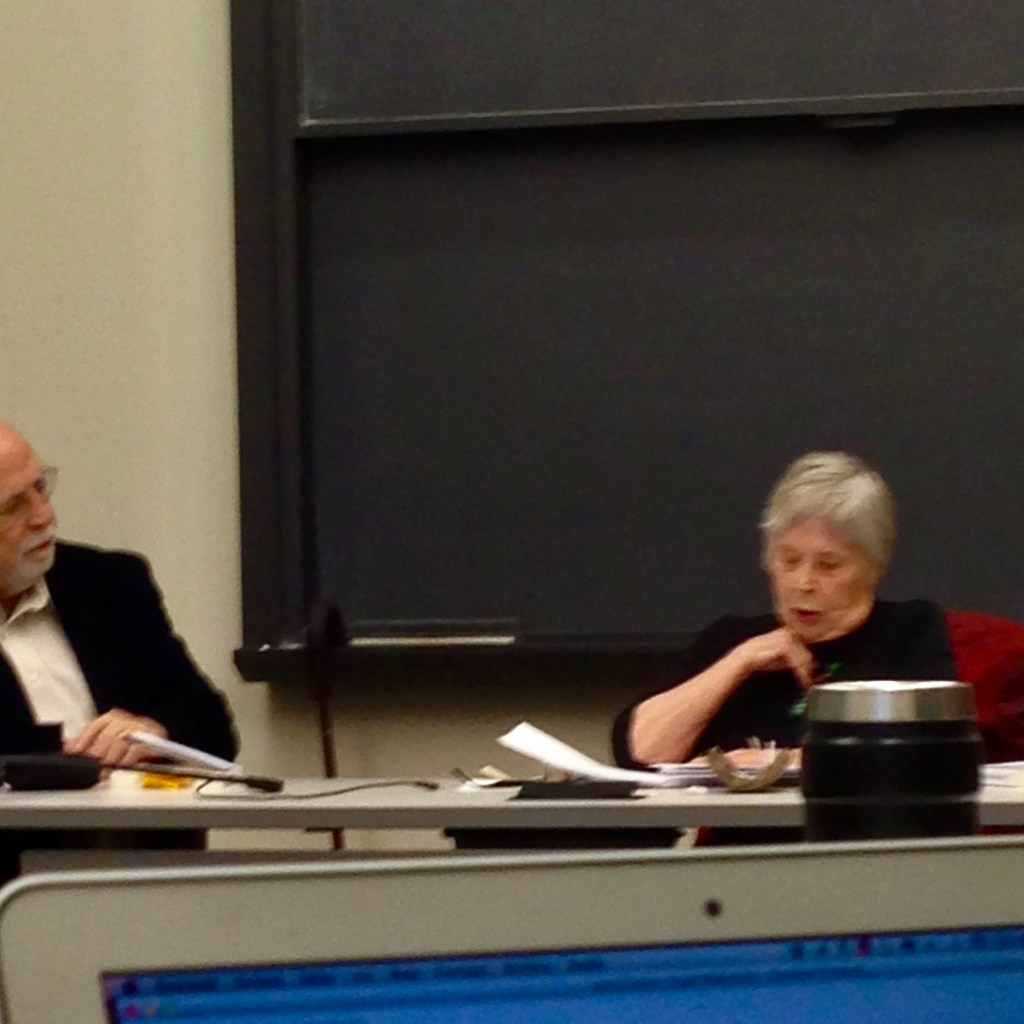
Jean Franco, pioneer of Latin American Cultural Studies and witness to its Cold War gigantomachy, passed away a couple of weeks in December at age 98. She remained lively and curious even at the very end of her scholarly life, and for some of us that saw her in action she embodied the memory of the century. The photograph above is of Jean’s visit to Arcadio Díaz Quiñones graduate seminar in the fall of 2015 where she discussed some of the main arguments of her last book Cruel Modernity (Duke U Press, 2014), a cartography showing the definite closure of the Latin American insomnia for political modernity in light of its most oblique mutations: narcoviolence, the emergence of a dualist state structure, and new global economic forces that putted an end to the vigil of the revolutionary enterprise. I write “definite” purposely, since Jean’s own The Decline and Fall of the Lettered City (Harvard U Press, 2002) already hinted at a certain exhaustion (to borrow the strategic term of Alberto Moreiras also writing during these years), most definitely a thorough disillusion, in the sense deployed by Claudio Magris, of cultural substitution for the belated state-making modernization. The function of “culture” (and its hegemonic state apparatus) was always insufficient, dragging behind, or simply put, unintentionally laboring for the cunning of a project forever postponed in the sweatshop of the newest ideologue, or for the hidden interests of the “local” marketplace of moral academicism. All of this has come crashing down rather quickly even if the demand for culturalist janitorial or housekeeping services are still in demand to sustain the illusion sans reve et sans merci.

What always impressed me about Franco’s scholarship was her intellectual honesty to record, even if through an adjacent detours and academic finesse, the destitution of all the main categories of the Latin American modern wardrobe: developmentalism, state-civil society relations, the intellectual, cultural hegemony, revolutionary violence, the “rights revolution”, and the intra-national spatiality (rural/metropolitan divide). From now on it is hard to say that there is a “task of the critic”, if we are to understand the critic in the Kantian aspiration of sponsoring modern values and perceptiveness to an enthusiastic disposition (definitely optimistic towards action) to transforming the present. As a witness to the twilight of the Latin American modern epoch, Franco univocally resisted the inflationary, value-driven, demand for politicity and ‘more politics’. This is why her attitude remained at the threshold of any given effective political panaceas or half-baked illusions.

Does her biographical experience say anything to this particular inclination? It is difficult to say, although as a witness of the century Jean had lived through the coup in Guatemala in 1954, visited the Cuban Revolution during its most “intense years” of the sugar cane milestone (La Zafra de los Diez Millones), and followed with attentiveness the rise and transformation of the Southern Cone dictatorships in the 1980s coupled with the irreversible social transformation of neoliberalism in the 1990s signaling the effective end to regional integration in the face of planetary unity. All of this to say that I find it hard – at least leaving aside the many nuances – to see in Jean’s scholarly witness an enthusiasm for the Latin American Pink Tide, the communal state, or abstract regional historicizing that could finally bring about the moral universe of the national-popular state (as if said moral realization would be anything worthwhile, which we some of us seriously doubt). If Jon Beasley-Murray once said that John Beverley was the “Latin American unconscious”, I guess it is fair to claim that Jean Franco was an authentic Latin americanist realist; that is, someone that was up to task to see in the face of the tragic, the cruel, and the heinous as the proper elements of the interregnum. Or to better qualify this: she was a worldly realist, leaving aside utopias and its abstractions. At the end end of the day, Leninists are also realists, or at least claim to be so. What places Jean’s earthly realism apart from the Leninist realism is the subtraction from the seduction of Idealization, which even in the name of the “idea” (“the idea of communism”, say) or “immanent higher causes” must bear and render effective the logic of sacrifice at whatever cost, even the real sense of freedom if demanded by the party, the leader, or the community. This is why at the closure of Latin American modernizing enterprise communitarian arrangements, posthistorical subjects / identities, or grand-spaces that mimic the constitution of Earth are foul dishes for a final banquet. It is always convenient to refuse them.


Going back to my conversations with Franco at Princeton, and some exchanges a few months later in a cafe near Columbia University, for her there was remaining only the anomic geography of Santa Teresa in Bolaño’s 2666, a novel that charts the current ongoing planetary civil war in the wake of the crisis of modern principles of political authority. I can recall one remark from Jean during these exchanges: “¿Y quién pudiera mirar hacia otra parte?” This is the general contour of her witnessing: how not to look somewhere else? In other words, how not to look here and now, into the abyss that is no longer regional or national, Latin American or cultural specific, but rather proper to our own civilization? A civilization is, after all, nothing but the organization of a civis, which has now abdicated to both the metropolitan dominium, as well as the campo santo of sacrificed life at the hand of techno-administrative operators (the new praetorian guard) of a well lighted and fully integrated Earth.

There is no alternative modernity, decolonial state, or hegemonic culture that will not serve to the compensatory and sadistic interests of the cruel policing of death and value, as the only masters in town. We are in Santa Teresa as a species of energy extraction. Can reflection be courageous enough to look through and against them? This is the lasting and eternal question that Franco left for those who are willing to see. It does not take much, although it amounts to everything: mirar / to gaze – in an opening where human form is lacking and categories are wretched – is the the most contemplative of all human actions. Whatever we make of it, this practice now becomes the daring task of the coming scholar.

The closure of the eon of the state. On Lo cóncavo y lo convexo: escritos filosóficos-político (2022) by Jorge E. Dotti. by Gerardo Muñoz.

The posthumous volume Lo cóncavo y lo convexo: escritos filosóficos-político (Guillermo Escolar, 2022) of essays by the late political theorist Jorge E. Dotti is a very much needed contribution that opens up a conversation about a theoretical corpus that witnessed the collapse of the modern state and the crisis of its political categories in times of postliberal forms of global domination. Although an astute observer of the key moments in modern Argentine political history (from Peronism to the dictatorship, from the return to democracy to the failure of the democratic socialist party experiment), Dotti’s intellectual stamina remained on the margins of political adventurism, while openly rejecting the organic intellectual political advisor to heads of state. As editor Damian Rosanovich writes in his introduction, Dotti refused to subordinate his political thinking to immedaite ideological projects; a rather unique position to undertake in a national context like the Argentine, historically inclined towards philosophia militants of the national popular type [1]. Complementary to this inclination, Dotti’s political thinking also had little to say (at least in a direct manner) to the Latin-Americanist disputes about state modernization, regionalism as supranational identity, or cultural formation hegemonies that dominated twentieth century discussions in the region.

Dotti’s theoretical ambitions had a more prudential wager: a confrontation against all kinds of abstract universalities, as well as its partner in crime, locational exceptionalism always ready to infuse doctrinal flavor unto nominal situations and practical problems. A modernist political thinker at heart, Dotti was also a keen observer of the the modern state genealogical crisis, which he read in a tripartite scheme that included the classics of modern political thought (Hobbes, Rousseau, Hegel, Kant), modern philosophy of positive law (infomed by his research years in the Italian context), and finally the work of Carl Schmitt on sovereignty, divisionism, the exception, and the difficulty of “revolution” as the esoteric form of political crises. As an heir to this modern tradition, for Dotti modernity is best defined not as predicated on contingency or anthropological reserves, but rather about a certain ethos, historical in nature and spatially grounded (in this way his vision was close to that of JGA Pocock and the Cambridge School, although less emphatic to the centrality of concepts), which claimed that the political thinking of the classics had to their disadvantage the idealization of every practical situational problems encountered in concrete determinations [2]. In this way, Modernity was best defined as a struggle against abstraction and the taming of indirect powers over the configuration of social stability and endurance.

The classics of political thought, while claiming the intrinsic political nature of man and the primacy of organic totality over every principle of differentiation, imposed a nomalist metaphysics that turned its back to discrete and discontinuous situations. For Dotti at the heart of modern politics – very much in line with Hobbes’s critique of Aristotelian critique of the virtuous politics – is rooted in a practice that is attentive to practical reasons for action and the normative foundation of a social order. Hence, the modern ethos was able to favor the primacy of authority (auctoritas non veritas facit legem) as a minimalist non-substantive framework of public law. In other words, prior to doctrinal and categorical arrangement of modern political theories (social contract, constituent power, or individual conscience), authority helped dissolve the anarchy over words and actions proper to the European civil wars. Needless to say, legal positivism had to walk along modern subjectivity (“Quiero, luego existo…”) inadvertently promoting, while neutralizing, the latency of civil war from its inception. As Dotti claims in an essay on Melville too long to be included in this volume: “Quien contrata se concede el derecho de desencadenar la guerra civil” [3]. The concrete situation of the modern ethos, in this sense, is never enough for containment; and its positive arrangements, being insufficient, will ultimately depend on direct police powers. The story of political modernity is that of legality trumpeting legitimacy for optimal reasons of political control. The insufficiency of the modern political order entails that politics and nihilism walked every step of the way too near each other.

This outlook towards political modernity renounces all nostalgia as it is a genealogical critique. This position speaks to Dotti’s systematic dialogue with Carl Schmitt’s juristic thinking regarding the polemic over secularization of the state and its political categories. Like very few political thinkers of modernity, Dotti accepts Schmitt’s lessons without prejudices and against the political black legends (Schmitt as the poisonous enemy of legal positivism, political liberalism, archaic Catholic, or ally of Nazism) that have been incapable to comprehend the German jurist lessons. If according to Raymond Aaron Schmitt was far from thinking like a Nazi, Dotti take this promises to more refined elaborations: the combination of decisionism and institutional rule of law coagulate an compossitum whose main aim is to regulate the internal functions of validity of the every political order [4]. The force of political theology, then, is neither doctrinal nor axiological, but rather attentive to situational stress of instances as to deter the indirect powers and the logistics of immanence [5]. Dotti understands Schmitt’s political theology as a decision that is only possible within a normative system in order to guarantee the authority of the state. The minimalist conception of political-theology stands as the antithesis of immanent factional ends, which, ultimately, reality will venge in the worst possible ways [6]. Adjacent to the modernist ethos against indirect powers, Dotti’s stages the copernican discovery’ of Schmittian thought: the autonomy of the political as the only category capable of defending the sovereignty of the state in an energetic manner without stepping into either a hyperpolitical or an apolitical vectors common to messianic and subjectivist positions. If for Schmitt there were few things more modern than the battle against the political, for Dotti the consecration of global postmodern time opened a crisis of the political and the expansion of the field of immanence which freely drives “por la autopista preferential de la corriente antipolítica” in which all politics is exception and all exceptions are treated as antagonism for the political [7]. The epochal dispensation of total immanence of power means a liquidation of the regulatory conception of the political as well as the formal recognition of enmity within the modern state now vested into the global fabric of Empire.

Dotti’s scene of writing is that of the closure of the eon of the liberal secular state from its very conditions that made possible the development of its genesis. It is in this specific sense that Dotti’s prognosis is similar to that of Ernst W. Böckenförde’s famous theorem: the liberal secular state survives by conditions that it can no longer guarantee [8]. For both Böckenförde and Dotti the epigonal process of secularization meant the end of state authority and the exhaustion of the separation of state legitimacy and the internal legal rules for social action. Dotti, however, introduces a minimal although fundamental nuance to Böckenförde’s theorem: the liberal state collapses not at the apex of the compilation of secularization, but rather at its very origins in the notion of revolution. This is a lesson extracted from Political Theology II: the ius reformandi of the ecclastical powers soon became an unlimited ius revolutionis of subjective domination during the nineteenth century. [9]. It is to this transformation that political theology effectively looks to respond to. In fact Dotti suggests that the category of revolution is the strongest force to be secularized, which entails that what paved the way for the modern liberal state becomes an open ended indirect force against all mediations of legitimate rule. As Dotti writes in his late essay “Incursus teológico político”: “Estado y revolución son inseparables en su complementación y en su simultánea oposición inconciliable. Esta relación es el cogollo mismo de la legitimación de todo orden político moderno: está en el origen y la muerte de la era de la estatalidad.” [10] The immanent force of revolution has no single figure: it is the movement against state sovereignty, the emergence of the total state in the twentieth century, as well the legal interpretation of statutes as idealistic forms (as in the jurisprudence of Robert Alexy) that intensifies a permanent state of exception whose real end is now a power for “definition, differentiation, regulation” as the tripartite form of political struggle. In this framework, the revolutionary spirit against formal mediation and authority can only take the form of an uninterrupted holy war against its enemies without end [11].

To the extent that revolution does not disappear but becomes unmatched immanent power, it becomes possible to understand Dotti’s central theorem in its proper light: “the problem with the revolution is not how to make it, but rather how to bring it to a close” [12]. There are at least two things we can say regarding the theorem: first, political modernity was fundamentally understood as the making of the revolution without any attention to formal mediation and the autonomy of the political; secondly, even the exponents of political liberalism during the second half of the twentieth century did not think of a revolution as closure, but rather they continued to foment an aperture based on a necessary retheologizaiton. It is in this way that John Rawls’ social state depends on a specific conception of original sin for equity; while Ronald Dworkin’s defense of principles and moral interpretative constitutionalism reintroduces a secularized form of the old iusnaturalist model. The socialization of the modern state at the historical instance of its eclipse had to pay the price of abandoning its commitments to both Pelagianism and positive law on behalf of a permanent exceptionality now dressed as the balancing of social equity. It is an irony that the two strongest attempts at the secularization of the concept of the revolution provided, in turn, a restitution of theological hidden subtleties that are ultimately optimal for the transformation of the rule of law into an instrument of world legal revolution. And, it is no coincidence that the closure of the eon of the state meant the end of exclusive legal positivism, while socializing the state police powers as compensatory for the collapse of the modern transcendental authority. The alleged neo-liberal state now subsists as an all encompassing administrative rule that mimics the practice of the confessional state. This could explain why today some jurists continue to understand the practical function of the administrative state as the concrete instance to constitute an uninterrupted iustitium. Dotti’s comprehensive and panoramic view of the modern tradition and its conceptual fulmination leaves open a task for future political thought: how would the closure of revolution might look like? This is no optimist question, as the only honest answer must depart from the farewell of the modern state, while also rejecting the substantive, doctrinal, and militant reallocations of power that steer, but never bring to an end, the violence of a planetary unity devoid of separation or enmity.

.

.

Notes 

1. Jorge Dotti. Lo cóncavo y lo convexo: los escritos filosoficos-polilicos (Guillermo Escolar, 2022)

2. Ibid., 133.

3. Ibid., 28.

4. Ibid., 174.

5. Ibid., 176.

6. Ibid., 26. 

7. Ibid., 79. 

8. Ernst W. Böckenförde. “The Rise of the State as a Process of Secularization”, en Religion, Law, and Democracy: Selected Writings (Oxford U Press, 2022). 167.

9. Carl Schmitt. Political Theology II (Polity, 2008  ), 101. 

10. Ibid., 434.

11. Ibid., 424.

12. Ibid., 421.

The enemy from the argument of purity. by Gerardo Muñoz

A rebuttal against the notion of enemy frequently hinges on conflating the enemy with total enmity. It usually takes the form of a hypothetical: once an enemy is declared as such, is there anything that can deter the escalation into total enmity? The historical record provides analytical reassurance to the hypothetical, but it does not eliminate its generality, since its ultimate probe is conditioned by an ideal of conceptual purity. Not every hypothetical is idealistic, but every hypothetical exerted from purity is. This concerns any understanding of politics, given that the notion of the enemy presupposes an impure origin of conflict, threats, disorder, or unjustified propensity towards evil. If the enemy is best understood as an operative principle between repression and totalization of enmity, it also entails a rejection of purity as sacralization of the political.

The argument from purity has been deployed with equal force by both Liberalism and Marxism, although they are not the only two contenders. Whereas the first suppresses the enemy from civility and economic utility; for the second, there are no necessary enemies given that politics is a process that will culminate in moral emancipation. For both Liberalism and Marxism, the problem of separation is fixed in two opposite poles: for Liberalism the separation is originary and consubstantial to the genesis of modernity as the separation of Church and State; for Marxism, the separation comes to end in the future collapse of the alienation of ideal and manual labor, and state and civil society. The argument from purity liquidates the enemy as the operative function because it doesn’t consider conflict intra muros on its merits. It is always surpassed or to come.

From the argument of impurity, the notion of the enemy demands that the political be understood as here and now (more than temporal it is topological: externality). Let us consider Shakespeare’s Hamlet. It is a tragedy that stages the friction between the suppression of the political enemy in medieval society and the not-yet autonomy of the political of the moderns. In an old essay Leo Lowenstein noted that Hamlet is an existential limbo as to whether to judge and execute his father’s murderer, or to desist in his decision of revenge and become paranoid crossing the line into madness [1]. The world of Hamlet’s indecision is no longer that of imperium theologiae where the enemy is an entity to be deposed of; but rather it vacillates because it knows the fracture between wrongdoing and action, legality and legitimacy. The malaise of Hamlet condition is the impossibility of enemy mediation: “Shakespeare’s theatre, in general, and his Hamlet, in particular, are no longer ecclesiastical, in the medieval sense. On the other hand, they are not yet a political state theatre, in the concrete sense state and politics acquired on the Continent as a result of the development of state sovereignty.” [2]. The intrusion of historical time reminds us that original separation will not be enough in the face of a concrete conflict.

The tragic dimension in Hamlet is given negatively: the paralysis of not being able to establish the proper mediation to deal with political enmity. This paralysis – or the inconceivable regicide of naturalist theologians – can only amount to madness. Indeed, one becomes one’s enemy, because the enemy (the usurper King) lacks the mediation with its exteriority: “Hamlet is of the faction that is wronged / His madness is poor Hamlet’s enemy…That I have shot my arrow o’er the house / And hurt my brother” [3]. What does it mean to be one’s own enemy, and who could decide here? The incapability of generating an external hostis will prompt bad consciousness and perpetual resentment.

From the side of impurity, the enemy as “one’s own form” means a depersonalization of the political and the neutralization of the stasiological force that places reasons, justifications, and actions as primary ends. But a civil war waged on internal reasons do not imply mediation. From the argument of purity the dismissal of the enemy is no longer Hamlet’s negativity; it turns itself into subjectivism and unfettered self-autonomy that will require not the judge but the priest, and not political form but the police.

.

.

Notes 

1. Leo Lowenstein. “Terror’s Atomization of Man”, Commentary, 1946, 7.

2. Carl Schmitt. Hamlet or Hecuba: The Intrusion of the Time into the Play (Telos Press, 2009), 51.

3. William Shakespeare. The Tragedy of Hamlet (Signet Classics, 1987), 168. 

The Independent State Legislature Doctrine as indirect power. by Gerardo Muñoz

This Wednesday the Supreme Court of the United States will consider arguments in Moore v. Harper, coming out of the North Carolina State Legislature, which revolves around a specific doctrine: the Independent State Legislature. When the legislature of North Carolina tried to pass a new redrawing district boundaries for electoral purposes, the state supreme court decided against it, concluding that the map violated provisions of the constitution affecting free elections and the equal protection clause of the federal constitution. On other hand, the sponsors of the Independent State doctrine claim that state legislatures enjoy unsubordinated independence from the state supreme court, acting freely from the structure of state constitutions. The defenders of ISL doctrine “interpret” the term legislature as free-floating affirmation of constituent power when it comes to matters of voting under Election Clause of Article I in which legislatures decide on “the times, places, and manner of holding elections for senators and representatives”. Hence, ISL doctrine is fundamentally about political-theological question of ‘who decides?’ (quis judicabit) in the structure of federalism. But insofar as it is the question of ‘who decides’ it is also about what orients application today: ‘who interprets?’

When legal practice becomes open to interpretation each word immediately becomes a door. Each term becomes contested meaning as a free-floating signifier where balancing will ultimately serve particular political purposes. It is no coincide this ISL doctrine has come to the surface at this precise moment – after the 2020 election results – when, in fact, for most of the history it has been rarely used [1]. What does a floating and independent legislature power entail for electoral ends? What is of interest here is precisely how, in the name of a direct justification of constituent power (‘The People’), ISL represents a truly indirect power within the structure of federalism and state-constitutions. By name and function, indirect powers are understood as external interreference within a structure of stable organized powers. Now, the novelty of the ISL doctrine is that this indirect power emerges from within as it were, capable of upending judicial review and constitutional authority. The stability of ‘who will decide’ becomes an indirect power that, potentially, could even override state elections wherever political asymmetries exist between the legislature, governorship, and judges at the courts.

We know from the history of political thought that indirect powers (the undecidability of who will decide) leads to a stasiazon or internal civil war between the constituted powers. In other words, it is with the ISL doctrine that we can now see the true nature of what I called in the beginning of 2021 a legal civil war in Trump’s efforts to overturn the election results. A legal civil war is far more intense than the political partisan struggle of the movement – even if, at times, they can both cooperate as joint partners – since indirect force tries to ambush the constitutional organization of powers. The legal civil war of direct democracy comes full circle: unmitigated legislative force will constitute itself as the unstrained guardian of the question ‘who will decide’. For the champions of ISL doctrine legislature has no penumbra: it is always “We”. And it is no coincide that, as it has been shown by one of the great scholars of American federalism, a legislative supremacy once defended by Madison could allow for the “raising of every conflict to a constitutional crisis and civil war” [2].

In other words, what at first sight appears as total independence at state level actually facilitates its oppositum: the production of “standing” for higher courts litigation. Contrary to common opinion, the function of constitutional interpretation is full of cracks due to its brittle fabric: it allows for the indirect powers to be justified vis-à-vis the naturalism of the People as ‘original electors’ without mediations [3]. The historical irony cannot escape us at this point, since the American Revolution was waged against a legislature (the British Parliament) and legitimized through broad voting. This was the great innovation of Atlantic republican political theory. The question is whether a constitutional ‘interpretation’ could wage a battle against indirect powers facilitated by the revolutionary penumbra of ‘who will decide?’.

.

.

Notes 

1. “Brief of Amici Curiae Professors Akhil Amar, Vikram Amar, and Steven Calabresi in Support of Respondents”, October 24, 2022: https://www.supremecourt.gov/DocketPDF/21/21-1271/243761/20221024133404048_21-1271%20Amicus%20Brief.pdf  

2. Alison LaCroix. “What If Madison Had Won? Imagining a Constitutional World of Legislative Supremacy,” Indiana Law Review 45 (2012):

3. Carl Schmitt. The Value of the State and the Significance of the Individual, Vinx & Zeitlin eds, (Cambridge U Press, 2021), 231. 

De Maistre’s modern politonomy. by Gerardo Muñoz

The conservative Spanish political theorist Jesus Fueyo used to say that given that politics is not strictly a science, it always requires an attitude to vest the political. This holds true especially for the reactionary tradition given their sharp and distinctive rhetorical style, which at times it can outweigh the substantive orientation of its principles, doctrines, and immediate commitments. The attitude towards the political defines and frames the energy of the political, and it helps to define a politonomy, or the laws of its political conception. This is particularly relevant in Joseph De Maistre’s work, who doctrinally was a monarchist, legitimist, and, if we are to take Isaiah Berlin’s words, also a dogmatic precursor of fascism [1]. For a classical liberal like Berlin, De Maistre’s critique of liberalism all things considered (contractualism, deism, separation of powers, public deliberation, and individual civil liberties) amounted to a fascist threat. This reading crosses the line towards doctrinal and substance but it says little about its politonomy. On the contrary, what surprises (even today, as I was rereading some of his works) about De Maistre is the recurrent emphases on political autonomy, which automatically puts him in the modernist camp against doctrinal theologians and otherworldly moralists who do not truly classify as counterrevolutionaries. But insofar as the counterrevolution presupposes the revolutionary event, we are inhabiting the modern epoch. Furthermore, and as Francis Oakley has shown, even De Maistre’s classical ultramontane book The Pope (1819) emphases the authority of the pope against history, tradition, and the conciliarist structure of the Church [2]. In this sense, De Maistre taken politonomically is no different from Hamilton’s energetic executive or the sovereign decisionism that put an end to the confessional state.

In fact, De Maistre’ conception of politics measures itself against a “metaphysics of politics” which he links to German universality of the modern subject and Protestantism. Against all ideal types, for De Maistre politics is always best understood as politonomy; that is, a second order political authority that validates itself against the insecurity, unpredictability, and radical disorder of the modern revolutionary times [3]. For the counterrevolutionary position to take hold, the volatile modern reality of the political needs first to be accepted as well as the positivist emergence of modern constitutionalism. Indeed, De Maistre’s critique of written constitutions in the “Essay on the Generative Principle of Political Constitutions” is leveled against the assumption that text is all there is to preserve order and institutional arrangement.

De Maistre argues that there is also an unwritten dimension that functions to preserve authority and genealogical force of the political regarding who has the last word in all matters of public decisions (something not too strange in contemporary jurisprudence). Of course the function of the unwritten for De Maistre has a divine origine but its assignment is to control the proliferation of discussion that weakens institutional authority, thus pouring a war over the meaning of words (this was the same problem that Hobbes confronted regarding interpretation). De Maistre’s attack against textualism and incredulity of the written text of positive law was exerted in the name of a defense of a sovereign transcendence as the sole guardian of the institutional stability [4]. This is why De Maistre defends a combination of traditional unwritten Common Law with sovereign rule guarding institutional continuity. The politonomic condition elucidates that institutional arrangement is proper to a concrete order, and not doctrinally about the Church regarding secular temporal matters. This is why the Pope enjoys sovereign immunity from the doctrinal production of the Church that allows for the emerge of politonomy.

In a way this becomes even more obvious from what at first appears as De Maistre’s most controversial and antimodern treatise Letters on the Spanish Inquisition, where he takes neither the role of the theologian nor of Hispanic monarchic providence, but rather that of modern autonomy of the political conditioned by civil power: “…any great political disorder – any attack against the body of the state – be prevented or repelled by the adoption of energetic means” [5]. Notwithstanding the different ends, this is not very different from The Federalist’s conception of executive power as energetic for second order of institutional threats. What’s more, emptying all christological substances of the Inquisition, De Maistre defines its practice from a politonomical viewpoint: “The Inquisition in its origin was an institution demanded and reestablished by the King of Spain, under very difficult and extraordinary circumstances…under control, not of the priesthood, but of the civil and royal authority” [6]. For De Maistre even a religious and clearly antimodern institution like the Inquisition was a first a political institution that was required to obey the “lawful and written will of the Sovereign” [7].

This polarity also attests to De Maistre’s politonomy: in a context where positive sola scriptura triumphed, he recommended the internal genealogical control and sovereign decisionism; whereas in monarchical Spain where no revolution had taken place, the Inquisition had to respond to norms, written laws, and civil power. This could explain at least two things: on the one hand, why De Maistre’s political philosophy was discarded and regarded with suspicious by Hispanic royalists and Carlists; and secondly, why De Maistre understood political economy in his text on commerce and state regulation regarding grain trade in Geneva [8]. Here one can see how the structure of politonomy aims at regulating the constant friction of norm and the exception in a specific institutional arrangements. To return to our starting point: the reactive attitude towards subjective politics was also modern insofar as it breaks radically with the classical view of politics that understood itself as oriented towards the good, the virtuous, and equity balancing (epikeia). If modern politics opens as an abyssal fracture, then politonomy is always the management of a catastrophic, fallen, and demonic dimension of politics. Thoroughly consistent with the dialectic of the modern epoch and its oppositorum, politics becomes destiny precisely because religious sacrifice has ceased to guarantee social order in the temporal kingdom. Politonomy emergences as the formal science of the second-best; that is, an effective way, by all means necessary, of administrating aversion given that “sovereignty is always taken and never given” [9].

.

.

Notes

1. Isaiah Berlin. “Joseph De Maistre and the Origins of Fascism”, in The Crooked Timber of Humanity (Princeton U Press, 1990), 91.

2. Francis Oakley. The Conciliarist Tradition Constitutionalism in the Catholic Church (Oxford U Press, 2003). 201. 

3. Joseph De Maistre. “Essay on the Generative Principle of Political Constitutions and Other Human Institutions”, in Major Works, Vol.1 (Imperium Press, 2021). 4. 

4. Ibid., 42-43. 

5. Joseph De Maistre. On the Spanish Inquisition (Imperium Press, 2022). 6

6. Ibid., 18.

7. Ibid., 49.

8. Joseph de Maistre. “Report on the commerce of grain between Carauge and Geneva”, in The More Moderate Side of Joseph de Maistre (McGill Queen U Press, 2005), 230. 

9. Joseph de Maistre. St. Petersburg Dialogues (McGill Queen U Press, 1993), 263.

Two comments on Pedro Caminos’ essay on Vermeule normative framework. by Gerardo Muñoz

In a forthcoming dossier on “common good constitutionalism” at the journal of the Universidad del Salvador (Buenos Aires), edited by the good offices of Guillermo Jensen, there is a featuring essay, “El concepto de marco normative en la obra de Adrian Vermeule”, by Pedro A. Caminos that makes an original attempt to read Vermeule’s legal theory from strong jurisprudential position, and it does so by suggesting that the ‘marginalization’ of the judiciary and the transformation of the administrative state (the Chevron paradigm) implies a normative framework, analogous to Martin Loughlin’s superlegality or Fernando Atria’s common norms (I would be tempted to also add to this list Scott Shapiro’s conception of law as planning). Although I agree with the normative framework in both scope and design of the constitutional theory, there are two underlying elements that I would slightly challenge for further discussion. The first element concerns the notion of tyranny, and the second one to the allocation of “politics” in administrative framework

First, towards the end of the essay, Caminos cites Robert Alexy’s rendition of the Radbruch formula in which no positive law can be tyrannical (or unjust) or it ceases to be legitimate law from an external perspective. For Alexy the conditions of intelligibility must answer not only to internal rules of recognition as positivism would have it, but, more fundamentally, to the challenge of the participant perspective, which is external to the rule of recognition. The problem with the Alexian antipositivist stance in Vermeule’s normative framework is that it would seem to come to a halt if the institutional design is constructed as “second best” safeguards for administrative decision-making. Indeed, the second-best optimizing rule is the same thesis defended in The Exeuctive Unbound (2010), which suggested that ultimate concerns for tyranny (trypanophobia) could ultimately serve the master that it seeks to prevent. To some extent the administrative state – if read from the internal point of view of executive power – is best understood as the optimizing and taming of presidential power through the normative framework. Now, it is true that in “common good constitutionalism” the emphasis against tyranny is counterposed by an objective morality proper to the ragion di stato, which explains why the “second best” optimizing rule is silently replaced by the determinatio that defines the construction zone of the praetorian decision making. The nuances here are important: whereas second-best optimizing rule has no moral purposiveness; the determinatio is by nature a moral discriminatory principle (ius). Whereas the Bartolist jurisprudence aims to tame the privately infused tyrannical forces for good government; the unbounded executive does not fear tyranny as long as it controls the immanent force of administration [1].

Secondly, Caminos derives from the normative framework the construction of a common legal space in which disagreements could flourish. And Caminos sees this as consistent with Schmitt’s concept of the political as the distinction between friend and enemy. But so far as the notion of enmity in The Concept of the Political moves through different determinations, it is an open question as to which determination are allocated or relevant to the normative framework. However, if what defines the “reasonable arbitrariness” of administrative adjudication is predominantly informed by cost & benefit analysis, it would seem that it is value rather than the political distinction the distinctive feature of its logic. This makes sense given the jurisdictional supremacy of the administrative state, which subsumed the legislation into the normative framework. As Carl Schmitt predicted it in his Tyranny of Values, in this context function of the legislator becomes that of a tailor of suturing and producing new mediations for value stratification [2]. But could one conceive the concept of the political within the values of administrative rationality? At the end of his essay, Caminos himself seems to think otherwise, and suggests that normative framework allows for a new conception of political friendship. Of course, in the regime of value administration friendship is defined first and foremost by those are “valued” or “devalued”. Ultimately, this would be strange conception of “friendship”, since, as De Maistre showed, the friend is always outside the margin of utility, and thus constituted outside value [3]. Hence the difficulty for an alleged new politics of friendship: either the concrete friendship is diluted into a “fellow man” (blurring the specificity of friendship) or embracing as friends only those that share common values that can be imposed to non-friends, but who are not recognized as formal “enemies”. This second variant is most definitely the common good ideal type. In either case, friendship and politics become two poles in the procedural organization of values: a hellish reality notwithstanding appearing as a ‘friendly’ paradise of values.

.

.

Notes

1. Adrian Vermeule. Common Good Constitutionalism (Polity, 2022), 27-28.

2.Carl Schmitt. La tiranía de los valores (Hydra Editorial, 2012), 147.

3. Joseph De Maistre writes: “¿Qué es un amigo? Lo más inútil del mundo para la fortuna. Para empezar, nunca se tiene más de uno y siempre es el mismo; lo mismo valdría para un matrimonio. No hay nada que sea verdaderamente más útil que los conocidos, porque se pueden tener muchos y, cuantos más se tengan, más se multiplican las posibilidades en cuanto a su utilidad.”, in El mayor enemigo de Europa y otros textos escogidos (El Paseo, 2020), 212.

Operative determinations in Carl Schmitt’s concept of the enemy. by Gerardo Muñoz

If the modern state presupposes the concept of the political, then the notion of the political presupposes the concept of the enemy. And if in Political Theology (1922) Schmitt claimed that the modern ethos was predicated as a struggle against the political, a decade later The concept of the political makes the case as to why the political could have only emerged in the wake of the crisis of the modern liberal state aggravated by the rise of the total state and the politization of the economy. All things considered, what Schmitt claims about “politics as destiny” (quoting Walter Rathenau, although the original is handed to us by Hegel quoting the Napoleon- Goethe conversation) has been misunderstood: “It could be more exact to say that politics continues to remain the destiny, but what has occurred is that economics has become political and thereby destiny” [1]. The total politization of economic relations – social contract as structured in value transaction and production – does not imply that Schmitt thinks that politics is destiny. If the ‘concept of the political’ is suppressed and subsumed by economics and techno-administration, then this implies that every sphere of human activity becomes political including one’s destiny. But no destiny can be fully administered or it ceases to be one.


The suppression- expansion of the political allows for the destruction of the enemy, who turns a mere protuberance in a pacified world order. In other words, for Schmitt (unlike what is usually said on his behalf) proposes a concept of the political to achieve a separation from politics that doesn’t amount to ‘critique of politics’ (allegedly what Liberal epoch offers), in the same way that the figure of the enemy is not to be understood normatively as the telos of political activity, but rather an operation that indicates degrees of association and dissociation given that the modern theory of the state is inseparable from plural conflict. In fact, as Schmitt states, the concept of the political as operatively defined by the enemy does not turn its back to pluralism, but rather wants to produce (“yield other consequences” is the language used) pluralism without suppressing the political unit itself [2]. And to yield “space of recognition” for friend-enemy divide does not entail war is neither the end nor the continuation of politics, as it has been understood, but rather an optimal effect whenever there is the existence of political units [3]. In this sense, the notion of enemy as presupposed in the concept of the political is not a substantive and personalist notion, but a particular operation that tries to contain domination while providing breathing space for a non-suppressive practice of politics (a counterpoint to fleeing from catastrophic techno-politics, suggested by Erich Unger’s Politics and Metaphysics during the same time).

One could outline at least four operative determinations of the enemy, which support the thesis of Schmitt’s effort to amend the conditions of the liberal state not negating them: a) the enemy is always a public enemy (hostis) and not a private one (enemicus). Here Schmitt retains the modern juristic conception of positive law. As Schmitt recalls in Ex captitvate salus, for the theologians the enemy is something to destroy, but he thinks as a jurist and not a theologian [4]. b) the hostis is not reducible to a person, but rather to a political unit, although the political could amount to an existential condition. If the “enemy is one’s own question as figure (Gestalt)”, as Schmitt quotes from Däubler, this also means that enemy is a principle of differentiation and mediation rather than a substantive essence, ideological or otherwise [5]. This is why it could be a mistake to confuse the gestalt formation with the unity and relative homogeneity of society required for the modern state.

c) If any political thinking is a thinking oriented towards optimization of the extreme case (this presupposes a negative anthropology), then it follows that the enemy is also the “enemy” in a concrete conflict. And it is clear why Schmitt taught that the suppression of war in the wake of the Kellogg Pact 1928 meant, as least tendentially, that enemies cease to be taken as a unit of differentiation transforming politics into a world police as the dominant practice of managing partners that eradicate the hostis. d) Finally, the notion of the enemy allows the state to recognize concrete threats and dispose of capabilities to respond to a crisis (here the polarity between decision and discussion comes to light), but also without discarding the basic principles of the rule of law such as nulla poena sine lege. In this final determination, the concept of the political is directed at displacing the separation of state and civil society, which according to Schmitt was incapable to offering a concrete response to the rise of neutralization posed by totalization of the “society” superseding the authority of the state (this is a variant of the economic primacy). The notion of the enemy is thus understood best as an optimal operativity that seeks to relieve politics from this polarity (totalization and repression) laying bare at the origin of the modern state.

.

.

Notes 

1. Carl Schmitt. The Concept of the Political (University of Chicago Press, 1996), 78.

2. Ibid., 45

3. Ibid., 34.

4. Carl Schmitt. Ex Captivate Salus (Polity, 2017), 135.

5. Ibid., 136.

6. Carl Schmitt. “Premessa all’edizione italiana”, Le categorie del politico (Il Mulino, 1972), 39.