Painting and Paradise. by Gerardo Muñoz

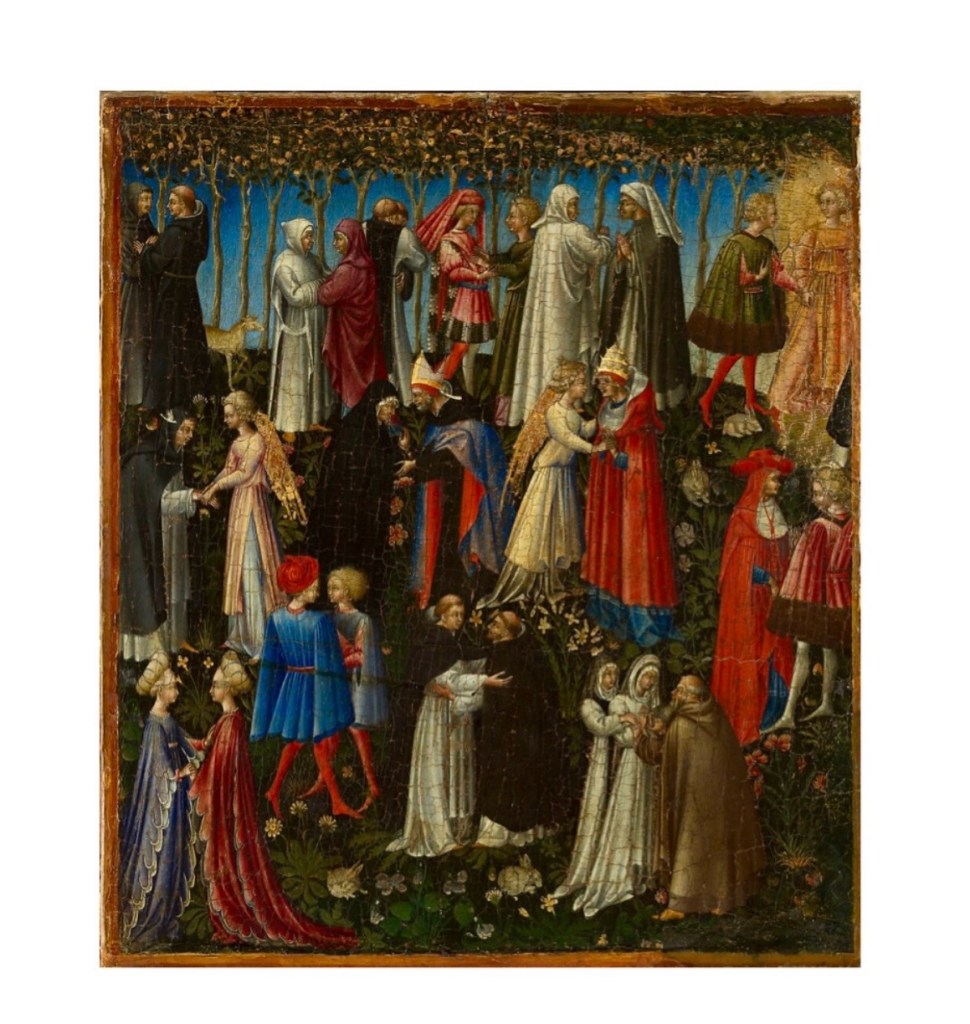
Giovanni di Paolo’s “Paradise” (1445) is a small scene once featured as a predella of an altarpiece from Siena’s San Dominica cathedral. Albeit its miniature proportions it is a striking image of Paradise that puts us in front of a choreography of encounters of the dead, as if the heaven was not a superior and separate stage of life in the cycle of salvation, but rather a continuous stretched territory that takes off where “this life” had left. In its rather simple and rhythmic composition, surrounded by citrus and vegetation, Di Paolo offers the viewer a state of paradise that is not about absolute bliss or bathed in irresistible enchantments, but rather something that in poverty reveals itself in proximity, literally face to face, with an other, perhaps a friend or lover. If we zigzag across the figures it is almost as if the picture would confirm Roberto Antelme’s intuition that “the only transcendence is the relation between beings”. And nothing else is the painterly texture of paradise. In this way, one can define the earthly paradise as a space where transcendence is dispensed because it primarily welcomes and senses otherness.

One of the striking details of the picture is precisely the positioning of the hands of each couple. Just take a second to gaze around them. These are hands that gesture towards a supreme affection; it is the hand that reciprocates and welcomes. It has been noted – for instance, in Berenson’s A Sienese Painter of the Franciscan Legend (1910), that Sienese painting of the fifteenth century introduced a new pictorial attention that manifested the coming to life of the spiritual. In Giovanni di Paolo’s Paradise the flickering hands, moving around the bodies, are perhaps signifying the initial touch of renewal between heaven and earth. In fact, it is almost as if the sliding of hands was the vehicle for the nongranular transition into the arrival of heaven. In a way of synthesis, one could say that paradise is always at the distance of the hand; which is why painting and happiness remain in an intimate dialogue regardless of themes or historical epochs.  

And one can ponder whether the absence of paradise from imagination in the wake of the absolute intrusion of hell in reality, is not precisely a world where the incommensurability between hand, nature, and language become indistinguishable; the transparency of sameness in an expansive totality well beyond reach. To be in nearness is not just an ethical transcendence between beings, but ultimately allowing a divine region to flourish for possible encounters. This is why Angelus Silesius says that “nothing exists except you and I, without both of us then god would not be god, and the heavens will cease to exist” [1]. Paradise is, as Di Paolo’s painting reveals, not the utopia to come in another time, but the  inconceivable place never fully detached from the experiences in this earth. As Karl Barth once wrote: “As the place of God in heaven is, of course, a place which is inconceivable to us. It cannot be compared with any other real or imaginary place. It is inaccessible. It cannot be explored or described or even indicated. All that can be affirmed concerning it is that it is a created place like earth itself and the accessible reality of earth which we can explore and describe or at least indicate; and that it is the place of God” [2].

This inconceivable place of God is the apocatastasis of what sorrounds us, of what has touched us, and of what we have touched; and this includes above all, the nexus of the living and the dead in a strenuous thought that gathers itself in what has loved. This space outlives the world of the living in order to express the divine that is, precisely, the unmediated appearance of each encounter. This means that painting paradise does not commission what a new life should look like as a way to overcome a previous existence of deficiencies and missed opportunities; what is recollected, and thus the only true apocatastasis, is a path to presence that knows neither end nor name. 

Notes 

1. Angelus Silesius. El peregrino querúbico (Ediciones Siruela, 2005), 2005.

2. Karl Barth. Church Dogmatics: The Doctrine of Creation, III (T&T Clark, 2010), 149.

*image. Giovanni di Paolo’s “Paradise” (1445), part of the Metropolitan Museum Collection.

An epoch unmoved (V). by Gerardo Muñoz

The intrusion of appearance in the world posits the question of the unlived in every life. This taking place that appears in the world descends temporal finitude; and, more fundamentally, it posits the caducity of its unlived possibilities. In a recent book on the history of citrus in Italy, the author says in passing that blood oranges, being from the lowlands near the Etna, mixes a variation of flavors that ultimately make this particular orange expire sooner than others of its kind. Heterogeneity is a marker of caducity. The shimmering crust of this orange reveals that something like the mystery of what has not happened yet (and perhaps never will) comes to us in the sensorium, in the open of the ambient, and in the time of decay: “It gave us pause for thought. How long does it take for a lemon to completely rot?” [1]. This sense of the unlived in life was thematized by Hölderlin in his late drama The Death of Empedocles, a figure intimate to the Etna volcanic topoi“In holy union each beloved clings to love, a love One thought was dead…To they are this! The ones we so long did without, the living; The goodly gods, declining with the star of life! Farewell!” [2]. We have yet to develop a theory of the encounter that opens the epoch. But the solicitation for an experience entails the seeking of an outside to reality, in which the unlived facilitates nearness to an escape route. As we know, Hölderlin thought of the fissure of unity as excess between outside and reality, in which the relation between object and subject, thinking and action, imagination and things come to a tragic diremption.  

In this light, the actualization of the unlived is the vortex against the immobility of the epoch in which life is rendered actual in its becoming. But this requires specification; or at least a certain amendment of the pure aorgic immanence. We know that centuries before Hölderlin, Angelus Silesius provided a point of entry: “The Sun gives movement unto all, and makes the stars dance in the sky: if I still stand immovable, no part in the great whole have I” [3]. The mystical kenosis is ground cero to attunement of life. However, Silesius also seems to be suggesting that even under the dress of nature, movement is the condition for any instantiation with the abode. If glimpsed from the interior of the site of the natural world, pure immanence appears as the interrupted image without partition; but if described from the exteriority of the unlived, then world and life now meet in a kinetic extraneous divergence. 

But what is the limit of an intensity? There are two ways of coming to terms with this problem: every process of intensification reaches its caducity whenever its violence is overcome by the seduction of possession in submitting to the absolutism of reality. On the other hand, every intensity is perturbed when it finds an obstruction in the formal orientation of the concept. Therefore, when the co-existence between the exogenic and ecstatic limits meet, the free playing of forms becomes flow (plynein).  In other words, we cease to become immobile to deviate from the obstruction of the suspended wreck of every encounter.

Untimely, this invites that we reconsider the status of happiness. As a contemporary philosopher that I admire has insinuated it: perhaps happiness is the unthought notion in our tradition. In a certain way, the unthought and the unlived depart from the caesura of their own evasion. There is perhaps no need to reconstruct how “happiness” has been subordinated to designs proper to politics or commerce; or, as in the more classical tradition, the moral virtue for self-regulation and privation. Everything changes if we locate happiness in the site of the unlived, insofar as now the violence that is constituted of the separation between form and event in the texture of life. The immediacy of happiness is not being able to conquer something like a state of “blessed life” but being able to release the unlived in every succession of deaths that traverse a life [4]. 

But the unlived exits not only to de-constitute the vital determination, but also, and more fundamentally, to escape the seduction of the negative that assumes that loss and tragicity are irreparable limits. Rather, because there is something like an unlived there is happiness in the way that we constantly move within the available set of unlimited possibilities. The unlived initiates a physics that cuts absolute immanence in virtue of the genesis of style, since it is only in style where the overcoming of the unlived shelters the soul in the face of caducity. Indeed, it is in this invisible texture where the color of our mobility approaches asymptotic twirl between divinity and the world.

.

.

Notes

1. Ciaran Carson. Still Life. Winston: Wake Forest University Press, 2020. 16.

2. Friedrich Hölderlin. The Death of Empedocles. Trad. Farrell Krell. Albany: SUNY, 2008. 93.

3. Angelus Silesius. El peregrino querúbico. Madrid: Ediciones Siruela, 2005. 

4. Pacôme Thiellement. “Le Bonheur est un twist”, 25 june 2017: www.pacomethiellement.com/corpus_texte.php?id=326 : “l y a deux lumières: il y a la lumière d’avant la nuit et il y a la lumière d’après. Il y a celle qui était là au début, l’aube radieuse du jour d’avant, et puis il y a celle qui a lutté contre les ténèbres, la lumière qui naît de cette lutte : l’aube scintillante du jour d’après. Il n’y a pas seulement deux lumières, il y a aussi deux joies : il y a la joie d’avant la peine et il y a celle d’après. La joie originelle, la joie innocente, primitive, cette joie est sublime, mais c’est juste un cadeau de la vie, du ciel, du soleil… La joie qui vient après la peine, c’est le cadeau que tu te fais à toi-même : c’est la façon dont tu transformes ta peine en joie, l’innocence que tu réussis à faire renaître des jours d’amertume et des nuits de bile noire. C’est le moment où tu commences à vivre, mais vivre vraiment, parce que tu commences à renaître de toutes tes morts successives. C’est le moment où tu t’approches de la divinité ou du monde”.