A recent roundtable entitled “American Constitutional Collapse”, organized at Red May, and now archived here, with Aziz Rana, Camila Vergara, and Michael Hardt should confront us with the limit of political form today. All the interventions were able to shed light on distinct angles of the current collapse of the American constitutional order, which has only intensified since the beginning of the new current administration, although its sedimentation, as it is well known, has deep historical legal-political itineraries. However, here I just want to register the question that I posed to the panel, which is one not alien to some of the chapters of La fisura posthegemónica (2025), and that concerns the exhaustion of constituent power. There are many ways of posing this question, but in the tradition of American republicanism, the most clearcut of the problem is to take seriously the end of historical social majorities as vehicles for enacting a ‘constitutional moment’ of democratic reformation.
Some of us remember that towards the end of the third volume of We The People: The Civil Rights Revolution (2014), Bruce Ackerman claims that in our epoch we might very well be entering into the dusk of social movements. Ackerman’s book is from 2014, that is, a couple of years before the landmark victory of Donald J. Trump’s first electoral victory of 2016, and written in the wake of the decision of Shelby County v. Holder (2013), which abolished substantive parts of the Voting Rights Act of 1965. The sequence of the last decade has only validated Ackerman’s intuition about the effective collapse of movements as the driving force of American iusreformandi within the constitutional order (in other countries is no different, take Chile for instance, which we discussed two years ago at Red May, and that is also the story of the the ills of transformative constitutionalism).
However, to anyone that has paid any attention to the political turmoil in the United States in the last decade, it is completely clear that the paralysis of the constitutional system is far from being a state rigidity or stability, but rather it has shown itself to measure every social pressure through an equal force of legal force, testing the durability, probing the reach, and outsourcing the validity of implicit norms and guardrails within the tripartite structure of powers through an enacted process that some American legal theorists have called “liquidation”; that is, the adjudication of fixing and enforcing textural legal provisions in historical time. This means that what animates the internal process of American law is no longer that axiological conditions of political republicanism – representation and minimalist judicial review, separation of powers and state authority, congressional representation and autonomy of the legislation – but rather a stasis, that is both paralysis with respect to the the formal aspiration of classical social representation; and, at the same time, total legal mobilization, in which social majorities are oriented under the nexus of the administrative presidency that can take (it has taken) priority over institutional mediation and process – if anything should be learned in the last decade is precisely the effects of Moore v. Harper (2023) on the doctrine of the independent state legislature (in spite of its ruling at the Supreme Court); and, most recently, the legal showdown regarding process (or lack thereof) and the suspension of habeas corpus for migrants residents and illegal aliens, which according to an American Federal Judge, could prefigure as a potential invasion.
We have good reasons to assume that mobilization and social movements from below can no longer stand as the source of constitutional change. They must be taken at face value in order to avoid rhetorical platitudes: mainly, that any movement today is a vector in the ongoing stasis and decomposition, that ultimately animates (even if against its own intentions, as the progressives seems to ignore) the verisimilitude of state form in the age of stagnation. But this is not very different from the inchoate promises of the new right-wing populism that projects new historical heights of economic growth in epochal decline (and now the progressive programmatic calls for technocratic abundance coextensive to the administrative state).
It is perhaps in demobilization and a de-socialization derives where other horizons might soon emerge. If the modern epochality was defined by the energetic transfer of total social movements, our epoch of collapse will be shaped by that of non-movements outside political hegemony. There is no doubt that it brings paralysis and distress to the political thinker looking for historical reiterations. But then again, the anxiety for mimesis before a breakthrough is always dreadfully sharp.
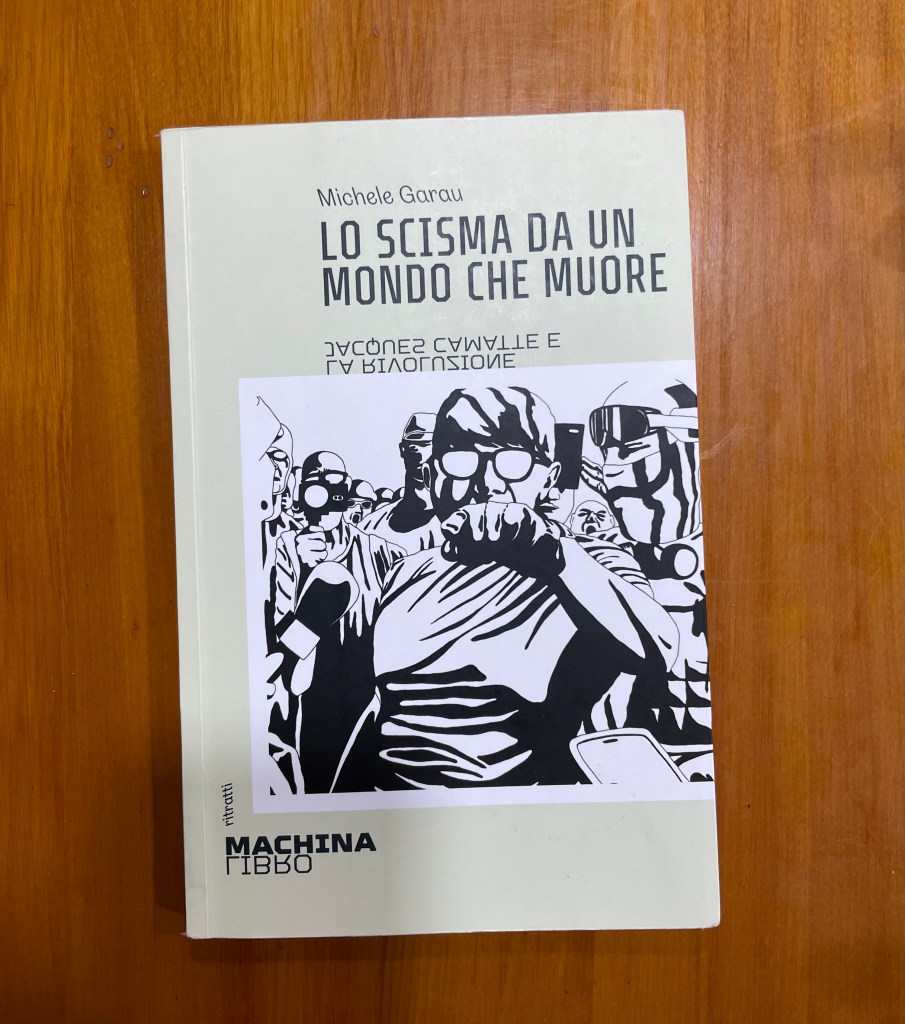
We must welcome that Michele Garau has written the first monograph on Jacques Camatte’s thought in any language, although the book, Lo scisma da un mondo che muore: Jacques Camatte e la rivoluzione (DeriveApprodi, 2024) it is also more ambitious than a mere philological reconstruction of the thinker of Invariance. Of course, not that there is anything particularly wrong with philological or archival work; rather, it is also that Lo scisma da un mondo che muore (2024) tries to think with Camatte (and also beyond some of his potential impasses) the historical bifurcation of a watershed moment in the history of humankind through the realization of the “capitalist revolution” as an autonomous colonization of every form of exteriority (Garau 7). If Camatte’s work has been only selectively considered in our ongoing discussions – while completely ignored at large by the so-called contemporary theory, which I guess it is an uplifting symptom – is precisely because he poses a challenge for a possible breakthrough in times of stagnation, while firmly announcing a much needed farewell to the modern revolution. But who would want to jump on that wagon when precisely voluntarism, prosthetic revolutionary cosmetic, and fictive communitarianism are all necessary platitudes to hold on to the illusion of ground right above the abyss? It is a rhetorical question, of course, but also one that Camatte move passed it in the in the decades of sixties and seventies observant to the material transformation of the working class, and the overall lesson of Amadeo Bordiga’s communism of the human species, which has also been rendered opaque and fossil-like by the victorious force of cultural hegemony and the whole grammatical structure of Gramsci’s thought in postwar political thought (and some will say well into our very present in the most recent cycle of failed left-populism). We said ‘farewell’ and this act, for Camatte after Bordiga’s teaching, means that the revolution has already taken place and must be perceived in the perspective of the crisis of negativity and the inception of the real absorption of capitalist development (Garau 14).
Hence, new challenges lay ahead, which implies the abandonment of the historical and temporal productivity of revolutionary time – and Garau does an excellent mapping of bourgeois revolutionary thinking from Abbe Sieyès to Saint Just to later formulations of the Leninist paradigm of the dictatorship of the proletariat – which in the grand scene of modernity oriented the economy between form and function, but also between thought and action. If the epoch is said to be ‘anarchic’ is mainly because all these mediations and exclusive autonomous spheres have collapsed unto each other, and to favor one over the other is to work within the fiction of ideological reproduction at best. After Bordiga – Garau claims glossing Camatte, although there are nuances that I cannot consider in the space of this short commentary – the temporalization of the ius revolutionis can only bear in mind the crisis of presence (De Martino) as a suspension of exteriority that liberates right unto real subsumption. This means, following the recently polished phrase of Bordiga from his article “Tempo di abiuratori di scismi” (1965), that all revolutions are born and deployed as the affirmation of the schism. “Schism” or “scisma” — and one is reminded or taken back to a theological terrain, and not just as mitigated by the old ecclesiastical memories of the “Great Schism”, but because “schism” is also the “stazion” that fractures the visible-invisible legacy of form of the Church’s Trinitarian doctrine, and which is still the esoteric boiling point of the myth of political theology. This is a detour around Garau-Camatte-Bordiga’s intuition, since none of this is explicitly thematized in the book, nor should it be. It suffices that it opens to this question, given that Camatte’s own grammar of exhaustion – “extinction”, “inversion”, “autopoiesis”, “critique of organization”, “wandering” (erranza) – distill the echoes of an apocalyptic movement proper to the modern anthropological crisis, to put in terms of Ernesto de Martino.
Be as it may, the longue durée of civilizational development of Western revolutions (Edward Gibbon would claim at least since the reconstitution of the Christian Empire) there has been a process of adequation to invariant processes of capitalist accumulation that its substrate (whether permanent, uneven, natural law justified) becomes isomorphic to the structural needs of capitalist autonomization. In a cogent reading of Sieyes with Saint-Just in the framework of the French Revolution, Garau demonstrates how the genesis of modern politics and its categorial scaffolding (localization, constituent power, social unity, subject of rights, and representation) presuppose a thoroughly new vision to make the human community a clean slate for surface legibility (Garau 42). If the civil concept of the ancient polis was measurement and exchange; the crafting of high-modern state politics that took off in the eighteenth century was much thicker and spatially robust dynamics so that the ‘laws of commerce’ and population disciplining could come to fruition with its necessary infrastructural support. The schism was always a perturbation of the “sphere of politics” (and also of politics as a translucent sphere that can be observed, stabilized, and managed), and thus a great scandal.
Hence, the critique of political economy in the history of marxism was never able to untangle this mutual correspondence. For Garau at this point one can locate the difference between Camatte’s thought and Italian operaismo; given that Italian workerism at mid-century was never able to overcome the dialectic between the valence of value form and the theory of the production of capital. Whereas for Mario Tronti the struggle was still to be inscribed in to confrontation between the proletariat qua labor power; for Camatte the “invarianza” is not an permanent stage within the history of class struggle or Marxism, but of the human community and its resistance against the real subsumption of the material community (Garau 48). Decoupling the history of the working class as constitutive of productionism from the human community, allows Camatte, in the wake of Bordiga’s communism, to register the subsumption of capital as it collapses into dialectical negativity. Hence, communism is neither produced nor organized as operaismo always thought (Garau 26-27). And citing a passage from “Against domestication”, Garau argues that for Camatte the history of the proletariat struggle after 1945 is only the struggle to maintain the myth of the proletariat as the subject of a historical breakthrough (Garau 73). This is a staggering affirmation, and one that most definitely produces a theoretical schism. But the schism is also against the fictionalization of a subject of history, which has also been integrated into the emptying of social reality as we have come to know it in the final triumph of the fictive unto itself (Garau 93).
There is the triumph of the fictive and expansive force of capital despotism, and then there is the struggle for the originary community (Gemeinwesen), which as Gianni Carchia argued in his “Glosa sull’umanismo” (1977) was still enmeshed in the contradiction between humanism and anti-humanism obstructing the vascular movement of non-identical fragments imploding the social. Is this getting at an impasse of Camatte’s own effort of thought to find an exit route? As an intelligent book, Lo scisma da un mondo che muore (2024), refuses to give an essay in the last three pages of the essay, although this difficulty is an object of attention. For instance, Garau writes in one of the clearest elaborations to tackle the problem directly: “La comunità deve allora essere riscoperta in una memoria della specie che finisce per radicarsi, questo è il rischio, esclusivamente in un bagaglio biologico. Nell’esaurimento delle strutture sociali preesistenti, dei linguaggi e degli schemi culturali, delle intelaiature rappresentative e cognitive, nella colonizzazione delle capacità psichiche, affettive, simboliche, è davvero possibile individuare un resto intoccabile dall’antropomorfosi del capitale che non debba essere, invece, creato dal nulla? C’è una «parte irriducibile», come scriveva Bataille, rispetto alle unità di misura del dispotismo economico? Non è semplice rispondere” (Garau 124).
In light of this rumination, Garau also attends to the cycle of contemporary revolts, which might stand as an instance of linguistic and existential struggle against domestication and the crisis of presence (Cesarano), and that might be capable of “absorbing the sky of politics into the most simple and elements components” (Garau 124-125). This is a great image, and one that has pictorial density and durability for thought even if it lacks specific elaboration. To absorb the open sky is to confront the exteriority of the world only as transfigured and brought back as a gathering of experience. The great German critic Kurt Badt comes to mind when writing about Constable: “the sky’s the organ of sentiment”. The embarrassing loss of the world today is fundamentally the destruction of the right attunement to our relation to the opening registered by what gleams above our heads. And perhaps this is a way to measure the capacity for non-movements rather than thinking that movements can disclose the sky. To this end, what could it mean to absorb the sky of politics – which is also a way to refuse the politics of sky, that is, the total planetary grand designs of geopolitical Tianxia? The irreductible may not be reduced to a substance, nor an ontological science nor a vitalist return to an originary community (if only mediated by the restriction of the archaic myth); but precisely that positionality of contact between what is exterior to life itself. To dislodge thought from all political plotting of objectivation and its plastic ligament of social adaptation. A life beyond itself that endures, and perhaps will outlive this dying world.
Today the political surface only seems to obfuscate the analyses of the real forces that move at different pace underneath the crust. When recently Emmanuel Macron referred to the popular unrest protest as “la foule…pas de légitimité face au peuple qui s’exprime souverain a traversé ses élus”, he was not only speaking as the sovereign, but as something more specific; that is, as an administrator. If the old sovereign stood metonymically for the totality of the whole constituent body, Macron’s political rhetoric cleverly distinguishes between the “groups” or “masses” (this is also the same term that Sigmund Freud deployed in his contestation to Le Bon’s theory of the multitudes in 1921), and the institutional mediation of the “People”. What is interesting, in any case, is the cleavage between the two figures becoming well delimited: one being on the side of political legitimacy, the other on its inverse pole of apolitical illegitimacy. The logistics of administration (or what I have called in recent research the administrative nexus) serves to conjoint this specific separation. By the same token, we should not let pass the occasion to recall that if Macron is a hyperbolic political commander of the West, it is precisely because he stands as the executive force at the helm of the administrative legitimacy (as a political elite, he was shaped at the École nationale d’administration).
What do we mean by administrator in this specific historical conjuncture? It goes without saying that modern French public law has a long and important history of droit administratif, which in France is structured around a dual jurisdictional system enshrined by an extensive legal case law and its juridical principles. The French system of droit administratif, however, is not to be understood as an amalgamation a posteriori of classical separation of powers, but rather a concrete institutional design within public powers. This was an institutionalist design that profoundly impacted Schmitt’s thought on the concrete order in the first decades of the twentieth century. The bureaucratic institutionalization was an integral organizational mechanism of legislative congressional practice. The rise of the administrative state differs from droit administratif insofar as it represents liquidation, as well as a thorough transformation of the modern system from within. In this sense, the rise of the administrative state is an excedent to bureaucratic legitimation – and Schmitt was right to characterize as the ‘motorization of law’, a force that he saw unleashing already in the overall tendency of European public law of the 1930s, although only taken to its fulfillment in the United States (something that Schmitt did not foresee) [1]. And if we were to sketch out a minimal phenomenological reduction of administrative law today we could state that it consists of the overflow of executive power through the exercise of the principle of delegation and the extension of intra-agency policy-police enforcement. What early on administrative law professors termed the revolution of an ‘administrative process’ has now come to full extension by subsuming the tripartite structure of the separation of powers to the administrative oversight of the space of social reproduction.
That Macron can only frame his political analysis in terms of “la foule” entails that he is already occupying (at least tendentially; and I can not speak myself for the concrete institutional transformation of the executive office in the French political system) and envisioning role of executive branch as a presidential administration. In an academic legal article that will exert an enduring influence in American public law, “Presidential Administration” (Harvard Law Review, 2001), Judge Elena Kagan stated that the era of executive administration had arrived; which rather than the supremacy of an institutional branch over others, it aspired to defend the orderly equilibrium to the total functioning administration of the whole system [2]. It is important to note that today’s ascent of the administrative state across the Western Anglo-Saxon public law is not rooted in maximization of bureaucratic rationalization nor in the authority of the charismatic office of a Reichspräsident as in the Weimar Republic (I have previously shown its difference), but rather in the production of delegation and deference of political authority that flows from executive power, while remaining bounded within a logistics of balancing and equity (in fact, the notion of equity has become the administrative unity of enforcing a positive production of exceptionality, but this is a discussion for another occasion). In other words – and as paradoxically as this may sound – the Macronite experiment with executive action based on Article 49 of the French Constitution, bypassing Congress, is a thoroughly habitual and normalized practice in the American legal system, which have led some jurists to claim a last farewell to the legislative body of the State – the same branch that Woodrow Wilson would describe as the ‘body of the nation’ in his seminal Congressional Government (1885).
All things considered, whenever Macron’s technocratic politics are described there is an amnesia to the concrete fact that Americanism is not just economic planning or the drive towards indexes of productivity and financial credit standards; it is also a specific governmental stylization. And this stylization is the administrative government, whose stronghold on public law should not be taken for granted. This means at face value that the empire of judges and congressmen (the “elected representatives” upheld by the Macron internal doctrine) is ultimately marginalized in the new center stage government occupied by an elite cadre of administrators and regulators in charge of grand policydesigns in virtues of expertise, rationality, adjudication, and compartmentalized decision-making process – that Kagan recommended should orient “a coherent policy with distance from politics and public opinion” [3].
Contrary to Macron’s republicanist rhetoric, the true and concrete ethos of the administrator is no longer at the level of classical modern political representation (elections, legislative body, judicial restraintment), but rather on the production of statute rulemaking balancing (equity) that unifies the aggregation of private preferences and calculations to the specific determinations of broad and discretionary public interests. At the level of the analytics of ideal types, this transformation sediments the passage from the political elite to the executive administrator of new normative indirect powers. The ‘americanization’ of Macron’s policymaking universe is centered on the exclusion of political governance or judgement in favor of abstract administrative principles (the so-called ecological transition tied to metropolitan or specific territorial energy hubs, to cite one example) and optimal regulatory determinations. What emerges at the threshold of modern republican politics is, then, the rise of a fragmented ‘la foule’ and the activation of police-powers (legality) through the procedures of statute enactment oriented at the unruly state of contemporary civil society.
.
.
Notes
1. Carl Schmitt. “The Plight of European Jurisprudence”, Telos, March, 1990, 35-70.
This Wednesday the Supreme Court of the United States will consider arguments in Moore v. Harper, coming out of the North Carolina State Legislature, which revolves around a specific doctrine: the Independent State Legislature. When the legislature of North Carolina tried to pass a new redrawing district boundaries for electoral purposes, the state supreme court decided against it, concluding that the map violated provisions of the constitution affecting free elections and the equal protection clause of the federal constitution. On other hand, the sponsors of the Independent State doctrine claim that state legislatures enjoy unsubordinated independence from the state supreme court, acting freely from the structure of state constitutions. The defenders of ISL doctrine “interpret” the term legislature as free-floating affirmation of constituent power when it comes to matters of voting under Election Clause of Article I in which legislatures decide on “the times, places, and manner of holding elections for senators and representatives”. Hence, ISL doctrine is fundamentally about political-theological question of ‘who decides?’ (quis judicabit) in the structure of federalism. But insofar as it is the question of ‘who decides’ it is also about what orients application today: ‘who interprets?’
When legal practice becomes open to interpretation each word immediately becomes a door. Each term becomes contested meaning as a free-floating signifier where balancing will ultimately serve particular political purposes. It is no coincide this ISL doctrine has come to the surface at this precise moment – after the 2020 election results – when, in fact, for most of the history it has been rarely used [1]. What does a floating and independent legislature power entail for electoral ends? What is of interest here is precisely how, in the name of a direct justification of constituent power (‘The People’), ISL represents a truly indirect power within the structure of federalism and state-constitutions. By name and function, indirect powers are understood as external interreference within a structure of stable organized powers. Now, the novelty of the ISL doctrine is that this indirect power emerges from within as it were, capable of upending judicial review and constitutional authority. The stability of ‘who will decide’ becomes an indirect power that, potentially, could even override state elections wherever political asymmetries exist between the legislature, governorship, and judges at the courts.
We know from the history of political thought that indirect powers (the undecidability of who will decide) leads to a stasiazon or internal civil war between the constituted powers. In other words, it is with the ISL doctrine that we can now see the true nature of what I called in the beginning of 2021 a legal civil war in Trump’s efforts to overturn the election results. A legal civil war is far more intense than the political partisan struggle of the movement – even if, at times, they can both cooperate as joint partners – since indirect force tries to ambush the constitutional organization of powers. The legal civil war of direct democracy comes full circle: unmitigated legislative force will constitute itself as the unstrained guardian of the question ‘who will decide’. For the champions of ISL doctrine legislature has no penumbra: it is always “We”. And it is no coincide that, as it has been shown by one of the great scholars of American federalism, a legislative supremacy once defended by Madison could allow for the “raising of every conflict to a constitutional crisis and civil war” [2].
In other words, what at first sight appears as total independence at state level actually facilitates its oppositum: the production of “standing” for higher courts litigation. Contrary to common opinion, the function of constitutional interpretation is full of cracks due to its brittle fabric: it allows for the indirect powers to be justified vis-à-vis the naturalism of the People as ‘original electors’ without mediations [3]. The historical irony cannot escape us at this point, since the American Revolution was waged against a legislature (the British Parliament) and legitimized through broad voting. This was the great innovation of Atlantic republican political theory. The question is whether a constitutional ‘interpretation’ could wage a battle against indirect powers facilitated by the revolutionary penumbra of ‘who will decide?’.


 Infrapolitical Reflections