
Plastic spirit and depth. by Gerardo Muñoz

In an issue of The Listener in 1935, the renowned British art historian Kenneth Clark penned a short article titled “The Future of Painting” that can be read as an early eulogy to the tradition of the pictorial craft. As a provocation – this was still the high tide of Modernist art – the ‘future’ of painting for Clark was undeniably reaching a point of irreversible exhaustion, at least in the Western tradition. In a phenomenological reduction of two major strands of modern painting – what he called “pure painting” that included Impressionism and Post-Impressionism; and, on the other, “super-realism” as the artistic consciousness that bypassed  “spiritual salvation”, such as that of Surrealism and other visual experiments – Clark’s indictment deployed an indictment on what he sought as the end of the “plastic spirit”: “We must keep in mind the possibility that in the western world the plastic spirit is really exhausted and that art will be lost for many decades” [1]. 

For Clark, it was not that art ceased to exist as an autonomous practice of sensorial activity; it was rather that its imaginative and spiritual endeavors had a future only if mediated and “linked up” (sic) with the evolution of a “new social economic system” driven by the standards of productivity and mass spectatorship. Unlike Clement Greenberg’s reflexive plea of modernist painting as the triumph of the dialectical inversion of flatness over depth, for Clark the convergence of pictorial relation with social objectivity resulted, in the tradition of a post-Cezanne world, in draining the inherent sensible communication of painting and myth. This meant that modernist painting tout court was devoid of any mythical relation. In fact, one could very well claim that the outwardly material support (the flat canvas) of the picture became its most dramatic corroboration. Modernist painting was the triumph of social symbolization insofar as it served as a reminder of the objective space that could only be taken as unserious gratification of its own objectivity.

It does not take too many readings of Greenberg’s large claim on modernist painting to see that behind “flatness”, its very surface, lurks variations of the aura of subjectivity, expressed in “success of self-criticism”, “resistance to the sculptural”, and the drive towards systematic consistency viewed in the mirror of the “convergence of spirit with science; their concern does show the degree which Modernist art belongs to the same historical and cultural tendency as modern science” [2]. Or so writes Greenberg in his landmark text. If Greenberg goes out of his way to invite modern science into the field of aesthetics it is precisely because Modernist art has been able to spell out the potential for representation into an autonomous surface that has given up depth to the conscious effort of its material limitations as its primary concern (imagination, the divine, the liturgical theatrical aura are all secondary). It is perhaps against this backdrop that one can understand what Clark means by the exhaustion of the “plastic spirit” that underpins his prophetic understanding of the decline of painting. 

But what is, ultimately, the “plastic spirit”? It is not referring to sacred representation nor artistic inspiration of the artist, but rather the receptive affinity of the pictorial gesture with nature without ever being reducible to its material support (flatness). If painting exists, it is because its lovely being “is neither sensuous nor spirit, but rather the ungraspable, diffusing over the figure…this being is ungraspable yet perceptible to everyone is what the Greek language called [kharis] and we call grace” [3]. What the ‘plastic spirit’ discloses in its suspension of judgement through very disclosure of appearance is the imperturbable space, and by extension ungraspable, where figuration arrest an instance of eternity. In this sense, it always resists any assertion towards the future, because it dwells in the opening of a space “there” that fails to coincide with the material extension and limitation of the canvas.

This is what perhaps Walter Benjamin had in mind in an early fragment where he reflected on painting as an art of paradise or a state other-than-being grounded in visual contours: “Painting, too, generates space spiritually; its generation of form is likewise grounded originally in space, but it generates space in an­ other form. Not the dimension but the infinity of space is constructed in painting. This happens through the surface, in that, here, things develop not their dimensionality, their extension in space, but their being toward space. The depth yields infinite space. In this way, the form of concentration is given, but this now requires for its fulfillment, for the allaying of its tension, a presentation of the infinite in itself and no longer as dimensional and extended” [4]. Was not this the ungraspable caesura between depiction and nature already pointed out by Schelling?

Painting is depth, or at least it is about a certain way to accout for depth. And depth, fundus, before it takes the form of a flat spatial region in ‘thereness’, it is eminently the display of the figure that emerges from it. This “space otherwise” – that is not just a different spatial arrangement or geometrical calculation – is something of the infinite that makes both flatness and the diachronic arrow of time collapse in its unattainable rigor brought to bear in the affection through figures and colors. Every painting shows therenesss, but that is only possible through the depth of interiority that remains invisible. This can illuminate what Osip Mandelstam said of the plastic spirit when writing that “painting is also much more a matter of internal secretion than of apperception, that is, of external perceiving. To appreciate a picture you must go through a process making of restoring it” [5]. It is in this renewal that the imperturbable depth of painting fulfills before the abdication of the future. And from the “depths of nature” into the blossoming manifestation of appearance, painting recalls, beyond words, what in the sequence of time is understood, and yet often neglected, as the ungraspable. 

Notes 

1. Kenneth Clark. “The Future of Painting”, The Listener, October 2, 1935, 578.

2. Clement Greenberg. “Modernist Painting” (1960), in The Collected Essays and Criticism (University of Chicago Press, 1993), 91.

3. F.W.J. Schelling. “On the relationship of the plastic arts to Nature” (1807), Kabiri: The Official Journal of the North American Schelling Society, Vol. 3, 2021, 146.

4. Walter Benjamin. “The Rainbow, or the Art of Paradise”, in Early Writings 1910-1917 (Harvard University Press, 2011), 225.

5. Osip Mandelstam. Journey to Armenia & Conversation about Dante (Notting Hill Editions, 2011), 79.
A painting that knows no evil. by Gerardo Muñoz

In several places of his Lectures of Aesthetics, Hegel refers to Dutch painting as a way to thematize the concept of completion that fulfills being in the world. For a moment his commentary brings to bear a state of the mundane while avoiding the vulgarity of the overachieving surface that would define the general tendency of modern painting. True, Hegel’s indictment of Dutch painting does not negate the modern sensibility either, insofar as the portraits of the Flemish tradition fail to disrupt that is always held incredibly visible in the frame of pictorial representation. The artistic triumph of Dutch painting depends on a specific oscillation between the inner and outer experience of the subject visible range of depiction. This is not an exclusive one-directional movement towards the immanence of life; which Carlo Levi will denounce as the estrangement from the world, but rather a synthesis that gracefully falls on the sensuous activity of painting just at the moment that appearance dispenses in the world. 

Thus, the emergence of Dutch painting was only possible in a specific form of life that was resolutely experiential in nature and spiritual rich. As Hegel writes in a first moment in the Lectures: “the Dutch in their taverns, at weddings and dances, at feasting and drinking, everything goes on merrily and jovieall, even if matters come to quarrels and blows; wives and girls join in and a feeling of freedom and gaiety animates one and all…this spiritual cheerfulness in a justified pleasure, constitutes the higher soul of pictures of this kind” [1]. And this spiritual freedom, sublated from the necessities and constraints of external things in the world, validates a concept of the ‘ideal of life’ that is transcendent only to its sense of living. Hegel notes that Protestantism facilitated the Dutch a materiality for this sense of worldly transcendence, of communitarian deificatio, allowing them to have, in his words, “some footing in the prose of life” [2]. So, Dutch painting is predominantly concerned with depth; and this depth is not concerned with the absorption of the spectator, but quite literally, almost in a physical way, enmeshed in the inner tonality of everyday figures. This is their inner being made visibly manifest. The manifested and gathered presence of this inner and outer movement of the infinite is precisely what retains the imperturbable trace of the divine beyond time; indeed; an eternal Sunday of life, as Hegel says in another important moment: 

“This painting has developed unsurpassably, on the one hand, through and through living characterization in the greatest truth of which art is capable…For this reason we have before us no vulgar feelings and passions but peasant life and the down-to-earth life. lower classes which is cheerful, roguish, and comic. In this very heedless boisterousness there lies the ideal feature: it is the Sunday of life which equalizes everything and removes all evil; people who are so whole-heartedly cheerful cannot be altogether evil and base”. [3] 

It is well known that in the art historical discipline, the moment of Dutch painting has been understood within the framework of the scientific and optical revolution of that century; a new “faith in the eyes”, to follow Francis Bacon’s terms, capable of generating a concrete and rational knowledge of the “common world” of a new, more geometrico, regime of light [4]. But nothing could be further from how Hegel’s synthesis approached the sensibility of Dutch painting; mainly, as fundamentally a site of the overcoming of evil because it was not alien to the comic downfall of human experience. In Dutch painting, Hegel reminds us, it is not that evil or wrongdoing is removed from the factical life; rather, it means that the comic is a nested experience that can grasp and transfigure the miseries or the disasters beyond taxative transactions of the social world and preparing the conditions for a kallipolis

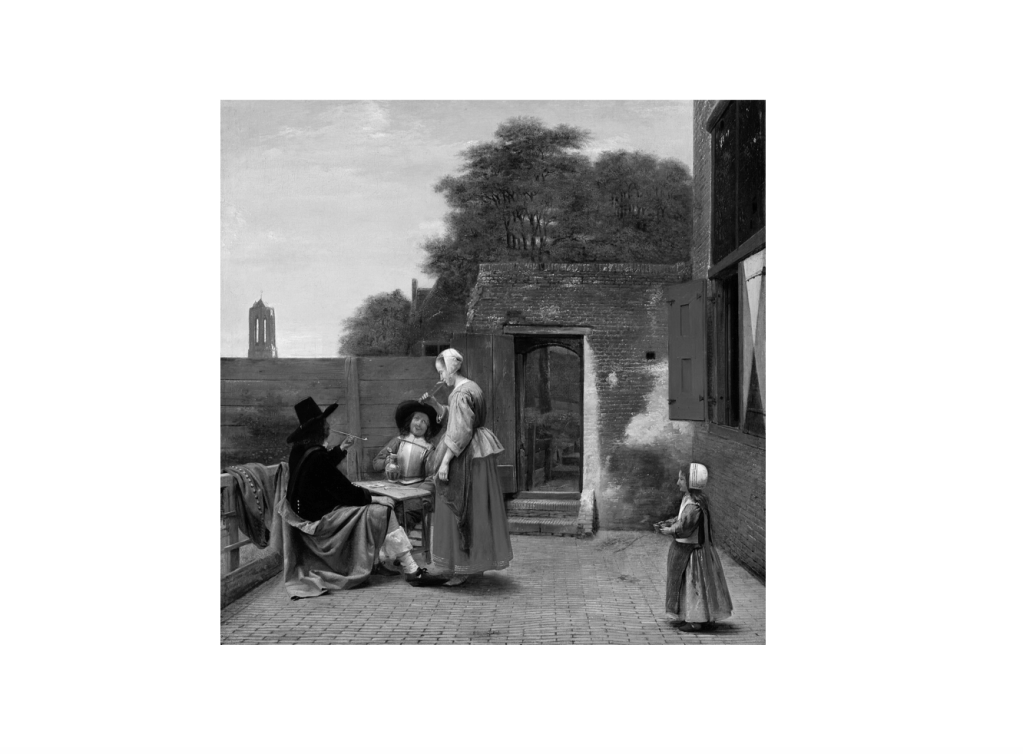
Although it is not clear who are the Dutch painters that Hegel had in mind when writing about a painting that enters into the “Sunday of life”, certainly the pictures of Pieter de Hooch – “A Dutch Courtyard” (1660) comes to mind – where distant and miniscule figures smile at each other in the open encounter of a place. The erasure of evil from painting is achieved not from stating the dogma through which the world could transcend and reverse the fall from nature, that is something like a new “faith in the visible”; it is more the event that accounts for the surrounding as it becomes oblivious to the very artifice of depiction. In this sense, the imperturbable state of Dutch painting is achieved as a life that dwells in the folds of the world as it retreats from the force of anticipation. And, if according to Chrysippus, evil is nothing but losing the capacity of affection or mediation of our inner sensibility; what the Dutch pictorial order brings to bear is that the ‘good’, rather than being a substantive function of the will and contingency, it can only be accessed in a form of life that is indistinct from the inconspicuous and breathable space through which it dwells.

And what is the sensibility of the comic if not what remains ungraspable in each and every in a painterly expression in a world in consonance, a place without remainder? In other words, if there is a painting that has abdicated from evil, it is because its has attuned the soul to an exteriority that is no longer dependent on the weight of the sign. It is still the business of the mute things (Poussin) in order of the beautiful. This is the state the state of grace that Schelling thought the plastic arts could bestow human sensuous experience after the irredeemable apotheosis of nature: “In painting a lovely being that is neither  sensuous nor spiritual, but rather ungraspable, diffuses itself over the figure and nestle into all the figures and to each oscillation of the extremities. This being, which as we said, is ungraspable yet perceptible to everyone, is what the Greek language calls kháris and we call grace (Anmut) [5]. And the movement of grace in painting is what initiates the transfiguration of death – the muted voices of the dead – into a divine whose sole task is the disclosure of presence. 

Notes 

1.  G.W. F. Hegel. Aesthetics. Volume I (Oxford University Press, 1975), 169-170.

2.  Ibid., 597-98.

3. G.W. F. Hegel. Aesthetics. Volume II (Oxford University Press, 1975), 886-887.

4. Svetlana Alpers. The Art of Describing: Dutch Art in the Seventeenth Century (University of Chicago Press, 1983), 91. 

5. F.W. J. Schelling. “On the relationship of the plastic arts to Nature” (1807), Kabiri : The Official Journal of the North American Schelling Society, 2021, Vol. 3, 146.