The recent response to Nelly Richard’s stance against infrapolitics, has prompted an ongoing conversation although not always public. However , there has been a public reaction in a column by Samuel Toro Contreras, “El poder ya no está donde creemos” published in El Mostrador. I do not think that this reply is necessarily critical of Contreras’ article, since I tend to agree with its main framework. I mean this comment as a sort of recalibration of Contraras’ observation, which ultimately hinges upon on two central elements: first, that there is no need for “cultural war”; and second, that a debate regarding the centrality of politics (the hegemonic position) or the non-centrality of politics (infrapolitics) is already a duality surpassed by the question of technology.
Of course, I agree with the analytical intuition deployed by Contreras that the essence of concrete domination today is to be analyzed in the organization of infrastructure. The transformation of sovereign power into the molecular and administrative dispersion of control has been invariably present in what infrapolitics has tried to think through in its different approaches. And not only infrapolitics, of course, but also other theoretical positions that refuse the fantasy of hegemonic politics. I do think that infrapolitics does not think this problem factually; what we continue to call “politics” – inherited from the Greek dispensation of the polis, in contrast to the chôra and the Arcadia, just to name two counterfigures – is already functioning as proto-infrastructure of the social community of norms and reproduction and the economy. The meson of the polis is the infrastructural design, to use the terminology of Alejandra Castillo, in which life is only possible as determined by the equivalent. The problem of technology does not begin with the locomotive, “cybernetics”, “Artificial Intelligence”, or what have you.
When Contreras writes that “la pregunta de base seria anterior, sobre que infraestructura técnica produce hoy aquello que todavía seguimos llamando política”, he is inadvertently endorsing infrapolitical thought, with the caveat that infrapolitics is not merely invested in the objective conditions of politics, but on those conditions of thought cannot be absorbed by politics. To say that politics amounts to infrastructure in our time is to say that the “destiny as political” as defined in European modernity can be paragraphed today as “our destiny is geopolitical”. This is another way to say that politics is no longer organized around time and decision, but on space and administration.
To simply call this “politics” responds to the inertia of language that tends to obscure the terms of exchange. Infrapolitics does not claim clarity, but in the wake of the absolutization of infrastructure of the Gestell, it does favor the possibility of thought rather than exerting a new political primer of action or reform. In light of this, it is not the relation between technology and politics what is at stake; the authentic step back is the difficulty presented by the non-relation of technology and thinking. This might be a slight displacement from Contreras’ own position about infrastructure, and it is one that never really wanted to align itself with either politics or culture.
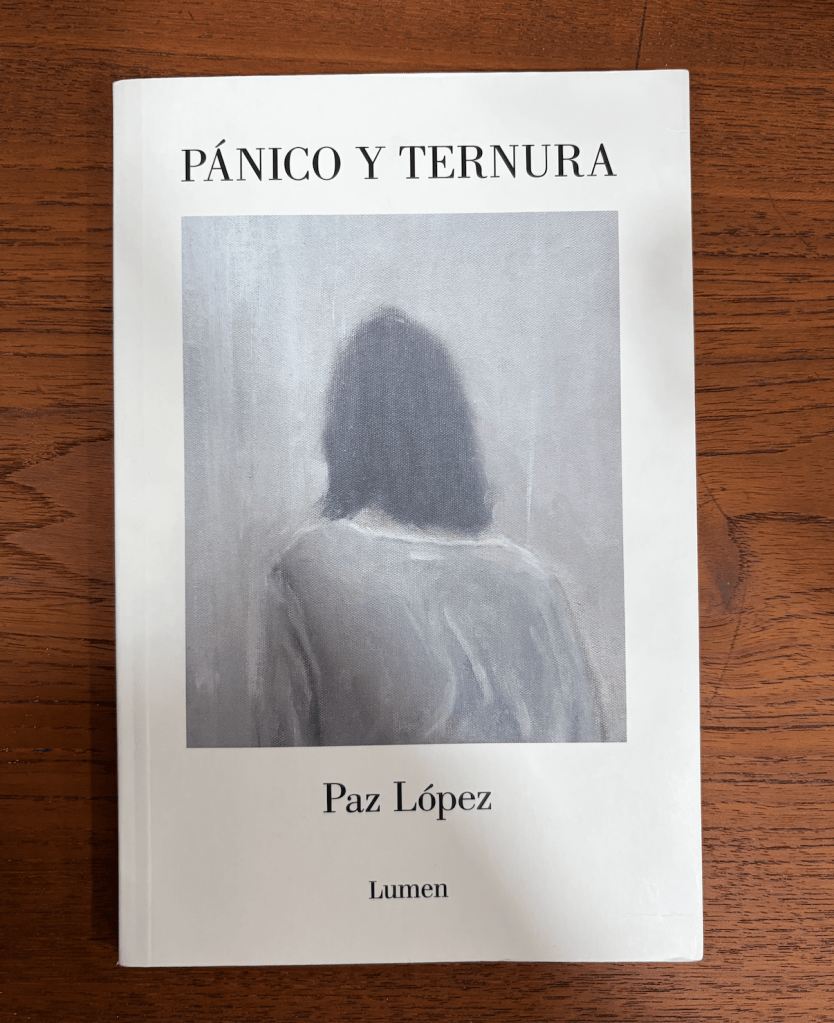
Paz López’s Pánico y Ternura (2026) opens with an analogy between life and school that immediately places us in attention to her writing: “Entramos a la vida como entra un niño a la escuela: mirando hacia atrás, con los ojos llorosos buscando la mano de quien hace un rato nos había variado el pelo, la nariz, las rodillas heridas, los diminutos labios” (López 14). Although the synecdoche (“la mano”) does not reveal to whom it belongs, in a way the mother is spectrally present, a figure overtly present in Paz’s writing. We enter life in the wake of separation and caesura, and that is the site of the original wound that will lead to all sorts of civilizational and mimetic compulsions that unfortunately we know too well. And yet, López does not say we enter the “law” (although this is also presupposed of course), but rather we enter school. Our civilization has slandered and tainted the notion of “schooling” and “school” to such an extent that we have entirely forgotten the fact that school is schola; that is, time of rest and interruption, “free time”, a lagging duration of contemplation of language and being, and of being in language. And if the notion of “school” is under ruthless attack in our present by an infantry of pedagogues and technicians, it is mainly due to the fact that what is being threatened is the very possibility of a form of life. Of course, our epoch is one in which the chatter of “life” is continuous and intoxicating, but the form of life is something altogether different: it entails to inhabit a space of a convergent and planar movement between language and world.
This is one of the regions that opens in López’s book; one out of many, allow me to follow it. As López says toward the end of the essay: “…cada vez que hay un corte tenemos la posibilidad de inventar una nueva lengua, de poner de movimiento el mundo” (López 128). It would be too convenient to follow up this claim and say that this is precisely what Paz López does in her writing; clearing language in order for a tonos or a vibration of the voice to unearth tropes that have been traced almost at the level of the flesh. This is something to this autographic practice that moves gently without fetishing the body and its materiality. Ultimately, a body is always more than surface. I want to retain from López’s scene of writing a responsive form of thought that in its inconspicuous relation to writing it refrains from the certitude of both philosophy and the letter. López’s search could perhaps be one of “tanteo”, a beautiful Spanish verb that refers to the hand that seeks and reaches out for something in space, and in my memory it immediately recalls some short stories of Carmen Martín Gaite’s fiction where this gesture figures in a cinematic fashion. Hence, for López ‘tanteo’ is to refuse the hell of a world of acrimonious security and confirmations that discards the inexorable presence of doubts and fissures (López 39). But the hand that seeks is also not a pure gesture in the void; it is one that asymptotically discloses an erotic mediation with the passing world without ever abandoning it; yet unequivocally assertive in the lamentation of the state of the world (López 56).
In other words, because we can seek (here López is enrolled in the school of Hölderlin), there is no end to the world now configured as a fragile fishing net of relations, unsaid words, glances, and incommensurable distances that make up, without exhausting it, the spectacle of life. Not “this life”, of course. For López, the brutality of our times (I am less prudent and I will say ‘onto-theology’) is precisely the general concerted opinion that we are all owners of our own little and mediocre lives, the last avatar of a self-serving will to power. Rather, for López life is always elsewhere, and this is why the “escape” or “exile” from oneself is not a place of arrival or destiny, but precisely the disposition that is always traversing every relation and every touch between bodies and souls (López 65). We are creatures of the outside, and by extension, only the cohabitation of the outside, can redeem the pain of the original laceration, as in the first image of the infant walking his path to school with his eyes turned. This is not a messianic or monastic retreat, it does not depend on the parousia, but rather one of poetic dwelling in the spaces that are both familiar and strange. It is only in them (through them) that we can only cultivate through the garden of our language. López’s anti-messianic orientation, devoid of the fiction of future time and its anxieties, is proportionally a prose of hanging spaces, of curvatures of language that affects the reader deeply without ever renouncing to the beauty that thinking that defies being brutalized through the crushing weight of technical terms or philosophical concepts.
In this sense, López’s writing is already an autographic writing at the threshold of onto-theology convinced that only style through the resources of the voice is the path that mitigates between poetry and philosophy, painting and memory, experiences and the unlived. López’s prose, if anything, is a lot about “gathering” through the tenderness; a contact where image and eros become the medium of life: “No es eso también la ternura, una forma de “recortar nuevos espacios en el vacío informa del exterior y conquistarlos a la medida de la vida (Claudio Magris)?” (López 94). To gather and to cut through the spaces: this is the highest task of the ethics of a form of life that requires a new theology of the sensible. Theology can be taken as a strange word in López’s lexicon, and I do not think that it appears even once in Pánico y Ternura. And yet, López’s proposal is completely theological if we take the theos as the highest and most beautiful light that can nominally allow for depth through the analogy of things in the net of the world. Hence, the importance of the sighting to the inner most depth in some moments of López’s writing, such as when she ponders on the fact that every time that she plunges eyes on a minuscule element or figure of the world, she senses that “se revela el elemento bestial que se enceuntra en el centro de nuestro mundo, como si la mirada fuera un cordon umbilical….amarrados todavia al vientre brumoso del origen” (López 121). And theology is not just the highest, but also the science of the first things: through the piercing expression of our senses, we elevate ourselves not with some revealed transcendence, but with the proximity with the things that have found us.
And yet we have been automatized – this is the sensible devastation that Pánico y Ternura is responding to without ever taking a political stance, because politics is thoroughly insufficient – to see every-thing, and every being at all times; all entities realized in the feast of interchangeability and availability. The heliotropic force of modernity now truly blinds and burns our skin, which means that no access to the solar totality of social existence can guarantee anything except continuous conflagration and commanded muteness. We cannot but feel “panic” in this current predicament López is completely right. Thus, we must find the flickering light and flames elsewhere, such as in the lamp of a dark night that can illuminate the page of a book that keeps us in attention without any real purpose. Nabokov’s suggestion comes to mind: in the lamp of our study, we reject the nihilist demands of the cacophonous social world. Paz López has given us a delicious essay to read under this tenuous light. It is a present memory of an abode that keeps the secret of secrets, a resting place of the soul where still some melody is heard.
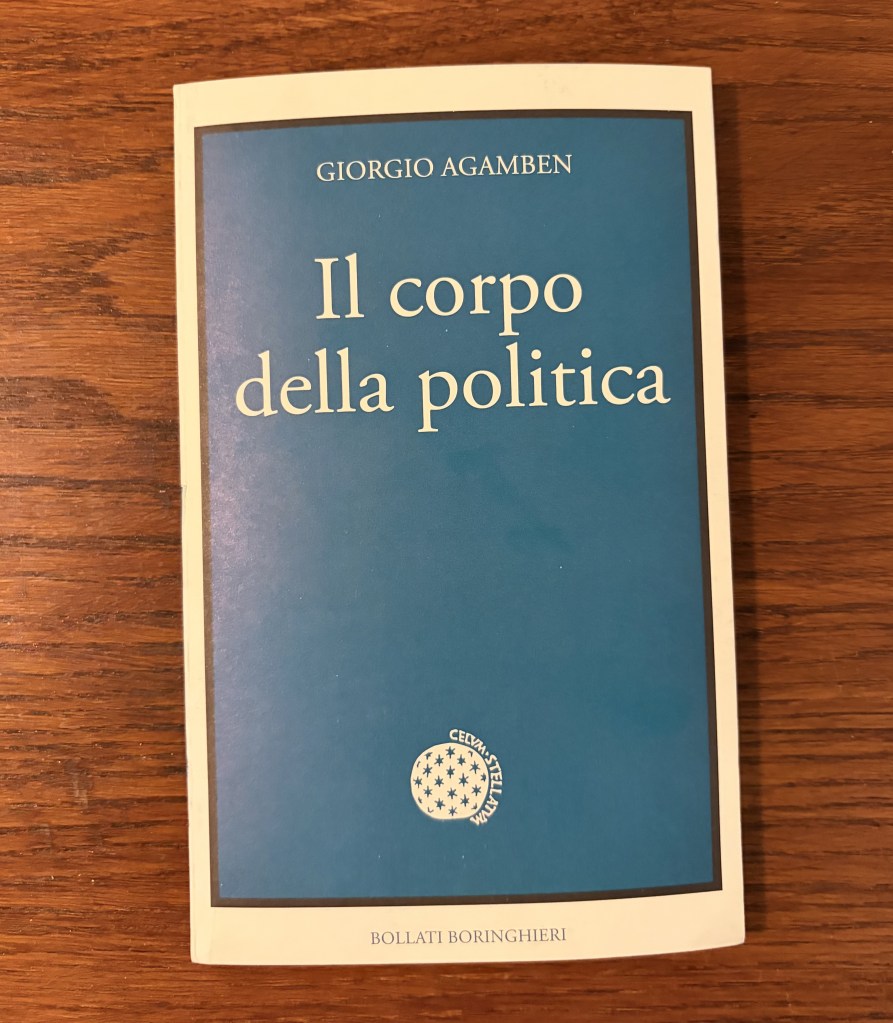
One of the decisive lessons of Giorgio Agamben’s archeological examination of Western politics is that the imperative to confront the closure of representation, sooner or later it must also come to terms with the notion of the body (corpo) as a central metapolitical condition in the genesis of modernity. If L’uso dei corpi (Neri Pozza, 2014) brought to its final stage the philosophical exploration of Western ontology of politics defined by efficacy and realization; in most recent opuscules, Agamben has shown how the fixation and regulation of the body is also embedded in the regions of language and sensation of human life as well. In this sense, it is impossible not to read Il corpo della politica (Bollati Boringhieri, 2026) along with Il corpo della lingua (Einaudi, 2024), as two parallel commentaries on the defining stature of political representation. If a new beginning is one of the decisive questions of our times, then one of the pending tasks is precisely to think the body (corpo) against the ontotheological assumptions of calculative reason.
Similar to Il corpo della lingua (2024), Il corpo della politica (2026) starts with the treatment of the Copernican revolution of bodies in Hobbes and Newton, which in the face of the cosmological infinity inscribed a notion of two bodies in order to allow for representation within spatial coordinates. In other words, Hobbes’ artificial sovereign represented by the mortal god Leviathan (state normative authority) will have an autonomous colorary in the autonomy of the subject that will become “political” as long as it becomes coterminous with the civic body of the “People”. Thus, to speak of “bodies” is not just to rationalize physicality in space – although it is also this from a technical viewpoint that state legibility will soon demand of the incipient civil society – but more importantly, it entails the administration of energy and movement (in Agamben’s well known lexicon, the domestication of potency to the realization of purposeful ends). For Agamben, Spinoza’s conatus, which appears in the Baroque period in critical dialogue with Hobbesian and Newtonian frameworks should be read precisely a way to think past the body as substance, following the steps of the tradition of ancient Stoicism in which beings are corporeal insofar as they are in tension with the world, allowing the tonos or acoustics to animate being in its movement towards preservation and exposure (Agamben 20-21).
If all beings are traversed by a tonos – a tension that crosses as its medium in virtue of its contact with the world – this means that they are no longer defined by a substance, but as intensity within a field of forces once thrown in the world. As Agamben writes in passing with explicit confrontation with Heidegger’s Being and Time: “…con la tesi perentoria ‘l’essenza dell’esserci giace (liegt) nell’esistenza’. L’esserci è stato “gettato” nel mondo, ma si direbbe che, una volta gettato, non cade in piedi, ma giace (liegen significa innanzitutto essere sdraiato). E questa concezione sub-stanziale dell’essere che il conatus mette radicalmente in questione” (Agamben 23). In an archeological gesture that is already signatura of his work, Agamben reminds us that Hobbes’ substantive and artificial division of the “two bodies” that anchors modern politics can be traced to the corpus mysticum and the theological debates concerning transubstantiation that will later be recasted in the intersecting works of both Ernst Kantorowicz and Carl Schmitt, in which the impolitical dimension of the multitude becomes political through the artifice of decision and representation of a unified and indivisible body (Agamben 25-26).
The catastrophe of modern politics takes place when the body, once reduced to a substance and computable object in space, ceases to be understood as an inteusum or intensity of an irreducible multitude that expressed a generic and universal human species, as it was for Dante: “La politico – il finis totius humanae civilitatis che Dante intende definirie nel suo trattato – è ancora una volta un campo di tensioni interne allo stesso genere umano e questa intensità ha la foram di una moltitudine” (Agamben 39). In other words, for Agamben following the implicit tonus present in Dante’s Monarchia, the political is neither action nor mediation, but what names the very site of the possible. Agamben calls the hypothesis of an “anarchic politics” (politica anarchica), which no longer defines itself in relation to a formal mediation of government and state, but rather as the intensity of the multitude through the generic being (Marx) or the universal humanity (Dante) that takes the form of sensible Empire devoid of principial politics mediated by constituent power (Agamben 47).
Where does the multitude dwell outside the constituted representation of a community of belonging or the social mediation of the state? Already in 1990s Agamben had written a gloss on the politics of exile collected in Mezzi senza fine (1996), and the last part of Il corpo della politica (2026) he returns to philosophical and theological notion of the exile vis-a-vis the historical experience of the Jewish tradition as an errant or stateless people, as Erich Unger called it in 1922, whose existence has been defined by exile or galut (Agamben 48). It is a bit of a misnomer to call the exilic experience a “politics”, since for Agamben the authentic tradition of exile does not entail the right or duty fixed to a community of belonging; rather, what outlives the law is the only path capable of deposing it (in the manner of Paul, that is, as katargeo). In this way, justice is now understood not as a procedure in a normative system, but as a written tradition that can only be studied and reflected upon and ultimately experienced as a state of passivity.
Hence, the exilic experience is the caesura between language and world, in which we touch the exteriority with a renewed intimacy that unfolds the uncommunicative solitude that keeps the mystery of our use of language. Following the neoplatonic formulation “phygé monou pros monon” – understood by Erik Peterson as an expressive mystical relation of a “fuga di un solo presso un solo” – there is intimacy and authentic belonging whenever there is sensible separation in being (Agamben 55). Following Plutarch and Plato, for Agamben the exilic dimension is the very home of philosophy and thought, which confirms, against Crito’s suggestions at the end of Socrates’ life, that there life outside of the polis and the conglomerate of the demos, because life is outside itself once it is assimilated in the virtuality of a divine that nourishes its own potency. In what stands as one of the most precise formulations of the pheugein (exile) condition as a figure of existence, Agamben writes of its precise ascesis:
“La celebre definizione ascetica della fuga dal mondo come assimilazione a Dio andrà resa, pertanto, restituendo tutta la sua forza alla metafora politica: “l’assimilazione a Dio virtualmente un esilio” (kata ton dynaton significa qui, secondo il sense più proprio del termine dynatos, “virtualmente, secondo la potenza). L’affermazione e tanto piu significativa in quanto, con queste parole, Platone rompe con l’insegnamento socratico del Critone, secondo cui la possibilità di phygé offerta al condannato non potrà che essere rifiutata, perché non vi è vita possibile fuora dalla polis” (Agamben 57).
This region that precedes and exceeds politics – in the language of Sophocles, the well known ypsipolis apolis – is akin to the tone that runs to the forgetting of any substantive ontology of politics that seeks to subsumes life into the confinement of external forces. It is in this paradoxical situation of assimilation in exile, and a permanent exile that assimilates itself in God as shared thought that politics can be transfigured as an apodemia that refuses the closure of life into principles of government and dominium, and away from the community form of propriety and rooted belonging. Agamben recalls that in the history of Christianity, it is the time of the parish (paroikias) what allows the soul to live in earth as foreigner and exile, in proximity of the medium of the kingdom, and that only later with Saint Augustine it was transformed into a territorial institution for the communio and communal salvation (Agamben 60-61). In the paroikias, Agamben returns to the kingdom not as a retheologization of the politics, but as a figural parable in which a poetic dwelling is enacted in the measureless passivity of a form of life, a project consistent with the formulation of the singular whatever being articulated in La comunita che viene (1990).
The assimilation in the exile of the divine, which recalls the forgetting of oneself and the god announced by Hölderlin in“Note on the Oedipus”, is refined in the last essay of the book entitled “Il corpo dell’Europa”, which reproduces a lecture delivered in Venice in May 2024 about idea of Europe. As a sort of concluding reflection or apostilla, we are now able to say that for Agamben the only possibility of dwelling in the vestiges of the European tradition and memory is to rescue, from the wreckage of its history, the sediments of a texture of the phygén: to be exiled is not just a vitalist affirmation of this life, but more importantly, it also implies disclosing the possibilities buried in the past with the dead, that is, in contact not only with Gaia, but also in the downward movement to the domus of the infraworld (a figure that receives a novel treatment Agamben’s recent book La lingua che resta). Agamben exemplifies this exile with the dead with three poetic moments of high european modernism: Ezra Pound’ Cantos, T.S. Eliot’s The Wasteland, and Eric Auerbach’s masterpiece Mimesis written from his exile in Turkey – and of course, we could also think here of Kafka’s parables and Joseph Roth’s narratives of Jewish errancy; as well as Alexandre Lerrnet Holenia’s phantasmatic crumbling of Empire in The Standard and Osip Mandelstam’s “The Fourth Prose”, where the end of the work leads to the human voice as the supreme poetic task in the face of nihilism and political totalitarianism.
It should be clear, however, that the problem is not found a temporary refuge or a last stand in the fortress of modern literature, but of coming to terms with the phygé as a fundamental problem of language that, in virtue of its unique and irreplaceable experience, delivers a world nested in the affection of remembrance. As Agamben asks towards the end of the lecture: “Is there a sensibility and a form of life that we can call European?” (Agamben 82). This question can only be answered when we dwell and assimilate into the exile of thought that harbors the residues, figures, and voices that speak to us from the dead in a tradition because it is no longer transmitted, we can only access it poetically. In the only moment that the word anima (soul) appears in the text, in the very last sentences, it becomes clear that it is only in the intensity of thought that life accounts for the inseparability of the body and the soul that historical abstraction has rendered oblivious and alien from the tonos of presence. We are not yet ready to declare a return to the appearance between being and world, and for that very reason even the presence of the divine, as Agamben says following Isaac Luria, is itself exiled from the creation of the world until the advent of the tiqqun in the night of restitution. The exilic dwelling of life outside itself is marked by this sort of secret unfaithfulness in the absence of the god. In the meantime, the task of an ethical life is to passively reside in an exile where the reality of the soul returns what is possible and breathable to the appearance of the real.
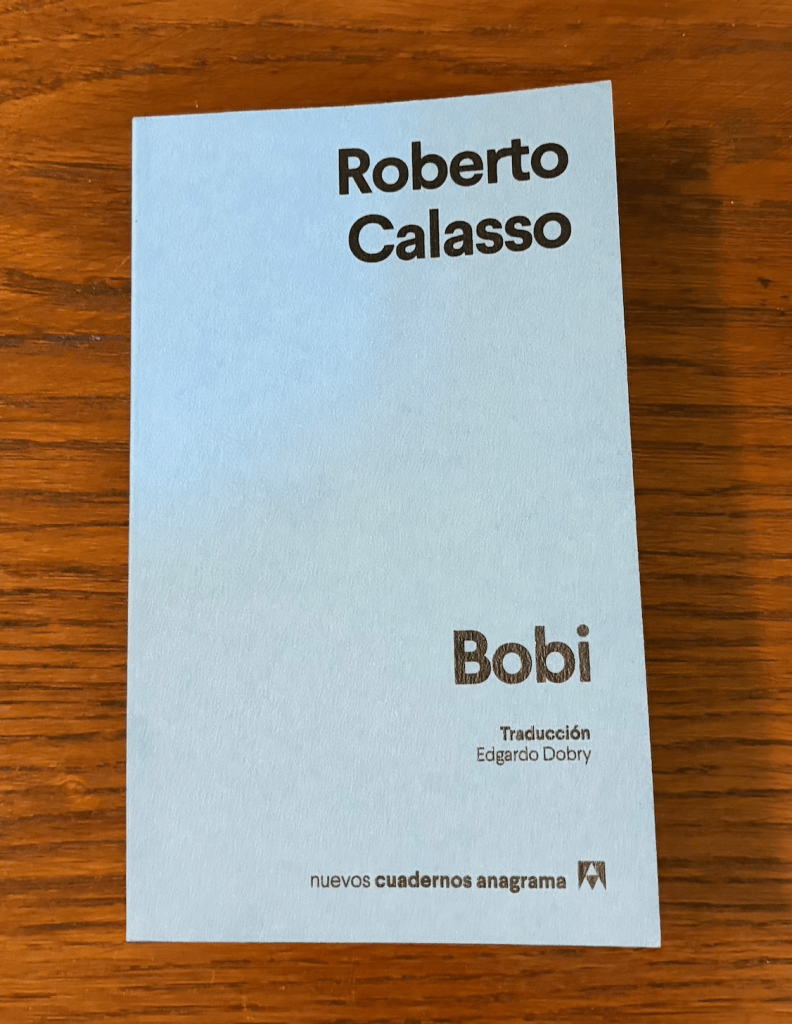
Roberto Calasso’s short and epigrammatic posthumous book Bobi (Anagrama, 2026) on the opaque figure of Roberto Bazlen has just appeared in Spanish. It is a nebular autobiographical book that does not attempt to render legible the subterranean and oblique figure of Robert Bazlen, but rather to filter some of his obsessions and tonalities, many times through his own voice. Calasso is well qualified to write such book as a frequent stroller companion of the anonymous man of Trieste. There is no aura of the detective mystery about the person’s auratic psychic life, establishing a sharp contrast to Del Guiudice’s polyphonic narrative in Lo stadio di Wimbledon (1983). But in this short memoir book, I am particularly intrigued by a moment when Calasso inscribes Bazlen’s vortex of thought and life as an affinity for the acoustic.
Calasso quotes Bazlen (we assume that from his own memory): “Bazlen used to say regularly: “This does not sound too good”, and immediately we knew what he meant. His capacity to recognize sound was thorough” [1]. Calasso tells us, moreover, that he cared little about cultural or intellectual polemics of his time. All that matter was sound, the grain of the voice. His meridian crossing was the song and rhythm of another. It is this proximity to the light of the voice what allowed Bazlen to conceive life and writing as a unified sensible reality; mutually interdependent, and always intertwined like the threads in a rigged tablecloth. To inhabit the world without judgement – of History, of morality, of punishment and guilt, of retribution – means to secure an aperture to an acoustics that will remain close to us, albeit incomplete, in the dissonance and impropriety of meaning.
To be able to attune oneself to the voice is a practice that retreats from the order of the world; that is, to descend into anonymity in order to inhabit a subterranean region, which speaks to Bazlen’s insistence on tugurios or spelonche, which Calasso does not hesitate to render as naked spaces, miniature deserts or caves to immunize oneself from the chatter of the world: minima chôra where something could take place or not. It is hard to define them but we know perfectly well what these are. Perhaps we can be more emphatic: to listen to the voice is already the encounter. And very much like Osip Mandelstam’s figure of the interlocutor, true poetics (and first and foremost that of life) “is ever moving toward that more or less distant, unknown addressee, whose existence the poet cannot doubt without also doubting himself. Only a reality can bring to life another reality” [2].
Bazlen’s notion of writing as the writing of life, experience as writing, very much like Mandelstam’s dialogic poetics, finds a tugurio so that language can emerge in absolute presence. And this is precisely what Bazlen understood in the becoming of life against the metabolic strain of survival, since the repression of the voice will result in the annihilation of what is most alive. Calasso recalls Bazlen’s affirmation: “In a world of death – there was an epoch where one was born alive and would later die. Today, on the contrary, one is born dead – and only a few are able, little by little, to be alive” [3].
For Bazlen there is no community of the living granted in immanence, because to live means to conquer the putrefaction of the culture of death, which is only permanent revolution and hostility. But one cannot conquer death from death; that is, by means of the beautiful soul’s literary prose of the world. It does not take Hegel to say that this is still unwarranted insubordination and permanent bondage. What is then to be alive? It is a resurrection that takes place as an existential decision, that is “at a point in life when a fundamental decision has to be made. I believe that was his passion, and his masterpiece” [4]. This is Del Giudice’s indictment, although surely not fully at odds with Calasso’s autobiographical sketch of Bazlen. In the melodic contact the possibility of a vita nuova is transfigured in not-knowing because the Western modernity is devoid of any notion of ethical destiny. Indeed, “et tout le reste est littérature”, as Verlaine famously wrote. For Calasso’s spectral portraiture in Bobbi (2026), the adventure is to remain alive well beyond completion and needs, as evidenced in our encounter with his languishing voice and memory.
.
.
Notes
1. Roberto Calasso. Bobi (Anagrama, 2026), 83.
2. Osip Mandelstam. “El interlocutor”, en Gozo y misterio de la poesía (El Cobre Ediciones, 2005), 71.
3. Roberto Calasso. Bobi (Anagrama, 2026), 55-56.
4. Daniele Del Giudice. A Fictional Inquiry (New Vessel Press, 2021), 123.
In an issue of The Listener in 1935, the renowned British art historian Kenneth Clark penned a short article titled “The Future of Painting” that can be read as an early eulogy to the tradition of the pictorial craft. As a provocation – this was still the high tide of Modernist art – the ‘future’ of painting for Clark was undeniably reaching a point of irreversible exhaustion, at least in the Western tradition. In a phenomenological reduction of two major strands of modern painting – what he called “pure painting” that included Impressionism and Post-Impressionism; and, on the other, “super-realism” as the artistic consciousness that bypassed “spiritual salvation”, such as that of Surrealism and other visual experiments – Clark’s indictment deployed an indictment on what he sought as the end of the “plastic spirit”: “We must keep in mind the possibility that in the western world the plastic spirit is really exhausted and that art will be lost for many decades” [1].
For Clark, it was not that art ceased to exist as an autonomous practice of sensorial activity; it was rather that its imaginative and spiritual endeavors had a future only if mediated and “linked up” (sic) with the evolution of a “new social economic system” driven by the standards of productivity and mass spectatorship. Unlike Clement Greenberg’s reflexive plea of modernist painting as the triumph of the dialectical inversion of flatness over depth, for Clark the convergence of pictorial relation with social objectivity resulted, in the tradition of a post-Cezanne world, in draining the inherent sensible communication of painting and myth. This meant that modernist painting tout court was devoid of any mythical relation. In fact, one could very well claim that the outwardly material support (the flat canvas) of the picture became its most dramatic corroboration. Modernist painting was the triumph of social symbolization insofar as it served as a reminder of the objective space that could only be taken as unserious gratification of its own objectivity.
It does not take too many readings of Greenberg’s large claim on modernist painting to see that behind “flatness”, its very surface, lurks variations of the aura of subjectivity, expressed in “success of self-criticism”, “resistance to the sculptural”, and the drive towards systematic consistency viewed in the mirror of the “convergence of spirit with science; their concern does show the degree which Modernist art belongs to the same historical and cultural tendency as modern science” [2]. Or so writes Greenberg in his landmark text. If Greenberg goes out of his way to invite modern science into the field of aesthetics it is precisely because Modernist art has been able to spell out the potential for representation into an autonomous surface that has given up depth to the conscious effort of its material limitations as its primary concern (imagination, the divine, the liturgical theatrical aura are all secondary). It is perhaps against this backdrop that one can understand what Clark means by the exhaustion of the “plastic spirit” that underpins his prophetic understanding of the decline of painting.
But what is, ultimately, the “plastic spirit”? It is not referring to sacred representation nor artistic inspiration of the artist, but rather the receptive affinity of the pictorial gesture with nature without ever being reducible to its material support (flatness). If painting exists, it is because its lovely being “is neither sensuous nor spirit, but rather the ungraspable, diffusing over the figure…this being is ungraspable yet perceptible to everyone is what the Greek language called [kharis] and we call grace” [3]. What the ‘plastic spirit’ discloses in its suspension of judgement through very disclosure of appearance is the imperturbable space, and by extension ungraspable, where figuration arrest an instance of eternity. In this sense, it always resists any assertion towards the future, because it dwells in the opening of a space “there” that fails to coincide with the material extension and limitation of the canvas.
This is what perhaps Walter Benjamin had in mind in an early fragment where he reflected on painting as an art of paradise or a state other-than-being grounded in visual contours: “Painting, too, generates space spiritually; its generation of form is likewise grounded originally in space, but it generates space in an other form. Not the dimension but the infinity of space is constructed in painting. This happens through the surface, in that, here, things develop not their dimensionality, their extension in space, but their being toward space. The depth yields infinite space. In this way, the form of concentration is given, but this now requires for its fulfillment, for the allaying of its tension, a presentation of the infinite in itself and no longer as dimensional and extended” [4]. Was not this the ungraspable caesura between depiction and nature already pointed out by Schelling?
Painting is depth, or at least it is about a certain way to accout for depth. And depth, fundus, before it takes the form of a flat spatial region in ‘thereness’, it is eminently the display of the figure that emerges from it. This “space otherwise” – that is not just a different spatial arrangement or geometrical calculation – is something of the infinite that makes both flatness and the diachronic arrow of time collapse in its unattainable rigor brought to bear in the affection through figures and colors. Every painting shows therenesss, but that is only possible through the depth of interiority that remains invisible. This can illuminate what Osip Mandelstam said of the plastic spirit when writing that “painting is also much more a matter of internal secretion than of apperception, that is, of external perceiving. To appreciate a picture you must go through a process making of restoring it” [5]. It is in this renewal that the imperturbable depth of painting fulfills before the abdication of the future. And from the “depths of nature” into the blossoming manifestation of appearance, painting recalls, beyond words, what in the sequence of time is understood, and yet often neglected, as the ungraspable.
.
.
Notes
1. Kenneth Clark. “The Future of Painting”, The Listener, October 2, 1935, 578.
2. Clement Greenberg. “Modernist Painting” (1960), in The Collected Essays and Criticism (University of Chicago Press, 1993), 91.
3. F.W.J. Schelling. “On the relationship of the plastic arts to Nature” (1807), Kabiri: The Official Journal of the North American Schelling Society, Vol. 3, 2021, 146.
4. Walter Benjamin. “The Rainbow, or the Art of Paradise”, in Early Writings 1910-1917 (Harvard University Press, 2011), 225.
5. Osip Mandelstam. Journey to Armenia & Conversation about Dante (Notting Hill Editions, 2011), 79.
We have attempted to read Florensky and Schmitt side by side, and certainly many fundamental questions have been raised converging profusely on the problem of Catholic form. At the same time, it is undoubtedly true that some questions have not been pursued at length, and they exceed the modest purpose of this short seminar. As a way of synthesis, I want to press against one question that seems to me to link both thinkers in the wake of secularization, and especially modern representation. Modernity is always too many things at once – it is purely the force of the contingent, but ultimately it is the temporalization of space through objectivity and its necessary legibility. It seems to me that the spatial question is a guiding thread, not the exclusive one, that connects Florensky and Schmitt’s interventions circa 1922. It is obviously the problem that the German jurist never ceased to reflect upon, if we recall how in the very end of his work he situated the very arcana of the law in relation to the visuality of the Homeric “kai nomon egnō”, a predicament for seeing space laying before the law; that is, subsumming the sense of worldly opening into the necessary predicate of a legitimate ground for order.
Schmitt’s purified, prima facie formalist conception of the Catholic form, is also fundamentally spatial, because the primordial essence of the duality of the ekklesia as an institution comes about through the dominion of life unifying the communities and burgs into an internal system of legitimation that builds a concrete order (in recent years the work of Anna Grzymala-Busse has convincingly tracked the morphologies from the medieval church the modern city state and the rule of law). As we know, for Schmitt Rome (Catholic form) is Raum, spatial arrangement, dilation of orders and institutions, representation and decision elevated beyond the fundamental norm. In this sense, the thesis on the ‘visibility of the Church’ hinges upon the opening of the world as always already oriented towards salvation through the structural deficiency of human beings (original sin) and communitarian order of representation and delegation. This is why Schmitt remains a modern political thinker – perhaps the most acutely aware of thinkers when it comes to the fragility of the political project based on the specular visibility of legitimation – because the fusion of the political and that of territory remains indivisible, in spite all of his self-conscious response to the force of immanence noted in Political Theology (1922). The liquidation of the limiting autonomy of the political against technical neutralization is only possible because “space” has been first subsumed into the visible nomos of the nomon egno.
It goes without saying that Pavel Florensky’s strategy is also extremely sensitive to visuality, but his position departs from the assumption that modernity is about the flattening of the unilateral and objective specular regime of visibility. One can recast what Alberti writes quite ostentatiously in De Pictura: “No one will deny that things which are not visible do not concern the painter, for he strives to represent only the things that are seen. Points joined together continuously in a row constitute a line” [1]. In Alberti’s visual inception of pictorial representation, space is already orienting the direction for the flattening of pictorial space that defines modern pictorial representation in the well established argument by Clement Greenberg [2]. Obviously, Florensky wants to break against the flatness of modern representation, which is the condition of possibility for the very nihilism of subject and object that becomes worldness because it has no longer any possible carving out the “thereness” of space. It seems to me that this is what Florensky is after when elaboration of the ‘reverse’ or ‘inverted’ perspective. The inversion here is not just an aesthetic problem of the autonomy of work of art in the new distribution of labor, and here is where liturgy marks a fundamental distinction in terms of the analytical paradigm that frames Florensky’s investigations. Around the same years, Romano Guardini in his The Spirit of the Liturgy (1918) defined the liturgical experience as anti-aesthetic phenomenon, because in its communion of souls, it gathers the visible as well as the invisible, whose exclusive beauty shines in the light of truth and not of delimited notion of “work”. For Florensky moving past linear perspective, and by extension objective representation, is the path that prepares “a new structure of thinking” as such [3]. In virtue of its own experiential depth, “a certain spiritual excitement, a joly that rouses one’s attention to reality itself. In other words, perspective too, if it is worth anything, should be a language, a witness to reality” [4].
The so-called inversion of perspective is a destructive operation at the level of sensibility against the traps of illusionism and abstraction, opening in the concrete and yet not-yet-here space where life and its alterity enter into contact. This is why Florensky claims that it is “the content of space that is transmitted, but not the organization” [5]. And in a more densely and rich moment of the “Reverse perspective” (1920) he writes the most clearly expressed elaboration of this new structure of thinking: “To sum up. It is possible to represent space on a surface, but only by destroying the form of the thing represented. Yet it is form, and only form, that visual art is concerned with. Consequently, the final verdict is proclaimed for painting, as for the visual arts in general, to the degree that it claims to provide a likeness of reality: naturalism is once and for all an impossibility” [6]. As it is obviously clear, Florensky is not thinking destruction in virtue of restating a metaphoric sacralization of nature; rather, for him the liturgical depth of the reverse perspective discloses an experience is only possible in the contact between the possibilities of the world and being. It is this region that he call the “abyss of own freedom”, and that the attempt to contain it through the hegemony of the matheme and calculation only amounts to “as tasks of insane presumptuousness” [7]
The turning of experience must inhabit this abyss of freedom retreating from an “unmoving monumental and ontological massiveness of the world, activity by the cognising spirit that lives and labours in these thresholds of ontology” [8]. Thus, accounting for that ontological reduction makes possible inhabiting realities in the world that never become validated through representation. As Florensky writes in a short piece published around these years: “Obviously our living remoteness from reality must again destroy realism in art as well. There are realities in the world; one comes to know them by coming into living contact with them through work in the worldwide sphere….art can unite us with realities are inaccessible to our sense – such are the formal prerequisites of any artistic reality, and a tendency that rejects even one of them thereby forfeits its right to be called realism” [9].
If the Christian liturgy remains the most “realistic” experiential arrangement for Florensky it is because the texture of space appears in its non-visibility as the “missing aspect of what what we might call the surrounding world…it is this surrounding world, place as such, which the liturgy addresses” [10]. It is this surrounding world, that is both beyond the world and yet within it, almost folded unto it, what I would claim that relates tendentially to the notion of the chora (χώρα), not as an interchangeable modulation of “place”, but as what allows externality as the requirement of experience to be indifferent to sense because it its presence is that of possibility. John Sallis in an essay on the notion of the chôra puts it in a way resonates with the abyss of freedom withdrawn by Florensky:
“One could say—though not without some risk of falling into the dream in which the chora (χώρα) is conflated with place—that the chora (χώρα) is the other of being, not just in the sense of being other than being (as every eidos except being would be other than being), but rather in a more abysmal sense, in a sense irreducible to a difference of sense. One could say, too, that the chora (χώρα) is the outside of being, that it is what enables externality as such and thus makes it possible for something outside being nonetheless to be” [11].
We should linger on those words: “a more abysmal sense, in a sense irreducible to a difference of sense”. But this abyss is not what refers to an ontological vacancy that becomes operative for the subject; it is the excess that allows being, and for that matter “ethical being”, to have composed duration in its region. I think it is possible to accept the minimalist thesis of the liturgy as the sanctification of “time-place that the world is” (this is the syntagm deployed by Hemming) beyond divine revelation, but only if one takes up the chôra as the space of spaces (ur-space) at the end of secularization, a transformative leap that transcends time to land somewhere in the depths of regionality. It is the region that makes the passage, as Florensky would say, fata voletem ducunt, nolentem trahunt, from interiority to exteriority without ever achieving consummation, perhaps as a folded relation. The stakes are enormous no doubt. In an entry in his recent Quaderni XIII (Quodlibet, 2025), Giorgio Agamben defines it in a particular way that traverses Heidegger, but also beyond him. This is a difficulty disclosed by the chôra, and it is the beginning of further challenging investigations waiting for us:
“It is the choice of this misleading conceptualization that leads Heidegger to privilege, like Hegel, time and action over space and contemplation. Not “Being and Space [chôra],” as in Plato, but “Being and Time,” as in Hegel. Even the “wonder that beings are” becomes a task and a “sacrifice”. Instead, the aim is to understand this wonder ethically as “use” (“to use it again in order to contemplate it”). Admittedly, in his later years, Heidegger attempts to rewrite Being and Time as “Being and Space”; yet here too, the conceptualization remains imprecise because it does not sufficiently question itself. (Although he merely acknowledges the inadequacy of language, he continues to propose terms that are necessarily deficient.)” [12].
.
.
NotesNotes
Notes
1. Leon Battista Alberti. On Painting (Penguin Books, 2004), 37.
2. Clement Greenberg. “Modernist Painting” (1960), in The Collected Essays and Criticism (University of Chicago Press, 1993), 90.
3. Pavel Florensky. “Reverse Perspective”, in Beyond Vision: Essays on the Perception of Art (Reaktion Books, 2002), 246.
4. Ibid., 254.
5. Ibid., 258.
6. Ibid., 258.
7. Ibid., 260.
8. Ibid., 269.
9. Pavel Florensky. “On Realism”, in Beyond Vision: Essays on the Perception of Art (Reaktion Books, 2002), 181
10. Laurence Paul Hemming. Worship as Revelation: The Past Present and the Future of Catholic Liturgy (Burns & Oates, 2008), 47-48.
11. John Sallis. “The Politics of the χώρα”, in Platonic Legacies (SUNY Press, 2004), 42.
12. Giorgio Agamben. Quaderni XIII 2020-2021 (Quodlibet, 2025), 248
In several places of his Lectures of Aesthetics, Hegel refers to Dutch painting as a way to thematize the concept of completion that fulfills being in the world. For a moment his commentary brings to bear a state of the mundane while avoiding the vulgarity of the overachieving surface that would define the general tendency of modern painting. True, Hegel’s indictment of Dutch painting does not negate the modern sensibility either, insofar as the portraits of the Flemish tradition fail to disrupt that is always held incredibly visible in the frame of pictorial representation. The artistic triumph of Dutch painting depends on a specific oscillation between the inner and outer experience of the subject visible range of depiction. This is not an exclusive one-directional movement towards the immanence of life; which Carlo Levi will denounce as the estrangement from the world, but rather a synthesis that gracefully falls on the sensuous activity of painting just at the moment that appearance dispenses in the world.
Thus, the emergence of Dutch painting was only possible in a specific form of life that was resolutely experiential in nature and spiritual rich. As Hegel writes in a first moment in the Lectures: “the Dutch in their taverns, at weddings and dances, at feasting and drinking, everything goes on merrily and jovieall, even if matters come to quarrels and blows; wives and girls join in and a feeling of freedom and gaiety animates one and all…this spiritual cheerfulness in a justified pleasure, constitutes the higher soul of pictures of this kind” [1]. And this spiritual freedom, sublated from the necessities and constraints of external things in the world, validates a concept of the ‘ideal of life’ that is transcendent only to its sense of living. Hegel notes that Protestantism facilitated the Dutch a materiality for this sense of worldly transcendence, of communitarian deificatio, allowing them to have, in his words, “some footing in the prose of life” [2]. So, Dutch painting is predominantly concerned with depth; and this depth is not concerned with the absorption of the spectator, but quite literally, almost in a physical way, enmeshed in the inner tonality of everyday figures. This is their inner being made visibly manifest. The manifested and gathered presence of this inner and outer movement of the infinite is precisely what retains the imperturbable trace of the divine beyond time; indeed; an eternal Sunday of life, as Hegel says in another important moment:
“This painting has developed unsurpassably, on the one hand, through and through living characterization in the greatest truth of which art is capable…For this reason we have before us no vulgar feelings and passions but peasant life and the down-to-earth life. lower classes which is cheerful, roguish, and comic. In this very heedless boisterousness there lies the ideal feature: it is the Sunday of life which equalizes everything and removes all evil; people who are so whole-heartedly cheerful cannot be altogether evil and base”. [3]
It is well known that in the art historical discipline, the moment of Dutch painting has been understood within the framework of the scientific and optical revolution of that century; a new “faith in the eyes”, to follow Francis Bacon’s terms, capable of generating a concrete and rational knowledge of the “common world” of a new, more geometrico, regime of light [4]. But nothing could be further from how Hegel’s synthesis approached the sensibility of Dutch painting; mainly, as fundamentally a site of the overcoming of evil because it was not alien to the comic downfall of human experience. In Dutch painting, Hegel reminds us, it is not that evil or wrongdoing is removed from the factical life; rather, it means that the comic is a nested experience that can grasp and transfigure the miseries or the disasters beyond taxative transactions of the social world and preparing the conditions for a kallipolis.
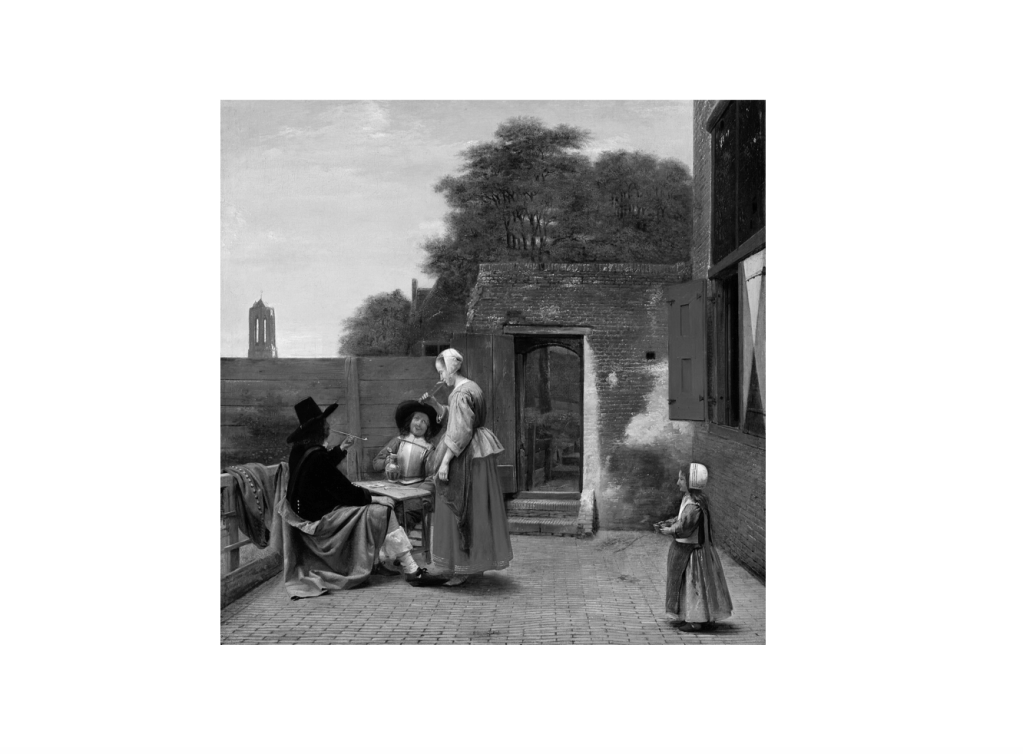
Although it is not clear who are the Dutch painters that Hegel had in mind when writing about a painting that enters into the “Sunday of life”, certainly the pictures of Pieter de Hooch – “A Dutch Courtyard” (1660) comes to mind – where distant and miniscule figures smile at each other in the open encounter of a place. The erasure of evil from painting is achieved not from stating the dogma through which the world could transcend and reverse the fall from nature, that is something like a new “faith in the visible”; it is more the event that accounts for the surrounding as it becomes oblivious to the very artifice of depiction. In this sense, the imperturbable state of Dutch painting is achieved as a life that dwells in the folds of the world as it retreats from the force of anticipation. And, if according to Chrysippus, evil is nothing but losing the capacity of affection or mediation of our inner sensibility; what the Dutch pictorial order brings to bear is that the ‘good’, rather than being a substantive function of the will and contingency, it can only be accessed in a form of life that is indistinct from the inconspicuous and breathable space through which it dwells.
And what is the sensibility of the comic if not what remains ungraspable in each and every in a painterly expression in a world in consonance, a place without remainder? In other words, if there is a painting that has abdicated from evil, it is because its has attuned the soul to an exteriority that is no longer dependent on the weight of the sign. It is still the business of the mute things (Poussin) in order of the beautiful. This is the state the state of grace that Schelling thought the plastic arts could bestow human sensuous experience after the irredeemable apotheosis of nature: “In painting a lovely being that is neither sensuous nor spiritual, but rather ungraspable, diffuses itself over the figure and nestle into all the figures and to each oscillation of the extremities. This being, which as we said, is ungraspable yet perceptible to everyone, is what the Greek language calls kháris and we call grace (Anmut) [5]. And the movement of grace in painting is what initiates the transfiguration of death – the muted voices of the dead – into a divine whose sole task is the disclosure of presence.
.
.
Notes
1. G.W. F. Hegel. Aesthetics. Volume I (Oxford University Press, 1975), 169-170.
2. Ibid., 597-98.
3. G.W. F. Hegel. Aesthetics. Volume II (Oxford University Press, 1975), 886-887.
4. Svetlana Alpers. The Art of Describing: Dutch Art in the Seventeenth Century (University of Chicago Press, 1983), 91.
5. F.W. J. Schelling. “On the relationship of the plastic arts to Nature” (1807), Kabiri : The Official Journal of the North American Schelling Society, 2021, Vol. 3, 146.
In the section of the unclassified “pensées”, Pascal’s meditation on the notion of “opinion” is so incandescent that it is hard to imagine that this was, in fact, written in age of deep religious conflict, an epoch increasingly transformed by the fascination of bodies in space (this is the substance of the counter-reformation and the Newtonian thematization of the limit afterall). In particular gloss 554 strikes a tenor for our current epoch: “Power rules the world, not opinion, but it is opinion that exploits power. It is power that makes an opinion. To be easygoing can be a fine thing according to our opinion. Why? Because anyone who wants to dance the tightrope will be alone, and I can get together a stronger body of people to say that there is nothing fine about it” [1]. In the world after the fall, the intramundane system of felix culpa, is already one of dual power.
In many respects, this image is stronger than that of nihilism as the oblivion of walking upwards gazing at the abyss, because it connects the social pressure of “opinion” to that of the common ground that makes out of blindness the legitimacy of vacuous enlightenment. In the very void that truth will carve out for authority, Pascal seems to imply that the imperium of opinion will reign as a dual power of administration and mediation with the world. This is why for Pascal, force without opinion is indocile; but opinion without force amounts to the persuasion of solitude of the last man in the earth. At the heart of the groundlessness of modern legitimacy there is the necessary organization of opinion or doxa that will regulate the community of the living and the dead because ultimately its end is to master the mystery of language in its inability to name.
Of course, Pascal thought that language could overcome the fictive empire of opinion, which in its modern avatar of propaganda is meant to design apocalyptic tendencies towards self-destruction in the course of historical development. As a “properly speaking wholly animal”, the human can only dwell in a poetic region “entre-deux”, that is, between the abhorrent light and the infinite depth of darkness, where language endures through the symbol well beyond the experience of the fallen corruption of nature. As Lezama Lima reminds us in a short essay on the French thinker, the poetic region in Pascal is ultimately the experience of language as a mystery of creation that refuses to accept the post-mythic condition of nature and human boredom that will euthanize the use of linguistic creation [2]. Now it can be said that the intrusion of the infinite chatter of opinion takes place precisely in the logged forest of speech, which consolidates its rhetorical autonomy of language away from the possibility of distance and self-constrain of the sayable. The statecraft of rhetoric is the infrastructure of the reign of opinion, because here the draining of the depth of being is supplanted by alienated voluntary participation at the very ground of nothingness. Nihilism takes a decisive step forward when language can become any differential sign to communicate what has become impossible to be said outside the cubicle of the enthymeme.
Paraphrasing the ancient wisdom of Pindar’s famous opening verse in Fragment 169 (“Law, νόμος, the king of all”), Pascal assures us of the fragility of this imperium: “An empire based on opinion and imagination resigns for a time, and such an empire is mild and voluntary. That force reigns for ever. Thus opinion is like the queen of the world, but force is its tyrant” [3]. Is it possible to separate, nevertheless, the reign of opinion from that of force; and, secondly, the circulation of force as grounded in a fabric of language that has already descended into the empire of opinion without any trace? In a way, there is no modern politics without the presupposition of the autonomy of a field of opinion integrated into “rational control”, to use the expression of American political theorist Harvey Mansfield. And even if Carl Schmitt could state in his Constitutional Theory (1928) that no democratic secular state could effectively exist out without opinion as a diffused and disorganised form of acclamation, it is now completely obvious to us that the post-liberal state configuration, persists in a constant state of the fluctuation, compartmentalization, and archic steering of opinions. What survives the utter collapse of the category of political modernity is the flattening of language into “opinion” that provides standing to the epochal anomia.
Following classical philologists we are tempted not to ignore that in the word anomia entails not just the suspension of legislated norms and positive commands, but also the decline of the distance between existence and the divine that in antiquity, in the age of Pindar, subsisted under the notion of eunomia as harmonious attunement of the very lived experience. In other words, the consolidation of opinion is a long historical effect of the erosion of distance and perspective that restricts the capacity to “ascertain a spiritual excitement…and if worth anything, a language, a witness to reality” [4]. To bear witness in language is a poetic enactment that, at heart of its solitude, refuses the glacial ripples of the force of opinion vested in reality.
The common Spanish verb “desvivirse” resists obvious translations. Could one translate “desvivirse” as “unliving”, “constructing by destroying”, or “fulfilled life”? It seems that none of them capture the full meaning of an expression that is anchored in practical use. It is important to note that when the term emerged in the intellectual discourse of Spanish twentieth century, its depth was intimately connected to its meaning (life, living, vocation) that it immediately took the life of a concept for cultural milieu and national character. In his lecture “Ideas para una filosofía de la historia de España”, Manuel García Morente suggested that “vivir desviviendose” was the singular form of life of Hispanic being that attained eternity while on the terrestrial world:
“Porque lo típico del hombre hispánico es, por decirlo así, su modo singular de vivir, que consiste en “vivir no viviendo”, o, dicho de otro modo, en “vivir desviviéndose”, en vivir la vida como si no fuera vida temporal, sino eternidad. El hombre hispánico no considera la vida eterna. O la salvación del alma como el remate, término y fin de la vida terrestre, sino como remate, término y fin de cada uno de los instantes y de los actos de la vida terrestre. La salvación eterna no es para él solamente un objeto de contemplación; ni tampoco solamente una norma de conducta, sino que es, ante todo y sobre todo, lo que da sentido y finalidad concreta a cada uno de los actos en que se descompone la vida terrestre” [1]”.
For García Morente, the specific meaning of “desvivirse” entails a tension between interiority and exteriority; and, by extension, between life and death, and in fact of death in life that leads to resurrection and a new life. He writes: “La vida del alma hispánica es un constante morir y resucitar para volver a morir; hasta que la última resurrección” [2]. “Desvivirse”, quite literally, happens at the level of the soul when life continuous through finitude and concrete death. This is why the notion of “desvivirse” has a clear theological underpenning that one can pair with the divine apocatastasis in intramundane life. “Desvivirse” is never about personal salvation and the economy of election, which is why Americo Castro would emphasize that this vocation does not align well with modern individualism, because the “vivir desvivido” experiences its own ruin like a joyous and exuberant Saturnalia” [3].
As in the indication by García Morente, for Castro “desvivirse” entails something like an external perspective in which life can ultimately only take place from its transcendence with a relation to what’s outside ofitself. This outside is neither determined by politics nor rhetoric [4]. To live “desviviéndose” entails an intensity that persists not just as an interior affirmation of self-preservation, but as an erotic relation with what is most desired and venerated (many Spanish thesaurus of the nineteenth century would define desvivirse as “to love or desire with eagerness”, “amar con ansia”). If extracted from the cultural and identitarian historical context, “desvivirse” appeals to the object of passion that overflows the senses of human life.
This overflow is embedded in the word itself. The great Spanish scholar of Benedictine monasticism, García Colombás, in his book El monje y el Misterio Pascual (1984), made a simple, and yet remarkable lexicographical observation about the word “desvivirse”. Colombás noted that while in most of monastic literature the prefix “-des” donates privation and deficiency, the function of this prefix in “desvivirse” suffered a complete inversion, since now it entails to love intensively and thoroughly, as in “se desvive por complacer a todo el mundo” [5]. As a theologian, it should not have passed Colombás that the term in question is a triad of three linguistic units: -des/vivir/-se. This means that it is not just that the prefix exerts the meaning of privation of “life”, but also makes room for the reflexive “se”. It is curious that in in Spanish grammar “vivirse” is often used in relation to location (i.e. “el va a vivirse al campo”), and never as a conventional reflexive action (i.e. “él quiere vivirse solo”, “el se vive solo” = this would be incorrect). Taking this cue, one could perhaps say that the inversion so keenly perceived by Colombás acts upon the living so that they can repeatedly making space for the unfolding of life, rendering possible the soul’s crossing the inside and outside in every form of life.
.
.
Notes
1. Manuel García Morente. “Ideas para una filosofía de la historia de España”, in Idea de la Hispanidad (Espasa-Calpe, 1947), 215.
2. Ibid., 216.
3. Américo Castro. España en su Historia: Cristianos, Moros, y Judíos (Editorial Losada, 1948), 45.
4. Ibid., 279.
5. García M. Colombás. El monje y el Misterio Pascual (Ediciones Monte Casino, 1984), 132.
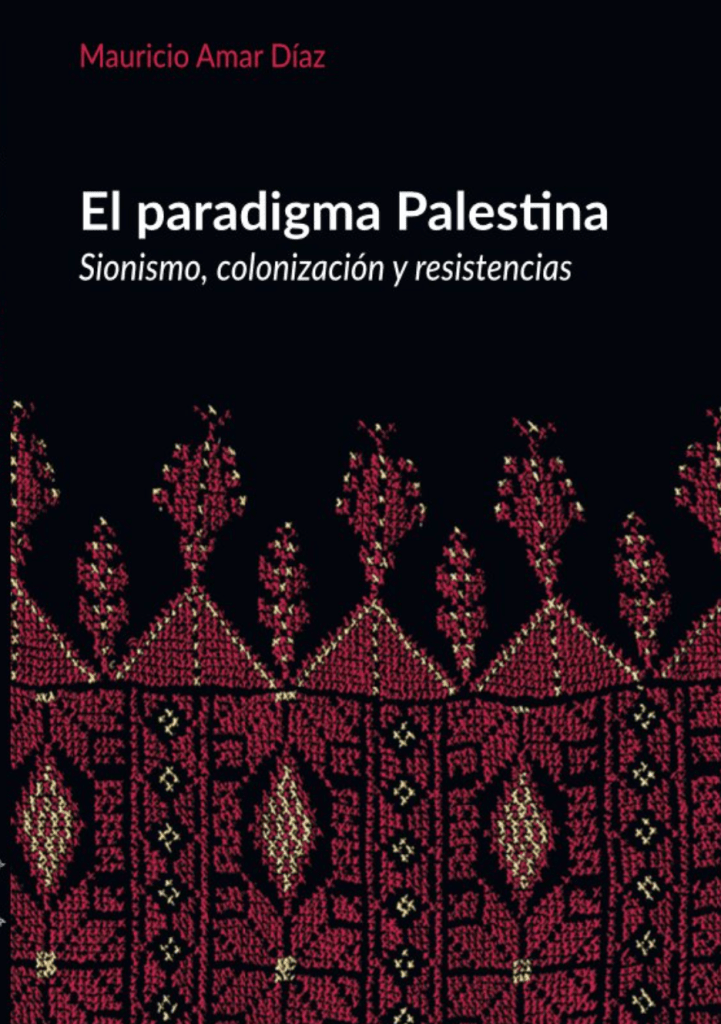
What does it take to destroy a world? It would seem that the question itself is too metaphoric and impertinent; perhaps also hyperbolic and presumptuous against the flight of the infinite embodied in worldling. But this is the question that we should direct ourselves to according to Mauricio Amar’s short and highly accessible book El Paradigma Palestina: Sionismo, Colonización, Resistencias (DobleaEditores, 2024), which is written in the wake of the ongoing war of annihilation in Gaza in order lay bare the paradigmatic abyss of social death in which humanity finds itself at the peak of its civilizational dominance. Amar does not use the term “paradigm” lightly, and nor is he interested, as recasted recently by none other than Steven Bannon citing Thomas Kuhn’s work about scientific revolutions, in posting a central conflict towards transformation; rather, one must situate this strategic conceptual deployment in light of the Chilean philosopher’s own work on imagination and use, which provides an irreducible and sensible texture to every emergence of a paradigm [1]. This means that if Palestine is, indeed, the paradigm of our epoch is precisely because it has no-space in the world – it is what can be infinitely be destroyed, as Maurce Blanchot famously said commenting Antelme’s work – and what illuminates the core and extension of the “integrated” planetary humanity oriented towards the administrative governmentality of contemporary Western democracies, and its corollary geopolitics of the total artificial spaces, as Bruno Maçaes has recently called it. Reading Amar one senses that under the name “Palestine” he is registering a limit to the Humanist force, where an existential claim reveals the maelstrom of an epoch that has resorted to a grotesque parody of the ancient homeric standards of domination and submission. It is the outlook that Simone Weil described as the paradigm of transforming the world into nonliving things.
If understood as a paradigm, Palestine reminds us that the homeric energy towards the aristocracy of equality through force and death among the human race never truly ceased, but only changed forms and cloaks throughout the ages. The post-mythic West seemed to have constructed itself through the repeated revolutions that accommodate justifications for usurpation and containment, self-deification and legibility of the territory at the service of a fictive ethnos. The belated nationalism of modern Zionism has had the paradoxical quality of being both a project of territorial usurpation after its illegalization in International Law (The Kellogg-Briand Pact of 1928); while, at the same time, a politico-theological configuration that, as Monica Ferrando has shown in L’elezione e la sua ombra: Il cantico tradito (2022), clings upon the manipulation of the theological election of “a People” in order to deploy the coterminous binding between community and territory justified through divine narration. The interdependence of the spiritual goal of Zion is only possible through the construction of a settler state, at the same time that the occupying state’s only legitimacy based on ‘one God, one People’ relies on the restitution of an instrumentalized form of the theological election. This is why for Amar the Zionist state building project is a the paradigm of a specific type of colonial governance whose end is not just to capture errant people into social subjects, but more fundamentally a translatio imperii that folds the Earth into a territorial nomoi of distinct multilevel functions: checkpoints, walls, vigilante control of movements, constructions and erasure of surfaces, administration of critical infrastructures, development of extractive resources, and finally the hunting down of humans that necessarily blurs the line between civil population and battlefield combatants. When Amar reminds us of Israel’s predominance in planetary security and warfare technology, one can immediately recall Emile Benveniste’s suggestion that “measurement” (med*-) and the proportional addition to produce objectivity, entails an efficacy of permanent dominance and governability whose main enterprise is the management of populations through the regime of accumulation. As Andreas Malm reminds us of the current cartography of Palestine: “The genocide is unfolding at a time when the state of Israel is more deeply integrated in the primitive accumulation of fossil capital than ever…This is the political economy of normalization: a sacralization of busines as usual that destroys first Palestine and then the earth” [2]. The ongoing devastation of Gaza is a window into the project as a whole: the necessary destruction of the worlds and the total artificiality of the life-worlds, always at the service of maintaining the needs of anthropological symbolizations.
For Amar this points to an epochal scenario of a people without world; and, following the lead of Sari Hanafi, he will claim that the paradigmatic mirroring of Palestine is also an spatial-cide, in which the living are deprived of a sense of inhabiting and roaming that brings to bear that the nakba is not something that has taken place in history once and for all, it is a catastrophic event that has not ceased from repeat itself, and whose ultimate intention is to suture the world and existence, the soul and the spirituality of the open atmosphere that is needed to sustain life. Reading Amar between the lines – who towards the end of the book finds distant interlocutors in Darwish’s poetry, the philosophy of Gilles Deleuze, as well as in the glosses of Walter Benjamin on history and the prose of Edward Said – one learns that the true arcana of Palestinian resistance is also a secret promise for our apocalyptic times: to hold on to the world, so that we can all passionately land on the Earth and freely breath in its surroundings. The nexus of the Palestinian question and the intrusion of Gaia, although underdeveloped in Amar’s analysis, obliquely runs through a text that is also very much about the central question of ethics that never abandons thought: how to name what escapes without taking the world as such into an object to be possessed, destroyed, and remade anew as a hostile secular imago dei. The vindictive hyper-consciousness of the contemporary unmediated arcana imperii now reveals, as Amar says towards the end of he book, a mirror through which we can observe our own increasing domestication, in which the metropolis is just the luminescent and self-protected hub, but whole ultimate darkening shadow is the Gaza’s pile of rubbles resembling an open air necropolis (Amar 108-109). Through different arrangements of organized destruction, both the metropolis and the necropolis converge in their preeminent ‘struggle against space’ and its form of life for the sake of familiar pieties of enslaved survival of unworldly anomie (Amar 116).
Does this mean that we are all “Palestinians”? Mauricio Amar’s El Paradigma Palestina (2024) rejects the all too well expected craft of solidarity and subjective identifications that can only work on the payroll of the gravediggers of the current civilizational project. On the contrary, if Palestine is our paradigm, and it remains so, it is because it can only refuse measurement and recognition in order to dwell in the only possible exteriority as embodied to Darwish’s poetry that Amar quotes towards to the end book: “Do not trust the poem / absent child / it is the throbbing of the abyss” (Amar 140). From the abyss we nourish the soul as the return to land on Earth prepares itself in order to no longer conquer a territory, an ancient tradition, or a “People” (ethnos), but to dwell on the nearness of a place that is an excess to every location or community of belonging (this is the false exit of the kibbutzim). We do not have political grammar to articulate what this integral freedom could mean, except that it is an exotic relation in Victor Segalen’s sense: a creation of a world alien from the compatible and petty one that currently drains us into its ongoing desperate destruction and passive enslavement [3]. Finally, like all authentic paradigms, it is worth noting that Paradigma Palestina (2024) teaches and preaches nothing; it only invites us into the swirling sensation that crosses over the imagination and the singing voice, from the world of the last remaining lives to the isles of the dead martyrs, and back.
.
.
Notes
1. Mauricio Amar. Ética de la imaginación: averroísmo, uso y orden de las cosas (Malamadre, 2018).
2. Andreas Malm. The Destruction of Palestine is the destruction of the Earth (Verso, 2025), 53.
3. Victor Segalen. Essay on Exoticism (Duke University Press, 2002), 24.


 Infrapolitical Reflections