Sentence and prose. by Gerardo Muñoz

After more than ten years, I have recently reread several works of contemporary novelist Alan Pauls, and only now I have come to understand the precision of his language; a perfect combination of the rhythmic movement of a swimmer combined with a dry stroke of a brush on a canvas. This precision is not holistic, but found in every sentence of his prose. Aside from the content of his intuitions about literature or the almost microscopic development of frozen time of his characters, what Pauls ultimately teaches is that the unit of prose is the sentence, both its cadence and its ability to be severed and be brought to an end. This is precisely the meaning of the “period” (periodos) as the internal unit of the sentence: periodos is afterall, the circular moment of something that has a beginning and an end. The achievement of a good prose is the articulation of periods that can launch and make a sentence retire. 

For a novelist who is also a self-reflective essayist, it is puzzling that Pauls has not implicitly thematized the unity of the sentence in the craftsmanship of prose (although he has considered accentuation in an essay) [1]. But it is wholly absent in El factor Borges (2004), and his most recent collection of musings and glosses on reading and writing in a volume titled Trance (2014). It is perhaps too easy to overstate the fact that there cannot ever be a general theory of the sentence, because both tone and periodos are expressions of style. The construction zone of a well crafted prose can only be analyzed in the movement of the sentence. In a fabulous moment of his Arcadian Rhetorike (1588), the sixteenth century grammarian and poet Abrabham Fraunce writes the following regarding the sentence: 

“The beginning and the end of a poemt must not be the beginning or ending of prose. For the beginning, a little consideration will suffice, for the middle, less; but in the end the chief care is to be had, for it is most examine, and the longest in memory. It must therefore be sweetly contruied, that it seem not hasty and abrupt: it must also be varied and changed often time…if the same foot should in the end be continualed repeated.” [1]. 

In his treatise of rhetoric, Fraunce connects the end of the sentence, the coming to the periodos to the work of memory and sweetness. Perhaps because the cadence embedded in the sentence is the instance that allows us to connect past and present without hesitation or interruption; not the moment of suspension and surprise, but of landing in language, so that something, once again, can commence. This is also why a novelist in Spanish like Alan Pauls has not ceased to be fascinated by the idea of the past, especially in El pasado (2003), but also in his historical trilogy about his coming of age in the seventies. In other words, it is not enough to write the past in mere prose; the most important solicitation is to lodge its memory in the nest of the sentence. It is only here where memory arrives at a region called “home”.

Notes

1. Alan Pauls. “Elogio del acento”, in Temas lentos (Random House, 2022), 52.

2. Abraham Fraunce. The Arcadian Rhetorike (Oxford University Press, 1950), 34.

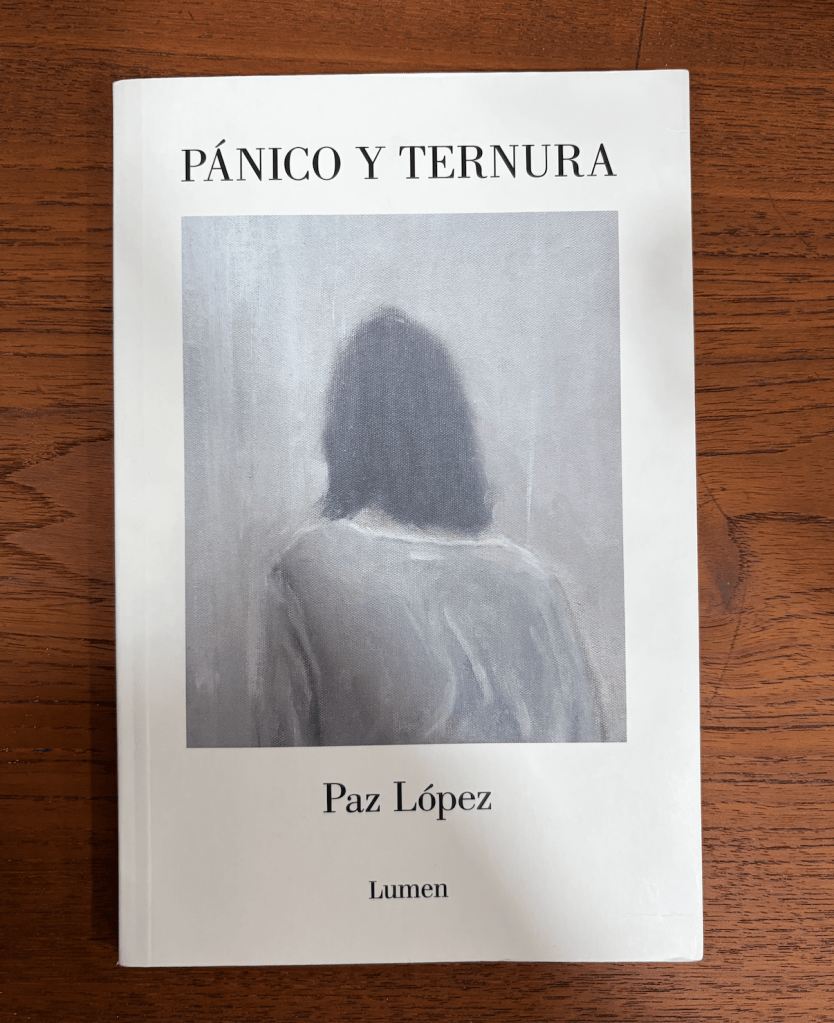
Breathing in the pain of the world. On Paz López’s Pánico y Ternura (2026). by Gerardo Muñoz

Paz López’s Pánico y Ternura (2026) opens with an analogy between life and school that immediately places us in attention to her writing: “Entramos a la vida como entra un niño a la escuela: mirando hacia atrás, con los ojos llorosos buscando la mano de quien hace un rato nos había variado el pelo, la nariz, las rodillas heridas, los diminutos labios” (López 14). Although the synecdoche (“la mano”) does not reveal to whom it belongs, in a way the mother is spectrally present, a figure overtly present in Paz’s writing. We enter life in the wake of separation and caesura, and that is the site of the original wound that will lead to all sorts of civilizational and mimetic compulsions that unfortunately we know too well. And yet, López does not say we enter the “law” (although this is also presupposed of course), but rather we enter school. Our civilization has slandered and tainted the notion of “schooling” and “school” to such an extent that we have entirely forgotten the fact that school is schola; that is, time of rest and interruption, “free time”, a lagging duration of contemplation of language and being, and of being in language. And if the notion of “school” is under ruthless attack in our present by an infantry of pedagogues and technicians, it is mainly due to the fact that what is being threatened is the very possibility of a form of life. Of course, our epoch is one in which the chatter of “life” is continuous and intoxicating, but the form of life is something altogether different: it entails to inhabit a space of a convergent and planar movement between language and world. 

This is one of the regions that opens in López’s book; one out of many, allow me to follow it. As López says toward the end of the essay: “…cada vez que hay un corte tenemos la posibilidad de inventar una nueva lengua, de poner de movimiento el mundo” (López 128). It would be too convenient to follow up this claim and say that this is precisely what Paz López does in her writing; clearing language in order for a tonos or a vibration of the voice to unearth tropes that have been traced almost at the level of the flesh. This is something to this autographic practice that moves gently without fetishing the body and its materiality. Ultimately, a body is always more than surface. I want to retain from López’s scene of writing a responsive form of thought that in its inconspicuous relation to writing it refrains from the certitude of both philosophy and the letter. López’s search could perhaps be one of “tanteo”, a beautiful Spanish verb that refers to the hand that seeks and reaches out for something in space, and in my memory it immediately recalls some short stories of Carmen Martín Gaite’s fiction where this gesture figures in a cinematic fashion. Hence, for López ‘tanteo’ is to refuse the hell of a world of acrimonious security and confirmations that discards the inexorable presence of doubts and fissures (López 39). But the hand that seeks is also not a pure gesture in the void; it is one that asymptotically discloses an erotic mediation with the passing world without ever abandoning it; yet unequivocally assertive in the lamentation of the state of the world (López 56). 

In other words, because we can seek (here López is enrolled in the school of Hölderlin), there is no end to the world now configured as a fragile fishing net of relations, unsaid words, glances, and incommensurable distances that make up, without exhausting it, the spectacle of life. Not “this life”, of course. For López, the brutality of our times (I am less prudent and I will say ‘onto-theology’) is precisely the general concerted opinion that we are all owners of our own little and mediocre lives, the last avatar of a self-serving will to power. Rather, for López life is always elsewhere, and this is why the “escape” or “exile” from oneself is not a place of arrival or destiny, but precisely the disposition that is always traversing every relation and every touch between bodies and souls (López 65). We are creatures of the outside, and by extension, only the cohabitation of the outside, can redeem the pain of the original laceration, as in the first image of the infant walking his path to school with his eyes turned. This is not a messianic or monastic retreat, it does not depend on the parousia, but rather one of poetic dwelling in the spaces that are both familiar and strange. It is only in them (through them) that we can only cultivate through the garden of our language. López’s anti-messianic orientation, devoid of the fiction of future time and its anxieties, is proportionally a prose of hanging spaces, of curvatures of language that affects the reader deeply without ever renouncing to the beauty that thinking that defies being brutalized through the crushing weight of technical terms or philosophical concepts. 

In this sense, López’s writing is already an autographic writing at the threshold of onto-theology convinced that only style through the resources of the voice is the path that mitigates between poetry and philosophy, painting and memory, experiences and the unlived. López’s prose, if anything, is a lot about “gathering” through the tenderness; a contact where image and eros become the medium of life: “No es eso también la ternura, una forma de “recortar nuevos espacios en el vacío informa del exterior y conquistarlos a la medida de la vida (Claudio Magris)?” (López 94). To gather and to cut through the spaces: this is the highest task of the ethics of a form of life that requires a new theology of the sensible. Theology can be taken as a strange word in López’s lexicon, and I do not think that it appears even once in Pánico y Ternura. And yet, López’s proposal is completely theological if we take the theos as the highest and most beautiful light that can nominally allow for depth through the analogy of things in the net of the world. Hence, the importance of the sighting to the inner most depth in some moments of López’s writing, such as when she ponders on the fact that every time that she plunges eyes on a minuscule element or figure of the world, she senses that “se revela el elemento bestial que se enceuntra en el centro de nuestro mundo, como si la mirada fuera un cordon umbilical….amarrados todavia al vientre brumoso del origen” (López 121). And theology is not just the highest, but also the science of the first things: through the piercing expression of our senses, we elevate ourselves not with some revealed transcendence, but with the proximity with the things that have found us. 

And yet we have been automatized – this is the sensible devastation that Pánico y Ternura is responding to without ever taking a political stance, because politics is thoroughly insufficient – to see every-thing, and every being at all times; all entities realized in the feast of interchangeability and availability. The heliotropic force of modernity now truly blinds and burns our skin, which means that no access to the solar totality of social existence can guarantee anything except continuous conflagration and commanded muteness. We cannot but feel “panic” in this current predicament López is completely right. Thus, we must find the flickering light and flames elsewhere, such as in the lamp of a dark night that can illuminate the page of a book that keeps us in attention without any real purpose. Nabokov’s suggestion comes to mind: in the lamp of our study, we reject the nihilist demands of the cacophonous social world. Paz López has given us a delicious essay to read under this tenuous light. It is a present memory of an abode that keeps the secret of secrets, a resting place of the soul where still some melody is heard.

Plastic spirit and depth. by Gerardo Muñoz

In an issue of The Listener in 1935, the renowned British art historian Kenneth Clark penned a short article titled “The Future of Painting” that can be read as an early eulogy to the tradition of the pictorial craft. As a provocation – this was still the high tide of Modernist art – the ‘future’ of painting for Clark was undeniably reaching a point of irreversible exhaustion, at least in the Western tradition. In a phenomenological reduction of two major strands of modern painting – what he called “pure painting” that included Impressionism and Post-Impressionism; and, on the other, “super-realism” as the artistic consciousness that bypassed  “spiritual salvation”, such as that of Surrealism and other visual experiments – Clark’s indictment deployed an indictment on what he sought as the end of the “plastic spirit”: “We must keep in mind the possibility that in the western world the plastic spirit is really exhausted and that art will be lost for many decades” [1]. 

For Clark, it was not that art ceased to exist as an autonomous practice of sensorial activity; it was rather that its imaginative and spiritual endeavors had a future only if mediated and “linked up” (sic) with the evolution of a “new social economic system” driven by the standards of productivity and mass spectatorship. Unlike Clement Greenberg’s reflexive plea of modernist painting as the triumph of the dialectical inversion of flatness over depth, for Clark the convergence of pictorial relation with social objectivity resulted, in the tradition of a post-Cezanne world, in draining the inherent sensible communication of painting and myth. This meant that modernist painting tout court was devoid of any mythical relation. In fact, one could very well claim that the outwardly material support (the flat canvas) of the picture became its most dramatic corroboration. Modernist painting was the triumph of social symbolization insofar as it served as a reminder of the objective space that could only be taken as unserious gratification of its own objectivity.

It does not take too many readings of Greenberg’s large claim on modernist painting to see that behind “flatness”, its very surface, lurks variations of the aura of subjectivity, expressed in “success of self-criticism”, “resistance to the sculptural”, and the drive towards systematic consistency viewed in the mirror of the “convergence of spirit with science; their concern does show the degree which Modernist art belongs to the same historical and cultural tendency as modern science” [2]. Or so writes Greenberg in his landmark text. If Greenberg goes out of his way to invite modern science into the field of aesthetics it is precisely because Modernist art has been able to spell out the potential for representation into an autonomous surface that has given up depth to the conscious effort of its material limitations as its primary concern (imagination, the divine, the liturgical theatrical aura are all secondary). It is perhaps against this backdrop that one can understand what Clark means by the exhaustion of the “plastic spirit” that underpins his prophetic understanding of the decline of painting. 

But what is, ultimately, the “plastic spirit”? It is not referring to sacred representation nor artistic inspiration of the artist, but rather the receptive affinity of the pictorial gesture with nature without ever being reducible to its material support (flatness). If painting exists, it is because its lovely being “is neither sensuous nor spirit, but rather the ungraspable, diffusing over the figure…this being is ungraspable yet perceptible to everyone is what the Greek language called [kharis] and we call grace” [3]. What the ‘plastic spirit’ discloses in its suspension of judgement through very disclosure of appearance is the imperturbable space, and by extension ungraspable, where figuration arrest an instance of eternity. In this sense, it always resists any assertion towards the future, because it dwells in the opening of a space “there” that fails to coincide with the material extension and limitation of the canvas.

This is what perhaps Walter Benjamin had in mind in an early fragment where he reflected on painting as an art of paradise or a state other-than-being grounded in visual contours: “Painting, too, generates space spiritually; its generation of form is likewise grounded originally in space, but it generates space in an­ other form. Not the dimension but the infinity of space is constructed in painting. This happens through the surface, in that, here, things develop not their dimensionality, their extension in space, but their being toward space. The depth yields infinite space. In this way, the form of concentration is given, but this now requires for its fulfillment, for the allaying of its tension, a presentation of the infinite in itself and no longer as dimensional and extended” [4]. Was not this the ungraspable caesura between depiction and nature already pointed out by Schelling?

Painting is depth, or at least it is about a certain way to accout for depth. And depth, fundus, before it takes the form of a flat spatial region in ‘thereness’, it is eminently the display of the figure that emerges from it. This “space otherwise” – that is not just a different spatial arrangement or geometrical calculation – is something of the infinite that makes both flatness and the diachronic arrow of time collapse in its unattainable rigor brought to bear in the affection through figures and colors. Every painting shows therenesss, but that is only possible through the depth of interiority that remains invisible. This can illuminate what Osip Mandelstam said of the plastic spirit when writing that “painting is also much more a matter of internal secretion than of apperception, that is, of external perceiving. To appreciate a picture you must go through a process making of restoring it” [5]. It is in this renewal that the imperturbable depth of painting fulfills before the abdication of the future. And from the “depths of nature” into the blossoming manifestation of appearance, painting recalls, beyond words, what in the sequence of time is understood, and yet often neglected, as the ungraspable. 

Notes 

1. Kenneth Clark. “The Future of Painting”, The Listener, October 2, 1935, 578.

2. Clement Greenberg. “Modernist Painting” (1960), in The Collected Essays and Criticism (University of Chicago Press, 1993), 91.

3. F.W.J. Schelling. “On the relationship of the plastic arts to Nature” (1807), Kabiri: The Official Journal of the North American Schelling Society, Vol. 3, 2021, 146.

4. Walter Benjamin. “The Rainbow, or the Art of Paradise”, in Early Writings 1910-1917 (Harvard University Press, 2011), 225.

5. Osip Mandelstam. Journey to Armenia & Conversation about Dante (Notting Hill Editions, 2011), 79.