
On the abyss of pictorial space (work in progress notes for a seminar). by Gerardo Muñoz

We have attempted to read Florensky and Schmitt side by side, and certainly many fundamental questions have been raised converging profusely on the problem of Catholic form. At the same time, it is undoubtedly true that some questions have not been pursued at length, and they exceed the modest purpose of this short seminar. As a way of synthesis, I want to press against one question that seems to me to link both thinkers in the wake of secularization, and especially modern representation. Modernity is always too many things at once – it is purely the force of the contingent, but ultimately it is the temporalization of space through objectivity and its necessary legibility. It seems to me that the spatial question is a guiding thread, not the exclusive one, that connects Florensky and Schmitt’s interventions circa 1922. It is obviously the problem that the German jurist never ceased to reflect upon, if we recall how in the very end of his work he situated the very arcana of the law in relation to the visuality of the Homeric “kai nomon egnō”, a predicament for seeing space laying before the law; that is, subsumming the sense of worldly opening into the necessary predicate of a legitimate ground for order.

Schmitt’s purified, prima facie formalist conception of the Catholic form, is also fundamentally spatial, because the primordial essence of the duality of the ekklesia as an institution comes about through the dominion of life unifying the communities and burgs into an internal system of legitimation that builds a concrete order (in recent years the work of Anna Grzymala-Busse has convincingly tracked the morphologies from the medieval church the modern city state and the rule of law).  As we know, for Schmitt Rome (Catholic form) is Raum, spatial arrangement, dilation of orders and institutions, representation and decision elevated beyond the fundamental norm. In this sense, the thesis on the ‘visibility of the Church’ hinges upon the opening of the world as always already oriented towards salvation through the structural deficiency of human beings (original sin) and communitarian order of representation and delegation. This is why Schmitt remains a modern political thinker – perhaps the most acutely aware of thinkers when it comes to the fragility of the political project based on the specular visibility of legitimation – because the fusion of the political and that of territory remains indivisible, in spite all of his self-conscious response to the force of immanence noted in Political Theology (1922). The liquidation of the limiting autonomy of the political against technical neutralization is only possible because “space” has been first subsumed into the visible nomos of the nomon egno

It goes without saying that Pavel Florensky’s strategy is also extremely sensitive to visuality, but his position departs from the assumption that modernity is about the flattening of the unilateral and objective specular regime of visibility. One can recast what Alberti writes quite ostentatiously in  De Pictura: “No one will deny that things which are not visible do not concern the painter, for he strives to represent only the things that are seen. Points joined together continuously in a row constitute a line” [1]. In Alberti’s visual inception of pictorial representation, space is already orienting the direction for the flattening of pictorial space that defines modern pictorial representation in the well established argument by Clement Greenberg [2]. Obviously, Florensky wants to break against the flatness of modern representation, which is the condition of possibility for the very nihilism of subject and object that becomes worldness because it has no longer any possible carving out the “thereness” of space. It seems to me that this is what Florensky is after when elaboration of the ‘reverse’ or ‘inverted’ perspective. The inversion here is not just an aesthetic problem of the autonomy of work of art in the new distribution of labor, and here is where liturgy marks a fundamental distinction in terms of the analytical paradigm that frames Florensky’s investigations. Around the same years, Romano Guardini in his The Spirit of the Liturgy (1918) defined the liturgical experience as anti-aesthetic phenomenon, because in its communion of souls, it gathers the visible as well as the invisible, whose exclusive beauty shines in the light of truth and not of delimited notion of “work”. For Florensky moving past linear perspective, and by extension objective representation, is the path that prepares “a new structure of thinking” as such [3]. In virtue of its own experiential depth, “a certain spiritual excitement, a joly that rouses one’s attention to reality itself. In other words, perspective too, if it is worth anything, should be a language, a witness to reality” [4].

The so-called inversion of perspective is a destructive operation at the level of sensibility against the traps of illusionism and abstraction, opening in the concrete and yet not-yet-here space where life and its alterity enter into contact. This is why Florensky claims that it is “the content of space that is transmitted, but not the organization” [5]. And in a more densely and rich moment of the “Reverse perspective” (1920) he writes the most clearly expressed elaboration of this new structure of thinking: “To sum up. It is possible to represent space on a surface, but only by destroying the form of the thing represented. Yet it is form, and only form, that visual art is concerned with. Consequently, the final verdict is proclaimed for painting, as for the visual arts in general, to the degree that it claims to provide a likeness of reality: naturalism is once and for all an impossibility”  [6]. As it is obviously clear, Florensky is not thinking destruction in virtue of restating a metaphoric sacralization of nature; rather, for him the liturgical depth of the reverse perspective discloses an experience is only possible in the contact between the possibilities of the world and being. It is this region that he call the “abyss of own freedom”, and that the attempt to contain it through the hegemony of the matheme and calculation only amounts to “as tasks of insane presumptuousness” [7] 

The turning of experience must inhabit this abyss of freedom retreating from an “unmoving monumental and ontological massiveness of the world, activity by the cognising spirit that lives and labours in these thresholds of ontology” [8]. Thus, accounting for that ontological reduction makes possible inhabiting realities in the world that never become validated through representation. As Florensky writes in a short piece published around these years: “Obviously our living remoteness from reality must again destroy realism in art as well. There are realities in the world; one comes to know them by coming into living contact with them through work in the worldwide sphere….art can unite us with realities are inaccessible to our sense – such are the formal prerequisites of any artistic reality, and a tendency that rejects even one of them thereby forfeits its right to be called realism” [9].

If the Christian liturgy remains the most “realistic” experiential arrangement for Florensky it is because the texture of space appears in its non-visibility as the “missing aspect of what what we might call the surrounding world…it is this surrounding world, place as such, which the liturgy addresses” [10]. It is this surrounding world, that is both beyond the world and yet within it, almost folded unto it, what I would claim that relates tendentially to the notion of the  chora (χώρα), not as an interchangeable modulation of “place”, but as what allows externality as the requirement of experience to be indifferent to sense because it its presence is that of possibility. John Sallis in an essay on the notion of the chôra puts it in a way resonates with the abyss of freedom withdrawn by Florensky:

“One could say—though not without some risk of falling into the dream in which the chora (χώρα)  is conflated with place—that the chora (χώρα) is the other of being, not just in the sense of being other than being (as every eidos except being would be other than being), but rather in a more abysmal sense, in a sense irreducible to a difference of sense. One could say, too, that the chora (χώρα) is the outside of being, that it is what enables externality as such and thus makes it possible for something outside being nonetheless to be” [11].

We should linger on those words: “a more abysmal sense, in a sense irreducible to a difference of sense”. But this abyss is not what refers to an ontological vacancy that becomes operative for the subject; it is the excess that allows being, and for that matter “ethical being”, to have composed duration in its region.  I think it is possible to accept the minimalist thesis of the liturgy as the sanctification of “time-place that the world is” (this is the syntagm deployed by Hemming) beyond divine revelation, but only if one takes up the chôra as the space of spaces (ur-space) at the end of secularization, a transformative leap that transcends time to land somewhere in the depths of regionality. It is the region that makes the passage, as Florensky would say, fata voletem ducunt, nolentem trahunt, from interiority to exteriority without ever achieving consummation, perhaps as a folded relation. The stakes are enormous no doubt. In an entry in his recent Quaderni XIII (Quodlibet, 2025), Giorgio Agamben defines it in a particular way that traverses Heidegger, but also beyond him. This is a difficulty disclosed by the chôra, and it is the beginning of further challenging investigations waiting for us:

“It is the choice of this misleading conceptualization that leads Heidegger to privilege, like Hegel, time and action over space and contemplation. Not “Being and Space [chôra],” as in Plato, but “Being and Time,” as in Hegel. Even the “wonder that beings are” becomes a task and a “sacrifice”. Instead, the aim is to understand this wonder ethically as “use” (“to use it again in order to contemplate it”). Admittedly, in his later years, Heidegger attempts to rewrite Being and Time as “Being and Space”; yet here too, the conceptualization remains imprecise because it does not sufficiently question itself. (Although he merely acknowledges the inadequacy of language, he continues to propose terms that are necessarily deficient.)” [12].

Notes

1. Leon Battista Alberti. On Painting (Penguin Books, 2004), 37.

2. Clement Greenberg. “Modernist Painting” (1960), in The Collected Essays and Criticism (University of Chicago Press, 1993), 90.

3. Pavel Florensky. “Reverse Perspective”, in Beyond Vision: Essays on the Perception of Art (Reaktion Books, 2002), 246.

4. Ibid., 254. 

5. Ibid., 258.

6. Ibid., 258.

7. Ibid., 260. 

8. Ibid., 269. 

9. Pavel Florensky. “On Realism”,  in Beyond Vision: Essays on the Perception of Art (Reaktion Books, 2002), 181

10. Laurence Paul Hemming. Worship as Revelation: The Past Present and the Future of Catholic Liturgy (Burns & Oates, 2008), 47-48.

11. John Sallis. “The Politics of the χώρα”, in Platonic Legacies (SUNY Press, 2004), 42.

12. Giorgio Agamben. Quaderni XIII 2020-2021 (Quodlibet, 2025), 248
A painting that knows no evil. by Gerardo Muñoz

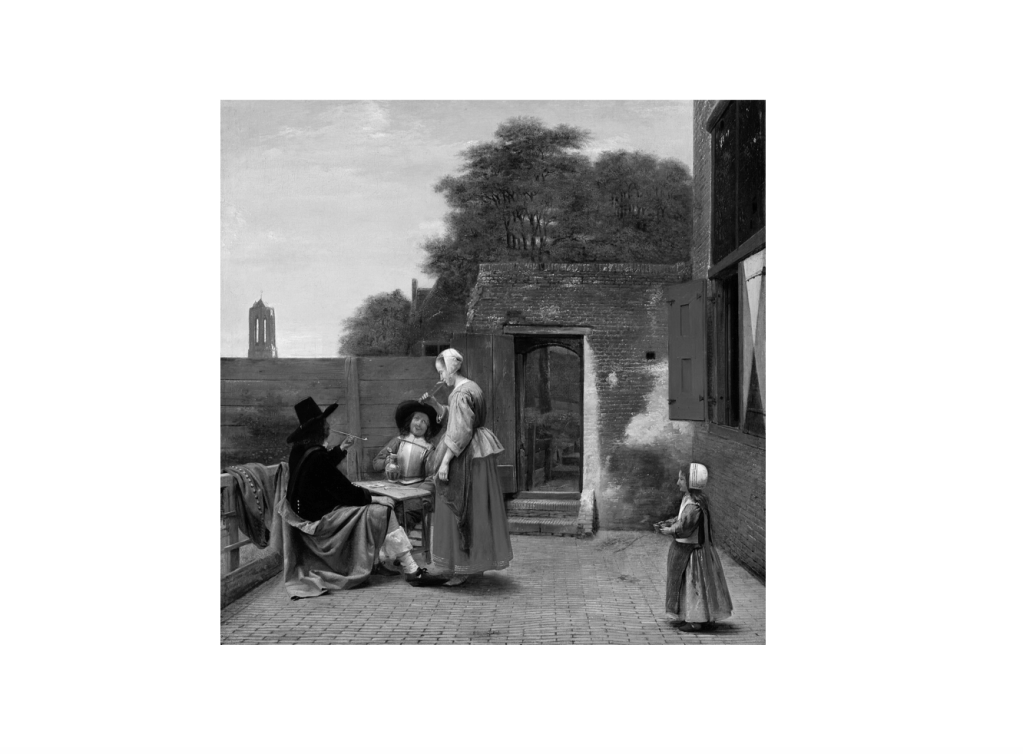
In several places of his Lectures of Aesthetics, Hegel refers to Dutch painting as a way to thematize the concept of completion that fulfills being in the world. For a moment his commentary brings to bear a state of the mundane while avoiding the vulgarity of the overachieving surface that would define the general tendency of modern painting. True, Hegel’s indictment of Dutch painting does not negate the modern sensibility either, insofar as the portraits of the Flemish tradition fail to disrupt that is always held incredibly visible in the frame of pictorial representation. The artistic triumph of Dutch painting depends on a specific oscillation between the inner and outer experience of the subject visible range of depiction. This is not an exclusive one-directional movement towards the immanence of life; which Carlo Levi will denounce as the estrangement from the world, but rather a synthesis that gracefully falls on the sensuous activity of painting just at the moment that appearance dispenses in the world. 

Thus, the emergence of Dutch painting was only possible in a specific form of life that was resolutely experiential in nature and spiritual rich. As Hegel writes in a first moment in the Lectures: “the Dutch in their taverns, at weddings and dances, at feasting and drinking, everything goes on merrily and jovieall, even if matters come to quarrels and blows; wives and girls join in and a feeling of freedom and gaiety animates one and all…this spiritual cheerfulness in a justified pleasure, constitutes the higher soul of pictures of this kind” [1]. And this spiritual freedom, sublated from the necessities and constraints of external things in the world, validates a concept of the ‘ideal of life’ that is transcendent only to its sense of living. Hegel notes that Protestantism facilitated the Dutch a materiality for this sense of worldly transcendence, of communitarian deificatio, allowing them to have, in his words, “some footing in the prose of life” [2]. So, Dutch painting is predominantly concerned with depth; and this depth is not concerned with the absorption of the spectator, but quite literally, almost in a physical way, enmeshed in the inner tonality of everyday figures. This is their inner being made visibly manifest. The manifested and gathered presence of this inner and outer movement of the infinite is precisely what retains the imperturbable trace of the divine beyond time; indeed; an eternal Sunday of life, as Hegel says in another important moment: 

“This painting has developed unsurpassably, on the one hand, through and through living characterization in the greatest truth of which art is capable…For this reason we have before us no vulgar feelings and passions but peasant life and the down-to-earth life. lower classes which is cheerful, roguish, and comic. In this very heedless boisterousness there lies the ideal feature: it is the Sunday of life which equalizes everything and removes all evil; people who are so whole-heartedly cheerful cannot be altogether evil and base”. [3] 

It is well known that in the art historical discipline, the moment of Dutch painting has been understood within the framework of the scientific and optical revolution of that century; a new “faith in the eyes”, to follow Francis Bacon’s terms, capable of generating a concrete and rational knowledge of the “common world” of a new, more geometrico, regime of light [4]. But nothing could be further from how Hegel’s synthesis approached the sensibility of Dutch painting; mainly, as fundamentally a site of the overcoming of evil because it was not alien to the comic downfall of human experience. In Dutch painting, Hegel reminds us, it is not that evil or wrongdoing is removed from the factical life; rather, it means that the comic is a nested experience that can grasp and transfigure the miseries or the disasters beyond taxative transactions of the social world and preparing the conditions for a kallipolis

Although it is not clear who are the Dutch painters that Hegel had in mind when writing about a painting that enters into the “Sunday of life”, certainly the pictures of Pieter de Hooch – “A Dutch Courtyard” (1660) comes to mind – where distant and miniscule figures smile at each other in the open encounter of a place. The erasure of evil from painting is achieved not from stating the dogma through which the world could transcend and reverse the fall from nature, that is something like a new “faith in the visible”; it is more the event that accounts for the surrounding as it becomes oblivious to the very artifice of depiction. In this sense, the imperturbable state of Dutch painting is achieved as a life that dwells in the folds of the world as it retreats from the force of anticipation. And, if according to Chrysippus, evil is nothing but losing the capacity of affection or mediation of our inner sensibility; what the Dutch pictorial order brings to bear is that the ‘good’, rather than being a substantive function of the will and contingency, it can only be accessed in a form of life that is indistinct from the inconspicuous and breathable space through which it dwells.

And what is the sensibility of the comic if not what remains ungraspable in each and every in a painterly expression in a world in consonance, a place without remainder? In other words, if there is a painting that has abdicated from evil, it is because its has attuned the soul to an exteriority that is no longer dependent on the weight of the sign. It is still the business of the mute things (Poussin) in order of the beautiful. This is the state the state of grace that Schelling thought the plastic arts could bestow human sensuous experience after the irredeemable apotheosis of nature: “In painting a lovely being that is neither  sensuous nor spiritual, but rather ungraspable, diffuses itself over the figure and nestle into all the figures and to each oscillation of the extremities. This being, which as we said, is ungraspable yet perceptible to everyone, is what the Greek language calls kháris and we call grace (Anmut) [5]. And the movement of grace in painting is what initiates the transfiguration of death – the muted voices of the dead – into a divine whose sole task is the disclosure of presence. 

Notes 

1.  G.W. F. Hegel. Aesthetics. Volume I (Oxford University Press, 1975), 169-170.

2.  Ibid., 597-98.

3. G.W. F. Hegel. Aesthetics. Volume II (Oxford University Press, 1975), 886-887.

4. Svetlana Alpers. The Art of Describing: Dutch Art in the Seventeenth Century (University of Chicago Press, 1983), 91. 

5. F.W. J. Schelling. “On the relationship of the plastic arts to Nature” (1807), Kabiri : The Official Journal of the North American Schelling Society, 2021, Vol. 3, 146.

The social efficacy of Thomism. By Gerardo Muñoz

One of the merits of Sandor Agócs’ The troubled origins of the Italian Catholic Labor Movement (1988) is located on the question of Thomism during the rise of a national industrialization and the new centrality of the worker. This is a question that informs the very genesis of modern political thought, so I want to zoom in to the specifics: in Agócs’ narrative, the reinvention of Thomism goes hand in hand with the ‘social question’; that is, not just as the substrate for state legitimacy, but also as a supplement in the very mediation between the state and social incorporation. After reading Agócs a question lingers: what to make of the success story of social Thomism in the long history of modernity, that includes episodes from the both the left and the right; from the Italian Catholic Social Movement to Corporate Francoism, from the Pinochet Constitution drafted by Jaime Guzman to the most recent articulations of an interpretative common good in the contemporary American postliberal constitutional and interpretative balancing? One easy way out of the explanation is to delegate the answer to the historical uses (and misuses, depending who is defending what) of Aquinas’ thought, but that hardly answers the question. A while ago, John Finnis made a claim that could point to an important destination: 

“This grand metaphysical overview of reality, and of our knowledge (‘theoretical’ in the first two kinds of order, ‘practical’ in the second two) of it, has been as fundamental to the new classical natural law theory from its beginnings as it was to Aquinas. It enables us to identify as illegitimately reductionist almost all the streams of social-theoretical thought, including political and legal, that have emerged since early modernity. It helps in identifying the errors of those would-be followers of Aquinas who reject the new-classical natural law theory on the ground that it neglects or subordinates nature and metaphysics; the misunderstanding of Aquinas, and of the relation between practical and theoretical thought” [1]. 

For Finnis, although writing for legal theorists, Aquinas’ thought properly understood possesses a ‘metaphysical view of reality’, a sort of plasticity interlocking practical reason for action and morality that serves socio-theoretical ends. In other words, the thomistic plasticity for social legitimation can be connected to what Martin Heidegger held as ‘adequatio’ as a fixed point in the problem of Medieval representation of beings. And this means that thomism is always already a theory of legitimate ground for governing that reality. As Finnis suggests in different moments of his work, the lesson of Thomism is construed in its emphasis on the rule of law as the source for justice and fairness, and in this sense it was never alien to modern social contract. Karl Barth’s rhetorical question -“Why did Hegel not become for the Protestant world something similar to what Thomas Aquinas was for Roman Catholicism? – can now be understood in its most consequential light. 

Now it makes sense that Agócs refers to early twentieth century Italian Catholic Neo-Thomism as a “counterrevolution”, although he does not denote that this would be a second instance of counterrevolution with social prospects that the post-French Revolution figures (De Maistre, Bonald, and Donoso) could not meet in their antimodern stance. And here the divide is sharpened: whereas the counterrevolution post-1789 had very limited and unstable sources in social facts, Neo-Thomism offered a theory of law that was consistent with modern class dynamics supported towards social cohesion and stabilization proper to the ideal of the community centered in urban centers. If one defining feature of political modernity is reversibility, it would then make sense that thomistic natural law could rise to the demands of any given historical time to offer a nexus informed by the onto-theological structure of adequatio and analogia entis, whose proper end is the stabilization of social pressure. The second order ideological uses of Thomism (left, right, revolutionary, moral conservative, traditionalist, pre-post Vatican councils) are contingent to its malleable adequation generated by its own claim to natural morality. Heidegger once pointed in this direction when he claimed that Aquinas’ philosophical horizon was fundamentally the inception of metaphysics over theology as faith (that is actio and efficiency unto subjection) [2]. If modernity is the realization of onto-theology, then it can only make sense that Thomism takes as many garments as necessary to prevent gazing towards the abyss, becoming a manifold phosphorescent theory of social morality.

Notes 

1. John Finnis. “Aquinas and Natural Law Jurisprudence”, in Duke & George, Natural Law and Jurisprudence (Cambridge University Press, 2017), 32.

2. Jean Beaufret. Dialogue with Heidegger (Indiana University Press, 2006), 106.