Constitutionalism and sense. Text for “Legal Crisis in Chile” Session, Red May Forum, 2023. by Gerardo Muñoz

It has been said repeatedly – in the best hyperbolic spirit, no doubt – that Chile always stands, regardless of the angle from which we are looking, for what is to come in our epoch. The Chilean laboratory prefigures the coming mutations and solidifies the effective tendencies of public powers. The 2019-2023 political cycle is no different: it began with the experiential revolt at the heart of the metropolitan center, and it culminated with yet another constitutional scene seeking to replace the “constitución tramposa” now at the mercy of those that hold a deep admiration for the post-dictatorship subsidiary state. The newly elected advisors and experts will place the final cap to the momentum of institutional transformation, which welcomes back the official garments of public legality, official languages, and grammars of public security. And even if it is true, as Rodrigo Karmy has argued, that the most recent electoral results confirm the exhaustion of the Chilean post-dictatorship regime, the question posed to us is what capacity can constitutionalism and the constituent scene contribute for any possible transformation. [1]. In other words, can a breakthrough be produced from within the conditions of constitutionalism? As Martin Loughlin has recently demonstrated, our historical epoch is one marked by the irreversible triumph of constitutionalism; a design that differs from the modern constitutional state of representation and legislative legitimacy, envisioning an encompassing “dynamic order of an evolving society rather than an authoritative text, the basic ideals of constitutionalism have been realized” [2]. Constitutionalism emerges in the wake of the end of the liberal presuppositions of modern political theology and everything that it implies for the stability, separation, and judicial control of public powers.

The system of constitutionalism presupposes a total governmental nexus whose legality (discretionary, exceptional, based on the application of general principles / ius) will be treated as “an order of values that evolves as social conditions change” [3]. The passage into an administrative system of legal order presupposes a suture between principles and political necessity, state and civil society, economic rationality and executive planning and oversight. The old paradigm of the modern “dual state”, theorized by Ernst Fraenkel in the 40s have now supplied an internal abdication of positivist jurisprudence and minimalist constitutional framework, paving the way for the total constitutionalization as a flexible art of governance. Although it has been said that the first constitutional drafting of the new Chilean constitution was confusing and overtly ideological (a “magical realist” menu of rights and everything under the sun, one contemporary jurist called it), there is still something to say about the veneer of “social rights” within the epochal system of constitutionalism [4]. It is at times forgotten that the abundance of enumerated social rights implies the infrastructure of constitutionalism to bind legal, political, and social spheres into a regulatory apparatus without fissures. To govern the social means steering over the abstraction of social values. There are good reasons to discharge skepticism against constitutionalism, and they keep coming. Of course, the argument of skepticism, alas, rarely has good press (it fails to provide an insight into totality, Max Horkheimer famously argued), but I do think it is necessary to reclaim skepticism in the wake of the systematization of public constitutional principles [5]. Skepticism demands separation from constitutional absolutism and the legal nexus in which social action interaction finds itself. The skeptical position in the face of constitutionalism at its most minimalist bearing insists in the separation of life from law, of experience from political order, of expression from the order of rhetorical mimesis. The skeptic might not want to negative law as authority; but it wants to refuse the post-authoritarian conflation of life and social rule underpinning political domination.

To be able to see beyond the framework of constitutionalism is the task at hand, especially when the old predicates around the political subject and the social contract make their way back from a position of weakness and desperation (another way of saying that morality returns as nihilism). But one does understand its success: it is a compensatory psychic mechanism for the ongoing existential pain under the abstract orderability of the world. And where there is pain, there is also an accumulation of experience that pokes through the fictive state of things, refusing the objective staging of phenomena. Simply, it refuses to be absorbed by what’s available. At this point it becomes impossible not to recall the October revolt for one particular motive: mainly, that its emergence did not favor social demands nor was it driven by the grammar of a political program. Every experiential uprising has an aesthetic dimension – or even better, pictorial set up, a canvas of everyday life – that we have yet to rediscover. Painting from real life is no easy thing, some painters have told us. And something similar goes for the revolt: an alteration of gestures, inscriptions, graffitis, and corporal tracings, dissonances and masks color the expressive discharge against the pledge of objective realism and the police of languages. Indeed, pictorial skepticism can only emerge when there is an excess to representation; that is, when there is a sensible stubbornness to enter into contact with the unfathomable of the world as such. The world and its others, one should say. This pictorial dislocation of reality dispenses a rhythmic structure of the senses that is neither chaos nor destruction, but an arrangement of a different sort: the communication between souls (from soul to soul, Rimbaud had said) without regulatory mediations through the tokens of recognition and filiation. The rhythmic movements provide a spatial continuation devoid of justifications [6]. This is why pictorial semblance tells us something that language or the science of politics cannot. How can we last together as a community that is not?

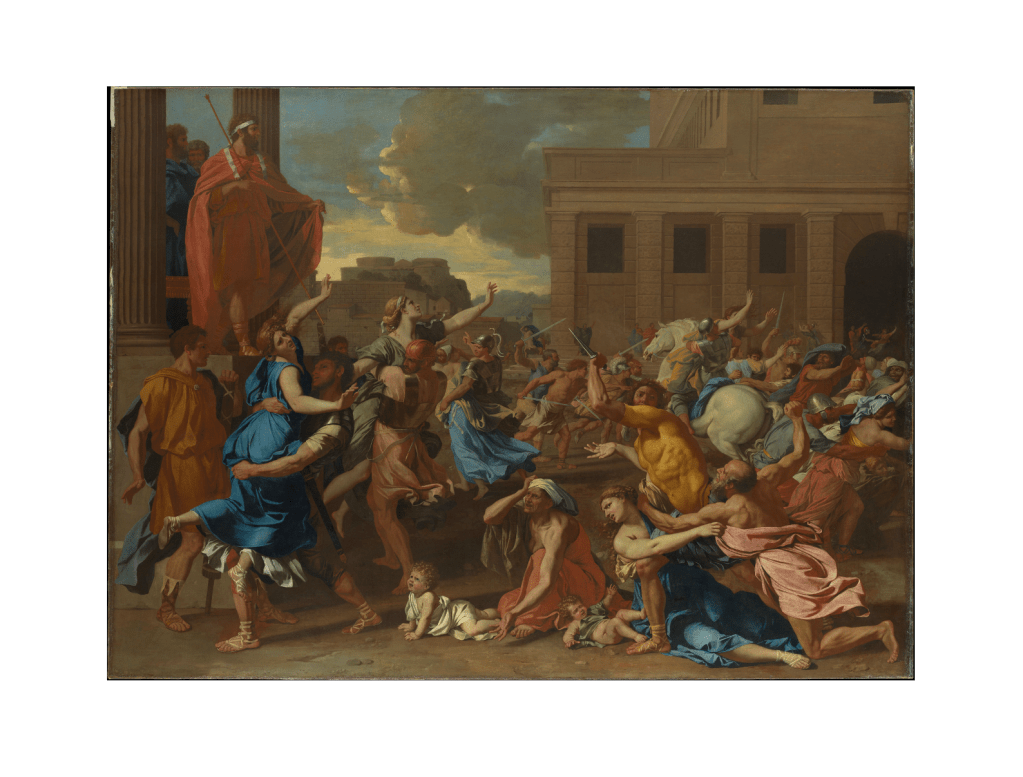
Pictorial dislocation wants to claim distance and separation the non-totalizable while being there. Let us take a painting like Nicolas Poussin’s The Abduction of the Sabine Women (1633-1634): here we have a complex composition ordered around rhythms and modes of figures and distances; the possibilities of communication between forms and the expressivity of the figures hold everything as if in a state of grace. What is striking in the picture is the subtle mounting of activities and gestures without ever falling into the sublimation of the concept. There are no guidelines, and yet we feel that everything communicates. Or to put it in Poussin’s pictorial terminology: “what follows is unlearnable” [7]. I do not think that the painter tried to posit a negative foundation of knowledge for an even higher learning; rather the unlearnable is a practical activity (a gesture, a word, a contact) that is both unique and indispensable; impossible to let itself be arranged into a set of alienated function for a task. Poussin reminds us of the unknowability of rhythms taking place: an uncompressed experience outside the force of systematization. We need thought to incorporate something like this exercise in rhythm.

It does not come as a surprise that a conservative scholar during the first months of the October revolt hypostatized the event as a “gnostic program” claiming that: “Plato’s philosophy offered a simple solution to the gnostic problem: instead of adapting the world to our desire, the task is to adapt the soul of the world…we now know that public order is the our most urgent occupation” [8]. Needless to say, and as Díaz Letelier noted at the time, this was a political Platonism devoid of chōra as a nonsite of our sensible imagination that allows the renewal of the creative experience with the world [9]. There is no ‘common sense’ as the pragmatists of realism assert with conviction; there is only the sensorial passage allowed by the chōra. This is what constitutionalism needs to pacify and incorporate: the battle over the status of the soul at a moment in which material goods and its economic arrangement (and in the Chilean case, its negative subsidiarity principle) becomes insufficient for the psychic production of a rectilinear subject (a masculine subject, Alejandra Castillo would claim) [10]. The postliberal constitutionalism as it stands (and it is postliberal because it cannot longer said to appeal to an internal principle of positive norm nor to a source of ‘Higher Law’, but to the executive command of the principle); a world legal revolution of governmental administration of anomia, amounts to a systematic offensive that exceeds mere material appropriation or personal liquidation. And this is so, because its ultimate mission is the “soul murder” (seleenmord) that currently stands as the basic unit of the ensemble to govern over socialization [11]. Constitutionalism now appears as the last avatar of Americanism. Perhaps there is no higher and modest task at hand than affirming the medium of the chōra that preexists the submission of life into the polis, and which retains, like the pictorial gesture, the unlearnable and the unadaptive. Only this could slowly render another possible sense in the relationship between liberty and law.

.

.

Notes

* This text was in preparation for the conversation panel on the current legal and political cycle in contemporary Chile with Alejandra Castillo, Rodrigo Karmy, and Philip Wohlstetter that took place in May 31, 2023 at the Red May Seattle Forum. The conversation is now archived here.

1. Rodrigo Karmy. “Ademia portaliana: algunos puntos para el “nulo” debate”, La Voz de los que sobran, May 5, 2023: https://lavozdelosquesobran.cl/opinion/ademia-portaliana-algunos-puntos-para-el-nulo-debate/05052023 

2. Martin Loughlin. Against Constitutionalism (Harvard University Press, 2022), 11-12.

3. Ibid., 161.

4. Pablo de Lora. “Constitucionalismo mágico”, The Objective, May 2022: https://theobjective.com/elsubjetivo/opinion/2022-05-07/constitucionalismo-magico/ 

5. Max Horkheimer. “Montaigne and the Function of Skepticism”, in Between Philosophy and Social Science: Selected Early Writings (MIT Press, 1993), 265-313. 

6. Rodrigo Karmy. “The Anarchy of Beginnings: notes on the rhythmicity of revolt”, Ill Will, May 2020: https://illwill.com/the-anarchy-of-beginnings

7. Avigdor Arikha. “On Nicolas Poussin’s Rape of Sabines and Later Work”, in On Depiction (Eris | Benakis Museum, 2019), 112.

8. Manfred Svensson. “Una revolución gnóstica”, The Clinic, November 2019: https://www.theclinic.cl/2019/11/25/columna-de-manfred-svensson-una-revolucion-gnostica/ 

9. Gonzalo Díaz Letelier. “Un platonismo sin khorâ”, Ficcion de la razón, December 2023: ​​https://ficciondelarazon.org/2019/12/04/gonzalo-diaz-letelier-un-platonismo-sin-khora/ 

10. Carlos Frontaura. “Algunas notas sobre el pensamiento de Jaime Guzmán y la subsidiariedad”, in Subsidiariedad en Chile: Justicia y Libertad (Fundación Jaime Guzmán, 2016), 123.

11. Ernst Jünger. The Forest Passage (Telos Press, 2003), 93.

Lezama Lima and the Etruscan way. by Gerardo Muñoz

Towards the end of his life, poet José Lezama Lima will mysteriously begin to sign the letters to his friends and family as “the Trocadero Etruscan”, a “member of the Etruscan religiosity”, and even the “man who lives in the Etruscan village” [1]. Why call himself an “Etruscan” in this particular moment of his life, and what could it possibly mean? The question about the meaning of the Etruscan authorial mask has been so thoroughly ignored by the literary critics that commentators at their best have noted that “being Etruscan” merely stands for his “cosmopolitanism” and “well-learned Europeanism”. Of course, this explains little to nothing. A sophisticated poet such as Lezama Lima, who ruminate over every single word he would write, could not have ignored that the Etruscans, unlike the civilized Romans and the Latin authorities, was a remnant to the very civilizational enterprise; a prehistoric people poor in written culture, achieved expressivity by the whole outlook of their form of life. And as in the case of Hölderlin’s adoption of different nom de plume (Scardanelli, Killalusimeno, Scaliger Rosa, etc), Lezama’s becoming Etruscan points to something so fundamental that if underscored we would fail to grasp the endgame of his vital poetic experience. The transfiguration of the name does not merely stand as a metaphor; rather it points to a distant figure that will finally dissolve him so that his immortal voice could continue to live on.

Indeed, the self-identification as an Etruscan for Lezama became a subterfuge to flee a political reality – his political reality, entirely structured by the revolutionary gigantic productivism and subjectivism – through a poetic refraction that would free an ethos from the overpowering of alienated autonomous space of the linguistic reproduction of social life. If at first glance it seems like a paradox that Lezama will adopt the Etruscan figure for his antisocial ethos – a civilization lacking written records or high literary achievements, a religious community known for its necropolis – this strangeness will ultimately prove that behind the Etruscan name there was no poetic exclusivity of the poet’s genius, but rather, as he claims in “A partir de la poesía”, the possibility for a divinization of reality to retreat from the historical epoch. In fact, Etruscan culture for Lezama was not a mere archeological ornament, but one of the “imaginary eras” of the West; that is, a stage of condensed and unnumbered imaginative possibilities resistant to griping subsumption and totalization of values. The Etruscan was the mythic remnant through the pantheistic divinization between language and the world. As Lezama writes glossing, in passing, Vico:

“Vico cree que las palabras sagradas, las sacerdotales, eran las que se transmitían entre los etruscos. Pero para nosotros el pueblo etrusco era esencialmente teocrático. Fue el más evidente caso de un pueblo surge en el misterio de las primeras inauguraciones del dios, el monarca, el sacerdote, y el pueblo unidos en forma indiferenciada … .les prestaba a cada una de sus experiencias o de sus gestos, la participación en un mundo sagrado. […] Pues en aquel pueblo, el nombre y la reminiscencia, animista de cada palabra, cobran un relieve de un solo perfil” [2]. 

The divinization of the Etruscans stubbornly insisted on the wonder of things. The human participation in divinity is no longer about founding a new theocracy or a “theocratic politics” in the hands of a ‘mystic accountant’ that would finally put the nation back in track (into the res publica), as Lezama would solicit out of desperation in the 1950s diaries [3]. On the contrary, for Etruscan people the fundamental tonality was the divine music of experience. Of course, we know that D.H. Lawrence captured this when claiming in his Etruscan Places (1932) that “the Etruscans are not a theory or a thesis. If they are anything, they are an experience. An experience that is always spoilt” [4]. And this experience (like every true experience) needs to be necessarily spoiled, which ultimately means that it cannot be mimetically rendered, arbitrarily modified, or subsumed into the order of idealization. But all of this is merely redundant, since the Etruscan inscription is what accounts for the limit to civilization, becoming the impossibility of the destruction of myth in the arrival of modern aesthetic autonomy. Thus, for Lezama the Etruscan way had something of a persistent cure against the ongoing civilizational disenchantment, even if it does not cease to appear in the modern attitude. In fact, Lezama writes that: “Rimbaud is the best reader of the Etruscan liver” (“hígrado etrusco”) to describe the dislocated position of the poet in the modern world of technology [5]. In the Etruscan cosmology, the liver was a symbolon of the vision of the cosmos registering the divisions of the spheres in the sky through the divine naming of the gods; it is the figure by which the poet guards the desecularizing remnant of the prehistoric inception of myth [6]. But this does not mean that Lezama will look at himself in the mirror of Rimbaud’s symbolist alchemy.

Rimbaud as an Etruscan is the poet who descends into hell because his lyricism can bear the pain in the disruption of language after the archaic peitho. Does the possibility mean a travel back in historical time? Not the least, as Lezama knew how to let go of storytelling and historical necessity. This is why Etruscans stand for an image or a sort of handwoven picture (the hand will make a comeback, as we will see) to gain vision. And this is one case on point: the Etruscan stands paradigmatically to the “sufficient enchantment” (“la cantidad hechizada”) , which discloses a higher knowledge of the soul (psychê) in the taking place of poetic errancy: “Sabemos que muchas veces el alma, al escaparse de su morada, tripulaba un caballo inquieto, afanoso de penetrar en las regiones solares” [7]. To wrestle against the historical reduction of autonomy of the modern age means to find this enchanted sufficiency necessarily for myth remnant to elevate itself against the aesthetic mediation that, in the words of Gianni Carchia, had become a consoling surrogate of the emptied historical time [8]. An entirely other conception of freedom is firmly implicated the Etruscan way: the gathering of the enchanted poetic dwelling to dissolve a reality that had become too thick in the business of brute force purporting to call ‘what’s out there’. The Etruscan reintroduces a divine nominalism of pure exteriority.

However, the Etruscan way does not commute with things of the world; rather, his soul unbinds the empirical limit of death to overcome death, and learn to live as if it were already dead. The trespassing of death through the poetic enchantment – which Lezama will also call an ‘potens etrusca’, or the Etruscan potentiality- will multiply the invisible possibilities against the rhetorical closure of reality legitimation. By accepting the thick of the dead as an illuminated presence, the Etruscans draw out the most important consequence: learning to live among the dead as the ultimate form of a dignified life. This is why D.H. Lawrence reminds us that the underworld of the Etruscans – their refusal of reality, the embrace of their dead, the augurium – was after all “a gay place…For the life on earth was so good, the life below could but be a continuation of it. This profound belief in life, acceptance of life, seems characteristic of the Etruscans. It is still vivid in the painted tombs. They are by no means downtrodden menials, let later Romans say what they will” [9].

If civilization is a construction that takes place at the crust of the Earth as some have claimed; the way of the Etruscan is a downward declination away from the architectural reduction of world sensing [10]. For Lezama the Etruscan dreams of a civilization submerged in the depths that only an acoustic totality that bear witness to its sensorial gradation: “Esas civilizaciones errantes por debajo del mar, sumergidas por el manteo de las arenas o por las extensivas exigencias…reaparecen, a veces, en los sueños de los campesinos” [11]. Hence, the fundamental dignity of poetry resides in the mythical homecoming that guards the possibility for what remains inexistent: “this is why the poet lives in the Etruscan world of the birth of fire” [12]. And although the Etruscan stands as one of the worlds in possession of an imaginary epoch (the other two for Lezama being the Catholic world and the feudal feudal Carolingian Empire), it is only in the Etruscan where the resurrection had taken the transubstantiation in the name itself; even if the price was its own liquidation as a historical people that refused to be incorporated into the doxa of postmythical order [13].  

The fiery force of the mythic peitho outlives and predates the political epoch of the nomos of fixation organized as “One People, One State, One Language” [14]. As Lezama explains in “La dignidad de la poesía”: “…el odio en la polis contra el daimon socrático, hizo que la nueva doxa no logra sustituir a cabalidad el período mítico….Si por lo mitos, los dioses se irritable con la felicidad de los de los mortales, pero al menos, se interesaban por sus destinos; en la nueva doxa, la poesis se extinguía – el daimon individual reemplazando al destino individual liberado de la polis” [15]. The primacy of myth as orientation to happiness should make clear that for Lezama the poetics of naming follows the overflow of its permanent modalization [16]. The Etruscan way marks the path for the irrevocable retreat from the space of the polis where civilization will be erected on the grounds of deliating ethos and daimon, polis and poesis, and ultimately life and death as a rubric of a new science of separation. The fact that the civilization of social reproduction has been erected on the basis of the destruction of the chthonic underworld speaks to the systematic erasure from the dead as a vital extension of life [17]. The poetic natality of the Etruscans will only be cultivated, as Aby Warburg suggests, from the assumption of deep superstition in the face of the placement of political autonomy, which allows for the persistence of the image as inseparable from the needs and uses of the living [18]. And only persistence could prepare the final triumph over death.

19
[19]

Towards the later phase of his work, the poet seems to never want to abandon the Etruscan inframundo. Lezama returns to the Etruscan scene towards the end and unfinished novel, Oppiano Licario (1977), in which the central character Fronesis describes at length the mutation of reality following the footsteps at a distance of Ynaca Licario slowly merging into the Tarquinia necropolis painted wall, which is accompanied by a visual reproduction of the Etruscan tomb:

“El sacerdote, en el lateral izquierdo, hace gestos de ensalmo en torno a una espiga de triga. Un pájaro que se acerca queda detenido sin poder posarse en el ámbito hechizado de la hoja. En el lateral derecho, el sacerdote repite idéntico rito, pero ahora de la raíz colorida hace saltar la liebre que cavaba en las profundidades. El aire cubría como unas redes de secreta protección en torno de la mutabilidad de las hojas y de la inmovil jactancia de los troncos. Una indetenible pero resguardada evaporación alcanza aquella llanura con los muertos …La conversación subterránea era el símbolo del vencimiento de la muerte. [20]

The ongoing conversation (the shared word koina ta philōn) in a mysterious divine language had triumphed over death because it had overcome death and the sight of death. It is no longer the transposition of a historical sublime that must protect experience from the fixity of the human corpse, since the soul can escape the limit of form. In passing through and embracing death, the Etruscan validated their passions for mirrors and the palm, which according to Lezama is the true keep of the appearance of the uttermost revealing of the face in its own irreducible ethos. The possibility (potens etrusca) of defeating death while in life finds in the Etruscan appearance Lezama’s most intimate poetic arcana: the persistence of the anima renounces symbolic legibility as too innocuous and ornamental; where the flags of victories now resembled an accumulation of well settled defeats nurtured in the name of the muteness over “life”.

The Etruscan distance mysterium validated myth as the affirmation of the cosmos as based on the potentiality of contemplative imagination [21]. Lezama will call this distance the “eros de la lejanía” (Eros of distance) in the experience of the inframundo that will break through by affirming the possibilities of divine naming as a correlative causation in the world [22]. As Lezama tells his sister in a letter from 1966, he had already assumed to have crossed the bridge between the dead and the living: “Para mi ya ha sucedido todo lo que podía tocarme….Pues creo ya haber alcanzado en mi vida esa unidad entre los vivientes y los que esperan la voz de la resurrección que es la supresa contemplación” [23]. Or yet again: “El que está muerto en la muerte, vive, pero el que está muerto en la vida, es la única forma para mi conocida de la vida en su turbión, en su escala musical, en su fuego cortado” [24]. To scale up life to the higher music is the final trope of happiness as already dead. The Etruscan dirita vía of descension – “a weight going down” of stepping into the Earth, as Ruskin would have it – achieves the arrest of the divine contact between the voice and the dead [25]. It is for us to raise this mirror before our impoverished and fictive unswerving reality.

.

.  

Notes 

1. José Lezama Lima. Cartas a Eloísa y otra correspondencia (1939-1976) (Verbum, 1998), 230.

2.  José Lezama Lima. “A partir de la poesía”, in Obras Completas, Tomo II (Aguilar, 1977), 831.

3.  José Lezama Lima. Diario (Verbum, 2014), 87.

4. D. H. Lawrence. Etruscan Places (The Viking Press, 1957),  90.

5. José Lezama Lima. “La pintura y la poesía en Cuba”, in Obras Completas, Tomo II (Aguilar, 1977), 968 

6. Gustav Herbig. “Etruscan Religion”, in Encyclopedia of Religion and Ethics, Volume V (Dravidians-Fichte, 1912), 533.

7. José Lezama Lima. “Introducción a los vasos órficos”, Obras Completas, Tomo II (Aguilar, 1977), 861. 

8. Gianni Carchia. Orfismo e tragedia (Quodlibet, 2019), 81.

9. D.H. Lawrence. Etruscan Places (The Viking Press, 1957), 31.

10. Amadeo Bordiga. “Specie umana e crosta terrestre”, in Drammi gialli e sinistre della moderna decadenza sociale (Iskra, 1978). 

11. José Lezama Lima. “Estatuas y sueños”, in Obras Completas, Tomo II (Aguilar, 1977), 449.

12.  José Lezama Lima. “La dignidad de la poesía”, in Obras Completas, Tomo II (Aguilar, 1977), 774. 

13. Ibid., 776.

14. Erich Unger. Die staatslose Bildung eines jüdischen Volkes (Verlag David, 1922).

15.  José Lezama Lima. “La dignidad de la poesía”, in Obras Completas, Tomo II (Aguilar, 1977), 777.

16. Monica Ferrando. “Presentazione”, in Hermann Usener, Triade: saggio di numerologia mitologica (Guida Editori, 1993).

1176.  Giorgio Agamben. “Gaia e Ctonia”, Quodlibet, 2020 https://www.quodlibet.it/giorgio-agamben-gaia-e-ctonia 

18. Aby Warburg. The Renewal of Pagan Antiquity (Getty, 1999), 189.

19. Image included in Chapter VII of Oppiano Licario (Cátedra, 1989), 375. 

20. José Lezama Lima. Oppiano Licario (Cátadra, 1989), 374.

21. Aby Warburg’s treatment of the symbolic mediation between myth and distance appears at the center of his essay on Pueblo Indians. See, Aby Warburg, El ritual de la serpiente (Sexto Piso, 2022), 66.  And also, Franz Boll, Vita Contemplativa (Heidelberg, 1920), who connects contemplari to the augur’s spatiality of the templum.

22. José Lezama Lima. Cartas a Eloísa y otra correspondencia (1939-1976) (Verbum, 1998), 411.

23. Ibid., 109.

24. Ibid., 266. 

25. John Ruskin. The Letters of John Ruskin (George Allen, 1909), 133.

The Gnostic residue. On Mårten Björk’s The Politics of Immortality in Rosenzweig, Barth, and Goldberg (2022). by Gerardo Muñoz.

Mårten Björk’s The Politics of Immortality in Rosenzweig, Barth, and Goldberg: Theology and Resistance Between 1914-1945 (Bloomsbury, 2022) is a major contribution to the ongoing discussion on theology, politics, and life in our present. Indeed, this book of unmatched originality will radically change the coordinates that have structured these debates in and beyond the academic disciplines involved. First conceived as a longer dissertation entitled Life outside life and defended at Gothenburg University in 2018 (which included an voluminous and illuminating chapter on the work of German theologian Erik Peterson, not included in the published monograph and scheduled for publication in the near future) studies three figures of the German interwar period that confronted the civilizational catastrophe of the twentieth century and the rise of the regime of mass production. Through different conceptual elaborations in Franz Rosenzweig, Karl Barth, and the Oskar Goldberg Group (it also includes thinkers such as Adolf Caspary and Erich Unger) a unified thesis emerges: these thinkers crafted a fundamental response to the collapse of the legitimacy of the modern epoch through a radical imagination of immortality and eternal life (Björk 2022, 3). From an angular perspective, Björk’s book measures to Hans Blumenberg’s groundbreaking defense of the legitimacy of modernity through “self-affirmation” of the human; a philosophical anthropology predicament that today has become fully integrated into the arts of planetary destruction, although its genesis is to be captured in the first decades of twentieth century through the dawn of a new catastrophic politics (the term is coined by Erich Unger in his Politics and Metaphysics). In Björk’s account, these thinkers took the stance against the stimmung of the epoch, its historical closure as well as the immanence of nature in order to take up a historical collapse that was civilizational in nature.

It would be a common place to remind the readers of this book that the figures of the research (with the exception of Rosenzweig who in some corners has been taken as the greatest Jewish philosopher since Maimonides) have been unwarranted buried in the monumental and political historiographies of the period and in the edifice of normative Continental philosophies of the twentieth century. However, Björk’s monograph is no simple restitution of dead old men, as this would be too accommodating to the field of the history of philosophy. Behind these figures there are multiple strategic displacements that connect the destruction of biopolitics to the reformulation of ethics of the dead, as well as the revision of Judaic theological sources to execute an effective retreat from the collapse of civilization of the last 5000 years of the human species. In this quadrant there is also a timely gesture on the complicated relationship between Judaism and Christianity; a relation that the book never really solves, although it runs throughout the book flagged for possible future explorations. Methodologically, it is the field of “theology” (not of science of religions a la Weber) that returns to the center as a way to explored an unthought dimension of immortality – that Björk properly renders as life outside life, against all biopolitical saturation and ecological catastrophe of the natural world. It goes without saying that there is an untimely tone that directly speaks to our present. Indeed, it is the radical theological and cosmological presuppositions (outside the formalism of religion and the apocalyptic historical saeculum of the Church) where something like a radical new existence of what it means to live can be rethought. This is Björk’s fundamental invitation.

In “Yearning for a system: Franz Rosenzweig and the great paganism of life’, Björk offers an all-encompassing outlook to the work of the Jewish scholar whose famous Star of Redemption was also accompanied by an interest in European geopolitics of the first decades of the century. In the midst of the First World War, Rosenzweig witnessed the rise of a new paganism of the state as the acceleration of the struggle for life in the West reproducing forever war (Björk 2022, 29). For Rosenzweig modernity was not an authentic or unfinished secularization, but rather the institutionalization of a pagan order of depredatory confrontation that foreclosed the world without outside: absolute immanence now meant the subjectivation of new false gods of modern civilization ordered towards survival and struggle (Björk 2022, 25). Against this backdrop, Björk reads Rosenzweig’s Star as an original theosophy of redemption of the world that exceeds the national political counters, while offering a new planetary and universal dimension of salvation beyond the state as articulated in Globus. Furthermore, Björk notes that Rosenzweig saw himself as a sort of Jewish fighter in the defense for a new planetary community with “religion as an instrument for change” (Björk 2022, 53). Even though the language had residues of imperial imagination proper to the time, it is the theological vector that distorts the political register of the ground battle for survival. Here Judaism appears as a subtraction from conventional historicity by retreating to a prehistoric past where the ‘unity of the world’ had no nomoi, states, or borders (Björk 2022, 54). It should be noted that something similar was advocated in his 1922 booklet Die Staatslose Bildung eines Judischen Volkes about the stateless wandering of the Hebrew people, by Erich Unger who thought could show a way out of the decadence of Western civilization through the revitalization of ancient Judaism. The Jew had never been a member of the polis or a slave of the state, since the Judaic Kingdoms were ruled, as Björk explains, “by an antipolitical priesthood” or a “metapolitical priesthood and not political kingdoms” (Björk 2022, 61). The sharp contrast to the modern Judaic subtext is of importance: whereas Eric Nelson shows in The Hebrew Republic (2010), how the ancient Jewish sources influenced the constitution of the modern state theories of Thomas Hobbes and John Milton; the work of Unger and Rosenzweig centuries later, in the wake of the Weimar era, seeked to radically alienate the command of Judaic prophecy from the regulatory political and geopolitical techniques of anthropological modernity. The gap between the two, for Rosenzweig, would be the hope for eternal life against the management of survival to which modern political grammar succumbed without return (Björk 2022, 66).

But theology offers the route to imagination and vocabulary of restitution, and infinite recapitulation. To grossly synthesize Björk’s thesis: life is best understood as an endless dialogue with the dead. The second chapter “Abundance and scarcity” glosses aspects of Reformed theologian Karl Barth’s thought against the materialism of scarcity of the world and the principle of abundance proper to eternal life. By tracing Barth’s critical dialogue with Feaubach’s sociology of religion of the species-being (which radically impacted the way Marx and Marxism came to understand theology), Björk’s theology puts paradisal life at the center of the mission of salvation; a heretical notion that exceeds the predestination theology of grace deployed in the organization of the modern kakedomonic public powers of modernity (Björk 2022, 88). In this sense it is insufficient to define the capitalist religion as merely a cult without dogma or atonement; it is also, perhaps more fundamentally, an axiomatic system that accentuates the two-dimensional positionality of death and life without residue. For Barth, Björk reminds us, theology is a way out from the cultish axiomatics of the countable and measurable of the visible world: “Theology….seeks to open the believer to the belief in the invisible side of the reality of the world. Theology must become an investigation of this invisible world to which further posits that the visible world is related” (Björk 2022, 103). And Barth’s lifelong interest in the theology of resurrection was precisely a way to insist on the invisible register that conflates nature, morality, and survival of the living within the objective normativity of the world.

Perhaps the most interesting aspect of Barth’s theology discussed by Björk comes by way of the opposition of ethics and morality – this is elaborated as a rejection of the predicament of natural law’s imago naturae and its dependency on rationality – where the second is discarded as merely finite life unto directive command of the natural good. On the contrary, an ethics suspended by the postlapsarian stage is guided by the principle of suum cuique (Björk 2022, 114). The suum cuique (‘to each its own’), although prima facie echoes the Thomist epikeia, it is also free standing for something more: it is a limit to the irreducibility of life in relation to God, which cannot be inscribed in a system of balancing of moral principles in the hands of a sacerdotal authority. Whereas the moral principle of equity (epikeia) organizes the government of this world through principles and moral reasons for action; the suum cuique is the limit set upon our finite life and the eternal in the scope of the saeculum. Björk connects the notion of the suum cuique to the Barthian figure of the “strange saint” who “with tears and laughter provides God and in this provocation is obedient to the election that forms death into life” (Björk 2022, 116). The suum cuique, accepting the postlapsarian condition rejects the instrumentalization of original sin in order to become a “vast eon of the cosmos itself…temporal and finite but also eternalized as that which once was” (Björk 2022, 117). In this way, the suum cuique prepares the paradisal affirmation of every unlived life, an anathema to the thomist substantiation of merely personal dignity and the exceptional mechanism of individual mediation with the economy of election and grace.

The theological exploration of modality of being – this is one of Björk’s implicit lessons in the book – never truly disappears in modernity, but rather reemerges in unexpected spheres. The politics of immortality does not pretend to exhaust this problem. But it is in the last chapter on the enigmatic figure of Oskar Goldberg where this theme is best explored as the true meaning of a life outside life at the center of the book’s conceptual development. Oskar Goldberg is one of the most enigmatic figures of the Weimar era; a magnetic personality that gathered diverse personalities from all corners of the intellectual milieu. He was looked with high suspicion by Thomas Mann, who portrayed him as a mystical undemocratic thinker in Doctor Faustus, but also dismissed by Walter Benjamin and Gershom Scholem (it only suffices to look at the correspondence collected in Scholem’s Walter Benjamin: The Story of a Friendship). A scholar with strong and sedimented knowledge in the Talmud and Ancient Judaism, Goldberg developed a highly sophisticated and speculative theology of the transcendental organism, to put it in Bruce Rosenstock’s terms, which provided an original formulation of a transcendent being based on the Torah in the wake of the new biological theories of the species (the work of Driesch, Uexküll, Spemann, among others) [1]. The biological and mystical vocabulary of Goldberg aroused immediate skepticism from the German intellectual class, but Björk convincingly shows that Golberg’s project was not an arabesque of a madman, but rather a very peculiar modal speculative system that seekd to confront the 5000 years of the civilization of fixation of the Western transition from the society of myth to the civilization of production and psychic energy imbalance (Björk 2022, 127). For Goldberg the passage from the prehistoric stage of myth to the inauguration of the religion of the state meant the sedimentation of a civilizational regimen oriented towards production, devastation, and positionality (Theophanidis recently expressed the proximity between Goldberg’s fixation and Heidegger’s Gestell, unexplored in Björk’s book). Björk is attentive to the fact that Goldberg was not just a proper name but also the constitution of a sort of ‘metapolitical university’ that gathered diverse figures, such as the economic historian and political thinker Adolf Caspary or the philosopher Erich Unger, both who developed their own critique of technological domination under the shadow of Goldberg. Thus, the critique of civilization is not to be taken as an abstract mysticism; for Björk, the concrete effects can be read in Caspary’s forgotten The Machine Utopia (1927), which criticized the utopia of machine civilization proper to both Soviet Bolshevism and Western capitalism – two social orders that shared the same the same historical horizon: reproduction and accumulation of surplus value (Björk 2022, 142).

In this framework, and against the historicist analytics of Marxism, for the Goldberg circle class antagonism and division of labor was not oriented towards emancipation, but rather towards the realization of a global total state. For the Goldberg circle to escape the civilization of the Behemoth of the industrial state required nothing short than a politics of errancy (defended by Unger in his Politics and Metaphysics of 1921) and the reversal to a modal relation with YHWH as an effective and potential dimension against the imbalance of an impoverished reality. Björk claims that for the Goldberg circle there were three possibilities of existence of coming to terms of the modern decline towards: civilizational fixation, myth, or Torah (Björk 2022, 154). And in different ways, they opted for the Torah, which implied not an identitarian reversal to a territorialized Volk but rather an infinite task of becoming immortal, given that our modes correspond to the nature of God and the world (Björk 2022, 166). The task was to depose the production of evil and suffering here and now as mobilized by the incarnation of historical progress. This infinite retreat from the materiality of the finite of the species was a way to open a new polytheism to the Ancient Hebrew metaphysics elaborated in Goldberg’s book, The Reality of the Hebrews (Die Wirklichkeit der Hebräer, 1925). In other words, to exit from the fixation of the 5000 years civilization required a passage to immortality as a way to “make us unadapted to the normal laws of evolution” and to the objective world (Björk 2022, 178).

Truth be told, immortality never disappears from modern political imagination and governmentality. Some of us still remember that one of the famous mottos of the Cuban Communist Party was: “Los hombres mueren, el Partido es Inmortal” (“Men die, but the Party is immortal”), which ultimately served to guarantee the idolatry of the state’s sacrificial principle through a continuous “lucha” (struggle) of everyday life under real-existing administrative communism. Likewise, in recent years Boris Groys has argued at length that immortality lives off in the topology of contemporary art, where archivization, spatial flexibility, and museification of the historical Vanguard stand in for the desire to become immortal [3]. This is, indeed, what Björk calls, following Blumenberg, the moralization of immortality whose political translation resulted in truly barbaric consequences that we are still suffering (Björk 2022, 186). Against all moralization and political instrumentalization of immortality, The Politics of Immortality in Rosenzweig, Barth, and Goldberg (2022) rises the theological mirror so that yet another anthropogenesis event through the “the Gnostic residue by insisting that the problem of evil could only be solved by God” (Björk 2022, 190). In other words, the problem of immortality restores the gnostic residue to its proper place beyond exceptionalism and anthropological humanism, since finitude (death) externalizes what is living, while “life” now becomes the meaning as its own otherness to the modes of God. Departing from the fourfold structure of the history of the modern error in Nietzsche’s typology, we could add a fifth: the error of conceiving the gnosis as worldly aspiration to domesticate exteriority as a forever postponed apocatastasis.

It is in the sense that Björk’s important book complements the unfinished elaboration on the gnosis undertaken by Giannia Carchia towards the end of his life: the exodus from the fiction of the subject and the person implies nothing short than the “resurrection of the human community capable of renewing the arc of history that appears so dramatically broken” [3]. Perhaps Carchia was a bit of an optimist here: the historical arch emanating from the potstlapsarian moment is now in ruins, but the gnostic residue remains once the darwinism of human-assertion has fallen flat into pieces across our planet (Björk 2022, 197). But Mårten Björk majestically teaches us that to keep insisting on life (on absolute life, on dignified life, or the monstrous “good enough life” recently proposed in a frank instance of academic nihilism) cannot but reproduce the civilization of calamities that has put the world in the road to extinction. In the current epochal implosion all these pieces are more apparent than in any other time in history. Yet, life is elsewhere, always escaping objectivity and immanence: “it is the invisibility of the wished, the desired and the dreamt. This is what human life entails. It is related to the wide world of what could have been or what should have been” (Björk 2022, 199). The modality of eternal life is also what value cannot apprehend, and for this reason what remains undialecticized, stubbornly disjointed from every unbearable fiction of the world. The Politics of Immortality (2022) is not only an exceptional book; it moves us to look to what always remains on the side of the invisible, to the unsaved in the exterior elan of every life, our lives.

.

.

Notes 

1. Bruce Rosenstock. Transfinite Life: Oskar Goldberg and the Vitalist Imagination (Indiana University Press, 2017).

2. See, Boris Groys, Política de la inmortalidad (Katz editores, 2008), and “The Immortal Bodies”, Res, Vol.53-54, 2008.

3. Gianni Carchia. “Elaborazione della fine: mito, gnosi, modernità”, in L’amore del pensiero (Quodlibet, 2000), 150.