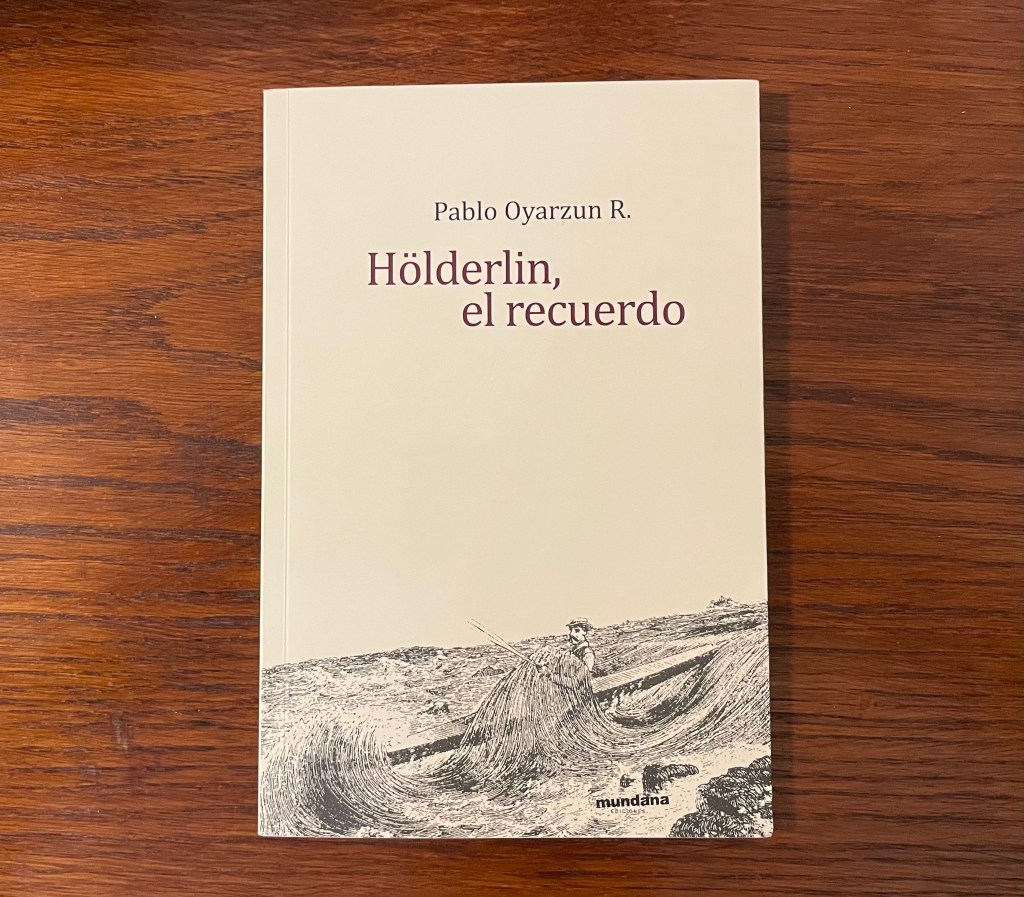
The concluding verses of Hölderlin’s “Andenken” (“Rembrance” or “Memoria”), “Yet what remains, the poets found” stands as one of the preeminent testaments of modern poetry, and in Heidegger’s famous characterization, as a declaration of the task of the poet. At least since the time of Stefan George and Max Kommerell, the figure of poet or Dichter, a hyperbolic figure of illumination and guidance caught in the net of poetry and philosophy, was already dependent on Hölderlin’s mysterious words. What remains in what the poet remembers and clears for foundation? What is the relationship between remembrance and what is ‘found’ or ‘established’? “Andenken / Remembrance” is a hymn from the late period, which means that it must be read in consistency with Höderlin’s poetological framework as it reaches its maximum degree of intensity in its declaration and deliverance. Pablo Oyarzun’s most recent Hölderlin, el recuerdo (Mudana ediciones, 2025) is a powerful and subtle contribution to the understanding of this poem that measures up to the task in its attention to lexicon and structure, metaphysical condensation, and the vortex of ‘memory’ that discloses the poem. One of the merits of Oyarzun’s philosophical hermeneutics, if we can call it that, resides in its refusal to incorporate philosophical doctrines to inform the major questions of the hymn; rather, he favors the very unfolding of the poem ramping its internal structure for possibilities (Oyarzun 18-19). Rereading “Remembrance” opens a path between philosophy and poetry in the dawn of the realization of metaphysics, whose price was paid by crushing the possible and the voice of the poem.
For Oyarzun the poet’s remembrance is that of appropriation of what is proper, and thus inappropriable, and to which the hymn can only ‘thank’ in the way of thinking as figure in the face of the unfathomable. Following Heidegger’s reading to a point, to give thanks is also to welcome and greet that lets humans and things be in their truth; since greeting always assumes otherness as foreign into presence (Oyarzun 29-30). And in presence life acquires texture, depth, singularization, but also conversation; a reminder that will control the rhythm of Hölderlin’s hymn. What is brought to presence, then, is neither a possession nor a legible inheritance, but the non-synthetizable modulation of what is proper in virtue of being absolutely alien (Oyarzun 34). What is recalled in this poem that remembers and thinks the unthinkable? Is it just a stage for Hölderlin to poetically transfigure his well known travels in Bordeaux? Oyarzun tells us that even if that is to be taken into account, the foreigner path is only essential as a way of homecoming, making the site (and song) into the hymn (Oyarzun 42). There is relation to the absolute other, but only as transitory to becoming and divine destiny in the world: “…el espíritu ama, porque precisamente así, ensa autoalienación puede transitar a lo otro que lo otro, es decir, apropiarse de lo propio […] el pensamiento del Ereignis está condicionado estructuralmente poesía ex-propiación, por ese retraimiento, distracción o retiro (Entzug), solo puede el cual se da lo propio (Oyarzun 54-55). Höderlin’s poem sings from the lacuna of its own expropriation of the abode. And that abode is ultimately the unworking of remembrance and memory that is defaced in being absolutely intimate and irreducible.
In order to elucidate the contours of this memory and its oblivion, Oyarzun follows Dieter Heinrich observation that: “este movimiento [of remembrance as transcendence] conocedor de su propio curso y a la vez desviado del mismo, aspirando a un conocimiento en que algo perdurable (lasting), con gratitud, reine aún en la superación – esto es remembranza” (Oyarzun 61). What is remembrance if not what unweaves time? It is not an actual faculty of human psychology, nor a spectral incorporation of a missing object; rather, it is the non-syntheizable partition between language and the wound of existence; a separation that is only redeemed in the way of remembrance that deposes an ideal recollection of missing facts in preparation for recomposition. Oyarzun’s reading will depend on clearing the notion of severability as a condition for remembering and forgetting as it makes an entry into the poem’s final verse about the “fixating eyes of love” (den Blick heften). Helena Cortés Gabaudán translates it as “y el amor también fija aplicadamente los ojos” [1]. “Y también”, “but also”, a conjunction of persistence that Oyarzun reads as an inexorable attachment to memory and separation, and the memory of separation (Oyarzun 68). Because there is no sliding towards remembrance without departure, coming into the presence welcomes the memory that, in that very moment, has transformed our souls.
Ultimately, for Oyarzun the vortex of Hölderlin’s “Andenken” is love understood as the supreme citation that enacts the place of both thanking and remembering: “Amar es recordar, frecuentar con el recuerdo (el pensamiento), lo amado, incluso allí donde lo amado está presente, porque así lo resguarda de la mera posesión y agradece su presencia. Amar es pensar-en, un modo, tal vez el más entrañable, de Andenken, amor” (Oyarzun 73-74). And this means that what remains and endures, as Adorno observed in his well known essay on parataxis in Hölderlin’s late poetry, is neither of the logical nor of the temporal indexes, but the event of language as originary creation and donation without contestation (Oyarzun 77). This is the instance where Hölderlin’s strange case of the divinization of the word – and this is the particularity of the hymn form, an element that is never teased out by Oyarzun – becomes absolute and intransigent. It is Höderlin’s absolute proximity with the classical world, but also its radical separation in the post-mythical world of dissenchantment. It can be said that that what endures ‘thanks’ the love of remembrance in its persistence of the word that does not allow history and the crisis of tradition: “en nombre de la cosa que queda, en la fragilidad de su tiempo, que es ese mismo quedar” (Oyarzun 79).
The poem becomes the verbal and sayable site where the poetizing resides, as well as the greeting and farewell of departure, just like the spectral sailors of the poem. What endures intimately can be called love as a form of the immemorial (Oyarzun 80). And that is because in inscribing, or holding on to the irreducible origin, poetics becomes the supreme form of love – the love in separation – of an expropriated language that welcomes us home in conversation with friends. This attests to the spirit of Hölderlin’s well known letter to his friend Böhlendorff in 1802: “A los artistas les hace falta la psyche entre amigos, el nacimiento del pensamiento en la conversación y la carta. De lo contrario, no gozamos de nada de esto para nosotros mismos” [2]. And this intoxicated love in language that departs from separation situates Hölderlin as radically different from the Chirstian agape and its bond of perfect unity for securing salvation (Colossians 3:14). A salvation that Hölderlin overcame in the drama of Empedocles, enacting the impossible incorporation of the aorgic physis through the writing of the tragic myth.
Now we are also able to understand why Hölderlin transited to the hymn as the supreme form of the poem; not because because it is the origin or its last stage, but a suspension of language retrieved is gathered in the two moments of salutation and farewell, celebration and lamentation [3]. The hymnal dimension of the poem becomes language as such, which Oyarzun calls the immemorial without ever alluding to the notion of hymn. Indeed, the love of remembrance only becomes possible as a disjointed factum of experience anchored in its abyssal noncorrespondence (Oyarzun 84). Thus, to remember is to love the caducity of life – “este ya no es la signatura indeleble del amor”, as beautifully expressed by Oyarzun – in a world in which the testament of language awaits no resurrection.
.
.
.
Notes
1. Friedrich Hölderlin. Poesía esencial (La Oficina, 2017), Trad. Helena Cortés, 129.
2. Friedrich Hölderlin. Correspondencia completa (Ediciones Hiperión, 1990), trads. Helena Cortés & Arturo Leyte, 554.
3. Nicoletta Di Vita, Il nome e la voce: Per una filosofia dell’inno (Neri Pozza, 2022), 246-247.


 Infrapolitical Reflections