That painting was an activity at the end of its long tradition – a tradition that perhaps coincides with the very genesis of anthropogenesis – appears explicitly in Cézanne’s late conversations with Joaquim Gasquet, which is full of rambling thoughts and anxieties. At some point in the dialogues, Cézanne says in context of the pictorial tradition: “Rubens…that is another age, all that. We are in the evening of the world. Painting, like everything else, is vanishing….” [1]. Cézanne’s work is already the painting of the evening of the world, which is the closure unto itself, not so much a deprived world of certain elements or things, but a privatized space of intelligence and logic. This structure is alien to the painter who only pledges alliance to what is seen and revealed: “The painting owes allegiance to that lone. Never to the logic of the brain…and if he abandons that logic, he is lost. Painting is first and foremost an optical affair” [2].
What the essence of technology enhances in its computational and logical capacities to make the world legible, it loses in the optical capacity for the thinking of vision, that flickering and always novice opening to the world. The calamity of the automation of the world resides in the blinding legibility where thinking-eyes, as in Cézanne’s expression, are rescinded and a thing of the past. Of course, in the name of the present legibility of blinding lights, the past will also be reduced to a pile of stuff that can be assembled and registered – as in the vulgar poet Carlos Argentino Daneri in Borges’ “The Aleph” – but in exchange for abandoning the truth and sensation.
Well before the argument of Veblen on the centrality of engineers in this new world, Cézanne was aware that the future belonged to the engineers of nature, who can both bend and straighten the crooked lines of the world, and whose final realization is the nuclear organization and the pacing of energy distribution. It does not take too much to see an overtly furious Cézanne around 1890s: “Nature abhors a strain line. And to hell with engineers! We are not road surveyors. A lot they care for color, whereas for me sensation is at the root of everything” [3]. The personal outcry ‘to hell with engineers!’ is still being heard today, although we are less convinced that such an imperative has any chance at halting the ongoing vanishing sensations of the world.
Michael Fried has argued that Fraggonard’s The Swing and Blind Man’s Bluff are two pictures that appear to us as also harbingers of an extinction of a world (the world previous to 1789 that is) [4]. Whether it is Fraggonard or Cézanne, there is an imperturbable core in painting in witnessing the moment that the world is vanishing, and retaining whatever remains of the “world” for generations capable of seeing and feeling. Borges’ aleph (a supreme optical affair) once again comes in handy when faced with the vision of the infinite: “Algo, sin embargo, recogeré”. In other words, something remains imperturbable at the end of the world. Is this what painting stood for in late Cézanne? To gather something from the world, to make it imperturbable appears as the supreme task of painting.
.
.
Notes
1. Joachim Gasquets. Cézanne: A Memoir with conversations (Thames & Hudson, 1991), 170.
2. Ibid., 161.
3. Ibid., 166
4. Michael Fried. Collected Writings, Volume II (Eris, 2026), 281.
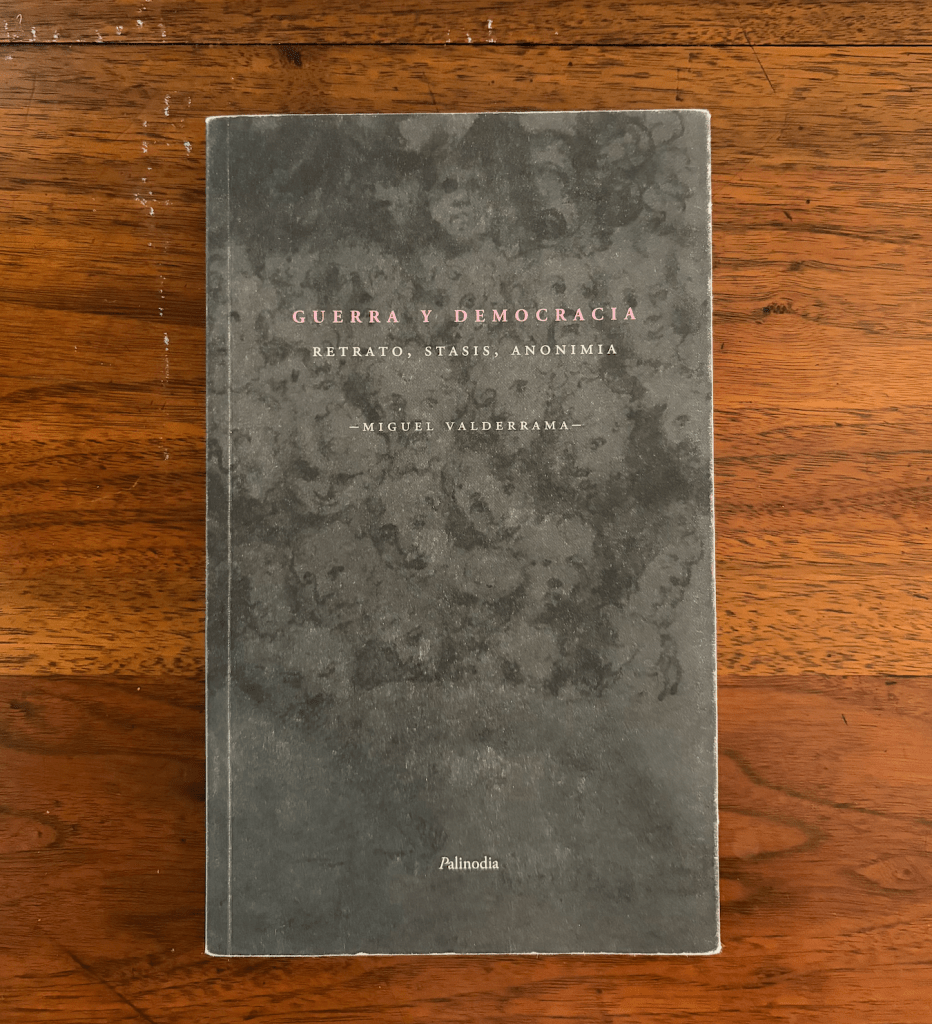
How to think through the stasis as a figure of thought in an epoch of transition and decline? This is the task of the historian – perhaps also of the philosopher and the critic – at the threshold, according to Miguel Valderrama in his book Guerra y Democracia: Retrato, Stasis, Anonimia (Palinodia, 2025), where stasis is extended beyond its categorial inscription in the grammar of political thought in order to capture its oscillatory movement. Dispersion is a word at the heart of Valderrama’s scene of writing; a scattering of sense that radicalizes the enterprise of the historian’s task that cannot remain alien to the problem of language. In fact, it is at the conjunction where Valderrama wants to situate the problem of stasis. As he writes early on in the book: “Pasión en la dispersión, sí, sí con esta frase se nombre en secreto lo que en la errancia del vocablo stasis evoca una escena traumatizante, una herida, una punzada la escenificación de un acontecimiento y el orificio de su representación, la memoria de una stasis y de la anonimia que le es más propia, impropia” (Valderrama 15).
For Valderrama the Greek term – which holds on to definitions of civil war but also conflict and internal stabilization – now welcomed in theoretical discussions, comes to name the errancy and wound of the endurance of war in the modern political project of representation and legibility. As a thinker of the local scene (and its counter-scenes), Valderrama perceives that in recent years the Chilean contemporary critical discussion, especially in the wake of the Chilean revolt of October 2019, has introduced the pulsating grammar of stasis to think this fissure in representation. Valderrama cites the essays by Rodrigo Karmy, and Alejandra Castillo, Juan Pablo Arancibia, Willy Thayer; but also publications like Escrituras Americanas and the now defunct Revista Disenseo, and the novelist Nona Fernández (Valderrama 31). Obviously, the list is not exhaustive. In the Chilean contemporary scene, stasis is removed from its hellenistic origins, in order to name the unmediated irruption of images, inscriptions, and languages as fragments in the interior of history (Valderrama 50). In post-dictatorship Chile these fragments gravitate around the impossible image of La Monada bombed in 1973, which is juxtaposed to the anonymous images of the revolt in Santiago in October 2019, where some are more monumental than others.
One of the novelties in Valderrama’s Guerra y Democracia (2025) is precisely the insistence to think the problem of stasis as radially bound to the regime of visibility and legibility that organize the artifact of political representation. In fact, and following the canonical studies of the Leviathan’s frontispiece and its relation to modern optics, we know that modern political representation has relied consistently on material technologies where representation and the homogeneity of the social body coincide (Valderrama 79). From Thomas Hobbes at the birth of political liberalism to Carl Schmitt’s political theology in Weimar, the visual artefact has been the infrastructure in the making of political authority and the unity of civil society. The repressed containment of stasis at the heart of the modern liberal state is granted only if the regime of public legibility has been constructed. In this sense, all modern politics is necessarily heliotropic, revolving around the sun of sovereignty that will later transform into the electric and atomic form of energy reserves.
By the same token, following Valderrama, we can then say that what stasis names is precisely the breakdown of the helitropic movement in an epoch of absolute exposure and blinding transparency. More than a century ago, in 1913 Malevich could speak of the “Victory over the Sun”, but this can only make sense if such victory can allow for a regime of nocturnal seeing and generic anonymity, which is always on the ‘other side’ of political dominium (be it techno-capitalism or communal administration) where all identifications fails, because there is no longer a common body or a name as energy reserve for social organization. It is because of this rupture that there cannot be a stasis within the social, but also against the closure of the spatial arraignment of the Social understood as the site that requires energy (production) in order to produce a certain degree of comprehensive idealization. Of course, Valderrama is not oblivious to this, as he writes in one of his most programmatic definition of the stasis:
“La revuelta, la stasis, se define contra esta dieta y contra este régimen de luz. Al bertillonismo que define los límites y la lógica del espacio público, la revuelta opone la multiplicación de máscaras, la suspensión del retrato, la proliferación de lo anónimo. El régimen diurno del aparecer opone la noche, las sombras y el humo de los enfrentamientos de cuerpos liberados del rostro y del retrato, de la ficha policial. La revuelta pone en movimiento una anonimia, un juego de máscaras que desata anónimos, pseudónimos, alonomios, sobrenombres, para nombres, antenombres….La anónimo guarda un secreto en la imagen, lo guarda como lagrima y caída de la imagen” (Valderrama 109-110).
But is it just a festive game of defacement and creative destruction that would resemble the spirit of carnival festivities, in which masks evoke, in an exceptional time of inversion, the supernatural powers and the dead as studied by Karl Meuli? Is not the carnival a compensatory act of the logistics of expenditure and realignment for any community of social exchange? If true, then the notion of stasis would need to break from the polarity of social identification and instance of mask, in the same way that already in the classical period the stasis emerged as a zone of indistinction between domestic and public spaces, an unbreachable black hole between the oikos and the polis that is well beyond the exception (Valderrama 119). In other words, stasis needs to be rethought as something other than an interruption in temporality, which is still the negative duration that feeds negatively into the course of temporal order of social domination and its ‘economy of violence’. Valderrama reminds that for the poet Armando Uribe, this economy of violence names the very engine of historical development. And poets tend to be better than political analysts at imagining other worlds.
Towards the end of Guerra y Democracia: Retrato, Stasis, Anonimia (2025), Valderrama briefly glosses Armando Uribe’s 2000 lecture “El fantasma Pinochet” in order to introduce not only the problem of violence, but also language; a language that he calls uncanny, “une inquietante étrangeté” (Valderrama 120). These words are glossing Uribe who is also commenting a speech by former President Eduardo Frei, but that can also be used to thematize the central problem that Guerra y Democracia introduces in its scene: how to traverse a destitution of language if stasis is the capacity to traverse the moribund language that metaphoric and cataphoric politics speaks, without any possibility of saying anything at all? As an initial promise of the book, Valderrama had called for ‘another lexis’ (“otra lexis”) against narrativity and the hallucination of language towards a ‘language as such’, which is the language of naming approaching the coasts of physis. It is tempting to say that the revolt only appears liberating when understood as a problem of inventing and making space for this other language that ceases to be a metaphor of this world.
First published in the Chilean publishing house Mundana back in 2016 and long out of print, Victoria Cirlot’s Imágenes Negativas: las nubes en la tradición mística y en la modernidad (2026) finally appears in a new and upgraded edition from Siruela Ediciones. This short essay, initially a conference delivered at the Universidad Católica de Valparaíso, is another contribution to Cirlot’s important work on European mystical tradition of European early modernity, but like other of Circlot’s book its value also resides in its prudential contribution to contemporary thought. In this sense, Cirlot’s visual exploration of the cloud allows us to raise the question without much hesitation: what is a cloud in a field of vision, anyways? In Kurt Badt’s John Constable’s Clouds (1950), a book that is curiously missing from Cirlot’s commentary and bibliography, the cloud is merely a modern phenomenon in painting; a specular effect of the rise of meteorology in post-Enlightenment England that paved the way for a new construction of the modern landscape painting.
If Cirlot does not need to follow Badt’s insights, it is due to the fact that she wants to take a step back, even if her point of departure is Von Dillis’ drawings from the nineteenth century that she encountered in the Alte Pinakothek in Munich. These are relatively small works, and more profusely unfinished than Constable’s cloud exercises in oil painting. I seriously wonder if Cirlot’s would have taken another direction in her analysis if she had confronted another series of cloud paintings of the modern tradition. Perhaps not. Following Gombrich’s dictum that clouds are accidental forms reserved in the mind and extended to the pictorial space, Cirlot immediately goes on to document the long mystical tradition where the cloud stands for theosgnophos, or the incandescent light that descend from the divinity right into the human’s heart (Cirlot 18). In the mystical tradition the cloud of the story of Moses, later deployed as a trope by Pseudo-Dionysus and Gregory of Nyssa, the cloud refuses to be an accident of substance; it is rather the image of substance itself: the impossibility of knowing and having access to the divine, and thus the need for the recollection of the light of ignorance.
If mysticism and painting go hand in hand it is because what the divine cannot be said in language, but it be disclosed through the spectacular persuasion of an image that is carved in the veil of theology. In this way, the cloud is a bit like a dress in a painting, both conceptually and figuratively: Cirlot does not fail to note that in Medieval representations one can grasp the figure of God swerving in a cloud before a horned Moses, but it is also the turbulence in the depth of the picture that allows for the ascension of the gaze that fails to establish a horizon and the linear perspective. Although Cirlot does not put it in this way – she is obviously more refined and attentive to her historical sources – one could easily find an opposition between clouds (and perhaps clouding of the background of a picture, an activity) and horizon of pictorial representation. It is in this sense that Cirlot defines the “via negativa” that clouds appeal to the impossible knowledge of God (in my translation): “The images of ascension and clouds are modes of making visible the negative way of the proximity with God…the fact that the experience of god takes place through the mode of negative images is something that persist from Pseudo-Dionysus to Mechthild of Magdeburg, and San Juan de la Cruz” (Cirlot 23-25).
In other words, the cloud is the non-human figure of a mode of cohabitation in God – Cirlot goes as far as quoting that it is the medium, “el entre”, the incommensurable distance between the sensible being and god (Cirlot 27). This is why the cloud, in virtue of what it discloses in its non-disclosure, is a bit like a hole in the picture, and we fail to account for its potency to stabilize its mystery through the categories of the autonomy of the work of art. This is why it is very fruitful when Cirlot tells the reader that the cloud defies vision in its very appearance, since through its clearing and light, it can only “sense through the inner soul” (Cirlot 30). This was also present, at least residually in Badt’s Constable Clouds, when referring to the externalization of the clouds as the spiritual organ of the living. But it is precisely this exteriority that defies the epistemological grounds of meteorological knowledge that would facilitate the technical ability to condense the cloud into force and energy, whose ultimate expression is crowned in a work such as Hans Haacke’s Condensation Cube (1963). A fallen cloud from the sky that can only be experienced in the abstraction degrees and measurements of its objective “data”.
There is an intimate and communicate vessel between painting and clouds that can be derived from Imágenes Negativas (2026), and that can be sound in the state of imperturbable contemplation where life and thought convergence without the energy of struggle that would define modern artistic creation and its fall into autonomization (Cirlot 33). If painting is to release and live as a mode folded in God; the modern sensibility would require the energy of creation in order to open the passage between worlds. Following Puech’s important work on Gnosticism, Cirlot sees that the nebular trope of the cloud persists in modernity well beyond San Juan de la Cruz: one can sense in the attempts to “escape this world” – from Piranesi’s ladders to Thomas De Quincety’s prose, and of course, Charles Bauderlaire – a hymnal longing for the clouds that depends on the energy of the reversibility of the modern seen as a form of confinement (and from the pictorial space, I would argue also as the triumph of flatness in modern painting) (Cirlot 44). The cloud becomes a window for gnostic imagination, although this could very well be a sort of self-serving pleonasm, given that the “possible” of the gnostic remnant in the work of art only appears as momentary reversibility; a temporality that necessarily subsists without transforming the plane of sensibility. These are wonderful experiments in poetry, painting, photography; and yet, the negative, I take it, cannot be refused its place in the historical wealth of historical capture of exteriority. Both Hölderlin and Baudealire’s clouding of poetry is already the document of the impossible attempt to live the serene life in god. Thus, any attempt at a full-fleshed exodus via negativa, runs into catastrophe and possibly madness in the wake of disenchantment.
In her final and short essay of the volume, titled “La estrella y la nube”, Cirlot speaks of the return of the cloud in modern photography, concrete the work of André Kertész, as ‘laceration in the sky” (“agujerear el cielo”), or a tear in the heavens (Cirlot 60). The passage here appeals to an inverse tonality, where lamentation becomes an inexorable dimension of affection in the world now organized through massification and urbanization of all spaces. Disenchantment is ultimately spatial enclosure. But this tear in the sky is a remnant of a memory of the divine, as well as the absence of the divine in the world; the failure of establishing a transcendence with the unknown and the inapparent. But it is thanks to Victoria Cirlot’s pictorial explorations that we can raise these questions, which are also more than mere questions pertinent to theology and art.
Monia Ferrando’s archeological reconstruction of Arcadia as a “political paradigm” that retreats from the nomos of force and usurpation has as its fundamental condition poetry and the voice of the poets. Given the tripartite nomoi of Arcadia (as law of the heart, song, and meadows), which exceeds the autonomy of the polis in Athens, poetic voice functions as the mediation for the effective transmission of the mythopoetic figure that would guarantee another relation, a non-productive and authentic proximity with the world. Throughout the book, whenever Ferrando wants to take a distance from the polis as derivative from the polis she goes to the poets and poetry. Consider for instance, this moment (all the translations are mine from the Spanish edition) in the last chapter on the political paradigm of Virgil: “Poetry, then, is called upon, from its own painful present, to venture like a new Orpheus, but as a memore veggente [a memorious seer], into the darkness of the past, to give new form to love without being content with its mere image. To traverse the stratification of human experience that has shaped the world in order to reshape, in turn, a love reduced to a bloodless and deceptive phantom” [1]. The ‘pre-political’ site of Arcadia is in the poetic voice, whose fundamental task is to transform the ideal of triumph and victory to that of erotic enchantment and fascination that refuses the autonomization of the erotic image [2].
If one considers the totality of Il Regno Errante it is not all too difficult to discern that the transmission and ambivalent origin of irruption in the tradition – which Ferrando thinks with Overbeck’s urgeschichte – is only possible through both a poetization of politics, and the substitution of the hēgemon by the poet when thinking about the afterlife of Arcadia in the genesis of the West, in the very passage from Antiquity to the modern epoch. In this way, poetics is not subsumed to political practice, guided by the classical figure of the ‘Dichter als fuhrer’ described by Max Kommerell, but a state of the via contemplativa in its distancing with the world. In a very elucidating moment Ferrando thematizes this as follows: “Eros is not a political practice in which thought is neatly concealed, but a poetics that culminates in the disinterested contemplation of beauty, in pure theoria. Here, poetry will be philosophical, and philosophy, poetic, without any distinction” [3]. But it is also here that poetry is acting as the supreme activity that can retrieve and connect existence in the world, which is the proper to the classical antiquity, which solicits the question: could this still hold for the philosophical predicament of the poem in modernity? Can the poet stand and mediate to the prophecy at the moment of the decline of the logos, positing the dichtung as an operative substitute? It seems to me that this presents us with an unavoidable difficulty about the transmission of the memory of Arcadia. And we should do well to articulate it.
In her recent biography of Paul Celan, Anna Arno mentions in passing and without no theoretical pretensions, that the young Jewish poet, still under the influence of his mentor Alfred Sperber, wrote a poem that while taking place in the meadows of Arcadia, there is a loose arrow that hinders and hunts the possibility and and shadow of death. The last verses of the poem titled “The arrow of Artemis” introduce something like an oblique and unfathomable shadow in the landscape of Arcadia, which Arno describes in this way:
“The ‘born again’ poet dedicated “The arrow of Artemis” to his mentor. Celan rendered the Arcadian landscape, but in the final stanza he expressed his fear: “How should he who, above sky-blue pebbles…not ponder that Artemis’ arrow, still lurks in the forest and in the end will strike him?”. Introducing a sense of peril, the poem struck up a polemic: mythical lands provided no shelter against the shockwaves of historic barbarism. Celan was declaring a new path, unlike what Sperber could have chosen for him”. [4].
While on the surface there is a superficial way of reading this commentary in the manner of the typical proximity-distance of the “anxiety of influence”, I want to read this moment as emblematic and hyperbolic of the condition of the crisis of the age of the poets in modernity where the transmission of the Arcadian bliss is impossible in the wake of historical barbarism, which also shatters the structure of poematicity as it runs through the intricate work of Celan. How do we understand Celan’s ‘new path’ that seems absolutely heterogeneous to the divinization of the musical voice required to disclose the Arcadian myth? Perhaps modern poetry, and modern poets at large, cannot initiate the restitution of Arcadia because they can only recognize its own autonomy in a postmythic world after the fleeing of the gods and the absence of God (as verbalized in Hölderlin’s fragment on Oedipus).
This is what Giorgio Agamben has seen in his text on San Juan de la Cruz when discussing poetry to mystical theology: “Indeed, San Juan’s mystical theology still presupposes the existence of a positive theology and of a Holy Scripture, from which it derives its own legitimacy and guarantee. Modern poetry, instead, does not recognize any other holy scripture but itself. For this reason, modern poetry—insofar as it is its own, sole guarantor—has been fatally led to question its own limits and its own adequacy and to search in its own incessant, ironic sacrificial self-negation for the only valid guarantee of its own authenticity” [5]. And more recently, this thesis has also been validated explicitly in Il corpo della (2026), where he recalls that all major poetic gestures of Western poetry in the twentieth century – from Pound’s Cantos to Eliot’s The Wasteland, from Mandelstam’s Fourth Prose to Celan’s own destructive poetry of the German language – only manages to preserve the ruins and fragments of the tradition. The poet can only register those fragments, but he is incapable of building another world in the accumulated site of its ruins.
In its possibility of bearing witness in language, experience might open up the trace of the voice in the non-place of death as the sole destiny of between beings, as Carchia suggests in his early essay on Celan’s “The Meridian” [6]. But poetry transfigured in this way entails that the figure of Arcadia can only be taken as the possibility that emerges from the event of language at the border of nihilism and madness. As emblems of this poetic experience without revelation, both Hölderlin’s madness and Celan’s suicide are perhaps instances of this ‘seeking’ in the shadow of Arcadia’s disinterested via contemplativa of beauty, where the nocturnal black that casts a shadow into the clear and sunny landscape of the memory of Arcadia. This shadow does not eclipse the myth of Arcadia; far from it; in its theistic passage disclosed by light of the eros daimon, the voice seems to be prolonged and eternal at the very end of the experience of modern poetry.
.
.
Notes
1. Monica Ferrando. El reino errante: la Arcadia como paradigma político (Adriana Hidalgo, 2024), 638.
2. Ibid., 595.
3. Ibid., 538.
4. Anna Arno, Paul Celan: A Life (Harvard Press, 2026), 60-61.
5. Giorgio Agamben. “La notte oscura di Juan de la Cruz”, in Poesie: Juan de la Cruz (Einaudi, 1974), xii.
6. Gianni Carchia. “Il Meridiano di Celan”, Rivista di Estetica, XVIII, May-August 1973, 196.
I still remember quite well how, a few years back at the Harvard University Bookstore, the Loeb Collection of Latin And Greek Classics, with their crimson and green covers respectively, were nowhere to be found on the shelves. And a slim store clerk when asked told me that those books on “dead languages” were no longer carried at the store. If this anecdote transmits anything is precisely the central question that still lingers from the pulsating notion of “dead languages”. What does it mean that a language is dead; if there is, in fact, such an ontological status for any language that has been traced from our past? This question returns to us today with some urgency as the most recent avatar of cybernetics, “Artificial Intelligence”, positions itself high above not just the alleged “dead languages” of the antiquity that many readers cannot longer master, but also the living spoken languages of human race as a whole.
Prophetically, this was the problem confronted by W.H.D Rouse in a short text titled “Machines or Minds?”, and published in The Classical Weekly in winter of 1913. And as we know, Rouse, a trained philologist who translated Homer and Plato, was also the creator of the Loeb Classical Collection published by Harvard University Press beginning in 1912. The task of reviving the “dead languages” in Rouse’s program was a way to contest what he saw as the collapse of civilization in the face of rise of machine and the colonization of “leisure time”, as it was becoming a world of pure “electric force” (a topoi of modern civilization that will also finds its place in the writings of Warburg, Schmitt, and Florenski as we have recently noted ).
In a description that resonantes in form and spirit with Carlo Michelstaedter’s forecast that the future of language will amount to an international language composed of technical terms, Rouse was more refined and precise in defining this instrumental transport by connecting the rise of science with that of English as a homogenous planetary language. Thus, inverting the assumption that “dead languages” are the defunct and no longer spoken idioms of past civilizations and archaic cultures; for Rouse it is “English”, and more specifically, scientific English that is ultimately a dead language, as it transmits nothing, as it is fundamentally detached from linguistic experience and imagination. As Rouse writes in one moment of his essay: “The very languages give what English does not give. Modern English is full of roundabouts, of metaphors without meaning, verbiage, shams; Greek and Latin are plain. The English language is largely dead: Greek and Latin are living languages. […] The scientific English sentences are all dead: they either wrap a single sense in meaningless words, or they seem to have a meaning when they have none [1]”. The rhetorical artifice to which language succumbs expresses itself not through the use of words, signs and icons, but in a proliferation of discourse that no longer communicates anything precisely because it has communicated everything out of the fallacy of absolute representation and absorption of a flat system of wordless objectivity. In Rouse’s indictment of human decline finds its correspondence in what language’s entry into what he called the “Dagon of Science”, opening a new scenario for human historical destiny: “never was there a world that cared less for truth in speech and thought” [2].
There is a huge risk in reading Rouse’s defense of the “classical languages” (Latin, Greek) as a humanist blueprint for a forthcoming antiquarian revival, a nihilist outlook that is being fulfilled in the United States as a parodic reiteration of Winckelmann’s neoclassical imitation ideal. Against the reification of dead languages as fictive “living entities” positioned as tools for knowledge and expertise, division of labor notwithstanding, what was fundamental for Rouse in the dead languages of the past – and in this sense, any language – is the ability of bringing about the experiential dimension of its use, thus connecting thinking and the experience without separations [3]. In other words, Rouse, very much like the last Émile Benveniste, found interest in classical languages not as a moral principle of civilization and identity foundation, but rather a site for the immediate experience between speakers embedded in a degree of the lived [4]. This is also why a poet like Eliseo Diego would state in Conversación con los difuntos (1991) reading other languages is a form of friendship beyond presence of the living. The conversation in languages is a way to keep open the passage from the living to the dead and back.
And whoever lives in language dwells in the memory and traces of all the dead languages, inscriptions, voices, and rhythms, because these contain the past as a reservoir of the figure of life. The consolidation of basic English as the hegemonic medium of communication with the return of extreme nationalism emerges, as Erich Auerbach wrote from his Istanbul exile, “to a ruse of providence designed to lead us along a bloody and tortuous path of an International of triviality and a language of Esperanto”. In this scenario, the slow annihilation of the human species takes place outside the world; that is, in the field of language, which has now become the central historical program of domination against the lived experience that connects the dead and the living. As languages become an autonomous frame of order and force, human beings’ existence is transformed into a mobile receptor of rhetoric, information, and opinion.
.
.
Notes
1. W.H.D Rouse. “Machines or Mind?”, The Classical Weekly, V.6, 1913, 85.
2. Ibid., 86.
3. W.H.D Rouse. “Latin as a Universal Language”, Nature, February, 1916, 706.
4. Émile Benveniste. Last Lectures: Collège de France 1968 and 1969 (Edinburgh University Press, 2019), 67.
In his 1982 novel Aladdin’s Problem (1982), Ernst Jünger defined planetary domination through the actualization of the trope of Aladdin’s lamp. Whenever a symbol of this sort is used, we know that it always carries weight of ambivalence more than that of synthesis. The mythic lamp is a trope for magic and enduring power; of countering visibility and invisibility, but it is also made from a material that has been extracted from the Earth. In other words, raw materials are manipulated as a reservoir of energy that dispense the world of forms. In the most succinct moment of the novel, Jünger writes: “Aladdin’s lamp was made of pewter or copper, perhaps merely clay. The lamp guaranteed domination as far as the frontiers of the traveled world – from China to Mauritania. Aladdin preferred the life of a minor despot. Our lamp is made of uranium. It establishes the same problem: power streaming towards us titanically” [1]. Aladdin’s lamp is no longer a tool deployed by governments and armies, it is rather the autonomous commanding force that opens to human domination and technological catastrophe that generates calculable objectivity in the world.
In his conversations with Julien Hervier, Jünger stated that the “problem of Aladdin” is not a political problem, but rather one that involves the administration of energy and intelligence that is already beyond our hands, because it has been set loose by ongoing compulsion necessary to meet the indexes of production and transference of technology [2]. Of course, energy defined the broad design of modernity as the necessary condition to amplify historical forms and mediations (and deform, since it was always dialectic) of worldly events and relations. One should only be reminded that in the beginning of the 1920s three major texts by European thinkers – I am thinking of Pavel Florensky, Carl Schmitt, and Aby Warburg – saw the necessity to allude to the settled hegemony of electricity as the defining feature of the dominion of the world.
As Warburg understood it prophetically in his lecture on the serpent ritual of the Hopi Indians: “But myths and symbols, in attempting to establish spiritual bonds between man and the outside world, create space of devotion and scope for reason which are destroyed by the instantaneous electrical contact – unless a disciplined humanity reintroduce the impediment of conscience” [3]. And it goes without saying that this “instantaneous electrical contact” has become so thoroughly engrained in human existence, that it is now clear that life on Earth, as advanced by the latest phase of Artificial Intelligence (AI), is no longer point to the destruction of space but of the total disruption of electricity and energy that exceeds any sensible contact. Electricity as the paradigm of artificial mediation can only liberate the spiritualization of ongoing decline.
It is no historical accident that empires and nations have always been driven by the accumulation of energy, although at its historical exhaustion, there is no longer a veneer of development and production between energy and empire, but only a unified empire of energy in a lamp that quenches and overruns itself towards extinction. This means that what defines the darkness of our times is neither disorientation nor political violence (although there is much of that too), but the blinding darkness of a translucent expropriation of the world of the living and the dead. It is through this assumption that Jünger makes the last business of the epoch of Aladdin – extractive energy as domination of objects and objecthood between worlds – as a large necropolis called Terrestra, financed by a banker named Jersson, where there is no longer any need for the liturgy or cults proper to myths, but naked exchange between gold and the material corpse that suppresses, via technological titanism, any possible relations to the irreducible. It remains to be thought whether the moment when the lamp goes off in the drained excess of its energy will also lead to the end of this world.
.
.
Notes
1. Ernst Jünger. Aladdin’s Problem (Marsilio Publishers, 1992), 118.
2. Julien Hervier. Conversaciones con Ernst Jünger (Fondo de Cultura Económica, 1990), 100.
3. Aby Warburg. “A Lecture on Serpent Ritual”, Journal of Warburg Institute, V.2, April 1939, 292.
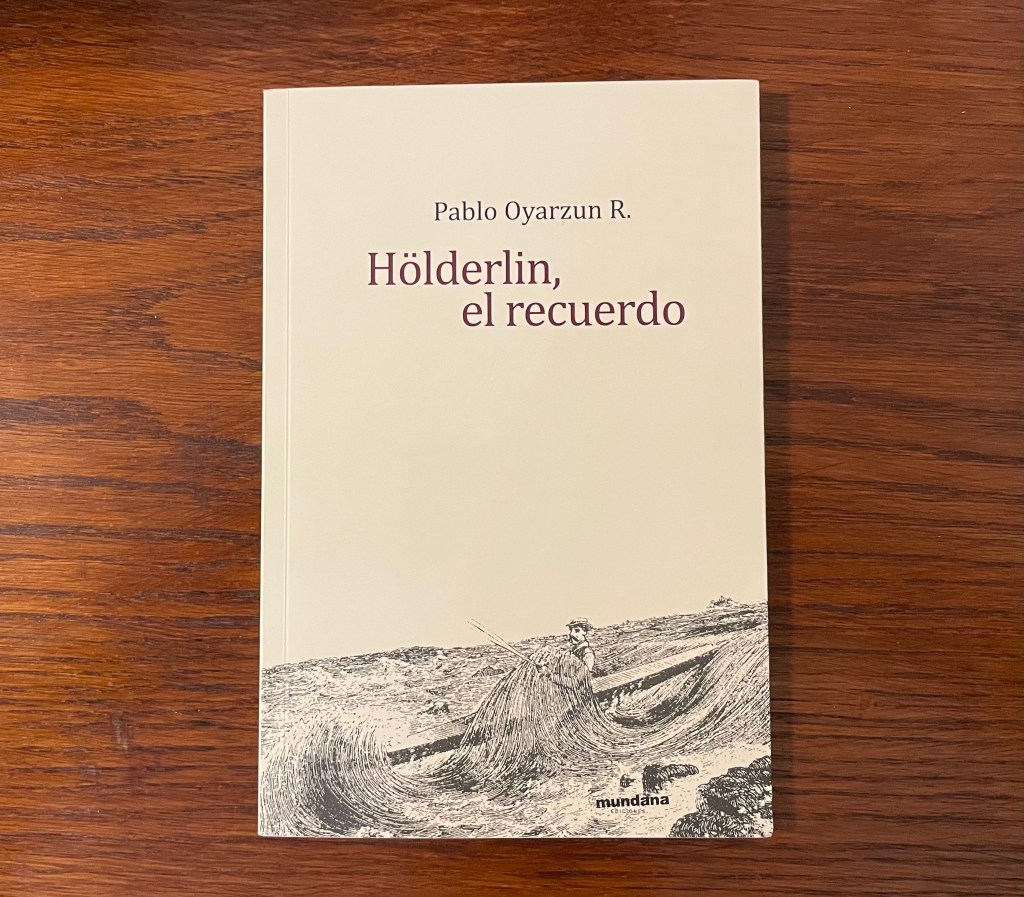
The concluding verses of Hölderlin’s “Andenken” (“Rembrance” or “Memoria”), “Yet what remains, the poets found” stands as one of the preeminent testaments of modern poetry, and in Heidegger’s famous characterization, as a declaration of the task of the poet. At least since the time of Stefan George and Max Kommerell, the figure of poet or Dichter, a hyperbolic figure of illumination and guidance caught in the net of poetry and philosophy, was already dependent on Hölderlin’s mysterious words. What remains in what the poet remembers and clears for foundation? What is the relationship between remembrance and what is ‘found’ or ‘established’? “Andenken / Remembrance” is a hymn from the late period, which means that it must be read in consistency with Höderlin’s poetological framework as it reaches its maximum degree of intensity in its declaration and deliverance. Pablo Oyarzun’s most recent Hölderlin, el recuerdo (Mudana ediciones, 2025) is a powerful and subtle contribution to the understanding of this poem that measures up to the task in its attention to lexicon and structure, metaphysical condensation, and the vortex of ‘memory’ that discloses the poem. One of the merits of Oyarzun’s philosophical hermeneutics, if we can call it that, resides in its refusal to incorporate philosophical doctrines to inform the major questions of the hymn; rather, he favors the very unfolding of the poem ramping its internal structure for possibilities (Oyarzun 18-19). Rereading “Remembrance” opens a path between philosophy and poetry in the dawn of the realization of metaphysics, whose price was paid by crushing the possible and the voice of the poem.
For Oyarzun the poet’s remembrance is that of appropriation of what is proper, and thus inappropriable, and to which the hymn can only ‘thank’ in the way of thinking as figure in the face of the unfathomable. Following Heidegger’s reading to a point, to give thanks is also to welcome and greet that lets humans and things be in their truth; since greeting always assumes otherness as foreign into presence (Oyarzun 29-30). And in presence life acquires texture, depth, singularization, but also conversation; a reminder that will control the rhythm of Hölderlin’s hymn. What is brought to presence, then, is neither a possession nor a legible inheritance, but the non-synthetizable modulation of what is proper in virtue of being absolutely alien (Oyarzun 34). What is recalled in this poem that remembers and thinks the unthinkable? Is it just a stage for Hölderlin to poetically transfigure his well known travels in Bordeaux? Oyarzun tells us that even if that is to be taken into account, the foreigner path is only essential as a way of homecoming, making the site (and song) into the hymn (Oyarzun 42). There is relation to the absolute other, but only as transitory to becoming and divine destiny in the world: “…el espíritu ama, porque precisamente así, ensa autoalienación puede transitar a lo otro que lo otro, es decir, apropiarse de lo propio […] el pensamiento del Ereignis está condicionado estructuralmente poesía ex-propiación, por ese retraimiento, distracción o retiro (Entzug), solo puede el cual se da lo propio (Oyarzun 54-55). Höderlin’s poem sings from the lacuna of its own expropriation of the abode. And that abode is ultimately the unworking of remembrance and memory that is defaced in being absolutely intimate and irreducible.
In order to elucidate the contours of this memory and its oblivion, Oyarzun follows Dieter Heinrich observation that: “este movimiento [of remembrance as transcendence] conocedor de su propio curso y a la vez desviado del mismo, aspirando a un conocimiento en que algo perdurable (lasting), con gratitud, reine aún en la superación – esto es remembranza” (Oyarzun 61). What is remembrance if not what unweaves time? It is not an actual faculty of human psychology, nor a spectral incorporation of a missing object; rather, it is the non-syntheizable partition between language and the wound of existence; a separation that is only redeemed in the way of remembrance that deposes an ideal recollection of missing facts in preparation for recomposition. Oyarzun’s reading will depend on clearing the notion of severability as a condition for remembering and forgetting as it makes an entry into the poem’s final verse about the “fixating eyes of love” (den Blick heften). Helena Cortés Gabaudán translates it as “y el amor también fija aplicadamente los ojos” [1]. “Y también”, “but also”, a conjunction of persistence that Oyarzun reads as an inexorable attachment to memory and separation, and the memory of separation (Oyarzun 68). Because there is no sliding towards remembrance without departure, coming into the presence welcomes the memory that, in that very moment, has transformed our souls.
Ultimately, for Oyarzun the vortex of Hölderlin’s “Andenken” is love understood as the supreme citation that enacts the place of both thanking and remembering: “Amar es recordar, frecuentar con el recuerdo (el pensamiento), lo amado, incluso allí donde lo amado está presente, porque así lo resguarda de la mera posesión y agradece su presencia. Amar es pensar-en, un modo, tal vez el más entrañable, de Andenken, amor” (Oyarzun 73-74). And this means that what remains and endures, as Adorno observed in his well known essay on parataxis in Hölderlin’s late poetry, is neither of the logical nor of the temporal indexes, but the event of language as originary creation and donation without contestation (Oyarzun 77). This is the instance where Hölderlin’s strange case of the divinization of the word – and this is the particularity of the hymn form, an element that is never teased out by Oyarzun – becomes absolute and intransigent. It is Höderlin’s absolute proximity with the classical world, but also its radical separation in the post-mythical world of dissenchantment. It can be said that that what endures ‘thanks’ the love of remembrance in its persistence of the word that does not allow history and the crisis of tradition: “en nombre de la cosa que queda, en la fragilidad de su tiempo, que es ese mismo quedar” (Oyarzun 79).
The poem becomes the verbal and sayable site where the poetizing resides, as well as the greeting and farewell of departure, just like the spectral sailors of the poem. What endures intimately can be called love as a form of the immemorial (Oyarzun 80). And that is because in inscribing, or holding on to the irreducible origin, poetics becomes the supreme form of love – the love in separation – of an expropriated language that welcomes us home in conversation with friends. This attests to the spirit of Hölderlin’s well known letter to his friend Böhlendorff in 1802: “A los artistas les hace falta la psyche entre amigos, el nacimiento del pensamiento en la conversación y la carta. De lo contrario, no gozamos de nada de esto para nosotros mismos” [2]. And this intoxicated love in language that departs from separation situates Hölderlin as radically different from the Chirstian agape and its bond of perfect unity for securing salvation (Colossians 3:14). A salvation that Hölderlin overcame in the drama of Empedocles, enacting the impossible incorporation of the aorgic physis through the writing of the tragic myth.
Now we are also able to understand why Hölderlin transited to the hymn as the supreme form of the poem; not because because it is the origin or its last stage, but a suspension of language retrieved is gathered in the two moments of salutation and farewell, celebration and lamentation [3]. The hymnal dimension of the poem becomes language as such, which Oyarzun calls the immemorial without ever alluding to the notion of hymn. Indeed, the love of remembrance only becomes possible as a disjointed factum of experience anchored in its abyssal noncorrespondence (Oyarzun 84). Thus, to remember is to love the caducity of life – “este ya no es la signatura indeleble del amor”, as beautifully expressed by Oyarzun – in a world in which the testament of language awaits no resurrection.
.
.
.
Notes
1. Friedrich Hölderlin. Poesía esencial (La Oficina, 2017), Trad. Helena Cortés, 129.
2. Friedrich Hölderlin. Correspondencia completa (Ediciones Hiperión, 1990), trads. Helena Cortés & Arturo Leyte, 554.
3. Nicoletta Di Vita, Il nome e la voce: Per una filosofia dell’inno (Neri Pozza, 2022), 246-247.
One of the merits of Sandor Agócs’ The troubled origins of the Italian Catholic Labor Movement (1988) is located on the question of Thomism during the rise of a national industrialization and the new centrality of the worker. This is a question that informs the very genesis of modern political thought, so I want to zoom in to the specifics: in Agócs’ narrative, the reinvention of Thomism goes hand in hand with the ‘social question’; that is, not just as the substrate for state legitimacy, but also as a supplement in the very mediation between the state and social incorporation. After reading Agócs a question lingers: what to make of the success story of social Thomism in the long history of modernity, that includes episodes from the both the left and the right; from the Italian Catholic Social Movement to Corporate Francoism, from the Pinochet Constitution drafted by Jaime Guzman to the most recent articulations of an interpretative common good in the contemporary American postliberal constitutional and interpretative balancing? One easy way out of the explanation is to delegate the answer to the historical uses (and misuses, depending who is defending what) of Aquinas’ thought, but that hardly answers the question. A while ago, John Finnis made a claim that could point to an important destination:
“This grand metaphysical overview of reality, and of our knowledge (‘theoretical’ in the first two kinds of order, ‘practical’ in the second two) of it, has been as fundamental to the new classical natural law theory from its beginnings as it was to Aquinas. It enables us to identify as illegitimately reductionist almost all the streams of social-theoretical thought, including political and legal, that have emerged since early modernity. It helps in identifying the errors of those would-be followers of Aquinas who reject the new-classical natural law theory on the ground that it neglects or subordinates nature and metaphysics; the misunderstanding of Aquinas, and of the relation between practical and theoretical thought” [1].
For Finnis, although writing for legal theorists, Aquinas’ thought properly understood possesses a ‘metaphysical view of reality’, a sort of plasticity interlocking practical reason for action and morality that serves socio-theoretical ends. In other words, the thomistic plasticity for social legitimation can be connected to what Martin Heidegger held as ‘adequatio’ as a fixed point in the problem of Medieval representation of beings. And this means that thomism is always already a theory of legitimate ground for governing that reality. As Finnis suggests in different moments of his work, the lesson of Thomism is construed in its emphasis on the rule of law as the source for justice and fairness, and in this sense it was never alien to modern social contract. Karl Barth’s rhetorical question -“Why did Hegel not become for the Protestant world something similar to what Thomas Aquinas was for Roman Catholicism? – can now be understood in its most consequential light.
Now it makes sense that Agócs refers to early twentieth century Italian Catholic Neo-Thomism as a “counterrevolution”, although he does not denote that this would be a second instance of counterrevolution with social prospects that the post-French Revolution figures (De Maistre, Bonald, and Donoso) could not meet in their antimodern stance. And here the divide is sharpened: whereas the counterrevolution post-1789 had very limited and unstable sources in social facts, Neo-Thomism offered a theory of law that was consistent with modern class dynamics supported towards social cohesion and stabilization proper to the ideal of the community centered in urban centers. If one defining feature of political modernity is reversibility, it would then make sense that thomistic natural law could rise to the demands of any given historical time to offer a nexus informed by the onto-theological structure of adequatio and analogia entis, whose proper end is the stabilization of social pressure. The second order ideological uses of Thomism (left, right, revolutionary, moral conservative, traditionalist, pre-post Vatican councils) are contingent to its malleable adequation generated by its own claim to natural morality. Heidegger once pointed in this direction when he claimed that Aquinas’ philosophical horizon was fundamentally the inception of metaphysics over theology as faith (that is actio and efficiency unto subjection) [2]. If modernity is the realization of onto-theology, then it can only make sense that Thomism takes as many garments as necessary to prevent gazing towards the abyss, becoming a manifold phosphorescent theory of social morality.
.
.
Notes
1. John Finnis. “Aquinas and Natural Law Jurisprudence”, in Duke & George, Natural Law and Jurisprudence (Cambridge University Press, 2017), 32.
2. Jean Beaufret. Dialogue with Heidegger (Indiana University Press, 2006), 106.
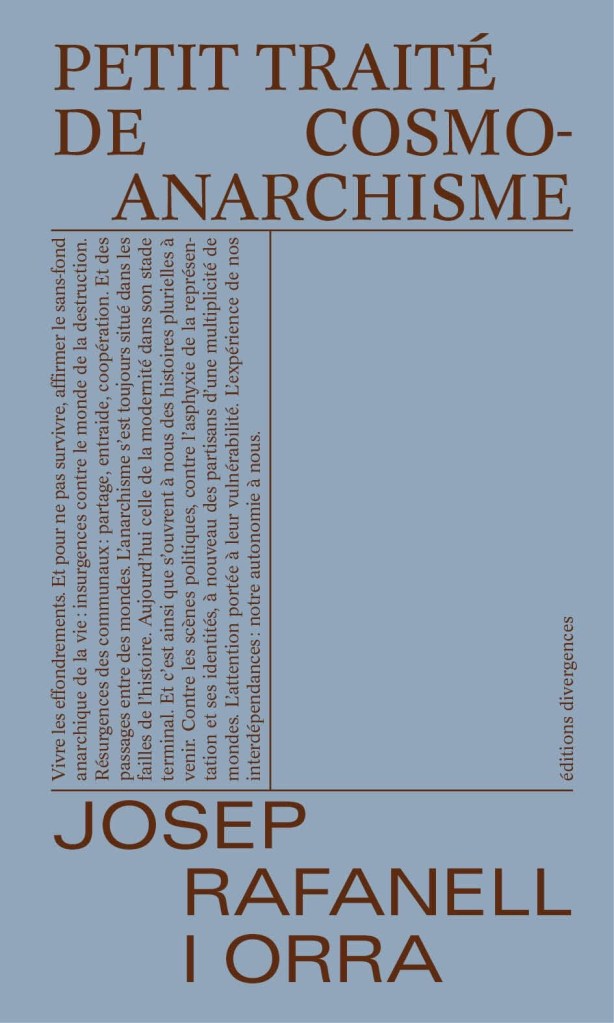
Anyone somewhat familiar with the writing of Josep Rafanell i Orra knows that we are in the company of a wanderer and itinerant in an infinite pursuit of what the experiences of worlds might offer [1]. A mad endeavor for a groundless epoch oriented towards planetary reduction and confinement, so obsessed with infrastructure and security, most recently through the reiteration of the politico-theological program of national sovereignty, one more desperate reaction to unrestrained planetary decline. We can say with Hölderlin that we are vagabonds in a destitute time, a poet who figures prominently at the entrance of Josep’s Traité. In our posthistorical epoch we are confronted with the thicket over the dominion of life, which means that the question of exteriority becomes pressing as existence enacts a path beyond the endless rubble of representation bestowed upon the human species in every point of the globe.
The book that the Spanish reader now holds in his hands thanks to Luciole Ediciones will immediately let in a dimming light of a singular style or maniera that dislocates the modernist assumptions of political thought into what one could what I am willing to name an analytics of sensible hybridizations between languages and thought. This analytic of the sensible refuses immediately Social normativity as well as the melancholic hangovers of the modern revolutionary tradition (always caught up between constituent and constituted power, representation and humanism, growth and production). This is why Josep will redefine communism as the nonprogramatic event that irrupts through hybridization of surrounds and regions capable of overcoming the ontotheological adequation of subject and object that has led an entire civilization astray (33). The project of the critique of metaphysics finds in Josep’s Traité a powerful schematic cartography that raises questions precisely in those spaces where the rationality of the science of political economy has never dared to enter.
If the critical projects of High Modernity were fundamentally temporal (including that of Messianism and its overemphasized trance towards absolute immanentization), Josep’s writing also has the virtue of displacing the focus to the spatial formation and the thinking of the creation of spaces understood as dwelling, once populated by the gods of the events and which modern ontotheology obliterated through integrated objectivation and technological positionality. We know that the greatest nearness of the last god eventuates only when the event is elevated into refusal, especially when it manages to become too near [2]. As a shorthand, this drift towards objectification in the liquidation of modern politics is domination of the Social totality; ultimately, it is through the plasticity of the social bond that the reproduction of biopolitical life is temporalized, legally ordered, and rhetorically subsumused into an apparatus of predatory accumulation. It is the Social (not the State, or this or that concept of the modern grammar of political thought, or even fascism) that we must refuse. The collapse of the modern secular state and its moral guarantees, is the beginning of an autonomized social bond that now coincides with the total administration of world forms. The hegemony of the Social reduction is what allows Josep to claim that the opposition is no longer between Society and the State; but rather between community as a process and praxis against the static formation of the Social. Thinking today drifts from social domination to communities of encounters, heteronomic relations, communication, and interdependence in a web that characterizes the exotic movement of the imaginative possibilities of exteriority for manifold worlds.
The notion of community in Josep’s thinking is neither about ecstatic groups or “little platoons” of identitarian belonging (as once famously defined by Edmund Burke); nor referring to filiation and propriety reductions that can subsist quite nicely under the heatwaves of the ongoing conflagrations of Empire. For Josep communities insofar as they are exposed to their excess (ubermass) are processes of external contact between souls as rites of passages. The community is formless, and in this sense it ceases to be a problem of Chistological stereology in order to become one in the order of ethics and language (50). In this sense, very much like the late Mario Tronti looking at the collapse of the modern revolutionary experiment; for Josep the ruinous fragmentation of the worlds has a silver lining: that all human, and non-human, souls are dwelling on the outside world calling for worldiness, and thus potentially sharing a sense of intimacy that re-enchants the appearance and knowability of the world through the invisible attunement to the outside (un nuovo modo di essere fuori e contro) [3].
Beyond the subject and the narcissism of the Ego, the light of a “spark of the soul”, in the words of Meister Eckhart’s memorable sermon, a new animism returns not because there is a transcendental revelation to be asserted, but because the encounter between souls brings forth the concatenation of worlds that are entangled with other worlds (68). If Jünger described the epoch of planetary machination as “soul murder” (seleenmord) it was because there was no longer any contact with the unfathomable opacity between the soul and any possible worlds [4]. Josep with an elegant mannerist style enhances this intuition: “We are no longer exiles on Earth, as the romantic moment freighted by the loss of world. We ended up forcing the Earth into exile after so many deadly abstractions (108). The modern age has not ceased accumulating abstractions against the human species until becoming a whirlwind of soul murdering that has extended into the current ecocide of the worlds.
It does not come as a surprise that throughout Petit traité de cosmoanarchisme (2023) Josep appears more than skeptical about political critique (and to say skeptical might be an understanding). There is a clear imperative that is mobilized in the book and that it should not be taken for granted: political critique should evolve into the negation and abandonment of politics, which also includes the always anachronistic anarchist politics. We know that ever since the Greek polis the autonomy of politics partition and distribution was waged against the incommensurable topos of the chora, the ungovernable and infrapolitical hinterland of the new substantive community of rights and obligations posited by the logistics of representation [5]. As we know, this is what forced Heraclitus to resolutely remain playing knucklebones in the temple of Artemis: “What are you gaping at, you scoundrels? Or is it not better to do this than to work with you on behalf of the polis?” [6]. The knucklebones of the ancient anecdote of the presocratic philosopher is symbolic to what Josep demands of existence: the liberation of environments and surrounds for multiplicities of experiences. The experience of gaming always starts in the middle, expressing the ineffable ethics of how I become what I am already on my way of becoming (142). The maximization of politics into the very thicket of life (this is biopolitical administration) have increasingly defaced the experiential practice of existence that now extends over the course of the historical dispensation of civilization. This is the vortex of the struggle against the realist validations in the interregnum.
Against and beyond the force of abstraction and the prison of individuality, Josep situates the stakes: “It is there, where the fierce struggle we can lead today: to find the intimacy of our soul in the welcome of other souls to hear their silences and their voices. To participate in the animation of the world is to perceive the outside. And gently find the inside of the outside” (145). And between the process of the community and the soul there is no longer struggle or enmity, but only solvent philia; the influx of creation that, insofar was enmeshed in solitude, allows pain to speak in the time of transition, in the skirmishes between worlds. Ultimately, the experience of the itinerant is not that of learning to live in places; rather, it is the one that intensively yearns the presence of encounters. This remains the only ethopoetic imperative [7]. As Carlo Diano observed in an erudite study on the notion of the chora, the attunement of the soul with the world is not a conceptual entelechy; it runs materially through the sensorium of this body as it traverses the world towards its renewal [8]. To grasp this chiasmic region that dispenses the harmony of the soul as it flees the prison gates of an objective world, is the enduring letter and spirit that Petit traité grants to the ongoing task of thought.
.
.
Notes
1. Gerardo Muñoz. “Escuchar las llamadas del mundo: diálogo con Josep Rafanell i Orra”, Disenso: Revista de Pensamiento Político, N.3, July 2020, 134-158.
2. Martin Heidegger. Contributions to Philosophy (Indiana University Press, 2012), 329.
3. Mario Tronti writes in “Disperate speranze” (2019): “È necessario trovare un nuovo modo di essere fuori e contro. Io posso farlo nel solo modo in cui so farlo: tirando l’arco al punto che permette di cogliere il bersaglio più raggiungibile. Realistica visione.”. CRS, October 2019: https://centroriformastato.it/disperate-speranze/
4. Ernst Jünger. The Forest Passage (Telos Press, 2003), 93.
5. Julien Coupat. “Dialogo con i morti”, in Gianni Carchia’s Orfismo e tragedia (Quodlibet, 2019).
6. Martin Heidegger. Heraclitus: The Inception of Occidental Thinking and Logic (Bloomsbury, 2018).
7. Josep Rafanell i Orra. Fragmenter le monde (Divergences, 2020), 70.
8. Carlo Diano. “Il problema della materia in Platone: la chora del Timeo”, Giornale Critico della Filosofia Italiana, V.1, 1970, 335.
Michael Lobel’s new monograph on Van Gogh’s work, Van Gogh and the End of Nature (Yale University Press, 2024) undertakes a systematic effort, brilliantly argued and researched, at showing the redeeming visual capacities of the nineteenth century painter towards the natural world. If we call it redeeming it is because in more than one way, Van Gogh, in the last three decades of the modernizing century, was painting at the threshold of nature that soon enough was assaulted by the copious designs of modern industrialization, energy production, and the application of its effective scientific techniques over all spheres of life. It is the final culmination of the disenchantment of the world, and so also the moment of great temptations, such as standing up against it through the metaphorization of the imago naturae in one last desperate attempt at salvation through a reified ideal representation. Lobel’s art historical work shows us along the way that Van Gogh’s situation was far more complex, and that a French critic’s quip that he merely “captured nature with a soul” in his pictures requires specification and analytical comprehension within the context of the century of steam (Lobel 2).
In other words, Van Gogh is not a painter of a return to the conscience of the “Beautiful Soul” that has interiorized the exhaustion of artistic imagination; implicitly throughout Lobel’s monograph is the well grounded intuition that Van Gogh was an artist of the depth of vision without necessarily translation their specular commitment to the efficacy of realism. Immersed in his age as every artist obviously is, Van Gogh’s vision is mediated and conditioned by the effects of modernization that will severely affect the act of looking and gazing. This is not exclusively reduced to the new subject of labour production of the industrial age, although certainly there in his mining drawings, but also ecological transformations such as pollution, gaslight, geographical sites, the new chemistry of color pigments, and the tonality of human expressivity (the hues of a human face) in its new surroundings. Although there is no ambition in offering (or modifying) a theory of modernity in Lobel’s account of Van Gogh, one is reminded in the historical documentation the total and integral dimension of modernity in terms of its spatial totality: the essence of modernity was a revolution in the immanence of forms and perceptions that transcended the mere mechanization of the atmospheric designs.
Thus, when Van Gogh gazed at a peasant field and saw the isolated and orderly harvest he was simultaneously preferring the composition of the color palette of a painter that is now conscious of the material elements of his process of production (Lobel 9). But the colors return to the field, and this already provides us with a symptom of Van Gogh’s pictorial signature – which again runs implicitly throughout the book without ever coming to the forefront – about retaining the outlook towards nature and the natural world, which for the painter it becomes the enduring task to be resolved in manifold ways. But there is one way in which Van Gogh tries to tackle this drift to the infinite vanishing of nature: the capacity to move visually through space. To this end, Lobel does well to remind us that Van Gogh, perhaps more than any other artist of his time, was able to travel places thanks to the new rail system efficiently connecting regions and cities that made his work possible (Lobel 28). But besides the autobiographical standpoint, what is noteworthy is how Van Gogh trained his vision to capture industrial air pollution, trainlines, malformations of the land the end of Parisian Montmartre, and of course, the starry skies of Arles transformed by the new coal driven modern gas lamps. In all of these figural vistas, Van Gogh is always situated somewhere above the territory looking outwards, and in this way, attentive to the transformation of the exterior world; insisting whether there is any exteriority out there in the world at all (it does seem he thought there were).
Van Gogh prefigures as a painter of the eclipse of the world because it is a world in which the very notion of horizon (and thus of landscape) enters into a terminal crisis. Lobel brings to our attention Avenue de la Gare with Plane (1888) that captures this problem: here is a picture where the line of the horizon in the foreground mutates into the main PLM train line from Arles to Marseille (Lobel 33). The rail line cuts through the horizon becoming the new transcendental vector of progress; the axis of movement that carries the world forward. And yet there is something visually “earthly” in Van Gogh’s pictorial works that drives our gaze downwards; it is a symptom of its grounded vision, but also, for Lobel, of his tense relation with the temporal mobilization of modernity, as if seeking rest and detention (Lobel 43). What are the sources of this tension? Does it mean that it is never resolved? These are questions that are poorly tackled in Lobel’s book, and that remain attached strictly to art historical documentation and archival sources. But these are nonetheless fundamental questions de ayer y hoy, as the Spanish saying goes.
One could linger in the question of visual grounding in Van Gogh’s work – a perspective (although not just an optical question) that permeates his work, even when there is no outside field as a visual referent, such as the well known The Night Café (1888), where the billiard table seems to slide down towards the spectator, making the true and ultimate actor of the painting the intense and palpable wooden floor (Lobel 90). But the same could apply to the perspective of the Roi Canal or the starry skies over the Rhône, the examples abound. Is there something about vision and grounding that offers a point of entry into Van Gogh’s proposal to look into the cage of modernity one last time in order to find some non-space solace of the resting gaze? Could one argue that this “tension” – between horizontal closure and downwards grounding – his personal response to what T.J. Clark called when analyzing Pissarro, the “ongoing vileness of our epoch of transition”? [1]. It is hard to tell because, unlike Pissarro, Lobel tells us nothing about Van Gogh’s political views.
However, we do know that at a young age Van Gogh wanted to pursue theological studies that he soon gave up for visual arts (Lobel 74). Could it be that his insistence towards the ground is resolutely theological, as if he wanted to retain the god of place (theos aisthetos) as the ungraspable region for extraction and production, the new axiological order of the industrial age? Lobel’s does well to cite Victor Hugo at the beginning of the second chapter “Earth” about the outskirts quarries and sewages of Montmartre: “a variety of those misshapen fungi from the underside of civilization” (Lobel 68). It all seems that even when he was not attending to capture the limits of Montmartre, the fields of Arles, or the domestic spaces, Van Gogh’s provokes a downward descension into the ground that invites any participating space. Looking at the vanishing world one last time needs a ground from which to stand and retain a sensible distance; that very distance that the nascent bourgeois world will effectively dissolve giving up on the cohabitation between life and nature into generic and massive alienation.
The question of the ground perspective is also corroborated by Van Gogh’s interest in strong and emphatic hues for his picture, learning from the previous generation of artists that “all the colors that Impressionism has made fashionable are unstable” (Lobel 149). In other words, the effect of color for the Impressionists, including Seurat and Pissarro, is too dialectical, which means that the tension evolving from the ground is immediately resolved between color and form, the orderly and the interdependence of the composition for stable appearance. This allows us to consider that one of Van Gogh’s key signatures – his almost bombastic and expressive use of colors – have something intimate, and perhaps also secret, to the spatial-temporal closure of modernity and its contingencies. I do accept Lobel’s suggestion that Van Gogh seized the opportunity of new industrial non-natural hues in order to mitigate the coming lackluster world oriented towards production, extraction, and human survival. For Van Gogh color becomes the barrister to gaze firmly upon the fleeting temporization of the highly visible and transparent world of disenchantment and total organization.
But to say color is also an artifice or short for the insistence on light, which is not the light of the new immanent world, but certainly a painterly light that transcends immanence by insisting on the irrevocable character of places, arrangements, inhabitation, and contingency of phenomena. This is painting at its best against the vile epoch of transition, that has extended itself as the transition of the end of the modern epoch into our present. The ruins of Van Gogh’s industrial materials allow Michael Lobel to come full circle about Van Gogh’s inscription in the modern age (Lobel 153). But we should not let go of the idea that while materials do decompose and rot, the painter’s ultimate material utensil is nothing but light, and this means “a thinking of light, an image that is aware of the relation that light has with things. This matter is equally concrete”, as Monica Ferrando has recently advised [2]. Is not the descending lux the sensorial condition for disclosing the gradual proximity between vision and ground? It is with this exterior lighting as pictorial praxis that Van Gogh stood as a madman and a witness to the endless night of our disappearing our world.
.
.
Notes
1. T.J. Clark. “We Field-Women”, Farewell to an idea: Episodes from a History of Modernism (Yale University Press, 1999), 109.
2. Monica Ferrando. “From History to Anarchy: The Painting of Louis Comtois in the Thought of Reiner Schürmann”, Philosophy Today, Vol.68, Fall 2024, 875.