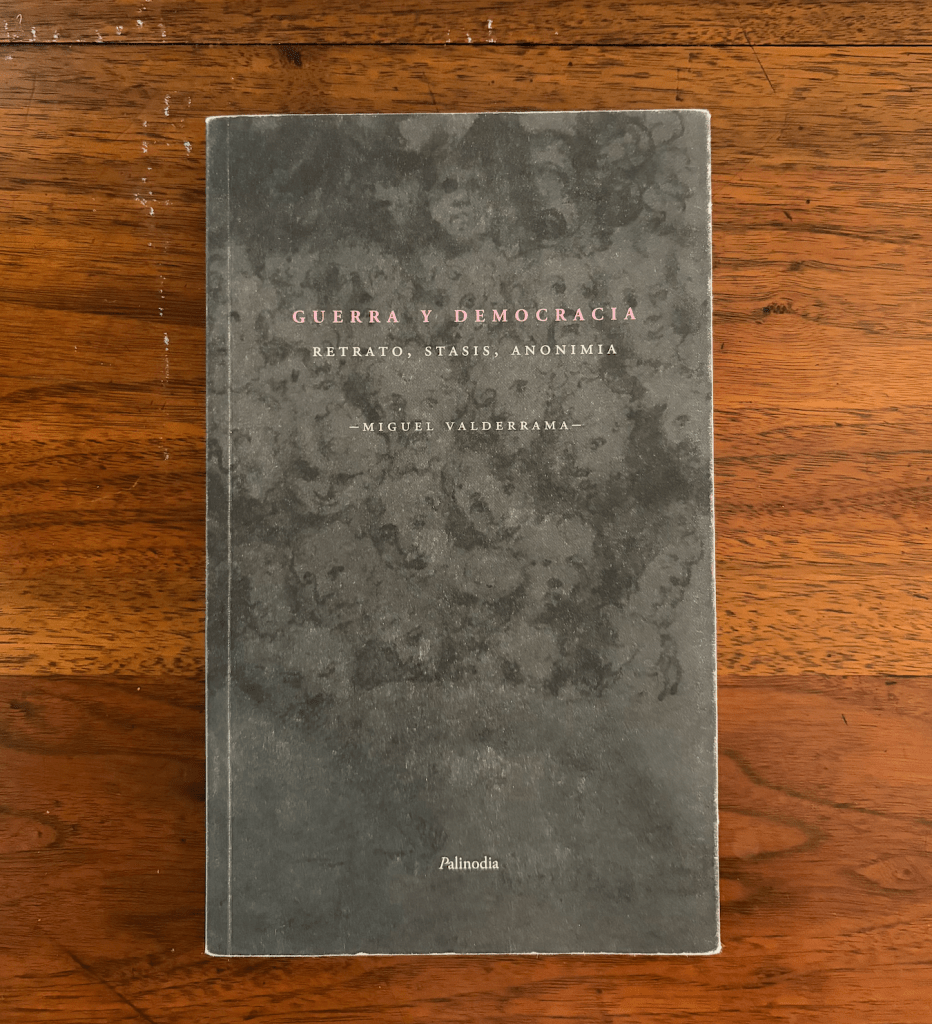
How to think through the stasis as a figure of thought in an epoch of transition and decline? This is the task of the historian – perhaps also of the philosopher and the critic – at the threshold, according to Miguel Valderrama in his book Guerra y Democracia: Retrato, Stasis, Anonimia (Palinodia, 2025), where stasis is extended beyond its categorial inscription in the grammar of political thought in order to capture its oscillatory movement. Dispersion is a word at the heart of Valderrama’s scene of writing; a scattering of sense that radicalizes the enterprise of the historian’s task that cannot remain alien to the problem of language. In fact, it is at the conjunction where Valderrama wants to situate the problem of stasis. As he writes early on in the book: “Pasión en la dispersión, sí, sí con esta frase se nombre en secreto lo que en la errancia del vocablo stasis evoca una escena traumatizante, una herida, una punzada la escenificación de un acontecimiento y el orificio de su representación, la memoria de una stasis y de la anonimia que le es más propia, impropia” (Valderrama 15).
For Valderrama the Greek term – which holds on to definitions of civil war but also conflict and internal stabilization – now welcomed in theoretical discussions, comes to name the errancy and wound of the endurance of war in the modern political project of representation and legibility. As a thinker of the local scene (and its counter-scenes), Valderrama perceives that in recent years the Chilean contemporary critical discussion, especially in the wake of the Chilean revolt of October 2019, has introduced the pulsating grammar of stasis to think this fissure in representation. Valderrama cites the essays by Rodrigo Karmy, and Alejandra Castillo, Juan Pablo Arancibia, Willy Thayer; but also publications like Escrituras Americanas and the now defunct Revista Disenseo, and the novelist Nona Fernández (Valderrama 31). Obviously, the list is not exhaustive. In the Chilean contemporary scene, stasis is removed from its hellenistic origins, in order to name the unmediated irruption of images, inscriptions, and languages as fragments in the interior of history (Valderrama 50). In post-dictatorship Chile these fragments gravitate around the impossible image of La Monada bombed in 1973, which is juxtaposed to the anonymous images of the revolt in Santiago in October 2019, where some are more monumental than others.
One of the novelties in Valderrama’s Guerra y Democracia (2025) is precisely the insistence to think the problem of stasis as radially bound to the regime of visibility and legibility that organize the artifact of political representation. In fact, and following the canonical studies of the Leviathan’s frontispiece and its relation to modern optics, we know that modern political representation has relied consistently on material technologies where representation and the homogeneity of the social body coincide (Valderrama 79). From Thomas Hobbes at the birth of political liberalism to Carl Schmitt’s political theology in Weimar, the visual artefact has been the infrastructure in the making of political authority and the unity of civil society. The repressed containment of stasis at the heart of the modern liberal state is granted only if the regime of public legibility has been constructed. In this sense, all modern politics is necessarily heliotropic, revolving around the sun of sovereignty that will later transform into the electric and atomic form of energy reserves.
By the same token, following Valderrama, we can then say that what stasis names is precisely the breakdown of the helitropic movement in an epoch of absolute exposure and blinding transparency. More than a century ago, in 1913 Malevich could speak of the “Victory over the Sun”, but this can only make sense if such victory can allow for a regime of nocturnal seeing and generic anonymity, which is always on the ‘other side’ of political dominium (be it techno-capitalism or communal administration) where all identifications fails, because there is no longer a common body or a name as energy reserve for social organization. It is because of this rupture that there cannot be a stasis within the social, but also against the closure of the spatial arraignment of the Social understood as the site that requires energy (production) in order to produce a certain degree of comprehensive idealization. Of course, Valderrama is not oblivious to this, as he writes in one of his most programmatic definition of the stasis:
“La revuelta, la stasis, se define contra esta dieta y contra este régimen de luz. Al bertillonismo que define los límites y la lógica del espacio público, la revuelta opone la multiplicación de máscaras, la suspensión del retrato, la proliferación de lo anónimo. El régimen diurno del aparecer opone la noche, las sombras y el humo de los enfrentamientos de cuerpos liberados del rostro y del retrato, de la ficha policial. La revuelta pone en movimiento una anonimia, un juego de máscaras que desata anónimos, pseudónimos, alonomios, sobrenombres, para nombres, antenombres….La anónimo guarda un secreto en la imagen, lo guarda como lagrima y caída de la imagen” (Valderrama 109-110).
But is it just a festive game of defacement and creative destruction that would resemble the spirit of carnival festivities, in which masks evoke, in an exceptional time of inversion, the supernatural powers and the dead as studied by Karl Meuli? Is not the carnival a compensatory act of the logistics of expenditure and realignment for any community of social exchange? If true, then the notion of stasis would need to break from the polarity of social identification and instance of mask, in the same way that already in the classical period the stasis emerged as a zone of indistinction between domestic and public spaces, an unbreachable black hole between the oikos and the polis that is well beyond the exception (Valderrama 119). In other words, stasis needs to be rethought as something other than an interruption in temporality, which is still the negative duration that feeds negatively into the course of temporal order of social domination and its ‘economy of violence’. Valderrama reminds that for the poet Armando Uribe, this economy of violence names the very engine of historical development. And poets tend to be better than political analysts at imagining other worlds.
Towards the end of Guerra y Democracia: Retrato, Stasis, Anonimia (2025), Valderrama briefly glosses Armando Uribe’s 2000 lecture “El fantasma Pinochet” in order to introduce not only the problem of violence, but also language; a language that he calls uncanny, “une inquietante étrangeté” (Valderrama 120). These words are glossing Uribe who is also commenting a speech by former President Eduardo Frei, but that can also be used to thematize the central problem that Guerra y Democracia introduces in its scene: how to traverse a destitution of language if stasis is the capacity to traverse the moribund language that metaphoric and cataphoric politics speaks, without any possibility of saying anything at all? As an initial promise of the book, Valderrama had called for ‘another lexis’ (“otra lexis”) against narrativity and the hallucination of language towards a ‘language as such’, which is the language of naming approaching the coasts of physis. It is tempting to say that the revolt only appears liberating when understood as a problem of inventing and making space for this other language that ceases to be a metaphor of this world.

