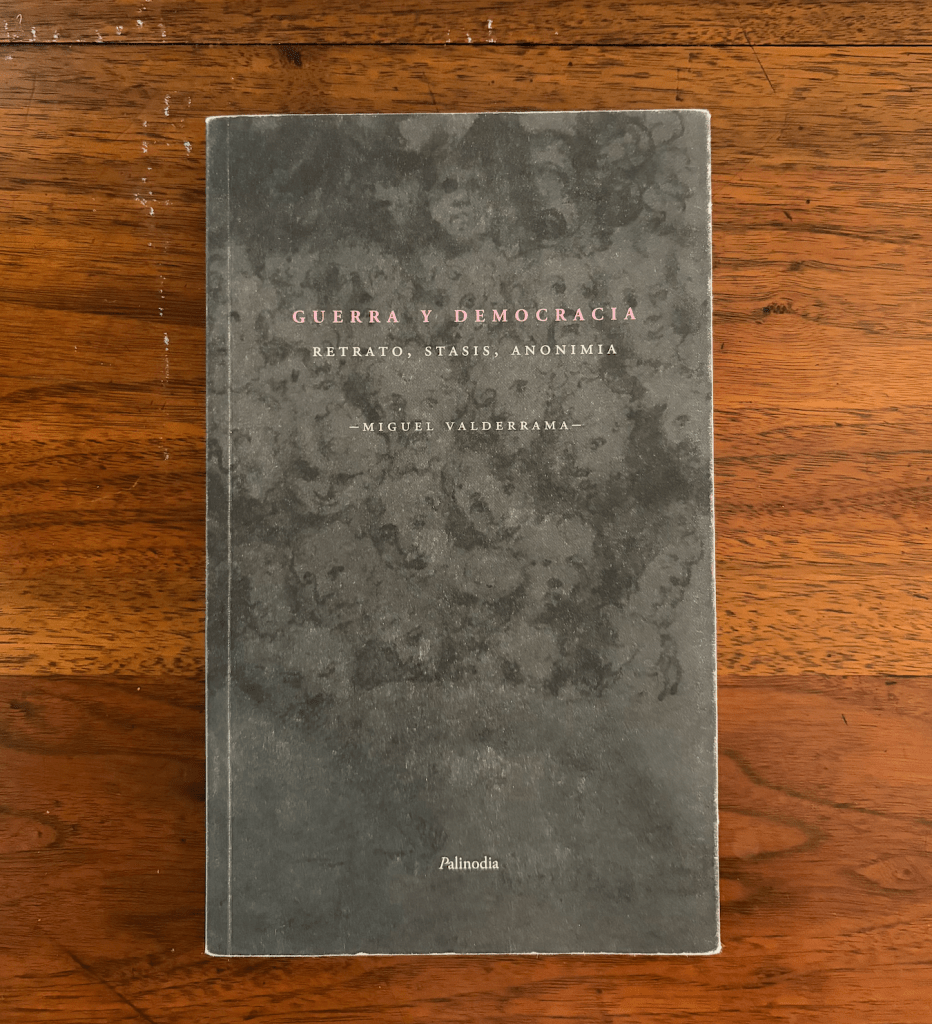
Lexis alia. On Miguel Valderrama’s Guerra y Democracia: Retrato, Stasis, Anonimia (2025). by Gerardo Muñoz

How to think through the stasis as a figure of thought in an epoch of transition and decline? This is the task of the historian – perhaps also of the philosopher and the critic – at the threshold, according to Miguel Valderrama in his book Guerra y Democracia: Retrato, Stasis, Anonimia (Palinodia, 2025), where stasis is extended beyond its categorial inscription in the grammar of political thought in order to capture its oscillatory movement. Dispersion is a word at the heart of Valderrama’s scene of writing; a scattering of sense that radicalizes the enterprise of the historian’s task that cannot remain alien to the problem of language. In fact, it is at the conjunction where Valderrama wants to situate the problem of stasis. As he writes early on in the book: “Pasión en la dispersión, sí, sí con esta frase se nombre en secreto lo que en la errancia del vocablo stasis evoca una escena traumatizante, una herida, una punzada la escenificación de un acontecimiento y el orificio de su representación, la memoria de una stasis y de la anonimia que le es más propia, impropia” (Valderrama 15). 

For Valderrama the Greek term – which holds on to definitions of civil war but also conflict and internal stabilization – now welcomed in theoretical discussions, comes to name the errancy and wound of the endurance of war in the modern political project of representation and legibility. As a thinker of the local scene (and its counter-scenes), Valderrama perceives that in recent years the Chilean contemporary critical discussion, especially in the wake of the Chilean revolt of October 2019, has introduced the pulsating grammar of stasis to think this fissure in representation. Valderrama cites the essays by Rodrigo Karmy, and Alejandra Castillo, Juan Pablo Arancibia, Willy Thayer; but also publications like Escrituras Americanas and the now defunct Revista Disenseo, and the novelist Nona Fernández (Valderrama 31). Obviously, the list is not exhaustive. In the Chilean contemporary scene, stasis is removed from its hellenistic origins, in order to name the unmediated irruption of images, inscriptions, and languages as fragments in the interior of history (Valderrama 50). In post-dictatorship Chile these fragments gravitate around the impossible image of La Monada bombed in 1973, which is juxtaposed to the anonymous images of the revolt in Santiago in October 2019, where some are more monumental than others. 

One of the novelties in Valderrama’s Guerra y Democracia (2025) is precisely the insistence to think the problem of stasis as radially bound to the regime of visibility and legibility that organize the artifact of political representation. In fact, and following the canonical studies of the Leviathan’s frontispiece and its relation to modern optics, we know that modern political representation has relied consistently on material technologies where representation and the homogeneity of the social body coincide (Valderrama 79). From Thomas Hobbes at the birth of political liberalism to Carl Schmitt’s political theology in Weimar, the visual artefact has been the infrastructure in the making of political authority and the unity of civil society. The repressed containment of stasis at the heart of the modern liberal state is granted only if the regime of public legibility has been constructed. In this sense, all modern politics is necessarily heliotropic, revolving around the sun of sovereignty that will later transform into the electric and atomic form of energy reserves.

By the same token, following Valderrama, we can then say that what stasis names is precisely the breakdown of the helitropic movement in an epoch of absolute exposure and blinding transparency. More than a century ago, in 1913 Malevich could speak of the “Victory over the Sun”, but this can only make sense if such victory can allow for a regime of nocturnal seeing and generic anonymity, which is always on the ‘other side’ of political dominium (be it techno-capitalism or communal administration) where all identifications fails, because there is no longer a common body or a name as energy reserve for social organization. It is because of this rupture that there cannot be a stasis within the social, but also against the closure of the spatial arraignment of the Social understood as the site that requires energy (production) in order to produce a certain degree of comprehensive idealization. Of course, Valderrama is not oblivious to this, as he writes in one of his most programmatic definition of the stasis: 

“La revuelta, la stasis, se define contra esta dieta y contra este régimen de luz. Al bertillonismo que define los límites y la lógica del espacio público, la revuelta opone la multiplicación de máscaras, la suspensión del retrato, la proliferación de lo anónimo. El régimen diurno del aparecer opone la noche, las sombras y el humo de los enfrentamientos de cuerpos liberados del rostro y del retrato, de la ficha policial. La revuelta pone en movimiento una anonimia, un juego de máscaras que desata anónimos, pseudónimos, alonomios, sobrenombres, para nombres, antenombres….La anónimo guarda un secreto en la imagen, lo guarda como lagrima y caída de la imagen” (Valderrama 109-110). 

But is it just a festive game of defacement and creative destruction that would resemble the spirit of carnival festivities, in which masks evoke, in an exceptional time of inversion, the supernatural powers and the dead as studied by Karl Meuli? Is not the carnival a compensatory act of the logistics of expenditure and realignment for any community of social exchange? If true, then the notion of stasis would need to break from the polarity of social identification and instance of mask, in the same way that already in the classical period the stasis emerged as a zone of indistinction between domestic and public spaces, an unbreachable black hole between the oikos and the polis that is well beyond the exception (Valderrama 119). In other words, stasis needs to be rethought as something other than an interruption in temporality, which is still the negative duration that feeds negatively into the course of temporal order of social domination and its ‘economy of violence’. Valderrama reminds that for the poet Armando Uribe, this economy of violence names the very engine of historical development. And poets tend to be better than political analysts at imagining other worlds.

Towards the end of Guerra y Democracia: Retrato, Stasis, Anonimia (2025), Valderrama briefly glosses Armando Uribe’s 2000 lecture “El fantasma Pinochet” in order to introduce not only the problem of violence, but also language; a language that he calls uncanny, “une inquietante étrangeté” (Valderrama 120). These words are glossing Uribe who is also commenting a speech by former President Eduardo Frei, but that can also be used to thematize the central problem that Guerra y Democracia introduces in its scene: how to traverse a destitution of language if stasis is the capacity to traverse the moribund language that metaphoric and cataphoric politics speaks, without any possibility of saying anything at all? As an initial promise of the book, Valderrama had called for ‘another lexis’ (“otra lexis”) against narrativity and the hallucination of language towards a ‘language as such’, which is the language of naming approaching the coasts of physis. It is tempting to say that the revolt only appears liberating when understood as a problem of inventing and making space for this other language that ceases to be a metaphor of this world.

The necessity of Penia. by Gerardo Muñoz

It is well known that Aristophanes’ late comic work on wealth, Plutus (388), provides us with what is perhaps the most dramatic and conceptual elaboration of the mythic personification of poverty (Penia) of late antiquity. What is remarkable is that in her self-presentation to the character Chremylus, Penia draws on a political parallelism that colors the ongoing crisis of governance of the ancient polis. If the Greek comedy is dependent on the function of the pólos (which is the vortex of movement that makes possible grasping the specificity of the being that is said), always prior to the arrangement of the polis, then it would follow that Aristophanes’ commentary on the centrality of Penia is neither mockery nor irony within the structure of the play, but rather an element fundamental to the historical presentation of the consciousness of historical public life. The emergence of Penia in Plutus is recorded in the lines 550-554 (a paraphrase might be adequate here): “Thrasybulus and Dionysius are one and the same according to you. No, my life is not like that and will never be. The beggar, whom you have depicted to us, never possesses anything. The poor man lives threfitly and attentively to his work; he has not got too much, but does not lack what he really needs” [1]. Poverty is an intimate relationship with needs; perhaps an unsaid relation, but one that must be accounted for nonetheless.

At her entrance into the play, we are told that Penia’s complexion is both mad (makaron) and tragic (tragōdikon); she could very well be an Erinyes companion from the underworld of the dead. Penia as a mythic figure is a fullfilled form of life. More importantly, what is crucial in the Plutus is that Penia defines herself in sharp contrast to the life of beggars or ptochos. This means that while the penetes is tied to a constitutive need as condition for a form of life; the ptochoi is a being that merely lives in a state of survival, and endures his absence of proper needs. Because Penia is contrasted to the destitute life embodied by ptochos, she can state in one moment primacy over wealth: “all your blessing….you have all that you need in abundance, thanks to me” [2]. Hence, as it has been noted, the irrevocable presence of Penia in the polis is the condition of possibility for Ploutus, god of wealth and abundance, shown in ancient representations as holding the flourishing cornucopia from the fertile harvest season. 

What is important to note is that the close and fluid relationship between Ploutus and Penia; that is, between abundance and need, far from being opposition is relational and nourished by its pólos. In this way, the being of need, the penetes, is only able to flourish if he is capable of attaining a free relation with its desire of its vital making, and not from an external power that can determine the functions directed to abstract modeling of population survival. If Aristophanes’ Penia is defined against the ptochos is not because there is a difference of degrees in terms of dispossession, negative or quantitative, but rather it is because it is a disjointed relationship between poverty as a transfigured life, and a life that become destitute because it has ceased to be attentive to its own needs. In the incommensurable ground of the polis, it could be said that the ptochoi were unformed lives that merely persisted in time on the margin of the system of relation of the human community, and for this reason they dwelled in a permanent state of apolis, since their only viable horizon was the result of economic abstraction for secondary needs. In other words, the beggars of the apolis are ultimately effects of economic forces that they do not control, precisely because they no longer have any existential relation with the realm of necessity, that is, with poverty as understood under the shadow of Penia. 

In this sense, the condition of beggar is an ultimate economic subjection that is already beyond the sufficient limitation of needs, and thus it has lost all contact with the world. It is has become deprived of the world without being truly dead. Here, one should not forget that as Plato registers the genetic relationship between Penia and Eros in an important moment of The Symposium: “Eros is the son of Poros and Penia, and partakes of the nature of both parents, the fertile vigor of the one, the wastrel neediness of the other. As he is a mean between mortal and immortal” [3]. But the erotic soul in the last resort is nothing but the desire for immortality; and, as a daimon, it mediates between passions and the beautiful, between the divine and the mortal, between need and wealth towards the depth of a harmous life [4]. As Sandrine Coin-Longeray has shown in her exemplary study, Penia (πενία) exceeds the effective qualification of the “good life” based on labour; rather it is a route of life that outlives itself in the erotic transfiguration of world towards the preservation of irreducible homeostasis of common life [5]. 

This is why Plato’s conception of the ‘happy city’ or the kallipolis was imagined as a deposition of the process of abstraction between “rich” and “poor” that ultimately has come to regulate the modern organization of social rationality proper to accumulation, production, and distribution to supply to rhe demand of ever expanding secondary needs in the general field of consumption. As Plato writes in Book III of The Laws in a section precisely dedicated to showing how to bring civil war to an end: “Because of all this, they were not intolerably poor, not driven by poverty to quarrel with each other; but presumably they did not grow rich either, in view of the prevailing lack of gold and silver. Now the community in which neither wealth nor poverty exists will generally produce the finest characters, because tendencies to violence and crime, and feelings of jealousy and envy, simply do not arise” [6]. The civilizational path undertaken by West since the rise of institutionalized isonomy could not be but exactly the opposite of the platonic deposition of the autonomy of alienated classes. Today it is all too apparent that every sphere of social reproduction stimulates a ferocious race to the bottom between a kleptocracy and a vast administered population of ptochoi that, precisely because they have no relation to Penia, is left pursuing compensatory reactions within the social mechanism of organized begging that they are forced to endure. Under the oblique light of Penia, it becomes clear that both redistributionist policies through state institutions, as well as the autonomous market initiatives of financial models tend to be two sides of the same defense of abstract abundance on the back of the human community of penetes

The negative subsumption of material needs, and thus of poverty into quantifiable assets that characterize abundance and growth at a civilizational scale – with the collaboration of all modern political ideologies without exception always oriented towards production – has contributed to thwart the path of Penia that is necessary to live freely between passions and needs. This is why in his 1945 lecture “Die Armut” (“Poverty”), Martin Heidegger, departing from a well-known intuition from Hölderlin, claimed that ‘being-poor’ does not mean the absence of some property or substance, but a relation to needs; because only in poverty do we preserve a free relation unto what we need (not-wedigkeit) as necessary. And only this can be taken as the true and ultimate wealth: ‘we have become poor in order to be rich’, means that only through the preserving necessity of Penia will there be a liberating dislocation for human life beyond the indigence of mere exchange and the endless struggle over material goods and the private property. As the world becomes a more vast wasteland of beggars and disposable bodies at the service of technology, Heidegger, in Eckhartian tenor, was not wrong to claim that poverty and Penia will ultimately be the ethical destiny of the people of the West only if they become attune to the divine overtone of poverty as their destiny. Thus, the only possible abundance in a declining world can be realized through the enduring necessity and disquiet return of the essence of poverty – to come near the nothing, because there we find the dearth of the earth. Indeed, as Penia says in Plutus before leaving the stage: “One day you will speedily send for me back” [7]. 

Notes 

1. Aristophanes. Plutus (Loeb 1946), 550-555, 421. 

2. Ibid., 501-511, 409.

3. Plato. The Symposium (Penguin Books, 1987), 203b, 82. 

4. F. M. Cornford. “The Doctrine of Eros in Plato’s Symposium” (1937), in The Unwritten Philosophy and Other Essays (Cambridge University Press, 1950), 74. 

5. Sandrine Coin-Longeray. Poésie de la richesse et de la pauvreté: Étude du vocabulaire de la richesse et de la pauvreté dans la poésie grecque antique, d’Homère à Aristophane: ἄφενος, ὄλβος, πλοῦτος, πενία, πτωχός (Publications de l’Université de Saint-Etienne, 2014), 153-56.

6. Plato. The Laws (Penguin Books, 1975), 122. 

7. Aristophanes. Plutus (Loeb 1946), 630, 421.

Espectáculo ex vitro. por Gerardo Muñoz

En la presentación sobre Filosofía de la apariencia física (Taugenit, 2021), de Ángel O. Álvarez Solís, y que ya puede ser vista en diferido, José Miguel Burgos Mazas se refirió a la noción de “espectáculo” como “feliz omisión” a lo largo del libro. Desde luego, no se trata de una omisión que pone en crisis la arquitectura de este fabuloso tratado sobre los modos técnicos de la apariencia, sino que introducirla permitiría explicitar la circulación misma de las imágenes como normatividad renovadora de las miradas. Ahora sabemos que, tras la crisis del Hombre, solo contamos con la potencia de ver y de ser visto, incluso cuando se trata del allanamiento de los cuerpos como en Crash de Cronenberg. Y esto sólo se ha intensificado en la fase pandémica. Pero lo importante – en mi lectura de la tesis de Burgos Mazas, ya que no quiero hablar por él – es que el espectáculo permitiría una exteriorización en condiciones de entregarnos otra noción de realismo (en el pasado hemos discutido algunas hebras relativa a este tema) [1]. Un realismo más allá de lo político y del tiempo, pero nunca como fuga del mundo.

Al menos para mi, quien dice realismo quiere apuntar a la desrealización efectiva de un espectáculo glorioso, del “espectáculo integrado”, como le llamó Guy Debord en su última etapa [2]. En el espectáculo integrado de la vida queda comprimida a una imagen extensa sin fisuras ni relieves. El espectáculo integrado anuncia futuro, pues su orden es la temporalidad de todos los entes del mundo, clausurando el abismo entre existencia y su afuera. En cambio, le podemos dar la vuelta al problema y llamar “espectáculo menor” a la proliferación de imágenes excéntricas que abren posibilidades aberrantes que ahora pueden medir su verdad gracias a la individuación que establecen en el mundo.

En este sentido, me parece que no es que ‘nunca ha habido espectáculo’, sino que para la época que nos convoca lo único que hay es espectáculo. Y esto es así, porque la mirada está fuera del hombre, y porque el juego entre forma y acontecimiento desutura el espectáculo glorioso que, en la tradición onto-teológica cristiana, siempre estuvo ligada a la liturgia de la comunidad (por eso integraba y era integral). El temor fundamental de la Gloria no era otra cosa que la dimensión superflua y “fleeting” (pasajera) de los modos, esto es, el movimiento interno de la stasis en la estructura trinitaria [3]. El espectáculo menor, en cambio, abriría la turbulencia de esta stasis, la cual ya no es producción de presencia, sino apariencia como acontecimiento de una verdad singular. Una verdad que es, siempre en cada caso, decisión de existencia (‘como es que yo aparezco como aparezco’). Este es el espíritu especular, transfigurado, que aborda filosofía de la apariencia para una época que ya no se encuentra dominada por la representación, sino por la fuerza de la expresión.

Y mientras que la gloria integral es manifiestamente unificadora; el espectáculo menor nos permite atenernos al misterio de la apariencia misma sin el peso de una compensación nocturna propia de los poderes gnósticos o mitológicos del poema. Así, el espectáculo menor es la forma de stasis aparente para una época después de los poetas, aunque abierta a la poetización común de la existencia en el afuera. El misterio reside en el recorte de lo inaparente en los propios modos en que aparecemos más allá de la asignación que la disponibilidad que la integración demanda del mundo de la vida. Otro nombre para esto es biopolítica.

La naturaleza del espectáculo sería una fuerza de des-integración, siempre fuera del sujeto y de sus asignaciones retóricas, porque su modalidad es ex vitro. En ese afuera nos aproximamos a la posibilidad de recortarnos a los modos de las cosas que encontramos, asumiendo que el mundo es, ante que un concepto civil o de legitimidad, un campo de fuerzas para ir y venir. El resto teológico ha sido transfigurado ex vitro. Como ha visto Pacôme Thiellement con lucidez:

“Se entra en el interior de su misterio en forma progresiva. Y es también una imagen de este mundo: no se trata de ver más allá de este, sino de ver que este mundo es, en el interior de si mismo, un campo de fuerzas en el cual uno está siempre inscrito…que nos conducen al descubrimiento de las fuerzas de la Luz y de las Tinieblas presentes en absolutamente cada detalle de nuestras vidas” [4].

El alma está en los detalles, y los detalles son los medios. Se pudiera decir que el alcance político de asumir el espectáculo ex vitro no es menor, aunque exige que tengamos presente que la revolución hoy depende de una modificación óptica. Una óptica fragmentaria desde la cual las cosas nos devuelven la mirada y nos transforman.

.

.

Notas

1. Gerardo Muñoz & José Miguel Burgos Mazas. “Realidad, Éxodo, Imaginación”, Ficción de la razón, 2019: https://ficciondelarazon.org/2019/12/10/gerardo-munoz-y-jose-miguel-burgos-mazas-realidad-exodo-imaginacion-un-intercambio/

2. Debord define el “espectáculo integrado” de esta manera: “The society whose modernization has reached the stage of integrated spectacle is characterized by the combined effect of five principal features: incessant technlogical renewal; integration of state and economy; generalized secrecy; unasnwerable lies; an eternal present”, en Comments on the Society of the Spectacle (Verso, 1990), 11-12.

3. Dietrich von Hildebrand. Liturgy and Personality (Hildebrand Project, 2016), 96.

4. Pacôme Thiellement. Tres Ensayos sobre Twin Peaks (Alpha Decay, 2020), 159.