The idea of a world state. by Gerardo Muñoz

As a theme for his 1949 Aquinas Lecture at Marquette University, an American scholar, Robert Hutchins, decided to titled his conference “St. Thomas and the World State”. It is obvious that Hutchins had fresh in his mind the fact that the long European Civil War of the twentieth century, which included two World Wars, was a direct consequence of warring nationalisms and militarized nations that in our times it is once again has lavishly returned with even higher lethal consequences. There is a major historical difference, however; and that is the fact that whereas the nationalisms of the twentieth century were distinct territorial struggles in the wake of crumbling empires, the emergence of the new nationalisms are concerted, nourished, and aligned to the global commanding American imperialism. The techno-political ideal of an influential figure on American elites such as Peter Thiel takes the form of warring nations and firms against the possibility of a global world state to secure peace, interdependence, and free movement of populations across borders and communities [1]. It is fair to say that contemporary technopolitical dominance is a combination of imperial and national forces through the perpetual administration of anomia or lawlessness. 

What is striking about Hutchins’ 1949 lecture is that although Aquinas’ philosophy of law has been traditionally understood as the most important source of natural law, in his proposal Thomas’ actuality is able to fulfill positive law against the instrumental morality of nationalist empires (the United States and the Soviet Union then) that “in the absence of positive law; they may be expected to break the peace” [2]. For anyone that knows the emergence of the European state as coterminous with the secular authority of legal positivism will find this emphasis contradictory at best. The very notion of positive law requires principles of sovereign authority and normative internal recognition of its command coordination in order to consolidate a stable political form over time. This is a contradiction that Hutchins was aware of throughout his lecture. Consider, as an example, when he claims that: “The origin and meaning of the saying that a state has the natural right to sovereignty therefore, is that one state may not forcibly impose its will upon another. It means that Catholicism should oppose the foundations of a world state by force” (36). 

Or, when glossing over the obvious tension between the right of national sovereignty and a potential international federal state in the views of popes and Catholic thinkers: “I think they know that the national state is no longer the perfect community and that positive law is required to make the world community an effective political organization. I believe that they are making two points that are of the utmost importance: first, they are saying that any world government must be a federal government; and second, they see that world must come into existence by consent and not by conquest” (34). However, any student of modern political thought knows that consent and coercion are two internal modalities of governance for legitimate rule. Hutchins’ notion of “consent”, along with positive law, remains not only unthematized, but dependent on a circular of definition of law; that is, the “common good”, which is not a political concept, but a theological and moral notion extracted from the philosophy of history of Christian salvation. 

Towards the end of the lecture, Hutchins goes beyond strict positive law as if searching for some substantive ground: “…the West should not only survive, but also revive and rescue a deeper conception of human civilization than the one recently current, which enters around a religion of progress by resourceful greed and technological mastery of non-human nature” (42). But Hutchins’ plea for the retrieval of a past memory of the West runs astray when it relocates Church and State into a dual predicament of a new world state for peace on the conditions of the same structure of political theology that are no longer operative, but that actually make up the very ground of the modern collapse into nihilism – nihilism that political form does not remain immune to, quite the contrary. In fact, it is the most salient symptom of civilizational collapse. In the same way that Ernst Jünger immediately after the war called for the subsidiary spiritual assistance of the churches in the face of technological power- “the true conquest of nihilism and attainment of peace will be possible only with the help of the churches” – Hutchins will also repeat that only the conjointment of Church and State “must now work together for world peace founded on university charity…and universal democracy” (44) [3]. And the same thesis has found a clear expression in Pope Francis’ Apostolic Letter Candor Lucis Aetenae (2021): “To restore order and salvation, faith and reason, Beatrice and Virgil…Church and Empire are called to operate in harmony” [4]. This speaks directly to what we have recently called the plasticity inherent in the historical adaptations of thomism in social life [5].

This plasticity amounts to the administration of desperate souls from the structures of the state and Churches, without ever transforming the mere survival of life on Earth. This leaves us with the notion of kingdom, which Hutchins introduces in opposition to the political community of city life (polis), but only to reabsorb it into the order of political theology. And it is at this threshold, that we can claim that the kingdom is not a political theological category, but an experiential allowance in which life, the dead and languages occur beyond and before political determinations. It is no surprise, then, that Ivan Illich called the kingdom primarily a mystical experience: “I will dare to formulate a hypothesis: the kingdom is what constitutes the authentic mystical experience, if the mystic knows what experience is really constituted by. The mystical experience of the believer is the conscious experience of the kingdom before the parousia. The mystical experience is the fruit of love, and, therefore, it is also accessible to every lover. The awareness about its meaning is the fruit of faith…” [6]. 

We tend to forget that both national units and the contemporary empires of world building and destruction have been first and foremost enemies of spoken living languages and idioms. On the one hand, the historical grammars to build the unity of people’s official language, and in our days the rise of Artificial Intelligence has clearly become the last stage through which power abandons languages to computational and rhetorical obsolescence. This opening towards awareness is not an article of faith through consent nor a moral predicament that can be adequate prima facie into a political register; it is fundamentally a linguistic experience that allows for the delicate cultivation of peaceful coexistence taking place not in a world, but between them: “To learn a language in a human and mature way way is to accept the responsibility for its silences and sounds. The gift a people gives us in their language is more a gift of the rhythm, the mode, and the subtleties of its system of silences than its system of sounds…The greater the distance between two worlds, the more this silence of interest is a sign of love” [7]. 

.

.

Notes 

1. “Apocalypse Now? Peter Thiel On Ancient Prophecies And Modern Tech,” in conversation with Peter Robinson, October 2024, Hoover Institute: https://youtu.be/wTNI_lCvWZQ?si=M8-qrBh-G7bYZPfw

2. Robert M. Hutchins. St. Thomas and The World State (Marquette University Press, 1948), 15. 

3. Ernst Jünger. The Peace (Henry Regnery Company, 1948), 69. 

4. Pope Francis. “Apostolic Letter Candor Lucis Aeternae (2021)”: https://www.vatican.va/content/francesco/en/apost_letters/documents/papa-francesco-lettera-ap_20210325_centenario-dante.html 

5. Gerardo Muñoz. “The social efficacy of thomism”, Infrapolitical Reflections, August 2025: https://infrapoliticalreflections.org/2025/08/31/the-social-efficacy-of-thomism-by-gerardo-munoz/

6. Ivan Illich. “Concertning Aesthetic and Religious Experience”, in The Powerless Church and other selected writings, 1955-1985 (University of Penn State Press, 2018), 86.

7. Ivan Illich. “Missionary Silence”, in The Church, Change, and Development (Urban Center Training Press, 1970), 121.

A certain life. A note on Marguerite Duras’ La vie tranquille (1944). by Gerardo Muñoz


Let us imagine a person that in a short period of time finds himself haunted by successive deaths, abandonments, missed encounters, displacements, and lost possibilities – the list could go on. All of this amounts to a loss of world. This is obviously the narration of anyone’s life, and every moment of it would seem to imply an internal necessity of its unfolding as felt in the weight of its coming together in remembrance. Obviously factical life will continue on – and it always goes on – but the ultimate question will reside in the relationship between existence and the narrative order of that past. All of Duras’ narrative world is almost entirely a direct wrestling with the possibility of going against this specific weight of narrativization, because to narrate means to forget oneself from the experience of being in the world here and now. The demand of recollection imposes rhetorical limitations to the unfathomable present. Remembrance is the courtyard of historical and religious necessity where self-transformation takes a secondary role in a massive and alienated narrative of causes and reasons.

Duras’ first novel La vie tranquille (1944) reacts strongly against the burden of memory in the name of forgetting: “Once you lose the ability to forget you are deprived for a certain life” [1]. But what could a “certain life” amount to? Obviously, this forgetting here does not mean a neutralization of conflict in life (as in the status of a civil war in a political community); rather, it entails a sort of rebirth, in which the density of life refuses the crushing force of fictitious acceptance dispensed by the order of the past. That loosely defined “certain life” does not qualify nor situates “life” to the survival of “this life”; on the contrary, it seeks to open life to its open and self-evolving possibilities. In other words, there is “only one life” because there are only irruptions of the tragic possibilities that will always elicit a vita nova. The “certain life” that is always lacking allows the infinite possibilities of rebirth in the face of the eruption of the tragedy. And tragedy requires affirmation and exposition to the world in a strong sense. This could very well be the ultimate tone and color of the adventure for Duras.

Dionys Mascolo once wrote that Marguerite Duras’ literary and cinematic work is a transfigurative elaboration of the the tragic, and for this very reason the active undoing of the civilizational narrative at least since the humans of the neolithic that had resulted in the production of justifications and reasons to live “our life” [2]. And in a way the irruption of the tragic is the confirmation that civilization does not have the last word of absolute moral order. But life  – and this is the “mystery” coloring a good part of Duras’ imagination – is always about keep afloat the possibility of the certain life without the threats of self-absorption and destruction in the wake of nihilism and abstract political equality between beings in the world. A “certain life” (our certain life without qualifications other than being attuned to the object of our passions) is always elsewhere, and for this very same reason as a transfigured revelation outside of what appears as the enclosed necessities of ‘this life’. “A certain life” is a higher indented form of the theos unto life, whose transcendence is not regulated by an article of faith or the anthropological deficiency of sin (this is at bottom the difference between Christ and Saint Paul). In other words, the tranquil life that many readers have generally understood as wilful irony wrapping Duras’ narrative bears the truth to that life – the only one worth affirming as destiny – must always be outside itself. As the character of La vie tranquille (1944) confesses in one of the peak moments of the monologue in the second part of the novel:

“I’ve existed for twenty-five years. I was very little, then I grew and reached my size, the size I am now and that I’ll be forever. I could have died in one of the thousand ways people die, and yet I managed to cover twenty-five years of life, I am still alive, not yet dead. I breathe. From my nostrils emanates real breath, wet and warm. Without trying, I managed to die of nothing. It advances stubbornly, what seems halted, in this moment: my life. …My life: a fruit I must have eaten without tasting it, without realizing it, distractedly. I am not responsible for this age or for this image…” [3]. 

The bite into the fruit in this monologue differs from the metaphoric self-confession that ascertains the theological irreversibility of  original sin and felix culpa; it signals the passage of the narrative of life into denarrativization. Here a “certain life” might open against the fluvial current of the order of necessity that will make the subject into a bundle of legible and memorable infortunios. The passage to the tranquil or serene life, however, is not just grounded in the description of a trembling account of onself. In Duras, it has a proper name: thought. In fact, as we will find in the last part of the novel: “You must advance with the last of your powers;…with the power of thought” [4]. And following Mascolo to the letter, one could say that this ‘power’ is misplaced – it is not a power of the subject to force a will to do or act – it is rather a passion of thought (“la passion de la pensée”) that elevates itself against necessity and actualization through a “refusal” of any given historical order. 

This is to say, the breakthrough to the ‘certain life’ or the ‘serene life does not presuppose a counterpolitical strategy, as much as the movement of thought enacted in refusal as condition for any democratic requirement that no one can ultimately possess, as Duras a decade later will go on to write in the third issue of Le 14 Juillet [5]. The serene life is only possible as an infinite movement of denarrativization. The inhabitation of the world in La vie tranquille (1944) was already preparatory for the gesture of ‘refusal’ where a certain life follows a retreat from the hypsipolis apolis (superpolitical apolitical) into the existential xenikos of a contemplative life that is irreducible to both the principles of humanity and the normative regulations of social interaction. The serene life is only achieved when the separation of thought and life enters into the  incommunicable sense of persuasion (the ancient peitho) capable of decompressing the vector of force that has only produced a generic humanity of political depredation, acceptance, and excruciating tonality of boredom. Duras’ writing – at its best moments – is an intense search of this kind; a search does not end in neither politics nor literature, but on what remains outside of them.

Notes 

1. Marguerite Duras. The Easy Life (Bloomsbury Publishing, 2022), 90.

2. Dionys Mascolo. “Naissance de la tragédie”, in A la recherche d’un communisme de pensée (fourbis, 1993), 397.

3. Marguerite Duras. The Easy Life (Bloomsbury Publishing, 2022), 96-97.

4. Ibid., 114.

5. Marguerite Duras. “Responses à l’enquête auprès d’intelectuels français”, Le 14 Juillet, N.3., 1959, 5-6.

Two side notes on Anna Grzymala-Busse’s Sacred Foundations: The Religious and Medieval Roots of the European State (2023). by Gerardo Muñoz

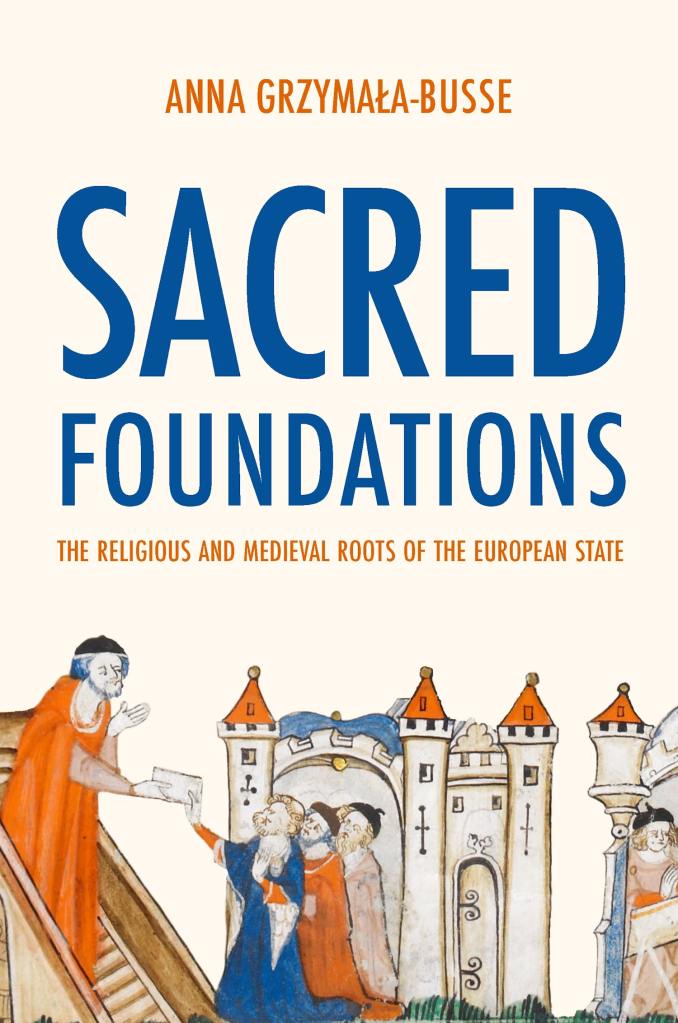
Anna Grzymala-Busse’s recent study Sacred Foundations: The Religious and Medieval Roots of the Modern State (Princeton U Press, 2023) makes a compelling historical and data analysis grounded case for the emergence of the modern state through the process of the Church’s autonomization in its ongoing disputes with the European monarchs across the centuries. This process of the secularization of ecclesiastical forms (conciliarism, legal administration, the uniformity of procedures, rules for governing institutions, the emergence of educational training and mechanisms for political representation and fiscal control, etc), however, is silent about two defining features of the modern secular state. And I do not think it is an exaggeration to say that these two elements bring forth the way in which political authority was established after the victory of modern European Enlightenment. Busse’s book, if anything, has the felicity of putting in perspective, even if only in negative, the two pieces of the puzzle: a) coercion as guarantee by a legal process (not just the monopoly of force); b) and the inter-institutional coordination that we tend to associate with a ‘principle of an internal rule of recognition’ between different spheres of bureaucratic rationality. Busse admits for (a) that “….the authority of the people over the whole Church was not statelike. It depends on moral authority and influence, not on coercive control. Both kings and popes cajoled, convinced, and threatened rather than demanded or extracted force” (Busse, 78). But ruling on morality and influence are two weak presuppositions to guarantee systemic, homogeneous and uniform process required by institutional authority.

In other words, the Church was able to construct forms of civil mediations, although it lacked the power of efficacy; that is, a coherent set of reasons for action that would define a strong concept of sovereign authority as service (to put it in Raz’s well-known formulation). The classical apothegm by which ‘kings rule rule but do not govern’ (Rex regnat sed non gubernat) now is protracted by the exercise of an efficacious rule, which means laying out a combination of forms and a well-ordered power over coercive forms. In fact, this is one feature that will define the legitimacy of the Enlightenment according to historian Franco Venturi; the discovery of punishment understood within the scheme of a trade off between the “necessity of the right to punish when man was not able to re-establish communism” [1]. Hence, the genesis of modern legitimation is not exclusively “a given” vis-a-vis the structure of separation of powers and the ultimate source of the plenitudo potestatis; rather, it requires a second-step rule, as it were, to convalidate the specificity of institutional authority with ample concrete efficacy of police powers in charge of compliance and punishment. The reach and exercise of public police powers and the systematic ordering of penal codes through a criminal procedure and its guarantees (reasonable doubt, fair trial and due process, no crime published without a previous enacted law, nullum crimen sine lege) is what renders effective and “energic” the principle of authority.

Now, broadly speaking, when it comes to (b) Busse admits that (and this is in spite of its institutional schemes) laying down justice “…the church relied on secular enforcement, for example when it came to religious orthodoxy. […] The carrying out of sentences against heretics and apostates lay in secular hands – those found guilty were handed over the temporal authorities so as to not sully the clergy. Legal coevolution and influence, the struggles between popes and monarchs, and the diffusion of both canon law and personnel into the juridical systems were critical to the rise of constitutionalism and the rule of law in Europe” (Busse, 132-133). This asymmetry between two systems of legal jurisdiction confirm the inexistence of a strong internal rule of recognition that for H.L.A. Hart defines any robust modern legal system of public law. The internal rule of recognition, one must remember, is not a set of principles or norms for social action, but rather the internal mediation between a legislative authority and its internal obedience within a concrete application thereof. The internal rule of recognition binds a central authority with its specific formal enforcement in institutional union of primary rules and secondary rules to avoid the pathology of uncertainty. This is thoroughly absent from the free-floating institutional forms of the medieval church whose principal construction of primary rules was divorced from the objective and rational procedures of its internal coherence (the rule of recognition) that would ground, in time and place, the otherwise abstract primary norm and the pressure of contested social conflict.

But going straight to the crux of the matter, it follows that medieval templates as superbly redrawn in Busse’s studies lack the two fundamental determinations that ground the modern concept of law: law as the necessarily monopoly over coercion (the Austin thesis), and the concept of law as the construction of an internal rule of recognition to unite primary and secondary rules (the Hart thesis). But insofar as all major modern political concepts and mediations are secularized forms of religious and medieval forms – something we can say that Busse’s scholarship also confirms – we can then say that modern legitimacy will consist in the congruence of these two determinations to organize the mediations between civil society and state. Already in his early The value of the state and the significance of the individual (1914), Carl Schmitt will note of this formal transplant: “…the Catholic doctrine of the Pope as the infallible interpreter of the natural moral law and of the content of revelation, who receives the competence to declare state statutes that stand in contradiction with the moral law or ius divino-naturale to be non-obligatory in conscience. The exercise of his potestas indirecta which is regarded as an act of jurisdiction, and which is held, by many canonists, to be determinative of a statute’s validity in state law – contains real vis coactiva, even where the expression potestas directiva is employed in place of potestas indirecta (Suárez, de fide cath, 3.22.1)” [2].

For Schmitt, then, the process of rationalization between ecclesiastical form and the modern legal norms of the state is very much straightforward. This is what constitutes the very texture of secular modernity. But as we know, for Schmitt the secularization of forms was not enough – it must be said that he himself did not negate in his theory of adjudication of his constitutional thought – which is why the construction parameters of his ‘political theology’ proposes supplemental safeguards to isolate law and power, extending the power of secularization into the decision of the potentia dei asoluta (at times this was contained in the theological figure of the Katechon) [3]. But as Carlo Galli has noted, Schmitt’s political theology is far from a “political christology” or a substantive theological politics grounded in natural law; rather it is a resolute affirmation to defend any concrete order from the potential fallouts of the secularized cornerstones of rational neutralization (potentia directiva and potestas coactivva) of state authority [4]. Neither mechanic state forms nor a higher source of morality (natural law) would define the modern law; rather the autonomy of the political in the existential situation could provide the sufficient energy to avoid the self-defeating circularity of ius revolutionis (this is what most of the times is obliterated from the so called question of “decisionism”)[5]. If Busse is correct in making the case that all modern institutions have sacred medieval foundations; Schmitt’s concurrence in the wake of modern secularization will be to define the energy of the political as the defining element that must stand as the threshold of formal transplantations to have a chance within nihilism and against nihilism. It is both things. In other words, formlessness is the constitutive dimension of political forms; an element that defines, in my view at least, the strongest practical element of what it is to inherit a Christian political foundation. The process of secularization is thus infinite and groundless, ultimately without a moral foundation and universal design. Among its many achievements, a book like Sacred Foundations: The Religious and Medieval Roots of the Modern State (Princeton U Press, 2023) has the ability to refine what political theology is, what it meant, and what to make of its endurance and possible iterations in our present.

Notas 

1. Franco Venturi. Utopia and Reform in the Enlightenment (Cambridge University Press, 1971), 116.

2. Carl Schmitt. The value of the state and the significance of the individual, in Carl Schmitt’s Early Legal-Theoretical Writings (Cambridge University Press, 2022), eds. Zeitlin & Vinx, 215.

3. See my “Schmitt y Hart: los puntos fijos del concepto de derecho”, 2022: https://infrapoliticalreflections.org/2022/11/07/schmitt-y-hart-los-puntos-fijos-del-concepto-de-derecho-por-gerardo-munoz/ 

4. Carlo Galli. Genealogía de la política : Carl Schmitt y la crisis del pensamiento político moderno (Unipe, 2019), 301. 

5. Jorge Dotti. “Sobre el decisionismo”, en Lo cóncavo y lo convexo (Guillermo Escolar Editor, 2022), 391.

Constitutionalism and sense. Text for “Legal Crisis in Chile” Session, Red May Forum, 2023. by Gerardo Muñoz

It has been said repeatedly – in the best hyperbolic spirit, no doubt – that Chile always stands, regardless of the angle from which we are looking, for what is to come in our epoch. The Chilean laboratory prefigures the coming mutations and solidifies the effective tendencies of public powers. The 2019-2023 political cycle is no different: it began with the experiential revolt at the heart of the metropolitan center, and it culminated with yet another constitutional scene seeking to replace the “constitución tramposa” now at the mercy of those that hold a deep admiration for the post-dictatorship subsidiary state. The newly elected advisors and experts will place the final cap to the momentum of institutional transformation, which welcomes back the official garments of public legality, official languages, and grammars of public security. And even if it is true, as Rodrigo Karmy has argued, that the most recent electoral results confirm the exhaustion of the Chilean post-dictatorship regime, the question posed to us is what capacity can constitutionalism and the constituent scene contribute for any possible transformation. [1]. In other words, can a breakthrough be produced from within the conditions of constitutionalism? As Martin Loughlin has recently demonstrated, our historical epoch is one marked by the irreversible triumph of constitutionalism; a design that differs from the modern constitutional state of representation and legislative legitimacy, envisioning an encompassing “dynamic order of an evolving society rather than an authoritative text, the basic ideals of constitutionalism have been realized” [2]. Constitutionalism emerges in the wake of the end of the liberal presuppositions of modern political theology and everything that it implies for the stability, separation, and judicial control of public powers.

The system of constitutionalism presupposes a total governmental nexus whose legality (discretionary, exceptional, based on the application of general principles / ius) will be treated as “an order of values that evolves as social conditions change” [3]. The passage into an administrative system of legal order presupposes a suture between principles and political necessity, state and civil society, economic rationality and executive planning and oversight. The old paradigm of the modern “dual state”, theorized by Ernst Fraenkel in the 40s have now supplied an internal abdication of positivist jurisprudence and minimalist constitutional framework, paving the way for the total constitutionalization as a flexible art of governance. Although it has been said that the first constitutional drafting of the new Chilean constitution was confusing and overtly ideological (a “magical realist” menu of rights and everything under the sun, one contemporary jurist called it), there is still something to say about the veneer of “social rights” within the epochal system of constitutionalism [4]. It is at times forgotten that the abundance of enumerated social rights implies the infrastructure of constitutionalism to bind legal, political, and social spheres into a regulatory apparatus without fissures. To govern the social means steering over the abstraction of social values. There are good reasons to discharge skepticism against constitutionalism, and they keep coming. Of course, the argument of skepticism, alas, rarely has good press (it fails to provide an insight into totality, Max Horkheimer famously argued), but I do think it is necessary to reclaim skepticism in the wake of the systematization of public constitutional principles [5]. Skepticism demands separation from constitutional absolutism and the legal nexus in which social action interaction finds itself. The skeptical position in the face of constitutionalism at its most minimalist bearing insists in the separation of life from law, of experience from political order, of expression from the order of rhetorical mimesis. The skeptic might not want to negative law as authority; but it wants to refuse the post-authoritarian conflation of life and social rule underpinning political domination.

To be able to see beyond the framework of constitutionalism is the task at hand, especially when the old predicates around the political subject and the social contract make their way back from a position of weakness and desperation (another way of saying that morality returns as nihilism). But one does understand its success: it is a compensatory psychic mechanism for the ongoing existential pain under the abstract orderability of the world. And where there is pain, there is also an accumulation of experience that pokes through the fictive state of things, refusing the objective staging of phenomena. Simply, it refuses to be absorbed by what’s available. At this point it becomes impossible not to recall the October revolt for one particular motive: mainly, that its emergence did not favor social demands nor was it driven by the grammar of a political program. Every experiential uprising has an aesthetic dimension – or even better, pictorial set up, a canvas of everyday life – that we have yet to rediscover. Painting from real life is no easy thing, some painters have told us. And something similar goes for the revolt: an alteration of gestures, inscriptions, graffitis, and corporal tracings, dissonances and masks color the expressive discharge against the pledge of objective realism and the police of languages. Indeed, pictorial skepticism can only emerge when there is an excess to representation; that is, when there is a sensible stubbornness to enter into contact with the unfathomable of the world as such. The world and its others, one should say. This pictorial dislocation of reality dispenses a rhythmic structure of the senses that is neither chaos nor destruction, but an arrangement of a different sort: the communication between souls (from soul to soul, Rimbaud had said) without regulatory mediations through the tokens of recognition and filiation. The rhythmic movements provide a spatial continuation devoid of justifications [6]. This is why pictorial semblance tells us something that language or the science of politics cannot. How can we last together as a community that is not?

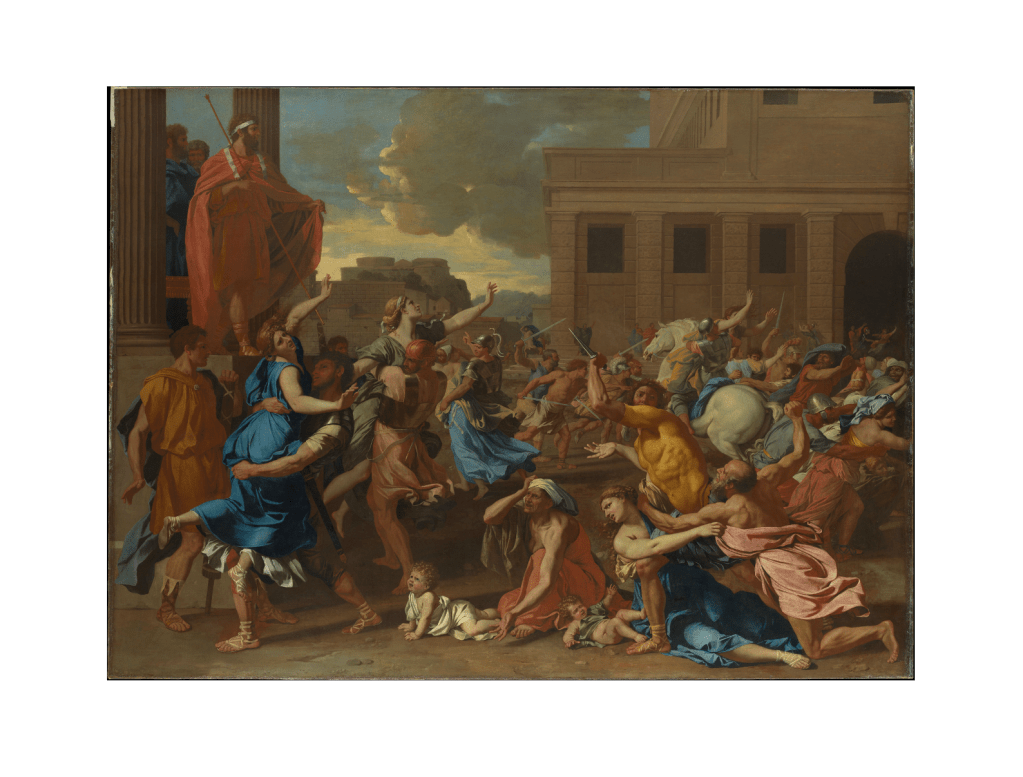
Pictorial dislocation wants to claim distance and separation the non-totalizable while being there. Let us take a painting like Nicolas Poussin’s The Abduction of the Sabine Women (1633-1634): here we have a complex composition ordered around rhythms and modes of figures and distances; the possibilities of communication between forms and the expressivity of the figures hold everything as if in a state of grace. What is striking in the picture is the subtle mounting of activities and gestures without ever falling into the sublimation of the concept. There are no guidelines, and yet we feel that everything communicates. Or to put it in Poussin’s pictorial terminology: “what follows is unlearnable” [7]. I do not think that the painter tried to posit a negative foundation of knowledge for an even higher learning; rather the unlearnable is a practical activity (a gesture, a word, a contact) that is both unique and indispensable; impossible to let itself be arranged into a set of alienated function for a task. Poussin reminds us of the unknowability of rhythms taking place: an uncompressed experience outside the force of systematization. We need thought to incorporate something like this exercise in rhythm.

It does not come as a surprise that a conservative scholar during the first months of the October revolt hypostatized the event as a “gnostic program” claiming that: “Plato’s philosophy offered a simple solution to the gnostic problem: instead of adapting the world to our desire, the task is to adapt the soul of the world…we now know that public order is the our most urgent occupation” [8]. Needless to say, and as Díaz Letelier noted at the time, this was a political Platonism devoid of chōra as a nonsite of our sensible imagination that allows the renewal of the creative experience with the world [9]. There is no ‘common sense’ as the pragmatists of realism assert with conviction; there is only the sensorial passage allowed by the chōra. This is what constitutionalism needs to pacify and incorporate: the battle over the status of the soul at a moment in which material goods and its economic arrangement (and in the Chilean case, its negative subsidiarity principle) becomes insufficient for the psychic production of a rectilinear subject (a masculine subject, Alejandra Castillo would claim) [10]. The postliberal constitutionalism as it stands (and it is postliberal because it cannot longer said to appeal to an internal principle of positive norm nor to a source of ‘Higher Law’, but to the executive command of the principle); a world legal revolution of governmental administration of anomia, amounts to a systematic offensive that exceeds mere material appropriation or personal liquidation. And this is so, because its ultimate mission is the “soul murder” (seleenmord) that currently stands as the basic unit of the ensemble to govern over socialization [11]. Constitutionalism now appears as the last avatar of Americanism. Perhaps there is no higher and modest task at hand than affirming the medium of the chōra that preexists the submission of life into the polis, and which retains, like the pictorial gesture, the unlearnable and the unadaptive. Only this could slowly render another possible sense in the relationship between liberty and law.

.

.

Notes

* This text was in preparation for the conversation panel on the current legal and political cycle in contemporary Chile with Alejandra Castillo, Rodrigo Karmy, and Philip Wohlstetter that took place in May 31, 2023 at the Red May Seattle Forum. The conversation is now archived here.

1. Rodrigo Karmy. “Ademia portaliana: algunos puntos para el “nulo” debate”, La Voz de los que sobran, May 5, 2023: https://lavozdelosquesobran.cl/opinion/ademia-portaliana-algunos-puntos-para-el-nulo-debate/05052023 

2. Martin Loughlin. Against Constitutionalism (Harvard University Press, 2022), 11-12.

3. Ibid., 161.

4. Pablo de Lora. “Constitucionalismo mágico”, The Objective, May 2022: https://theobjective.com/elsubjetivo/opinion/2022-05-07/constitucionalismo-magico/ 

5. Max Horkheimer. “Montaigne and the Function of Skepticism”, in Between Philosophy and Social Science: Selected Early Writings (MIT Press, 1993), 265-313. 

6. Rodrigo Karmy. “The Anarchy of Beginnings: notes on the rhythmicity of revolt”, Ill Will, May 2020: https://illwill.com/the-anarchy-of-beginnings

7. Avigdor Arikha. “On Nicolas Poussin’s Rape of Sabines and Later Work”, in On Depiction (Eris | Benakis Museum, 2019), 112.

8. Manfred Svensson. “Una revolución gnóstica”, The Clinic, November 2019: https://www.theclinic.cl/2019/11/25/columna-de-manfred-svensson-una-revolucion-gnostica/ 

9. Gonzalo Díaz Letelier. “Un platonismo sin khorâ”, Ficcion de la razón, December 2023: ​​https://ficciondelarazon.org/2019/12/04/gonzalo-diaz-letelier-un-platonismo-sin-khora/ 

10. Carlos Frontaura. “Algunas notas sobre el pensamiento de Jaime Guzmán y la subsidiariedad”, in Subsidiariedad en Chile: Justicia y Libertad (Fundación Jaime Guzmán, 2016), 123.

11. Ernst Jünger. The Forest Passage (Telos Press, 2003), 93.

The closure of the eon of the state. On Lo cóncavo y lo convexo: escritos filosóficos-político (2022) by Jorge E. Dotti. by Gerardo Muñoz.

The posthumous volume Lo cóncavo y lo convexo: escritos filosóficos-político (Guillermo Escolar, 2022) of essays by the late political theorist Jorge E. Dotti is a very much needed contribution that opens up a conversation about a theoretical corpus that witnessed the collapse of the modern state and the crisis of its political categories in times of postliberal forms of global domination. Although an astute observer of the key moments in modern Argentine political history (from Peronism to the dictatorship, from the return to democracy to the failure of the democratic socialist party experiment), Dotti’s intellectual stamina remained on the margins of political adventurism, while openly rejecting the organic intellectual political advisor to heads of state. As editor Damian Rosanovich writes in his introduction, Dotti refused to subordinate his political thinking to immedaite ideological projects; a rather unique position to undertake in a national context like the Argentine, historically inclined towards philosophia militants of the national popular type [1]. Complementary to this inclination, Dotti’s political thinking also had little to say (at least in a direct manner) to the Latin-Americanist disputes about state modernization, regionalism as supranational identity, or cultural formation hegemonies that dominated twentieth century discussions in the region.

Dotti’s theoretical ambitions had a more prudential wager: a confrontation against all kinds of abstract universalities, as well as its partner in crime, locational exceptionalism always ready to infuse doctrinal flavor unto nominal situations and practical problems. A modernist political thinker at heart, Dotti was also a keen observer of the the modern state genealogical crisis, which he read in a tripartite scheme that included the classics of modern political thought (Hobbes, Rousseau, Hegel, Kant), modern philosophy of positive law (infomed by his research years in the Italian context), and finally the work of Carl Schmitt on sovereignty, divisionism, the exception, and the difficulty of “revolution” as the esoteric form of political crises. As an heir to this modern tradition, for Dotti modernity is best defined not as predicated on contingency or anthropological reserves, but rather about a certain ethos, historical in nature and spatially grounded (in this way his vision was close to that of JGA Pocock and the Cambridge School, although less emphatic to the centrality of concepts), which claimed that the political thinking of the classics had to their disadvantage the idealization of every practical situational problems encountered in concrete determinations [2]. In this way, Modernity was best defined as a struggle against abstraction and the taming of indirect powers over the configuration of social stability and endurance.

The classics of political thought, while claiming the intrinsic political nature of man and the primacy of organic totality over every principle of differentiation, imposed a nomalist metaphysics that turned its back to discrete and discontinuous situations. For Dotti at the heart of modern politics – very much in line with Hobbes’s critique of Aristotelian critique of the virtuous politics – is rooted in a practice that is attentive to practical reasons for action and the normative foundation of a social order. Hence, the modern ethos was able to favor the primacy of authority (auctoritas non veritas facit legem) as a minimalist non-substantive framework of public law. In other words, prior to doctrinal and categorical arrangement of modern political theories (social contract, constituent power, or individual conscience), authority helped dissolve the anarchy over words and actions proper to the European civil wars. Needless to say, legal positivism had to walk along modern subjectivity (“Quiero, luego existo…”) inadvertently promoting, while neutralizing, the latency of civil war from its inception. As Dotti claims in an essay on Melville too long to be included in this volume: “Quien contrata se concede el derecho de desencadenar la guerra civil” [3]. The concrete situation of the modern ethos, in this sense, is never enough for containment; and its positive arrangements, being insufficient, will ultimately depend on direct police powers. The story of political modernity is that of legality trumpeting legitimacy for optimal reasons of political control. The insufficiency of the modern political order entails that politics and nihilism walked every step of the way too near each other.

This outlook towards political modernity renounces all nostalgia as it is a genealogical critique. This position speaks to Dotti’s systematic dialogue with Carl Schmitt’s juristic thinking regarding the polemic over secularization of the state and its political categories. Like very few political thinkers of modernity, Dotti accepts Schmitt’s lessons without prejudices and against the political black legends (Schmitt as the poisonous enemy of legal positivism, political liberalism, archaic Catholic, or ally of Nazism) that have been incapable to comprehend the German jurist lessons. If according to Raymond Aaron Schmitt was far from thinking like a Nazi, Dotti take this promises to more refined elaborations: the combination of decisionism and institutional rule of law coagulate an compossitum whose main aim is to regulate the internal functions of validity of the every political order [4]. The force of political theology, then, is neither doctrinal nor axiological, but rather attentive to situational stress of instances as to deter the indirect powers and the logistics of immanence [5]. Dotti understands Schmitt’s political theology as a decision that is only possible within a normative system in order to guarantee the authority of the state. The minimalist conception of political-theology stands as the antithesis of immanent factional ends, which, ultimately, reality will venge in the worst possible ways [6]. Adjacent to the modernist ethos against indirect powers, Dotti’s stages the copernican discovery’ of Schmittian thought: the autonomy of the political as the only category capable of defending the sovereignty of the state in an energetic manner without stepping into either a hyperpolitical or an apolitical vectors common to messianic and subjectivist positions. If for Schmitt there were few things more modern than the battle against the political, for Dotti the consecration of global postmodern time opened a crisis of the political and the expansion of the field of immanence which freely drives “por la autopista preferential de la corriente antipolítica” in which all politics is exception and all exceptions are treated as antagonism for the political [7]. The epochal dispensation of total immanence of power means a liquidation of the regulatory conception of the political as well as the formal recognition of enmity within the modern state now vested into the global fabric of Empire.

Dotti’s scene of writing is that of the closure of the eon of the liberal secular state from its very conditions that made possible the development of its genesis. It is in this specific sense that Dotti’s prognosis is similar to that of Ernst W. Böckenförde’s famous theorem: the liberal secular state survives by conditions that it can no longer guarantee [8]. For both Böckenförde and Dotti the epigonal process of secularization meant the end of state authority and the exhaustion of the separation of state legitimacy and the internal legal rules for social action. Dotti, however, introduces a minimal although fundamental nuance to Böckenförde’s theorem: the liberal state collapses not at the apex of the compilation of secularization, but rather at its very origins in the notion of revolution. This is a lesson extracted from Political Theology II: the ius reformandi of the ecclastical powers soon became an unlimited ius revolutionis of subjective domination during the nineteenth century. [9]. It is to this transformation that political theology effectively looks to respond to. In fact Dotti suggests that the category of revolution is the strongest force to be secularized, which entails that what paved the way for the modern liberal state becomes an open ended indirect force against all mediations of legitimate rule. As Dotti writes in his late essay “Incursus teológico político”: “Estado y revolución son inseparables en su complementación y en su simultánea oposición inconciliable. Esta relación es el cogollo mismo de la legitimación de todo orden político moderno: está en el origen y la muerte de la era de la estatalidad.” [10] The immanent force of revolution has no single figure: it is the movement against state sovereignty, the emergence of the total state in the twentieth century, as well the legal interpretation of statutes as idealistic forms (as in the jurisprudence of Robert Alexy) that intensifies a permanent state of exception whose real end is now a power for “definition, differentiation, regulation” as the tripartite form of political struggle. In this framework, the revolutionary spirit against formal mediation and authority can only take the form of an uninterrupted holy war against its enemies without end [11].

To the extent that revolution does not disappear but becomes unmatched immanent power, it becomes possible to understand Dotti’s central theorem in its proper light: “the problem with the revolution is not how to make it, but rather how to bring it to a close” [12]. There are at least two things we can say regarding the theorem: first, political modernity was fundamentally understood as the making of the revolution without any attention to formal mediation and the autonomy of the political; secondly, even the exponents of political liberalism during the second half of the twentieth century did not think of a revolution as closure, but rather they continued to foment an aperture based on a necessary retheologizaiton. It is in this way that John Rawls’ social state depends on a specific conception of original sin for equity; while Ronald Dworkin’s defense of principles and moral interpretative constitutionalism reintroduces a secularized form of the old iusnaturalist model. The socialization of the modern state at the historical instance of its eclipse had to pay the price of abandoning its commitments to both Pelagianism and positive law on behalf of a permanent exceptionality now dressed as the balancing of social equity. It is an irony that the two strongest attempts at the secularization of the concept of the revolution provided, in turn, a restitution of theological hidden subtleties that are ultimately optimal for the transformation of the rule of law into an instrument of world legal revolution. And, it is no coincidence that the closure of the eon of the state meant the end of exclusive legal positivism, while socializing the state police powers as compensatory for the collapse of the modern transcendental authority. The alleged neo-liberal state now subsists as an all encompassing administrative rule that mimics the practice of the confessional state. This could explain why today some jurists continue to understand the practical function of the administrative state as the concrete instance to constitute an uninterrupted iustitium. Dotti’s comprehensive and panoramic view of the modern tradition and its conceptual fulmination leaves open a task for future political thought: how would the closure of revolution might look like? This is no optimist question, as the only honest answer must depart from the farewell of the modern state, while also rejecting the substantive, doctrinal, and militant reallocations of power that steer, but never bring to an end, the violence of a planetary unity devoid of separation or enmity.

.

.

Notes 

1. Jorge Dotti. Lo cóncavo y lo convexo: los escritos filosoficos-polilicos (Guillermo Escolar, 2022)

2. Ibid., 133.

3. Ibid., 28.

4. Ibid., 174.

5. Ibid., 176.

6. Ibid., 26. 

7. Ibid., 79. 

8. Ernst W. Böckenförde. “The Rise of the State as a Process of Secularization”, en Religion, Law, and Democracy: Selected Writings (Oxford U Press, 2022). 167.

9. Carl Schmitt. Political Theology II (Polity, 2008  ), 101. 

10. Ibid., 434.

11. Ibid., 424.

12. Ibid., 421.