
The irreducible in language: a note on Robert Antelme’s L’espèce humaine (1947). by Gerardo Muñoz

At the outset of L’espéce humaine (1947), Robert Antelme discloses the difficulty between language and experience that lays at the heart of the book, and which is never thoroughly assumed at the level of form in the novel. L’espèce humaine (1947) is ultimately not an account about the impossibility of describing what took place in the camps; from the banal physical violence to the desperate hunger, from the microaggressions to the slightest movements and carnage of bodies in space; from the joyful smiles in the most miserable of scenario where the ultimate goal was for the human life to slowly rot; the sequence of actions engage in no struggle to bring to a crisis the level of representation. And Antelme goes into painstaking efforts to give us a full picture of what took place, only to never talk about it again in writing or in personal conversations as Marguerite Duras tells us [1]. So, what to make of Antelme’s initial affirmation in the “Forword” where he states that: “…during the first days after our return, I think we were all prey to a genuine delirium. We wanted at last to speak, to be heard. We were told that by itself our physical appearance was eloquent enough; but we had only just returned, with us brought back our memory of our experience, an experience that was still very much alive and we felt a frantic desire to describe it as such as it had been…[..]. No sooner would we begin to tell our story than we would be checking over it. And then, even to us, what we had to tell would start to seem unimaginable” [2]. The unimaginable for Antelme is a sort of threshold of language; a limit for the unrestricted, that is, for what could allow for an experiment of language after the catastrophe, or in the wake of the civilizational catastrophe that is consummated in the camp. 

This delirium and anxiety over language – to tell it now and how it happened and to tell “the world”, only to immediately acknowledge the impossible task of doing so – does not take place at the order of the narrative; it is first and foremost something that we get a glimpse of at the end of the book as the liberating soldiers enter the rubbled towns only to encounter the incontinence of the survivors “talk and talk, and pretty soon he isn’t listening anymore” [3]. At that moment, the face to face between human beings will follow “to a kind of infinite, untransmittable knowledge”, Antelme tells us [4]. But what type of untransmittable and nocturnal knowledge is Antelme referring to here? It is not about some ethical exigency of the defacement of experience through linguistic construction; it is rather the torrential and densely weight of description and events, that numbs and deposes language in the very mediation of its effective sayability. The experience of human suffering and domination is untransmittable not because there is a deficit in language or the effacement of representation; but, on the contrary, precisely because there an excess of language that flattens irreducible suffering to an anaphoric socialization of speech that tacitly accepts inhumanity at face value. And that socialized distribution of speech underserves suffering, in virtue of equalizing an expansive chatter that neutralizes in survival the inherent pain of the irreducible human species within the imposible ordeal of total annihilation. 

Antelme’s L’espéce humaine  is stubbornly nominalistic in its thick descriptions of things and events, and it wants to avoid metaphoric transports. He prefers to call things as he sees it and get to the thicket of things in the most nauseating of repetitions. In a way, the hellish atmosphere of the concentration camp resides in the slow moving degradation of human life deprived of the world. However, there is one moment where Antelme resorts to calling a situation ‘hell’; that is, precisely, to an account of the transparent use of language, the raw incontinence and commanding force towards exteriority, as if there is no longer a caesura or separation between being and language once enunciation has been homogenized as commanding force. This is a language without a secret or unsaid, moving against the outside of consciousness in the same depretatory form as the same administrative machinery that has lifeless bodies as its target. In this way, language being turned into the force of speech will not only foreclose itself to the world, but it will signal the very intangibility by virtue of the flattening of verbal communication as an immediate and furious call to an annihilation of appearance. Antelme writes in this admirable moment – one of those instances where description of the state of things is incepted by the negation of the very conditions that allow for the narrative order: 

“Degradation, and flabbiness of language. Mouths whence nothing any longer ever came that was ordered, or strong enough to last. A weakly woven cloth fraying to bits. Stencens succeeded one another, contradicted one another, expressed a kind of belched up wrtnessness; a bile of words. They were all jumbled together: the son of a bitch who’d done it, the wife left on her own, food, drink, the old lady’s tear, the fuck in the ass, and so on; the same mouth could say it all, one thing after the other. It came forth all by itself; it would be empty. It only stopped at night. Hell must be like that, a place where everything that’s said, everythat’s expressed, comes forth equalized with everything else, homogenized, like a drunkard’s puke” [5]. 

The incontinence of language at the limit of what can be said is a secondary hell; that is, the last contortion that the inhumanity of the human can offer outwards in order to outlive in a moment of minimal pleasure, since the absolute pain of a glacial existence has been deprived of any real contact with the world and things. It is a linguistic hell – the looping language of the camp, will only mirror also the linguistic codification that around the same years will be elevated to the paradigm of cybernetics and the regime of information theory – will now appear as a unified block of application, enforcement and extraction. Hence, we should take Antelme at his word: language has become “flabby”, and it is a “puke”. It is circulation without sense, as in the looping mechanics of the furnaces charted by the Nazi engineers that appears in the recent sequence of the film Zone of interest (2023). It is not that sayability loses it claim to the autonomy of its form before an event; it is also that by virtue of its own degradation against the erasure of events, it can only be unified, packed, homogenized and rendered into equivalence in the wake of the absolute triumph of the historical project of alienation and external objectivity.  

The passage of the old hymnal texture of language as solace and lamentation could only entail the conservation of communication, which for Theodor Adorno writing during the same years as Antelme (1946-1947) will deduce as the “techniques of insolence enabling each individual to spread around him the glacial atmosphere whose shelter he can thrive” [6]. That the experience of the camp for Antelme ultimately meant that the “executioner can kill a man but cannot change him into something else”, must be placed in tension with the epochal transformation of a hellish experience of language at the service of the nihilistic service of equivalence that unveils its purest semblance at the camp [7]. The unitary reduction between the “socialized Man” and the “deportee” enters into a proper focus that Antelme was able to grasp with uttermost honesty: “…that there is no inherent difference between the “normal” system of man’s exploitation and that of the camps. That the camps are simply a shepherd image of the more or less hidden hell in which most people still live” [8]. At the risk of an overtly mannerist claim, it seems to me that the kernel of Antelme’s intellectual effort is to withdraw from the condition of hell that is condensed in the block of ice fixated in the ruinous material of language [9]. Memory, experience, friendship, truth, writing, the soul – these are all tools to chip against the brute reification of the glacial subjection at the price of ultimate solitude. Is there anything else worth a shot? In the last pages of L’espéce humaine, Antelme returns to the question of “freedom”, only to claim that “to be free” implies to “say no to everything” – and could we also refuse the language as it declines into flabbiness, equivalence, and its putrid decline, as overflowing mountain of trash that covers up the ongoing pain of the human species? [10].  

Sure thing, the hölderlinean enduring and difficult task of the “free use of one’s own” appears here with some urgency as the requirement of traversing the attunement to pain. Antelme seems to have wanted to offer a negative theology to “forever starting anew”, in which the irreducible of human sayability is posited as the condition of the “only transcendence between beings” [11]. “To speak, in a word, is to seek the source of meaning in the prefix that the words exile, exodus, existence, exteriority, and estrangement are committed to unfolding in various modes of experience;  a prefix that for us designates distance and separation” [12]. Aren’t distance and separation two conditional criteria for grounding the irreducible? The habitation of the speaking being can harbor the contours of the unfathomable expression on the reverse of social tribulations, which is always the primal nomos of equivalence. Allowing the expansion of the irreducible as a the site of an ordinary accumulation of freedom preserves a sensible region for what takes place (“whatever happens”and is not this taking place the opening of the non-site of the chorá?) in a language attuned to the relentless event that has forever touched us. This is already the site of the unimaginable beyond and away from the language of survival that permeates everything in both times of peace and of war. 

Notes 

1. Marguerite Duras. El dolor (Alianza editorial, 2019 ), 71.

2. Robert Antelme. The Human Race (The Malboro Press, 1998), 3.

3. Ibid., 289.

4.Ibid., 290.

5.  Ibid., 135. 

6.  Theodor Adorno. Minima Moralia: Reflections from the damaged life (Verso, 2020), 33

7. Robert Antelme. The Human Race (The Malboro Press, 1998), 220.

8. Robert Antelme. “Poor Man – Proletarian – Deportee”, in On Robert Antelme’s The Human Race Essays and Commentary (The Marlboro Press, 2003), 22. Dionys Mascolo makes more or less the same claim in Autour d’un effort de mémoire: sur une lettre de Robert Antelme (1987) when speaking about the stratification of species in the camps and the division of classes in society: “l’intuition aveuglante de tous les survivants est celle d’avoir fait quant à eux, sous une forme extrême, cette expérience: que l’organisation de la société en classes telle que nous la vivons est déjà une image de la division de cette société en espèces, comme dans les camps”, 87.

9. Robert Antelme. “Revenge?”, in On Robert Antelme’s The Human Race Essays and Commentary (The Marlboro Press, 2003), 15.

10.  Robert Antelme. The Human Race (The Malboro Press, 1998), 291..

11. Robert Antelme. “The Smiling Angel: Rheims Cathedral”, in On Robert Antelme’s The Human Race Essays and Commentary (The Marlboro Press, 2003), 10. 

12. Maurice Blanchot. “The Indestructible”, in The Infinite Conversation (University of Minnesota Press, 1992). 
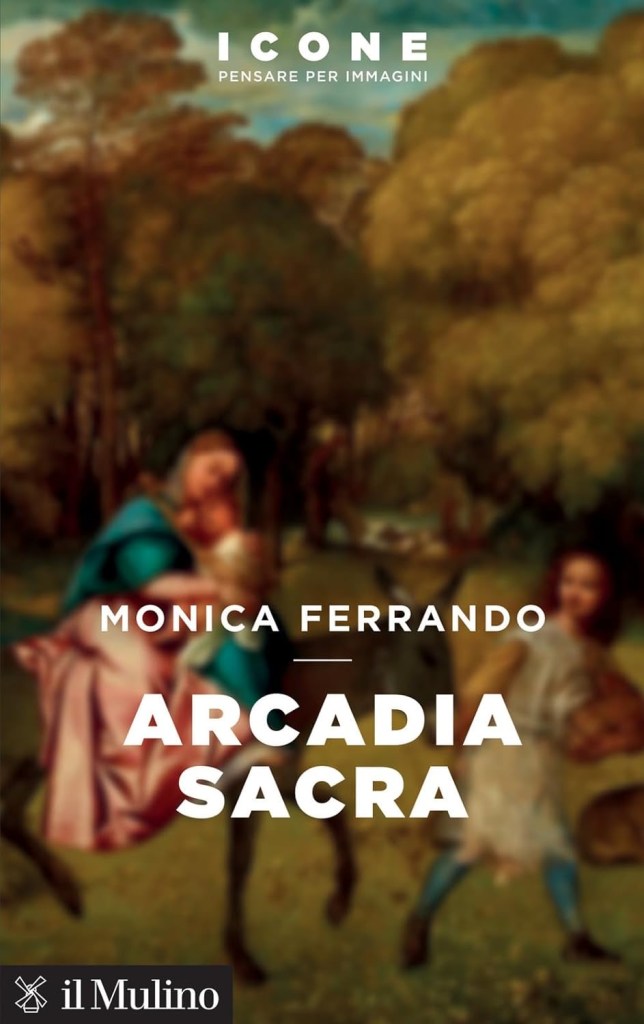
Living among the gods. On Monica Ferrando’s Arcadia Sacra (2024). by Gerardo Muñoz

For anyone familiar with the delicate thought of Monica Ferrando, the short book just published, Arcadia Sacra (Il Molino, 2024), makes it impossible not to read it in light of her the two previous works, the ambitious Il regno errante (Neri Pozza, 2018) that reconstructs the political paradigm of the nomos of Arcadia, and L’elezione e la sua ombra: Il cantico tradito (2022), which brought to light the corrupted meaning of a theopoetic understanding of “election” and its appropriation by an effective economic theology apparatus that governs over the destiny of the modern edifice. Arcadia Sacra continues Ferrando’s highly original reconstruction of the unforgettable myth of Arcadia within the obscure setting of secular  modernization in which painting itself has come into crisis to the point of utter obsolescence. We might be the first epoch in the history of humanity (or even prehistoric, since painting goes back to the non-original origin of the caves, as Ferrando has argued) in which painting itself is lacking and almost non-existent [1]. And although Ferrando does not allude to the present directly, it goes without saying that by choosing as her focal point Titian’s early picture “The Flight into Egypt” (1508), the vision deployed in the essay can only speak to us as urgently, where the thematics confronted by the Renaissance of Venetian painting returns to our present in a fractured flash: imperial conflagration, unlimited deployment of force, usurpation of territory and  multiplication of legal checkpoints, and the accelerated disconnection between architecture and nature, color the ongoing devastation of the vantage point of the landscape now eclipsed by the radiant artificial confinements of the contemporary metropolitan designs.  

Already during his postwar years in the United States, Theodor Adorno observed how the unbounded sadness of the American landscape has nothing to do with an inhuman romantic sublime; it was rather that the landscape feels as if it bears no traces of the human hand [2]. If Americanism configures the long lasting night of planetary nihilism; this is so, not only due to capitalist subsumption and production of human life, but fundamentally because of the inherent obliviousness of the  landscape that forecloses dwelling in the world. But the myth of Arcadia, as Ferrando will insists, is no utopia nor crafted rhetoric (the bucolic genre as an aesthetic compensation to the normative grid of the social bond); it is also the question about the earthly ground of existence, and the necessary attunement with the things that have been domesticated into order of the metaphysics of idolatry and objectivity (Ferrando 28). In this sense, Arcadia does not name another world to come; it is a world that has been registered many times, reappearing whenever the hand reaches out in proximity as if caressing the landscape’s skin.

The mytho-poetical deployment of Arcadia returns amidst a world in conflagration, and for Ferrando this has fundamental political implications insofar as it shows a way out from the grammar at the service of force and political dominion of commanders and soldiers – which is always already exercised as legitimate to coerce and to become a tool for the regulation of abstract mediations – into the voice of poets, painters, and shepherds (Ferrando 51). Arcadia reveals that the human species is a ductile animal that can sense by the ability to touch and use. This is why Arcadia stands as a third space outside the political dichotomy of empire and republicanism, between the struggle of usurpation and conquest, and the techno-political administration of common goods of social distribution and institutional delegation. The abstract humanism of the Renaissance, as Heidegger once claimed alluding to Machiavelli’s political thought, is also the commencement of a specific political technology rooted in certainty and justification that can only conceive representation as the ground for the production of an “effective truth” [3]. The virtuous homini militari of the Italian city states anticipate the neutralization of force as legitimate rule that will prepare the stage of modern political realism based on fear and normative rule of law. The final efficacy of force is to transform the sense of the world into a mere object, as Weil clearly understood it in her essay on Homer’s Iliad. One of the key insights of Ferrando’s Arcadia Sacra (2024) is that it shows that, parallel to the revolution in political technologies taking place in Renaissance Humanism, the image of Arcadia was being rediscovered in treatises and paintings in order to remain faithful to a different attunement of the nomoi, in which the philosophy of history of sacrifice, endless civil wars, and destruction of the Earth do not constitute true destiny (Ferrando 14). In an exoteric way – and it is so, because the craft of the painter is, precisely, depiction and figuration of the nakedness of what appears before our vision-  painters like Titian, Veronese, and Bellini, became witnesses to the acquiescence of the nomos mousikos, which far from soliciting the conceptual density of a theory of Justice; it registered the preeminent condition of poetizing nature of  living in the vanishing world. Indeed, it was in the musical nomos where the soul could establish the communication between exteriority and interiority within the gleaming order of things. 

If Heidegger in The Origin of the Work of Art suggests that the erection of work occupies the open space of this clearing; Ferrando will thematize how Boccaccio’s understanding of the Earth as radiantly divine was drawing upon the tradition of Arcadia will emerge as the pictorial space of the artists to disclose the vibrant sense of a necessary freedom (Ferrando 43). This means that living among the gods is not reducible to panentheism, if understood as oppositional to monotheism; rather, it was the opening to the event that gathered forms of life,  creations,  affections, and territories. In other words, there will always be gods whenever the world is not enclosed into the homogenous surface of a unified planetarity. And is not painting the quasi-originary activity of human anthropogenesis (the event of being in the world as such) the  sensible evidence that negates any conceptual and political translation directed towards action and justification? After all, painting is, among other things, the business of depicting mute things, as Nicolas Poussin famously claimed. 

But muteness must be qualified and expanded, since Arcadia is no asylum or final refuge of man. Titian’s “The Flight into Egypt” depicts a rite of passage, but also opens to a set of rhythmic connected activities that lead to the landscape. Thus, as Monica Ferrando reminds us, building from her previous Il regno errante, Arcadia is also the material experimentation of acoustic energy; music, or the the nomos mousikos, no longer guided by the command of political service, directed by attunement of the lyre and the syrinx, will speak the unwritten language of the human soul. Painting and music convergence at the nonsite of permanent formlessness. And it is rhythmic music allowing improvisation and experimentation that reimagines a different conception of the polis; a transfiguration of political life, in which the principle of civility in all of its complexity (citizenship, objective transference and negation, civilizational fortitude) will no longer articulate the principal axis of the human commonwealth. Neither a source of higher natural law nor a mere expansion of positive norms, the nomos of Arcadia for Ferrando entails: “inalterabile a unire intimamente musica e legge, entrambe  ágrapha, non scritte, se non nel cuore. L’interdipendenza tra modi della musica e nomoi della città, che sarebbe vano interpretare secondo un rapporto causale, trova nella stessa parola nomos un compendio inesauribile, ribadito nella Politeia: «Non si introducono mai cambiamenti nei modi della musica senza che se ne introducano nei più importanti nomoi della polis” (Ferrando 54). The separation of law from music – as Ferrando will say for poetry and philosophy in later pages – will ultimately lead to the moral struggle towards the rise of the fictitious (and whoever can impose it through their effective hegemony) against the emergence of the “love of thought” (l’amore del pensiero) (Ferrando 57). In this sense, the moralization of justice and its conversion into a specific historical grammar (lex scripta in the juridical apparatus) will ground the order of the polis in which the human will be absolutely sacred so that the sacred nearness between existence and the world – the atopia where the promise of happiness can take place – will vanish forever. As Carlo Levi saw clearly during the postwar years, the rise of the political administration of fear will coincide with the decline of painting as the source of being in liberty within the senses [4]. And, in our days, the historical termination of secularization can only be felt like an unending glacial interregnum (it is no surprise that Disney’s epochal blockbuster is precisely a defense of alienation of a cold being in a Frozen castle) in which the prehistoric reminiscence of the garden can only appear as an afterthought or mere representation, always out of reach, and viciously grazed by wild beasts before our own eyes.  

But seeing is already an exercise in prefiguration of a world that returns where painting stands as the medium for a mediation between the formlessness and the soul. This is why, above all, pictorial space is a privileged surface from which to flee our condition of unworldly inmates of our times. In a certain way, painting does not just bring to bear truth against the regime of calamitous fictions; it is also bears witness, as Ferrando states towards a high moment of Arcadia Sacra (2024), to the rediscovery of a new mental space that revives the attunement to a state of the world no longer reduced to the depredatory practices of civilizational extraction and consented servitude (Ferrando 77). The tradition of painting is not just a collection of forms and artistic conventions, but the ongoing concert that facilitates our movement (and being moved) towards happiness.

This is the promise of the itinerant Mary’s passive and inclined face in Titian’s early masterpiece. It does not come to surprise that for Ferrando, the mother dwells among the gods of peace, in contrast to the figures of the commander or the inquisitorial or priestly judge that monitor an endless narrative of intra-species civil war (Ferrando 63). It should not go without saying that at the same time that some contemporary scholars in the face of a historical crisis of legitimation attempt to revive the aura of the homini militari, the precepts of the ragion di stato and the technical virtues of the charismatic Prince; it has been the work of Monica Ferrando, in fully in display in Arcadia Sacra (2024), that invites us to turn to the counters of eros of painting that, almost stubbornly, transmit to us the infinite possibilities of life among the green blades of grass in Pan’s spiritual land (Ferrando 82) [5]. The sacredness of Arcadia resides in this unbounded exteriority that thanks to the mystery of the mother, is always commencing; and, having achieved happiness, it wants to know nothing about bring the world to conclusion. Beneath the arcana imperii (Rome) and the bylaws of the polis (Athens), the landscape of Arcadia remains a harmonious passage of our cohabitation.   

Notes 

1. Monica Ferrando. “Editoriale”, De pictura 3, 2020: https://www.quodlibet.it/rivista/9788822011643 

2. Theodor W. Adorno. Minima Moralia: Reflections on a Damaged Life (Verso, 2005), 73.

3. Martin Heidegger. Acerca de Ernst Jünger (El Hilo de Ariadna, 2013), 113.

4. Carlo Levi. “Paura della pittura” (1942).

5. I am thinking here of the works of several American  historians of political thought and  legal scholars in recent years that have mobilized efforts to restore a “neoclassical”, Renaissance centered political tradition, as a response to the crisis of modern liberalism. The most prominent list includes, although it is not limited to James Hankins’ Virtue Politics: Soulcraft and Statecraft in Renaissance Italy (Harvard U Press, 2020), Harvey Mansfield’s Machiavelli’s Effectual Truth (Cambridge U Press, 2023), and Adrian Vermuele’s endorsement of Renaissance imperial categories such as Ragion di stato, Lex Regia and the tradition of the Mirror of Princes, see his “Sacramental Liberalism and Region di Stato” (2019) and “The Many and the Few: On the American Lex Regia” (2023). The pastiche of this neoclassical investment made possible by rhetorical and hermeneutical deployments of instrumentalized myth, it is something that I have taken note of in “¿Revival de la tradición legal clásica?” (2022). Drawing a parallel to this classical absorption in American political thought, one could say that this is a reiteration of what Monica Ferrando herself has analyzed in her chapter on German Romantic Neoclassicism and the Winckelmann aesthetic project in her L’elezione e la sua ombra. Il cantico tradito (Neri Pozza, 2022), except now that it lacks aesthetic meditations (there is no Dichter als Führer), thus culminating in the direct exercise of applied executive force.