Karl Barth’s suum cuique. by Gerardo Muñoz

In his chapter on the radical theology of abundance and ethics of Karl Barth, Mårten Björk discloses a central concept to the reformist theologian: the suum cuique, a term that prima facie could be rendered in natural law definition of legal justice, inherited from Roman lawyer Ulpian, as “may all get their due”. In the thomist tradition the legal notion of epikeia promptly became equity as the moral supervision of law’s principle (ius) understood as the application of the fair and the objective good. The justification of the balancing of aequum became a regulatory mediation on the grounds of a fictive principle of nature as moral reasoning, which has been well documented by Stephen Humphreys [1]. What makes Barth’s drawing on the notion of suum cuique in his interwar pamphlet Church and State (originally entitled Justification and Law, 1938), on the contrary, is precisely that it is not reducible to equity, but rather as Björk explains it: “the limit to our life, a limit brought forth by death itself, is in the end the vast chams that posits the creature as create of God…and this has ethical and political consequences” [2]. This is telling, and my aim here is to supplement the discussion in “Abundance and Scarcity” by showing its radical asymmetry with the reasonableness of the natural law. Barth’s anti-activist Church (although not neutral in the wake of the total state of the 30s) and apathy towards morality, stands as a sui generis bearing.

First, in the moral natural law tradition of equity (epikeia) “giving each one their due” becomes a strict legal-authoritative command principle on the reasonableness of nature centered on the ontology of the person. It is quite the opposite for Barth who does not favor a constant moral adjudication, since the separation between Church and State presupposes a previous divine justification that belongs exclusively to the Church, but not to the state. In fact, law practiced on the condition of natural principles will undermine the authority of the liberal positivist state, which Barth defends vehemently, making the case for its coherence with the teachings of the New Testament: “The democratic conception of the state is justifiable expansion of the of the New Testament…Christians must not only endure the earthly state but they must will it as a just state, not as a “Pilate” state” [3]. It is not surprising, then, that Barth wrote this tract openly defending the authority of the modern positivist state, contrasting it to the anti-statist unjust pretarian judgement of the trial of Jesus. This makes sense given that the pretorian ius honorarium could be understood, at least in part, as belonging to the tradition of the moral balancing of equity between morality and norms (just as the two irreducible kingdoms) [4]. Barth’s defense of the positivist state is even contrasted to natural law, which for Barth is incommensurable with the word of God: “We cannot measure what law is [in the State] by any idea of natural law…” [5].

Accepting the primacy of the equity of a substantive bonum will not only serve to override the authority of the state, but also, and more importantly, to flatten out theology’s monopoly over divine justification. At this point Barth is quite explicitly in saying that this is what took place – and I think he is correct, specially if we take into account that the degenerate legality in Nazi Germany and Stalinist Russia was not an abuse of positivism, but a consequence of the open-ended common and natural law principles to the point of distortion – in the wake of fascism and Bolshevism in the interwar years of Europe. Barth writes with this in mind against artificial heavens on earth, as part of a hyperbolic “politicizing from above”:

“Fascism and Bolshevism alike will be dethroned and the true order of human affairs will arise. Not as heaven (not even a miniature heaven) on earth! No, this “true order” will be able to arise only upon this earth and within the present age, but this will take the place really and truly, already upon this earth, and this present age, in this world of sin and sinners…this is what the Church has to offer to the state…” [6]. 

The political domination of the total state amounted to a conflation between the lapsarian condition of man and the theology of eternal life. The passage or mediation between the two dimensions, which he also described as a “tailor made garment” was the suum cuique, understood as a limit to life and death beyond morality and biological reductions. Barth insisted on the principle of separation in face of every temptation of technico-rational closures. Thus, by externalizing divine justification to the sphere of theological eternity, Barth’s conception of “giving one’s due” was radically disambiguated from the Nazi motto “Jedem das Seine” (to each his own) in the concentration camp of Buchenwald in 1937, made possible by the opened force of common law adjudication against the state positivist authority (understood by Nazi legal scholars as “too Jewish”). This was the barbaric dereliction of duty of the state becoming what Barth called a “clerical state” [7]. Barth’s ethical limit on finite and eternal life, so well reconstructed in Björk’s brilliant monograph, can only be a witness to a ‘world passeth away’ to which no priestly jurists have the last word unless catastrophic consequences are expected. The ethical response to the lapsarian condition was a radical drift from the dangers of natural absolute rationalism that was directly implicated in the arousal of immanent powers and the reduction of the population as mere administration of doctrine of last things through consciousness and not grace. The suum cuique introduced a radical exteriority in which all men became “strangers” (to the Church, national identity, the community, to the social) whose proper involvement pertained to the eternal mystery of life and death.

.

.

Notes 

1. Stephen Humphreys. “Equity before ‘Equity’”, Modern Law Review, 2022, 1-37.

2. Mårten Björk. The politics of immortality in Rosenzweig, Barth, and Goldberg: Theology and Resistance Between 1914-1945 (Bloomsbury, 2022), 115.

3. Karl Barth. “Church and State”, in Community, State, and Church (Anchor Books, 1960), 146.

4. Gerardo Muñoz. “El pretor romano y el ius honorarium”, Infrapolitical Reflections, 2022: https://infrapoliticalreflections.org/2022/04/24/el-pretor-romano-y-el-ius-honorarium-por-gerardo-munoz/ 

5. Ibid., 147.

6. Ibid., 148.

7. Ibid., 132.

The enemy from the argument of purity. by Gerardo Muñoz

A rebuttal against the notion of enemy frequently hinges on conflating the enemy with total enmity. It usually takes the form of a hypothetical: once an enemy is declared as such, is there anything that can deter the escalation into total enmity? The historical record provides analytical reassurance to the hypothetical, but it does not eliminate its generality, since its ultimate probe is conditioned by an ideal of conceptual purity. Not every hypothetical is idealistic, but every hypothetical exerted from purity is. This concerns any understanding of politics, given that the notion of the enemy presupposes an impure origin of conflict, threats, disorder, or unjustified propensity towards evil. If the enemy is best understood as an operative principle between repression and totalization of enmity, it also entails a rejection of purity as sacralization of the political.

The argument from purity has been deployed with equal force by both Liberalism and Marxism, although they are not the only two contenders. Whereas the first suppresses the enemy from civility and economic utility; for the second, there are no necessary enemies given that politics is a process that will culminate in moral emancipation. For both Liberalism and Marxism, the problem of separation is fixed in two opposite poles: for Liberalism the separation is originary and consubstantial to the genesis of modernity as the separation of Church and State; for Marxism, the separation comes to end in the future collapse of the alienation of ideal and manual labor, and state and civil society. The argument from purity liquidates the enemy as the operative function because it doesn’t consider conflict intra muros on its merits. It is always surpassed or to come.

From the argument of impurity, the notion of the enemy demands that the political be understood as here and now (more than temporal it is topological: externality). Let us consider Shakespeare’s Hamlet. It is a tragedy that stages the friction between the suppression of the political enemy in medieval society and the not-yet autonomy of the political of the moderns. In an old essay Leo Lowenstein noted that Hamlet is an existential limbo as to whether to judge and execute his father’s murderer, or to desist in his decision of revenge and become paranoid crossing the line into madness [1]. The world of Hamlet’s indecision is no longer that of imperium theologiae where the enemy is an entity to be deposed of; but rather it vacillates because it knows the fracture between wrongdoing and action, legality and legitimacy. The malaise of Hamlet condition is the impossibility of enemy mediation: “Shakespeare’s theatre, in general, and his Hamlet, in particular, are no longer ecclesiastical, in the medieval sense. On the other hand, they are not yet a political state theatre, in the concrete sense state and politics acquired on the Continent as a result of the development of state sovereignty.” [2]. The intrusion of historical time reminds us that original separation will not be enough in the face of a concrete conflict.

The tragic dimension in Hamlet is given negatively: the paralysis of not being able to establish the proper mediation to deal with political enmity. This paralysis – or the inconceivable regicide of naturalist theologians – can only amount to madness. Indeed, one becomes one’s enemy, because the enemy (the usurper King) lacks the mediation with its exteriority: “Hamlet is of the faction that is wronged / His madness is poor Hamlet’s enemy…That I have shot my arrow o’er the house / And hurt my brother” [3]. What does it mean to be one’s own enemy, and who could decide here? The incapability of generating an external hostis will prompt bad consciousness and perpetual resentment.

From the side of impurity, the enemy as “one’s own form” means a depersonalization of the political and the neutralization of the stasiological force that places reasons, justifications, and actions as primary ends. But a civil war waged on internal reasons do not imply mediation. From the argument of purity the dismissal of the enemy is no longer Hamlet’s negativity; it turns itself into subjectivism and unfettered self-autonomy that will require not the judge but the priest, and not political form but the police.

.

.

Notes 

1. Leo Lowenstein. “Terror’s Atomization of Man”, Commentary, 1946, 7.

2. Carl Schmitt. Hamlet or Hecuba: The Intrusion of the Time into the Play (Telos Press, 2009), 51.

3. William Shakespeare. The Tragedy of Hamlet (Signet Classics, 1987), 168. 

Homo Lupus Felix: Against Civilization. Notes for a presentation in the Eckhardt S. Program, Lehigh University. by Gerardo Muñoz

There is no question that Alice Rohrwacher’s Lazzaro felice (2018) is a marvelous cinematic work insofar as it measures up against the epoch by radically questioning the principles that have upheld what we know as civilization. This slight adjustment is critical given that ideology, political economy, or subject oriented frameworks of analysis have become insufficient to deal with the crisis of civilization. As a matter of fact, they have become functional (mere deployments of technique, to put it in Willy Thayer’s vocabulary) to the infrastructure, and its specific philosophy of History that promotes the maintenance of Order after the liquidation of its legitimacy. I would like to clarify that I am understanding civilization in a twofold register: as a genetic process of human anthropology based on the matrix of “appropriation, distribution, and production” of the world (a techno-political grid popularized by Carl Schmitt); but also as the total realization of an economic or political theology, which we can directly link to the function of “credit” (and the process of abstract dialectic between credit and debt, as a ground of a new “faith”) that is deployed as the medium of the total sum of social relations that commands beings in the world. Civilization is the general matrix of a process of optimal rationalization of the events that take place in the world, making us potential reactionary agents of the time of its phenomenality.

Aside from all the Christian and religious imaginary, Lazzaro felice is a theological film, but only insofar as it takes the irruption of the mythical remnant very seriously. There is something to be said here – and I think the film stresses this in several parts of the story – between religion and theology, dogma and the spiritual (anima), and the sacred and the commandment solicited by faith (pistis). In other words, Lazzaro felice enacts a destruction of a political theology by insisting on the civilizatory decline towards reproduction of as mere life of survival; a life that is delegated to the abstract faith of credit. In this sense, it is no mistake that Lazzaro’s homicide takes place in a bank and executed by the community of believers (capital, in the end, has already been incarnated; it is the Subject). The laboratory where this takes place is the metropolis, which as I have argued elsewhere is the site of devastation and optimization life in our epoch, which unifies world and life putting distance into crisis, in a suspense of the experiential [1]. The consumption of the new political theology of unreserved equivalence between humans and objects is what Rohrwacher interrupts through the fable of the beatitude of Lazzaro as a life to come in the threshold of the highest phase of the metropolitan stagnation. I will limit my commentary here to three nodes that allow the Lazzaro felice to expand this critique of civilization and the principle of the “civil society”, a notion that we will return to.

First, there is the fable, a capsule of an ancient gnostic wisdom. The fable is what can radically alter evil by tipping its objective realism into a real of the imagination against the grammar of order. Avoiding the order of narration based to account for the history of progress and developmentalism from the rural to the civilization of the metropolis, Rohrwacher’s strategy resorts to the ancient craft of the fable. This is fundamental for a number of reasons. First of all, because the fable allows to withdrawal from pure counter-narrative of historical development and its justifications that allow for the interruption of the time of development, while offering a possibility of an otherwise transformation of the world. This is the gnostic texture of the fable that Hans Blumenberg identified in this form, since obscuring of the distinction between humans and animals relaxes the burden of proof of the absolutism of reality as predicated in the matter of facts [2]. It through fables that something escapes, because there is always an image that escapes the narration of the events of this world. But the fable also offered something else: the beginning of myth as the site of legitimation for foundations of social relations. This is why, as T.J. Clark has reminded recently, Hegel associated the fable with the origin of master and slave dialectic, as a new form of domination of world once the world’s enchantment and mystery was dissolved: “In the slave, prose begins” [3].

The end of a paractical poetics? Perhaps. This means that the price to be paid to enter into the prose of “civilization” is to assimilate the unfathomable and invisible contours of the world into the polemos of storytelling; to be a subject of a story, and as a result, of historical transition. This is what civilization mobilizes through the fable as its posited legitimacy. It is in the fable where the abyss that separates us from the world becomes animated, ordered, and narrated in order for the apparatus of production to commence. It seems to me that Alice Rohrwacher goes to arcanum of civilization when she treats the fable of the wolf, which has functioned to legitimize the passage from the state of nature to the modern concept of the civil in Hobbes’s theory of the state. We should remember the brief fable in Lazzaro felice:

“Let me tell you the story of the wolf. A very old wolf had become decrepit, he could hunt wild animals anymore. So, he was excluded from the pack…and the old wolf went to houses, to steal animals, checks and sheep. He was hungry. The villagers tried to kill him in every way possible, but they didn’t succeed…as if he were invisible.”

It is a remarkable fable that inverts the political fiction of the wolf in Hobbes; mainly: a man is an arrant wolf to another man (homo homini lupus), which justifies the exodus from the state of nature as the “miserable condition of civil war” between men. The stakes are clear: by repressing civil war (stasis), civil society emerges as a divided but unified body under a sovereign principle of authority [2]. The wolf is first established as creature of fear and depredation in order to allow for the principle of civilization to emergence as uncontested and necessary. The fable of the wolf is the protofigure that guards the history of perimeters of civilization as a way to pacify and repress the latency of civil war. Rohrwacher, against the Hobbes political fable, gives us a fable of the wolf that not only is uncapable of waging life as war, but that it enacts full refusal and desertion to be hunted; that is, to be invisible, which ultimately entails a life not outside of a politics of hunting and the secondary pacification by which the end of hunting mutates to the enclosure of domestication [4]. 

If the wolf stands for the invisible it is because it occupies the excess of total legibility of a new civil order, that is, of a world administered by technique of order. The wolf is a prefiguration of the invisible that is improper to every life (and thus to all biopolitical domestication proper to civilization) in the passage from the organic community of the living to the civilizatory topos of the metropolis. The wolf condenses the instructive character in every life; that is, what cannot be reduced to the fiction or the depredatory total war of the civilization nor the fiction of the community lacking an open relation to the world.  This fable, then, is not just what unveils the fictional grounds of the legitimacy of civilization (its “black magic” under the light of rationality and control) but also what reprepares another community. A community in which what we have in common is not an attribute, a substance, or an identity, but an irreducible ethical relation in which civil war cannot equate total hostility and what establishes an absolute difference between life and the “principle of the civil” that formalized the aspiration of isonomic equality:

“The immemorial bad reputation of the wolf (wolf bashing) informs us about one of the oldest tricks of civilization. This consists of bearing the weight of predation on what is heterogeneous to it. To be able to say that man is a wolf of man, the wolf must first have been disguised as a “predator.” We do not mean that the wolf is gardener of daisy flowers, we mean that he behaves neither as a tyrant nor as a bloodthirsty animal, and even less as an individualist (the famous “lone wolf”). In fact, the wolf may have taught communism to humans. The cub that opens its eyes among humans recognizes them as part of its clan. Two lessons: 1) friendship ignores categories; 2) the common is the place where we open our eyes to the world. What the human, for his part, has “taught” to the wolf – like an angry father yelling at his son “I’ll teach you!” – is the servility of the good puppy and the good cop”. [5]. 

               The end of the film comes full circle with the only condition of finding a way out, producing a break in the infrastructure of the domestication, opening a path within and against the metropolis. It is almost as if the film, like in life, was a preparation for the moment of exodus and retreat. In fact, the wolf deserts the metropolis passing through and beyond the highway in plain rush hour. According to Alice Rohrwacher, the wolf leaving the city and not being seen was a reinforcement of the invisible ethical dimension that is proper to every life (an ethos, which in the old Pindaric sense that refers not only our character, but also, and more fundamentally to our abode and habits that are world-forming), and that is devastated by the anthropological crisis of the species in the wake of the process of civilization [6]. However, the wolf exit from the metropolis is not an abandonment of the world in the manner of a monastic communitarian retreat; but rather the pursuit of liberating an encounter with the events of the world foreclosed by topological circulation of credit that amounts to borrowed life without destiny. 

Now to the question that signals an instance of construens in what follows the desertion: what about happiness? It is here, it seems to me, where the beatitude of Lazzaro could be thought as an ethical form of life – as preparation to learn to how live a life against the abstract processes of domestication – that exceeds the two hegemonic paradigms of happiness offered by Western civilization: on the one hand, happiness understood as an equilibrium operative to virtue (aretē); or, on the other, the community of salvation as a compensatory effect for the structural gap of the fallen subject, original sin (felix culpa). One could clearly see that politics at the level of civilization could now be defined as the instrument that manages the production of happiness as a temporal exception in life, but never a defining form of our character.

The wolf that is Lazzaro’s form of life – at a posthistorical threshold that dissolves the anthropological divide man and animal – offers us a third possibility: happiness understood as the refusal to partake in the promises of civilization in order to attune oneself to an errancy of life that allows itself to be hunted by an experiential imbuing of the world. Happy Lazzaro? Yes, but never a Sisyphus who is incapable of experiencing the vanishing horizon between earth and sky in infinite divisibility of the world. The wolf unleashed traverses a geography against domestication, revoking the phantasy of home (the oikos). I will let the last words be made by some fellow-travelers contemporary American thinkers: “Civilisation, or more precisely civil society, with all its transformative hostility was mobilized in the service of extinction, of disappearance. Fuck a home in this world, if you think you have one.” [7].

=

Notes

1. Gerardo Muñoz. “Dix thèses sur Lazzaro felice” en tant que forme de vie”, Lundi Matin, May 2019: https://lundi.am/Dix-theses-sur-Lazzaro-felice-en-tant-que-forme-de-vie

2. Hans Blumenberg. “Of Nonunderstanding: Glosses on Three Fables” (1984), in History, Metaphors, Fables (Cornell University Press, 2020), 562-566.

3. T. J. Clark. “Masters and Fools”, LRB, vol.43, No.18, September 2021. 

4. Thomas Hobbes. Man and Citizen (De Homine and De Cive) (Hackett, 1991), 11.

5. “Éléments de descivilisation” (part 2), Lundi Matin, april 2019:  https://lundi.am/Elements-de-decivilisation-Partie-2

6. Jerónimo Aterhortúa Arteaga. “Creer en las imágenes: entrevista a Alice Rohrwacher.”, Correspondencias, May 2021: http://correspondenciascine.com/2021/03/creer-en-las-imagenes-entrevista-a-alice-rohrwacher/

7. Stefano Harney & Fred Moten. The Undercommons: Fugitive Planning & Black Study (Minor Compositions, 2013), 132.

Production as a total religion of man: Notes on Gramsci’s Prison Writings (VII). by Gerardo Muñoz

In an important moment of Notebook 7, Antonio Gramsci writes that production in the age of industrialization amounts to a “new religion of the common man”. This thesis conditions many aspects of Gramsci’s thought and fully exposes his thinking as determined by the epoch of industrialization. If so, this means that his thinking is fundamentally insufficient for our historical present as defined by stagnation and the end of growth. First of all, the condition of industrialization allows for the famous “war of position”, which is exerted as a moralization of politics (hegemony). It is important to note that the concept of hegemony is introduced only “after” the historical reduction to industrial productivity is rendered as the unity of all historical time. In an explicit Hegelian fashion, Gramsci argues that: “The process of historical development is a unity in time, which is why the present contains the whole of the past and what is “essential” of the past realizes itself in the present, without any “unknowable” residue that would constitute its real “essence”. Whatever is lost….it pertained to chronicle not History, a superficial episode and, in the final analysis, negligible” (175). This is at the core of Gramsci’s thinking, not at the margins.

So, the Hegelian absolute movement of the philosophy of history as coterminous with the flattening of the “rational is the real” is the metaphysical ground in which Gramsci not only operates but the venue through which he offers us a “new religion of the common man”. A few sections later (§. 35), Gramsci confesses that “hegemony was also a great “metaphysical event”. Of course, one could suppose that Gramsci was delivering a new God within the gigantomachy of the age of production. The irony is, of course, that this strict “political theology” is only justified by the industrial regime that it seeks to overturn. Therefore, the question that the so-called contemporary Gramscians (or anyone taking up Gramsci today, say from the 1970s to the present) should respond is: how can the analytical conditions of Gramsci’s thought illuminate post-Fordism in the wake of the exhaustion of growth? 

If according to Jason E. Smith’s important new book Smart Machines and Service Work (2020) since the 1980s we are witnessing an ever-expanding service sector (in the US and the UK drifting well above the 80% of the GDP) as a compensatory for growth stagnation in the age of technological innovation, how could the Gramscian “new religion” on industry mobilize a horizon of emancipation, or even minimal transformation from said regime of exploitation? On the contrary, it seems (as I tried to argue recently here) that if we take Gramsci’s insight about the material conditions of “production” in any given epoch, the work of hegemony today can only open to a demand for exploitation as subjected to servant domination in the stagnant regime. In other words, if we accept Gramsci’s own analytical conditions (industrial production), this necessarily entails that we must move beyond hegemonic domination. To think otherwise – say, believing that a “temporal form of dictatorship” or “populist takeover”, now in ruins – amounts to a solution oblivious to the historical conditions, which can only blindly accept the “command” of a hegemonic principle. It is not a surprise that only the new nationalist right in the United States today can be properly labeled “Gramscian”, since they want to recoil political form to industrialization, organic community flourishing, and national “delinking” from globalization decomposition of the regime of total equivalence. But this is only a “storytelling” (a bad one, indeed) in times of stagnation.

More broadly, this speaks to the divergence between Gramsci’s faith in industrialization and Protestantism, as he defends it in section 47 of the Notebook. While glossing Max Weber’s Protestant Ethic, Gramsci notes that only the “spirt of the Reform” can produce reciprocal positions vis-à-vis grace and “good works”; whereas in Catholicism, activity and human action is not bounded by labor form, but by corporativism. On the surface this links Gramsci’s thesis with that of Max Weber’s; however, given the conditions explained above, it also shows that Gramsci’s thinking is really at odds with a commitment to thinking reform within the concrete conditions of a historical epoch. In other words, the political categories of Gramscianism (war of position, hegemony, production) are undeniably more on the side of reaction rather than in the production of new reforms. Of course, his position is not even a Catholic reaction; since, as Carl Schmitt observed in Roman Catholicism and Political Form (1923), at least the Church offered formal institutionality as a response to the total electrification of the world, whether in the hands of the Soviets or the American financial elite. But, as we know, the theory of hegemony is also oblivious to the problem of institution and the concrete order. 

A New Priest: Notes on Gramsci’s Pre-Prison Writings. by Gerardo Muñoz

While reading the articles of the young Antonio Gramsci (penned from 1914 to 1920) it becomes evident that he was a keen observer of the historical and geopolitical reality of his time. Gramsci was a realist thinker but of a strange kind. The emphasis on “faith”, for instance, runs through the articles conforming a providential design of history. There are many “entities” that incarnate this providentialism: the Party, the transitional state, the proletarian culture, the organizational discipline, and the productionism of the working class. In fact, all of these subjects are vicarious and obedient to historical developmentalism. In a way, Gramsci appears as a “new Priest” (humanist, Hegelian, and providential) rather than a “new Prince” (Machiavellian, contigent, desicionist), which has become the gentle image through which he is remembered today. The 1914-1920 newspaper articles are filled with theological deposits, but I will limit these notes to three subdivisions, which do not exhaust other possible combinations.

  • The Party. The conception of the “Party” is understood by Gramsci in the same way that official authorities of the Church understood the providential mission; that is, as “the structure and platform” for salvation. But it is also a subjunctivizing apparatus that demands submission and supreme cohesion under a party-culture. For instance, in “Socialism and Culture” (1916) he writes: “Culture is something quite different. It is the organization, the discipling of one’s inner self; the mastery of one’s personality, the attainment of a higher awareness, through which come to understand our value and plea within history, our proper function in life, our rights and duties” (9-10). So, for Gramsci, it is through the energic investment with the Party that one “becomes master of oneself, assert one’s own identity, to enter from choke and become an agent of order, but of one’s own order, one’s own disciplined dedication to an ideal” (11). In the same way that official Church administered the “soul” through a regulatory exercise of “sin”; Gramsci’s conception of the Party is limited to an administration of “revolutionary energy” vis-à-vis discipline and sacrifice in the name of an objective ideal of “philosophy of history”.


  • Faith. The notion of faith in Gramsci is intimately intertwined with History. To have faith is to “transcend” the otherwise empty void of History. In this well-known theological conception, faith is the force to have true “objects of History”. The object here means two things: both the intention and “end” to carry forth the revolutionary process. But faith here is nothing like the “knight of faith” who stands beyond the ethical and universalist positions. On the contrary, faith is always a communal faith of believers, whose are the resilient militants of the communist idea. As Gramsci says clearly in “The Conquest of the State” (1919): “And it must be ensured that the men who are active in them are communist, aware of the revolutionary mission that their institution must fulfill. Otherwise all our enthusiasm and faith of the working classes will not be enough to prevent the revolution from degenerating wretchedly…” (114). Or as confirmed in “History” (1916): “Our religion becomes, once again, history. Our father becomes; one again, man’s will and his capacity for action” (14). We see the double movement produced by the apparatus of “faith”: it unifies under a command (the Party), but it also instantiates an objectification to cover the void of History. Indeed, “life without an end’ is a ‘life not worth living”, says Gramsci. This particular instrumentalization of faith legitimizes the struggle against the bourgeois cosmos.


  • Order. Throughout these articles the defense of order is quite explicit. It is in this point where Gramsci comes closer to upholding a political theology that transposes the principles of liberalism unto “socialism”. He writes in “Three Principles and Three Kinds of Political order” (1917): “And the socialist program is a concrete universal; it can be realized by the will. It is a principle of order, of socialist order” (25). There is never a substantive idea of “order”, in the same way that there is no clear “transformation” of the state once the state has been occupied and functional to “administrating”, “managerial”, “productive systematization”, “vertical planning’, and “coordinating functions” (“The Conquest of the State”, 113). Gramsci goes as far as to say that “the proletarian state is a process of development…a process of organization and propaganda” (114). And although he claims that it is not, the occupation of the state is a pure “thaumaturgic” act pushed by the community of believers. Isn’t someone like Álvaro García Linera today a faithful follower of this strategy?

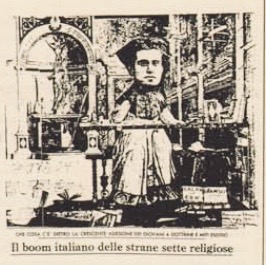
So, in this early Gramsci I find a priest rather than a modern prince. A priest driven by a substantive and coordinated theological effort to establish a voluntarist and teleological dogma for historical change, which really does not differ much from the principles of modern Liberalism and its potestas indirecta. It is interesting that in the last issue (1977) of the mythical Italian journal L’erba Voglio, there is a small satirical portrait of Gramsci dressed as a bishop with pen in hand, which speaks to the theological garments of Gramscianism well into our days. But the problem is not theology; it is rather that it is a theology of submission organized around order, reproduction, and history as idols in the name of consented domination.

Finally, I could very well imagine that some could rebuttal these theological imprints by claiming that this is only early Gramsci, and that things change later on. I am not too sure about this. It seems that this heuristic claim is analogous to Kafka’s “Leopards in the Temple” parable. In other words, isolating an “early” from a “late” Gramsci becomes a general ceremony to save the philosopher in spite of himself. But this is a self-defeating maneuvering from the very start.


*Image source: from the magazine L’erba Voglio, N.30, 1977.

Teología transfigurada. Una aclaración a la conversación en “Dublineses”. Por Gerardo Muñoz

No quiero repetir aquí todos los hilos de la rica conversación que tuvimos ayer en la tarde con Ángel Octavio Álvarez Solís, Joseba Buj, Aldabi Olvera, y José Miguel Burgos Mazas en el programa “Dublineses” que se emite desde Radio Ibero (se podrá escuchar aquí el jueves a las 11pm ET). Tan solo quiero dejar un addendum sobre el tema de la teología, el cual surgió al final de la conversación y que puede generar algunas ambigüedades. Estas aclaraciones son solo mías, pero me interesará saber lo que piensen los otros amigos. Me refiero en particular a un momento en el que José Miguel dijo que pensar la crisis de la pandemia hoy requiere dejar atrás toda teología, y por lo tanto toda teología cristiana o católica, e imagino que judaica también. Yo anteriormente había dicho que en un momento de fragmentación del mundo y de creciente transformación en el orden mundial, crecen los arcanos y regresan los mitos fuertes.

En efecto, es lo que vemos en lo mejor del constitucionalismo norteamericano, así como en ciertos países del Europa. No hay dudas de que hay un timbre del viejo catolicismo romano que llega a nuestros oídos: ahí donde la maquinación ha adquirido una totalización extrema, reaparece la teología como orden concreto. Para Schmitt esto suponía el regreso político institucional de la Iglesia, por supuesto. Ángel no se equivocó en extrapolar esta dimensión a un problema antropológico de las instituciones, puesto que tanto neoliberalismo como el discurso moral de una “izquierda verde” carecen de una institucionalidad para el mundo de la vida.

Y, sin embargo, no es menos cierto que ya la Iglesia como “gran actor” contemporáneo en el tablero mundial no tiene un peso significativo. Su misión se limita a un débil pasteo moral ahora vestido de franciscanismo “mundializado” (la expresión es de Massimo Faggioli). Pero conviene preguntar: ¿se agota la teología en la estructura eclesiástica? Yo diría que no, al contrario. Quizás estemos ante una impronta teológica fuerte que nos permite pensar la morada del mundo desde el afuera del dogma, pero también más allá del pastoreo, de las descargas del pecado, y de la oikonomia. Esto es, una teología del jardín contra toda posibilidad de una nueva administración del rebaño por viejos teólogos y nuevos sacerdotes políticos.

En su Autorretrato en el estudio (2016), Agamben reescribe una conversación con el poeta español José Bergamín, quien en una ocasión le dijo: “Dios no es monopolio de los sacerdotes y que, como la salvación, es extra Ecclesiam…no es posible hallar la verdad si primero no se sale de la situación – o de la institución – que nos impide el acceso. El filósofo debe convertirse en extranjero respecto de su ciudad. Extra es el lugar del pensamiento” (1). Si la teología facilita la búsqueda de ese afuera – y de ese “afuera” con respeto al mundo (y contra la metrópoli), del que hemos estado hablando – pues bienvenida sea. Es obvio que esta teología ya no es compensatoria de un espíritu comunitarista ni arcanum de la conflictividad humana, sino solo sombra contemplativa y melodía serena. Por eso su figura no es el Reino ni el Imperio, sino el belén. Esta es mi tesis.

Esta marca teológica ya no es providencialista en su temporalidad, sino que es más bien una transfiguración en el espacio. Me parece que Hölderlin – que probablemente haya sido quien más profundamente experimentó esa “fuga de los dioses” de lo profano – lo condensa en un momento de sus “Notas sobre Antígona”: “Padre del tiempo, o: padre de la tierra, porque su carácter es, contra la eterna tendencia, volver el aspirar, partiendo de este mundo, al otro en un aspirar, a partir de otro mundo, a éste” (2). Esta sustancia “aórgica” le devuelve al hombre el sentido telúrico y el recuerdo inmoral del suave vivir de los paganos (lo confirma la ecfrástica de un pequeño San José pensativo que vi el año pasado en la entrada de la Iglesia de Santo Domingo, en Soria). En efecto, si queremos evitar nuevos titanismos desaforados, no debemos denegar a la teología. Ahora es importante transfigurarla.


Referencias

1. Giorgio Agamben. Autorretrato en el estudio (Adriana Hidalgo editora, 2018). 46.

2. Friedrich Hölderlin. “Notas sobre Antígona”, en Ensayos (Libros Hiperión, 1980). 147.