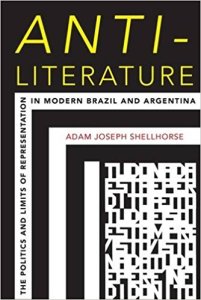
A Friendly Katechon: on Adam Joseph Shellhorse’s Anti-Literature: The Politics and Limits of Representation in Modern Brazil and Argentina. By Gerardo Muñoz.

shellhorse 2017Adam Joseph Shellhorse’s Anti-Literature: The Politics and Limits of Representation in Modern Brazil and Argentina (U Pitt Press, 2017) is a bold and timely intervention in a dire moment for “literary studies” in the field of Latin American Studies. What is the epistemological status of the ‘literary’ today, if not an ambiguous force driven by machinistic inertia? The institutional erosion of the discipline’s legitimacy cannot easily be ignored, as every scholar is confronted today with interrogative demands for ‘definition’. Ambitious in scope, theoretically sophisticated, and generous in its readings of a heterogeneous corpus, Shellhorse attempts to understand “what is meant by “literature in contemporary posthegemonic times” (Shellhorse 3). Whether such interrogation opens up a desirable future, is the very heart of this important book.

Anti-Literature departs from the wake of the exhaustion of a well known triad: the Boom as a last attempt to generate a strong allegorical machine; Ángel Rama’s culturalist thinking to come to grip with the uneven development through transculturation; and the political vanguard experiment of the Cuban Revolution in 1959. The aftermath of these watershed moments has led to what is now a permanent state of crisis. The end of ‘hegemony’ in Shellhorse’s reflection demands the end of the centralized state form of the literary, but also the turning away from models of ideological Marxist critique, over that of affect, the multiple, and the experimental in writing. Compensatory to this insolvent condition, Shellhorse proposes ‘anti-literature’ as a new framework for literary studies. Although, more urgently, it offers the minimal condition for the task of reading in a present devoid of objective legitimacy, or what Shellhorse calls, perhaps more prudently, a ‘perilous present’ (Shellhorse 16).

The archive Shellhorse attends to is minimalist, functioning hyperbolically for a larger and more programmatic invitation to read in the anti-literature key. The works sketched throughout the book are the following: Lispector’s language of life and the specular feminism of immanence; David Viñas’ ‘half made literature’ as a de-spiritualized materialist gesture in his novel Dar la cara (1962); concrete poetry as a post-culturalist and post-conceptual artifact; Haroldo de Campos and Osman Lins’ poetics of the baroque; and last but not least, a mediation on historical redemption and the messianic in Salgado’s photography and De Campos’ poem “O anjo esquerdo da historia”. Irreducible in style and geopolitical demarcations, all these anti-literary projects negotiate language within the limits of its own materiality while assuming a writing of finitude. This is crucial, as it is what distinguishes Shellhorse’ anti-literature from John Beverley’s known ‘against literature’.

Whereas Beverley demanded an exception to literary hegemony in the name of a subalternist ‘subject’ formalized in the testimonio, Shellhorse’s following Moreiras’ predicament on exhaustion, does not seek to close off the promise and secret of literature, but only to interrupt its identitarian and representational pretensions (Shellhorse 42). Therefore, against the Boom as an ideological critique towards state building on one hand, and testimonio as exception to high literary sovereignty on the other, Shellhorse proposes anti-literature as posthegemonic experimentation through affect and the sensorium. Whereas testimonio demanded hegemonic filiation until the triumphant victory, anti-literature endorses the post-hegemonic in the face of defeat. Anti-literature is only anti-literary to the extent that it demands a relation to the secret of ‘what might come’. This is why Shellhorse’ Anti-Literature is untimely tied to literature as a singular procedure of writing, instead of organizing a counter-canon, in what could be taken as an effort to immunize itself through an alternate ‘aesthetic form’. This is why, it is important that Shellhorse tells us very late in the book:

“…it could be said that anti-literary writers hook up writing to literature’s outside, to nonwriting and egalitarian modes of imaging the community. What is at issue is precisely this: the concept of anti-literature need not restrict itself to an avant-garde, modernist paradigm of the arts. Rather an approach to the anti-literary entails reconceptualizing the problem of writing as a sensory procedure and perpetual force. The question of what is anti-literature can perhaps best be posed only in the wake of literature’s exhaustion, when the arrival of defeatist accounts demands the time for speaking concretely” (Shellhorse 164).

This comes as a warning to careless readers who, perhaps too hazily, will try to inseminate periodical categories of sociology or history of literature to ensure the timelessness of the boundaries of literature’s autonomy. Indeed, Shellhorse immediately writes: “Indeed, bibliography on the nature of literature in the field is marginal” (Shellhorse 164). We can only guess that the very asymmetry between an understudied Argentine writer (Viñas), ranked among giants of modern Brazilian literature (Andrade, De Campos brothers, Lispector), functions as the affective corpus of Shellhorse’s own singular judgment. This is his secret posthegemonic cabinet, just like everyone has his or her own.

By taking distance from an overdetermination based on a ‘historical period’ or a particular ‘literary movement’, Shellhorse performs his own affective caesura against the hegemonic temptation that demands age-old historico-metaphysical entelechies; such as periodization, social context, base/superstructure dichotomy, form, or aesthetic framework. If the book’s starting point is the fall of the legitimacy of Latinamericanism or Hispanism at large, this means that there is no calculative arrangement that can sustain the alleged bona fide of ‘literature’. The polyphonic assemblage regime of tones and signs is also irreducible to a life, to any life, that belongs to the student and professor of literature in the exercise of the imagination. And as I see it, this is what the anti-literature tries to register so suitably to us.

Yet, at first sight there appears as a latent paradox in the book, and it is a problem that I would like to convey, since it remains of one the strong effects of its reading upon me. Of course, I can only hope to solve it in my own name and style, and I hope that others find their own ways to wrestle with the problem. Basically, the problem could be advanced in this way: if we are in a present condition of interregnum, of the total transitional epoch in the field within a larger transformation that Moreiras has called full machination through the principle of general equivalence, where anything is replaceable and interchangeable, why does the book offers yet another frame to re-invent literary studies? [1]. What is the need of literature at a time in which it can no longer speak for itself (the ‘being’ of Literature)? Isn’t the literary today a mere defunct fossilized object, a repetition for commemorations, and museum-like artifact that only seeks the stimuli of social-media to imagine itself Eternal? Literature automatically wants to be part of the ‘museum’, but the trade-off is that the museification of the new demands its own concrete death. It is difficult to name anything interesting in contemporary literature (nothing that can compare with the Boom), and the fact that we keep reading Lezama Lima or Haroldo de Campos or Borges, bears witness to the aftereffect of being able to establish some livable relation with nihilism at the end of literature. Shellhorse does well to inscribe this important symptom in a crucial moment at the end of the book, which opens to an important discussion:

“If “literature” persists in crisis in our field, the task today is to reconstitute its critical force. Literature becomes anti-literature when it subverts itself. My contention is that it is only by bearing witness to this relation of non-essence, non-identify, and non-closure – literature is not literature – that we can begin to read anew” (Shellhorse 166).

I would like to advance the thesis that Anti-literature as a project comes to us in the form of what I would call a friendly katechon. While it is clear that Shellhorse is not proposing a new “turn” beyond literature, anti-literature is not just repetition of the same as the new. To do so would be “old”, since it would be integral to the register of High Modernity up to the readymade, that is, to the museum. Rather, anti-literature is something akin to a shadow that overlaps in what we call “literature”; a sort of dirty stain in the tradition and in the immemorial institutionality of texts. At same time, anti-literature has a reformist undertone, in the theological sense of celebration and transformation through transference.

But it is a katechon to the extent that Anti-literature retains and delays the temporal disappearance of the evermore so irrelevance of literature. As we know, the Pauline Greek word katechon (κατέχον) means restrainer (who or what), a mysterious force that helps avoiding the fall unto the anomia that imposes illegitimacy in any particular historical epoch. Although at times the katechon is understood in tandem with its own archaic regression, I do not think this is Shellhorse’s intention or effect in inviting us to partake in Anti-literature to “begin anew”. The reason is fairly simple: to the extent that we have literature, there is always already excess to every hegemonic phantasm, and that is enough to retain literature as a residual condition for thought, even when we move beyond textualism or politization.

Like Carl Schmitt, who appears in Ex captivate salus, as the last conscious representative of Modern European Law of Nations, Shellhorse appears to us as the last existential witness of the literary in the form of the anti-literary. But like an Anti-Schmittian, he does not succumb in the myth of political theology and Empire. His katechon can only be one of friendship: in the love of the text, and for the friendship of an-other to come. Anyone, at any time. But isn’t this a mirror of the measureless principle of democracy? The friendly katechon does not seek what Nietzsche called the antiquarian relation to History, but rather a reflexive and disinterested democratic thinking. The katechon, in the platonic reading that I favor here, thoroughly deters disintegration of the authentic life of the mind, which is consistent with Lispector’s language of life [2]. That is, literature is no longer revealed as accumulation and principle (archē of the archive), but as homecoming of Justice. Shellhorse explicitly sets foot on this trail this in his reading of De Campos at the very end of the book (which I would like also to de-center from the given messianism):

“Such a field no doubt defines the logic of domination. Justice as a continuous line of singularities: blurs, bends back, and breaks up the reified character of social relations as well as banal accounts of “progress” that fail to count the part that has no part in society. Citable in all their moments, as freed expressions that articulate the desire to be exception, to think the relationless relation, the affective dimension of Campos’ text inscribe the crisis of poetry in the wake of subaltern tragedy” (Shellhorse 196).

But can the Poem be a secondary substitute before the ruin, a safeguard against tripping into the abyss? It is useful to paraphrase Derrida here to remember that, neither the poem nor deus absconditus, neither decorative baroque nor the messianic community, neither the experimental sensorium nor philosophy of history, can exert as hyperbolic condition of any possible living democratic construction [3]. This is only literature’s task. Anti-literature as friendly katechon, keeps this unavowable promise as its dearest secret that nourishes from the democratic expectancy in an incalculable waiting. A politics among friends? It could well be, but only with the caveat that like friends, literature also comes like a stranger late in the day. Will it come again? All of this to say that anti-literature resists succumbing in the nihilistic abyss of equivalence as the last avatar of the contemporary university’s death-drive. The friendly invitation of anti-literature confronts us, once more, as a lux acarna. We only hope that it is not too late, and that another path could open in the very place of what has always been.


 Notes

1. Alberto Moreiras. “Universidad. Principio de Equivalencia”. Enero 17, 2017. https://infrapolitica.wordpress.com/2017/01/17/universidad-y-principio-de-equivalencia-hacia-el-fin-de-la-alta-alegoria-borrador-de-conferencia-para-17-instituto-de-estudios-criticos-mexico-df-22-de-enero-2017-por-alberto-moreiras/

2. For example, at one point the baroque/ neo-baroque appears as a trope for anti-literature. In my account, this will amount to the ‘catholic’ affirmation the katechon, raising its status in a complexio oppositorum between archaic and an-archy of the eschatology, which is always political theology. Consider this passage cited from Haroldo de Campos: “…Brazilian culture was born under the sign of the baroque…it cannot be understood from ontological, substantialist, metaphysical point of view. It should not be understood from an ontological, substantialist, metaphysical point of view. It should not be understood in the sense of an idealist quest for “identity” or “national” character. Baroque, paradoxically, means non-infancy. The concept of “origin” here will only fit if it does not imply the idea of “genesis”, of a generative process with a beginning, middle, and maturity…Baroque is, therefore, a non-origin. A non-infancy. Our literature, springing up from the baroque vortex, was never aphastic; it has never developed from a speechless, aphasic-infantile limbo in the fullness of discourse”. 115 pp. The baroque as literary form, even deprived of genesis, seems to lead stray into the “frame” whether in transcendental or immanentist planes of the modern metaphysics of the political.

3. Panagiotis Christias has recently offered a very interesting reading of the figure of the katechon in a platonic key, in which he suggests that the restrainer stands against potential rise of tyranny, thus making the Philosopher, the Greek antecedent of the katechon fearing the disintegration of the polis. To what extent philosophy can deter anomia today is a completely different question. I am interested in the figure of the Philosopher as metonymic for life as it converges with passion without sacrifice. See, Platon et Paul au bord de l’abîme. Pour une politique katéchontique (2014).

Illegitimacy? Review of Giorgio Agamben’s The Mystery of Evil: Benedict XVI and the End of Days. By Gerardo Muñoz.

agamben mystery 2017Giorgio Agamben’s Il mistero del male, now translated in English as The Mystery of Evil: Benedict XVI and the End of Days (Stanford U Press, 2017), is an intense repudiation of the mundane legitimacy of every institution, costume, and political structure hitherto existing on earth. For Agamben, the decline towards illegitimacy has not been a matter of a few years or decades, but part of a larger inherited drama. The core of the book reads Benedict XVI’s “great refusal” as an ‘exemplary act’ [sic] against the Church, bringing to awareness a vital “loss of substantial legitimacy” (Agamben 3). Overstating the dual structure characteristic to Western governmentality – potestas and autorictas, or economy and mystery, legality and legitimacy – Agamben asserts that Ratzinger’s gesture cuts through the very thicket of the ekklesia arcanum, reversing the mystery of faith in time to the point of abandoning the very vicarship of Christ (Agamben 5). Of course, this comes as no surprise to those that have engaged with his prior The Kingdom and the Glory (2011), where Agamben interprets the Trinity as a stasiological foundation of an oikonomia that plays out (vicariously) as a praxis without Being [1].
In many ways, this essay is supplemental to the larger turn already undertaken in The Kingdom, only that this time, Agamben brings to focus a seminal institution of the Western political tradition. Here Agamben seems to be pressing more heavily on the state of global affairs in which the Church is a metonymy: “…if this gesture interests us, this certainly is not solely insofar as it refers to a problem internal to the Church, but much more because it allows us to focus on a genuinely political theme, that of justice, which like legitimacy cannot be the eliminated from the praxis of our society” (Agamben 16-17). This is consistent with overall structure of The Kingdom, by which the structure of the oikonomia is understood vis-à-vis the true ‘providential machine’ of human administration. So every administrative structure is illegitimate, since for Agamben, it governs through de-substantial vicarious being. It is a true ‘kakokenodicy’ (referring to the emptying) that can only justify effective evil (Agamben 36). To the extent that Agamben’s overarching project seeks to establish a responsive unity to the problem of discessio or internal division, it is not difficult to grasp how Benedict XVI’s return to Tyconius’ obscure thesis of the Church composite of good and evil is highly relevant, as we shall see.

We are far from Augustine’s City of God, where the split was produced between two cities, allowing for what Erik Peterson understood, against Schmitt, as the impossibility of any political theology. Tyconius is, in a sort of way, the persistence of an Anti-Augustinian gnosis. Agamben’s effort, let’s be clear, tries to make Augustine a son of Tyconius, which makes it even more mysterious; since whereas Augustine separated Church and Empire, Tyconius separates evil and good in the temporal katechontic nature of the Church (Agamben 10-11). Agamben cites Illich’s testimony to claim that the Church is always already mysterium iniquitatis as corruption optima pessima (the worst possible corruption of the best). But once again, Agamben seems to be forcing positions, since whereas for Illich the Church, consistent with Augustine, allowed for ius refomandi (reform), Agamben posits discessio as the arche of the corporeal Church, in this way reintroducing the myth of political theology to stage the mysterical drama of History.

In a strange sense, the mystery is not that mysterious. It becomes messianic eschatology on reserve. According to Agamben’s narrative, the Church as a dual nature of opposites, possesses an internal stasis between a temporal restrainer (katechon), the evil that runs counter to against law’s integrity (anomos), and the eschatological dimension of the End. This last character points to the Pauline’ messianicity, which allows Agamben to link Benjamin and Tyconius’ in a common salvific structure. As he writes: “The mysterium iniquitatis…is a historical drama, which is underway in every instant, so to speak, and in which the destiny of humanity, the salvation or fall of human beings, is always at stake.” (Agamben 14). Benedict XVI is a counter-katechon, as he is able to reveal, in his exodus, the eschatological structure that leaves behind the vicarious economy. According to Agamben, Benedict XVI’s message was “nothing but the capacity to keep oneself connected to one’s own end” (Agamben 16).

On the reverse, this entails subscribing a messianic turning of life from within the Church in order to posit a metapolitical form without remainder. The renunciation of the katechon implies that we are left with an economy (oikonomia) devoid of legitimacy. The central problem here is that history itself has become mystery of the economy, instead of an economy of mystery, which is the Pauline arche. What compensates for this illegitimacy becomes messianic politics that “does not remain a mere idea, entirely inert and impotent in the face of law and economy, but succeeds in finding political expression in a force capable of counter-balancing the progressing leaving out onto a single technico-economic plane of the two coordinated but radically heterogeneous principles [legitimacy and legality] that constitutes the most preciouses patrimony of European culture” (Agamben 18).

But if the machine of governance of the West is dual, playing legitimacy and legality in a skirmish co-dependency, why does Agamben conflate the renewal of legitimacy to the coming of a new politics? The reason seems to be that once you accept the condition that what exhausts government is an economical structure of the Christian katechon, you can then accept as exodus a metapolitics of salvation. What is interesting is that this politics, seemingly against Schmitt, actually re-enacts the same movement for an exact, albeit reverse, political trade-off. Agamben does not follow Peterson here. Let us recall that Peterson’s argument was never that the Church is an oikonomia, but that Schmitt’s totalizing and unifying political theology applied not to the Church, but only to Empire. This principial politics, as we know, has always led to catastrophic dominance, from Rome to Christian Monarchy to Nazi Germany. Counter to Schmitt, Agamben wants to produce not an imperial katechon, but “a time of the end, [where] mystery and history correspond without remainder” (Agamben 30).

The problem becomes that in order to set the stage for such “drama”, Agamben needs to avoid at all costs the Augustinian/Petersonian split of the Church in its facticity (as it actually happened). This explains why, in the second essay, history is understood as mysterical. In this context, it is noteworthy that Peterson is fully absent, even though he famously authored the essay “The Church”. There he writes in an important passage:

“The worship the Church celebrates is public worship and not a celebration of the mysterious; it is an obligatory public work, a leitourgia, and not an initiation dependent on voluntary judgment. The public-legal character of Christian worship reflects the fact that the church stands much closer to political entities like kingdom and polis, rather than voluntary associations and unions” [2].

I highlight Peterson’s reference to the “the mysterious”, because this is an explicit polemical stance against Casel, the Benedictine monk that informs Agamben’s mysterical adventure in history. But this has important implications, only two of which I will register here. First, accepting Casel’s mysterical Church leads us to conclude that internal worldly illegitimacy requires that we embrace a messianic politics ‘again’ (Agamben 38). In fact, politics is ultimate salvation in Tyconius, Casal, and Benjamin.

Secondly, mysterical historicity demands voluntary filiation. Agamben lays this out in plain sight: “it is in this drama, always underway, that all are called to play their part without reservation and ambiguity” (Agamben 39). Messianism forces agonic politics, displacing administrative vicarship with a conceptual theodicy. But profane life does not need to coincide with or abdicate a metapolitics of salvation. Now, if this is so, perhaps the accusation raised against governmental structure as illegitimate is in itself not legitimate. What if instead of being on the side of the metapolitics of the eschatological mystery, legitimacy is nothing other than the internal rational enactment of the separation of the profane that is always taking place in the world?


Notes

  1. Agamben writes in The Kingdom and the Glory (2011): “And, more generally, the intra-Trinitarian relation between the Father and the Son can be considered to be the theological paradigm of every potestas vicaria, in which every act of the vicar is considered to be a manifestation of the will of the one who is represented by him. And yet, as we have seen, the an-archic character of the Son, who is not founded ontologically in the Father, is essential to the Trinitarian economy. That is, the Trinitarian economy is the expression of an anarchic power and being that circulates among the three persons according to an essentially vicarious paradigm… The mystery of being and of the deity coincides entirely with its “economical” mystery. There is no substance of power, but only an “economy,” only a “government.” 138-39 pp.
  2. Erik Peterson. “The Church”. Theological Tractates (Stanford U Press, 2011). 38 pp.


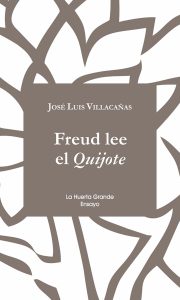
Pious Humor: on José Luis Villacañas’ Freud lee el Quijote. By Gerardo Muñoz.

villacanas freud leeThe almost banal simplicity of the title of José Luis Villacañas’ most recent book, Freud lee el Quijote (La Huerta Grande, 2017), could incite false expectations. This is not a book about the esoteric references of the Quijote in the father of psychoanalysis, and it is most certainly not a psychoanalytic contribution on Cervantes, the author. Although these principles are at the center of Villacañas’ meditation, they do not exhaust his argument. There are, I think, at least two other important premises that deserve to be noted at the outset: on the one hand, Freud lee el Quijote is a continuation, a sort of minimalist diagram, of Villacañas’ massive Teología Política Imperial (Trotta, 2016); while on the other, it is an exoteric ongoing polemic with Carl Schmitt, who understood Quijote as a Catholic hero of the European destiny in the wake of secularization and the crisis of the Catholic ratio. Although Villacañas does not explicitly cite Schmitt’s early essay on Quijote (preferring to polemicize with the late work Hamlet or Hecuba), Schmitt lingers as an accompanying shadow figure throughout Villacañas’ intervention [1].
It must be said that, at a time of contemporary debates around political theology and the future of Europe, Freud lee el Quijote is a salient exposition of a decisive question on the political and historical defeat. Villacañas’ book is really about an affirmation of defeat as an irreducible condition of the political. It does not come to a surprise that Villacañas is fully honest when he writes in the prologue: “… [este libro] es mi hijo menor, pero en verdad el de más larga gestión, y el más querido de todos mis libros” (Villacañas 9).

The names of Freud and Schmitt work jointly and at opposite ends and they limit the frame of Villacañas’ strong reading of the Quijote. The central idea is that Cervantes wrote neither a work of cruelty or tragedy, nor of comedy.  El Quijote for Villacañas is a work of humor. But let us step back from this assertion. Villacañas is generous and attentive to the archival sources (Freud’s letters to Silberstein, among other things), which allows him several factual connections, such as the mimesis between the Academia Española as an antecedent of the Psychoanalytic Association, or even the Coloquio de los perros as a formal precedent of the psychoanalytic session. But more importantly, these juxtaposed scenes pepper the ground for the question that Villacañas is after: how to think the heroic figure of the Quijote, and what relation does it contract with the origin of psychoanalysis?

Villacañas’ thesis is that the Quijote is an eruption beyond the comic and the tragic into the humorous. This is, he tells us at the very end, a process of moral rationalization that Freud understood only after Cervantes’ discovery of the “pious humor” (humor piadoso) (Villacañas 25). To understand the way to Freud’s reading of humor in Cervantes, Villacañas first needs to cross paths with Schmitt. He recalls that in Schmitt’s reading of European secularization, there are three potential mythical representatives. We should bare in mind that the three are intellectual representatives: that of the Catholic Quijote in Spain, the Protestant Faust in Germany, and that of the rational and doubtful Hamlet, pulled by the tragic phantasm of the Law-Father. Throughout the essay, Villacañas wants to correct Schmitt’s perhaps too hasty typology of the first heroic type. It is not that Villacañas wants to dispute Schmitt’s circumscription of Cervantes’ Quijote into the Spanish catholic tradition; the problem is that Quijote only emerges in the ruinous aftermath of the catholic imperial ratio. Quijote in La Mancha is an existential and moral figure of a defeat that confronts reality without resentment or guilt. Hence, Quijote, like the Marranos and the Spanish pícaro, affirms without reserve the time of the interregnum as a profane Post-Reform location. Spain is the land of a double fissure into modern secularization. Villacañas tells us:

“…allí donde dominó el catolicismo nacional posterior, tal proceso fue imposible, pues ese catolicismo se puso al servicio de toda tradición mundana. Entre un catolicismo que ya no podía ser universal y un Estado que nunca sería soberano, don Quijote es el héroe errante en un mundo escindido y roto, sin soberano estatal ni Iglesia universal: el mundo español. Por eso es que es mito existencial y concierne a cualquier español que reflexione sobre su destino histórico” (Villacañas 32).

Cervantes’ profane epoch is that of the newborn Leviathan, which Villacañas reminds us did not need to wait for Hobbes, since the myth was noticed by Juan de Santa María, a Felipe III’ censor, in his Tratado de república y policía cristiana. The mythic Leviathan demolishes the old principles of medieval history based on the absolute potentiality of God in the name subjective freedom protected by the new mechanicist secular state (Villacañas 34). Up to this point, this narrative is very much consistent with Schmitt’s The Leviathan in the State Theory of Thomas Hobbes. But Villacañas abandons Schmitt when contenting that Quijote cannot amount and should not be reduced to a mythical Spanish katechon. Quijote is, in fact, the very opposite of any positing of time restrainer of terrestrial time. He is, unlike Schmitt, not the last witness of the European ius, but the prima witness of the time of ruin and devastation: “Don Qujiote es un héroe católico, pero su figura emerge de entre las ruinas de Roma y del Imperio” (Villacañas 37). Villacañas seems to place Schmitt, vis-à-vis Quijote, on its head: whereas in Hamlet and Hecuba, Shakespeare’s tragedy inscribed the irruption of history within the work, in Cervantes’ Quijote irrupts the historical end of the roman imperium, and the Catholic Church as form of the gnosis. But how does the humor play out within this configuration?

Quijote represents a turning point of the triumph of the modern gnosis, which in a turn to Hans Blumenberg’s Legitimacy of the Modern Age, equips Villacañas with the possibility of fleeing the stereotype of the reformist and salvific composition of the modern subject. For Villacañas, Don Quijote “es la paranoia del impotente y del solitario, mientras el reformado se entrega a la experiencia entusiasta y sin fisuras del que es consciente de su poder y lo ve compartido por los que confiesan con él” (Villacañas 68-69). Quijote is a marrano figure away from Protestant salvific subjection, but also turning its back to the messianic kingdom of the Catholic fidelitas. The wonder and uniqueness of the Quijote is that he represents a third option that does not run through resentment or will to power, since its compensation is a pious humor in the face of the ruinous and the powerlessness (impotencia). Villacañas summarizes the point in an important moment of his book:

“Lo decisivo está en la forma de interpretar las derrotas. La autoafirmación moderna no trata de culpabilizar a un poder mágico por sus fracasos, ni a una finalidad perversa del mundo, ni a un manipulador chapucero y cruel, sino solo a una falla del principio epistemológico respecto a lo real, lo que constituye un nuevo reto a la curiosidad” (Villacañas 73).

The disheveled Quijote can only compensate the wake of the imperial absolute trauma with humor. This is a complex game, Villacañas notes, since it is done through phantasy as the possibility of exodus for what otherwise could amount to the acceleration of the death drive, the sublimation of the Ideal, and the proximity with the speculative teleology of the genius and the superhuman. This latter was the rubric by which German Romanticism read and appropriated the “Catholic” myth as fetish after the failure of the Protestant bourgeois transformation. The work of humor is the possible thanks to the work of self-affirmation in the face of tragic finitude: “Está diseñado para mostrar la finitud del héroe que un día fuimos, y que todavía somos, y ese el trabajo del humor, el que asegura a pensar de todo el triunfo del yo y su condición narcisista” (Villacañas 88). While the joke and comedy are blind to loss, Villacañas goes as far as to claim that the joke or the prank are always potentially on the side of aggression (Villacañas 92). Not so the humor, which can divide itself in a psychic equilibrium between the Ego and the Super-Ego, between the playfulness of the youngster and the theatrical seriousness of the elder. The joke, as reactive mechanism, does not recoil back to the Ideal. Humor – as in “tiene sentido de humor” – is always a singular form of humility.

This is, at heart, the latent gnosticism of Cervantes as Quijote, and Quijote as Cervantes. The function of comedy, which Giorgio Agamben has elevated in work as a phantasm of Italian culture and of his own potenza, dissolves in the Hispanic Marrano tradition in which Villacañas places Quijote as a humorous figure [2]. The work of compensation of the super-ego makes humor a substrate of the psychotic figure of disbelief, while affirming the narcissist drive of a modern fragile and gracious “I”. It makes sense that Villacañas argues at the end of his book this superego cannot be tyrannical (Villacañas 99). This could open rich and important discussions that we can only register here.

As a treacherous hidalgo, Alonso Quijano is never a psychotic leader, but a humorous madman. And humor is only an aftereffect of an epistemological rupture of the modern, of an unclear and unforgotten defeat that characterizes modern man, and that characterized, no doubt, Cervantes himself in his attempt to find a proper balance to nihilism. But, did he succeed? The book does not say openly, but it is fair to say that the impossible balance to nihilism is also symmetrical to the nihilism of the political.


Notes

  1. Schmitt in his early essay on Quijote notes some of the aspects that he will take up in the late book on Hamlet, such as the “image of the Hispanic heroism”, and the “great sense of humor of the work”. See, “Don Quijote un das Publikum” (1912). There is a Spanish translation of the essay by Isabel Moreno Salamaña (2009).
  2. For Agamben on the comic as a category of Italian thought in the wake of Dante, see “Comedia” in Categorie italiane: Studi di poetica e di letteratura (2010). Most recently, this is also the problem at the heart of his book on the Neapolitan puppetry figure Pulcinella, Pulcinella ovvero divertimento per li regazzi (2016).

Presidencialismo y liderazgos. Una pregunta para José Luis Villacañas. Por Gerardo Muñoz.

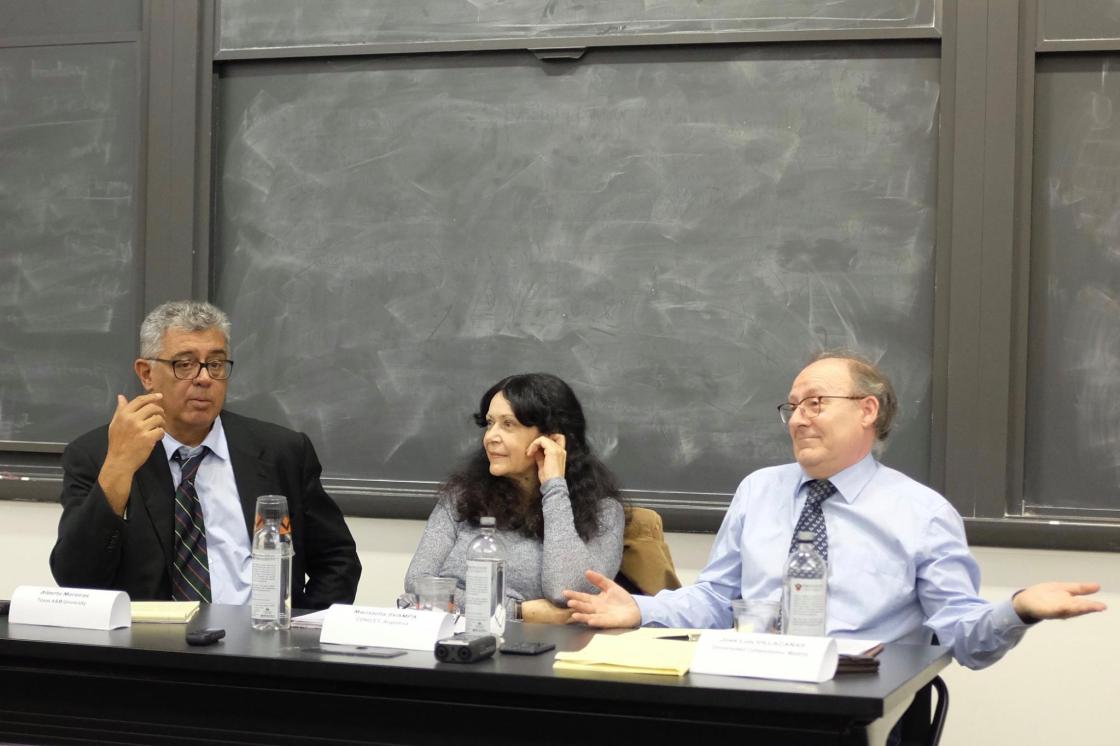
populismos2017foto

En los buenos talleres siempre pareciera que nos traiciona el tiempo. Y el congreso “Populismos”, que tuvo lugar el pasado viernes en Princeton, no fue una excepción. Hubo tres excelentes ponencias que darán mucho de qué hablar y pensar, aunque en este comentario solo quiero atenerme a un aspecto que quedó colgado del intercambio con el Profesor José Luis Villacañas.

José Luis leyó un magnífico texto sobre Max Weber, Ernesto Laclau, y la actualidad de la crisis constitucional de Weimar para pensar nuestro tiempo. Implícitamente estaba en juego una hermenéutica relativa a la interpretación de la crisis democrática alemana de los treinta, y aunque no fue nombrado, se podía escuchar cierto eco de Helmuth Plessner, cuya Nación tardía: sobre la seducción política del espíritu burgués (1935-1959), acaba de aparecer por el sello Biblioteca Nueva en una magnifica edición y estudio crítico del propio Villacañas. No quiero intentar hacer un resumen de la charla de José Luis, la cual puede escucharse aquí. Me sumo al gesto de Alberto, y tan solo quiero dejar por escrito un comentario para avanzar en la discusión.

En el tiempo que tuvimos de preguntas y comentarios, yo le preguntaba a José Luis cómo pensar la “actualidad” de Weber en un momento como el nuestro (al menos en EEUU, que es donde vivo), dominado por lo que los constitucionalistas norteamericanos (Posner 2008, Hamburger 2014, Vermeule 2016), han venido llamando la expansión del estado administrativo. Sobre esto y la conspicua frase de Steve Bannon, ya hemos comentado en este espacio [1]. La cuestión es relevante en la medida en que el problema del administrative state y la burocracia es central en el propio pensamiento de Weber. Pero también es fundamental si aceptamos cierta irreversibilidad del derecho de los estatutos de las agencias gubernamentales administrativas cuyo peso ya han desplazado lenta pero decisivamente el centralismo de las cortes.

Si esta es la realidad fáctica, entonces no es posible ni deseable, volver al centralismo jurídico, en la medida en que volver al centralismo jurídico no sería más que volver a re-inscribir las condiciones que en un primer momento hicieron posible la expansión del estado administrativo. Lo que hay es lo que hay, como a veces se dice desde cierto “realismo”. Esto es, un estado administrativo que solo puede ser más o menos democrático. Pero el estado administrativo no solo desplaza lo que Dworkin entendió, en el que quizás sea el más influyente libro del derecho norteamericano del siglo veinte, el ‘Imperio de la Justicia’. En la última sesión de debate con Moreiras y Svampa, Villacañas retomó el tema de Weber ahora visto desde la rama del executivo. Quiero citar a Villacañas, y luego pasar a mi pregunta:

“….por eso el carisma anti-autoritario es específicamente democrático, puesto que el carisma es delegado en la medida en que responde a los intereses de los dominados. Cuando Weber establece esa diferencia está pensando en el Presidente de los Estados Unidos que es para él es el prototipo del carisma antiautoritario que tiene que defender los intereses de los dominados si quiere ser reconocido como tal. El líder anti-autoritario es quien está en condiciones de representar intereses que no son los suyos. Pero que los mira con una objetividad que está en condiciones de producirles la pasión…”

Seguido de este comentario, Moreiras le preguntó a Villacañas si esa descripción aplicaba a todos los líderes norteamericanos, o si era una especie de “tipo ideal”, pinchando una categoría medular del pensamiento sociológico de Weber. Lo que yo quisiera anotar es que si asumimos la realidad fáctica del estado administrativo, entonces quizás el “principialismo” (¿es principial?) del líder anti-autoritario en Weber, quizás ya no tenga tanto efecto como lo pudiera haber tenido, digamos, durante Weimar o durante período de Woodrow Wilson (quien además es una figura admirable, puesto que escribió una de las mejores defensas del cuerpo legislativo que hay en la tradición política norteamericana titulada Congressional Government, de 1885). ¡Y no olvidemos que el Congreso de EEUU no aprueba una ley en el Congreso en casi una década!

Villacañas diría, y en efecto, dijo: “el líder anti-autoritario es aquel que está en condiciones de recibir una patada en el culo…en caso de no cumplir las demandas materiales de la sociedad”. Y estoy de acuerdo con este razonamiento. Y hasta ahora Trump ha sido eso. Pero el problema es que si aceptamos la condición del estado administrativo, tal vez solo un nuevo parlamentarismo se adaptaría mejor al tejido de nuestras sociedades poshegemónicas. Al fin y al cabo, el sistema norteamericano es presidencialista, y como ha visto Bruce Ackerman y antes el gran historiador Arthur J. Schlesinger, desde hace décadas está en ascenso hacia una metamorfosis imperial. Me pregunto si el anarco-populismo de Moreiras, o el énfasis en los movimientos propuestos por Svampa, serían más susceptibles a un nuevo parlamentarismo, incluso a un federalismo, que es por otro lado lo que a mí me interesa, para un futuro democrático y democratizante [2]. Pero si es así, tendría que ser necesariamente anti-presidencialista, esto es, sin líder.


Notas

  1. Gerardo Muñoz. “An explaination for deconstructing the administrative state”. https://infrapolitica.wordpress.com/2017/03/07/an-explanation-for-deconstructing-the-administrative-state-by-gerardo-munoz/
  1. Alberto Moreiras. “Republicanismo arcaico”. https://infrapolitica.wordpress.com/2017/02/14/republicanismo-arcaico-por-alberto-moreiras/

*Foto, de Pablo Dominguez-Galbraith. 7 de Abril, Princeton University.

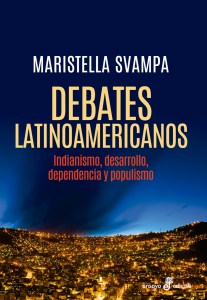
The Paradox of the Void at the End of Hegemony: on Maristella Svampa’s Debates Latinoamericanos: Indianismo, desarrollo, dependencia, y populismo. Notes from Presentation & Workshop at the University of Pennsylvania. By Gerardo Muñoz.

debateslat2017Maristella Svampa’s most recent book Debates Latinoamericanos: Indianismo, desarollo, dependencia, y populismo (Edhasa 2016) is truly a significant book. It is the result of more than a decade of archival research and theoretical elaboration, with deep implications in the sociological and political scholarship of the region. In a recent workshop held at the University of Pennsylvania this week, Prof. Tulia Falletti referred to Svampa after the publication of Debates Latinoamericanos and Maldesarrollo (2014) as a “new Guillermo O’Donnell” given the long-lasting impact that her systematic work will produce for so many fields of investigation both in the United States and in Latin America. Framed through four competing analytical problems – indigeneity, development, dependency theory, and the Latin American populist tradition – Debates Latinoamericanos engages and assesses the limits of the political reflection of the region in the last half a century. Furthermore, the book is beneficial for both specialists and students, since it covers a large bulk of historiographical debates in a polemical fashion. And I say polemical here not just in terms of its heterodoxy, but also in terms of a polemos relief that moves thought forward, inviting further reflection and contestation.

In the space of a brief commentary on the book, I cannot attempt the impossible, and offer an substantial summary of such a massive book. Rather, I want to take this opportunity to advance some of the questions that we juggled a few days ago when I presented this book in a workshop. I also want to have in mind Maristella Svampa’s brilliant keynote on populism and the end of the Latin American Progressive Cycle, which she delivered the day after and that was linked to relevant problems elaborated in the book [1].

Svampa writes Debates Latinoamericanos facing the ruinous space of the political in the Latin American tradition. But what and where is the origin of this catastrophe? To what extent can we offer a counter-imperial explanation for imperial domination against a marginalized locality in the world system of modern capitalism? Svampa does not say that the counter-imperial position is insufficient as a model to explain internal expropriation and continuous democratic deficit, but she runs a scan through the different four paradigms that shed light to what is, certainly, the meaty question of Latin American political reason: why has there not been democratic legitimacy in the region for the last two hundred years? I want to pause briefly in a moment that seems to provide a good starting point for conversation, and that I think should be cited at length:

“En ambos países [Argentina y Chile] el espacio ocupado por los indígenas era visto como “desierto”, “espacio vacío”, o para utilizar libremente la imagen de David Viñas, como la “contradicción de lo vacío que debe ser llenado” (1981:73). En Argentina, la metáfora del desierto creaba así una determinada idea de la nación, que tanto había obsesionado a la Generación del 37: más que una nación para el desierto, se trata a de construir un desierto que justificara la expansión de la nación. En Argentina, la expansión del capitalismo agrario y la consolidación del Estado nacional (mediante la estrategia de control territorial y afirmación de la frontera con Chile), se realizaría a través de la violencia genocida contra las poblaciones originarias en diferentes campañas militares, en la Patagonia y en el norte del país, entre 1870 y 1885. Dicha violencia tuvo un efecto demoledor sobre los diferentes pueblos indígenas.” (Svampa 43)

At first sight, it could well be that this passage is just a strict gloss of Tulio Halperin Donghi’s Un nación para el desierto argentino (1989) juxtaposed with David Viñas ’ Indios, Ejercito, y Frontera (1983). But I want to suggest that Svampa is doing something else here too. Whereas for Halperin Donghi the Dessert Campaign commanded by General Roca was the consolidation and crowning of the national state, for Svampa it marks the void at the center and origin of the political in Argentina. The extermination of the indigenous population as a form of ongoing originary accumulation, to say it with John Kranaiuskas, is what is common to the historical development in neoliberal times. But I do not think that Svampa is in agreement with David Viñas’ thesis either. According to Viñas’ narrative, the military defeat of the indigenous community is equivalent, a mere repetition, to the desaparecidos of the military dictatorship during 1976-1983. This repetition points to an originary and symmetrical violence that must be overcome by revolution. As I have studied in my work on Viñas, this critique of historicism of the Argentine state remains within the horizon of revolutionary violence as transcendental excess for liberation [2].

Svampa seems to tell us that this paradox or contradiction at the void makes us aware of a different problem, but also of an alternate reasoning beyond national consolidation and subjective militant liberation. A few pages after this moment, Svampa writes: “Cierto es que la “invisibilización no los borró por completo, sino que los transformó en una presencia no-visible latente y culturalmente constitutiva de formas hegemónicas de la nacionalidad”. Tan hegemónico ha sido el dispositivo fundamental en la representación de la Argentina como nación que muchos argentinos que se lamentaron de la brutalidad de la Campaña del Desierto, incorporaron el dispositivo invisiblizador, contribuyendo a reproducir la idea de que lo indígena ya no es parte de la nación” (Svampa 45). This is telling for a number of reasons. But I mainly want to suggest that the paradox of the void is integral to the labor of hegemony, both as an apparatus of exclusion, but also in its function as a spectral and residual transport.

Whereas both Halperin and Viñas, one from the side of Liberalism and the other from Sartrean Marxism, subscribe a hegemonic closure of history, Svampa’s paradox of the void concerns the very articulation of hegemony as what is installed as the central problem of accounting for the democratic deficit of the region as well as for the exceptional and fissure legitimacy of sovereignty. It is in this way that documents as important as Alberdi’s axiomatic principle of “gobernar es poblar”, Rodolfo Walsh’s “Carta Abierta a la Junta Militar”, or even Ernesto Laclau’s theory of the empty signifier of populist theory, are just different variations the same problem; that is, heterogeneous ways of coming to terms with the paradox of the void, but only to legislate the time of its ruin. What is Laclau’s theory of hegemony if not the assumption that there is a void, but only to the extent that we must find an equivalent filling to constrain the cavity that is constitutive of its origin? Take, for instance, what Laclau says in a moment of his posthumous The Rhetorical Foundations of Society (2014):

“”…the precise relationship between ’empty’ and ‘floating’ signifiers – two terms that have had a considerable currency in contemporary semiotic and post-structuralist literature. In the case of a floating signifier…while an empty signifier on the contrary, would ultimately be a signifier would a signified. All this leads to an inevitable conclusion: understanding the workings of the ideological within the field of collective representations is synonymous with understanding this logic of simplification of the social field that we have called ‘equivalence’.” [3]

In her talk on the end of the Latin American Progressive Cycle, Svampa mentioned three analytical models of populism. First, there is the weak version associated with Loris Zanatta’s analysis which obstinately, and in my opinion erroneously, conflates populism and theological irrationalism. This allows for outrageous comparisons, such as that of Eva Perón with Marie Le Pen, or even Juan Domingo Perón with Trump or Eastern European fascism. Secondly, there is Laclau’s model as first elaborated in his early Politics and Ideology in Marxist Theory (1977) and later in his On Populist Reason (2002), which tried to advance a coterminous elaboration of hegemony theory with the political vis-à-vis discourse theory and lacanian topologies. Third, is the sociology of populism, which Svampa inscribes herself, in particular elaborated in her book La plaza vacía: las transformaciones del peronismo (1997). This model is also shared by political scientists such as Margarita Lopez Maya, Carlos de la Torre, and in a different way with Benjamin Arditi. This third option is what Svampa offered as a model of “ambivalent populism”, which is in constant struggle with the problem of democracy. But just like the label suggests, ambivalent populism remains just that: ambivalent, which amounts to an impasse and limit. Can we move beyond it?

I read Debates Latinoamericanos as a timely opportunity to pose this problem, and think further. In response to my question about the possibility of a democratic populism without hegemonic closure and charismatic leadership, Svampa mentioned that in Latin America there has been only populisms of hegemony and nothing else. It is also clear that in Latinamericanist reflection, the narrative has been thoroughly populist, but only disguised as “cultural studies”, which was argued already late nineties by Jon Beasley-Murray. It is time to move beyond hegemony theory, in particular if it has proven catastrophic in short and long terms across the political spectrum. Populism with hegemony cannot fly very high, and there is no need to carry heavy burdens of a time long gone [3]. It is time to abandon it. If times have changed, and the composition of the national popular or integral state is no longer the main restraint of politics in the external global networks or even in the internal expansion of the administrative law, it only makes sense that we move towards a demotic populism for posthegemonic times.

This displacement will make a crucial difference between, on one hand, a posthegemonic populist experiment, and on the other a reactionary populism. Whereas right-wing charismatic leaders such as Le Pen or Petry promise a popular nationalism, they do so on the (false) premise that something other than factual globalization is still possible and better. The same could be argued in terms of the rule of law. According to Bruce Ackerman, there are moments of popular expansion of unmet social demands, and there are reactionary constitutional moments that restrain or betray these goals (take the Shelby County vs. Holder case of 2013 decided by the Roberts Court against the constitutionality of two key provisions of the Voting Rights Act of 1965) [5]. Neither delinking from the global economy nor a remote imperial past is desirable as the political fate for millions of citizens and social communities of the West. Such a demand, if called upon, could only be part of a decolonial neo-imperial fantasy. On the reserve of reaction, we could think about Errejón’s important political program “Recuparar la Ilusión”: here we have a great populist proposal that is based neither on charismatic presidentialism, nor in delinking from the Eurozone. Errejón openly sketches a program based on democratic transversality and European integration. In fact, the defeat of Errejón in the Second Congress held in Vistalegre earlier this year was a political catastrophe for those hoping for democratic revival in the European zone.

But we can also look at the so-called emergence of the Right in Latin America. Svampa correctly pointed out that Mauricio Macri’s government has not defunded the main welfare programs of the state during kirchnerismo. This is consistent with Pablo Stefanoni’s hypothesis a couple of years before the meltdown of the progressive cycle, that suggested that after a decade out of power, the Right might have learned to move around the structures of the state in tandem with global multinationals, avoiding the conditions of possibility that early in the millennium, led to the overthrow of several presidents in Argentina, and to the political rise of Hugo Chavez in Venezuela [6]. In a strange way, the Right knows better than anyone that the situation is no longer that of the 30’s or 40’s (or even the 90’s!), and that in order to foster new and stealth forms of domination, there is a need for constant adjustment. It is time for the Left to also learn from its mistakes if it wants to avoid the pendulum movement that bestows the dismantling of the social gains of the regulatory state in a time of decentralized administrations. Thus, it is not exaggerated or immodest to say that only by affirming a posthegemonic politics does a new progressive project have the capability for a democratic reinvention in Latin America, and across Europe where the future is even gloomier.


Notes

  1. Maristella Svampa. “Latin American Populisms at the End of the Progressive Cycle”. Talk given at the University of Pennsylvania, April 5, 2017. https://www.sas.upenn.edu/lals/event/lalses-seminar-2
  2. See my “Gloria y revolución en David Viñas: sobre “Sábado de Gloria en la Capital (Socialista) de América Latina”. La Habana Elegante, Mayo de 2012. http://www.habanaelegante.com/Archivo_Revolucion/Revolucion_Munoz.html . Also, John Kraniauskas, “Gobernar es repoblar: sobre la acumulación originaria neoliberal” (2003).
  3. Ernesto Laclau. “The Death and Resurrection of the Theory of Ideology”, in The Rhetorical Foundations of Society. London: Verso, 2014.
  4. The idea of hegemony as heavy weight that leads to disaster has been recently posed by Moreiras when reading Podemos in Spain, See, Alberto Moreiras. “The Populist Debate in Spain after 20-D”. https://infrapolitica.wordpress.com/2017/01/02/the-populist-debate-in-spain-after-20-d-draft-paper-for-mla-2017-by-alberto-moreiras/
  5. Bruce Ackerman. “Reactionary Constitutional Moments: Further Thoughts on The Civil Rights Revolution”. Jerusalem Review of Legal Studies (2016) 13: 47-58.
  6. Pablo Stefanoni. “La lulización de la izquierda latinoamericana”. http://www.eldiplo.org/notas-web/la-lulizacion-de-la-izquierda-latinoamericana

*This a commentary related to a two-day discussion with Maristella Svampa that took place at the University of Pennsylvania, April 4-5, 2017. The two events were organized by the Latino and Latin American Program & Political Science Dept. This is a work in progress for a forthcoming publication [DNC].

Entrevista a Bruce Ackerman en CTXT. Por Gerardo Muñoz.

Esta  semana entrevisto al Prof. Bruce Ackerman (Yale University) para el medio español ctxt. Reconocido como uno de los constitucionalistas más importantes en los Estados Unidos, Ackerman es autor de dieciocho libros, entre los que destacan su serie We The People, en tres volúmenes, un trabajo monumental que reconstruye el desarrollo histórico del constitucionalismo del país, el cual propone una interpretación del ‘espíritu de vivencia’ de la Constitución norteamericana contra la exégesis originalista y el centralismo de las cortes. Recientemente en España se ha publicado el primer volumen, bajo el título We The People: Fundamentos de la Historia Constitucional Estadounidense (Traficantes de sueños, 2015). Conversamos sobre Trump, Podemos, y las posibilidades para la reinvención de una agenda progresista para el siglo veintiuno. Leer la entrevista aquí.

¿Qué significa la unidad post-Vistalegre II? Por Luis Villacañas de Castro.

 No es lo mismo perder que quedar sentenciado. Si bien era previsible que el errejonismo perdiese en Vistalegre II, no era necesario que quedase sentenciado. A mi entender, esto último sucedió a partir del momento en que la palabra coreada por los asistentes (la que acabó cifrando el mensaje oficial del congreso) fue “unidad” y no “diversidad”. Creo que la diversidad sería lo propio de quienes se tratan, a pesar de todo, como aliados. De haber reclamado diversidad, los asistentes a Vistalegre II hubiesen lanzado un mandato al ganador para que integrase al aliado que quedaba por debajo. Porque la diversidad se organiza, forzosamente, en torno al que pierde, o de lo contrario no habría posiciones diversas que conservar. La unidad, en cambio, sólo puede tener como eje al ganador (sería un contra-sentido crear unidad alrededor del perdedor). Al corearla, el pabellón de Vistalegre II no sólo aclamaba ya al Secretario General, sino que enviaba un claro mensaje a aquéllos que habían acabado siendo su alternativa: dimitid o sumaos a la corriente ganadora, pero no cuestionéis su proyecto. Sólo así podrían evitar ser enemigos internos.

Ahora queda entender en qué va a consistir esta unidad. Permitid que me acerque al tema de una manera indirecta.

Creo que alguien ya lo dijo alguna vez: cuando miramos las fotografías trucadas del estalinismo, sin duda ocurre algo raro. Las más frecuentes son aquéllas en las que Stalin se va quedando solo a medida en que antiguos dirigentes y compañeros de fatigas van desapareciendo de su lado. Donde antes había un grupo (por lo general, retratado en blanco y negro) al final sólo existe Stalin (en ocasiones, a todo color). Pero el raro fenómeno al que me estoy refiriendo no es éste, sino el siguiente: cuando uno mira estas imágenes con atención, no puede sino percibir que los rasgos de los desaparecidos permanecen, de alguna manera, en la cara del Stalin que queda. No sé si se trata de una modificación real, de un efecto simbólico o de un mero automatismo del recuerdo, pero es imposible ignorar esta sensación. Por medio de un proceso que Zizek a buen seguro asociaría con la dialéctica de Hegel, Stalin parece incorporar de forma vampírica al menos un rasgo físico de cada uno de los individuos que fue borrando de su lado, sobre la foto y en la realidad.

Así, la desaparición de un hombre con bigote se traduce, en la figura de Stalin, en un renovado vigor de su mostacho. Y cuando desaparece un dirigente más joven, es Stalin quien entonces aparece más lozano y, además, copiando su peinado. En la última foto de una famosa serie, el gran líder ya aparece solo, tras haber convertido a tres camaradas en fantasmas, y se muestra a pleno color y plenamente humanizado. Parece una oruga que, tras una ardua metamorfosis, se hubiese convertido en mariposa. Sin duda, se trata de una experiencia singular.

La función política y propagandística de todo ello era obvia: promover la visión de que el gran líder lo hizo todo y, además, sin ayuda. Ni siquiera en los buenos tiempos hubo diversidad, y precisamente por eso el discurso oficial podía decir que tampoco hubo enemigos internos. Como lo prueban las fotos, Stalin siempre estuvo solo. Lo verdaderamente interesante, sin embargo, es que, al adoptar los rasgos de aquéllos que va derrotando, Stalin no sólo rescribía el pasado sino que lograba lo más difícil: que el ojo de quien miraba no echase de menos el cambio. Pues parte de los rostros que el observador busca al aproximarse a la foto los encuentra, de alguna forma, incorporados e integrados en el rostro de Stalin. Aunque sabe que ocurre algo raro, el observador ve sus expectativas parcialmente satisfechas y se convence a sí mismo de que aquello que falta jamás estuvo verdaderamente ahí. Así que debió ser verdad: Stalin lo hizo todo y, demás, sin ayuda. Así se reparaba la unidad simbólica que había quedado dañada al acabar con los aliados del pasado.

No traigo a colación esta práctica propagandística para hablar sobre purgas. Esto sería de mal gusto e improcedente. Lo único que pretendo es sugerir por dónde creo que va a ir la futura unidad de Podemos, ahora que la diversidad ha sido derrotada. Pues, si Iglesias es el líder maquiavélico que quiere ser, entonces, a partir del lunes, hará exactamente lo que decía Errejón que había que hacer, pero sin Errejón ni el errejonismo. Lo de menos es que estos últimos se queden o se marchen, se suman o dimitan. Porque el equipo de Iglesias va a vampirizar su discurso para que el errejonismo pierda su razón de ser, presente, pasada y futura. No sólo se les va a derrotar sino que les va a expropiar el suelo que los mantenía en pie. Los mismos que ayer gritaban convocando a la lucha en las calles de la clase obrera no van a tardar ni dos días en abrazar la moderación discursiva y la transversalidad. De pronto, va a haber unidad hasta en el pasado, cuando Iglesias recuerde que él desde siempre fue transversal (y es cierto que en algún momento lo fue; como cierto es que de pronto dejó de serlo, ahora sabemos con qué cálculo).

Lo más paradójico de todo es que este viraje hacia un errejonismo sin errejonistas se habrá hecho gracias al apoyo interno de la militancia más pablista, la cual, empachada de victoria, tardará algún tiempo en entender lo que está pasando. A saber: que Iglesias se ha apoyado en ellos para sentenciar aquello a lo que, a partir de ahora, se acabará pareciendo. Tras sentenciar la Transversalidad como alternativa (tras proteger su flanco derecho), asumirá su discurso para crear su propia unidad simbólica.

Hasta ahora el argumento ha sido paradójico. Pero me temo que será trágico a partir de ahora, cuando se descubra que todo este proceso ha sido catastrófico desde el punto de vista electoral.

El relato del bastón torcido: sobre En defensa del populismo de Carlos Fernández Liria. Por Gerardo Muñoz.

fernandez-liria-popEn defensa el populismo (Catarata, 2016), del pensador Carlos Fernández Liria, es un libro espinoso que busca instalarse con vehemencia al interior del debate en torno a la política española de los últimos años. Por supuesto, es también un libro abiertamente comprometido con el ascenso de Podemos, y su líder Pablo Iglesias, y sobra decir que su defensa de la ‘centralidad del tablero’ no se presta a equívocos. En efecto, en el prólogo del libro, Luis Alegre Zahonero celebra que Fernández Liria brinde su apoyo a la disputa por los nombres del enemigo, y que recupere para la izquierda nociones como democracia, ciudadano, derechos, o institución en línea con la obra elemental populista: la construcción de un pueblo. El punto de partida de Fernández Liria es volver sobre la textura del lenguaje, y desde ahí colonizar su gramática hasta efectuar un ‘nuevo sentido común’. Aunque Fernández Liria sitúa el problema en un arco de larga duración: al menos desde Platón y Sócrates, el lenguaje siempre ha obedecido al habla en el lenguaje del otro, léase del poderoso, y solo así ha sido capaz de generar escucha.

Según Liria ésta sería la lección decisiva de algunos diálogos socráticos, pero también de los sofistas, en la medida en que ambos discursos lo que se juega no es la verdad, sino su recursividad efectiva. Entonces, de la misma manera que Platón o los sofistas habrían derrumbado la verdad de los poetas, para Liria hoy no hacemos nada en decir verdades a orejas que no lograrían escucharla, puesto que son orejas que están blindadas a la verdad. Por lo tanto, es fundamental jugársela dentro de los límites impuestos por el falsum colectivo si es que se quiere llegar a un mínimo de veracidad. Pero, ¿qué nos dice esto del populismo? En una primera instancia que el discurso populista no depende de una aclamación de la verdad, y todo esfuerzo por desplegarlo en realidad terminaría atropellándose contra el blindaje que el ‘macizo ideológico’ (sic) de la mentira ha superpuesto en su economía general del sentido. El populismo tiene que entrar necesariamente a jugar el juego del sofismo. En un momento significativo para el argumento de Fernández Liria, éste recurre al relato leninista del bastón torcido que conviene citar íntegramente:

“Althusser recurría siempre a una cita de Lenin que hablaba de que para enderezar un bastón torcido no se podía sencillamente mojar la madera y atarla a una guía rectar, porque al soltar la guía el bastón quedaría menos torcido, pero seguiría torcido. Para enderezarlo, es preciso que la guía esté torcida en sentido contrario. Una idea falsa no se puede combatir sencillamente diciendo la verdad, hace falta otra idea falsa de signo contrario para que la verdad tenga alguna oportunidad. Una mentira se corrige diciendo la verdad. Pero en este mundo las ideas están impregnadas de una materialidad que pesa como el plomo, llevan adherido verdaderos sistemas de pasiones y afectos autorreferenciales y tautológicos…En esos casos, mover del sitio una mentira se parece a la tarea de intentar arrastrar un iceberg remando en una pirgua. Si hay que hacerlo es, por el contrario, para que verdad tenga alguna oportunidad en este mundo” (Fernández Liria 37-38).

Estaríamos ahora en condiciones de señalar la segunda dimensión del populismo que maneja Fernández Liria; a saber, que el populismo sería el mejor de los artificios posibles para el rendimiento de la política en un mundo de dilatada mitomanía. Y es esto lo único a lo que el populismo puede aspirar en su inserción social. Aunque según Liria es lo que debe aspirar toda política en tiempos de fin civilizatorio (sic) a causa del ascenso del principio general de equivalencia. No hay más fuera de esto (Fernández Liria 221). No se nos escapa en el fragmento citado anteriormente una cierta traslación leibniziana, donde el gesto de hipostasiar la imaginación política a una combinatoria lingüística es compensatorio de la crisis general de la política misma. Y tampoco es casual que Fernández Liria glose algunas fichas especulativas de Crítica de la Razón Política de Regis Debray, para dar cuenta cómo la maximización de la globalización, así como los experimentos por consolidar el socialismo real durante el pasado siglo, terminaron generando arcaísmos políticos y una perdurable proliferación de mitologías a contrapelo de la racionalidad moderna. De ahí que, si la política moderna de la secularización estuvo siempre caída hacia el nihilismo, entonces no queda otra opción que sostener cierta dosis de religiosidad edificante para retener cierta ‘calderilla antropológica’ (sic) contra el perpetuo ‘desnivel prometeico’ de la maquinación neoliberal. En estos trámites de compensación, la opción es solo una:

“Hace falta un populismo de izquierdas que, consiente de la necesidad de pertenencia tribal del ser humano, conocedor de que el mundo político tiene sus propios resortes y sabedor de que no se puede eliminar la superstición, sino, todo lo más, contribuir a su civilización, sea capaz de enderezar las energías populares a favor de instituciones republicanas” (Fernández Liria 159).

De esta manera, los capítulos “Razón y Cristianismo” y el epílogo “Progreso y Populismo”, apuestan a un registro mítico del populismo como interface o suplemento arcaico capaz de sostener lo mejor del Republicanismo, su ideal institucional, y estado de derecho. Estamos muy lejos, o casi en la posición contrapuesta a la invitación de José Luis Villacañas explicitada en Populismo (Huerta Grande, 2015), a la cual Liria alude, pero tan solo para subordinarla a su lógica principial de populismo. El sustento que alienta la teoría de Liria remite explícitamente a la lógica de hegemonía como vehículo monoestático para alcanzar y finalmente conquistar el llamado ‘sentido común’. Escribe Liria: “El mayor error que podría cometer un populismo de izquierdas sería renunciar a la defensa de esta objetividad republicana. Es más, esta defensa de la objetividad república es más bien lo único que puede convertir al populismo en un populismo de izquierdas” (Fernández Liria 109).

Si para Liria el populismo es más cercano a la Ilustración que al jacobinismo, no es porque tenga como referente último la legitimidad institucional y los derechos del hombre, sino porque el vaciamiento de estos principios hoy hace posible que el populismo les dispute el campo semántico a categorías de peso en la tradición. A diferencia de Villacañas, para quien el republicanismo pudiera aflorar como posibilidad poshegemónica y breakthrough del impasse del ‘momento populista’; en la defensa del populismo de Fernández Liria, el republicanismo y la institución son significantes y estructuras que permiten hipostasiar el pensamiento en nombre del sentido común en tanto hegemonía. En otras palabras, mientras que la deriva republicana de Villacañas busca pensar la política democrática para tiempos de interregno, el llamado ‘populismo-republicano’ de Liria funciona a la palestra de extender el presupuesto schmittiano de la enemistad. Este es, al fin y al cabo, la pieza última de la ‘defensa populista’, por la cual a pesar de todas las piruetas por distanciarse de Laclau – y que quizás implícitamente es uno de los flancos de un tipo de discursividad que ‘no convence’ en tiempos poshegemónica para Liria – reaparece acoplada sobre los mismos términos. De hecho, Liria no cambia nada de la matriz de la hegemonía entendida como reducción culturalista enchufada a la voluntad de poder. Veamos:

“…la hegemonía se ejerce, fundamentalmente, apropiándose de lo que solemos llamar el “sentido común”. Es allí, en el sentido común de la población, donde se produce la secreta mutación de los intereses particulares en intereses generales de la colectividad. Es por lo que los marxistas repitieron tanto eso de la ideología de una sociedad era siempre la ideología de la clase dominante…Es ahí donde se disputa lo que podríamos llamar “la ficción de una voluntad general”. Así pues, la lucha política es, ante todo, una lucha por la hegemonía, una lucha, por tanto, por instalarse en el sentido común de la población de manera que los propios intereses hagan pasar por los intereses de la voluntad general” (Fernández Liria 51-52).

El llamado a más hegemonía, a pesar de su apelación a la Ilustración o a la posibilidad republicana, desafortunadamente termina siendo una variante más del voluntarismo político propio del cierre onto-teológico, donde la estructuración del contrato social y la factura culturalista terminan por agotar las opciones de otra política. Y así, lo que solicita Fernández Liria, al igual que la que ha venido pidiendo Alan Badiou, es desde un principio una política para convencidos, o para militantes, o para quienes quieran creerse ‘el cuento’ [1]. Pero es también aquí donde el juego sofista entra en aprietos, puesto que, si la subsunción real del capital genera la más densa mitología del consumo y la publicidad, ¿qué puede hacer la hegemonía, sino fracasar ante ello, o bien ofrecer un contra-mito siempre limitado o insuficiente? O simplemente arribista, acotado a la ‘coyuntura’ sin más. Sin duda, la apuesta por un contra-mito tampoco es novedosa, y no habría muchas diferencias a la solución de Carl Schmitt en su conocido ensayo sobre la instrumentalización del mito en el nacional-socialismo contra la neutralización ejercida desde la ‘habladuría’ parlamentaria [2].

Pero estos fueron esfuerzos por una totalización de la política que se ha arruinado en nuestros tiempos, y sin embargo es la condición mínima para que Liria pueda echar a andar la fuerza apropiativa de la hegemonía como motor de conflicto, y de existencia en común durante tiempos de crisis. En cualquier caso, Liria no logra avanzar más allá del esquematismo constitutivo entre Ilustración y crisis que encuadra el gran relato de la soberanía popular desde la revolución francesa, y del cual la teoría de la hegemonía tendría que hacerse cargo de manera más delicada. De otra manera los sofismos antropológicos serán mellados por el tiempo efectivo del capital sin muchos reparos por las fantasías equivalenciales diagramadas sobre las lenguas comunicacionales.

Pero Liria no hace concesiones, y hacia el final del libro sentencia: “En todo caso, un auténtico cosmopolitismo no podrá jamás suprimir algo así como el Estado nación. Siempre seremos seres humanos y naceremos por ‘el coño de nuestra madre, aprenderemos a hablar en algo así como la familia y tendremos una identidad personal y tribal que tendrá que ser gestionada políticamente” (Fernández Liria 236). La pregunta que tendríamos que hacerle a la ‘defensa del populismo’ de Liria es si acaso, su ‘nuevo’ ‘populismo-republicano’ podría ser algo más que una tribulación antropológica entregada al pastoreo gubernamental, una contra-hegemonía de la dominación desde una metapolítica del pueblo. Y si así es, el relato del ‘bastón torcido’ es una teoría de ‘bandazos’, como le ha llamado recientemente Villacañas, ya que no puede convencer ni atraer a nadie en tiempos poshegemónicos [3]. Liria exige que mantengamos la vista fija sobre el listón de madera mientras el abismo que desfonda la política sigue su curso por debajo. El bastón, entonces, es principalmente un fetiche y la exigencia una plegaria.

¿Pero no sería hora de arrojar el bastón? Luego de la lectura de En defensa del populismo queda muy claro que hegemonía como suelo que agota la política es el principio ineludible del sentido común. Y es esa la razón por lo que Luis Alegre tilda de “pensadores perezosos o cobardes” a quienes se afanaban por inventar ‘cosas mejores’ (sic), esto es, cualquier cosa que no sea hegemonía (Fernández Liria 13). O bien pueda Liria exhibir a aquellos que, en lugar de ofrecer sus vidas a la teología de la liberación, “estaban intentado descifrar a Derrida o dándole vueltas y vueltas al insondable misterio que ellos llamaban el dilema del prisionero” (Fernández Liria 149). Aunque quizás la inventiva de ese hombre perezoso y poshistórico, tal y como lo pensaba Alexandre Kojeve, sea la que menos rebusque en los basureros intelectuales de la izquierda. Ese perezoso hombre poshegemónico, es cierto, no ofrece proezas salvíficas o descalificaciones altisonantes, pero tal vez remitiría a un tiempo de democracia más allá de fábulas antropológicas que hoy solo pueden sucumbir a la indiferencia generalizada, o bien a rechineos para espabilar solo a unos cuantos.


Notas

  1. Es lo que propone Badiou con su noción de “nueva gran ficción” en “Politics as a nonexpressive dialectics”, en Philosophy for Militants (Verso, 2012).
  2. Carl Schmitt. “La teoría política del mito” (1923). Carl Schmitt: Teólogo de la Política (Orestes Aguilar, ed., 2001).
  3. José Luis Villacañas. “Podemos, la hora decisiva”. http://www.levante-emv.com/opinion/2016/12/13/hora-decisiva/1503555.html

Inside the Industry of the Senses: on Carlos Casanova’s Estética y Producción en Karl Marx. by Gerardo Muñoz

casanova-marx

Carlos Casanova’s short book Estética y Producción en Karl Marx (ediciones metales pesados, 2016), a condensed version of his important and much longer doctoral thesis, advances a thorough examination of Marx’s thought, and unambiguously offers new ways for thinking the author of Das Kapital and beyond. Although the title could raise false expectations of yet another volume on ‘Marxism and Aesthetics’, or, more specifically, a hermeneutical reconstruction of a lost ‘aesthetics’ in Marx, these are neither the concerns nor aims of Casanova’s book. Instead, he does not hesitate to claim that there are no aesthetics in Marx’s thought derivative from German theories of romantic idealism, conceptions of the beautiful, or the faculty of judgment in the Kantian theory of the subject and critique.

Forcefully, Casanova situates his intervention apart from two well-known strands of thought: those that have sought to extract an aesthetics in Marx (of which Rose’s classic Marx’s lost aesthetic is perhaps a paradigmatic example), and those who have wanted to produce ‘a Marxist’ social theory for art (Lukacs and Eagleton, but also De Duve or Jameson). Casanova argues that Marx’s aesthetic can be located in a modality of thinking through an anthropological conception of man and the human (although, as we will see, perhaps ‘anthropogenic event’ is more accurate, than the claim for an anthropology). The anthropogenic event in the early Marx of the Manuscripts of 1844 is closely examined in light of the concept of praxis displacing the problem to the economy of potentiality and actuality inherited from the Aristotelean tradition. According to Casanova, this informs Marx’s concept of “exteriorization” understood as the capacity of use in the human. In Casanova’s conceptualization ‘use’ refers to potentiality, and not to a compensatory measurement of ‘value’, as it appears, for instance, in Bolivar Echevarria’s culturalist reading of the status of accumulation in Marxist theory. Challenging the Althusserian structuralism, which authorized the reduction of a heterogeneous corpus into two phases relative to the epistemological break; Casanova suggests that the early Marx inhabits the threshold of thinking the potentiality of Humanism as always producing the disruption of the apparatus of property and the person. What is at stake in Marx is an ‘industry of the senses’ in the constitution of the singular. Hence, Casanova writes early in the book:

“Vale decir: lo que hay en Marx es un pensamiento del limite, no del fin del humanismo, sino de un pensamiento de lo humano que consiste en un pasaje al límite del humanismo donde este se vera menos suprimido que suspenso, desfondo en su “raíz”. Digamos que, utilizan una expresión de Esposito y de Nancy, lo que hay en el pensamiento de Marx es más bien una “división/interrupción” del mito del humanismo” (Casanova 16).

Marx’s ‘aesthetic industry’ crashes the humanist onto-theological machine, which opens the inoperativity of man’s praxis as irreducible to the concrete and abstract extraction of value and production. This displacement pushes Marx away from the humanist machine of universality or particularity as the two poles of a locational dispute of the “subject”. Further, what follows from this claim, are two ways of liberating Marx from the constraints of the Marxist principial tradition and the opposition ‘structuralism vs. the subject’ towards a new use of man’s praxis. In the first part of the book, Casanova takes up the inoperativity of Marx’s humanism (“Humanismo del hombre sin obra”), and in the second section (“Tecnologías de la producción”), the analysis shifts towards a polemical scrutiny of the question of technê against the theorizations of telecratic instrumentality, but also from the phenomenological interpretations that have understood Marx’s thought as the consummation of the epochal technological enframing. Of course, Casanova’s book, and his own reflection on Marx, is situated in the wake of a reconsideration of the technology of the sensible, that allows him to read Marx beyond the humanist onto-theology as a messianic principle that propels the Hegelian philosophy of history as stasis for mastering the logic of revolution.

Casanova’s Marx is an-archic or aprincipial in Reiner Schürmann’s sense, as it avoids the substantialization of a ‘marxist politics’ to assert a stable ground for action over thinking. The Marx endowed in Estética y Producción is also an-anarchic in yet another sense: it offers no productive horizon of philosophical knowability as a new vanguard of intelligence, a technology of critique, or even a practice of restitution. Casanova makes no concessions to epochal nihilism, and there is no attempt in crafting Marx as an archē for militant hegemony or the invariant procedure of truth. His intervention is situated at the crossroads between Agamben’s archeology of potentiality, J.L. Nancy’s deconstruction, and more esoterically, a Chilean critical constellation, which includes, although is not limited to Pablo Oyarzun’s Anestética del ready-made (2000), Miguel Valderrama’s La aparición paulatina de la desaparición del arte (2008), Federico Galende’s Modos de Producción (2011), and Willy Thayer’s Tecnologías de la crítica (2010). This list could go on, and although none of these names are directly confronted, it would be interesting to read his intervention as a radical conceptual abandonment of the “aesthetic” in this specific cultural field.

In the first section “Humanismo del hombre sin obra”, Casanova complicates the early Marx of the Manuscripts by suggesting that the notion of the “generic being” takes place in a double-bind as part of the historicity of the human’s sensible organs that are both conditions and products of a “sensible activity” of the exteriorization of abilities. If both idealism and alienation are the forgetting of the material forms of production, Casanova is quick to underline that it is not just a mere extraction and division from a point of view of ‘functional socialization’, in terms of Alfred Sohn Rethel (although this is not explicitly thematized in the book), but an activity that is the very ‘mediality’ of life as the potentiality in which man can exercise a direct and unmediated relation with nature. In a crucial passage, Casanova writes:

“Los órganos humanos son las capacidades desarrolladas, esto es, el poder ser actual de los individuos al igual que los medios o instrumentos a través de los cuales esas mismas facultades se ejercen. Al mismo tiempo, ellos son los productos, el mundo objetivo del trabajo de toda una historia pasada: son los sentidos de una actividad productiva, entendida como “la relación historia real de la naturaleza (el “mundo sensible”) con el hombre. Son, en suma, los órganos de la industria del hombre” (Casanova 31).

What capitalism stages in the figure of the proletariat, as a result, is a series of divisions that obfuscate the taking place of a praxis constitutive of the industry of man; that is, of the life of the generic without work. In this intersection, Casanova is very much dependent on the Aristotelian’s definition of man’s essence as an-argos, or without work [1]. Hence, Marx’s “real humanism” entails necessary praxis of the industry of the senses, which capitalist humanism divides and codifies in terms of exploitation, alienation, rule of law, and private property. However, and more importantly for Casanova, is the privatization of the sensible transformed into an aesthetic apparatus that governs over life (Casanova 44-45).

The modes of production are in this way already a semblance and reduction of the overflowing of the senses in the praxis of man, which necessarily posits poesis as what cannot amount to work through the unlimited process of accumulation. The labor of the proletarian, understood as the industry of the generic being, enacts an undefined potentiality, in which action and thought, singularity and commonality, sensing and reason, collapse in a heterochronic plane of immanence with no remainder.

The becoming of man corresponds to the becoming of the world beyond the principle of equivalence as the structural circuit through which global spatialization of capital replaces the possibility of ‘earth’. Marx’s humanism without work is situated against this ruinous and fallen world confined to the logic of exchange and appropriation. The proletariat stands here less than a subject for and in history, as the site where an excess to productivity and equivalence is latent as a multiplicity of singular potentialities: “Ya no hay nada que apropiar mas que lo inapropiable – el libro uso de común de las fuerzas de producción – de una apropiación no capitalizable, es decir, excesiva respecto del marco económico politico de productividad, por ende no mensurable de acuerdo a la medida del valor, es decir, no gobernable bajo el principio o ley universal de la equivalencialidad” (Casanova 53).

To appropriate the inappropriable is the stamp of Marx’s industry of the forms of life as the turn towards what is an excess to equivalence. But Casanova’s Marx as the thinker of the inappropriable cannot escape the function of appropriation in the event of a modality of work, which constitutes, perhaps to the very end, the aporia’s of Marx’s thinking [2]. The function of positive appropriation of force in Marx is still tied to “esta producción multiforme del globo entero” (Schöpfungen der Menschen)” (Casanova 52).

Casanova forces Marx to say that a relation always implies the production with its own potentiality. But is not appropriation of production haunted by the unproductivity that is deposed in every praxis? That is, only because praxis is use, there is no longer an appropriation of wealth, which remains on the side of vitalism as a productive entelechy disposable for work. However, Casanova affirms that Marx’s communism was perhaps the first (sic) in taking into account how labor and property are economic categories of policing and subjecting the organization of life. In fact, all subjectivization is already a movement capture of immanence as a regime of equivalence in both the apparatus of modern sovereignty and in the capitalist form of exchange of the commodity. Marx’s communism is thus not a movement that trends towards the transformation of the actual state of things, but a deposition of a self-relation of one’s potentiality.

The mediality exposed in humanism without work is juxtaposed and analytically enlarged in the second part of the book when thinking the question of technology as originary technê, which Casanova also calls ‘co-constitutive’ of the generic being. Challenging Kostas Axelos’ standard reading of Marx as an epochal product of the complete exposure of the age of technology, he polemically advances a production of technology that is never reduced to instrumentalization, nor to the clarity of the concept in philosophy as a secondary tier of appropriation. Following Nancy, Marx’s thought is registered as one of finitude, as it opens to the mundane and profane dimension of the material conditions of sensibility:

“Un pensamiento de las condiciones denominadas “materiales” de existe es un pensamiento que necesariamente vincula, como cuestión ineludible la deconstrucción de la metafísica de la presencia con la pregunta por la condición material, económica, y social de los hombres. Un pensamiento así es, por otra parte, un pensamiento que se piensa en “la ausencia de presencia como imposibilidad de clausura del sentido o de acabada presentación de un sentido en verdad” (Casanova, 79).
Marx’s critique of political economy appears as a translation of his critique of religion as the deconstruction of the onto-theology of capital and the subject as coterminous with the principle of general equivalence. Equivalence is what renders abstract the industry of sense, capturing every singularity in a regimen of equality in exchange value and the commodity form. As such, the technology of capital equivalence is what separates and articulates for “work” the co-constitutive modal ontology of originary technê. More importantly, the originary technê allows for the emergence of politics in Marx that Casanova does not shy away to call “politics of presence” (política de la presencia) as the force that un-works the labour apparatus of labour. But, even in its appropriative force, is not production what thrusts the ‘absolute movement’ towards non-work?

Casanova is aware of this aporia when at the very end of his book he asks: “¿Continúan siendo las fuerzas en este movimiento metamórfico, fuerzas dispuestas dentro del marco de la productividad? ¿Siguen siendo las fuerzas del hombre fuerza de trabajo, o más bien, se transforman en fuerzas humanas en cuanto tales…” (Casanova, 118)? Could the limit of Marx’s thought be inscribed in the way in which concrete industriousness in the essence of man, only dispenses what is proper and productive in the anthropogenic event? Why is the status of “force” in the becoming of the sensible of the singular?

At the very end of the seminar Heidegger: The Question of Being and History (U Chicago, 2016), Jacques Derrida posits the existential analytic as what precedes anthropogenic event based on labor and its force of the negative [3]. But this is only the Hegelian telling of the ‘story’. Casanova grapples to make Marx a thinker of the originary technê in a metamorphic movement that brings to a zone of indistinction thought and action, whose appropriation is always that of the excess of the proper. Could this entail that communism in Marx rejects the notion of “equipementality” (verlässlichkeit) for a program of emancipation in the movement of appropriation of work? If so, then the labor of stasis at the heart of the sensible industry fails at being formalized into a ‘politics of presence’.

What opens up is an infra-political relation, a necessary fissure within any articulation of the common in the event of appropriation. In repositioning Marx to the improper site of desouvrament and the ungovernable, Casanova stops short of offering a Marxist ‘politics’. But perhaps no such thing is needed: the task of freedom is to abandon any metaphoricity as a new nomos of the senses. Bresson captured this freedom in a remark on Cezanne: “Equality of all things. Cezanne painted with the same eye, a fruit dish, his son, and Mt. Sainte-Victoroire” [4]. The ‘grandeur of Marx’ resides in that the sensible machine is never ontology of art; in the same way that hegemony never constitutes a phenomenology of the political. At the heart of Marx’s industry there lays, always and necessarily, a life without “work”, something other than politics.


Notes

1. This pertains to the passage from Aristotle’s Nicomachean Ethics (1098 a7) in which the philosopher argues that the musician has a particular function that defines his work, but the human to the extent that he is human, is born without work.

2. This is what Agamben detects in Use of Bodies (Stanford University, 2016), as the insufficiency of Marx’s oeuvre in terms of the fixity to the modes of production: “One-sidedly focused on the analysis of forms of production, Marx neglected the analysis of the forms of inoperativity, and this lack is certainly at the bottom of some of the aporias of his thought, in particular as concerns the definition of human activity in the classless society. From this perspective, a phenomenology of forms of life and of inoperativity that proceeded in step with an analysis of the corresponding forms of production would be essential. In inoperativity, the classless society is already present in capitalist society, just as, according to Benjamin, shards of messianic time are present in history in possibly infamous and risible forms.” 94.

3. Jacques Derrida. Heidegger: The Question of Being & History (U Chicago, 2016), p.194-96.

4. Robert Bresson. Notes On The Cinematographer. New York: NYRB, 2016.

Katargein. On Giorgio Agamben’s L’uso dei corpi. By Gerardo Muñoz

Luso dei corpi 2015

1. L’uso dei corpi (Neri Pozza, 2014) is the culmination of Agamben’s Homo Sacer project after a little more than a decade. The thinker has warned that the volume should not be taken as the end of the project, but as the last installment before its abandonment. To this effect, it is for future thinkers and scholars to continue carrying forth an investigation that polemically proposes an archeological destruction of politics in the West. L’uso is a book written with a backward gaze on what has been elaborated in other volumes, while thematizing instances of the unsaid in them. A novelty in L’uso dei corpi is the constant iteration of anecdotal impressions that enact as emblems of the indeterminate threshold between thought and life.

None of these details are meant to add flare to the content. Rather, they allude to one’s impossible strategy of sketching or bearing witness to life. It is precisely that alocation which already introduces the idea of form of life. It is worthwhile to note that in this bravado, there is little meditation on Agamben’s own life, which remains silently opaque and perhaps on the side of “ette clandestinité de la vie privée sur laquelle on ne possède jamais que des documents dérisoires”. The writing of a life is only potential or a habitual relation of the singular with itself, foreign to conventional literary genres or works of memory and identity. The form of life coincides here with a writing that never anticipates its own becoming; it seeks for an inclination or a “gusto” (as opposed to an ‘aesthetic’ form) [1]. Hence, if according to Benjamin Heidegger’s thinking is angular; one is tempted to say that Agamben’s style is scaly as in the skin of a fish, only visible when exposed to light, generating multiple intensities and shifting canopies.

2. As the culmination of Homo Sacer, L’uso dei corpi is in equal measure the writing of the end of the ontological metaphysical tradition and the opening of the question of life or existence. This is not accomplished, like in Heidegger or Schürmann, solely as an extraction of the history of metaphysics given primacy to philosophical discourse. Rather the methodological wager here is archeology, which allows not for a process of “destruction” (although in a certain sense it is consistent with a deconstructive practice), but for one of rendering inoperative the machine(s) that capture negativity into life and politics, or the political as always an impolitical foundation or archē of life:

L’identificazione della nuda vita come referente primo e pota in gioco della politica e stato perciò il primo atto della ricerca. La struttura originario della politica occidentale consiste in una ex-ceptio, in una esclusione inclusive della vita umana nella forma della nuda vita. Si rifletta sulla particolarità di questa operazione: la vita non e in se stessa politica – per questo essa deve essere esclusa dalla citta – e, tuttavia, e propio l’exceptio, l’esclusione-inclusione di questo Impolitico che fonda lo spazio della politica” (Agamben 333).

[“The identification of bare life as the prime referent and ultimate stakes of politics was therefore the first act of the study. The originary structure of Western politics consists in an ex-ceptio, in an inclusive exclusion of human life in the form of bare life. Let us reflect on the peculiarity of this operation: life is not in itself political – for this reason it must be excluded from the city – and yet it is precisely this exceptio, the exclusion-inclusion of this Impolitical, that founds the space of politics” (Agamben 263)].

This position allows Agamben to simultaneously bring the relation between biopolitics and sovereignty to a maximum proximity, while taking critical distance from the so-called Italian Theory, in the variants of Cacciari, Esposito, or Tronti. Like these three, politics cannot be rethought without the wrench of the theological register, but unlike them, Agamben is not interested in take part in the construction of a nomic difference posited as an exclusive modality of “Italian difference”.

His critique is situated against the political as a transversal in Western rationality and ontology vis-a-vis the unfolding of paradigms. In Agamben’s view there is no need for epochal structuration, and not even for a history of metaphysics proper. Rather, the ‘history of metaphysics’ is the history of its apparatuses; and that is why the critique of these apparatuses is not fulfilled at the domain of epochal presencing, but rather within an array of fields of tension and relays – from metaphysics proper to the classics, from theology to modern literature, from philology to jurisprudence and political philosophy – in which power articulates and divides the constitution of life.

In this way, Agamben is neither a philosopher nor a critical theorist (in the Foucaltian or Kantian sense), since for him the history of Western philosophical tradition cannot consecrate itself in two or more moment, since the narrative of the history of philosophy is far from being the place where the question of “life” is waged. (As opposed to Foucault’s position in Lectures at Dartmouth College would could still argue: “Maybe also we can say that there are two great philosophical moments: the pre-Socratic moments and the Aufklärung”). Archeology and the paradigm are not historical moments or epochs, but singular signaturas in which the amphibology between potentiality and actuality, the political and its impolitical are dispensed as ensembles of legibility.

3. Unlike conventional philosophical histories or historico-intellectual reconstruction of ideas, the archeology of paradigms has no intention of restituting something like an uncontaminated or esoteric tradition. Averroism, just to take one example, has been casted erroneously in such a light. There is no such thing as an alternative non-metaphysical history of Western metaphysics and ontology, and the form of life as the part construens does not amount to an alternative history, but rather to the unthought of metaphysics, secluded between the public and the private (in the sphere of life), the norm and the exception. What is then given is not a second history, but something like the history of intimacy of thought at the instance of contact, a region that dwells in an improper de-relation (itself-with-itself). How Agamben reads the notion of “intimacy” could also be displaced to his rewriting of the philosophical and political stakes of his work:

“א “Solo a solo” e un’espressione dell’intimità. Siamo insieme e vicinissime, ma non c’è fra noi un’articolazione o una relazione che ci unisca, siamo uniti l’uno all’altro nella forma del nostro essere soli. Ciò che di solito costruisse la sfera della privatezza diventa qui pubblico e comune. Pero questo gli amanti si mostrano nudi l’uno all’altro: io mi mostro a te come quando sono solo con me stesso, ciò che condividiamo non e che il nostro esoterismo, la nostra inappropriabile zona di non-conoscenza. Questo Inappropriabile e l’impensabile, che la nostra cultura deve ogni volta escludere e presupporre, per farne il fondamene negative della politica” (Agamben 302).

[“א Alone by oneself” is an expression of intimacy. We are together and very close, but between us there is not an articulation or a relation or a relation that unites us. We are united to one another in the form of our being alone. What customarily constitutes the sphere of privacy here becomes public and common. For this reason, lovers show themselves nude to one another: I show myself to you as when I am alone with myself; what we share is only our esoterism, our inappropriable zone of non-knowledge. This Inappropriable is the unthinkable; it is what our culture must always exclude and presuppose in order to make in the negative foundation of politics” (Agamben 237-238)]

The critique raised against negativity as a disjointed form stages the necessary condition for division and distribution of ontology as political. It would not be too grandiloquent to say that negativity for Agamben is always machination and positionality. The life of intimacy or the intimate life is consistent with an infrapolitical region that is at once “superpolitical and apolitical” (hypsipolis apolis): separated in the ban from the city, it nevertheless becomes intimate and inseparable from itself, in a non-relation that has the form of an “exile of one alone to one alone” (Agamben 236). An affirmation of the regime of exodus inscribes the life of beatitude that always dwells in an absolute politicity (to the extent that the exception is de-captured and suspended), opening to a new politics of exile. It is a unity, not separation, from the political. But calling for the politization of the absolute state of exodus is already recasting the political as something other than what it has been in the Western tradition, as tied to the duopoly of polis-oikos, of inclusion-exclusion, or one of doxology and sovereignty.

Agamben moves on to argue that there have signatures in the history of thought where this politics of exile could be recasted: first, Neo-Platonism vis-à-vis Plotinus and Marius Victorinus; and secondly, in Averroism as the signature of the noetic common intellect that evades the figure of the person. But these two traditions do not exhaust the form of life (eidos zoes) that Agamben wants to pursue. The task of the coming philosophy is to imagine and provide for such thought through traditions that function as paradigms for the potentialities of thought against the historical unfolding proper of metaphysics.

4. The project does not limit itself to an archive of philosophers, but necessarily poses problems for theology. This is the case, for instance, of the early Christian rhetor Marius Victorinus. Victorinus’ apothegm from his treatise on the Trinitarian polemic (Adversus Arium) functions as a sort of chant of the form of life: “quasi quaedma forma vel status viviendo progenitus” [“life is a habit of living, and a kind of form generated by living”] (Agamben 221). Victorinus displaces and renders inoperative the ontological ground of the post-Aristotelian Hellenistic School to a co-substantialism between Father and Son, existence and essence that already prefigures the modal ontology of the late Leibniz-Des Bosses epistolary exchange, but also the Spinozian singular substance of Nature. This is symmetrical to the Averroist intellect, since ‘life’ does not take the character of a declination between attributes, properties, and differences, but is a mode instantiated by its living. The way of living becomes the threshold of indistinction, and as such, an incalculable life that is always already singular and, by the same token, a common life. But what is not clear in Agamben’s glossing of Victorinus is his place within the debate of Trinitarian thought. In Regno e Gloria, the Trinitarian machine functioned as a dual-power that was able to divide sovereign power from administrative or oikonomical power, a regime of attribute causation to one of collateral effects, one of necessity into the site where the instrumentalization of contingency takes place [2].

The Trinitarian machine allowed for the emergence of governance and administration beyond the facticity of sovereignty in a perpetual form of the stasis of humanity. By placing Victorinus as a thinker of the eidos zoes (form of life) is a risky one, Agamben might be suggesting that another turn within the theological machine is potentiality within the Trinitarian machine [3]. And this would solidify Malabou and Esposito’s recent positions, against Agamben, that political theology cannot be deconstructed. But if stasis is always a conflict in representation of the political, what Marius Victorinus posits for thought is a reconsideration of conflict that cannot assume the form of a stasis against democracy. Perhaps at stake is a democracy that never one with the People or predicated upon legitimacy. Rather, a democracy without kratos that is generated in its living body that cannot take the shape of a bare body of life or the mystical body of the political already positioned for a governance in spite of the absent People, such as in Thomas Hobbes’ Leviathan.

5. Agamben’s exodus is not from the political, but rather a return to an absolute politicity. But what is the proper sphere of policity here? Are all aspects of Life subordinated to the political? What is the political for Agamben? Here the recoil is to Plotinus for whom the political is the happy life is the coincidental principle of “living well” (eu zen). Agamben condemns the Heideggerian “letting-be” (galassenheit), as yet another gesture already determinate to produce necessary exception (a ban) to the political [4]. This is why happy life is always extreme and minimal politicity that incorporates life in its form as always already taking place and as a form of beatitude. In the section “A life inseparable from its form”, Agamben writes:

Il mistero dell’uomo non e quello, metafisica, della congiunzione fra il vivente e il linguaggio (o la ragione, o l’anima (, ma quello, pratico e politico, della loro separazione. Se il pensiero, le arti, la poesia e, in generale, le prassi umane hanno qualche interesse, ciò e perché essi fanno girare archeologicamente a vuoto la macchina e le opera della vita, della lingua, dell’economia e della società per riportarle all’evento antropogenico, perché in esse il diventar umano, non cessi mai di avvenire. La politico nomina il luogo di questo evento, in qualunque ambito esso si produca” (Agamben 265-66).

[“The mystery of the human being is not the metaphysical one of the conjunction between the living being and language (or reason or the soul) but the practical and political one their separation. If thought, the arts, poetry, and human practices generally have any interests, it’s because they bring about an archeological idling of the machine and the works of life, language, economy, and society, in order to carry them back to the anthropogenetic event, I order that in them the becoming human of the human being will never be achieved once and for all, will never cease to happen. Politics names the place of this event, in whatever sphere it is produced” (Agamben 208)].

Politics here coincides fully with inoperativity, its katargein (the suspension and accomplishment of Law according his reading of Paul in The Times that Remains), a singular strategy of profanation that turns each action into its improper destitution. This is what constitutes use (chresis) in Agamben’s early part of the book, and it is also a general methodology for thought that coincides with politics. Since politics is not a sphere of life, or of an administrative partition of what life is (ontology), politics is a general strategy that renders life into an event for whatever (qualunque) use [5]. Strategic politics does not posit a principle of action; it is rather what does not solicit calculation, submersing into thought and distance of the non-relation. A handy example comes by way of chess, as explicitly thematized in the drift on Wittgenstein’s form of life in language, since gaming itself results in strategy in which rules are co-substantial and infinite in the state of things (the game). Hence, in every sphere of human activity, thought exceeds the productionism of calculation normatively captured.

But the qualunque – as we also learned from Agamben’s The Coming Community – is what reimagines another possibility of a community of singulars and homonyms vis-à-vis praxis and use as the kernel of pure means. This ‘politics’ de-appropriates the form in life that has remained caught in the schism of every biopolitics. Here Agamben differentiates himself from understanding the political as a public presencing in Schürmann’s anarchistic destruction of principal thought [6]. Figures such as the landscape, the intimate exposition, style, or the inclination to animality, are metonymic tropes for a politics of use and of the contemplative region of a life that is co-substantial with its form. On the other end, whatever divides and administers singularity is always production of bare life, which is why evil is first and foremost a consequence of biopolitical machination.

6. The major volumes of Homo Sacer always revolved around a series of polemical signatures: Carl Schmitt in State of Exception, Erik Peterson in Kingdom and the Glory, Kojeve in The Open, or Kant in Opus Dei. It is fair to say that in L’uso dei Corpi we are confronted with two names: Michel Foucault and Martin Heidegger. Unlike Schmitt and Peterson, these two names are not presented as archenemies, but rather as the thresholds where the possibility of new thought is contested and waged. Whereas Foucault’s limit is the hidden question of pleasure as use (chresis) still co-related with a care of the subject; Heidegger appears as the highest aporia of Western thought in thinking the ontological difference in the limit of the animal. It is fair to say that Agamben situates his thought at the crossroads of the existential analytic on one side, and the intimacy constitutive of the “care of oneself” as a work of art on the other [7].

If Heidegger lays down a destruction of ontology in Western metaphysics, Foucault’s genealogy of contemporary subjection, avoids precisely that problematization. The confrontation is not longer given between negativity and existence, but rather on the question of life and the strategies (aporetic, which for Agamben entail entrapment in the theological machine) of making thinkable an inoperative zone of the form of life. There is a third figure, Guy Debord, who accomplishes perhaps two interrelated strategies in the vortex of the book: first, it plugs thought to strategy (Debord invited a game of war, a sort of alteration of chess); and second, out points to the impossibility of narrativizing life. Debord’s Panegyric is form of life precisely because it fails to assume an autobiographical testamentary form as documentation. Of course, Agamben appears here not a thinker of semiology and traces, but of gestures and signatures. The coming philosophy of the form of life is precisely that mobility of signatures inclined towards a region that coincides with the event of thought.

7. L’uso dei corpi is also an attempt to thematize the place of singularity. ‘Singularity’ is a term that is never mentioned as such, but instead it takes the name of the form-of-life, the Ungovernable, or the Inappropriable. Similarly, there are three places where the singular is investigated at different moments of the book: a first ontological exegesis of the Aristotelian ti en einai, vis-à-vis Curt Arpe’s work on the Aristotelian grammar in a 1937 essay (Das Ti en einai bei Aristoteles). Secondly, a recast of Leibniz’s correspondence with theologian Des Bosses on the “substantial vinculum” as to inform the question of hexis. Thirdly, the figure of the form of life as happy life in the Neo-Platonic tradition, departing from Plotinus, and making its way to Marius Victorinus and Averroes. Spinoza comes to the forefront as the thinker of the passive immanent cause, only insofar as he accompanies other strategies, such as Guillaume’s operational time or Arpe’s grammatological exegesis in Aristotelian writings. The singularity is the life of thought as occurring, which opens itself to a conceptualization of the inoperativity of man: “We call thought the connection that constitutes forms of life into an inseparable context, into form of life…Thought is, in this sense, always use of oneself, always entails the affection that one received insofar as one is in contact wit a determinate body” (Agamben 210).

8. L’uso dei corpi picks up where Altisima Poverta left off; that is, on the question of the relation between life and law (regula), which for the Franciscans overdetermined the thinking through a relation instantiated in propriety. Against the nexus of the proper and rule of law, Agamben radicalizes the archeology of form of life with the notion of use (chresis) against biopolitical subsumption of life that attempts at making form of life of divisible and instrumentalized in ontology. The passage towards a form of life that is always already in use, seeks to inaugurate, on one hand, an ethics that is no longer predicated on subjective metaphysics concepts of will and duty, and that on the other, free the anthropogenic event of the human vis-à-vis its inoperativity [8]. In political terms this is not entirely solved in Agamben, and at the very end of the book, the gesture for a translation of praxis seems to retort, against all ‘negrism’ and counter-hegemonic rehearsals, as a process of institutionalizing the deposition maneuver of the destituent potential.

What is central is to think the anthropogenic form of life coincide with a new institutionalization of every singularity beyond a procedure of administration (oikonomia), but also the fiction of sovereignty (exceptio). Contra-Schürmann, Agamben admits that staging another principle of an-archy is a false exit, since power is always anarchic, but more importantly because economy remains on the shadowy side of the political. As Agamben argued in Regno e Gloria, oikonomia is the apparatus in which the West has organized the contingency and inoperativity of the anthropogenic event. Thus, the procedure of destituent power is fundamentally anti-an-archic, if the latter is to be understood as principally tangled as an ‘economy’.

What emerges for the allowance of the form of life is a strategy of the Pauline ‘as if not’ (hos me). Agamben understands this modality as a turning of the state of things without voluntarism, and beyond the creation of a ‘new identity’. In tune with Simone Weil’s decreation, the hos me does not instantiate a messianic escathon, sacrificially putting life before the transcendental or in the community (as in Taubes). Rather, the messianic hos me detonate a klesis in life that is no longer grounded in action or in communitarian terms. The Pauline ‘katargein’ deactivates the apparatus of criminalization of sin (which for Illich represents the machine of modern subjection), as well as the historical horizon of the philosophy of History as accomplishment of the law [9]. What Agamben is after, and still remains unresolved in the case of Paul, is a new de-relation with law in which the singular could face law without passing thorough property (Franciscanism) or the rule of law (anomie).

The coming politics is a politics of impotential actions, which is necessarily post-hegemonic politics, to the extent that it displaces the centrality of active domination in the polis to another region that takes ‘distance’ with politics [10]. The Pauline hos me becomes the true state of exception. In this sense, it is not an impersonal power immanent in every articulation of law, and which is why the inoperativity of law also takes distance from Esposito’s deconstruction of the politico-theological machine. Whereas law is always necessarily impersonal, the katargein is not on the reverse side of the person contained in generic equivalence of jurisdiction, but the deposition of every law in the irreducible life of the singular.

Albeit the critique of folding duality of the principial One into the person-subject, Esposito’s impersonal remains bounded to the limit of law that haunts the coming of modern biopolitics. Thus, the destitution of political theology has less to do with the deployment of certain terms whose provenance is the theological sphere, than the necessity of facing the question of law beyond the community and anthropologic productiveness of the subject. The Pauline ‘as if not’ is an effort to render thinkable a form of law no longer effective (‘actual’), but studied (impotential). Far from constituting a telic historical time, the messianic points to the potentiality of freeing the ethics immanent in every form of life, that is, decapturing the beatitude of humanity, which is the promise of Justice [11].

But how could a law of pure mediality be institutionalized? How can one open the way for law in line with the form of life not as constituting an impersonal relation, but an anarchical regulated game like the one that all infants play? After all, playing, like studying, is what denotes the force of Justice in the time of the living.


Notes

*Giorgio Agamben. L’uso dei corpi. Rome: Neri Pozza, 2014.

*Giorgio Agamben. Use Of Bodies. (Trans. Adam Kotsko). Stanford University Press, 2016.

  1. This has been recently published in another essay, Gusto (Quidlobet, 2015), although originally written in the 1970s.
  1. Agamben makes this distinction between sovereignty and the machine of oikonomia dominated by contingency in The Kingdom and The Glory: “In other words, two different concepts of the government of men confront each other: the first is still dominated by the old model off territorial sovereignty, which reduces the double articulation of the governmental machine to a purely formal moment; the second is closer to the new economico-providential paradigm, in which the two elements maintain their identity, in spite of their correlation and the contingency of the acts of government corresponds to the freed of the sovereign decision” (108).
  1. Marius Victorinus conception of absolute substantialization of the Trinity in his Treatise reads as follows in a crucial moment when introducing the ‘living life’: “Indeed, life is a habit of living, and it is a kind of form or state be- gotten by living, containing in itself “to live” itself and that “to be” which is life, so that both are one substance. For they are not truly one in the other, but they are one redoubled in its own simplicity, one, in itself because it is from itself, and one that is from itself because the first simplicity has a certain act within itself. For repose begets nothing; but movement and the exercise of acting forms for itself from itself that which it is or rather that it is of a certain mode. For “to live” is “to be”; but to be life is a certain modes of being, that is, the form of the living produced by the very one for which it is form. But the producer, “to live,” never having a beginning-for that which lives from itself has no beginning since it lives always-it follows that life also has no beginning. Indeed as long as the producer has no beginning, that which is produced has not a beginning. As both are together, they are also consubstantial. […] Therefore, from life comes understanding, and life itself comes from living, that is, from the Father comes the Son, and from the Son, the Holy Spirit. For he added this: “All things that the Father has are mine”; “I said that all that the Father has is mine, because all the Father has is the Son’s, “to be,” “to live,” “to understand.” These same realities the Holy Spirit possesses. All are therefore homoousia (consubstantial). [“Against Arius IV”, 277, from Theological Treatises on the Trinity, 1978.
  2.  Agamben writes: “And if being is only the being “under the ban” – which is to say, abandoned to itself – of beings, then categories like “letting-be”, by which Heidegger sough to escape from the ontological difference, also remain within the relation of the ban” (Agamben 268).
  1. Agamben retells this anecdote on his essay “Metropolis”: “Many years ago I was having a conversation with Guy (Debord) which I believed to be about political philosophy, until at some point Guy interrupted me and said: ‘Look, I am not a philosopher, I am a strategist’. This statement struck me because I used to see him as a philosopher as I saw myself as one, but I think that what he meant to say was that every thought, however ‘pure’, general or abstract it tries to be, is always marked by historical and temporal signs and thus captured and somehow engaged in a strategy and urgency. I say this because my reflections will clearly be general and I won’t enter into the specific theme of conflicts but I hope that they will bear the marks of a strategy”.
  1. Agamben’s moment of maximum proximity to Schürmann is also the one of his greatest remoteness. At the end of the last part of L’uso dei corpi he writes: “The limit of Schürmann’s interpretation clearly appears in the very (willfully paradoxical) syntagma that furnishes the book’s title: the “principle of anarchy”. It is not sufficient to separate origin and command, principium and princeps: as we have shown in The Kingdom and the Glory, a kind who rules does not govern is only one of the two poles of the governmental apparatus and playing off one pole against he other is not sufficient to halt their functioning” (Agamben 276).
  1. At the end of the Intermezzo on Foucault, Agamben takes this aporia of the subject to the end: “Certainly the subject, the self of which eh speaks, cannot be inscribed into the tradition of the Aristotelian hypokeimenon and yet Foucault – likely for good reasons – constantly avoided the direct confrontation with the history of ontology that Heidegger had laid out as a preliminary task. What Foucault does not seem to see, despite the fact that antiquity would seem to offer an example in some way, is the possibility of a relation with thyself and of a form of life that never assumes the figure of a free subject – which is to say, a if power relations necessarily refer to a subject, of a zone of ethics entirely substrate form strategic relation of an Ungovernable that is situated beyond states of domination and power relations.” (108).
  1. Andrea Cavalletti. “http://ilmanifesto.info/agamben-la-vita-e-forma-e-si-genera-vivendo/
  1. Agamben literally repeats the elaboration of inoperativity of the Law from the book on St. Paul: “An example of a destituent strategy that is neither destructive nor constituent is that of Paul in the face of the law. Paul expresses the relationship between the messiah and the law with the verb katargein, which means, “render inoperative” (argos), “deactivate”. Thus, Paul can write that the messiah “will render inoperative (katargese) every power, every authority, and every potential (Cor 15:26) and at the same time that the messiah is the telos of the law” (Romans 10:4): here inoperativity and fulfillment perfectly coincide”. (Agamben 273).
  1. The notion of ‘distance’ as a region of relation in the polis that precedes the equivalence grounded in administrative politics is thematized by Spanish philosopher Felipe Martinez Marzoa in his El concepto de lo civil (Ediciones Metales Pesados, 2008). Alberto Moreiras has recently treated this cuasi-concept as an infra-political register in his “Nearness against Community”: https://infrapolitica.wordpress.com/2016/03/12/nearness-against-community-the-eye-too-many-by-alberto-moreiras/
  1. Carlo Salzani has listed a typology of “messianic figures” (the messianic that in Agamben has little to do with a philosophy of History). These are also figures of the hos me such as dancing, the party, gesture, play, poetry, landscape, or thought. Introduzione a Giorgio Agamben (Il Melangolo, 2013). But at stake here is also the question of Justice. In the chapter “The Inappropriable”, Agamben recalls a fragment written by W. Benjamin entitled “notes towards a Wok on the Category of Justice” (1916): “no order of possession, however articulated, can therefore lad to justice. Rather, this lines in the condition of a good that cannot be a possession. This alone is the good through which goods becomes possessions…Virtue can be demanded [exigency]; justice in the final analysis can only be as a state of the world or as a state of God” (81). It is a strange fragment mainly because exigency of virtue (arête) is isolated from a notion of “Justice” as a state of the World. But was not exigency as demand what happens without ever being demanded? On the opposite side, the ‘state of the world’ should not be equipped with the Heideggerian notion of ‘letting be’, but rather as a politics of exile of the singular or as Agamben says “to experience is absolutely inappropriable” (81). This is connected also with a later essay that Benjamin writes on the tenth anniversary of Kafka, in which he famously writes: “…legal scholar Bucephalus remains true to his origins, except that he does not seem to be practicing law – and this is probably something new, in Kafka’s sense, for both Bucephalus and the bar. The law, which is studied and not practiced any longer, is the gate to justice. The gate to justice is learning”. Benjamin quickly notes that there is a distinction between learning and studying; the first case being on the side of that which can be mastered. Playing or studying the law is in every case the praxis of Justice and nothing more.