The notion of “zoning” in American public law refers to the compartmentalization of land use (residential, governmental, industrial, among others), as well as the “zones” of the administrative framework that dispenses its delegated power. It is a common fact that the Fifth Amendment of the United States Constitution, which includes the “Taking Clause”, states that taking territory must always be equitable compensated. The Fourteenth Amendment included during Reconstruction implements a non-discriminatory standard into zoning as division of space for political representation, and what is usually referred as “redistricting” in any given state. This means that the operative semantic and legal field of “zoning” refers simultaneously to both land as property, and territory as a spatial index of political representation. Of course, modern revolutions, whether in 1776 or in 1789, were stealth transformations of space into these two tier units of alienated property and representation, as we know from the territorial census in the aftermath of the French Revolution.
Likewise, the framework of Americanism as a political civilization is that of landsurveying, which ultimately means not just to make coterminous sovereign authority to territorial limitations, but to make transactions between world forms (territory and its inhabitants). If “zoning” has become a fundamental point of contention in all spheres of American life – from housing to development, from political representation to governmental “taking”, from wildlife sites to the circulation of good and services of the metropolis – is because the essence of Calvinism was fundamentally a settler cosmos that reduced life to usurpation of territory. In this sense, Bruno Maçaes is right that in the age of planetary Americanism the predominant form of domination is world-building and world-destroying. The perpetual social war over “zoning” is precisely the movement of building and destroying life-worlds through the linguistic justification of the administrative legal apparatus.
In his forgotten book Nomos and Physis: Origin and Meaning of One (1945) on the severability of the two notion of “order” in Ancient Greece, Felix Heinimann notes that the triumph of nomos over physis implied a separation from the world of “reality” and “deeds” from that of rhetorical language that came to dominate it (nomos). In the present, the separation between nomoi and physis is the void that is perpetually governed by the attenuation of zoning: the creation of artificial worlds, but, at the same time, the composition of artificial languages. But the paradox is the following: the world of nomoi ceases to have any contact with that of physis; and physis, the natural world, becomes an artificial life world only responsive to irreflexive and undetermined practices of social exchange. This means that zoning is the vector of force that constantly separates human beings from both the world and language, and ultimately stripped its “humanity” from the species-being.
As the zoning process plunges extensively into all spheres of practical and intellectual relations of human beings, an increasingly grouping of unalienable life emerges in a polar night. Here solitude in language brings forth the warmth of the unalienable. Perhaps it is in this night, where a trivial amor mundi will be cultivated for other generations, as beautifully suggested by Tim Ingold. A vita nota that will only commence on the lines that are invisible and opaque to the shining surfaces of zoning.
In recent years there has been a steady but increasing practice in the American legal system that has passed unnoticed outside the corridors of law professors and practitioners of litigation, including the federal state that has summoned to its practical use: the emergency relief, or ‘shadow docket’ that puts the burden on the Supreme Court to decide on concrete questions without a formal hearing, fact finding, or without proper argumentative opinions of visible authorship (the judge who pens the opinion tends to deface his authorship). Since the outbreak of the Covid-19 pandemic, the Supreme Court of the United States has increasingly expanded its so-called ‘shadow-docket’ in parallel with the merits docket to such an extent that, as some legal theorists have noted, the blurring of the borders between the first and the second have become so tenuous and intertwined that it would seem that the merits docket depends on the prior selection mustered in the shadow docket. As constitutional scholar Stephen Vladeck has registered in his The Shadow Docket (2023), a practice that historically was strictly tied to emergency relief for capital punishment executions, it has now become a normal vehicle to decide on the emergency contingencies, while at the same time exercise discretionary judgement regarding the merits, or actual dispute, of case pending future review that might never be considered at all [1].
It must be said that the selective practice of cases by the court through the notion of “certiorari” on merits cases was in itself a decision on the exclusivity of relief based on the criteria of major legal questions of interest to the court. But precisely the differentiation between certiorari and the shadow dockets grants sharp focus on their differences. On the one hand, the shadow docket fails to decide on “legal questions” – in fact, it avoids tailoring the boundaries between the other branches of government and itself, as some have noted – and, by the same token, its non-decision produces a precedent lacuna that further entrenches the ascension of the shadow docket, inviting an evermore practice of emergency relief to increase chances of ‘cert’. Contrary to expert opinion, this is a juridical situation that does not create the conditions for the normalization of the “state of exception”, since there is really no authoritative decision to stabilize a concrete order, which was the purpose of Carl Schmitt’s well known formulation about sovereign arcana in political theology. In a certain sense, we have already crossed this threshold. Rather, the shadow-docket as a juridical practice in the American legal order is an institutional symptom in which decision has been evacuated or rendered inoperative, so that emergent social needs enforce any specific arrangements and political vectors through an enacted order.
Furthermore, the shadow-docket as a regularized legal practice at the highest court confirms the historical shift within American legal system from the empire of the courts to administrative departmentalized commands, which ultimately means that the formal tendency towards “delegation” should not be solely circumscribed in allocated powers of the different branches’ oversight and control, but rather is a product of a holistic tendency towards the emergence of a new form of social indeterminacy in which authority resides in the shadows. As Supreme Court Jackson writes in the “Per Curiam” dissent in Trump v. JGG (April 7, 2025): “With more and more of our most significant rulings taking place in the shadows of our emergency docket, today’s Court leaves less and less of a trace. But make no mistake: we are just as wrong now has we have been in the past, with similar devastating consequences”. It is an astonishing statement from the Judge not only because of what it states, but also what it silences; mainly, that by leaving no trace at all of their argumentative reasons there is no precedent, and for that matter no process and thus no case. And what is a rule of law devoid of a case and precedent? The historical schism with respect to the tradition of Common Law that gives birth to its formal constrains should be utterly obvious. Ultimately, this evidences the uttermost decline of the legal positivist horizon of the modern law rooted in legitimate authority (authoritas, non veritas, facit legem), in which arbitrary decisionism, legal motorization, and appeals to external values align themselves in order to render absolute determinacy between social life and legal execution without any preclusion in the form of a social trial without end. In this sense, it would be foolish to assume that the crisis of authority with the dissolution of auctoritas in the social spheres compartmentalized in functions of the “political community”; on the contrary, in the shadow docket scenario, authority “becomes more and more abstract, more and more inhuman and inexorable; more and more demanding” [2]. The orientation of executive commands is met with proportional digression of adjudicated moral pondering, and each time the force of legalization is vigorously expanded.
The decline of the juridical decision, one would be tempted to say, paves the way for the infinite demands at the expense of the arbitrary values formation of social gigantism. In the opinion about college admissions and racial discrimination of the 2023 merits docket cycle (Students for Fair Admissions v. Harvard College), Justice Roberts wrote that “What cannot be done directly cannot be done indirectly. The constitution deals with substance, not shadows”. An ironic statement, indeed, given the preeminence of the shadow-docket in the adjudicative practice of the Supreme Court itself. While the administration of justice becomes a practice in the shadows, one cannot but be reminded of Plato’s protofigure of the Guardian of Constitution, the Nocturnal Council, as elaborated in the last pages of TheLaws. And for Plato “if a state lacks such constituent [a Nocturnal Council], no one will be surprise to see it staggering from one irrational and senseless expedient to another in its affairs…that body must posses virtue in all of its completeness which amens that it will not take erratic aim at one target after another but keep its eye on single target and shoot all its arrow at that” [3]. On the tail opposite end of the platonic Nocturnal Council, the United States’ highest court’s gliding abdication seems to erratically aim at repeated targets that emerge blasting flickering lights from within the ever present shadow docket – indeed, a momentary luminosity, full of ‘technical terms’ and deferrals, that aim to showcase that the rule of law still endures in the House of Justice.
.
.
Notes
1. Stephen Vladeck. The Shadow Docket: How the Supreme Court uses stealth rulings to amass power and undermine the republic (Basic Books, 2023), 19.
Even if it is appalling to witness the brute amount of executive force in the current American political system, it is nonetheless “business as usual” if understood within the internal development of its own legal order. In other words, what is emerging is not a drastic rupture or abdication due to external pressure against “legal liberalism”, broadly understood as a package of normative rights to solve social conflicts in a political community, but rather the consequential effect of the decline of the legitimating force of positive law, the modern legislative state, and the principles such as the right to due process – which includes but it is not limited to a public hearing, a defense, the right to a defense, cross-examination of witnesses, or an impartial jury. The slow erosion of constitutional due process has not only resulted in an unprecedented upsurge of civil cases resulting in “guilty pleas” devoid of legal process (about 95% of cases according to Supreme Court Judge Neil Gorsuch), but also in the collapse of remedies from government even if a federal court decides against the state. As Aziz Huq shows in The Collapse of Constitutional Remedies (2021), the demise of legal remedies means that the federal courts at large can only “interpret the constitution” but remains silent and inoperative in terms of the practical solutions to amend injuries, seizures, or plain violence enacted.
Any attentive student of the history of law does not second guess that many centuries before the ratification of the Constitution of 1789, the principles of modern criminal procedure, such as due process, fair trial and reasonable doubt, were already sedimented to such an extent that the Medieval canonist Guillaume Durand in Speculum iudiciale (1291) claimed that the right to defend himself should not be denied even to the devil if he were summoned to the court. In this sense, the so-called “Due Process Clause” of the Fifth Amendment of the U.S. Constitution that claims that “No person shall be deprived of life, liberty, or property, without due process of law” is a latecomer to the internal development of Common Law’s theological secularization. And it should not go unnoticed that the clause explicits states “person”, instead of the narrow privilege to the “citizen” or the “legal resident”, which is why during the Founding Era even foreign pirates accused of illegal activities were still subjects of the Due Process clause under the international and domestic legal order. As crude as it may sound, in the current moment one could very well say that the “concept of piracy” had more footing in a juridical concrete order than in the current legal stasis operative in a post-positive scenario.
Even those constitutional scholars that in the wake of the “War on Terror” defended the Sedition Act of 1798 in order to defend a “process reduction” during an instance of political emergency, also warned of governmental overreach could very well upset political opposition and public support or loyalty (Vermuele & Posner, 2007, 235). Today we are in muddier waters (although fully “rational”) in which the punitive juridical order increasingly acts without a “process”, and the Federal Courts are incapable of offering clear cut remedies. This begs the question: what comes after the classical paradigm of due process inherited from the historical dispensation of Common Law? In other words, if the rule of law can now fully prescind, under ordinary times (there is no “emergency declaration”), of the right to due process and to the guarantee of remedies, what is the source of its legal authority?
This is an ambitious question that we cannot even attempt to answer here, but there is at least one possible working hypothesis: mainly, that post-positive rule of law adjudicates from the production of its own justification. It goes without saying that legal justification has always been an internal mechanism of legal authority; but only now is the force of justification taking over formal procedures, normative guarantees, and written and unenumerated rights. Justification makes its way as a rhetorical subsumption of any sphere of social reality. This is why, for the Federal Judge James Ho, “migration” can be understood as hostile forces if properly justified as an “invasion”. As a further task to be explored, one should bear in mind as a symptom that the most influential and enduring legal philosophy to have emerged within the crumbling edifice of modern legal positivism was precisely a concept of law defined by two guiding criteria: “fit and justification”. This means that law’s empire is no longer ordered through the “process” but through what becomes “justified”.
In a fragment from 1919 entitled “World and Time”, written around the time of the elaboration of the essay on the question of violence, Walter Benjamin offers his most succinct definition of politics: “My definition of politics: the fulfillment of unelevated [ungesteigerten] humanness” [1]. The ontological reduction is compact, and the three terms in it are carefully chosen: fulfillment, unelevation, and humanness, which indicates a ‘preparation for a profane politics’ at the threshold of secularization and its negation in a new “spiritual ornamentation”, as he would claim in the notes of “Capitalism and Religion”. The stress on the refusal of “elevation” (gesteigerten), however, does bring to bear that Benjamin’s refusal of a political ontology constrained in subjective and objective representation, which is why in the same fragment he connects the abutting of politics to a “living-corporality” [Leiblichkeit] of the human species. To retract from the cycle of civilizational violence, politics had to be reformed from the groundlessness of the energy of the living.
Hence, for Benjamin there is a metapolitical condition or archipolitics that plays out in refusing “elevated humanity”, which for him was at the source of the romantic response to the impasse of the critical enlightenment, placing the subject of knowledge and its self-reflective faculty at the center of the developing self-rationalization of the spiritual transcendence of the world in this new critical religion: “…the ideal of humanity by rising up to…that very law which, joined to earlier laws, assures an approximation to the eternal ideal of humanity” [2]. Hence, neither trascendental representation nor spiritualized immanence of order could, but unelevation of the “human possibilities” (Menschhaftigkeit). But such possibilities could only be disclosed beyond the pretensions of spiritual elevations of a unified consciousness, as Erich Unger had proposed in his Politics and Metaphysics (1921) around the same time to enact a “politics of exodus” for a common psychosocial regeneration.
Benjamin’s proximity and distance from Unger’s position could perhaps inform why instead of writing a promised book that was going to be entitled True Politics (Die Wahre Politik) – allegedly containing two chapters “The destitution of power” and “Teleology without ultimate goal” – evolved into the landmark essay “Towards the critique of violence”, in which the frame of domination and the ontology of politics was recasted as a mediation about the folding of secularized annihilating violence, substance intrinsic to the philosophy of history and indestructible life of the soul (“annihilating only in a relative sense…never absolute with regard to the soul of the living”) [3]. Thus, one could say that accounting for the groundwork of “politics” meant accepting the constitutive verticality cosigned to modern philosophy of history, and its bipolar schematism between moral principles and sacrificial production. If Peter Fenves’ assumption is correct, Benjamin was not only inscribing a distance from Unger, but, more importantly, from Kant’s Toward Eternal Peace who defined his “true politics” as dependent on moral determination: “The true politics can therefore not take a step without having already paid homage to morality, and although politics by itself is a difficult art, its union with morality is no art all, for as soon as the two struggle against each other, morality into two cuts the knot that politics cannot dissolve – The right of human beings must be held sacred [heilig], however great a sacrifice this may yet the dominant power” [4].
The Kantian liquidation of politics to morality is hyperbolic to the modern epoch and its crisis – the crisis and enmity against the concept of the political, Carl Schmitt would claim in Political Theology (1922) – rendering modern politics and legitimacy hollow; something that Benjamin had understood well he saw to retract from the question of “politics” to that of a critico-metaphysical exploration waged on morality “as nothing other than the refraction of action in knowability, something from the region of knowledge…Morality is not ethos” [5]. Elevation could only have meant the production of a subject of knowledge and the specific (technical) arrangement of knowledges for subjection. On the contrary, the ethos was the necessary condition no longer for any “coming politics”, but rather for the disclosure of “the coming world” [die kommende Welt] itself. This means that working through the redemption of the world solicits a reversal from morality to ethics only to later transform the conditions of politics.
Let us return to the definition of politics as “unelevated [ungesteigerten] humanness”. What defines “unelevation”? From the ethical point of view it conjoins with the notion of “inclination” [Neigung] that Benjamin favors because of its unconditional valance that disarms the cycle of violence of the human community and its willful hostilities. The inclination rejects the paradigm of force because it an erotic mediation, that is, an affection of donation and love beyond exchange [6]. But inclination is only possible through language, as Benjamin had expressed in his “concept of politics” in a letter to Martin Buber from 1916: “I understand the concept of politics in its broadest sense…in this sense, therefore, language is only one means of more or less suggestively laying the groundwork for the motives that determine the person’s actions in his heart of hearts. Only the intensive aiming of words into the core of intrinsic silence is truly effective action” [7].
Thus, the suspended elevation of the subject and higher order meant that its persuasive purity allows the inception of the “divine” as a «teleology without a goal» validated by the suspension of judgement of appearance. The intensification of the unelevation opens life to an ethical demand of a “living corporality” that roams the world’s crust beyond depredation where the force of autonomy of social practices does not risks the world of life forms and the soul. Indeed, at this point Benjamin does join Unger’s cardinal thesis: “Overcoming capitalism through wandering”. Or as he wrote even earlier about Hölderlin’s poetics: “[In the world of Hölderlin], the living are always stretching of space, the plane spread out within which destiny extends itself…it already comprehends the fulfillment of destiny” [8]. A politics oriented pending dowards to “unelevation”, inhabits the ground level of co-existence and cultivation dismissing the ontological derivatives or principles (archein) of ‘politics’ in order to conquer every possible destiny in the lawless fulfillment of the world.
.
.
Notes
1. Walter Benjamin. “World and Time”, in Walter Benjamin: Toward the Critique of Violence: A Critical Edition (Stanford University Press, 2021), 74.
2. Walter Benjamin. “The Concept of Criticism in German Romanticism”, in Selected Writings, Volume 1, 1913-1926 (Harvard University Press, 1996), 138.
3. Walter Benjamin. “Toward the Critique of Violence”, in Walter Benjamin: Toward the Critique of Violence: A Critical Edition (Stanford University Press, 2021), 58.
4. Peter Fenves. “Introduction”, in Walter Benjamin: Toward the Critique of Violence: A Critical Edition (Stanford University Press, 2021), 18-19.
5. Walter Benjamin. “Ethics, Applied to History”, in Walter Benjamin: Toward the Critique of Violence: A Critical Edition (Stanford University Press, 2021), 74.
6. Walter Benjamin. “On Kantian Ethics”, in Walter Benjamin: Toward the Critique of Violence: A Critical Edition (Stanford University Press, 2021), 71.
7. Walter Benjamin. “Letter to Martin Buber” (1916), in The Correspondence of Walter Benjamin (University of Chicago Press, 1994), 79-80.
8. Walter Benjamin. “Two Poems by Fredrich Hölderlin”, in Selected Writings, Volume 1, 1913-1926 (Harvard University Press, 1996), 26.
Few characters are more memorable in the first book of Plato’s The Republic than the sophist Thrasymachus, whose shadow is still very much looming around us given that it is obvious that today everything in our contemporary world is optimized through force. Thrasymachus’s strict identification of reserve power (potentia) with justice (ius) is in many respects prophetic, since it already subordinates the ideal of justice with practical reason and effective norms, a crowning achievement of modern political power. This is why Leo Strauss could claim in The City and Man that Thrasymachus’ position is ultimately a defense of the thesis of “legal positivism” that brings to fruition the legitimate order and the police powers of the city. In other words, Thrasymachus discovered that the requirements for the permanence of an active social order of a police entails the mediation of the two dimensions of legal authority: obedience and the internal recognition of a secondary rule that liquidates the possibility of raising the question of what is “just” (now internal to the organization of internal powers). If the aim of “justice” becomes the optimal application of effective rules and norms that provide the services of the city, then political rule becomes an infallible and uncontested logic. Politics is ultimately force, and force is the energy organized by politics in the city.
As Strauss writes: “Thrasymachus acts like the city, he resembles the city, and this means according to a way reasonably acceptable to both…Thrasymachus is the city. It is because he is the city that he maintains the thesis of the city regarding justice and that he is angry at Socrates for his antagonism to the thesis of the city. Thrasymachus’ rhetoric was especially concerned with both arousing and appeasing the angry passions of the multitude, with both attacking a man’s character and counteracting such attacks, as well as with play-acting as an ingredient of oratory” [1]. Well before the general equivalent of contractual commercial relations, Thrasymachus’ rhetorical deployment functioned as a techne alupias against the unwarranted passions of human beings. And, contrary to the common opinion that separates the craft of sophistry from the unity of rational discourse (logos), Thrasymachus’ defense of force presupposes the autonomy of language in the rhetorical construction (very much like modern poetry centuries later) to serve as the hospice of rational pondering in the polis. To make language the exclusive battle ground: even in antiquity it was said of Thrasymachus, “you are just like your name, bold in battle”. And Plato wanted to hold on to this picture. This ultimately means – and it is still at the center of our contemporary predicament – that the coming of the “Social man” in the city is only possible on the condition of a primary transformation of the event of language and the speaking being. This is why if Thrasymachus was the “pioneer of rhetoric and elocution”, as it has been claimed, it is only because his appeal to the pragmatics of political power was mediated by the invention of the ‘mystery of the prose style’; that is, of reducing the non-grammatical mediation to the orderability of a prose adjusted as an instrument to the world [2]. The enslavement of the passions is the commencement of the social prose in which we are forced to act in our alienated roles.
Only when language becomes rhetorical communication it is possible to grasp the world as a case of an entity of legibility and knowability, where reasons (inclusive and exclusive, that is, as what can be delegated for my own interests) and political rule converge without residue. What will become obvious through the cybernetic dominion over “information”, it was first elaborated as the pressure of rhetoric where the logical force of predication took its force to disclaim myth as the unappropriated experience of worldly phenomena. The art of rhetoric does not render “truth” obsolete; it rather incorporates theoretical and systemic deductions – a flattening of logos without myth -, so that the event of truth can no longer stand as the unsurveyed horizon of the intelligibility [3]. The consolidation of force means this much: that Thrasymachus’ prose of the world is not just an exclusive political program of the “fictitious”, as much as a program for the total attainability of the world; a world that by becoming fully accessible and objective, it pays the high price of eclipsing the presence of things, and the event of truth and naming in language. A world without kallipolis that will only distribute and perpetuate ad infinitum injustice as the corollary for the triumph of immanence of force.
.
.
Notes
1. Leo Strauss. The City and Man (University of Chicago Press, 1964), 78.
2. Bromley Smith. “Thrasymachus: a pioneer rhetorician”, Quarterly Journal of Speech, 1927.
3. Gianni Carchia. “La persuasión y la retórica de los sofistas”, in Retórica de lo sublime (Tecnos, 1994), 60.
Over at the newspaper Perfil, the constitutional scholars Andrés Rosler and Guillermo Rosler have an excellent critical analysis of the omnibus emergency decree (“Decreto de Necesidad y Urgencia”) proposed by the newly minted Argentine President Javier Milei, which has the alberdinian ringtone in its title “Proyecto de Ley de Bases y Puntos de Partida para la Libertad de los Argentinos”. As members of his cabinet have described without vacillation, the aspiration of the legislative package has the high aspiration of enacting a true political revolution in the name of unmediated “civilization freedom” against the institutions and mediations of the state. Rosler & Jensen make a good case that Milei is far from being the ‘founding father’ of the instrumentalization of executive emergency; and in fact, at least since the the transition to democracy of the 1980s, Argentine executive power has increasingly become a normalized standard of broad executive decrees against the letter and spirit of Article 99 of the Argentinian Constitution. As a matter of habit and precedent, the exceptional character of the emergency decree over time has sort of become the supra-institutional norm of governance, thus blurring the state of emergency from the normal course of institutional mediations and consequential remedies. Paradoxically, Milei’s revolutionary force expresses more of a continuity with the collapse of the liberal modern state than a counter-revolutionary seeking a strong formal stabilization between the economic interests and state functions.
As an addenda to Rosler & Jensen’s illuminating piece, I wanted to register the symptomatic and perhaps unique paradox of the revolutionary executive command; mainly, that at the same time that it discharges an ambitious and total encompassing legislative omnibus bill for the emergency, its purpose differs from the classical conception of political decision that seeks to harmonize a strong state and a sound economy, as Carl Schmitt famously argued in the 1930s. Indeed, Schmitt argues in “Strong State and Sound Economy” (1932) that authority emerges from success and achievement between the spheres. Now this success presupposes not only the effective deployment of state institutions (“the constitutional legalization of new institutions”), but also that the autonomy of the political system guarantees the separation between the unity of the state and the plurality of civil society [1]. This means that even if Milei’s libertarian ideal of a strong financial state is taken at face-value, the betrayal on the autonomy of the political reveals the feeble dimension of his executive force; a self-defeating overreach that, similar to the ways of the Trump presidency (2016-2020) in the United States, ends up revealing the executive weakness with respect to the conservation of the autonomy of the political [2].
In other words, by disdainfully acting through an unbounded economic ideal to disarm the state, the executive also abdicates his energetic capacity to reorganize the chaos from partisan, ideological, and economic interests in the long run. In his proposal to the business class to consolidate the authority of the state, Schmitt advised about the necessity of a robust and independent neutral bureaucracy for legislative deference and operative allocation of reasonable decision-making regulations. This allows us to differentiate another structural disparity between the Argentine and the North-American forms of executive power: whereas the first tends to maximize the power of its office through a vicarious political charisma that leads to its own abdication; the hamiltonian energetic executive (Federalist 70) has drifted towards a process of abdication or self-evolving expansion and containment within the principal tracks of a gigantic administrative apparatus. The picture in question is, of course, one of paradox: this means that the presidentialist model of the Latin Americanist design, at least broadly speaking, differs substantially from the energetic American model, precisely because every attempt to enact hegemonic force ultimately shrinks the overall reach of the administrative execution. Hence when Rosler & Jensen write about the executive that “…nuestra Constitución no adoptó un modelo de ejecutivo fuerte de impronta alberdiana, con amplias facultades, sino que se inspiró en el modelo norteamericano en donde este tipo de decretos no existe”, they only partially give capture the full picture. In other words, the contrast is not merely at the level of executive forms of potestas (executive order without Congress authorization and “Decreto de Necesidad y Urgencia”), but also, and more importantly, at the very capacities for abdication and abnegation of delegated power within the two institutional arrangements where the administrative institutional building from within plays a fundamental role in the functioning of formal liberal political designs.
In fact, if we are to follow Rosler & Jensen’s astute intuition that Milei is nothing new under the sun, we could say that his executive habits, now cloaked under extreme commercial faith of the “invisible hand” of the market, follows to the letter the political tradition of the liberal criollo political class that the republican theorist Juan Bautita Alberdi criticized in the nineteenth century. As he wrote in his posthumous writings: “Argentine liberals are platonic lovers of a deity they have neither seen nor known. Being free for them does not consist in governing themselves, but in governing others. The position of the government: that’s all about freedom. The government’s monopoly: that’s all about liberalism…Liberalism, as we have to respect the discontent of other officials against us, is something that does not fit into the head of an Argentine liberal. The dissident is an enemy; the dissent of opinion is war, hostility, which authorizes repression and death” [3]. In this strong cautionary denunciation, Alberdi’s well-crafted portrait of Liberalism has at least two conjoined features that adds sharp historical relief: the deficiency of Liberalism was always the aspiration of unconstrained freedom (of interest) suppressing the autonomy of the political and dissent (the enemy), while increasing the frontiers of government over the space of civil society. In effect, the sovereign exception (broadly applies to Latin America) can be said to have been an exception to neutralize the very condition of exceptionality constitutive of sovereignty’s exclusionary political theology.
This will remind us, at least axiomatically, that Saint-Just’s maxim that a government ruled by hegemonic underpinning tends to produce only monsters and absolute enemies meets the truth of a historical pathology. In a wider panorama of Latin American political thought, the ideals of Liberalism have only fomented the administration of political stasis or civil war over the spiritual unity of constituent power in which the state and its institutions have been too fragile to overcome throughout its different renditions (the criollo oligarchic state, the national popular, the socialist welfare state, and the openly revolutionary socialist states) [4]. In contrast to the constitutional ‘royalism’ of the original North American republican organization of public powers and its abnegating executive office (a war of independence waged against the British Parliament), taking a look at contemporary presidential power allows us to derive the different compensatory strategies in confronting the collapse of the legitimacy of the modern legislative state [5]. The so-called “revolution of freedom” (with the consumer citizen at the center stage of the always unfinished and ongoing coercive consent required by the passive revolution) mandated by the executive against the institutional fabric is ultimately a renewed attempt at conserving the root and branch of the hegemonic logistics at the heart of the region’s post-independence apparent state and its rocky historical development.
.
.
Notes
1. Carl Schmitt. “Strong State and Sound Economy: An Address to Business Leaders” (1932), appendix in Renato Cristi’s Carl Schmitt and Authoritarian Liberalism (University of Wales Press, 1998), 221.
3. Juan Bautista Alberdi. Escritos Póstumos: Del Gobierno en Sudamérica (1896), Vol.IV, 188.
4. The continuity of stasis at the foundation in the region is something that can be derived from Rafael Rojas’ historiographical contribution Los derechos del alma: ensayos sobre la querella liberal-conservadora en Hispanoamérica 1830-1870 (Taurus, 2014)
5. Eric Nelson. The Royalist Revolution: Monarchy and the American Founding (Harvard University Press, 2014).
The Supreme Court of Colorado has recently upheld the constitutional argument developed by two constitutional scholars, William Baude & Michael Paulsen, that disqualifies former President Trump from a presidential nomination under section 3 of the Fourteenth Amendment of the US Constitution. According to this legal argument by one of the nation’s renowned legal originalists, any former public official who has taken an “oath” to the Constitution and engages in a rebellion or insurrection is disqualified from returning to public office as expressed in the letter of the Reconstruction Amendment. What is more, section three is ‘self-executing’, which means that it applies through adjudication by the courts without having to pass by legislative majority from Congress. Regardless of the future outcome of the contentious case, what is remarkable is how the development of American democracy – centered on the republicanist innovation of electoral power and voting, if we are to believe Sanford Levinson’s hypothesis – bends towards an executive constitutionalism that sits way above the political representation mediated by constituent power (Congressional authority) [1].
And insofar as to the normative nuances of the case are concerned, the application of section 3 of the Fourteenth Amendment does not express a constitutional crisis as much as it reveals the system of the constitution‘s arcana of power: “the officer” and the ‘highest office’. In fact, as many legal scholars have already noted, the center of the applicability of section 3 will be waged on whether the Presidential office qualifies as an “officer of the United States” or not [2]. Implicitly it should not be noted that this is the constitutional standard through which the case already presents itself. In other words, what is at stake in section is not only the betrayal of an oath, democratic legitimation, constitutional public meaning, or a violation of separations of power; what is at issue is the enduring force of an office and the command of the officer in a concrete institutional reality.
And not just any office, but according to the opinion of the Colorado Supreme Court, it pertains to the “highest office” of the land, which is not lex scripta in Constitution but implicitly derived: “President Trump asks us to hold that Section 3 disqualifies every oath-breaking insurrectionist except the most powerful one and that it bars oath breakers from virtually every office, both state and federal, except the highest one in the land. Both results are inconsistent with the plain language and history of Section 3″ [3]. As in the allegorical ‘Commandant’ in Franz Kafka’s “In the Penal Colony”, the highest office follows the unwritten Executive office tradition in order to bar a former president (involved to some degree in an insurrection) for its own endurance: the being of command that must self-execute itself in order to be what it is, that is, the highest office [4]. The paradox, then, it is not just at the level of interpretative enterprises of a specific legal culture – in other words, what legal theory will allow judges to accept Trump as officer or non-officer of the executive branch, as Vermeule suggests – but rather, the fact that in order to preserve the veneer of democratic legitimation between the different conflicting public powers and its potential rise to “authoritarianism”, the highest office must rank at the center of the executive force of either general economy of deference and public legitimation [5]. This also speaks to the ‘royal’ tailoring of American republicanism (the monarchical force in the executive) in which the unbound dimension of the “highest office” also entails a constrained, impersonal, and thus anti-constituent dimension that shows its relief upsetting the modernist liberal forms of the separation of powers [6].
From this picture it follows that the so-called post-liberal and virtuous calls for a neoclassical regime change perhaps have failed to grasp that this regime has always been beneath their own noses: the ‘highest office’ dispenses the soulcraft that subsumes civil society to the functions of the administrative state bypassing practical spheres of separation. If the arguments and debates about section 3 matter, it is precisely because it reveals the esoteric arcana (the highest office) of American structure of government runs parallel to its exoteric liturgical arcana (voting rights) – and, precisely, it it comes to no surprise that executive immunity under section 3 comes into full tension with voting rights in an unprecedented theater of active operations in which both levels of the arcanni convergence and collapse. In a way, this validates Carl Schmitt’s assumption that decision over exception is constitutive of every legal system, and that every legal system (insofar as it does not want to crumble under the abstraction of a general norm) arms itself with a sovereign decision. The highest office in the American constitutional system is the institution for the self-executing force of sovereign immunity.
In this legal landscape, a recently published book, Of Rule and Office: Plato’s Ideas of the Political (2023), by classicist Melissa Lane aptly analyzes the binding notion of political rule with the public office in Plato’s Republic. In another epoch, the publication of such book would have been taken as a theoretical touchstone for either side of the constitutional crisis, since Lane’s intricate argument illuminates the original tension between political rule and office in a democratic polis; a highpoint of intensity that fractures office-holding (anarchos) as in the account of the “democratic man” in the parabola of the young lotus-eater goes: “intolerance good breeding, anarchy freedom, extravagance magnificence, and shamelessness courage” [7]. Thus, as Lane observes, the attitude of the anarchos is not merely achieving the erasure of power or government, but more specifically the destruction of the proper constitution of the office. It is also telling that the energy of the anarchos is not against the state or a “leader” (archontes), but oriented towards the civil magistrates and bureaucratic power; or, to put it in the language of modern American public law, against the administrative state. At the end of the day, the elemental unit of administrative law is the autonomy of the command of an agency / office of regulatory power dispensed from the Executive branch. And is not in the modern opposition of movement – institution the very friction between office and anarchos? If politics is reduced to this polarity, then there is no longer any paradoteon, a complex term that Plato in his late work associated with restraint and prudence when regulating music for the fulfillment of the kallipolis through the generations [8]. The highest office constitutes, in this way, an ur-officium, the arcanathat binds the political system when all there is a system of commands.
.
.
Notes
1. Sanford Levinson. An Argument Open to All: Reading The Federalist in the 21st Century (Yale University Press, 2015).
Back in the fall of 2020, we discussed a book entitled Intifada: una topología de la imaginación popular (2020), written by Rodrigo Karmy, which considered the implications between the forms of contemporary revolts for the common imagination. It has been said with good reasons that the health-administrative controls deployed during the COVID-19 brought to a halt the high tides of revolts against the experiential discontent in the social fabric. The wearing out and domestication of experience has proved, at least for now, its stealth efficacy and unilateral success. However, what some of us did not see at the time was that this energy over protracted containment was also being waged at the very substance of language. This has now come forth in the wake of recent events at university campuses where administrative authorities, opinion writers, and legal analysts have suggested that a particular word, “intifada”, should be proscribed and effaced from campus life. One should not waste time considering the etymology, semantic reach, and political deployment of this term – for this there is already Karmy’s elegant and dense articulation of the term.
What has completely gone unnoticed in the current chatter about “intifada” is the fact that the full realization of a “rhetorical society” entails, necessarily, an ongoing preventive civil war over what is perceived as “sayable”. This means that containment does not only reach to the moment the realization of action (and its reason or justification of an act); but rather that it fully extends about what might be said potentially. The various calls – on the left and right, from the legal analysts to the pundits and some of the academic administrations – against “intifada” is not merely substantive (or at least it does not stop at this specific threshold); it is a preventive reaction against the very possibility of the name and naming. The act of naming is intimately related to the exterior events in the world; therefore, the proscription of naming is one more step in the domestication process in which the human specie is tore not only from establishing a contact with the world, but also incapable of accessing it through the specific density of naming.
The paradoxical situation of this interregnum is that, on one hand, the collapse of modern political authority that founds the Liberal State (non veritas facit legem) as an overcoming of language and truths, has led straight into the rhetoric inflation where naming is sacrificed and language codified into a second order normativity that imposes arbitrary obligations on what is licit and illicit. This is why the First Amendment of the United States Constitution – and total constitutionalism writ large – becomes the construction zone that allows the contingent justification of “time, place, and manner” under the civil right of “freedom of speech”, which turns naming into an ominous and terrible shadow; an unwarranted apostrophe. The almost anecdotal proscription over “intifada” reveals the heteronomic dominion over interiority; that is, over the possibility of saying.
I can recall how Quentin Skinner told some of us at Princeton years ago that a fundamental characteristic of unfreedom, broadly considered, begins when you think twice about whether it is convenient or prudent to say what you think. Of course, I do not think he favored a position of imprudence and generalized cacophony. I take it that he meant that the end of liberty begins when the possibility of naming disappears: “Between the motion and the act falls the shadow”. Fixation and transparency is the evolving grammar of the day. Can language subsist in such an impoverished minimum overseen by the general governmental logistics? As a preamble, one can say that in the current moment any conception of liberty begins with the opaque exercise of naming.
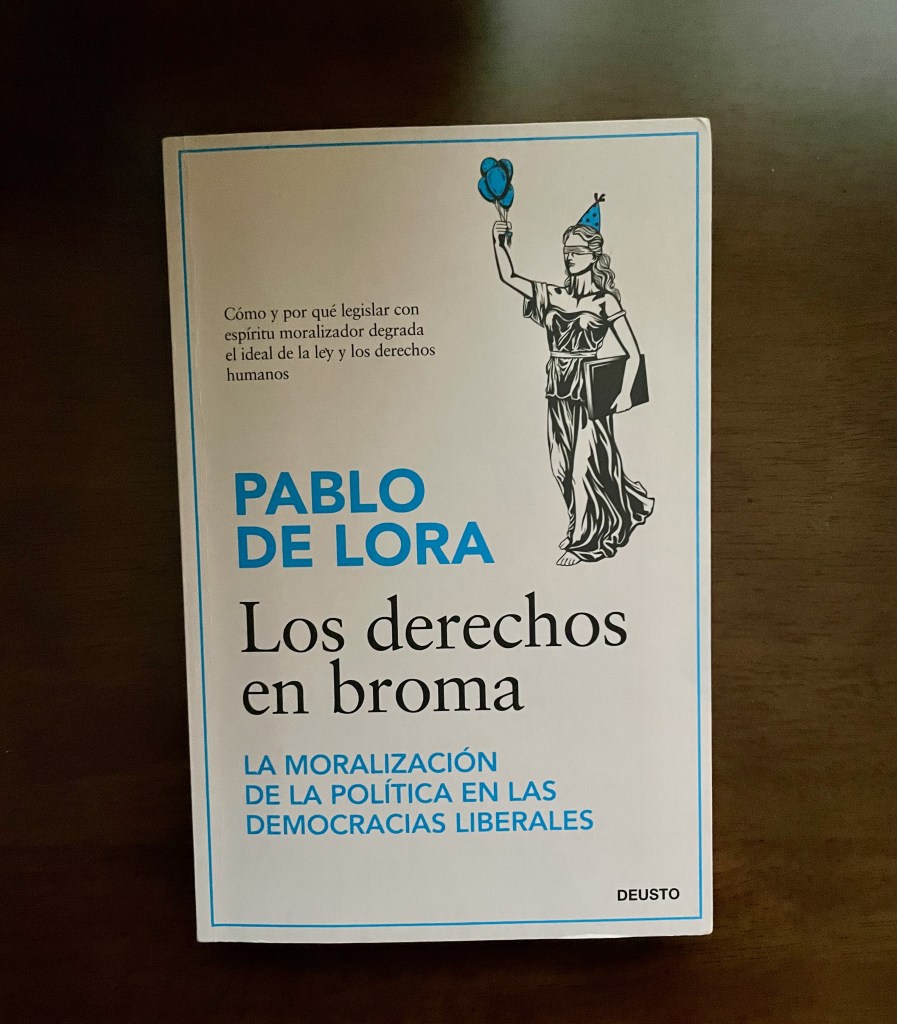
The crisis of the liberal legislative state is almost as old as the very project of the modern liberal state itself. And if we are to believe Carl Schmitt, the rise of the supreme values of the French revolution and ‘human rights’ (with its corollary of universal recognition within its normative system) also meant walking the fine line from the political theology of generative reform to the nihilism of ius revolutionis commanded by new discharges of individual will, political and technical movements, and immanent forces bringing the collapse of the separation between state and civil society. We are still living under its protracted shadow, albeit with a different intensity and intent. In his new book Los derechos en broma: la moralización de la política en las democracias liberales (Deusto, 2023), Pablo De Lora co-shares this point of departure, while daring to suggest a new sequence after the collapse of modern political form and legal order: we are currently living under a particular epochal transformation that is anti-legalist (sic) in nature – precisely because of its surplus of legal motorization – that erects a “nursery state” for the totality of the political community’s reasons and justification for action (De Lora 23).
Although De Lora case studies shown are almost entirely derived from the Spanish and Latin American contemporary social contexts, I do think that his sharp diagnosis could be extended to the epoch itself without blurring the important nuances. This is an epoch of a reigning “emphatic constitutionalism” (Laporta) or the total Constitution (Loughlin), at the same time that it no longer takes too much effort to imagine a political community devoid of a legislative body, as one eminent constitutional scholar has said repeatedly [1]. We are already here. In other words, whether by excess or deficit, the overall purpose of moral driven legislation announces the internal transformation of modern politics as we know it, extending itself to a civilizational regression from the ideals and norms of the Enlightenment rooted in the fiction of the citizen, the binding of the social contract, and the invention of the principle of sovereign authority.
De Lora does not quite says it in this way, but I think I am not diverting too much of his cartography when extracting some of the central consequences of these internal moral substitutions that are palpable everywhere across the West: ecological legislation that increases social conductivity and expansion of natural destruction; ‘feminist’ anti-sexual aggression that leads to lowering of sentences for convicted sexual predators; the inflationary instrumental use of “Human Rights” for persons and things, but only defined narrowly by those that, under the thick haze of institutional hegemony, can deprive their political adversaries and enemies of the most basic legal guarantees of due process transforming them into non-persons. These ‘moral substitutions’ is part of the “ironic” and “futile” consequence of the sacralization of morality whose end is the management of the “social model” at all costs. According to Pablo De Lora, within the limits of confronting a social dilemma such as disability, the specificity of the “case” is turned on its head; what matters is the overall structural design of the social order and its infinite adaptive changes (De Lora 71-72).
This mutation generates all sorts of unintended consequences when the rhetoric of “social benefit” takes the lead. As De Lora writes: “No hay apoyo anticipado a la discapacidad mental sin reconocimiento de que el discapacitado mental no puede ejercer su autonomía en el futuro. Dicho de otro modo, la institución de las voluntades anticipada de la lógica desideratum de modelo “médico” de la discapacidad mental que se rehuye en beneficio del modelo social” (De Lora 85). And in spite of normative incoherence within an institutional system, the deflection to the “social model” requires ever-expanding commands, rules, principles, and hyper-amendments to guide the adverse proliferation of reasons for action within the social state (in the United States this is soften by the police powers of inter-agency statutes of the administrative state through cost&benefit balancing of discretionary principles under the supervision of the executive branch). This transformation entails the collapse of the internal mediation between the validity of norms and its foundation in social facts as in the classical construction. Thus, the expansion of value-driven legislation that also requires of specific adjudicative constitutional theories, such as legal interpretation and the theory of balancing of principles advocated by Robert Alexy, the sponsors of social neo-constitutionalism, but also the embedded dialogic ideological positions of constitutional scholars such as Roberto Gargarella (or in the United States context, the work of Mark Tushnet and the so-called anti-originalist ‘living constitutionalists’).
All things considered, the fundamental problem for De Lora is that this specific transformation enacts what he calls a “Estado parvulario” or ‘nursery state’ that he defines as: “El que denominado “Estado parvulario” da pábulo a que el poder público, en sus diversos instancias y encarnaciones, escamotee las realidades y consecuencias que conllevan algunas discapacidad per oa que lo haga de manera internamente inconsistente: tratando a los menores como adultos, pero sólo simbólicamente, y, en cambio, de manera efectiva, a todos los ciudada como menores, congénitamente desvalidos, incapaces de encarar la realidad” (De Lora 87). In the framework of the nursery state within its specific moral legislative apparatus, children become adults and the mature civil society regresses to an infantile stage. And like in a nursery setting, the democratic virtues pave the way for new dramatic effects where the function of rhetorical annunciation – so central for the any credentials of moral hegemony – forecloses the void between morality and politics in the wake of the unification that the social model requires to begin with (De Lora 89).
This slippery slope can only lead straight to a sacralization of the political system that runs co-extensively with the infinite expansion of social rights; which, in turn, leads to an ever increasing conflict over the assumptions regarding its social facts (De Lora 151). In this narrow form, De Lora is audacious when citing Martin Loughlin’s recent indictment from his Against Constitutionalism (2022): “En la era de la Constitución total, el gobierno bajo el imperio de la ley ya no significa el gobierno sujeto a reglas formales independientemente pulgadas. Significa gobierno de acuerdo con principios abstractos de legalidad que adquieren significado sólo cuando son insuflados con valores…” (De Lora 188). And we know perhaps too well that values cannot be reasoned, but only weighted; values are commanded and taxed on the permanent devalorization of other values. This is why the rise of the value fabric of constitutionalism coincides with the ‘weighting’ proportionality of principles of law’s ideal social efficacy, to paraphrase Robert Alexy’s influential position as claim for “anti positivist legal justice” [2]. The nursery social state cannot be corrected merely from the position of the legislator; it can also be tracked as a triumph of moral jurisprudential theories of law that seek to overcome (and provide answers) to the overall crisis of institutional authority that characterized the so-called ordered liberty of the moderns.
Is there anything to be done beyond a description? It is quite clear that Pablo De Lora’s ambition is not so much the proposition of a new political or legal philosophy as much as the sketch of the current epochal predicament in its current practice. This is already enough to welcome a robust analytical discussion of our predicament in Los derechos en broma (2023). However, there is a cobweb of affinities in De Lora’s own position towards the end of the book that, even if not fully developed, must be registered as a mode of conclusion. First, there is an affinity with John Hart Ely’s deferential conception of judicial power that aims at overseeing the procedural mechanism for the democratic deliberation and legislation over a hot-button issues. In this vein, De Lora shares Akhil Amar’s position regarding the overturning of Roe in the Dobbs’ decision; a conception that fully embodies judicial deference to diverse legislative majorities [3]. Secondly, De Lora favors a judicial minimalism associated with the doctrinal theory sponsored by James Bradley Thayer over the practice of judicial review of the Court (De Lora 233). And last, but not least, De Lora sees transformative potential in John Rawls’ assertion in his late Political Liberalism (1993) that the use of public reason is a comprehensive doctrine to deal with our fundamental disagreements and contentions over shared political values (De Lora 241).
I am not sure how deep or for how long does De Lora wants to go with Rawls; however, it is important to remember – and specially given the treatment of the ‘social model’ in the morality presented in Los derechos en broma (2023) – that insofar as social paternalism is concerned, Rawls’ late liberal political philosophy at the heart of the crisis of the secular liberal state amounts to a political conception that, as Eric Nelson has brilliantly shown, abandons the commitment of individual non-cooperation or refusal to cooperate with unjust moral legislative burdens, and thus making everyone stuck in the same ship [4]. This ship is the management and balancing of the totalization of the values being trafficked in the Social as ‘egalitarian’, although they are fully endowed as a seterological scheme of “election” (and who is elected) balanced by secondary compensations.
On a larger canvas, if the current political structure is defined as a nursery state of social rights, then this means that appealing to ideal positions of justified reasons, “diaphanous” deliberation, and well crafted citizen arguments belong to the age of maturity of the Enlightenment, but not to the stage of social infantile disorder. And demanding political qualifications to the contemporary citizen today is not only naif, but at odds with what what institutional thinking requires. In other words, the concrete transformation of the post-liberal state is one of permanent optimization of conflict, which is why John Gray has lucidly defined the (contemporary) ‘new Leviathans’ are “engineers of the soul” with broad and sweeping capacities to govern over every inch of the social space [5]. In the wake of these institutional mutations, the call endorse a “moral critique” might be taken as a post-enlightened lullaby that among the blasting and striding cries of infants of the nursery will most likely just pass unheard.
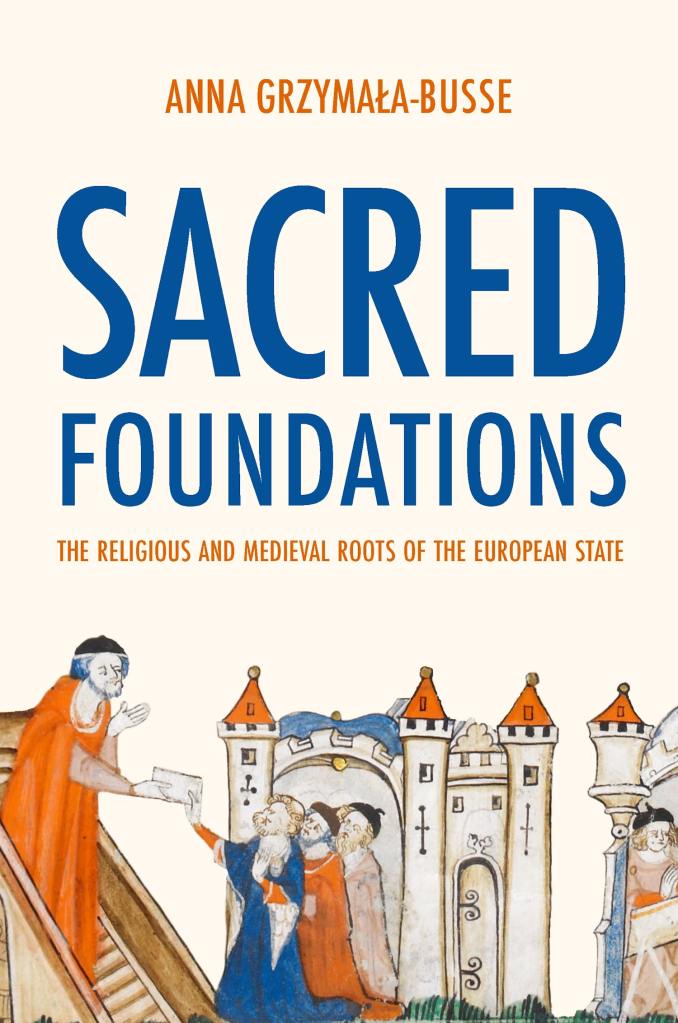
Anna Grzymala-Busse’s recent study Sacred Foundations: The Religious and Medieval Roots of the Modern State (Princeton U Press, 2023) makes a compelling historical and data analysis grounded case for the emergence of the modern state through the process of the Church’s autonomization in its ongoing disputes with the European monarchs across the centuries. This process of the secularization of ecclesiastical forms (conciliarism, legal administration, the uniformity of procedures, rules for governing institutions, the emergence of educational training and mechanisms for political representation and fiscal control, etc), however, is silent about two defining features of the modern secular state. And I do not think it is an exaggeration to say that these two elements bring forth the way in which political authority was established after the victory of modern European Enlightenment. Busse’s book, if anything, has the felicity of putting in perspective, even if only in negative, the two pieces of the puzzle: a) coercion as guarantee by a legal process (not just the monopoly of force); b) and the inter-institutional coordination that we tend to associate with a ‘principle of an internal rule of recognition’ between different spheres of bureaucratic rationality. Busse admits for (a) that “….the authority of the people over the whole Church was not statelike. It depends on moral authority and influence, not on coercive control. Both kings and popes cajoled, convinced, and threatened rather than demanded or extracted force” (Busse, 78). But ruling on morality and influence are two weak presuppositions to guarantee systemic, homogeneous and uniform process required by institutional authority.
In other words, the Church was able to construct forms of civil mediations, although it lacked the power of efficacy; that is, a coherent set of reasons for action that would define a strong concept of sovereign authority as service (to put it in Raz’s well-known formulation). The classical apothegm by which ‘kings rule rule but do not govern’ (Rex regnat sed non gubernat) now is protracted by the exercise of an efficacious rule, which means laying out a combination of forms and a well-ordered power over coercive forms. In fact, this is one feature that will define the legitimacy of the Enlightenment according to historian Franco Venturi; the discovery of punishment understood within the scheme of a trade off between the “necessity of the right to punish when man was not able to re-establish communism” [1]. Hence, the genesis of modern legitimation is not exclusively “a given” vis-a-vis the structure of separation of powers and the ultimate source of the plenitudo potestatis; rather, it requires a second-step rule, as it were, to convalidate the specificity of institutional authority with ample concrete efficacy of police powers in charge of compliance and punishment. The reach and exercise of public police powers and the systematic ordering of penal codes through a criminal procedure and its guarantees (reasonable doubt, fair trial and due process, no crime published without a previous enacted law, nullum crimen sine lege) is what renders effective and “energic” the principle of authority.
Now, broadly speaking, when it comes to (b) Busse admits that (and this is in spite of its institutional schemes) laying down justice “…the church relied on secular enforcement, for example when it came to religious orthodoxy. […] The carrying out of sentences against heretics and apostates lay in secular hands – those found guilty were handed over the temporal authorities so as to not sully the clergy. Legal coevolution and influence, the struggles between popes and monarchs, and the diffusion of both canon law and personnel into the juridical systems were critical to the rise of constitutionalism and the rule of law in Europe” (Busse, 132-133). This asymmetry between two systems of legal jurisdiction confirm the inexistence of a strong internal rule of recognition that for H.L.A. Hart defines any robust modern legal system of public law. The internal rule of recognition, one must remember, is not a set of principles or norms for social action, but rather the internal mediation between a legislative authority and its internal obedience within a concrete application thereof. The internal rule of recognition binds a central authority with its specific formal enforcement in institutional union of primary rules and secondary rules to avoid the pathology of uncertainty. This is thoroughly absent from the free-floating institutional forms of the medieval church whose principal construction of primary rules was divorced from the objective and rational procedures of its internal coherence (the rule of recognition) that would ground, in time and place, the otherwise abstract primary norm and the pressure of contested social conflict.
But going straight to the crux of the matter, it follows that medieval templates as superbly redrawn in Busse’s studies lack the two fundamental determinations that ground the modern concept of law: law as the necessarily monopoly over coercion (the Austin thesis), and the concept of law as the construction of an internal rule of recognition to unite primary and secondary rules (the Hart thesis). But insofar as all major modern political concepts and mediations are secularized forms of religious and medieval forms – something we can say that Busse’s scholarship also confirms – we can then say that modern legitimacy will consist in the congruence of these two determinations to organize the mediations between civil society and state. Already in his early The value of the state and the significance of the individual (1914), Carl Schmitt will note of this formal transplant: “…the Catholic doctrine of the Pope as the infallible interpreter of the natural moral law and of the content of revelation, who receives the competence to declare state statutes that stand in contradiction with the moral law or ius divino-naturale to be non-obligatory in conscience. The exercise of his potestas indirecta which is regarded as an act of jurisdiction, and which is held, by many canonists, to be determinative of a statute’s validity in state law – contains real vis coactiva, even where the expression potestas directiva is employed in place of potestas indirecta (Suárez, de fide cath, 3.22.1)” [2].
For Schmitt, then, the process of rationalization between ecclesiastical form and the modern legal norms of the state is very much straightforward. This is what constitutes the very texture of secular modernity. But as we know, for Schmitt the secularization of forms was not enough – it must be said that he himself did not negate in his theory of adjudication of his constitutional thought – which is why the construction parameters of his ‘political theology’ proposes supplemental safeguards to isolate law and power, extending the power of secularization into the decision of the potentia dei asoluta (at times this was contained in the theological figure of the Katechon) [3]. But as Carlo Galli has noted, Schmitt’s political theology is far from a “political christology” or a substantive theological politics grounded in natural law; rather it is a resolute affirmation to defend any concrete order from the potential fallouts of the secularized cornerstones of rational neutralization (potentia directiva and potestas coactivva) of state authority [4]. Neither mechanic state forms nor a higher source of morality (natural law) would define the modern law; rather the autonomy of the political in the existential situation could provide the sufficient energy to avoid the self-defeating circularity of ius revolutionis (this is what most of the times is obliterated from the so called question of “decisionism”)[5]. If Busse is correct in making the case that all modern institutions have sacred medieval foundations; Schmitt’s concurrence in the wake of modern secularization will be to define the energy of the political as the defining element that must stand as the threshold of formal transplantations to have a chance within nihilism and against nihilism. It is both things. In other words, formlessness is the constitutive dimension of political forms; an element that defines, in my view at least, the strongest practical element of what it is to inherit a Christian political foundation. The process of secularization is thus infinite and groundless, ultimately without a moral foundation and universal design. Among its many achievements, a book like Sacred Foundations: The Religious and Medieval Roots of the Modern State (Princeton U Press, 2023) has the ability to refine what political theology is, what it meant, and what to make of its endurance and possible iterations in our present.
.
.
Notas
1. Franco Venturi. Utopia and Reform in the Enlightenment (Cambridge University Press, 1971), 116.
2. Carl Schmitt. The value of the state and the significance of the individual, in Carl Schmitt’s Early Legal-Theoretical Writings (Cambridge University Press, 2022), eds. Zeitlin & Vinx, 215.


 Infrapolitical Reflections