Casa Bayona’s pensive slave. by Gerardo Muñoz

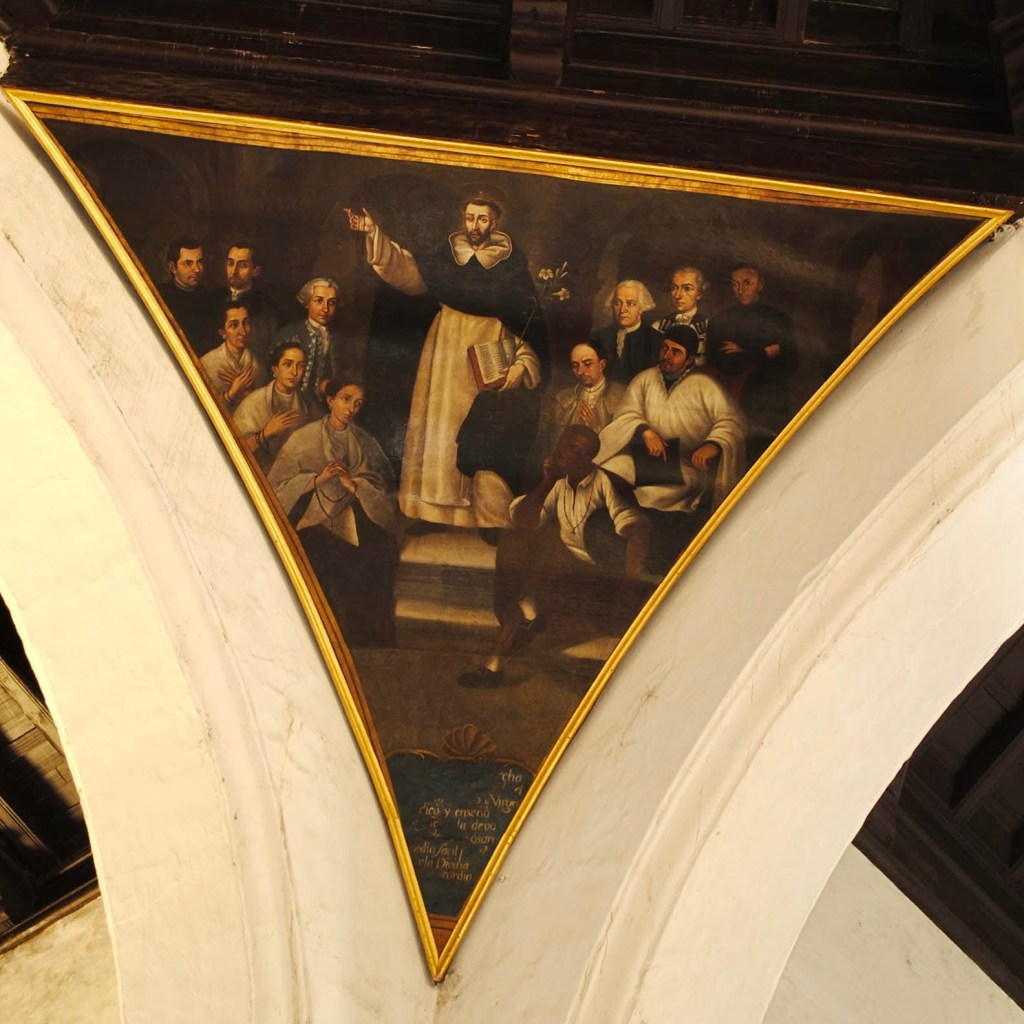
In the Church Santa María del Rosario of Havana there is a pendentive cycle completed in the 1770s painted by the baroque artist José Nicolás de Escalera – whom according to Guy Pérez Cisneros, was truly the first professional Cuban painter of the tradition – that includes a black slave in a pensive pose seating on a lower step, just below a Dominican priest who figures prominently in the middle of the picture holding a Bible and raising his right arm forward [1]. It has been noted that the figure of the black slave is also the first portrait of a slave in the New World, and its meaning has been highly disputed. The enigmatic slave or liberto portrait shows the man in a thinking pose, with a folded long white shirt, and what seems to be a wooden rosary hanging in plain sight. It is hard to make the details of his facial expressions, but it is obvious that his gaze is neither upwards nor directed at the viewer, but rather suspended, as if were, in a moment of attention and rest (and also listening?). The context here is fundamental, since Santa María del Rosario Church was commissioned by the Count of Bayona, a wealthy member of the sacarocracia (sugar plantation owner) after a previous church was burned to the ground by a slave revolt that took place in 1727 in an act of complete defiance to Christian indoctrination. 

The event that only has come down to us in just a handful of mentions and erasures of the colonial archive is featured prominently, as we know, in Manuel Moreno Fraginals’ El Ingenio when the historian documents the spiritual schism of the eighteenth century colonial plantations of the island. According to Fraginals’ historical account, the slave insurrection in the plantation took place in the wake of a theatrical enactment proposed by the Count of Casa Bayona in an act of repentance and humility aiming to mimic a well known moment of the Christian story: one day the Count washed the feet of twelve slaves, and when he finished he made them sat with him for dinner. Later that afternoon the slaves revolted and burnt down the whole sugar mill, including the chapel, to the ground. The episode ended with a plantation mayoral officer hunting down the runaway slaves, who was ordered to place the heads of the dead slaves high in spikes for the Count and everyone to see them [2]. It is an early staging of visibility and bodily dominion that the modern epoch will take to its final conclusion. 

The portrayal of human suffering was a symptom of the impossible hegemony of christianization of body and soul that the missionary Nicolás Duque de Estrada decades later will try to deploy in his pedagogical treatise Explicación de la doctirna cristiana acomoada a la capacidad de los negros bozales (1823), which argued that obedience of slaves could be achieved by implating “guilt” and work ethic in the affective interiority, in the forum internum of their souls. But even Estrada was of the fact that after sixteen hour workdays the Christian ascesis was imperceptible and little more than convoluted chatter to the ears of the slave. It is almost as if the slave, separated from the politico-theological inscription of salvation, was already outside the subjective domination of productive bondage and political freedom.

When Escalera was commissioned to do the cycle of frescos at Santa María del Rosario he was asked to combine a twofold narrative: the history of Christian salvation and the story of the Casa Bayona. At the center of the altar piece is the world as a common house or oikos, that carries history and its bodily sovereignty forward. One possible reading of the pensive slave shown in Santa María del Rosario’s pendentive is to assume that this figure is completely outside the eschatological vision embodying a sense of freedom that only painting could have documented in its unique and mute language. This raises the question about the relation between painting and freedom in which the figural emerges unmistakably fixed beyond historical narration. Although writing about Cézanne’s late work, Kurt Badt once suggested that there is no such a thing as the representation of freedom, but rather “painting generates a concept of freedom as two-faced: negatively, it is liberation from isolation and resistance, positively to the serious gentleness of freedom….expression in freedom to the scene from nature, which declares the world to be existing together, a mutual self-supporting and carrying of things” [3]. The pensive slave portrayed in the pendentive does not embody freedom understood as the spiritual accumulation of rights and duties known to the order of historical transformation; rather is an absolute pictorial appearance of freedom because it embodies, in its non-separation of life and thought, a static moment of a being that contemplates the liberty of his potency.

What is striking about the collective portrait where Escalera inserted the former slave is what we can call, following Bernard Berenson, a dimension of the ineloquent that appears just as “mute, with no urgent communication to make, and no thought of rousing us with look and gesture. If they express anything it is the character, essence rather than momentary feeling or purpose. They manifest potentiality rather than activity. It is enough that they exist in themselves” [4]. In the pensive gesture of his pose, the slave is the untouched existence and the revolt that rips the escathological narrative that ordains the interiors of Santa María del Rosario. Malraux once noted that the age of the divine disdained the realistic portrait of an ordinary person, because he was too distant and mundane from the stone conclave of the gaze of the gods. The slave’s inexpressive ‘naturalness’ refrains from partaking into a mood compensated by the semantic compulsion of the colonial painter, because his naturalness discloses the indestructible soul that has transfigured the realm of the divine. 

The unfathomable mystery of the pensive slave or liberto is the obscure and yet luminous portrait of a life in thought that is, at the same time, the thought of a life that is forever inexpressive, and as such the highest state of imperturbable freedom in the aftermath of worldly destruction. The ‘gentleness of freedom’ that Badt locates at the heart of painting is the imperative of the stream that carries, and yet restrains, thought and appearance into the figure of life. The freedom that anchors painting – because such freedom is never realized in painting except as vulgarity – becomes a tacit secret for which ultimately there is no image.  

Notes 

1.Guy Pérez Cisneros. Características de la evolución de la pintura en Cuba (Ministerio de Educación, 1959).

2. Manuel Moreno Fraginals. El Ingenio (Crítica, 2001), 99.

3. Kurt Badt. The Art of Cézanne (Faber & Faber, 1965), 314.

4. Bernard Berenson. Piero Della Francesca: The Ineloquent in Art (Chapman & Hall 1954), 7.

Introduction to José Bergamín’s For Nothing in the World (1937). by Gerardo Muñoz

The essay “Por nada del mundo. Anarquismo y Catolicismo”, by Spanish poet and essayist José Bergamín, should be read as a wartime reflection on the historical impasse of the Spanish Civil War. First published in Emmanuel Mounier’s Catholic journal Esprit in the 1937 April issue, the essay in its final version featured in Bergamín’s Mexican exile collection Detrás de la cruz: terrorismo y persecusión religiosa en España (Lucero, 1941). While on the surface Bergamín is responding to the struggle between secular political anarchism and traditionalist Spanish Catholicism intertwined at the heart of the civil war, the essay is also highly idiosyncratic in laying out the poet’s theological vision that permeates his entire body of work, and which can already be found, in nuce, in the fragments and aphorisms of his first book El cohete y la estrella (Índice, 1923). “Reality is the spirit, imagination, and thought…there is religiosity when it claims space positively”, he would write in the first pages of that book. 

The 1937 essay, along with his defense of illiteracy in “Decadadencia del analfabetismo” (1933), Bergamín argues for a living theology of the Spanish people (pueblo) that is neither imperial nor clerical, but rather always an excess to the imperial political theology that dominated the long historical narrative of Spanish modernity since the Reconquista. It was thanks to Bergamín’s genius that Catholicism appears connected to a habitual form of life of everyday people, their shared language, symbols, and experiences; and, ultimately the common imagination that grants them access to the world through the mystery of living and dying. In fact, as in “Decadencia” (1933), it is important to highlight the centrality of the term “pueblo”, which although translated as “people”, it coincides neither with the “People” of the unity of civil society nor the common historical identity of the Nation. For Bergamín, these determinations, in fact, were corrupted notions of pueblo. The pueblo is always the event that remains from the abstraction of political theology, and always pueblo minoría, a ‘minor people’ that dwells in the house of God within and beyond the mundane. This is why Bergamín would claim in the text that the pueblo is always ancilla mundi. In this light, Bergamín thought that political anarchism incapable of a revelation to the divine, and an imperial Church in charge of the administration of the “nothingness”, were two poles of the same vectorial force of modern nihilism. That was the color of his corruptio optimi pessima with clear echoes of Fridugisus’ De nihilo et tenebris

In “Por nada del mundo. Anarquismo y Catolicismo”, Bergamín’s theological position emerges as a third way to exit this historical poverty of relating to the theos. As Giorgio Agamben observes in a 1973 entry of Quaderni (Quodlibet, I, 2024, 46-47), for Bergamín the divine entails a corporeal cohabitation of a demon and an angel that expresses appearance of life, and thus the sensible and poetic mediation with the world of forms. In this sense, Bergamín’s theology differs fundamentally from the rational and canonical traditions, fostering the sensorial path of dramatic and divine beauty. This goes to the kernel of the 1937 essay: the rise of the Totalizing State (historical Fascism), was a corrupting form of theos insofar as it aimed at regulating the “nothingness” against the possibility of appearance and truth. But the word of God and the angelic hymns linger in the time of wreckage and devastation in its impatient drift towards anger in the world, which is still very much our own. Ultimately, Bergamín was convinced that the pueblo’s mute voice, resurfacing from the depths of pain, could dodge the abysmal fall into the tribulations of radical evil always too congenial with the survival of ‘this world’.

* This gloss was written to accompany the English translation of Bergamín’s “Por nada del mundo” forthcoming at New Personalism, summer 2025. 

Two side notes on Anna Grzymala-Busse’s Sacred Foundations: The Religious and Medieval Roots of the European State (2023). by Gerardo Muñoz

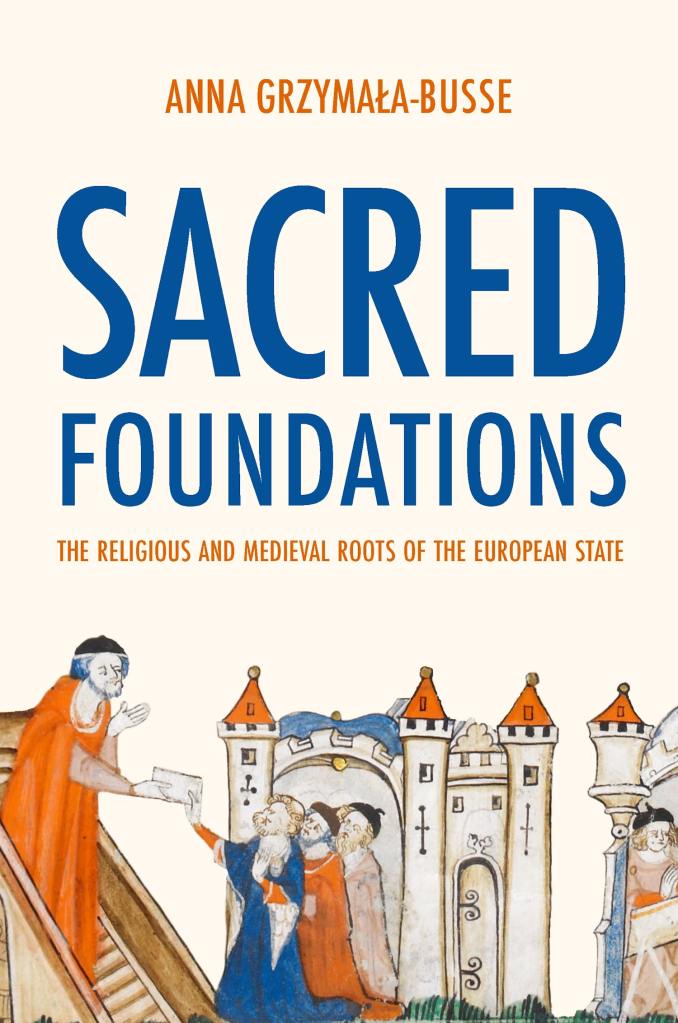
Anna Grzymala-Busse’s recent study Sacred Foundations: The Religious and Medieval Roots of the Modern State (Princeton U Press, 2023) makes a compelling historical and data analysis grounded case for the emergence of the modern state through the process of the Church’s autonomization in its ongoing disputes with the European monarchs across the centuries. This process of the secularization of ecclesiastical forms (conciliarism, legal administration, the uniformity of procedures, rules for governing institutions, the emergence of educational training and mechanisms for political representation and fiscal control, etc), however, is silent about two defining features of the modern secular state. And I do not think it is an exaggeration to say that these two elements bring forth the way in which political authority was established after the victory of modern European Enlightenment. Busse’s book, if anything, has the felicity of putting in perspective, even if only in negative, the two pieces of the puzzle: a) coercion as guarantee by a legal process (not just the monopoly of force); b) and the inter-institutional coordination that we tend to associate with a ‘principle of an internal rule of recognition’ between different spheres of bureaucratic rationality. Busse admits for (a) that “….the authority of the people over the whole Church was not statelike. It depends on moral authority and influence, not on coercive control. Both kings and popes cajoled, convinced, and threatened rather than demanded or extracted force” (Busse, 78). But ruling on morality and influence are two weak presuppositions to guarantee systemic, homogeneous and uniform process required by institutional authority.

In other words, the Church was able to construct forms of civil mediations, although it lacked the power of efficacy; that is, a coherent set of reasons for action that would define a strong concept of sovereign authority as service (to put it in Raz’s well-known formulation). The classical apothegm by which ‘kings rule rule but do not govern’ (Rex regnat sed non gubernat) now is protracted by the exercise of an efficacious rule, which means laying out a combination of forms and a well-ordered power over coercive forms. In fact, this is one feature that will define the legitimacy of the Enlightenment according to historian Franco Venturi; the discovery of punishment understood within the scheme of a trade off between the “necessity of the right to punish when man was not able to re-establish communism” [1]. Hence, the genesis of modern legitimation is not exclusively “a given” vis-a-vis the structure of separation of powers and the ultimate source of the plenitudo potestatis; rather, it requires a second-step rule, as it were, to convalidate the specificity of institutional authority with ample concrete efficacy of police powers in charge of compliance and punishment. The reach and exercise of public police powers and the systematic ordering of penal codes through a criminal procedure and its guarantees (reasonable doubt, fair trial and due process, no crime published without a previous enacted law, nullum crimen sine lege) is what renders effective and “energic” the principle of authority.

Now, broadly speaking, when it comes to (b) Busse admits that (and this is in spite of its institutional schemes) laying down justice “…the church relied on secular enforcement, for example when it came to religious orthodoxy. […] The carrying out of sentences against heretics and apostates lay in secular hands – those found guilty were handed over the temporal authorities so as to not sully the clergy. Legal coevolution and influence, the struggles between popes and monarchs, and the diffusion of both canon law and personnel into the juridical systems were critical to the rise of constitutionalism and the rule of law in Europe” (Busse, 132-133). This asymmetry between two systems of legal jurisdiction confirm the inexistence of a strong internal rule of recognition that for H.L.A. Hart defines any robust modern legal system of public law. The internal rule of recognition, one must remember, is not a set of principles or norms for social action, but rather the internal mediation between a legislative authority and its internal obedience within a concrete application thereof. The internal rule of recognition binds a central authority with its specific formal enforcement in institutional union of primary rules and secondary rules to avoid the pathology of uncertainty. This is thoroughly absent from the free-floating institutional forms of the medieval church whose principal construction of primary rules was divorced from the objective and rational procedures of its internal coherence (the rule of recognition) that would ground, in time and place, the otherwise abstract primary norm and the pressure of contested social conflict.

But going straight to the crux of the matter, it follows that medieval templates as superbly redrawn in Busse’s studies lack the two fundamental determinations that ground the modern concept of law: law as the necessarily monopoly over coercion (the Austin thesis), and the concept of law as the construction of an internal rule of recognition to unite primary and secondary rules (the Hart thesis). But insofar as all major modern political concepts and mediations are secularized forms of religious and medieval forms – something we can say that Busse’s scholarship also confirms – we can then say that modern legitimacy will consist in the congruence of these two determinations to organize the mediations between civil society and state. Already in his early The value of the state and the significance of the individual (1914), Carl Schmitt will note of this formal transplant: “…the Catholic doctrine of the Pope as the infallible interpreter of the natural moral law and of the content of revelation, who receives the competence to declare state statutes that stand in contradiction with the moral law or ius divino-naturale to be non-obligatory in conscience. The exercise of his potestas indirecta which is regarded as an act of jurisdiction, and which is held, by many canonists, to be determinative of a statute’s validity in state law – contains real vis coactiva, even where the expression potestas directiva is employed in place of potestas indirecta (Suárez, de fide cath, 3.22.1)” [2].

For Schmitt, then, the process of rationalization between ecclesiastical form and the modern legal norms of the state is very much straightforward. This is what constitutes the very texture of secular modernity. But as we know, for Schmitt the secularization of forms was not enough – it must be said that he himself did not negate in his theory of adjudication of his constitutional thought – which is why the construction parameters of his ‘political theology’ proposes supplemental safeguards to isolate law and power, extending the power of secularization into the decision of the potentia dei asoluta (at times this was contained in the theological figure of the Katechon) [3]. But as Carlo Galli has noted, Schmitt’s political theology is far from a “political christology” or a substantive theological politics grounded in natural law; rather it is a resolute affirmation to defend any concrete order from the potential fallouts of the secularized cornerstones of rational neutralization (potentia directiva and potestas coactivva) of state authority [4]. Neither mechanic state forms nor a higher source of morality (natural law) would define the modern law; rather the autonomy of the political in the existential situation could provide the sufficient energy to avoid the self-defeating circularity of ius revolutionis (this is what most of the times is obliterated from the so called question of “decisionism”)[5]. If Busse is correct in making the case that all modern institutions have sacred medieval foundations; Schmitt’s concurrence in the wake of modern secularization will be to define the energy of the political as the defining element that must stand as the threshold of formal transplantations to have a chance within nihilism and against nihilism. It is both things. In other words, formlessness is the constitutive dimension of political forms; an element that defines, in my view at least, the strongest practical element of what it is to inherit a Christian political foundation. The process of secularization is thus infinite and groundless, ultimately without a moral foundation and universal design. Among its many achievements, a book like Sacred Foundations: The Religious and Medieval Roots of the Modern State (Princeton U Press, 2023) has the ability to refine what political theology is, what it meant, and what to make of its endurance and possible iterations in our present.

Notas 

1. Franco Venturi. Utopia and Reform in the Enlightenment (Cambridge University Press, 1971), 116.

2. Carl Schmitt. The value of the state and the significance of the individual, in Carl Schmitt’s Early Legal-Theoretical Writings (Cambridge University Press, 2022), eds. Zeitlin & Vinx, 215.

3. See my “Schmitt y Hart: los puntos fijos del concepto de derecho”, 2022: https://infrapoliticalreflections.org/2022/11/07/schmitt-y-hart-los-puntos-fijos-del-concepto-de-derecho-por-gerardo-munoz/ 

4. Carlo Galli. Genealogía de la política : Carl Schmitt y la crisis del pensamiento político moderno (Unipe, 2019), 301. 

5. Jorge Dotti. “Sobre el decisionismo”, en Lo cóncavo y lo convexo (Guillermo Escolar Editor, 2022), 391.

The melody of the soul: on Guy de Pourtalès’ Nietzsche in Italy (2023). by Gerardo Muñoz

Nietzsche in Italy (Pushkin Press, 2023) by Guy de Pourtalès, originally published in 1929, has a particular texture that makes it inadequate to consider it a standard intellectual biography. Pourtalès does not follow the contours of the psychological and chronological construction; rather he is more interested in sketching out the telluric effects on the transformative tonality in the thinker’s soul. Nietzsche’s radiant affinity to Italy and “latinity” has been well known, and at stake there is the possibility of finding an exit from the grandiose enactments of the German romantic gestalt. For Pourtalès, “latinity” is the prescription that Nietzsche writes out for himself in order to maintain sanity in the world; and, ultimately, to find its own destiny and path in the face of modern nihilism. Sure thing, Italy is many things for Nietzsche: it is the zenith of his poetic relationship with the Wagners but also their farewell in Sorrento; it is Venetian music and pleasant weather; it is the open and physical form of a possible community of the Free Spirits and artistic expressivity. And Italy is also a refuge from brewing culture of force in the North through the Renaissance uomini singulari where music persists, as he writes to his friend Peter Gast: “Life without music is imply a mistake, enfeeblement, an exile” (94). Pourtalès narrative collage (the different vignettes of Nietzsche’s visits and residencies in the Italian geography) detects the philosopher’s fundamental existential homecoming: a melody of the soul in a world increasingly organized through the chaos as the essence of force. To be attuned to the melody of the soul becomes the task of the artist: “to hear and see beyond the vast “lost time” of humanity what others no longer hear or see, but just unwittingly hum as a tune, vague and wordless”, writes Pourtalès (41).

And if music is an aesthetic form of prophecy, Pourtalès’ sheds light on Nietzsche’s insistence to become a prophet of the age of nihilism: wrestling with the poignant homelessness in the human world of a postmythical age. Pourtalès insists that the “Italian experience” opens up for Nietzsche multiple possibilities to confront the Wagnerian solution through the concretion of the forced and unhealthy (these are Pourtalès’ terms) aesthetic formalization of the mythic redemption. The Nietzschean attempt (the beloved and unresolved versuch) is the final confrontation of “music versus music”, since “all philosophy is a series of events of the soul and finds its symbol only in music” (49) explains Pourtalès. This is what Italy seems to be providing Nietzsche with: the withdrawal from the intoxication of the “Wagnerian flame without being consumed by it” (66). This entails an acceptance to pain without instrumentalizing the rewards provided by the genial artistic form of the Gesamtkunstwerk and the enslaving commandments of Christianity. Wagner and Christianity now stand in the way of the path of destiny without paying dues to mimetic investments. This is Nietzche’s last battle, and thanks to Pourtalès we realize that Italy becomes the battleground for an ultimate detachment. But is it successful? Is Nietzsche as the artistic genialismus prophet able to accomplish the radical abandonment? 

This is the resolute ambiguity in Nietzche’s proximity and distance from the Italian tonality. Indeed, Nietzsche seems never to have abandoned the rhetoric of the genialismus. Pourtalès quotes him: “Italian genius is by far the one which makes the freest and most subtle use of what it has borrowed…..and is thus the richest genius, the one with the most to give” (89). At times Nietzsche’s words about Italians or latinity is a metonymic for Christianity, his ultimate confrontation after Wagner, because to overcome Christianity implies to embrace the melody of life. This is why for Nietzsche Jesus is a higher form of life, whose kingdom is, according to Pourtalès (resonating here with the late work of Von Balthasar), “that of children, his faith is without rancor and without reprimand; it lives, it is itself its own miracle and reward” (100). The transfiguration of Christianity becomes a path to arrive at the very attunement of life itself, although this requires understanding love so that the “Kingdom of heaven becomes a state of the heart” (100). This nomos of the heart is Nietzsche’s ultimate and impossible search; perhaps one that does not truly find the path to a proper homecoming. 

Was it due to Nietzsche’s failed efforts at finding the melody of the soul in his ruthless, cuerpo a cuerpo (“Dionysius against The Crucified”), struggle against Christianity? Were the terms of the prophetic transfiguration a mere illusion of guidance and redemptive incarnation? To put it in Cowper Powys’ lucid observation: “If Nietzsche had not been obsessed by Christianity he would have thought of Life before Christ came”. Pourtalès does provide us with another hypothesis: “Perhaps amongst the last things he [Nietzsche] understood was the profound speech of this piano, of this fiend, whose inner music he had always been the only one to hear. But no thought, no word emerged from this ruinate soul. Nietzsche expired, walled up his silence” (110-111). In Pourtalès’ interpretation, Nietzche’s lacked the central aspiration of melody of the soul: “knowing how to love”, which is obviously the unlearned lesson from the Italian landscape and the world of visuality. The fact that Nietzsche had no patience for painting according to Pourtalès says a lot regarding his incapability for an erotic mediation to escape spiraling towards madness in a desperate effort for completion. I am not saying that painting could have saved Nietzsche; but, as the last active metaphysical activity in modern nihilism (Kurt Badt), pictorial persistence is the ultimate exercise to hold on to the world from the point of view of one’s daimon. Pictorial persistence clears the illusionary strife over concepts of the tradition. Pourtalès’s Nietzsche in Italy (2023), even if only obliquely, is as lucid of a portrait as we might get in order to raise this question in a serious fashion.

A gloss on the “element” of love. by Gerardo Muñoz

It might be the case that the self-evident nature of love as an affection proves itself lacking mediation in thought, insofar as it is a resource of mediation between thought and the world. In this sense, it is true that what one “loves” resists to be grasped as an object of representation or exposition; it is a question of limits, and those limits posit the question of the world. Now, love gives form, but it is not in itself a form or a mandate or an object. This means that love is outside of reality; indeed, it is the absolute indifference between object and world.

The question perhaps is one regarding proximity and distance. The problem of “nearness”, which is why in the text one reads the orphic inscription: “When we are in nearness to which we love we then go through the other side of the mirror.” Of course, what is interesting it not the “other side”, but rather to have become transformed by something without ever being entirely dissolved. Amor fati? Perhaps. In the transient path of the night one is opened to the condition of the “moon hunter”, in which one path reveals itself as the question of destiny (“one life”). The trick is that no path is ever ‘obligatory’, but rather validated by an access to an experience. Now, it is obvious that love cannot exhaust an experience, but there is no experience that is not affected by love, since it is this affection what inscribes the limit of a world without the fantasy of possession and abuse. 

Another moment: “In abusing something we no longer love; and even in the pleasure that were invested in we do not love”. Here the exotic (extemporaneous) nature of love becomes visible: no love is exhausted in materiality and form. Love is ex-scription: it demands exodus as homecoming. However, no fundamental fantasy of love can validate what is granted to us by the irreducibility of an experience. Perhaps this is after all what Gianni Carchia, reading Schelling called the “transfiguration with the divine”. Or, as I would like to call it, the intromission with the invisible [1]. In the invisible we carve out the limits of our deconstitution with our world in which our existence is possible through separation. 

There might a rebuttal, although it might not be one after all. It is a recent suggestion by a friend who claimed in a psychoanalytic speculation that: “Perhaps after all ‘love’ is a Christian invention, a compensatory and necessary one for the fact that we do not communicate”. There might be a few ways to respond to this claim; the first one being that the task of the transfiguration of love responds, precisely, to the subordinated status of love as mere compensation to the subject of sin and thus of the pleasure principle. The existence that can traverse the pleasure principle of the subject could be said to have gained reentry into a happy life capable of outsourcing the succession of infinite deaths while in life. 

Contrary to life or death, love might be another name for the orphic passage between the two states of potentiality; that is, of pure affection and the opening of the impotential in every life. To experience the death of what is possible as transient to the time of existence opens the path towards a “life to come…in underground streams” (Auden). If love is to be taken as compensatory to the impossibility of communication, then there is a love of thinking, but not necessarily a thinking of love. It is strange that philosophy – just as “liberty” for political thought – fails when measuring itself up to a thinking of love, a vertigo before the immemorial attunement to the state of mousikos. Such is the taking place among the things that we have surprised in the world, but only accessible to those who “seek” outside reality. 

.

Notes 

1. Gianni Carchia. “Indifferenza, eros, amore: la critica dell’essere spirituale nella “filosofia della libertà” di Schelling”, in L’amore del pensiero (Quodlibet, 2000), 101-121.