The love of painting. by Gerardo Muñoz

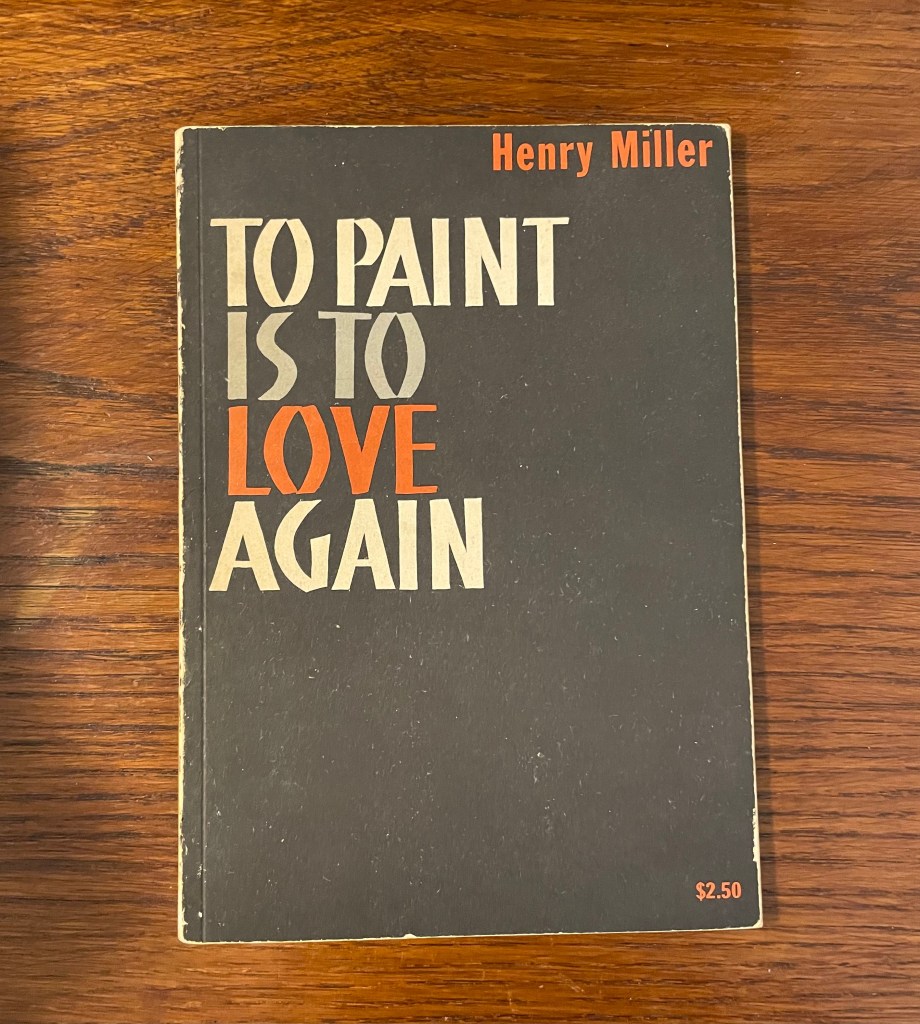
There might very well be an internal affinity between painting and love that at some point it becomes indistinguishable. A painterly picture can become love unquenched for that which remains persistently fixed and unrealizable. In one of the short essay books of his Big Sur period, Henry Miller asked this very question of painting. For him panting had a wondering origin that crosses the hand, undoing what we can easily enact. The erotic dimension of painting, thus, has nothing to do with the image or figure of the beloved, but rather with a specular limitation staged in the ability to allow the unseen to be incorporated in the visible scheme of the world. Only if we are able to see – and by the same token, only if there we are facing an event of painting – can something like use can be liberated from the constraints of mimetic compulsion. Miller writes in To Paint is to Love Again (1960): 

“To paint is to love again. It is only when we look with eyes of love that we see as the painter sees. His is a love, moreover, which is free of possessiveness. What the painter sees he is duty bound to share. Usually he makes us see and feel what ordinarily we ignore or are immune to a certain manner of approaching the world tells us, in effect, that nothing is vile or hideous, nothing is stale, flat or unpalatable unless it is our power of vision. To see is not merely to look. One must look-see .See into and around. Or, as John Marin, once put it – “art must show what goes on in the world” [1]. 

The place of painting for Miller is an imperturbable state that refuses to be fixated on objects, but in the invisible region (as in the figure of the chora) that allows for the thing in the world to be used. This is why Miller considered Japanese watercolor and prints an absolute primer of the pictorial: it taught him the appearance of worlds within the world, regionalizing the surroundings never logically stated unto itself, which in modernity it became the catastrophic horizon of autonomy towards its posterior liquidation. This is why Miller, very much like Carlo Levi, understood that the crisis of painting in the Western tradition ultimately signaled a general sense of social terror as a new phase of human desperation attenuated by the circulation of social fictions. 

At the height of the the closure of civilization, painting reemerged, if Kurt Badt’s axiom is correct, as the last metaphysical activity of human praxis. A metaphysical activity that holds on to the experience of belief in suspended appearance of originary anthropogenesis. For Miller, in painting as much as in love “one must be a true believer” [2]. And this assertion must be understood in the backdrop of Miller’s experiential retreat in the landscape of Big Sur: an experience away from the closure of American city life in research of a “feeling of aloness as spiritual achievement”, as a relation of oneself towards disclosure [3]. In this sense, the painter is a counter-social figure that, refusing to make stir in the world, turns to serenity, silence, and to the pressing contours of the unfathomable beyond any prefiguration. The believer in painting – who is a figure of belief in the desert, after the flight of the gods in the nocturnal vigil of history – is the thrust to the experience of things without barristers or shortcuts to what is revealed.

The age of automation in mid-century transformation of American industrial production serves as the historical backdrop of Miller’s indictment regarding the poverty and eventual disappearance of painting due to the autonomization of human praxis and the gigantic scale in spatial organization. Following Georges Duhamel’s prognosis in America: the menace (1931), he shared the intuition that the crisis of dexterity meant the impossibility of realizing painting, now situated beyond the grasp of human absorption [4]. A land without landscape that, as Adorno noted, bears no traces of the human hand. And this was seen already in the 1950s when the rise of abstract expressionism in North American announced not just the end of easel painting, but the funeral of the whole pictorial tradition. The barbarism of gigantic and unlimited Americanism would run counter to painting as a sensorial activity that embraced the vital limitations of its region. 

Miller’s insistence on painting was an eulogy to a life as experience – painting is indistinguishable from the hands and souls of the painters that he encountered and shared his life – and the value of poverty as absolute necessity for a life that regionalizes our contact with the world. It was through the love of painting that humanity could only restore its divine presence without rest.

Notes 

1. Henry Miller. To Paint is to Love Again (Cambria Books, 1960), 17. 

2. Ibid., 39

3. Henry Miller. Big Sur and the Oranges of Hieronymus Bosch (New Directions, 1957), 34.

4. Georges Duhamel. America: the menace (Houghton Mifflin, 1931), 85.

The Empire’s garden. by Gerardo Muñoz

The European Union elections this spring restate what otherwise is already felt almost everywhere; mainly, that the destiny of politics has ceased to mean anything historically, and that political representation stands as a compensatory preamble and veneer to planetary conflagration, in which Europe has become a minoritarian and bystander actor. This also means that the histrionic reaction to this reality can only bring out its counters more sharply: both pro-nationalist sovereignty political platforms, and abstract administrative pro-union coalitions are junior partners of the current geopolitical planetary regime, and they merely differ in mild policy nuances, social spending allocations, and rhetorical probing that can also be as flexible as needed  (such is the case of Italy’s Giorgia Miloni who one morning can be in a Vox Party Congress in Madrid, and later in the afternoon receive orders from Ursula von der Leyen and the White House). 

The passage of destiny politics to the gigantism of geopolitics entails not just the erasure of the modern boundaries of enmity recognition, but also the introduction of an administrative plasticity that responds to ad hoc organizational and infrastructural planning, as symptomatic of the collapse of the subject of history into the dominance of the objective. The final stage of the “disenchantment of the world” that characterizes bureaucratic legibility finally appears as the reign of objectivity and the objective. And the concrescence of objecthood as the last avatar of the colonization of forms of life allows us to see how the compensatory constructions of ‘community’ – both the “European Union” and the multiple sovereign communities as reactions to it – repeatedly oscillate between communities of fictive identitarian belonging, and formal political communities devoid of constituent authority. Regardless of their contrasting designs and contrasts, both defenders of national sovereignty and the supra-national EU share the same allure of communitarian integralism: a community for the living, that is, for those integrated into the social apparatus of a well lighted and funded administered world. Respectively, we can see that the debate that took place in the late 1980s about negative community in Europe among philosophers (Jean Luc-Nancy, Maurice Blanchot, Giorgio Agamben) has not lost any of its poignant relevance, as the compensatory communitarian options multiply and spread without ever retreating from the summoned shadow of politica arcana. In a certain sense, the confabulation of communities of belonging and communities of faith are dispensable painkillers to the effective disintegration of the immanence of the social bond. This explains why “people” can only assent to them.

Both community form and political empire are united by a legislative political principle that today remains chattered in the final stage of intrahistorical collapse. There is no communitarian option today that does not end up living negatively on the hinterlands of the nexus of Empire; an exception to the nomic organization of the globe incapable of taking into account the inmates of community form. What is at stake is access to the world; an excess beyond communitarian identification and the administration of the waning politics of Empire.

One can, I think, read Josep Borrell’s words in a speech given at the European Diplomatic Academy in 2020 in this direction, where he calls Europe a well cultivated garden [1]. Obviously if we read it in a political key, Borrell’s address maintains the perennial framework of civilization and barbarism, and in his head the role of the ‘gardener’ is only a metaphoric deployment to exalt the morality of the squalid and humiliated European diplomats on the global stage. However, we know that there is much more to the earthly garden, which retreats already at the moment it is enunciated, since it is a mythic-poetic trope that colors the sensibility of concordia rather than elevating itself as a sociological category of political orientation. 

As Italian historian Flavio Cuniberto notes in his beautiful book Viaggio in Italia (2020), for a poet like Dante the meridional Mediterranean region was the garden of empire (“che’l giardin de lo imperio sia diserto”) which attunes itself to the measureless relation between earth, landscape, and life. Is not this what is preparatory – that is, what must be posited in sensibility and in imagination through style – before any reduction of life into community and political mediation? Have not we felt this dissolving transport before a landscape in the outskirts of Tuscany or Orvieto? And is not this what political ecology (Green New Deals) are after in their effort to foreclose the world? The garden unworks empirical objecthood through its very refusal to be integral to devastation, usurpation and destruction of loci. This is why for Henry Miller the only “ideal community” would have the garden as its evanescent topoi, a “god filled place” even for those that have no gods: 

“Even if it lasts for only a few moments, the privilege of looking at the world as a spectacle of unending life and not a repository of persons, creatures and objects to be impressed in our service, is something never to be forgotten. The ideal community, in a sense, would be loose fluid aggregation of an individual whole elected to be alone and detached to be at one with themselves and all that lives and breathes. It would be a God-filled community, even if none of its members believe in (a) God. It would be a paradise, even though the word had long disappeared from our vocabulary” [2]. 

Looking at the world as a spectacle – of course, this brings to mind Petrarch’s specular heights at Mount Ventoux, in which the possibility of seeing, for once, has the upper hand against the mastering the worldly phenomena at our “service” and proportionality. There is no utopia without this attempt to grasp the spectacle in its taking place, infinitely exceeding the rationality that vests reality into amorphous abstraction. Perhaps the garden is a figure of this necessity of irreducible outlook, which in Marvell’s language touches the ungraspable as it is inwardly felt: “Annihilating all that’s made / To a green thought in a green shade” [3]. The promise of a new life takes resource in the abode of that green shade.

Notes

1. Josep Borrell. “Les jardiniers européens doivent aller “dans la jungle”, Le Grand Continent, October 2022: https://legrandcontinent.eu/fr/2022/10/16/les-jardiniers-europeens-doivent-aller-dans-la-jungle/ 

2. Henry Miller. Big Sur and the oranges of Hieronomys Bosch (New Directions, 1957), 34. 

3. Andrew Marvell. “The Garden”, Selected Poems (Routledge, 2002), 60.