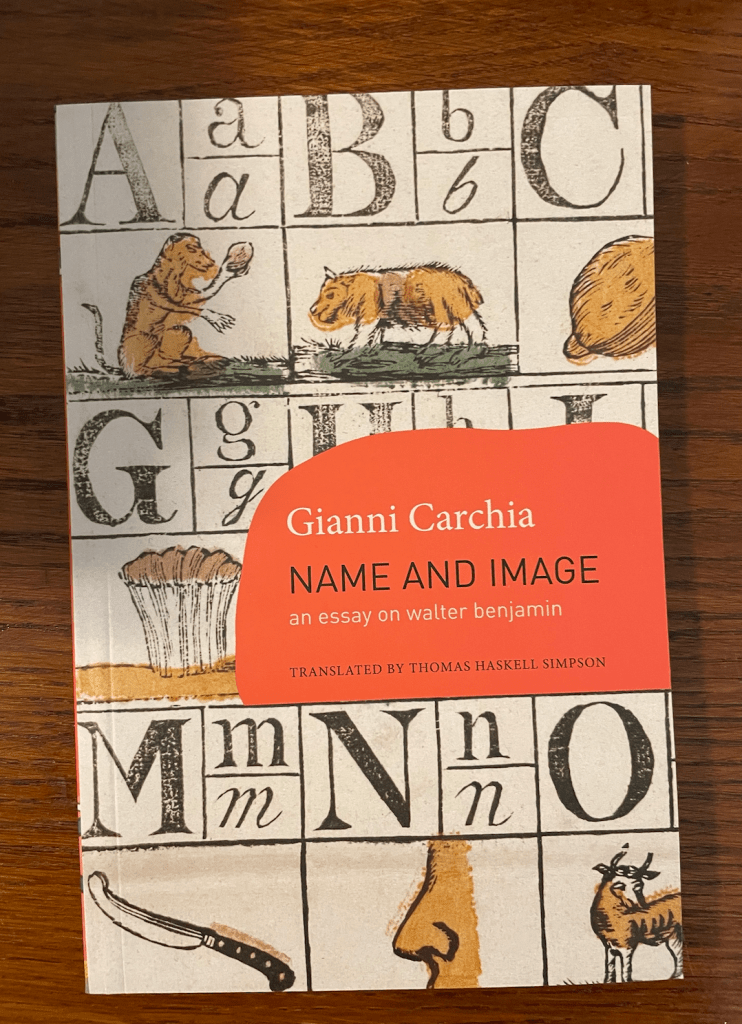
At long last readers in the English speaking world will be able to read Gianni Carchia’s work in translation thanks to the publication of Name and image: an essay on Walter Benjamin (Seagull Books, 2025), which was the Italian philosopher very last book published posthumously in 2008. This is not a work of late style as such, since these four essays on Walter Benjamin serve as an oblique and angular entry point to the thinking form of Carchia’s own philosophical concerns on sensibility, the survival of the myth through aesthetic mediation, and the post-kantian elaboration of the appearance as the condition for experiencing the world. This is a project without systematic architecture that dates back to his first books of the late seventies such as Orfismo e tragedia (1979) and Estetica ed erotica (1981), both published in the Milanese publisher Celuc Libri. It must be noted that although this is a marvelous introduction to Carchia’s philosophical idiosyncrasies and recurring themes, it is perhaps not the best introduction to Walter Benjamin, who in these four essays is read against the grain of dominant hermeneutical frameworks; that is, beyond Frankfurt Critical Theory and dialectics of the image, and on the other hand, the theologico-political concerned with messianic temporality as a transformative philosophy of history.
It does not mean that Carchia is oblivious to these constitutive elements in the corpus of the German thinker; but it does mean that the profile constructed is one that favors a critical project that has disinhibited affinity with the Platonist project of beauty as condition of the critical endeavor committed to truth. For Carchia it is at this vortex where one should locate the “brilliant degree of illumination” that awakens philosophy from its slumber, overturning the texture of thinking to an erotics of the lost detail and the enduring fragment. Citing the correspondences to Florens Rang and The Origin of the German Tragic Drama, we know that for Benjamin “without at least an intuitive grasp of the life of the detail in the structure all love of beauty is no more than empty daydreaming” (Carchia 33). The task of the critic is one capable of arresting the inexpressible, only because beauty lives in the world as a state of silence and expressed revelation (Carchia 38). And it must be said that platonism in Carchia never manages to crystallize into a doctrine of being, pivoting to persuasion as the route to an idea without form.
Carchia shows that for Benjamin the reinvention of the critical method cannot aspire to the totalization of origins and principles – or even that of the status of the visible (Schau), as he brought to bear in his comment to Max Kommerell’s Der Dichter als Führer in der deutschen Klassik (1928) – underpinning the emergence of the idea where the seeds of truth germinate to unfold the interstices of historical sedimentation (Carchia 62). Unapologetically, Carchia suggests that Benjamin’s critical method, if there is such a thing, must be read as a “philosophy of the infinitesimal aim to shatter the prejudice that attributes to totality predominance over phenomena…at the price of their insignificance” (Carchia 61-62). In turn, this means that “the smallest cell of visualized reality outweighs the rest of the world” (Carchia 63). The infinite cuts through the world as a remnant that must be redeemed precisely because of its incongruence in the face of the triumph of immanence and the distribution of forms. And this is yet another sign that Carchia’s Benjamin must read as a thinker of a platonism of the immanence that by folding forms it is able to escape modernity’s temporalization of the sensible reality and its lethargic material objectivity [1]. This hits a hight note about Benjamin’s philosophical thought as anointed in the ancient currents of Stocism, since as Pohlenz taught us, the material forms of this world are the hurdles that neutralize the inception of the divine in a reality governed by the necessity of kakia.
Hence the confrontation with language occupies the center of every critico-historical reflection, which means how to live the immemorial language that is neither an instrument nor the “medium of prophecy or domination” (Carchia 85). Carchia reminds us that for Benjamin Karl Kraus’ language is platonische sprachliebe, or platonic love of language, which means a voice that overcomes the separations of signification and symbol, object and subject, and the consolidation of exchange through the voice of gratitude and use: “thanking and dedication – for to thank is to put feelings under a name” (Carchia 85). The word as apophantic revelation places judgement under erasure, enacting not a return to Edenic pristine nature of divinization or virtuality that attests to the figure and repetition of appearances and the medium of the “spiritual verbalization that animates reality” (Carchia 92). The abdication of an original language survives as the mythic memory of a voice porously open to translation: “All higher language is a translation of lower one, until the ultimate clarity the word of God unfolds, which is the unity of this movement made up of language” (Carchia 92). If for Benjamin the problem of translation is coterminous with that of the mystery of language, it is because it reveals the fragments of a vessel that removes the ground of rhetoric through “variation and discontinuity” (Carchia 96).
In fact, reading Carchia one can infer that rhetoric is to language what the destiny is to human existence in its becoming. Thus, the destitution of language, its internal rhetorical and objective liquidation, appeals to the possibility of the event of happiness and bliss that is the only well illuminated path for redemption, that is, for the flourishing of the “nexus of truth and beauty” of the liberty of the soul. We are painfully aware that modernity is many contradictory elements at once, but Carchia tells us following Simmel, it is ultimately the historical project of Entseelung or loss of soul of the world, and thus “the faculty of memory as particular gift of the soul” (Carchia 121). The historical time of progress, its formal assumption and increasing autonomization, means a ritual situation that “seizes control in exteriority – as as continuum of temporal unfolding – of that entertainment, flashing, discontinuous awareness of the irrevocability of the past held firm by the image-memory” (Carchia 121). Hence, the exercise of thought and memory through the redemption of appearance is the necessary struggle against the usurpation of caducity, and thus the only promise of salvation through the dead, the defeated, and the forgotten. There are clear echoes of Hölderlin’s “Andenken” here that Carchia formulates as the necessity of memory in the repeated dispensation for the clearing of appearance. As he writes in one of the most formidable moments of the book when discussing the self-offering of the memory that guards the catacombs of the dead:
“…for Benjamin, aesthetic temporality, as temporality of the soul absorbed in the contemplation of the nexus of truth and beauty, is the very origin of temporality’s self-offering, of temporality tour court as the space of memory. The salvation of appearance and the dimension of memory are all one: here is rooted the connection between temporality and the aesthetic dimension. The appearance constitutive of the space of redemption, and the beauty whose sacrifice would sacrifice the space of truth itself, are nothing other than memory continuously rescuing them from the space of historical time. It is precisely this connection, between the sphere of appearance as the sphere of the irremediable caducity, and the counter-movement of memory in the involuntary image, that forms the nexus that some of the most subtle passages struggle to delineate as the world of the soul, or rather the world of the past” (Carchia 120).
Thinking the fragment becomes indistinguishable from retaining the sensible participation of the soul. It is this arresting breath (Hauch) of the soul that clears a path on which appearance is saved from the crushing weight of historical self-sufficiency. This confirms, if anything, that Benjamin’s sensibility for Carchia does not end in the confines of postromantic critique, nor in the utopia of totality and abstraction imposed by the metaphysics realized in money form over the living and the dead. As Carchia asserts: “utopia is the end of the constructive and generative ideal of knowledge” at the base of human anthropology and material conditions of social existence, but a whole “redirection underpinning what we have called thinking the informal” (Carchia 127, 135).
What does it mean to think the informal, and what accounts a thought of the informal where Carchia posits Benjamin’s most enduring and clandestine signature? Avoiding all false exists in neopaganism of worldly immanence, Carchia connects the formless dispensation of thought with a nirvana state of para-rūpa (a hypostasis of God that does not presuppose a form, but that it is transformational), the instance of imagination without an image and place that speaks of a chôra as the last refuge of the living. A refuge that, like the platonic cave, does not entail the accumulation or wealth of signification, but that retreats from the perils of insignificance and unhappy consciousness of nihilism. This is one way to understand what Benjamin writes in one of the glosses in “Short Shadows”: “…an image that has already crossed the threshold of the image and property, and knows only the power of the name, from which the lover lives, transforms, ages…and imageless, is refuge of all images”. An existence devoid of a central and authorized image can only prepare for the idea of justice that, because it is experienced it can retreat from the aleatory predication of the world. This enacts a descent into “an anarchy of being in this side of form”, as Carchia would beautifully call it towards the end of book; an inward saturation that is also a reservoir of sensibility because it is able to take a breath. And because it is breathing, it can assent to the external penumbra that restores the appearance of every thinking being in its very image and name.
.
.
Notes
1. On the platonic immanence and the soul, the central reference is Gianni Carchia’s essay “Platonismo dell’immanenza: Fenomenologia e storia in Hans Blumenberg”, Hans Blumenberg: Mito, Metafora, Modernità (il Mulino, 1999), 215-26.