The politics of schism: theses on Dionys Mascolo’s La révolution par l’amitié (2022). by Gerardo Muñoz

1. Remembrance without restitution. The publication of Dionys Mascolo’s essays in La révolution par l’amitié (La fabrique, 2022) opens a path to a singular thinking that refused to conform to a master thinking, and even less what has come to us as political theory, or radical critique. Theory and critique have shown their resilient adaptiveness to university discourse. Thinking, on the contrary, moves annexes a relation with the missing word. This caesura negates the closure of both politics and community, it shows its insufficiency. In a letter to Maurice Blanchot regarding his ceased friend Robert Antelme, Mascolo comes to terms with this specific question: the remembrance of what loss in the actual word is – the voice of his friend Robert Antelme – what cannot be posited as a restitution of representation, but rather as effective effort to transcend mutism and silence that would have sunk writing into a pathos not short of a “miserabilist” stance [1]. The exigency of language is absolute. In an analogous way, we can say that the writing in La revolution par l’amité (La fabrique, 2022) is not a matter of restituting the history of Marxism, the intellectual debates of French theory, or even the burial site of a thinker that rejected repeatedly the metaphysical function of the public intellectual (a sort of captain at the steering wheel of public opinion, a cybernetician); but rather the remembrance that thinking is the irreductible site of common to the species. Remembrance has no “archive” and it does not produce anything; on the contrary, it invites a path to thinking in order to bring the absolutism of reality to an end.

2. The irreducibility of the species. For Mascolo – as for Nicola Chiaromonte – the stimmung of the modern age is not a lack of faith, but a bad faith subscribed by the subject of knowledge, a guardian of the nexus of legitimacy. In his practice of writing, Mascolo explored something like a countermovement to the rationality of the intellectual posture, in which communication ceases to be a common means in order to become a production of ends and instrumentality. Hence, what Mascolo called the “part irreductible” – and its “doubt in any system of organized ideas in sight” – is the only intuition of the unity of the species in communication. And if the intellectual is an organic unity of hegemony that replaces the function of the priest in the Church bureaucracy and its paideia (recall Antonio Gramsci’s “organic intellectual”), for Mascolo irreducibility in the sharing of thought in communication is “not political” as he states in Autour d’un effort de mémoire – Sur une lettre de Robert Antelme (1987). This step back from the production of modern politics thoroughly imagines another figure of communism. It is at this point where the whole Cold War polemics between humanism and anti-humanism is destituted internally: the species finds a way out of political domestication.

3. Communism of thought. We can understand why for Mascolo “the word communism really belongs more to Hölderlin than to Marx, as it designates all the possibilities of thought; that which escapes in thinking, and only that can constitute its work (oeuvre)” [2]. In other words, communism for Mascolo is not a matter of doctrine or an Idea, nor about philosophy of history and its inversion; it is not about a political subject or a unity of organization of political force; communism is a use of thought in language in proximity with what escapes in every communication. The inoperative communism, hence, is only possible in friendship, as a continuous experimentation of taste that cannot coincide with a community form. As Mascolo writes in his essay on Antelme: “We did not live in community. This is a deceptive word…we existed in a sentiment of mutual gift of freedom” (53). Any reinvention of a politics to come after the collapse of authority must commence with this rejection of a compensatory communitarian closure. Today only a conspiratio between friends can animate a new field of intensification for renewal.

4. Refusal and friendship. Even in his earliest stages of writing such as “Refus incoditionnel” (1959), the condition for friendship for Mascolo is to refuse the current state of things; to retreat from the demand of reality in order to survive in the imagination of the shared word. In this sense, the thematic of friendship does not make subjects of duty towards a social bond, but rather a secret in the word designated by separation. Friendship floats high above symbolic representation, as it moves to an inclination that is singulare tantum. If modern politics thought itself as a repression and administration of the hostis; for Mascolo the practice of friendship is the sacred space that is never inherited, but, precisely the dwelling of those who “seek” after in the wake of the homelessness of man and nature. This is analogous to Hölderlin’s allowance of thought which moves in passion while accounting for the abyss of our relationship with the world (aorgic) of originary detachment.

5. Revolution as style. In a brief text on the Cuban revolution of 1959, originally written for the collective exhibition Salón de Mayo in Havana, Mascolo says a new revolution in the island could potentially offer a the opportunity of a new style [3]. Of course, as soon as Fidel Castro supported the Soviet invasion of Czechoslovakia in 1968, it was clear that such promised crumbled, and that the Revolution will fall well within the paradigm of the metaphysics of historical project and the subject (“a new man”). But what is style? Once again, this speaks directly to Mascolo’s passion for the irreductible outside of the subject, and for this reason never alienated from the schism of the species. The notion of style relates fundamentally to our exposition to the outside, to the event of expropriation, which defines our fidelity to the invariant dimension of our character. A new style, therefore, is not something to be produced, an effect of the subject, but rather the unit of an ethical practice in our encounter with the outside. If the apparatus of the revolution was instituted as a the production of a civilization; the fidelity to a style names the modes of life that cannot be oriented towards a specific work. A new aberrant freedom emerges.

6. Saint-Just’s ethos. Mascolo never ceased to reflect on the ethical determination of politics, against politics, and for a transfigurative notion of a politics for the here and now. And he dwelled on this problem in his writings on the ethical figure of Saint-Just during the French Revolution (“Saint Just” and “Si la lecture de Saint-Just est possible”). Unlike the monumental historiographies – both left and right, revolutionary and conservative, historicist or revisionist – that situated the revolutionary under the sign of Terror and Revolution, of will power and the emergency of Jacobinism; for Mascolo Saint-Just stands a figure that keeps an important secret. And this is it: “the inhumanity of Saint Just is that unlike many men, he does not possess many lives but only one” (130). This is a concrete definition of a ethos that is irreducible to the “monstrous arts of government” in an epoch where the political had become the secularization of fate. In the same way that Hölderlin turned his gaze towards the impossible and concealed distance of the moderns in relation to truth of the Greeks, for Mascolo’s Saint-Just the legitimacy of the modern universalization (in the State, the Subject, the Social) does not have the last word. The ethos of life keeps the remembrance of an abyss of the monstrosity of historical universality and the social equality.

7. Borrowed existence. Dionys Mascolo lived at the dusk of the modern arch of the revolution, whether understood as eschatology or a conservation of the natural order of the species, as Saint-Just proposed against the Rousseaunian social contract and the Hobbesian mechanical Leviathan in exchange for authority. We have already crossed this threshold, and we are in the desert of the political, retreating on its shadow fallen into administration of fictive hegemonies. Hence, the question of an ethos of existence becomes even more pressing from Mascolo’s thematic of friendship in order to refuse what he calls in “Sur ma propre bêtise et celle de quelues autres”, a “borrowed existence in a comedy that feels as if we are being watch by God alone” (219). Indeed, as some have diagnosed with precision, the religion of our time is absolute immanence, the full disposition of the tooling of our means [4]. A cybernetic dreamworld, whose pathetic figure is the “influencer” (a few strata beneath the luminosity of the intellectual). This can only fix us into the stupidity of intelligence of the species: specialized intelligence, in other words, prisoners in the sea of nihilism. The intelligence of the species, on the contrary, is the cunning (methis) of the fox: a way out in spite of the swelling tides. But against the nihilism of a borrowed life of immanence (beatitude of the impersonal, and iconicity of things), Mascolo’s thought insists stubbornly in friendship as the initiation in an uncharted path to reenter the world once again.

.

.

Notes 

1. Dionys Mascolo. Autour d’un effort de mémoire: Sur une lettre de Robert Antelme (Maurice Nadeau, 1987). 

2. Ibid., 50.

3. Dionys Mascolo. “Cuba premier territoire libre du socialisme”, in A la recherche d’un communisme de pensée (fourbis, 1993).

4. Lundi Matin. “Éléments de descivilisation. Partie 4”, Lundi Matin, 2019: https://lundi.am/Elements-de-decivilisation-Partie-4
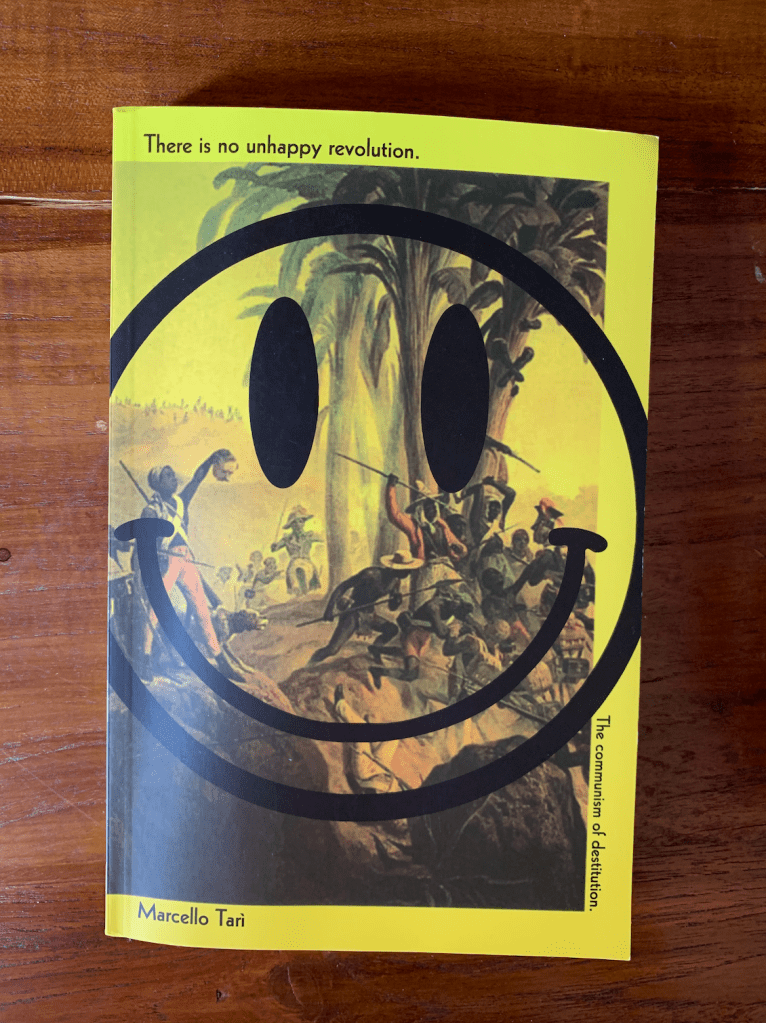
Revolutionary becoming and infrapolitical distance: on Marcello Tarì’s There is no unhappy revolution: the communism of destitution (2021) by Gerardo Muñoz

Marcello Tarì’s book There is no unhappy revolution: the communism of destitution (Common Notions, 2021), finally translated into English, is an important contribution in the ongoing discussions about politics and existence. It is also an exercise that pushes against the limits of contemporary political thought in the wake of the ruin of the grammars and vocabularies of the modern politics and the rise of the techno-biopolitics of governmentality. More importantly, the operation of Tarì’s book escapes the frame of “critique”, abandoning any false exits to regain the legacy of the Enlightenment and of “judgement” in hopes to reinstate the principles of thought and action in the genesis of the legitimation of the modern social contract. But the radicality of the horizon of destitution – which we have come to understand vis-à-vis the work of Giorgio Agamben, and the Invisible Committee – is first and foremost a thematization of the proximity between thinking and politics against the historical stagnation of a historical subsumed by the total technification of value (the principle of general equivalence). Since Tarì’s book is composed of a series of very heterogenous folds and intersections (literally a toolbox in the best sense of the term), in what follows I would like to sketch out a minor cartography to push the conditions forward that the book so elegantly proposes in three registers: the question of “revolutionary becoming” (the kernel of Tarì’s destituent gesture), the hermeneutics of contemporary domination, and the limits of political militancy.

Revolutionary becoming. Marcello Tarì correctly identifies the problem the epoch as fundamentally being about the problem of revolution. However, the notion of revolution must be understood outside the continuation of the modern horizon of the Leninist technique of the revolutionary vanguard nor party, the “revolution within the revolution”, and any appropriation of the “General Intellectual”. At the end of the day, these were all forms of scaling the desire as cathexis for the matrix of production. On the contrary, the problem of revolution is now understood in the true Copernican sense; mainly, how to inscribe an excentric apositionality within any field of totalization. When this is done, we no longer participate in History, but rather we are “freeing a line that will ultimately go down in History, but never coming from it”. Tarì argues that the field of confrontation today is no longer between different principles of organizing revolutionary strategies and even less about ideological critique; nor is communism an “Idea” (as it was thought just a decade ago in discussion that were philological rather than about thinking communism and life); the new epochal exigency is how to put “an end to the poverty of existence” (3). The potentiality of this transformation at the level of factical life, is what Tarì situates under the invariant of “communism”: “…not as an idea of the world, but the unraveling of a praxis within the world” (35). This communism requires a breakthrough in both temporal and spatial determinations, which prepares a dwelling in absolute relation with the outside (49). This revolutionary tonality is one closer to messianic interruption of historical time capable of destituting “actual state of things” governed the metaphysical apparatus of production and objetivation of the world, which depends on the production of the political subject. In an important moment of the book, Tarì writes: “…. only the revolutionary proletarian dimension can grasp the political as such, the true break from the current state of things. The real alternative to modern politics is thus not to be ground in what we usual can an “anti-politics”, which is merely a variation of the same there, but instead in a revolutionary becoming” (50).

The revolutionary becoming is a transformative intensity of singularization, which ceases to become a subject in virtue of becoming a “non-subject” of the political (67), which about a decade ago Alberto Moreiras announced to escape the dead end of the hegemony-subalternity controversy (one should note here that the fact that the Left today has fully subscribed the horizon of hegemony is something that I think it explains many of the deficits of the different experiments in a realization of a progressive political strategy). And this becoming revolutionary, in virtue of ceasing to be a subject (person, vanguard, multitude, worker) entails a new shift from action to use, and from technico-rationality to an opening of the sensible and singular means (metaxy). Again, Tarì’s continues as follows: “Becoming revolutionary…. means utilizing fantasy, freeing the imagination, and living all of this with the enthusiasm of a child” (75). The notion of “happiness” at stake in the book it is played out against the determination of the subject and the processes of incarnations (Karmy) that have haunted the modern revolutionary paradigm as always-already integrated into the metaphysics of the philosophy of history. 

 Metropolitan domination. Secondly, Tarì’s book locates the metastasis of domination at the level of a new spatial organization of the world in the apparatus of the metropolis. As we know the metropolis is not just an urban transformation of the Western form of the urbs and the polis, but rather the force of appropriation of the world into interconnectivity and surface in order to optimize, administer, and reproduce flows of the total fictionalization of life. The gesture towards the outside that crosses over Tarì’s book entails an exodus from the metropolitan structure that makes uninhabitable experience. This takes place by a process of domesticating its possibilities into the order of sameness (crisis of appearance) and translating our proximity with things into the regime of objects. What is stake in the metropolis – if we think of the most recent revolts in Santiago de Chile, Paris with the to the hinterlands of United States and Italy – if not precisely a response against the metropolitan machination “aiming at the destruction of every possibility of having any experience of the world and existence itself” (84). This why the intensity of any contemporary revolt today is proportional to the experiential texture of its composition and modes of evasion. Of course, Tarì correctly identifies the metropolis as an expanded field of cybernetic inter-connectivity, which, as I would argue is not merely the production of “bad substance” (to use Tiqqun’s Bloomian lexicon), but also a recursive dominion over the medium (metaxy) in which experience and the singular autopoiesis labors for the optimization and hylomorphic regimes that administer civil war. In this sense, destitution names an exodus from the metropolitan technical order and the sensible reproduction of the medium. It is in the outside the metropolis that the ongoing process of communization can free an infinite process of communization and forms of life.

Residual militancy and infrapolitics. But does not the exodus or the destitution of the metropolis – opening to singular experience, love, friendship, and the use of one’s disposable means and inclination – presuppose also a step back from a political determination, in other words, a fundamental separation from coterminous between existence and politics? At the end of the book, Tarì claims that “whenever anything reaches a certain level of intensity it becomes political” (117). But is the intensification of thinking or love or friendship always necessarily political? Tarì writes a few pages later that: “love is continually traversed by a line of extreme intensify, which makes it an exquisitely political affect” (126). But does not the politization of love depends on a certain commitment (a “faith”) to a residual militancy, even if it is a militancy posited as the principle of anarchy? But perhaps this is the difficulty at stake: since anarchy is only entails the “anarchy of phenomena” in reality, postulating a political principle as counter-exposition, however tenuous, might not be enough. For this reason, the crisis of appearance today needs a step back from the heliopoliticity of exposition. In an essay written a couple of years ago, Alberto Moreiras thematized this difficulty vis-à-vis Scürmann’s principle of anarchy, which I think is worth quoting: “The Schürmannian principle of anarchy could then be thought to be still the subjective reaction to the epochal dismantling of ontology (as metaphysics). But, if so, the principle of anarchy emerges, plainly, as principle, and principle of consciousness. Anarchy runs the risk of becoming yet another form of mastery, or rather: anarchy, as principle, is the last form of mastery.  At the transitional time, posited as such by the hypothesis of metaphysical closure, metaphysics still runs the show as consolation and consolidation” [1]. 

If politics remains the central condition of existence, then it follows that it depends on a second-degree militancy that can govern over the dispersion of the events and this ultimately transfers the force of steering (kubernates) to mitigate the crisis of thought and action in the sea of “absolute immanence”. But immense is also a contemporary fundamental fantasy [2]. Against all “faith” in absolute immanence we need to cut through in its letting be (poein kata phusin) of the abyssal relation between existence and politics. This originary separation is an infrapolitical step back that solicits a distance an irreducible distance between life, events, and community form. The commune would be a secondary condition of political organization, but the existential breakthrough never coincides with community, except as a “common solitude”. Secondly, the infrapolitical irreducibility between politics and existence wants to reject any compensatory temporal politico-theological substitution, which also includes the messianic as a paradigm still constitutive of the age of Christian community of salvation and the efficacy of deificatio. The existential time of attunement of appropriation with the improper escapes the doble-pole paradigm of political theology, which has been at the arcana of both philosophy of history as well as the messianic inversion. A communism of thought needs to produce a leap outside the politico-theological machine which has fueled History as narrativization and waged against happiness [3]. Attuning oneself to the encounter or the event against the closure of the principle of reality might be a way out from the “hegemonic phantasm” of the political, which sacrifices our infinite possibilities to the logistics of a central conflict. If civil war is the side of the repressed in Western politics, then in the epoch of the ruin of authority it opens an opportunity to undue the measurement (meson) proper to the “Social”, which is now broken at the fault lines as Idris Robinson has put it [4]. It is only in this way that we can move outside and beyond the originary positionality of the polis whose “essence never coincides with politics” [5]. The saving of this irreducible and invisible distance prepares a new absolute proximity between use and the world. 

.

.

Notes 

1. Alberto Moreiras. “A Negation of the Anarchy Principle, Política Comun, Vol. 2017: https://quod.lib.umich.edu/p/pc/12322227.0011.003?view=text;rgn=main

2. Lundi Matin. “Éléments de decivilisation” (3): “It is also about the creed of the dominant religion: absolute immanence. Doing itself, designed to obey the modes of proceeding from production, is in advance conforming and consecrated. On this sense, no matter what you do, you bend the spine in front of the cult dominant. If all things count, none has a price, and everything is sacrificeable.”. https://lundi.am/Elements-de-decivilisation-Partie-3

3. This is why Hegel claims in his lectures on the Philosophy of History that: “History is not the soil in which happiness grows. The periods of happiness in it are the blank pages of history”. The revolutionary overflow of happiness is only possible as an exodus from the theological political structure of historical production. Here the question of style is emerges as our defining element. 

4. Gerardo Muñoz. “The revolt eclipses whatever the world has to offer”: a conversation with Idris Robinson”, Tillfällighetsskrivande, May 2021: https://www.tillfallighet.org/tillfallighetsskrivande/the-revolt-eclipses-whatever-the-world-has-to-offernbsp-idris-robinson

5. Gerardo Muñoz. “Some Notes Regarding Hölderlin’s “Search for the Free Use of One’s Own”, January 2019: https://infrapoliticalreflections.org/2019/01/14/some-notes-regarding-holderlins-search-for-the-free-use-of-ones-own-by-gerardo-munoz/