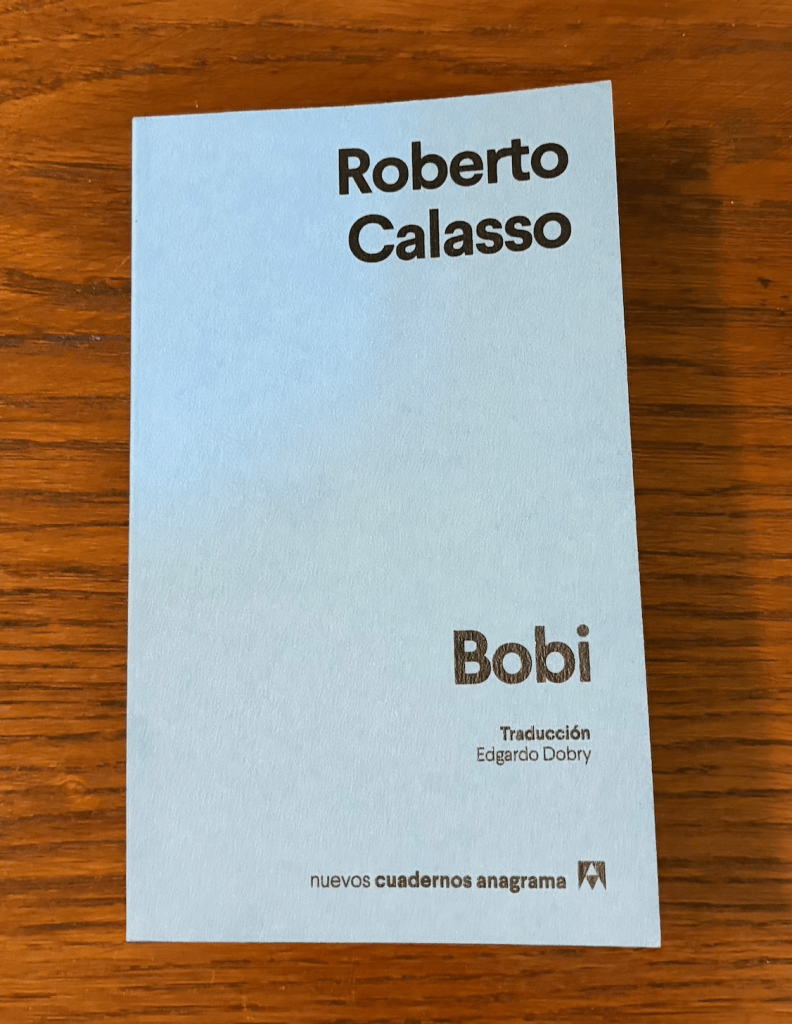
Roberto Calasso’s short and epigrammatic posthumous book Bobi (Anagrama, 2026) on the opaque figure of Roberto Bazlen has just appeared in Spanish. It is a nebular autobiographical book that does not attempt to render legible the subterranean and oblique figure of Robert Bazlen, but rather to filter some of his obsessions and tonalities, many times through his own voice. Calasso is well qualified to write such book as a frequent stroller companion of the anonymous man of Trieste. There is no aura of the detective mystery about the person’s auratic psychic life, establishing a sharp contrast to Del Guiudice’s polyphonic narrative in Lo stadio di Wimbledon (1983). But in this short memoir book, I am particularly intrigued by a moment when Calasso inscribes Bazlen’s vortex of thought and life as an affinity for the acoustic.
Calasso quotes Bazlen (we assume that from his own memory): “Bazlen used to say regularly: “This does not sound too good”, and immediately we knew what he meant. His capacity to recognize sound was thorough” [1]. Calasso tells us, moreover, that he cared little about cultural or intellectual polemics of his time. All that matter was sound, the grain of the voice. His meridian crossing was the song and rhythm of another. It is this proximity to the light of the voice what allowed Bazlen to conceive life and writing as a unified sensible reality; mutually interdependent, and always intertwined like the threads in a rigged tablecloth. To inhabit the world without judgement – of History, of morality, of punishment and guilt, of retribution – means to secure an aperture to an acoustics that will remain close to us, albeit incomplete, in the dissonance and impropriety of meaning.
To be able to attune oneself to the voice is a practice that retreats from the order of the world; that is, to descend into anonymity in order to inhabit a subterranean region, which speaks to Bazlen’s insistence on tugurios or spelonche, which Calasso does not hesitate to render as naked spaces, miniature deserts or caves to immunize oneself from the chatter of the world: minima chôra where something could take place or not. It is hard to define them but we know perfectly well what these are. Perhaps we can be more emphatic: to listen to the voice is already the encounter. And very much like Osip Mandelstam’s figure of the interlocutor, true poetics (and first and foremost that of life) “is ever moving toward that more or less distant, unknown addressee, whose existence the poet cannot doubt without also doubting himself. Only a reality can bring to life another reality” [2].
Bazlen’s notion of writing as the writing of life, experience as writing, very much like Mandelstam’s dialogic poetics, finds a tugurio so that language can emerge in absolute presence. And this is precisely what Bazlen understood in the becoming of life against the metabolic strain of survival, since the repression of the voice will result in the annihilation of what is most alive. Calasso recalls Bazlen’s affirmation: “In a world of death – there was an epoch where one was born alive and would later die. Today, on the contrary, one is born dead – and only a few are able, little by little, to be alive” [3].
For Bazlen there is no community of the living granted in immanence, because to live means to conquer the putrefaction of the culture of death, which is only permanent revolution and hostility. But one cannot conquer death from death; that is, by means of the beautiful soul’s literary prose of the world. It does not take Hegel to say that this is still unwarranted insubordination and permanent bondage. What is then to be alive? It is a resurrection that takes place as an existential decision, that is “at a point in life when a fundamental decision has to be made. I believe that was his passion, and his masterpiece” [4]. This is Del Giudice’s indictment, although surely not fully at odds with Calasso’s autobiographical sketch of Bazlen. In the melodic contact the possibility of a vita nuova is transfigured in not-knowing because the Western modernity is devoid of any notion of ethical destiny. Indeed, “et tout le reste est littérature”, as Verlaine famously wrote. For Calasso’s spectral portraiture in Bobbi (2026), the adventure is to remain alive well beyond completion and needs, as evidenced in our encounter with his languishing voice and memory.
.
.
Notes
1. Roberto Calasso. Bobi (Anagrama, 2026), 83.
2. Osip Mandelstam. “El interlocutor”, en Gozo y misterio de la poesía (El Cobre Ediciones, 2005), 71.
3. Roberto Calasso. Bobi (Anagrama, 2026), 55-56.
4. Daniele Del Giudice. A Fictional Inquiry (New Vessel Press, 2021), 123.
 Infrapolitical Reflections