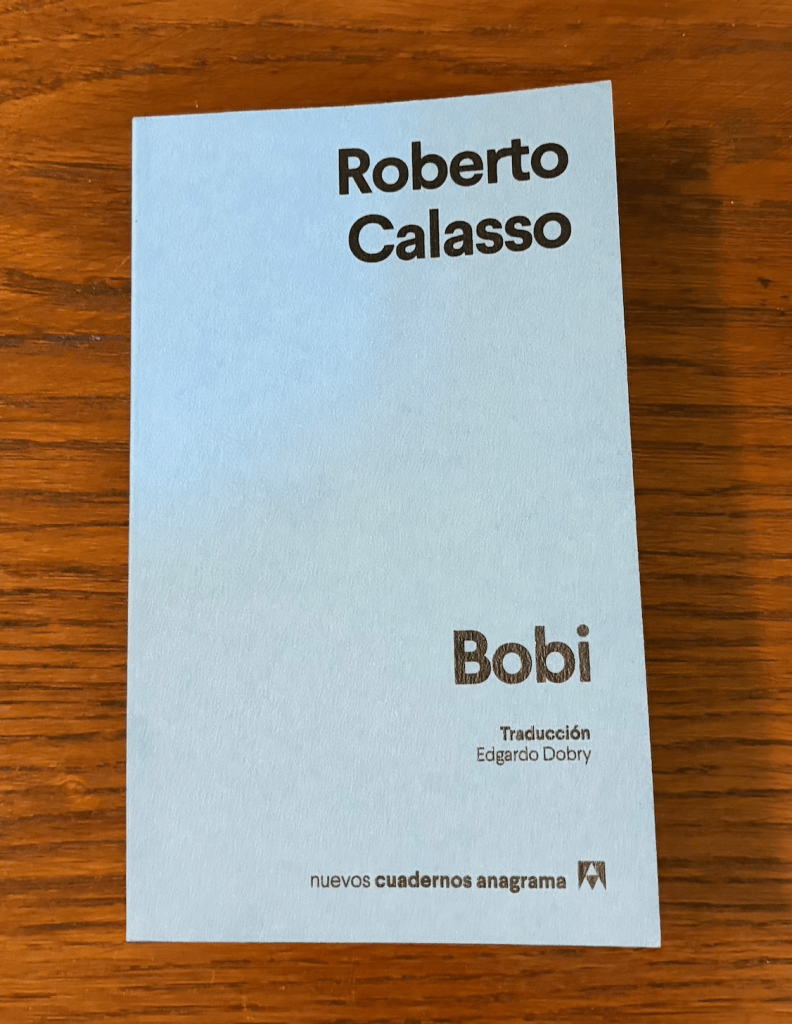
Bazlen’s acoustics. On Roberto Calasso’s Bobi (2026). by Gerardo Muñoz

Roberto Calasso’s short and epigrammatic posthumous book Bobi (Anagrama, 2026) on the opaque figure of Roberto Bazlen has just appeared in Spanish. It is a nebular autobiographical book that does not attempt to render legible the subterranean and oblique figure of Robert Bazlen, but rather to filter some of his obsessions and tonalities, many times through his own voice. Calasso is well qualified to write such book as a frequent stroller companion of the anonymous man of Trieste. There is no aura of the detective mystery about the person’s auratic psychic life, establishing a sharp contrast to Del Guiudice’s polyphonic narrative in Lo stadio di Wimbledon (1983). But in this short memoir book, I am particularly intrigued by a moment when Calasso inscribes Bazlen’s vortex of thought and life as an affinity for the acoustic. 

Calasso quotes Bazlen (we assume that from his own memory): “Bazlen used to say regularly: “This does not sound too good”, and immediately we knew what he meant. His capacity to recognize sound was thorough” [1]. Calasso tells us, moreover, that he cared little about cultural or intellectual polemics of his time. All that matter was sound, the grain of the voice. His meridian crossing was the song and rhythm of another. It is this proximity to the light of the voice what allowed Bazlen to conceive life and writing as a unified sensible reality; mutually interdependent, and always intertwined like the threads in a rigged tablecloth. To inhabit the world without judgement – of History, of morality, of punishment and guilt, of retribution – means to secure an aperture to an acoustics that will remain close to us, albeit incomplete, in the dissonance and impropriety of meaning.

To be able to attune oneself to the voice is a practice that retreats from the order of the world; that is, to descend into anonymity in order to inhabit a subterranean region, which speaks to Bazlen’s insistence on tugurios or spelonche, which Calasso does not hesitate to render as naked spaces, miniature deserts or caves to immunize oneself from the chatter of the world: minima chôra where something could take place or not. It is hard to define them but we know perfectly well what these are. Perhaps we can be more emphatic: to listen to the voice is already the encounter. And very much like Osip Mandelstam’s figure of the interlocutor, true poetics (and first and foremost that of life) “is ever moving toward that more or less distant, unknown addressee, whose existence the poet cannot doubt without also doubting himself. Only a reality can bring to life another reality” [2].

Bazlen’s notion of writing as the writing of life, experience as writing, very much like Mandelstam’s dialogic poetics, finds a tugurio so that language can emerge in absolute presence. And this is precisely what Bazlen understood in the becoming of life against the metabolic strain of survival, since the repression of the voice will result in the annihilation of what is most alive. Calasso recalls Bazlen’s affirmation: “In a world of death – there was an epoch where one was born alive and would later die. Today, on the contrary, one is born dead – and only a few are able, little by little, to be alive” [3]. 

For Bazlen there is no community of the living granted in immanence, because to live means to conquer the putrefaction of the culture of death, which is only permanent revolution and hostility. But one cannot conquer death from death; that is, by means of the beautiful soul’s literary prose of the world. It does not take Hegel to say that this is still unwarranted insubordination and permanent bondage. What is then to be alive? It is a resurrection that takes place as an existential decision, that is “at a point in life when a fundamental decision has to be made. I believe that was his passion, and his masterpiece” [4]. This is Del Giudice’s indictment, although surely not fully at odds with Calasso’s autobiographical sketch of Bazlen. In the melodic contact the possibility of a vita nuova is transfigured in not-knowing because the Western modernity is devoid of any notion of ethical destiny. Indeed, “et tout le reste est littérature”, as Verlaine famously wrote. For Calasso’s spectral portraiture in Bobbi (2026), the adventure is to remain alive well beyond completion and needs, as evidenced in our encounter with his languishing voice and memory.

Notes 

1. Roberto Calasso. Bobi (Anagrama, 2026), 83.

2. Osip Mandelstam. “El interlocutor”, en Gozo y misterio de la poesía (El Cobre Ediciones, 2005), 71.

3. Roberto Calasso.  Bobi (Anagrama, 2026), 55-56.

4. Daniele Del Giudice. A Fictional Inquiry (New Vessel Press, 2021), 123. 

Hölderlin’s song. Provisional annotations. by Gerardo Muñoz

There is a moment in Hölderlin’s late hymn “Friedensfeier” (1801) where communication is strictly defined as becoming a song. The verses in question are about midway into the poem, and we read read the following: 

“Viel hat von Morgen an, 

Seit ein Gespräch wir sind und hören voneinander, 

Erfahren der Mensch; bald sind wir aber Gesang.”

“Mucho ha, desde la mañana, 

desde que diálogo somos y oímos unos de otros, 

aprendido el ser humano; pronto empero seremos canto”.

This is the Spanish rendition by the Venezuelan poet and translator Verónica Jaffé [1]. These lines stand for Hölderlin’s unique effort during the years 1800-1804 to substantially qualify what he had confessed to his mother as his true task: to live a serene or quiet life. I think this Spanish translation is much closer to the original German. Jaffé hangs on the present perfect with conviction: “Mucho ha…”, as if knowledge remained at a distance in the metric while becoming a temporal duration, a form of experience. This is the poetic “strict mediacy” for Hölderlin that can only be cultivated [2]. And it is only through the duration of experience that one will become a song (“seremos canto”). We are not yet there, hence the apostrophe. In the late period, duration meant dealing directly with Pindar. Thus, the song is something other than language – even if announced through language. But it is a paratactic dispersion that seeks to free the pure voice. In one of the “Pindar fragments”, this is what Hölderlin claims: “then only the difference between species makes a division in nature, so that everything is therefore more song and pure voice than accent of need or on the other hand language”. [3]

I am caught up in the moment of “division in nature”. The subtraction from representational language allows for the true appearance of a more originary separation, where the song can finally emerge in its proper attunement with the world. The becoming song is another form of separation, which institutes the passage from the Empedocles (tragic sacrifice) to the Pindaric relation to the divine. This is the “highest” poetic challenge for Hölderlin – an impossible task after the fleeing of the gods. It is definitely maddening. Nevertheless, the song remains. It puts us in nearness in a postmythical world without recoiling back to the image of the tragic. Indeed, as Hölderlin says in passing in “The Ground of Empedocles”, his time already “did not demand a song” [4]. The passion for natural unity was an Olympic illusion whose retribution could only become romantic debris as the exclusive possession of the dichter. On the contrary, the clearing for the song has emancipated itself from the exclusivity of the modern autonomy of dichtung as mimetically separated from the experience of life. This is what the song wants to pursue before the closure of a significant (and signifying) world. Fundamentally, this means a subtraction from the continuum of language, and thus a form of prophecy as elaborated by Gianni Carchia in a difficult passage from “Dialettica dell’immagine”: 

“Where music and prophecy, in the inexhaustibility of their tension – an endless effort to overcome the Babel dissipation of language by freeing the residual state of the unexpressed – testify to a disposition to meet precisely in what passes, in pure transience, the need for salvation and the idea of fulfillment, beauty as a totalitarian and exclusive appearance is, on the other hand, nothing but the product of an arrest in the dynamics of the spirit which withdraws from the horror of worldly laceration to seek refuge on the scene circular and static of the eternal”. [5]

If the song addresses the prophetic it is because language has fallen to the fictitious needs that arrest the experience of the human being into the exclusivity of rhetorical force and poetic genius. Is not the song a refusal of both? A refusal now aimed at the “highest” task – that is, the serene life? Against the exclusivity of appearance that Carchia points to, what appears discloses a different sense of law. A few verses in the same poem, in fact, we are confronted with the “law of destiny”: when there is serenity (or peace) there are also words. And a few lines after: “the law of love” is equilibrium from “here” to the “sky”. What appears there is the landscape that comes through in a pictorial depiction: “[Sein bild….Und der Himmel word wie eines Mahlers Haus Wenn seine Gemälde sind aufgestellt] / “[su cuadro e imagen….y el cielo se vuelve como de un pintor una casa cuando sus cuadros de exponen]”.

Does not this also speak to the insufficiency of language, which justifies the step into a folded painting? There is a painting and a vanishing image, but also the painter marveled at gleaming finished masterpieces. Is painting the original placeholder for the song as originary attunement of life? Perhaps. But in its enactment it also means that the song is impossible to disclose except through pictorial invocation. It is a painting of a life in the world, and nothing less. The transfiguration of the law places men no longer into undisputed submission, whether in its positive or natural determinations, but rather of a “strict mediacy” that is ethical in nature. A third way of the law that does not renounce the problem of separation.

Monica Ferrando has insisted upon the enormous importance of this conception: the fact that Pindar’s nomoi, in fact, relates to the nomos mousikos, which is fundamentally dependent on gathering substance of the song [6]. The strict mediacy finds itself between the mortal and the immortal. It is definitely not a “return to the state of nature”, and I do not see how it could be reduced to “genius”, except as an ethics whereby appearing is no longer at the service of objectivity [7]. Adorno was of course right: it is a ruthless effort to deal with disentanglement of nature – and the nature of reason – but only insofar as it is a return to the song. Or, at least, to have a path toward the song: a lyricism of the indestructible against the closure of a finite time dispensed and enclosed.

.

.

Notes

1.  Friedrich Hölderlin. “Fiesta de Paz”, in Cantos hespéricos (La Laguna de Campona, 2016), Traducción y Versiones Libres de Veronica Jaffé, 93. I thank Philippe Theophanidis the exchange initial exchanges on these verses.

2. Friedrich Hölderlin. “Pindar fragments”, in Essays and Letters (Penguin Classics, 2009), 566. Kindle Version. 

3.Ibid., 565.

4. Friedrich Hölderlin. “The Ground of the Empedocles”, in Essays and Letters (Penguin Classics, 2009), 465. Kindle Version. 

5. Gianni Carchia. “Dialettica dell’immagine: note sull’estetica biblica e cristiana”, in Legittimazione dell’arte (Guida Editori, 1982), 21.

6. Lucia Dell’Aia. “Il Regno d’Arcadia: intervista a Monica Ferrando”, in Il mito dell’Arcadia (Ledizioni, 2023), 121. 

7. T.W. Adorno. “Parataxis: On Hölderlin’s Late Poetry”, in Notes to Literature (Columbia University Press, 1992), 148-149.