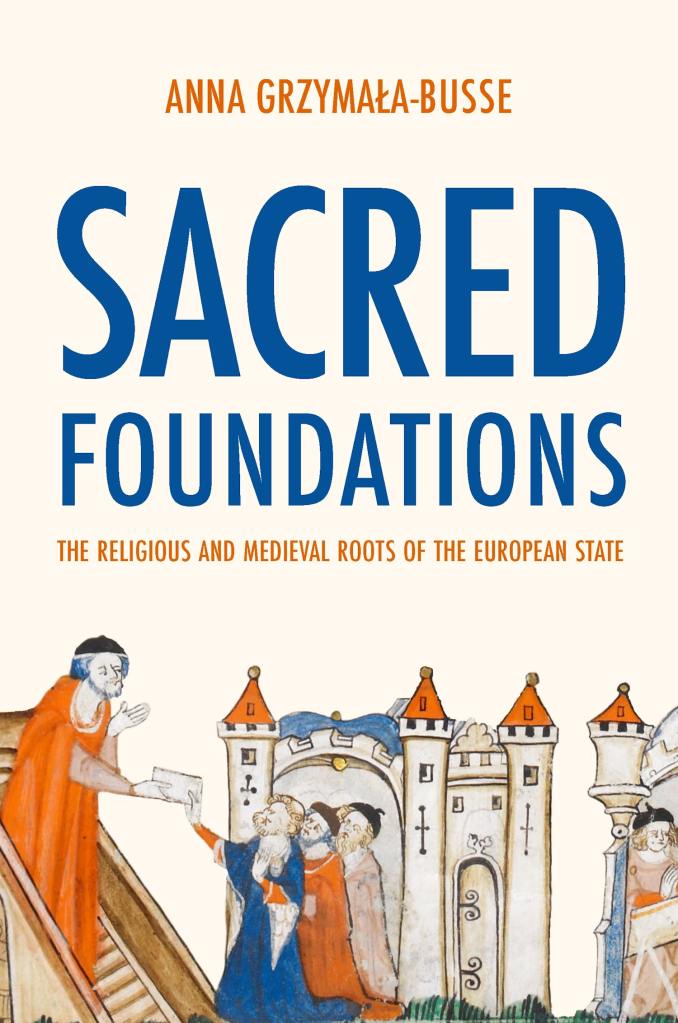
Two side notes on Anna Grzymala-Busse’s Sacred Foundations: The Religious and Medieval Roots of the European State (2023). by Gerardo Muñoz

Anna Grzymala-Busse’s recent study Sacred Foundations: The Religious and Medieval Roots of the Modern State (Princeton U Press, 2023) makes a compelling historical and data analysis grounded case for the emergence of the modern state through the process of the Church’s autonomization in its ongoing disputes with the European monarchs across the centuries. This process of the secularization of ecclesiastical forms (conciliarism, legal administration, the uniformity of procedures, rules for governing institutions, the emergence of educational training and mechanisms for political representation and fiscal control, etc), however, is silent about two defining features of the modern secular state. And I do not think it is an exaggeration to say that these two elements bring forth the way in which political authority was established after the victory of modern European Enlightenment. Busse’s book, if anything, has the felicity of putting in perspective, even if only in negative, the two pieces of the puzzle: a) coercion as guarantee by a legal process (not just the monopoly of force); b) and the inter-institutional coordination that we tend to associate with a ‘principle of an internal rule of recognition’ between different spheres of bureaucratic rationality. Busse admits for (a) that “….the authority of the people over the whole Church was not statelike. It depends on moral authority and influence, not on coercive control. Both kings and popes cajoled, convinced, and threatened rather than demanded or extracted force” (Busse, 78). But ruling on morality and influence are two weak presuppositions to guarantee systemic, homogeneous and uniform process required by institutional authority.

In other words, the Church was able to construct forms of civil mediations, although it lacked the power of efficacy; that is, a coherent set of reasons for action that would define a strong concept of sovereign authority as service (to put it in Raz’s well-known formulation). The classical apothegm by which ‘kings rule rule but do not govern’ (Rex regnat sed non gubernat) now is protracted by the exercise of an efficacious rule, which means laying out a combination of forms and a well-ordered power over coercive forms. In fact, this is one feature that will define the legitimacy of the Enlightenment according to historian Franco Venturi; the discovery of punishment understood within the scheme of a trade off between the “necessity of the right to punish when man was not able to re-establish communism” [1]. Hence, the genesis of modern legitimation is not exclusively “a given” vis-a-vis the structure of separation of powers and the ultimate source of the plenitudo potestatis; rather, it requires a second-step rule, as it were, to convalidate the specificity of institutional authority with ample concrete efficacy of police powers in charge of compliance and punishment. The reach and exercise of public police powers and the systematic ordering of penal codes through a criminal procedure and its guarantees (reasonable doubt, fair trial and due process, no crime published without a previous enacted law, nullum crimen sine lege) is what renders effective and “energic” the principle of authority.

Now, broadly speaking, when it comes to (b) Busse admits that (and this is in spite of its institutional schemes) laying down justice “…the church relied on secular enforcement, for example when it came to religious orthodoxy. […] The carrying out of sentences against heretics and apostates lay in secular hands – those found guilty were handed over the temporal authorities so as to not sully the clergy. Legal coevolution and influence, the struggles between popes and monarchs, and the diffusion of both canon law and personnel into the juridical systems were critical to the rise of constitutionalism and the rule of law in Europe” (Busse, 132-133). This asymmetry between two systems of legal jurisdiction confirm the inexistence of a strong internal rule of recognition that for H.L.A. Hart defines any robust modern legal system of public law. The internal rule of recognition, one must remember, is not a set of principles or norms for social action, but rather the internal mediation between a legislative authority and its internal obedience within a concrete application thereof. The internal rule of recognition binds a central authority with its specific formal enforcement in institutional union of primary rules and secondary rules to avoid the pathology of uncertainty. This is thoroughly absent from the free-floating institutional forms of the medieval church whose principal construction of primary rules was divorced from the objective and rational procedures of its internal coherence (the rule of recognition) that would ground, in time and place, the otherwise abstract primary norm and the pressure of contested social conflict.

But going straight to the crux of the matter, it follows that medieval templates as superbly redrawn in Busse’s studies lack the two fundamental determinations that ground the modern concept of law: law as the necessarily monopoly over coercion (the Austin thesis), and the concept of law as the construction of an internal rule of recognition to unite primary and secondary rules (the Hart thesis). But insofar as all major modern political concepts and mediations are secularized forms of religious and medieval forms – something we can say that Busse’s scholarship also confirms – we can then say that modern legitimacy will consist in the congruence of these two determinations to organize the mediations between civil society and state. Already in his early The value of the state and the significance of the individual (1914), Carl Schmitt will note of this formal transplant: “…the Catholic doctrine of the Pope as the infallible interpreter of the natural moral law and of the content of revelation, who receives the competence to declare state statutes that stand in contradiction with the moral law or ius divino-naturale to be non-obligatory in conscience. The exercise of his potestas indirecta which is regarded as an act of jurisdiction, and which is held, by many canonists, to be determinative of a statute’s validity in state law – contains real vis coactiva, even where the expression potestas directiva is employed in place of potestas indirecta (Suárez, de fide cath, 3.22.1)” [2].

For Schmitt, then, the process of rationalization between ecclesiastical form and the modern legal norms of the state is very much straightforward. This is what constitutes the very texture of secular modernity. But as we know, for Schmitt the secularization of forms was not enough – it must be said that he himself did not negate in his theory of adjudication of his constitutional thought – which is why the construction parameters of his ‘political theology’ proposes supplemental safeguards to isolate law and power, extending the power of secularization into the decision of the potentia dei asoluta (at times this was contained in the theological figure of the Katechon) [3]. But as Carlo Galli has noted, Schmitt’s political theology is far from a “political christology” or a substantive theological politics grounded in natural law; rather it is a resolute affirmation to defend any concrete order from the potential fallouts of the secularized cornerstones of rational neutralization (potentia directiva and potestas coactivva) of state authority [4]. Neither mechanic state forms nor a higher source of morality (natural law) would define the modern law; rather the autonomy of the political in the existential situation could provide the sufficient energy to avoid the self-defeating circularity of ius revolutionis (this is what most of the times is obliterated from the so called question of “decisionism”)[5]. If Busse is correct in making the case that all modern institutions have sacred medieval foundations; Schmitt’s concurrence in the wake of modern secularization will be to define the energy of the political as the defining element that must stand as the threshold of formal transplantations to have a chance within nihilism and against nihilism. It is both things. In other words, formlessness is the constitutive dimension of political forms; an element that defines, in my view at least, the strongest practical element of what it is to inherit a Christian political foundation. The process of secularization is thus infinite and groundless, ultimately without a moral foundation and universal design. Among its many achievements, a book like Sacred Foundations: The Religious and Medieval Roots of the Modern State (Princeton U Press, 2023) has the ability to refine what political theology is, what it meant, and what to make of its endurance and possible iterations in our present.

Notas 

1. Franco Venturi. Utopia and Reform in the Enlightenment (Cambridge University Press, 1971), 116.

2. Carl Schmitt. The value of the state and the significance of the individual, in Carl Schmitt’s Early Legal-Theoretical Writings (Cambridge University Press, 2022), eds. Zeitlin & Vinx, 215.

3. See my “Schmitt y Hart: los puntos fijos del concepto de derecho”, 2022: https://infrapoliticalreflections.org/2022/11/07/schmitt-y-hart-los-puntos-fijos-del-concepto-de-derecho-por-gerardo-munoz/ 

4. Carlo Galli. Genealogía de la política : Carl Schmitt y la crisis del pensamiento político moderno (Unipe, 2019), 301. 

5. Jorge Dotti. “Sobre el decisionismo”, en Lo cóncavo y lo convexo (Guillermo Escolar Editor, 2022), 391.

Virgil in contemporary America. by Gerardo Muñoz

The well-established American Liberal historian of ideas, Mark Lilla, writes in his recent essay “The Once and the Now” an outlandish thesis: “the ideologies of modern fascism are all heirs to the Aeneid.” Any reasonable reaction should start not by disputing the content of such superficial assertion, but rather by raising the central question: what has taken place in America so that this level of intellectual putrefaction and conscious oblivion towards the past could take place, thus becoming permissible and reasonable? From where does the intellectual confidence emerge so that such a lethal rhetorical force can be deployed? At a high paced rate, the United States has become a beacon for an ongoing fascination over “fascism and anti-fascism” to the point of adapting an absolute form of parody in the “serious” forms of culture, academic production, and current event discussions.

Perhaps it is not that difficult to find an answer; and, one can say that once a culture repeatedly defines itself by the parameters of its parodic enactment is precisely a culture that has effectively ceased to exist. Carl Schmitt was up to something when he writes in Glossarium (an entry from 1953) that fascism after the war amounted to the ultimate victory of Stalinism over every other geopolitical actor in the Western world. The Cold War was also a battle for mimetic containment and pacification: the uttermost consummation to the highest case of metonymic endurance. The diffused “cultural war” in America in every symbolic dimensions of life (the media, the university, the political jargon, the legal profession, the community interaction, etc) shows that the victory has now reached definitive and unprecedented heights. It is true that fascism has always triggered a sort of libidinal drive – something that Susan Sontag knew well – in the societal attachment to symbolic production. In this sense there is little new here. But the novelty shows itself if one understands that the rhetoric of fascism has now become autonomous and sine qua non to cultural solvency into nihilism.

If Lilla’s remark caught my attention it is because it fully captures this transformation at the highest levels of the American elite. This transformation is nothing but the essence of Americanism as a fictive rhetorical parody of everything belonging to “Western culture”. This is why, regardless of ideological commitments (or precisely because of them), Americanism is in the business of an active forgetting of the West; while, at the same time, presuming credentials to be its most courageous defender. But it should be clear that Americanism’s defense of the West ultimately means the compulsive expansion of public opinion through a trivialization of the alienability of the past in its own ever-changing image.

In 1935, a short book appeared in Europe penned by Catholic intellectual Theodor Haecker that was entitled Virgil, Father of the West. This essay reminded its readers that culture in Virgil’s Aeneid and Georgics is best understood as the possibility of dwelling in the land through the cultivation of the Eros itself. In fact, Haecker will go on to write that the paradigm of Virgil’s Georgica should remain well into the end of the epoch as a solid commitment to the iustissima tellus against the “mysticism of the machine and the glorification of technology”. Almost a century after, Haecker’s hope in the possibility of cultivating homecoming has literally vanished. To any attentive observer it is clear that American intellectual elites have abdicated their commitment to iustissima tellus, while the marching orders of Americanism, driven by the artificial hells of the Metaverse and planetary conflagration, have already animated the flock through the gate leaving behind nothing but resilient and uninterrupted destruction.

The metapolitical collapse. by Gerardo Muñoz

We had a very rich and productive conversation this week with Josep Rafanell i Orra around the new and updated edition of his book En finir avec le capitalisme thérapeutique (éditions météores, 2022). But here I just want to entertain an early moment in the book that has some importance for some ongoing discussions. In the introduction that he writes for the new edition, Rafanell engages in a rare and honest exercise in self-critique. This is what he writes:

“Dans mon livre, je défendais une politique du soin. Onze ans après, je me livrerai bien volontiers à une autocritique rétrospective : la politique me semble destinée, irrémédiablement, à devenir une métapolitique, si nous entendons par là l’inévitable ré-institution d’identités qu’il faut représenter. Retour éternel de la police avec la violence de ses abstractions. Je pense que la politique, le politique (que vaut-t-elle encore aujourd’hui cette distinction?) nous condamne à nous absenter des mondes pluriels de la communauté et à neutraliser les effectuations de la différence” [1]. 

A lot could change in a matter of a decade. Indeed, a lot has changed for some of us, and it seems that for Orra it is no different. He is willing to admit it. He is no longer interested in defending a “politics of care” (or a hyperbolic politics), and not because it has become a recursive cliché in the empty chatter of governing metropolitan progressivism (I think of NYC or Colau’s Barcelona), but more fundamentally because the full affirmation of politics today can only contribute to the ever expansive calculative scheme of representational politics; a representational enframing that has become defunct and emptied out with the rise of administrative rationality evolving from the internal premises of political liberalism. It is true that the liberal democratic project from its inception was too weak to deal with indirect powers, and its long-lasting solution has been to engage in practices of optimization and value dispensation. But no amount of social representation can minimize effective domination. No one could defend this except in bad faith. The destiny of politics now transformed into metapolitical saturation can only muster social existence into predatory lines.

But there is another sense in which the metapolitical collapse could be understood. At least this is where I would like to displace Rafanell’s lucid intuition: the metapolitical destiny of politics emerges in the wake of the fault line between the metapolitical conditions of politics and political representation and mediation as such. Obviously, this is the problem that, already in the 1960s, the German jurist Ernst Böckenförde had to confront in his now famous theorem: the liberal state lives through conditions that it can no longer guarantee or promote.

In other words, the metapolitical conditions required for secularization have evolved (now fully realized through the West with different intensities and semblances) into the collapse of society-state mediations, turning to police powers to maintain the ‘one piece garment’ of social life. Theoretically, the dissociation between politics and its metapolitical conditions has led to attempts at generating sedative hegemonies that are always furiously defended – even at the expense of their failures – through rhetorical bravado. So, the decline of metapolitical condition entails the passage from the conditions of social contact to the endgame of the flexible and coercive management of indirect powers.

.

Notes 

1. Josep Rafanell i Orra. En finir avec le capitalisme thérapeutique (éditions météores, 2022), 21.

The ascent of the administrator. by Gerardo Muñoz

Today the political surface only seems to obfuscate the analyses of the real forces that move at different pace underneath the crust. When recently Emmanuel Macron referred to the popular unrest protest as “la foule…pas de légitimité face au peuple qui s’exprime souverain a traversé ses élus”, he was not only speaking as the sovereign, but as something more specific; that is, as an administrator. If the old sovereign stood metonymically for the totality of the whole constituent body, Macron’s political rhetoric cleverly distinguishes between the “groups” or “masses” (this is also the same term that Sigmund Freud deployed in his contestation to Le Bon’s theory of the multitudes in 1921), and the institutional mediation of the “People”. What is interesting, in any case, is the cleavage between the two figures becoming well delimited: one being on the side of political legitimacy, the other on its inverse pole of apolitical illegitimacy. The logistics of administration (or what I have called in recent research the administrative nexus) serves to conjoint this specific separation. By the same token, we should not let pass the occasion to recall that if Macron is a hyperbolic political commander of the West, it is precisely because he stands as the executive force at the helm of the administrative legitimacy (as a political elite, he was shaped at the École nationale d’administration).

What do we mean by administrator in this specific historical conjuncture? It goes without saying that modern French public law has a long and important history of droit administratif, which in France is structured around a dual jurisdictional system enshrined by an extensive legal case law and its juridical principles. The French system of droit administratif, however, is not to be understood as an amalgamation a posteriori of classical separation of powers, but rather a concrete institutional design within public powers. This was an institutionalist design that profoundly impacted Schmitt’s thought on the concrete order in the first decades of the twentieth century. The bureaucratic institutionalization was an integral organizational mechanism of legislative congressional practice. The rise of the administrative state differs from droit administratif insofar as it represents liquidation, as well as a thorough transformation of the modern system from within. In this sense, the rise of the administrative state is an excedent to bureaucratic legitimation – and Schmitt was right to characterize as the ‘motorization of law’, a force that he saw unleashing already in the overall tendency of European public law of the 1930s, although only taken to its fulfillment in the United States (something that Schmitt did not foresee) [1]. And if we were to sketch out a minimal phenomenological reduction of administrative law today we could state that it consists of the overflow of executive power through the exercise of the principle of delegation and the extension of intra-agency policy-police enforcement. What early on administrative law professors termed the revolution of an ‘administrative process’ has now come to full extension by subsuming the tripartite structure of the separation of powers to the administrative oversight of the space of social reproduction.

That Macron can only frame his political analysis in terms of “la foule” entails that he is already occupying (at least tendentially; and I can not speak myself for the concrete institutional transformation of the executive office in the French political system) and envisioning role of executive branch as a presidential administration. In an academic legal article that will exert an enduring influence in American public law, “Presidential Administration” (Harvard Law Review, 2001), Judge Elena Kagan stated that the era of executive administration had arrived; which rather than the supremacy of an institutional branch over others, it aspired to defend the orderly equilibrium to the total functioning administration of the whole system [2]. It is important to note that today’s ascent of the administrative state across the Western Anglo-Saxon public law is not rooted in maximization of bureaucratic rationalization nor in the authority of the charismatic office of a Reichspräsident as in the Weimar Republic (I have previously shown its difference), but rather in the production of delegation and deference of political authority that flows from executive power, while remaining bounded within a logistics of balancing and equity (in fact, the notion of equity has become the administrative unity of enforcing a positive production of exceptionality, but this is a discussion for another occasion). In other words – and as paradoxically as this may sound – the Macronite experiment with executive action based on Article 49 of the French Constitution, bypassing Congress, is a thoroughly habitual and normalized practice in the American legal system, which have led some jurists to claim a last farewell to the legislative body of the State – the same branch that Woodrow Wilson would describe as the ‘body of the nation’ in his seminal Congressional Government (1885).

All things considered, whenever Macron’s technocratic politics are described there is an amnesia to the concrete fact that Americanism is not just economic planning or the drive towards indexes of productivity and financial credit standards; it is also a specific governmental stylization. And this stylization is the administrative government, whose stronghold on public law should not be taken for granted. This means at face value that the empire of judges and congressmen (the “elected representatives” upheld by the Macron internal doctrine) is ultimately marginalized in the new center stage government occupied by an elite cadre of administrators and regulators in charge of grand policydesigns in virtues of expertise, rationality, adjudication, and compartmentalized decision-making process – that Kagan recommended should orient “a coherent policy with distance from politics and public opinion” [3].

Contrary to Macron’s republicanist rhetoric, the true and concrete ethos of the administrator is no longer at the level of classical modern political representation (elections, legislative body, judicial restraintment), but rather on the production of statute rulemaking balancing (equity) that unifies the aggregation of private preferences and calculations to the specific determinations of broad and discretionary public interests. At the level of the analytics of ideal types, this transformation sediments the passage from the political elite to the executive administrator of new normative indirect powers. The ‘americanization’ of Macron’s policymaking universe is centered on the exclusion of political governance or judgement in favor of abstract administrative principles (the so-called ecological transition tied to metropolitan or specific territorial energy hubs, to cite one example) and optimal regulatory determinations. What emerges at the threshold of modern republican politics is, then, the rise of a fragmented ‘la foule’ and the activation of police-powers (legality) through the procedures of statute enactment oriented at the unruly state of contemporary civil society.

.

.

Notes 

1. Carl Schmitt. “The Plight of European Jurisprudence”, Telos, March, 1990, 35-70.

2. Elegan Kagan. “Presidential Administration”, Harvard Law Review, 114:2245, 2001, 2385.

3. Ibid., 2262.

The political elite and the dead. by Gerardo Muñoz


Over the weekend, the Catalan journalist Enric Juliana interviewed Ramón Tamames, former member of the Spanish Communist Party (PCE) who embodies the living memory of the 1978 transition to democracy. Nowadays he is the main protagonist of the motion of confidence against the government coalition raised by the nationalist right-wing party Vox. There is no surprise (at least for those of us that follow closely the idas y venidas of Spanish politics) that a former member of the Communist Party makes amends with with the neo-sovereignist right. Even the Medieval jurist Bártolo de Sassoferrato centuries ago diagnosed that an epoch void of political authority, leads to a ‘monstrous form’ of arbitrary governance. This is not the place to analyze the cartoonish Vox-Tamames’ alliance. Rather, what generated a chilling effect while reading Juliana’s exchange was the moment when he asked about what he would have said to the communist prisoners in the Burgos correctional facilities in the aftermath of the Spanish Civil War. And, to this Tamames responded: “Están todos muertos”. They are all dead. It is a monstrous phrase voiced by a hyperbolic figure of the Spanish political elite. The answer is bold and lacerant because the message is stated without formal investidures or pathos: the dead are dead, and we own them nothing, since they are nothing. They are less than nothing.

It is no minor feature that historical communist parties during the twentieth century, in spite of the public and rhetorical monumentalization of their ‘heroic pantheon’, had little patience with the dead. This is why a motto in some socialist countries was, indeed, “los hombres mueren pero el Partido es Inmortal” (men died, but the Party is Immortal). So, by organizing immortality and the relation to the dead around the Party, historical communism was able to solve two problems at some: it was able to justify sacrifice in the name of a transcendent cause; and, at the same time, it introduced the dead corpse in Party as a government that kept operating even well beyond people had ceased to believe in it. I mention this because as a historical communist, Ramón Tamames is still embedded in this metaphysical enframing, only that now it takes different garments through a full erase of the dead that a posteriori justifies a concrete political action. 

I have underlined a few times already the fact that Tamames is a trained political elite, because his alignment with Vox is rooted in his alleged elite credentials. This is an important feature. I remember a few years ago that Mario Tronti told me, in a Weberian spirit, that a new epochal transformation of Western politics required the elaboration of an elite in possession of vocation and conviction. But this is, paradoxically, what Tamames has always stood for, regardless of his political commitments. The problem is that today the restitution of political elitism is not only insufficient, but it is also visibly catastrophic and opportunist. It is opportunist because it can only self-affirm itself as a supreme value in the world of the living, which necessarily entails killing, once again, the dead. Under this light one should reconsider what Carl Schmitt enigmatically writes in his Glossarium: “elite is that category which no one dares to write a sociology about” [1]. It seems, however, that the contrary is true: sociology is the predominant form of political elite, since its final aim is the reproduction of material social relations at the expense of the dead. As administrators of the public life of the city, the political elite must hide the cemeteries and the world of the dead away from the arcana of its public powers (this is very visible in Washington DC or Madrid). This void demands a  relation with the dead as a fictitious memory based on public memory, monumentalization, infinite naming, and cultural commodification in exchange for foreclosing the relation with the dead. This also explains why the epoch of high-secularization is fascinated with the investment of public memory and practices of memorialization which maintain the equilibrium and endurance of the society of the living against the dead. 

And isn’t Tamames’ depreciation of the dead just an expression of the attitude present during the high peak of the epidemic across Western metropolises? The corpses amassed in registrator hums outside hospitals in New York was a monstrous spectacle that bore witness to the disconnect between the living and the dead in the triumphant epoch of absolute immanence. What is important here, it seems to me, is that one cannot but expect this from a “political elite”; that is, a denegritation and blockage from a contact with the dead that is neither in the home nor in the city, but in the khora or the extra muros. Whenever this has been achieved, the political consequence has been, precisely, punitive acceleration, social death or expulsion. 

In a beautiful text written during the height of the epidemic controls, Monica Ferrando reminded us that the socratic philosophical ethos was not rooted in the space of the city, but rather in relation to the underworld that grants “freedom every time” [2]. In times gone awry, nothing is more urgent than to do away with the gatekeepers that keep society a total space of inmates, while making the whirling presence of the dead a silent echochamber between cemeteries, as a friend likes to put it. In a certain way, we are already dead, and it is only the fiction of political elitism (or the permanence of those that appeal to the “political elite”) that taxes death – and our dead – to the sensible modes that we relate with the mysterious and the unfathomable.

.

.

Notes 

1. Carl Schmitt. Glossarium: Anotaciones desde 1947 hasta 1958 (El Paseo Editorial, 2021), 351.

2. Monica Ferrando. “Terra Giustissima: sulle tracce dei morti”, Laboratorio Archeologia Filosofica, February, 2021: https://www.archeologiafilosofica.it/terra-giustissima-sulle-tracce-dei-morti/ 

Reformation and administration. by Gerardo Muñoz

The dispute concerning the legitimacy of modernity also implies the question of the reformation, which transferred the power away from the hands of priests into a new priesthood of everyman’s consciousness. This was the Lutheran self-affirmation of economic theology (it has been laid out by Monica Ferrando’s recent work). The new priesthood implied a consolidation of the power over interpretation, since the biblical sources were now opened to battle over meaning itself. The interests over the Hebrew sources were not new, as a contemporary scholar has shown, but it was of central interest to the hermeneutics of sola scriptura over the scrutiny of the canons [1]. If this is the case, how come Thomas Hobbes account of the religious sources point to a different dimension of revelation? As we know, Hobbes was not alien to the ancient Hebrew sources, but his treatment and conclusions were entirely misplaced. Here I want to briefly account for this divergence.

In reality, it was Carl Schmitt who best confronted this problem in a late essay form 1964, published in “Der Staat, “Die Vollendete Reformation” by asserting that Hobbes’ place in the constellation of the modern political theology of the reform was rooted in the invention of the autonomy of the political. Schmitt works his way through Hobbes’ second bibliography in a subtle way, reminding us that the theorem “Jesus is the Christ” meant the artificial creation of a political technique over the battle over “meaning and truth” that fueled the European wars of religion. Hobbes, contrary to the theologians, became the founder of a counter-power: the confrontation between Leviathan and Behemoth. Indeed, for Hobbes the “reformed theologian” stands as the Behemoth, but it has yet to come to terms with the question posed by Leviathan as who will decide. This is for Schmitt the kerygmatic theme of the New Testament, which will only be decided at the end of times, but meanwhile the decision through authority is the only way in which the problem of “civil war could be neutralized. As a commentator of his time, Schmitt was directing a direct arrow to Rudolf Sohm’s idea of reform, which ultimately coincided with an economic theology bypassing the fact that the era of concrete political theology had its ultimate principle in authority of the sovereign’s decision [2]. 

Although never registered directly, the lesson of Hobbes for Schmitt resided in circumventing the rationality of the scientist and the technocrat, going as far as to mention Simone Weil’s critique of the codependency of the total state with the essence of technology [3]. The question of decision was Hobbes’ metaphysical solution to an “intra-evangelical war”, which introduced the immanentization of indirect powers unto the flatten space of civil society. In other words, for Schmitt, the true father of the “spirit and letter” of the Reformation was neither Luther nor Calvinism, but Hobbes’ Leviathan insofar as it was able to offer a third option against the secularization of a universal priesthood of the autonomous economic theology. But this is only the beginning of the problems, since we know that Hobbes’ political philosophy was dependent on “civil society” preparing the conditions for the liquidation of anti-normative decisionism. Schmitt himself was aware of this towards the end of his monograph on Hobbes as a farewell to state form. Hence, the epoch of political theology was brought to an end not through reformation, but through the ever-expansion of the operative sphere of the concept of the civil. The triumphant economic theology that has only intensified well into our days adequates to the fullest extent to the infrastructure of Hobbes’s project. 

If this is the case, the differentiation that Schmitt establishes in Political Theology II between ius reformandi and ius revolutionis collapses, given that the solicitation of the autonomy of the social requires an ever-expanding outsourcing of administrative apparatus that will turn legality into the bin of administrative application (Verwaltungsrechts einzufügen unwissenschaftlich) [4]. And in the face of administration political theology loses its grip, and economic theology silently takes hold. The subsequent internal triumph of the verwaltungsrechts einzufügen will bring to an end the epoch of political theology. The ideal of the Reform took this challenge and brought it to the very anthropological core of humanity.

.

.

Notes 

1. Eric Nelson. The Hebrew Republic (Harvard University Press, 2010), 8.

2. Carl Schmitt. “Die vollendete Reformation: Bemerkungen und Hinweise zu neuen Leviathan-Interpretationen”, Der Staat, Vol.4, 1965, 51-69.

3. Ibid., 66. 

4. Ibid., 67.

Civilization and revolution. by Gerardo Muñoz

There is something insufficient and risible in the attempt to isolate notions like “revolution” or “emancipation” from the total collapse of the grammar of politics. This insufficiency speaks to a rhetorical inflation which already at the turn of the twentieth century Carlo Michaelsteader identified with the attempt at securing the social bond at all costs. The rhetoric of “saving” (the revolution, emancipation, liberation: saving the subject) at bottom, only shows the simulacra of a redemptive movement of value at the heart of social exchange. And we also know that modern political revolutions were experiments in general socialization. Whether it is Saint-Just appealing to the laws of nature against the positive social contract in the wake of the French Revolution; or Lenin and the Bolsheviks more than a century later in their efforts to stage a utopia of production and classless society, the revolutionary horizon was ultimately about the production of the social bond and little else.

The dialectization between subject and the totality of the modes of production was realized in its reverse: the passage to a new temporal domination unto all sensual activities of life. This was expected given the premise: at the center of the genesis of political organization of the West is not the state, but rather the rhetorical structures of civility. That the last theoretical project of politics hinges on the so-called “rhetorical foundations” of society now comes full circle: the development of civilization in the open.


Of course, revolutionary and emancipatory imagination, except in rare occasions, has always been oblivious to the problem of civilization. And this is why Fordism and high Stalinism were perceived as civilizational projects that mirrored and competed against each other. In this sense, the civilizational rise never escaped the duality between politics and nihilism that is proper to the anxiety over order in the genesis of modern European public powers. This is also why early in revolutionary moments of triumph the excess of barbarism was never left behind, but rather it emerged as its siamese twin of the humanist enterprise. As Merleau-Ponty hinted in his old book Humanism and Terror (1947): “Even though our political life creates a civilization we can never renounce, does it not also cointan a fundamental disease?” [1]. This was Ponty in 1947, where the debris of the war was still in full display in major European cities. To some extent one could imagine not wanting to renounce civilization of such barbarism in the face of atomic disaster. But is this our predicament today? Obviously not, since, precisely the collapse of politics (and its main institutional forms such as positive law and political parties) also amounts to an ongoing crisis that is civilizational in nature.

It is not surprising that what emerges in front of us is a different typology than the one that Merleau-Ponty witnessed in 1947: it is no longer the piling of rubbish, but the rise of metropolitan paradises that organize the infrastructural regime of a contactless world. A decade later, written in the 1950s, Amadeo Bordiga will redefine the stakes of civilization: “…the vigorous coarseness of the barbarian peoples was less dire than the decadence of the masses in the capitalist epoch, the epoch that our enemies name as civilization – a word used well here, and in its proper sense, because it means the urban way of life, the way of life proper to the great amalgamated monsters of the bourgeois metropolises” [2]. Bordiga’s lucidity was capable of grasping that Fordism as the triumph of the utopia of capital now meant that civilization (now reduced as the allocation of exchange and distribution) became the central figure of nihilism. Perhaps Bordiga was too imprudent to call for the shadow of the civilized – that is, the barbarian – but his problem, I take it, is still ours to reflect upon.

.

.

Notes 

1. Maurice Merleau-Ponty. Humanism and Terror (Beacon Press, 1969), xxxviii.

2. Amadeo Bordiga, “Specie umana e crosta terrestre”, in Drammi gialli e sinistre della moderna decadenza sociale (Iskra, 1978), 95. My translation. 

On the community of friendship. by Gerardo Muñoz

There is no surprise that the growth of social fragmentation runs parallel to appeals to community and communitarian affirmations. For anyone today in the university (at least in the United States, but I am told that the trend is similar across parts of Europe and elsewhere) it is easy to see that all initiatives and justifications for actions (an art curatorial project, a library event, you name it) is almost always done in the name of the community. The communitarian affirmation emerges to help cure the otherwise too crude and unbearable wounds of the social bond and the community of the species (Gemeinwesen). A friend was on point recently in defining these communities of obligation, participation, and self-valorization as a minima societas; a mini society that helps to create the illusion that “Society”, somehow, is still here.

As we know, this is not far off from Edmund Burke’s famous theory of “little platoons” meant to orient humanity towards the virtues of public affections. The collapse of civil-society and state mediations realized the Burkean predicament to its integral idealization, which is why today radical Marxist, academic bureaucrats, postliberal nationalists, experts in mental health and psychiatric treatments, contemporary art curators and even special units of the police can all agree that community is the highest value that must protected and sustained. In this framework, there is no outside to the community, and every outside becomes integrated into the community as a value.

The community lodges the artificial allure to retract from catastrophe, but it does so by reproducing the catastrophic it seeks to avoid: that is, by negating the possibility of exteriority of every community sustained by the affective transmission of vanity and recognition. This is why to speak of community of friendship is a misnomer at best, which introduces a great amount of confusion between these two forms of contact. In a fabulous moment in his Il dialogo della salute, Carlo Michelstaedter goes as far as to write that: “In the communities of friendship that are born from a common vanity, every life off the death of those who are already outside the community. Everyone in its own solitude swallows with an empty stomach the sour implications of these lethal conversations. But these are the companies that please men”.

It is a remarkable passage that exposes the irredeemable position of a community of friendship, which ultimately subsumes the friend into the logistics of debt, obligation, and recognition and satisfaction. As in Mary McCarthy’s novel The Oasis (1949) about a group of disaffected antinuclear intellectuals who form a community in the mountains of New England, every community of friendship is destined to the worst catastrophe imaginable sacrificing both friendship and the world through the circulation of value.

Precisely, if friendship means anything, is that it is on the other side of valorization that permanently conflates language and directives of action. What happens in McCarthy’s The Oasis is precisely that language becomes a medium for directives and exchange, and friendship a hellish reality of ‘those who belong’ but now have nowhere to go.

The impossibility of separating community and friendship will only perpetuate the politics of catastrophe that has colored the entire course of Western political modernity. The Spanish political leader Pablo Iglesias recently captured the bad faith of our times: “Puede que la manifestación no tenga un impacto político inmediato pero del mismo que los católicos se encuentran en misa nosotros nos encontramos, nos abrazamos en las movilizaciones. Somos parte fundamental de una comunidad.”

For sure, a magnetic secularized religious liturgy lives on Iglesias’ candid heart. But we know that the partition of friendship is neither an offshoot nor a declension of a substantive community; it is what takes place on the other side of pathetic valorization.

A noncatastrophic politics. Some notes on Erich Unger’s Politics and Metaphysics (1921). by Gerardo Muñoz

Erich Unger’s Politics and Metaphysics (1921), published just a year before Political Theology (1922), fully captures the spirit of the epoch: it is the moment when politics becomes catastrophic; a vehicle for war conflagration, an instrument for the acceleration of technology, and the spatial fragmentation of civil society and state. The overcoming of man through technology meant a new ‘reality principle’ in which the species were forced to adapt to an abstract process of catastrophic metabolic regulation. Unger’s essay, thoroughly ignored at the time of its publication, was a product of what in Political Theology (1922) was labeled as the force of indirect immanent powers. And from his side, Walter Benjamin, in his preparatory notes for his essay on violence, made the obscure remark that Unger’s Politics and Metaphysics (1921) ultimately favored the ‘overcoming of capitalism’ through errancy (at times translated as “migration”, which has been recently corrected by Fenves & Ng’s critical edition of the “Critique of Violence”) [1]. Indeed, in his short tract, Unger called for a “non-catastrophic politics”, which he understood as coming to terms with the problem of metaphysical structuration and positionality, and for politics to have a chance a principle of exodus was needed. This goes to show why Schmitt reacted against this spirit of the epoch, going as far as to say that his “concept of the political ” was the unified response to a sentiment of a whole generation, as well as the detector of enemies of the political demarcation [2]. In contrast, for Unger modern political autonomy had collapsed, and catastrophe now expressed itself as a civilizational problem of living forms, and so it demanded a confrontation with the problem of unity and separation of politics and metaphysics.

Politics is not metaphysics, but it had to be confronted with it if a non-catastrophic politics is to be imagined. This meant a new conception of the problem of “life”, which in Unger’s speculative philosophy received its historicity from immanence through the temporality of the tragic. The psychic separation between metaphysics and politics (a politics of the subject and subjection) meant fundamentally a catastrophic politics, which Unger read against the backdrop of the Oskar Goldberg’s Hebrew speculative reversal as a new re-constitution of the people (Volk) outside the fixation of the state. All of this is connected to his previous work on the stateless dimension of the Hebrew people in a short tract entitled Die staatslose Bildung eines jüdischen Volkes (1922). For Unger, the Hebrew prophetic rulers were not just a form of government, but rather also of healers, practitioners of a “techné alupias” of psychic intensification in the business of instituting an autoregulation between the metaphysical and the political.

The contrast with Carl Schmitt’s position is, once again, illuminating to say the least: whereas the figure central to Schmitt’s juridical thinking is that of the Pauline Katechon, the restrainer against the apocalyptic catastrophe; for Unger, no stranger to theological myth, appealed to a Parakletos of a universal People (Volk), coming to one as a single consciousness against unreality. The theological drama that informed the positions of both Schmitt and Unger, recasted the problem of separation the central concern of a particular thinking in a time of constituent power (and its infrastructure in the principle of civil society). But whereas Schmitt’s Katechon depends on an institutional mediation conditioned by revelation and authority; Unger’s non-catastrophic politics evokes a ‘people’ emptied of patrimony as reservoir of new energies for the unification of reality against psychic imbalance. Against the “relentless forms of domination”, Unger did not appeal to institutional mediation of the moderns, but instead to the interiority of the species that, in turn, required a “political principle of exodus”:

The principle of the exodus can end the civil war and represent the presupposition for the emergence of real political units, thus putting an end to those centrifugal tendencies which are lethal for any real synthesis. This principle of separation of communities operates an external delimitation of the Material to give rise to a possible real unity. It now considers establishing the basic regulatory principles of its internal structure.” [3]

The principle of exodus of politics meant, all things considered, the opening the metaphysical order of the possible against what was understood as domination of the species within the paradigm of civil war. It is telling that for Unger, like for Carl Schmitt, the true force to be confronted is that of the stasiological force, or nihilism, as the condition for the catastrophic politics in the perpetuity of separation during time of finality (Endgultigkeit) in historical transformation. For Unger this was no easy task, nor fully passive and open to gnostic reversal. On the contrary, it is connected to “a kind of intellectual orientation required of anything who might wish to understand this reflection” [4]. This is ultimately tied to Unger’s most enduring idea in Politics and Metaphysics (1922) – at least for some of us that look with suspicion anything that the contemporary has to offer today, or that has ever offered – which is the metapolitical universities, not mere supplementary communities against the politics of catastrophe, but rather practical forms of encounter, languages, and exercises in thought that return the dignity to the shipwrecked fragments in the field of immanence.

Unger knew very well that there was no absolute “exteriority”, and so the defense of a metapolitical university was offered not as a “new political unit” of intellectuals leading the masses, but something quite different: the encounter of a finality that is not knowledge but “the effective treatment of the concrete” elevating itself from mundane understanding of social knowledge [5]. This is no collective practice either, since the discriminatory point assumes the internal perspective of the instance of “intensification” [6]. And intensification is not executed from the coordinates immanence of the social but rather as a ‘possibility of an elevation (Steigerbarkeit) capable of returning to reality against a non-catastrophic politics. For Unger the notion of elevation – necessarily to destroy the compulsory mimesis and automatic recursiveness of subjection – is predicated as a path of innerness, “that is, in the inclusion of originally alien psychical factors within a single consciousness” [7]. The metapolitical universities were, hypothetically, hubs for the concrete practice of elevation vacant of any universal pretensions of unreality. Here Unger, like Schmitt, does not propose an exodus from politics, but rather an elevation to a coming politics whose mediation is neither annihilation nor exchange, but rather the imagination and concrete practice of organization. The question, of course, is whether the politics of exodus today has not also collapsed to the catastrophic (no longer an exception to it but immanent to the logic of equivalence), which means implies a relocation: the practice of the metapolitical university, mutatis mutandi, now presupposes an exodus from politics.

.

.

Notes 

1. Peter Fenves & Julia Ng (eds.). Walter Benjamin: Toward The Critique of Violence: A Critical Edition (Stanford University Press, 2022), 92.

2. Carl Schmitt. Glossarium: Anotaciones desde 1947 hasta 1958 (El Paseo, 2019), 240. 

3. Erich Unger. Politica e metafisica (Edizioni Cronopio, 2009), 87.

4. Ibid., 92.

5. Ibid., 23.

6. Ibid., 100.

7. Ibid., 24.

The faction difficulty. by Gerardo Muñoz

The central contribution of American republican political thought is arguably the way it found a solution to the problem of factions, a legendary difficulty that not only has not disappeared but rather intensified in our present. For the enlightened republicans of the eighteenth century, well versed in the classical tradition and the histories of Florentine medieval strife, factionalism was the cardinal difficulty of social order; how to best deal with conflicting loyalties and the perpetuation of violence for virtuous and at times times even springing from “idleness and courage of the youth”, as told by Carol Lansing’s scholarship [1]. The existence of differences and cleavages in the society ultimately meant the brewing of an ephemeral coalitions and private masters, which, in turn, often resulted in the thorough expulsion of the enemies from the polis. These unregulated clashes of authorities and private actors was called by the fourteenth century jurist Bartolus of Saxoferrato a seventh form of government mixture: a “monstrous government”. The problem of faction will emerge for the moderns as the condition that prompts the articulation of a governmental rationality capable of constructing the homogeneity of social living. In other words, the modern classical homogeneity of the civil society is the creation of the domestication of factions as social grouping units to be obtained and arranged as an indirect power from within to transform ‘barbarism’ to civilization. David Hume’s political writings – and in particular his “Idea of a Perfect Commonwealth” (1752), which was highly influential to the Federalists, understood that the threat is of “factions” required a new framework: politics had to be reduced to a science [2]. What could politics as science entail? We are not yet in the administrative rationality and professional political vocation of Max Weber’s sociology. The scientific reduction meant a paradigmatic transformation of classical politics properly understood (virtuous, moral, and just) into an economic determination in which interests took the center stage over the combustion of the passions. The new science of politics implied a retooling of the problem of factions by decompressing the clustered interests of unaccounted and disloyal factional expansion under governmental action. For Hume the passage from passions to interests entailed a descaling of factionalism on one hand, while an expansion of a robust form of government over a large territory on the other.

However, if for Hume factions are still an impolitical unit of association that must be minimized, it is James Madison in “Federalist 10” who achieves the complete “scientific” aspiration of political construction over factions as inseparable from the Social ahead of the industrial modern economic division of labor. In fact, as Douglass Adair reminds us, this particular essay of the Federalist Papers only became important towards the end of the nineteenth century in the wake of industrialization and economic power groups; that is, at a moment when indirect economic powers began to exert their influence into the institutional and regulatory composition of the state [3]. One could say that it is only at the outset of the triumph of economic “Americanism” that the Madisonian framework on factions is situated in its proper tripartite structure: factions are conditioned by positive liberty and make up the totality of the economic interests that make up civil society. Indeed, for Madison factions as expressions of the nature of man, and their existence detail degrees of activities in civil society [4]. In a way there is no civil society without factions, and there are only factions because there is civic Liberty.

Madison even constructs a naturalist analogy: what unrestrained Liberty is to faction, air is to a propagating fire. The activity and energy of factionalism is exclusively understood as one of economic interests which, insofar as it is conditioned by positive, differentiated, and unregulated liberty that expresses the unequal distribution of property that characterizes the essence of the social. The new science of government in this framework becomes clear: the end of government is neither properly about political enmity in relation to the state nor about suppressing and limiting factions, but rather about the optimization of the effects of factions. Madison writes in the groundbreaking moment of “Federalist 10”: “The interference to which we are brought is that the causes of faction cannot be removed from that relief is only to be sought in the means of controlling its effects” [5]. The optimized logistics of factionalism displaces the modern hobbesian picture of the sovereign state to a minimalist and compensatory nature to attenuate public order against “local and particular state legislatures” [6]. The optimization of factions now appears as the dominant aspect of a fundamental cybernetics that seeks to isolate, fragment, and juxtapose the conflagration of factions without losing the barring of state energetic durability. The faction difficulty lays bare the arcanum at the center of the res publica politics: the administration and reproduction of civil conflict.

The consolidation of the cybernetic solution to the faction difficulty emerges as an upgraded version of state auctoritas whose aim is to establish a balance between public opinion as distrust over “dispute”: “communication is always checked by distrust in proportion to the number whose concurrence is necessary” [7]. If communication becomes a strict science of regulating the means of expression (itself a medium), political authority is superseded over a constant war over words and force of exchange. This means that rather than putting an end to the stasiological tension through a political mediation of the state, the problem of faction reveals that stasis becomes an instrument to manage effects, produce legislative, and translate interests in the struggle of social differences. It goes without saying that perhaps the modernist differentiation between state and civil society in light of the problem of faction loses its predominance, as an entirely new framework emerges: a monstrous socialization that takes the form of a productive stasiology given that if “men were angels no government would be necessary” [8]. The irony is that the auxiliary precautions of factions is a secularized form (or at least one could trace it to) of the ministry of the angels. This reality demands a new ethic of the passions against both the vigorous indirect struggle of factionalism (and its modern rendition in the party form) and the axiological arrangement of interests that made the foundation of the social community possible.

.

.

Notes 

1. Carol Lansing. “Violence and Faction”, in The Florentine Magnates: Lineage and Faction in a Medieval Commune (Princeton U Press, 2014), 181.

2. David Hume. “Idea of a Perfect Commonwealth”, in Political Writings (Hackett Publishing, 1994), 240-252.

3. Douglass Adair. “The Tenth Federalist Revisited”, The William and Mary Quarterly, Vol. 8, No. 1, 1951, 48-67.

4. Alexander Hamilton, James Madison, & John Jay. “Federalist 10”, in The Federalist Papers (Mentor, 1961). 79.

5. Ibid., 80.

6. Ibid., 83.

7. Ibid., 83.

8. “Federalist 51”, in The Federalist Papers (Mentor, 1961), 322.