“An angel passed by”. by Gerardo Muñoz

In the Spanish language there is a wonderful idiom that has gone out of fashion in our times to express a sudden silence: “ha pasado un ángel”, or an angel passed by. The phrase is commonly used whenever a sudden silence imposes itself in the middle of a conversation, which leads to obvious discomfort and embarrassment among those engaged. It is almost as if the invisible angel reminds human beings that conversation rests as much in words as in silence; and that the shadow of silence sooner or later interrupts any communicative practice. According to historians and lexicographers, the inception of this idiom into Spanish remains a curious enigma, since although used in early modernity it does not have a Latinized version, and its origins can only be traced to classical Greek antiquity. In fact, Plutarch notes in his De garrulitate that whenever silence is introduced in a meeting it is said that Hermes has joined the company [1]. The angel thus stands for the nonpresence of language in language, just like an icon is the sublimation of presence in pictorial representation. 

We know that in Antiquity the angel as a minor divinity (angeloi) was a mediator between heaven and earth, only that in that moment that an ‘angel passed by’, it is not all clear on which side is there heaven and where earth [2]. In his beautiful book Angels & Saints (2020), Eliot Weinberger reminds us that for Saint Augustine the angels were first and foremost original gardeners of Paradise – given that they are free from felix culpa and sin – and that they are messengers between the living and the divine, as documented in the beggar Lazarous carried by angels to the bosom of Abraham [3]. Here it seems that the invisible inception of the angel relates fundamentally to the dead and conclusion, which also carries its aspiration in the lacunae of a conversation that reaches an impasse, and that for a moment effectively dies. 

The angel that accompanies the dead and the poor – and thus our structural poverty in language, being in the language that always lacks a grasping signifier – is also confirmed by lexicographer Alberto Buitrago, who in his entry on the idiom writes that the expression has its origins in the fact that in antiquity whenever a dead person was mentioned or brought up in conversation there was a silence held, because it was thought that his “spirit” (his angel) had become present in its nonpresence of language [4]. Although Buitrago does not provide any documentation for his assertion, it does bring to bear that whenever we are in communication, whether we like it or not, we are in the communion of angels that are expressing the soul of the dead through the litany of their names. 

This is why Antelme could suggest the similar enigmatic notion that being powerless and in poverty means to ‘have to forever be’ in a silence adjourned so that language can continue speaking. This is why perhaps the irruption of authentic silence has the effect of a certain petrification of the human expression, as masterfully captured in Velázquez’s Apollo in the Forge of Vulcan (1630). It is through silence that we encounter the divinity that for a moment places itself outside of language in order to contemplate it, letting the angel make his entrance. The language of computational machines is not only a language that has renounced its poetic and ethical instance; it is also a form of gated communication that has expelled itself from the angelic visitation of its own contemplation. 

Notes 

1. Plutarch. “Concerning Talkativeness” (De garrulitate), Moralia 6 (Loeb Classical Library, 1939 ) 502F.

2. Paula Fredriksen. Sin: The Early History of an Idea (Princeton University Press, 2012), 54.

3. Eliot Weinberger. Angels & Saints (New Directions, 2020), 30. 

4. Alberto Buitrago. Diccionario de dichos y frases hechas (Espasa, 2007), 333.
Marruz’s Mount of Transfiguration. by Gerardo Muñoz

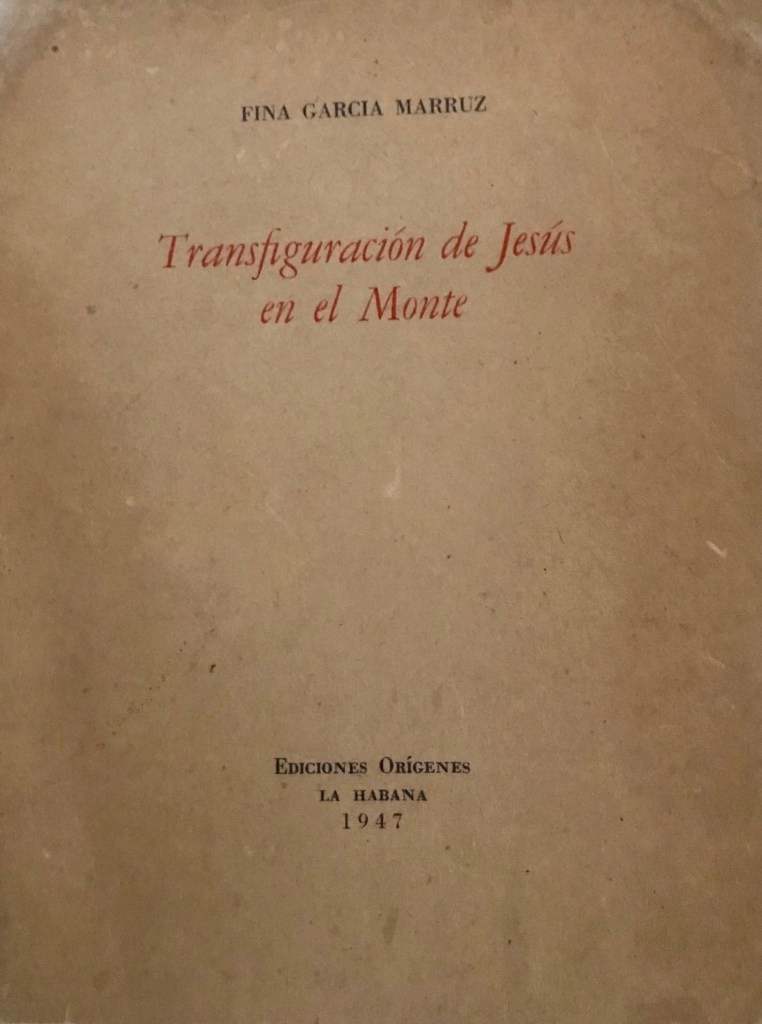
In 1947, the very young Cuban poet Fina García Marruz published the liturgical poem Transfiguración de Jesús en el Monte (Ediciones Orígenes, 1947), which stands in the modernist tradition series of attempts to probe the divine nature of language after the flight of gods and the triumph of the new secular jargons. If earlier in the century a well known Italian philosopher will predict that the international language of the future will be that of technical terms; the English Catholic poet David Jones, will reaffirm that we are “living in a world where the symbolic life (the life of the true cultures, of institutional religion and of all artists) is progressive eliminated – the technician is master. In a manner of speaking the priest and the artists are already in the catacombs, but separate catacombs – for the technician divides to rule” [1]. And if “liturgy” originally meant “public service” and the sphere of gestures, as suggested by Lubienska de Lenval, then Transfiguración has to be read, even into our days, as an attempt for language to measure to the transfiguration of revelation, in which the poem is a sacramental form that retracts language to possibilities of retaining communication.

In fact, Transfiguración de Jesús en el Monte, reinforcing the liturgical repetitions of an hymn and a sacred chant, enacts a flowing rhythm (“en tanto que”) that assesses the limits of the ineffable; a pure exteriority that is the negative or wound of language without ever being able to transcend it. In this sense, Marruz’s poem is only the poetic anabasis to the impossibility of a guided sacrament to organize interiority and visibility. Only the mystical can mediate between exteriority and the crisis of appearance. In an almost programmatic fashion, we read in the second part of the poem: “oh, difícilmente podríamos comprenderlo / Él se ha vuelto totalmente exterior como la luz; / Él ha rehusado la intimidad y se ha echado totalmente fuera de sí mismo” [2]. Transfiguration is the event that exiles oneself from the self (phygé), and in which language can generate contact with something other than its own conventions. This is why they [the witnesses and the martyrs] cannot provide an account about the transfigured revelation – just like anyone cannot truly provide a narrative, except by betraying the experience – except by their hearts as if being mysteriously called by a singular name (“ellos sienten que dentro de su corazón alguien / los ha llamado misteriosamente por su nombre”). 

How can language disclose a sense of exteriority that is capable of moving past the autonomy of signification and self-referentiality of language? Can language befall into exteriority? Marruz provides an answer to this question, which can be taken as her contribution to the aporias of modern poetics: poetry can only attune to transfiguration as a cohabitual of a communicating being. In the year that the poem was published, Marruz also wrote in the winter issue of 1947 Orígenes a dense essay titled “Lo Exterior en la Poesía” (“The exterior in poetry) where she claims that “the heart of poem is always outside of it – it should not be that the poet can offer infinite variations of a secret self-possessed knowledge, but rather to rediscover the liturgy of the real; the extreme degree of visibility, which is also its great escape” [3]. What could the “liturgia de lo real” have meant for Marruz in 1947? Marruz does provide a clearcut theological definition of the exteriority as the “angelic”, which does corroborate the hymnological dimension of language, a transcendence between beings of the invisible. The liturgy of the real that defines the exteriority of the poetics of life does not entail a Romantic elevation by the Poet, but the effort to animate reality beyond an alienated monologue. This is why Marruz writes that “only a dialogue can realize an impossible communication, mystical, whenever it does take place in all of its purity” [4].

In 1947 Marruz went a step further than her fellow poets Gaztelu & Lezama Lima, who had defined transfiguration as a learning exercise of the potentia dei of the divine (“a todo transfigurarse sigue una suspension y el ejercicio del Monte era solo un aprendizaje”) [5]. Read side by side with Antelme’s Angel of Reims, one could very well say that for Marruz there is an event of transfiguration whenever transcendence delivers communication between beings, soul to soul; a relation that can one truly speak of the ungrounded and commencement. The liturgy clamored in language is not the memory of an original Adam severed from Nature, but the transfiguration of a linguistic relationship with the world. This might be the secret to Marruz last two verses: “como la infancia que acuña nuestro Rostro allí / donde no puede ser despertado”. If transfiguration also entails recapitulation, this means that this is not a process of forward becoming, but of retaining the atemporal detention that, like that of childhood, traces our silhouette as both figural and pure presence in the bushes of language. 

Notes 

1. David Jones. “Religion and the Muses” (1941), in Epoch and Artist (Faber&Faber, 1959), 134.

2. Fina García Marruz. Transfiguración de Jesús en el Monte (Orígenes, 1947), 6.

3. Fina García Marruz. “Lo Exterior en la Poesía”, 19. 

3. Fina García Marruz. “Lo Exterior en la Poesía”, 22

4. Ángel Gaztelu & José Lezama Lima. Editorial: “Éxtasis de la Sustancia Destruida”, Nadie Parecía, Número IX, Nov, 1943, 1.

Antelme’s smiling angel of Rheims. by Gerardo Muñoz

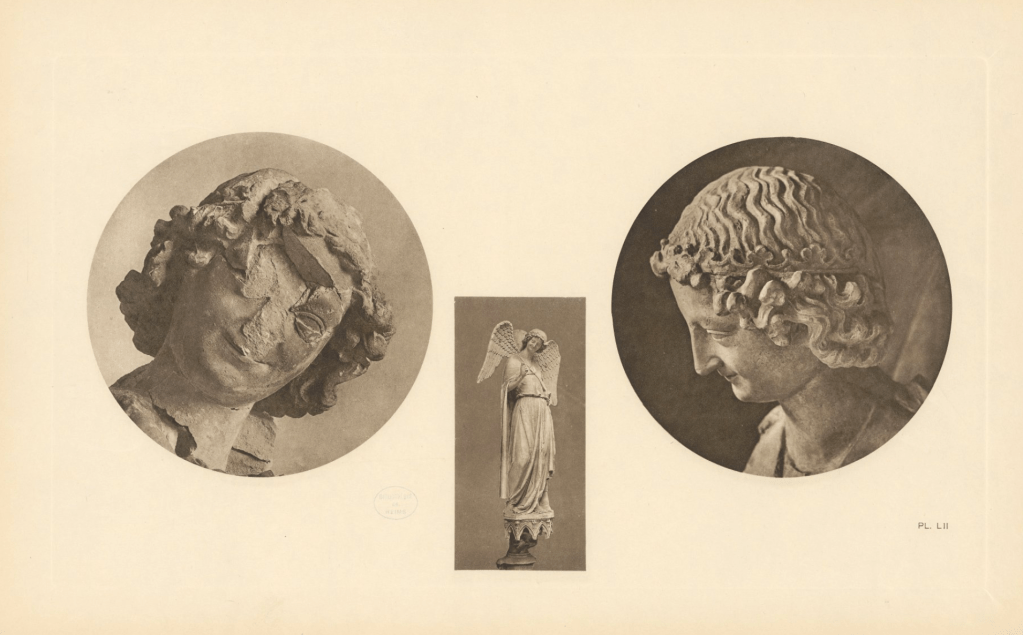
Among Robert Antelme’s posthumous writings the short text “L’ange au sourire” has a decisive place if we are to explain the transfigured theological experience of the French writer. To anyone familiar with French  architecture history the title should sound familiar, since the ‘l’ange au sourire’ was already a common expression used by French scholars of architecture during the interwar years. Charles Sarazin, arguably the most important scholar of the architecture of Reims, penned a separata titled “Le Sourire de Reims” (1929), in which he celebrated the mysterious smile of the angel Gabriel that was severely damaged due to shell fire of the Cathedral during the fall of 1914 [1]. But a decade prior to the destruction, art historian Arthur Gardner, in a detailed essay on the sculptures of the facade of the Rheims Cathedral, also took note of this angel’s gaze writing that: “…the angel Gabriel of the Annunciation in which the French smile has almost become a grin, the beginning of the contorted expressions frequently found over the border in Germany.” [2]. The particular aspect of this unique angel’s face that Antelme undresses from the cloak of authority is also wonderfully documented in the photographic book by Pierre Antony-Thouret, who also showed pictorial interest in the way that angel Gabriel was chipped in a large area of the right frontal relief (image 1) [3]. 

Image 1. Reims au lendemain de la guerre (1928), plate 52.

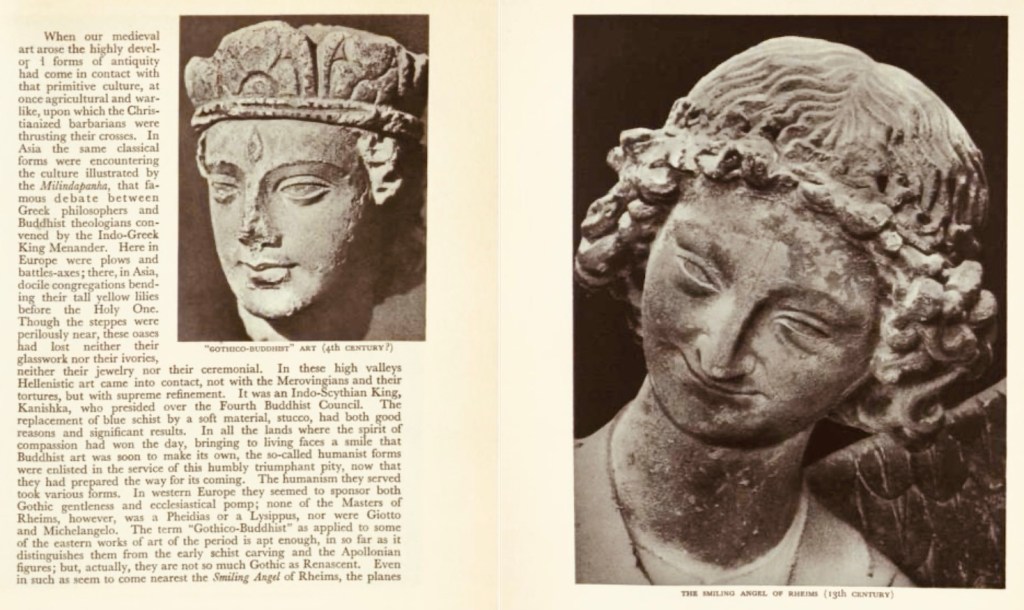
This curatorial context informs the historical background of Antelme’s reference to destruction and what he references as the crushed: “But not crushed by this building, or by that event, or by some power. It has always been crushed, crushed forever” [4]. For Antelme the tenuous, almost imperceptible, smile of the Angel of Rheims is what outlives absolute destruction because to be destroyed cannot be executed absolutely. It is the soul of existence that, because of its exteriority to history, is powerless “to have forever to be”.  Even if this being has become petrified and immobile from its original plastic appearance auf vif of sacred art. This is what Malraux captured in his brief mention of the  “L’ange au sourire” in The Voices of Silence (1951), where he also compares it to the Buddhist faces of Oriental sacred art (image 2): “The Smiling Angel of Rheims is a statue whose “stiffness” increased with every century; but at its birth it was a similar incarnate, a face that had suddenly come alive – like all faces sponsoring a discovery in the field of the lifelike” [5]. In order words, to see in the muteness of the face the nothingness that allows expressive relations to emerge in the open. This holds for Antelme’s description as well: “Radiant or hidden, inevitably it is there. Word, image, music: everything expresses it, and nothing. It lies at the heart of that realm where all relations are born. Forever starting anew. Possessing nothing, capable of nothing, it must be there, forever”. 

Image 2. Angel of Rheims in The Voices of Silence (1964).

But what Antelme was able to capture through the smiling angel of the Rheims Cathedral was not a problem of iconology of art forms, but rather the very essence of the theological problem of angels as it relates to the poetics of life itself. The angel is not a promythical figure scaled to a specific historical moment, but an instantiation of the divine appeals to the withdrawal the possibilities and modes of the human being. This is why Antelme can state that “the only transcendence is the relation between beings”. Even in its muteness, the theologica depth of the angel is the poetic speech of divinity through a surge in language that has no end, but only celebration or hymnology.

This is why Erik Peterson writes towards the end of  “The Book of Angels” about the intimate relation of angels in human existence: “A human being can draw near to the angels because the angel too – as its name already indicates – can draw near to humanity. […] The angels are more than poetic ornamentation left from the storehouse of popular fables, they belong to us. For us, they stand for a possibility of our being, a heightening and intensifying of our being – but for the possibility of a new faith…as a passion for mental clarity and an authentic existence” [6]. It is fair to say that, although the figure of the angel does not show again in Antelme’s work, all of his vision and witness accounts in the face of political horror must be placed in the endless vigil of a nocturnal life that is shared with the ethos of angels (utirur vigilis, angelorum vitam procul dubio meditatur). 

Notes 

1. Charles Sarazin. “Le Sourire de Reims” (s.l.n.d, 1929). 

2. Arthur Gardner. “The sculptures of Rheims Cathedral”, The Burlington Magazine for Connoisseurs, V.26, 1914, 64.

3. Pierre Antony-Thouret. Reims au lendemain de la guerre: la cathédrale mutilée, la ville dévastée (Jean Budry, 1928). 

4. Robert Antelme. Textes inédits sur l’Espèce humaine (Gallimard, 1996), 14.

5. Andre Malraux. The Voices of Silence (Secker & Warburg, 1964), 317. 

6. Erik Peterson. “The Book of Angels”, in Theological Tractates (Stanford University Press, 2011), 139.