The ascent of the Shadow Docket. by Gerardo Muñoz

In recent years there has been a steady but increasing practice in the American legal system that has passed unnoticed outside the corridors of law professors and practitioners of litigation, including the federal state that has summoned to its practical use: the emergency relief, or ‘shadow docket’ that puts the burden on the Supreme Court to decide on concrete questions without a formal hearing, fact finding, or without proper argumentative opinions of visible authorship (the judge who pens the opinion tends to deface his authorship). Since the outbreak of the Covid-19 pandemic, the Supreme Court of the United States has increasingly expanded its so-called ‘shadow-docket’ in parallel with the merits docket to such an extent that, as some legal theorists have noted, the blurring of the borders between the first and the second have become so tenuous and intertwined that it would seem that the merits docket depends on the prior selection mustered in the shadow docket. As constitutional scholar Stephen Vladeck has registered in his The Shadow Docket (2023), a practice that historically was strictly tied to emergency relief for capital punishment executions, it has now become a normal vehicle to decide on the emergency contingencies, while at the same time exercise discretionary judgement regarding the merits, or actual dispute, of case pending future review that might never be considered at all [1]. 

It must be said that the selective practice of cases by the court through the notion of “certiorari” on merits cases was in itself a decision on the exclusivity of relief based on the criteria of major legal questions of interest to the court. But precisely the differentiation between certiorari and the shadow dockets grants sharp focus on their differences. On the one hand, the shadow docket fails to decide on “legal questions” – in fact, it avoids tailoring the boundaries between the other branches of government and itself, as some have noted – and, by the same token, its non-decision produces a precedent lacuna that further entrenches the ascension of the shadow docket, inviting an evermore practice of emergency relief to increase chances of ‘cert’. Contrary to expert opinion, this is a juridical situation that does not create the conditions for the normalization of the “state of exception”, since there is really no authoritative decision to stabilize a concrete order, which was the purpose of Carl Schmitt’s well known formulation about sovereign arcana in political theology. In a certain sense, we have already crossed this threshold. Rather, the shadow-docket as a juridical practice in the American legal order is an institutional symptom in which decision has been evacuated or rendered inoperative, so that emergent social needs enforce any specific arrangements and political vectors through an enacted order. 

Furthermore, the shadow-docket as a regularized legal practice at the highest court confirms the historical shift within American legal system from the empire of the courts to administrative departmentalized commands, which ultimately means that the formal tendency towards “delegation” should not be solely circumscribed in allocated powers of the different branches’ oversight and control, but rather is a product of a holistic tendency towards the emergence of a new form of social indeterminacy in which authority resides in the shadows. As Supreme Court Jackson writes in the “Per Curiam” dissent in Trump v. JGG  (April 7, 2025): “With more and more of our most significant rulings taking place in the shadows of our emergency docket, today’s Court leaves less and less of a trace. But make no mistake: we are just as wrong now has we have been in the past, with similar devastating consequences”. It is an astonishing statement from the Judge not only because of what it states, but also what it silences; mainly, that by leaving no trace at all of their argumentative reasons there is no precedent, and for that matter no process and thus no case. And what is a rule of law devoid of a case and precedent? The historical schism with respect to the tradition of Common Law that gives birth to its formal constrains should be utterly obvious. Ultimately, this evidences the uttermost decline of the legal positivist horizon of the modern law rooted in legitimate authority (authoritas, non veritas, facit legem), in which arbitrary decisionism, legal motorization, and appeals to external values align themselves in order to render absolute determinacy between social life and legal execution without any preclusion in the form of a social trial without end. In this sense, it would be foolish to assume that the crisis of authority with the dissolution of auctoritas in the social spheres compartmentalized in functions of the “political community”; on the contrary, in the shadow docket scenario, authority “becomes more and more abstract, more and more inhuman and inexorable; more and more demanding” [2]. The orientation of executive commands is met with proportional digression of adjudicated moral pondering, and each time the force of legalization is vigorously expanded.

The decline of the juridical decision, one would be tempted to say, paves the way for the infinite demands at the expense of the arbitrary values formation of social gigantism. In the opinion about college admissions and racial discrimination of the 2023 merits docket cycle (Students for Fair Admissions v. Harvard College), Justice Roberts wrote that “What cannot be done directly cannot be done indirectly. The constitution deals with substance, not shadows”. An ironic statement, indeed, given the preeminence of the shadow-docket in the adjudicative practice of the Supreme Court itself. While the administration of justice becomes a practice in the shadows, one cannot but be reminded of Plato’s protofigure of the Guardian of Constitution, the Nocturnal Council, as elaborated in the last pages of The Laws. And for Plato “if a state lacks such constituent [a Nocturnal Council], no one will be surprise to see it staggering from one irrational and senseless expedient to another in its affairs…that body must posses virtue in all of its completeness which amens that it will not take erratic aim at one target after another but keep its eye on single target and shoot all its arrow at that” [3]. On the tail opposite end of the platonic Nocturnal Council, the United States’ highest court’s gliding abdication seems to erratically aim at repeated targets that emerge blasting flickering lights from within the ever present shadow docket – indeed, a momentary luminosity, full of ‘technical terms’ and deferrals, that aim to showcase that the rule of law still endures in the House of Justice.

Notes

1. Stephen Vladeck. The Shadow Docket: How the Supreme Court uses stealth rulings to amass power and undermine the republic (Basic Books, 2023), 19.

2. Theodor W. Adorno. “On the Problem of the Family” (1955), Endnotes, 2022: https://endnotes.org.uk/posts/theodor-adorno-on-the-problem-of-the-family-1955 

3. Plato. The Laws (Penguin Books, 1975), 520.

Justification and the demonic State. by Gerardo Muñoz

In the broadest sense of the term, questions about the law are predominantly about its justifications, and more specifically about where to locate the act of justifying. That one of the most important elaborations of exclusive positive authority was dependent on a theory of justification to transfer norms of authority (a theory labeled the “normal justification theory”) goes to show that the traditional opposition between positive law as pertaining to the sphere of rights and guarantees and natural law to that of justification comes short in the understanding of the internal development of judicial reasoning in the second half of the twentieth century that unsurprisingly coincides with the crisis of the secular liberal state [1]. The reliance on a “justification theory” will imply not only a new conception of legitimation, but also the outsourcing of the self-referential determination of “Nature” through which Roman Law constructed its principle of the rule of law and the validity of adjudication. As we know, Roman Law did not speak of “justification” but rather of necessity emanating from Nature, which could not oblige to performance or act through by what by nature is impossible or wrong [Ius plurimis modis dicitur: uno modo, cum id quod semper aequum et bonum est ius dicitur, ut est lus naturale]. The natural source of law, as famously defined by Ulpian in the Digest, is in this way permanently tilting between the good and the equitable (ius est ars boni et aequi). This is a matter of first principles of the law (ius), which did not solicit “argumentation” or second order reasoning to uphold its internal legal validity. 

The passage from natural necessity in the “hands of the priest”, in Ulpian’s conception, to the modern autonomy of justification takes place when principles are no longer the exclusive framework parameters for operative claims, but the very activity that defines the elasticity of an actual norm and its argumentation within a concrete positive order. This is one way in which one should define the specificity of the American practical legal order (not just its legal philosophies, which tends to run counter to this, cloaked under the vestigates of positivism vis-à-vis the letter and spirit of the Constitution) through juridical administration, whose structural polarity of command and justification defines the administrative process. Early in the twentieth century, Guglielmo Ferrero noted that one of defining characteristics of the American political model rested on a magistrate judicial power that fundamentally differed from European Common Law or positivist tradition in its practice [2]. Contrasting the independence of a limited bureaucracy to the predominance of an all encompassing “juridical administration”, Ferrero noted (although lacking the legal vocabulary to articulate it positively) that the administrative nexus will infinitely expand over social practical reasoning due to the unrestricted force of justification. And the need for justification is what outsources the ancient principles of natural law (ius) to the executive authority that renders operative every sphere of social action and interaction even if they are not explicitly declared prima facie by those principles. The efficacy of justification is the linguistic deployment – a rhetorical craft through rational argumentation – that will generate specific verisimilitude to the otherwise arbitrary and uncontested enactment of its principles. Justification could be said to appear as the work of language that provides internal cohesion of an array of coordinated conditions for secondary social actions. 

Since the inception of modern secularization, the nature of justification is the realization of the works without end, which inverts the notion of “justification” in the theological sphere that we owe to Paul. For the Apostle the idea of justification or dikaiōsis implies the making of righteousness through the soteriological narrative of Christianity that subsumes humanity’s fall (sin) for a redeeming liquidation of law. This means that man’s just act in faith generates “justification” (dikaiōsis) of life for all people (Roman 5:18). And as we read from Galatians 2:6: “Know that a person is not justified by the works of the law, but by faith in Jesus Christ. So we, too, have put our faith in Christ Jesus that we may be justified by faith”. The force of justification (dikaiōsis) trumps the production of the works of law that divides human beings in the immanence of this world between the saved and the condemned, the free and the imprisoned, the friend and the enemy. Whereas justification in the theological sense can only imply the ‘end of law’ for righteousness (Roman 10:4), in its late secularized rendition it implies exactly its distorted mirror image: to justify is transformed into the binding force over the void of authority that renders effective the hollow machinery of its own self-validation. 

It is telling that in an essay that was first published in German in 1938 under the title “Justification and Justice” (“Rechtfertigung Und Recht”), the German theologian Karl Barth takes note on the transformation of the State becoming “demonic” not due to its utter demise, but as a profanation of the theological justification of “unwarrantable assumption of autonomy as by the loss of its legitimate, relative independence, as by a renunciation of its true substance, dignity, function, and purpose…a renunciation which out in Caesar worship, the myth of the state and the like” [3]. The emergence of the “demonic nature” of the State was internal of its own making , since it conflated faith and people at the same level of social immanence, while preparing the actual realization of an authoritarian world without escape. Following Heinrich Schlier’s work on the figure of the State in the New Testament, Barth will suggest that this political totalization secularized the limit posited by the suum cuique of justification into an instrument of endless domination that characterized the emerging political reality. In fact, in his essay “The State according to the New Testament”, Schlier will define the phase of the demonic State as one colored by the inception of the sphragis, that is, “the sign of the state party as it were the secularized seal of baptism which levels all differences between men and only distinguishes between friend and energies of the ruling system. Those who refuse the new metaphysical slave are deprived of their economic foundations. Even economic life is directed by the spirit of the beast” [4]. 

Only in such context does the true light of the force of justification comes in full display: the sphragis can only labour to justify the vicarious social existence of the mystery of iniquity infinitely redressing itself as legal argumentation and juridical principles, administrative determinations and executive commands. And Schlier could not let the question pass: “What will Christians do in this situation? They will no longer want to have any part in this caricare of a state, they will “go out…they will simply be outlawed and persecuted” [5]. More than ever today, we are in desperate need of elaborating the elementary aspects of a political theory of demonology that defines a certain point where there is no turning back. To outlive persecution and tear the bond of justification shatters the civilizational course that has sublimated the end of time as an instrument of daemonic absorption into endless legal statues.

Notes 

1. Joseph Raz defines “normal justification thesis” of legal authority in this way: “I shall call it the normal justification thesis. It claims that the normal and primary way to establish that a person should be acknowledged to have authority over another person involves showing that the alleged subject is likely better to comply with reasons which apply to him (other than the alleged authoritative directives) if he accepts the directives of the alleged authority as authoritatively binding and tries to follow them, rather than by trying to follow the reasons which apply to him directly”, in “Authority and Justification”, Authority (NYU Press, 1990), 129.

2. Guglielmo Ferrero. “American characteristics” (1910), The Atlantic. 226. 

3. Karl Barth. Community, State, and Church (Peter Smith, 1968), 118.

4. Heinrich Schlier. “The State  according to the New Testament”, in The relevance of the New Testament (Herder and Herder, 1968), 236.

5. Ibid., 237.

The instrument stripped bare. On Adan Kovacsics’ Guerra y lenguaje (2025). by Gerardo Muñoz

Endless war and infinite strife is always preceded by the erosion and the putrid decomposition of language. Such is the thesis of Adan Kovacsics’ idiosyncratic and historically situated Guerra y lenguaje (Acantilado, 2025), which sets a specific date for the moment of such linguistic rot into consciousness in European modernity: Hugo von Hofmannsthal’s “Lord Chandos Letter” of 1902 in which civilizational decline signaled the total detachment of expression, making language flourish in the form of opinions resembling rotten mushrooms. For Hofmannsthal this event was neither accidental nor a temporary malady, but a tonality of existence that soon enough broadened like a “spreading rust” (Kovacsics 11). Just a few years later in his posthumous Persuasion and Rhetoric, Michelstaedter will describe this rusting of language as the triumph of “darkening ornaments” (kallopismata orphnes) of the epoch, liberating the destiny of language as a mere transactional exchange between “technical terms” mastered by everyone regardless of their idioms (it surprises the reader that the thinker of Gorizia is absent from Kovacsics’ Austro-Hungarian constellation on the crisis of language). 

The decline of an empire shimmering with languages and dialects across its territory began to suffer the malady of miscommunication that resulted in making language uninhabitable, throbbing in its empty chatter. Thus, the attempt to initiate an exodus from language began to appear everywhere according to Kovacsics: Fritz Mauthner drafts an encyclopedic treatise on the venereal misapprehension of language, Gustav Landauver battles in the trenches of linguistic scepticism and the mystical tradition in the name of revolution, while others like Hugo Ball attempts to flee from language altogether through the liberation of sounds and words, from the Dada avant-garde to his later Byzantine Christian asceticism. For his part, Karl Kraus in The last days of Mankind prefers to expose the surface of language as it becomes a regime regulated by opinion for bureaucratic administration over facts of reality. The nihilism that colors politics at the turn of the century is accompanied by the instrumentalization of language as the primordial technical apparatus that allows the flows of information through the acceleration of the autonomization of the linguistic mediation; as consequence, language began to arouse constant disbelief and doubt over the very essence of the sayable (Kovacsics 31). This throws light on contemporary debates about “misinformation” that, precisely because they are caught up on the epistemological determination proper to the linguistic crisis, it comes short to putting into perspective the range and depth of language over the problem of appearance now deprived of the expressive mediation between the speaking animal and phenomena, reducing experience to rhetorical commonalities or inter-social allocation of commands. 

Kovacsics’s Guerra y Lenguaje (2025) brings to bear – without totally exhausting the crushing weight of its archive and set of problems for thought – the immense significance of the first decade of the twentieth century at outset of the waning of the Austrian-Hungarian Empire, which has always been understood historically as the condition for the last configuration of European nationalism and its war-economies, but rarely in light of its functionalization of language. If read against the backdrop of Simone Weil’s “Are we heading for the proletarian revolution?” (1933) intervention about the “functional” dimension of the state form in the first decades of the twentieth century, Kovacsic’s essay ultimately helps us to define the concrete nature of functionality as the index of mobilization of ‘worlding’ through the commanding force of language. To deliver this point home, Kovacsics tells how language itself severed enunciation from action:

“La transformación que se produjo y que la ha alejado, como si un tablón se hubiese desprendido del muelle y se hubiera adentrado en el mar, no se debe a que otras gentes se impusieron en su día en Grecia, sino a un cambio radical en el uso concreto de la palabra. Es en la Gran Guerra cuando esa corriente inicial de la utilización del lenguaje como herramienta se consolida de manera definitiva. Es entonces cuando la palabra pasa a ser plenamente funcional y su papel se reduce a aportar argumentos para la acción o incluso a “parirla” mediante el tópico. Hemos visto hasta qué punto el silencio de Karl Kraus al comienzo de la contienda se debía a la percepción de este vínculo entre palabra y acción, al que no quería ni podía sumarse de ningún modo” (Kovacsics 76-77). 

Language does not disappear as much as it transforms itself into two vectors of social enforcement towards communication: functionality and rhetorical enthymemes. In this way, language is able to colonize reality and stabilize for the concrete order, or what Walter Benjamin called during those years the “bourgeois conception of language” hindering on causality and objectivity accelerating the collapse of its vocation to naming the exteriority of the world (Kovacsics 81). The totalization of this new rhetorical social structure becomes the main stage for the production of justification and competing regimes of fiction. But this implies no general theory or systematization of a linguistic science, but rather how language coincides with life in the form of an ethics. This is at the heart of the different attempts to retract language in the eclipse of empire and the new interstate fragmentation – which also entails grammatical and functional unifigies of national language – as a problem that concerns the limits of ethics. Ethics here cannot coincide with the general condition of ‘knowability’ that makes morality possible; rather, the problem of ethics can only reveal in turn the senseless of wanting to go beyond the facts of the world and allows us to dwell in one without completion.  The withdrawal from the language of propaganda and objectivity demanded an ethics of the sayable beyond the commodification and intentionality of words promoted by “war” and “ware” (commodity) that the West had continued to endure; a total communication of ends that decades later evolved into cybernetics as the warping of world into informational encoded relation.

Kovacsics reminds us that there is a story here of extreme violence and creative destruction, only comparable to nuclear fusion and the flaying of a human being, only that this time, unlike the myth of Marsyas, without ever reaching transcendence of redemption through the proximity of language to myth (Kovacsics 129). Underneath there is the body of language, stripped of its capacity for truth and reduced to functions of survival and needs oriented towards the homogeneity of the future. Towards the end of Guerra y lenguaje (2025), and glossing Hobbes’ notion of political authority that legitimated the modern interstate system to neutralize truth contents and the stasis over words, one cannot help but think that the date 1902 as a. arcana was an effective culmination rather than genesis of the modern, which means that the foul scent of the twentieth century was destined for decomposition since it had already stripped bared one of the most beautiful lacunae of the human species: being in language and the event of appearance became integrated into the worldly utopia of the machine.

As captured in Marcel Duchamp’s “The Bride Stripped Bare”, the obsolescence of language over time evolved into a candid instrument of social functions of proportional exchange, coordinated fortuitous relations, and increasing moral indictment that purported parodies of contested realities. Thus, the sickness is always unto language – a basic assumption that reveals the need for infrapolitical analysis before there is any political practice and categorial reinvention. The overexposure of language as an avatar of metaphoric communication for ends and needs of humankind brought itself bare and all encompassing in its appropriative force, but only at the expense of darkening and losing the world forever. 

Emergency and the abdicating liberal executive. by Gerardo Muñoz


Over at the newspaper Perfil, the constitutional scholars Andrés Rosler and Guillermo Rosler have an excellent critical analysis of the omnibus emergency decree (“Decreto de Necesidad y Urgencia”) proposed by the newly minted Argentine President Javier Milei, which has the alberdinian ringtone in its title “Proyecto de Ley de Bases y Puntos de Partida para la Libertad de los Argentinos”. As members of his cabinet have described without vacillation, the aspiration of the legislative package has the high aspiration of enacting a true political revolution in the name of unmediated “civilization freedom” against the institutions and mediations of the state. Rosler & Jensen make a good case that Milei is far from being the ‘founding father’ of the instrumentalization of executive emergency; and in fact, at least since the the transition to democracy of the 1980s, Argentine executive power has increasingly become a normalized standard of broad executive decrees against the letter and spirit of Article 99 of the Argentinian Constitution. As a matter of habit and precedent, the exceptional character of the emergency decree over time has sort of become the supra-institutional norm of governance, thus blurring the state of emergency from the normal course of institutional mediations and consequential remedies. Paradoxically, Milei’s revolutionary force expresses more of a continuity with the collapse of the liberal modern state than a counter-revolutionary seeking a strong formal stabilization between the economic interests and state functions. 

As an addenda to Rosler & Jensen’s illuminating piece, I wanted to register the symptomatic and perhaps unique paradox of the revolutionary executive command; mainly, that at the same time that it discharges an ambitious and total encompassing legislative omnibus bill for the emergency, its purpose differs from the classical conception of political decision that seeks to harmonize a strong state and a sound economy, as Carl Schmitt famously argued in the 1930s. Indeed, Schmitt argues in “Strong State and Sound Economy” (1932) that authority emerges from success and achievement between the spheres. Now this success presupposes not only the effective deployment of state institutions (“the constitutional legalization of new institutions”), but also that the autonomy of the political system guarantees the separation between the unity of the state and the plurality of civil society [1]. This means that even if Milei’s libertarian ideal of a strong financial state is taken at face-value, the betrayal on the autonomy of the political reveals the feeble dimension of his executive force; a self-defeating overreach that, similar to the ways of the Trump presidency (2016-2020) in the United States, ends up revealing the executive weakness with respect to the conservation of the autonomy of the political [2].

In other words, by disdainfully acting through an unbounded economic ideal to disarm the state, the executive also abdicates his energetic capacity to reorganize the chaos from partisan, ideological, and economic interests in the long run. In his proposal to the business class to consolidate the authority of the state, Schmitt advised about the necessity of a robust and independent neutral bureaucracy for legislative deference and operative allocation of reasonable decision-making regulations. This allows us to differentiate another structural disparity between the Argentine and the North-American forms of executive power: whereas the first tends to maximize the power of its office through a vicarious political charisma that leads to its own abdication; the hamiltonian energetic executive (Federalist 70) has drifted towards a process of abdication or self-evolving expansion and containment within the principal tracks of a gigantic administrative apparatus. The picture in question is, of course, one of paradox: this means that the presidentialist model of the Latin Americanist design, at least broadly speaking, differs substantially from the energetic American model, precisely because every attempt to enact hegemonic force ultimately shrinks the overall reach of the administrative execution. Hence when Rosler & Jensen write about the executive that “…nuestra Constitución no adoptó un modelo de ejecutivo fuerte de impronta alberdiana, con amplias facultades, sino que se inspiró en el modelo norteamericano en donde este tipo de decretos no existe”, they only partially give capture the full picture. In other words, the contrast is not merely at the level of executive forms of potestas (executive order without Congress authorization and “Decreto de Necesidad y Urgencia”), but also, and more importantly, at the very capacities for abdication and abnegation of delegated power within the two institutional arrangements where the administrative institutional building from within plays a fundamental role in the functioning of formal liberal political designs. 

In fact, if we are to follow Rosler & Jensen’s astute intuition that Milei is nothing new under the sun, we could say that his executive habits, now cloaked under extreme commercial faith of the “invisible hand” of the market, follows to the letter the political tradition of the liberal criollo political class that the republican theorist Juan Bautita Alberdi criticized in the nineteenth century. As he wrote in his posthumous writings: “Argentine liberals are platonic lovers of a deity they have neither seen nor known. Being free for them does not consist in governing themselves, but in governing others. The position of the government: that’s all about freedom. The government’s monopoly: that’s all about liberalism…Liberalism, as we have to respect the discontent of other officials against us, is something that does not fit into the head of an Argentine liberal. The dissident is an enemy; the dissent of opinion is war, hostility, which authorizes repression and death” [3]. In this strong cautionary denunciation, Alberdi’s well-crafted portrait of Liberalism has at least two conjoined features that adds sharp historical relief: the deficiency of Liberalism was always the aspiration of unconstrained freedom (of interest) suppressing the autonomy of the political and dissent (the enemy), while increasing the frontiers of government over the space of civil society. In effect, the sovereign exception (broadly applies to Latin America) can be said to have been an exception to neutralize the very condition of exceptionality constitutive of sovereignty’s exclusionary political theology.

This will remind us, at least axiomatically, that Saint-Just’s maxim that a government ruled by hegemonic underpinning tends to produce only monsters and absolute enemies meets the truth of a historical pathology. In a wider panorama of Latin American political thought, the ideals of Liberalism have only fomented the administration of political stasis or civil war over the spiritual unity of constituent power in which the state and its institutions have been too fragile to overcome throughout its different renditions (the criollo oligarchic state, the national popular, the socialist welfare state, and the openly revolutionary socialist states) [4]. In contrast to the constitutional ‘royalism’ of the original North American republican organization of public powers and its abnegating executive office (a war of independence waged against the British Parliament), taking a look at contemporary presidential power allows us to derive the different compensatory strategies in confronting the collapse of the legitimacy of the modern legislative state [5]. The so-called “revolution of freedom” (with the consumer citizen at the center stage of the always unfinished and ongoing coercive consent required by the passive revolution) mandated by the executive against the institutional fabric is ultimately a renewed attempt at conserving the root and branch of the hegemonic logistics at the heart of the region’s post-independence apparent state and its rocky historical development.

Notes 

1. Carl Schmitt. “Strong State and Sound Economy: An Address to Business Leaders” (1932), appendix in Renato Cristi’s Carl Schmitt and Authoritarian Liberalism (University of Wales Press, 1998), 221.

2. I argued for this position in several publications a few years ago, see for example Gerardo Muñoz, “¿Se avecina un momento Weimar en los Estados Unidos?”, La voz de los que sobran (Chile), November 2020: https://lavozdelosquesobran.cl/opinion/se-avecina-un-momento-weimar-en-los-estados-unidos/07112020 

3. Juan Bautista Alberdi. Escritos Póstumos: Del Gobierno en Sudamérica (1896), Vol.IV, 188.

4. The continuity of stasis at the foundation in the region is something that can be derived from Rafael Rojas’ historiographical contribution Los derechos del alma: ensayos sobre la querella liberal-conservadora en Hispanoamérica 1830-1870 (Taurus, 2014)

5. Eric Nelson. The Royalist Revolution: Monarchy and the American Founding (Harvard University Press, 2014). 

On the Highest Office. by Gerardo Muñoz

The Supreme Court of Colorado has recently upheld the constitutional argument developed by two constitutional scholars, William Baude & Michael Paulsen, that disqualifies former President Trump from a presidential nomination under section 3 of the Fourteenth Amendment of the US Constitution. According to this legal argument by one of the nation’s renowned legal originalists, any former public official who has taken an “oath” to the Constitution and engages in a rebellion or insurrection is disqualified from returning to public office as expressed in the letter of the Reconstruction Amendment. What is more, section three is ‘self-executing’, which means that it applies through adjudication by the courts without having to pass by legislative majority from Congress. Regardless of the future outcome of the contentious case, what is remarkable is how the development of American democracy – centered on the republicanist innovation of electoral power and voting, if we are to believe Sanford Levinson’s hypothesis – bends towards an executive constitutionalism that sits way above the political representation mediated by constituent power (Congressional authority) [1].

And insofar as to the normative nuances of the case are concerned, the application of section 3 of the Fourteenth Amendment does not express a constitutional crisis as much as it reveals the system of the constitution‘s arcana of power: “the officer” and the ‘highest office’. In fact, as many legal scholars have already noted, the center of the applicability of section 3 will be waged on whether the Presidential office qualifies as an “officer of the United States” or not [2]. Implicitly it should not be noted that this is the constitutional standard through which the case already presents itself. In other words, what is at stake in section is not only the betrayal of an oath, democratic legitimation, constitutional public meaning, or a violation of separations of power; what is at issue is the enduring force of an office and the command of the officer in a concrete institutional reality. 

And not just any office, but according to the opinion of the Colorado Supreme Court, it pertains to the “highest office” of the land, which is not lex scripta in Constitution but implicitly derived: “President Trump asks us to hold that Section 3 disqualifies every oath-breaking insurrectionist except the most powerful one and that it bars oath breakers from virtually every office, both state and federal, except the highest one in the land. Both results are inconsistent with the plain language and history of Section 3″ [3]. As in the allegorical ‘Commandant’ in Franz Kafka’s “In the Penal Colony”, the highest office follows the unwritten Executive office tradition in order to bar a former president (involved to some degree in an insurrection) for its own endurance: the being of command that must self-execute itself in order to be what it is, that is, the highest office [4]. The paradox, then, it is not just at the level of interpretative enterprises of a specific legal culture – in other words, what legal theory will allow judges to accept Trump as officer or non-officer of the executive branch, as Vermeule suggests – but rather, the fact that in order to preserve the veneer of democratic legitimation between the different conflicting public powers and its potential rise to “authoritarianism”, the highest office must rank at the center of the executive force of either general economy of deference and public legitimation [5]. This also speaks to the ‘royal’ tailoring of American republicanism (the monarchical force in the executive) in which the unbound dimension of the “highest office” also entails a constrained, impersonal, and thus anti-constituent dimension that shows its relief upsetting the modernist liberal forms of the separation of powers [6].

 From this picture it follows that the so-called post-liberal and virtuous calls for a neoclassical regime change perhaps have failed to grasp that this regime has always been beneath their own noses: the ‘highest office’ dispenses the soulcraft that subsumes civil society to the functions of the administrative state bypassing practical spheres of separation. If the arguments and debates about section 3 matter, it is precisely because it reveals the esoteric arcana (the highest office) of American structure of government runs parallel to its exoteric liturgical arcana (voting rights) – and, precisely, it it comes to no surprise that executive immunity under section 3 comes into full tension with voting rights in an unprecedented theater of active operations in which both levels of the arcanni convergence and collapse. In a way, this validates Carl Schmitt’s assumption that decision over exception is constitutive of every legal system, and that every legal system (insofar as it does not want to crumble under the abstraction of a general norm) arms itself with a sovereign decision. The highest office in the American constitutional system is the institution for the self-executing force of sovereign immunity. 

In this legal landscape, a recently published book, Of Rule and Office: Plato’s Ideas of the Political (2023), by classicist Melissa Lane aptly analyzes the binding notion of political rule with the public office in Plato’s Republic. In another epoch, the publication of such book would have been taken as a theoretical touchstone for either side of the constitutional crisis, since Lane’s intricate argument illuminates the original tension between political rule and office in a democratic polis; a highpoint of intensity that fractures office-holding (anarchos) as in the account of the “democratic man”  in the parabola of the young lotus-eater goes: “intolerance good breeding, anarchy freedom, extravagance magnificence, and shamelessness courage”  [7]. Thus, as Lane observes, the attitude of the anarchos is not merely achieving the erasure of power or government, but more specifically the destruction of the proper constitution of the office. It is also telling that the energy of the anarchos is not against the state or a “leader” (archontes), but oriented towards the civil magistrates and bureaucratic power; or, to put it in the language of modern American public law, against the administrative state. At the end of the day, the elemental unit of administrative law is the autonomy of the command of an agency / office of regulatory power dispensed from the Executive branch. And is not in the modern opposition of movement – institution the very friction between office and anarchos? If politics is reduced to this polarity, then there is no longer any paradoteon, a complex term that Plato in his late work associated with restraint and prudence when regulating music for the fulfillment of the kallipolis through the generations [8]. The highest office constitutes, in this way, an ur-officium, the arcana that binds the political system when all there is a system of commands.  

Notes 

1. Sanford Levinson. An Argument Open to All: Reading The Federalist in the 21st Century (Yale University Press, 2015). 

2. “Prof. Michael McConnell, Responding About the Fourteenth Amendment, “Insurrection,” and Trump”, The Volokh Conspiracy, August 2023: https://reason.com/volokh/2023/08/12/prof-michael-mcconnell-responding-about-the-fourteenth-amendment-insurrection-and-trump/ 

3. Supreme Court Case of Colorado, No.23S A300, 2023, page 84: https://www.courts.state.co.us/userfiles/file/Court_Probation/Supreme_Court/Opinions/2023/23SA300.pdf 

4. Giorgio Agamben. Opus Dei: An Archeology of Duty (Stanford University Press, 2013), 84.

5. Adrian Vermeule. “The Non-Originalist Decision That May Save Trump”, The New Digest, December 2023: https://thenewdigest.substack.com/p/the-non-originalist-decision-that 

6. Adrian Vermeule & Eric Posner. The Executive Unbound: After the Madisonian Republic (Oxford University Press, 2011), 5.

7. Melissa Lane. Of Rule and Office: Plato’s Ideas of the Political (Princeton University Press, 2023), 304-305.

8. Plato. The Laws (Penguin Books, 1970), 291, 802d.

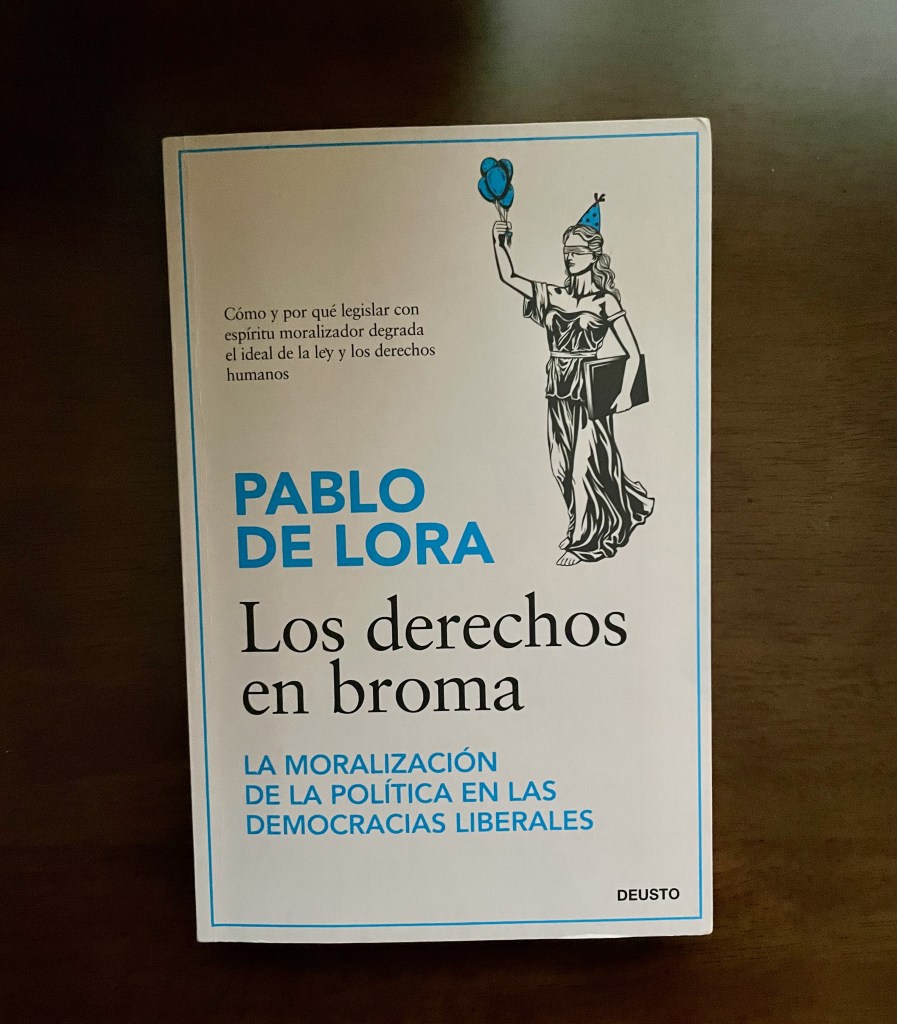
The nursery social state. On Pablo de Lora’s Los derechos en broma (2023). by Gerardo Muñoz

The crisis of the liberal legislative state is almost as old as the very project of the modern liberal state itself. And if we are to believe Carl Schmitt, the rise of the supreme values of the French revolution and ‘human rights’ (with its corollary of universal recognition within its normative system) also meant walking the fine line from the political theology of generative reform to the nihilism of ius revolutionis commanded by new discharges of individual will, political and technical movements, and immanent forces bringing the collapse of the separation between state and civil society. We are still living under its protracted shadow, albeit with a different intensity and intent. In his new book Los derechos en broma: la moralización de la política en las democracias liberales (Deusto, 2023), Pablo De Lora co-shares this point of departure, while daring to suggest a new sequence after the collapse of modern political form and legal order: we are currently living under a particular epochal transformation that is anti-legalist (sic) in nature – precisely because of its surplus of legal motorization – that erects a “nursery state” for the totality of the political community’s reasons and justification for action (De Lora 23). 

Although De Lora case studies shown are almost entirely derived from the Spanish and Latin American contemporary social contexts, I do think that his sharp diagnosis could be extended to the epoch itself without blurring the important nuances. This is an epoch of a reigning “emphatic constitutionalism” (Laporta) or the total Constitution (Loughlin), at the same time that it no longer takes too much effort to imagine a political community devoid of a legislative body, as one eminent constitutional scholar has said repeatedly [1]. We are already here. In other words, whether by excess or deficit, the overall purpose of moral driven legislation announces the internal transformation of modern politics as we know it, extending itself to a civilizational regression from the ideals and norms of the Enlightenment rooted in the fiction of the citizen, the binding of the social contract, and the invention of the principle of sovereign authority.

De Lora does not quite says it in this way, but I think I am not diverting too much of his cartography when extracting some of the central consequences of these internal moral substitutions that are palpable everywhere across the West: ecological legislation that increases social conductivity and expansion of natural destruction; ‘feminist’ anti-sexual aggression that leads to lowering of sentences for convicted sexual predators; the inflationary instrumental use of “Human Rights” for persons and things, but only defined narrowly by those that, under the thick haze of institutional hegemony, can deprive their political adversaries and enemies of the most basic legal guarantees of due process transforming them into non-persons. These ‘moral substitutions’ is part of the “ironic” and “futile” consequence of the sacralization of morality whose end is the management of the “social model” at all costs. According to Pablo De Lora, within the limits of confronting a social dilemma such as disability, the specificity of the “case” is turned on its head; what matters is the overall structural design of the social order and its infinite adaptive changes (De Lora 71-72).

This mutation generates all sorts of unintended consequences when the rhetoric of “social benefit” takes the lead. As De Lora writes: “No hay apoyo anticipado a la discapacidad mental sin reconocimiento de que el discapacitado mental no puede ejercer su autonomía en el futuro. Dicho de otro modo, la institución de las voluntades anticipada de la lógica desideratum de modelo “médico” de la discapacidad mental que se rehuye en beneficio del modelo social” (De Lora 85). And in spite of normative incoherence within an institutional system, the deflection to the “social model” requires ever-expanding commands, rules, principles, and hyper-amendments to guide the adverse proliferation of reasons for action within the social state (in the United States this is soften by the police powers of inter-agency statutes of the administrative state through cost&benefit balancing of discretionary principles under the supervision of the executive branch). This transformation entails the collapse of the internal mediation between the validity of norms and its foundation in social facts as in the classical construction. Thus, the expansion of value-driven legislation that also requires of specific adjudicative constitutional theories, such as legal interpretation and the theory of balancing of principles advocated by Robert Alexy, the sponsors of social neo-constitutionalism, but also the embedded dialogic ideological positions of constitutional scholars such as Roberto Gargarella (or in the United States context, the work of Mark Tushnet and the so-called anti-originalist ‘living constitutionalists’).

All things considered, the fundamental problem for De Lora is that this specific transformation enacts what he calls a “Estado parvulario” or ‘nursery state’ that he defines as: “El que denominado “Estado parvulario” da pábulo a que el poder público, en sus diversos instancias y encarnaciones, escamotee las realidades y consecuencias que conllevan algunas discapacidad per oa que lo haga de manera internamente inconsistente: tratando a los menores como adultos, pero sólo simbólicamente, y, en cambio, de manera efectiva, a todos los ciudada como menores, congénitamente desvalidos, incapaces de encarar la realidad” (De Lora 87). In the framework of the nursery state within its specific moral legislative apparatus, children become adults and the mature civil society regresses to an infantile stage. And like in a nursery setting, the democratic virtues pave the way for new dramatic effects where the function of rhetorical annunciation – so central for the any credentials of moral hegemony – forecloses the void between morality and politics in the wake of the unification that the social model requires to begin with (De Lora 89). 

This slippery slope can only lead straight to a sacralization of the political system that runs co-extensively with the infinite expansion of social rights; which, in turn, leads to an ever increasing conflict over the assumptions regarding its social facts (De Lora 151). In this narrow form, De Lora is audacious when citing Martin Loughlin’s recent indictment from his Against Constitutionalism (2022): “En la era de la Constitución total, el gobierno bajo el imperio de la ley ya no significa el gobierno sujeto a reglas formales independientemente pulgadas. Significa gobierno de acuerdo con principios abstractos de legalidad que adquieren significado sólo cuando son insuflados con valores…” (De Lora 188). And we know perhaps too well that values cannot be reasoned, but only weighted; values are commanded and taxed on the permanent devalorization of other values. This is why the rise of the value fabric of constitutionalism coincides with the ‘weighting’ proportionality of principles of law’s ideal social efficacy, to paraphrase Robert Alexy’s influential position as claim for “anti positivist legal justice” [2]. The nursery social state cannot be corrected merely from the position of the legislator; it can also be tracked as a triumph of moral jurisprudential theories of law that seek to overcome (and provide answers) to the overall crisis of institutional authority that characterized the so-called ordered liberty of the moderns. 

Is there anything to be done beyond a description? It is quite clear that Pablo De Lora’s ambition is not so much the proposition of a new political or legal philosophy as much as the sketch of the current epochal predicament in its current practice. This is already enough to welcome a robust analytical discussion of our predicament in Los derechos en broma (2023). However, there is a cobweb of affinities in De Lora’s own position towards the end of the book that, even if not fully developed, must be registered as a mode of conclusion. First, there is an affinity with John Hart Ely’s deferential conception of judicial power that aims at overseeing the procedural mechanism for the democratic deliberation and legislation over a hot-button issues. In this vein, De Lora shares Akhil Amar’s position regarding the overturning of Roe in the Dobbs’ decision; a conception that fully embodies judicial deference to diverse legislative majorities [3]. Secondly, De Lora favors a judicial minimalism associated with the doctrinal theory sponsored by James Bradley Thayer over the practice of judicial review of the Court (De Lora 233). And last, but not least, De Lora sees transformative potential in John Rawls’ assertion in his late Political Liberalism (1993) that the use of public reason is a comprehensive doctrine to deal with our fundamental disagreements and contentions over shared political values (De Lora 241).

I am not sure how deep or for how long does De Lora wants to go with Rawls; however, it is important to remember – and specially given the treatment of the ‘social model’ in the morality presented in Los derechos en broma (2023) – that insofar as social paternalism is concerned, Rawls’ late liberal political philosophy at the heart of the crisis of the secular liberal state amounts to a political conception that, as Eric Nelson has brilliantly shown, abandons the commitment of individual non-cooperation or refusal to cooperate with unjust moral legislative burdens, and thus making everyone stuck in the same ship [4]. This ship is the management and balancing of the totalization of the values being trafficked in the Social as ‘egalitarian’, although they are fully endowed as a seterological scheme of “election” (and who is elected) balanced by secondary compensations.

On a larger canvas, if the current political structure is defined as a nursery state of social rights, then this means that appealing to ideal positions of justified reasons, “diaphanous” deliberation, and well crafted citizen arguments belong to the age of maturity of the Enlightenment, but not to the stage of social infantile disorder. And demanding political qualifications to the contemporary citizen today is not only naif, but at odds with what what institutional thinking requires. In other words, the concrete transformation of the post-liberal state is one of permanent optimization of conflict, which is why John Gray has lucidly defined the (contemporary) ‘new Leviathans’ are “engineers of the soul” with broad and sweeping capacities to govern over every inch of the social space [5]. In the wake of these institutional mutations, the call endorse a “moral critique” might be taken as a post-enlightened lullaby that among the blasting and striding cries of infants of the nursery will most likely just pass unheard.

Notas 

1. Adrian Vermuele. “Imagine there is no Congress”, Washington Post, 2016: https://www.washingtonpost.com/news/in-theory/wp/2016/01/11/imagine-theres-no-congress/ 

2. Robert Alexy. “The Rationality of Balancing”, in Law’s Ideal Dimension (Oxford U Press, 2021), 122.

3. Akhil Reed Amar. “The end of Roe v. Wade”, The Wall Street Journal, 2022: https://www.wsj.com/articles/the-end-of-roe-v-wade-11652453609 

4. Eric Nelson. The Theology of Liberalism: Political Philosophy and the Justice of God (Harvard U Press, 2019), 164.

5. John Gray. The New Leviathans: Thoughts After Liberalism (Farrar, Straus, and Giroux, 2023), 5. 

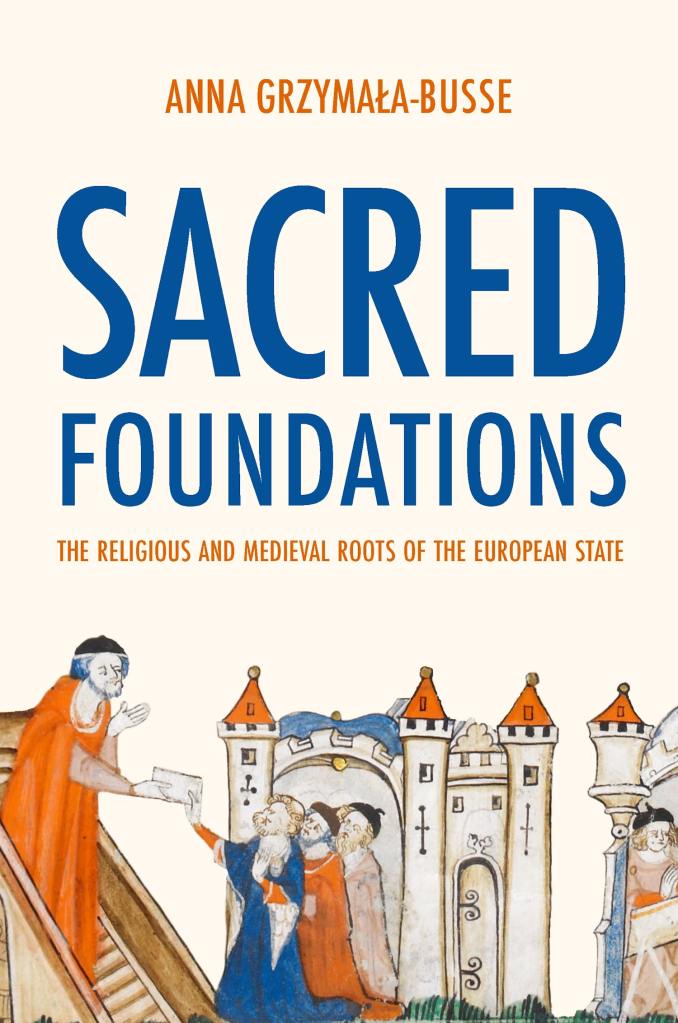
Two side notes on Anna Grzymala-Busse’s Sacred Foundations: The Religious and Medieval Roots of the European State (2023). by Gerardo Muñoz

Anna Grzymala-Busse’s recent study Sacred Foundations: The Religious and Medieval Roots of the Modern State (Princeton U Press, 2023) makes a compelling historical and data analysis grounded case for the emergence of the modern state through the process of the Church’s autonomization in its ongoing disputes with the European monarchs across the centuries. This process of the secularization of ecclesiastical forms (conciliarism, legal administration, the uniformity of procedures, rules for governing institutions, the emergence of educational training and mechanisms for political representation and fiscal control, etc), however, is silent about two defining features of the modern secular state. And I do not think it is an exaggeration to say that these two elements bring forth the way in which political authority was established after the victory of modern European Enlightenment. Busse’s book, if anything, has the felicity of putting in perspective, even if only in negative, the two pieces of the puzzle: a) coercion as guarantee by a legal process (not just the monopoly of force); b) and the inter-institutional coordination that we tend to associate with a ‘principle of an internal rule of recognition’ between different spheres of bureaucratic rationality. Busse admits for (a) that “….the authority of the people over the whole Church was not statelike. It depends on moral authority and influence, not on coercive control. Both kings and popes cajoled, convinced, and threatened rather than demanded or extracted force” (Busse, 78). But ruling on morality and influence are two weak presuppositions to guarantee systemic, homogeneous and uniform process required by institutional authority.

In other words, the Church was able to construct forms of civil mediations, although it lacked the power of efficacy; that is, a coherent set of reasons for action that would define a strong concept of sovereign authority as service (to put it in Raz’s well-known formulation). The classical apothegm by which ‘kings rule rule but do not govern’ (Rex regnat sed non gubernat) now is protracted by the exercise of an efficacious rule, which means laying out a combination of forms and a well-ordered power over coercive forms. In fact, this is one feature that will define the legitimacy of the Enlightenment according to historian Franco Venturi; the discovery of punishment understood within the scheme of a trade off between the “necessity of the right to punish when man was not able to re-establish communism” [1]. Hence, the genesis of modern legitimation is not exclusively “a given” vis-a-vis the structure of separation of powers and the ultimate source of the plenitudo potestatis; rather, it requires a second-step rule, as it were, to convalidate the specificity of institutional authority with ample concrete efficacy of police powers in charge of compliance and punishment. The reach and exercise of public police powers and the systematic ordering of penal codes through a criminal procedure and its guarantees (reasonable doubt, fair trial and due process, no crime published without a previous enacted law, nullum crimen sine lege) is what renders effective and “energic” the principle of authority.

Now, broadly speaking, when it comes to (b) Busse admits that (and this is in spite of its institutional schemes) laying down justice “…the church relied on secular enforcement, for example when it came to religious orthodoxy. […] The carrying out of sentences against heretics and apostates lay in secular hands – those found guilty were handed over the temporal authorities so as to not sully the clergy. Legal coevolution and influence, the struggles between popes and monarchs, and the diffusion of both canon law and personnel into the juridical systems were critical to the rise of constitutionalism and the rule of law in Europe” (Busse, 132-133). This asymmetry between two systems of legal jurisdiction confirm the inexistence of a strong internal rule of recognition that for H.L.A. Hart defines any robust modern legal system of public law. The internal rule of recognition, one must remember, is not a set of principles or norms for social action, but rather the internal mediation between a legislative authority and its internal obedience within a concrete application thereof. The internal rule of recognition binds a central authority with its specific formal enforcement in institutional union of primary rules and secondary rules to avoid the pathology of uncertainty. This is thoroughly absent from the free-floating institutional forms of the medieval church whose principal construction of primary rules was divorced from the objective and rational procedures of its internal coherence (the rule of recognition) that would ground, in time and place, the otherwise abstract primary norm and the pressure of contested social conflict.

But going straight to the crux of the matter, it follows that medieval templates as superbly redrawn in Busse’s studies lack the two fundamental determinations that ground the modern concept of law: law as the necessarily monopoly over coercion (the Austin thesis), and the concept of law as the construction of an internal rule of recognition to unite primary and secondary rules (the Hart thesis). But insofar as all major modern political concepts and mediations are secularized forms of religious and medieval forms – something we can say that Busse’s scholarship also confirms – we can then say that modern legitimacy will consist in the congruence of these two determinations to organize the mediations between civil society and state. Already in his early The value of the state and the significance of the individual (1914), Carl Schmitt will note of this formal transplant: “…the Catholic doctrine of the Pope as the infallible interpreter of the natural moral law and of the content of revelation, who receives the competence to declare state statutes that stand in contradiction with the moral law or ius divino-naturale to be non-obligatory in conscience. The exercise of his potestas indirecta which is regarded as an act of jurisdiction, and which is held, by many canonists, to be determinative of a statute’s validity in state law – contains real vis coactiva, even where the expression potestas directiva is employed in place of potestas indirecta (Suárez, de fide cath, 3.22.1)” [2].

For Schmitt, then, the process of rationalization between ecclesiastical form and the modern legal norms of the state is very much straightforward. This is what constitutes the very texture of secular modernity. But as we know, for Schmitt the secularization of forms was not enough – it must be said that he himself did not negate in his theory of adjudication of his constitutional thought – which is why the construction parameters of his ‘political theology’ proposes supplemental safeguards to isolate law and power, extending the power of secularization into the decision of the potentia dei asoluta (at times this was contained in the theological figure of the Katechon) [3]. But as Carlo Galli has noted, Schmitt’s political theology is far from a “political christology” or a substantive theological politics grounded in natural law; rather it is a resolute affirmation to defend any concrete order from the potential fallouts of the secularized cornerstones of rational neutralization (potentia directiva and potestas coactivva) of state authority [4]. Neither mechanic state forms nor a higher source of morality (natural law) would define the modern law; rather the autonomy of the political in the existential situation could provide the sufficient energy to avoid the self-defeating circularity of ius revolutionis (this is what most of the times is obliterated from the so called question of “decisionism”)[5]. If Busse is correct in making the case that all modern institutions have sacred medieval foundations; Schmitt’s concurrence in the wake of modern secularization will be to define the energy of the political as the defining element that must stand as the threshold of formal transplantations to have a chance within nihilism and against nihilism. It is both things. In other words, formlessness is the constitutive dimension of political forms; an element that defines, in my view at least, the strongest practical element of what it is to inherit a Christian political foundation. The process of secularization is thus infinite and groundless, ultimately without a moral foundation and universal design. Among its many achievements, a book like Sacred Foundations: The Religious and Medieval Roots of the Modern State (Princeton U Press, 2023) has the ability to refine what political theology is, what it meant, and what to make of its endurance and possible iterations in our present.

Notas 

1. Franco Venturi. Utopia and Reform in the Enlightenment (Cambridge University Press, 1971), 116.

2. Carl Schmitt. The value of the state and the significance of the individual, in Carl Schmitt’s Early Legal-Theoretical Writings (Cambridge University Press, 2022), eds. Zeitlin & Vinx, 215.

3. See my “Schmitt y Hart: los puntos fijos del concepto de derecho”, 2022: https://infrapoliticalreflections.org/2022/11/07/schmitt-y-hart-los-puntos-fijos-del-concepto-de-derecho-por-gerardo-munoz/ 

4. Carlo Galli. Genealogía de la política : Carl Schmitt y la crisis del pensamiento político moderno (Unipe, 2019), 301. 

5. Jorge Dotti. “Sobre el decisionismo”, en Lo cóncavo y lo convexo (Guillermo Escolar Editor, 2022), 391.

Reformation and administration. by Gerardo Muñoz

The dispute concerning the legitimacy of modernity also implies the question of the reformation, which transferred the power away from the hands of priests into a new priesthood of everyman’s consciousness. This was the Lutheran self-affirmation of economic theology (it has been laid out by Monica Ferrando’s recent work). The new priesthood implied a consolidation of the power over interpretation, since the biblical sources were now opened to battle over meaning itself. The interests over the Hebrew sources were not new, as a contemporary scholar has shown, but it was of central interest to the hermeneutics of sola scriptura over the scrutiny of the canons [1]. If this is the case, how come Thomas Hobbes account of the religious sources point to a different dimension of revelation? As we know, Hobbes was not alien to the ancient Hebrew sources, but his treatment and conclusions were entirely misplaced. Here I want to briefly account for this divergence.

In reality, it was Carl Schmitt who best confronted this problem in a late essay form 1964, published in “Der Staat, “Die Vollendete Reformation” by asserting that Hobbes’ place in the constellation of the modern political theology of the reform was rooted in the invention of the autonomy of the political. Schmitt works his way through Hobbes’ second bibliography in a subtle way, reminding us that the theorem “Jesus is the Christ” meant the artificial creation of a political technique over the battle over “meaning and truth” that fueled the European wars of religion. Hobbes, contrary to the theologians, became the founder of a counter-power: the confrontation between Leviathan and Behemoth. Indeed, for Hobbes the “reformed theologian” stands as the Behemoth, but it has yet to come to terms with the question posed by Leviathan as who will decide. This is for Schmitt the kerygmatic theme of the New Testament, which will only be decided at the end of times, but meanwhile the decision through authority is the only way in which the problem of “civil war could be neutralized. As a commentator of his time, Schmitt was directing a direct arrow to Rudolf Sohm’s idea of reform, which ultimately coincided with an economic theology bypassing the fact that the era of concrete political theology had its ultimate principle in authority of the sovereign’s decision [2]. 

Although never registered directly, the lesson of Hobbes for Schmitt resided in circumventing the rationality of the scientist and the technocrat, going as far as to mention Simone Weil’s critique of the codependency of the total state with the essence of technology [3]. The question of decision was Hobbes’ metaphysical solution to an “intra-evangelical war”, which introduced the immanentization of indirect powers unto the flatten space of civil society. In other words, for Schmitt, the true father of the “spirit and letter” of the Reformation was neither Luther nor Calvinism, but Hobbes’ Leviathan insofar as it was able to offer a third option against the secularization of a universal priesthood of the autonomous economic theology. But this is only the beginning of the problems, since we know that Hobbes’ political philosophy was dependent on “civil society” preparing the conditions for the liquidation of anti-normative decisionism. Schmitt himself was aware of this towards the end of his monograph on Hobbes as a farewell to state form. Hence, the epoch of political theology was brought to an end not through reformation, but through the ever-expansion of the operative sphere of the concept of the civil. The triumphant economic theology that has only intensified well into our days adequates to the fullest extent to the infrastructure of Hobbes’s project. 

If this is the case, the differentiation that Schmitt establishes in Political Theology II between ius reformandi and ius revolutionis collapses, given that the solicitation of the autonomy of the social requires an ever-expanding outsourcing of administrative apparatus that will turn legality into the bin of administrative application (Verwaltungsrechts einzufügen unwissenschaftlich) [4]. And in the face of administration political theology loses its grip, and economic theology silently takes hold. The subsequent internal triumph of the verwaltungsrechts einzufügen will bring to an end the epoch of political theology. The ideal of the Reform took this challenge and brought it to the very anthropological core of humanity.

.

.

Notes 

1. Eric Nelson. The Hebrew Republic (Harvard University Press, 2010), 8.

2. Carl Schmitt. “Die vollendete Reformation: Bemerkungen und Hinweise zu neuen Leviathan-Interpretationen”, Der Staat, Vol.4, 1965, 51-69.

3. Ibid., 66. 

4. Ibid., 67.

The closure of the eon of the state. On Lo cóncavo y lo convexo: escritos filosóficos-político (2022) by Jorge E. Dotti. by Gerardo Muñoz.

The posthumous volume Lo cóncavo y lo convexo: escritos filosóficos-político (Guillermo Escolar, 2022) of essays by the late political theorist Jorge E. Dotti is a very much needed contribution that opens up a conversation about a theoretical corpus that witnessed the collapse of the modern state and the crisis of its political categories in times of postliberal forms of global domination. Although an astute observer of the key moments in modern Argentine political history (from Peronism to the dictatorship, from the return to democracy to the failure of the democratic socialist party experiment), Dotti’s intellectual stamina remained on the margins of political adventurism, while openly rejecting the organic intellectual political advisor to heads of state. As editor Damian Rosanovich writes in his introduction, Dotti refused to subordinate his political thinking to immedaite ideological projects; a rather unique position to undertake in a national context like the Argentine, historically inclined towards philosophia militants of the national popular type [1]. Complementary to this inclination, Dotti’s political thinking also had little to say (at least in a direct manner) to the Latin-Americanist disputes about state modernization, regionalism as supranational identity, or cultural formation hegemonies that dominated twentieth century discussions in the region.

Dotti’s theoretical ambitions had a more prudential wager: a confrontation against all kinds of abstract universalities, as well as its partner in crime, locational exceptionalism always ready to infuse doctrinal flavor unto nominal situations and practical problems. A modernist political thinker at heart, Dotti was also a keen observer of the the modern state genealogical crisis, which he read in a tripartite scheme that included the classics of modern political thought (Hobbes, Rousseau, Hegel, Kant), modern philosophy of positive law (infomed by his research years in the Italian context), and finally the work of Carl Schmitt on sovereignty, divisionism, the exception, and the difficulty of “revolution” as the esoteric form of political crises. As an heir to this modern tradition, for Dotti modernity is best defined not as predicated on contingency or anthropological reserves, but rather about a certain ethos, historical in nature and spatially grounded (in this way his vision was close to that of JGA Pocock and the Cambridge School, although less emphatic to the centrality of concepts), which claimed that the political thinking of the classics had to their disadvantage the idealization of every practical situational problems encountered in concrete determinations [2]. In this way, Modernity was best defined as a struggle against abstraction and the taming of indirect powers over the configuration of social stability and endurance.

The classics of political thought, while claiming the intrinsic political nature of man and the primacy of organic totality over every principle of differentiation, imposed a nomalist metaphysics that turned its back to discrete and discontinuous situations. For Dotti at the heart of modern politics – very much in line with Hobbes’s critique of Aristotelian critique of the virtuous politics – is rooted in a practice that is attentive to practical reasons for action and the normative foundation of a social order. Hence, the modern ethos was able to favor the primacy of authority (auctoritas non veritas facit legem) as a minimalist non-substantive framework of public law. In other words, prior to doctrinal and categorical arrangement of modern political theories (social contract, constituent power, or individual conscience), authority helped dissolve the anarchy over words and actions proper to the European civil wars. Needless to say, legal positivism had to walk along modern subjectivity (“Quiero, luego existo…”) inadvertently promoting, while neutralizing, the latency of civil war from its inception. As Dotti claims in an essay on Melville too long to be included in this volume: “Quien contrata se concede el derecho de desencadenar la guerra civil” [3]. The concrete situation of the modern ethos, in this sense, is never enough for containment; and its positive arrangements, being insufficient, will ultimately depend on direct police powers. The story of political modernity is that of legality trumpeting legitimacy for optimal reasons of political control. The insufficiency of the modern political order entails that politics and nihilism walked every step of the way too near each other.

This outlook towards political modernity renounces all nostalgia as it is a genealogical critique. This position speaks to Dotti’s systematic dialogue with Carl Schmitt’s juristic thinking regarding the polemic over secularization of the state and its political categories. Like very few political thinkers of modernity, Dotti accepts Schmitt’s lessons without prejudices and against the political black legends (Schmitt as the poisonous enemy of legal positivism, political liberalism, archaic Catholic, or ally of Nazism) that have been incapable to comprehend the German jurist lessons. If according to Raymond Aaron Schmitt was far from thinking like a Nazi, Dotti take this promises to more refined elaborations: the combination of decisionism and institutional rule of law coagulate an compossitum whose main aim is to regulate the internal functions of validity of the every political order [4]. The force of political theology, then, is neither doctrinal nor axiological, but rather attentive to situational stress of instances as to deter the indirect powers and the logistics of immanence [5]. Dotti understands Schmitt’s political theology as a decision that is only possible within a normative system in order to guarantee the authority of the state. The minimalist conception of political-theology stands as the antithesis of immanent factional ends, which, ultimately, reality will venge in the worst possible ways [6]. Adjacent to the modernist ethos against indirect powers, Dotti’s stages the copernican discovery’ of Schmittian thought: the autonomy of the political as the only category capable of defending the sovereignty of the state in an energetic manner without stepping into either a hyperpolitical or an apolitical vectors common to messianic and subjectivist positions. If for Schmitt there were few things more modern than the battle against the political, for Dotti the consecration of global postmodern time opened a crisis of the political and the expansion of the field of immanence which freely drives “por la autopista preferential de la corriente antipolítica” in which all politics is exception and all exceptions are treated as antagonism for the political [7]. The epochal dispensation of total immanence of power means a liquidation of the regulatory conception of the political as well as the formal recognition of enmity within the modern state now vested into the global fabric of Empire.

Dotti’s scene of writing is that of the closure of the eon of the liberal secular state from its very conditions that made possible the development of its genesis. It is in this specific sense that Dotti’s prognosis is similar to that of Ernst W. Böckenförde’s famous theorem: the liberal secular state survives by conditions that it can no longer guarantee [8]. For both Böckenförde and Dotti the epigonal process of secularization meant the end of state authority and the exhaustion of the separation of state legitimacy and the internal legal rules for social action. Dotti, however, introduces a minimal although fundamental nuance to Böckenförde’s theorem: the liberal state collapses not at the apex of the compilation of secularization, but rather at its very origins in the notion of revolution. This is a lesson extracted from Political Theology II: the ius reformandi of the ecclastical powers soon became an unlimited ius revolutionis of subjective domination during the nineteenth century. [9]. It is to this transformation that political theology effectively looks to respond to. In fact Dotti suggests that the category of revolution is the strongest force to be secularized, which entails that what paved the way for the modern liberal state becomes an open ended indirect force against all mediations of legitimate rule. As Dotti writes in his late essay “Incursus teológico político”: “Estado y revolución son inseparables en su complementación y en su simultánea oposición inconciliable. Esta relación es el cogollo mismo de la legitimación de todo orden político moderno: está en el origen y la muerte de la era de la estatalidad.” [10] The immanent force of revolution has no single figure: it is the movement against state sovereignty, the emergence of the total state in the twentieth century, as well the legal interpretation of statutes as idealistic forms (as in the jurisprudence of Robert Alexy) that intensifies a permanent state of exception whose real end is now a power for “definition, differentiation, regulation” as the tripartite form of political struggle. In this framework, the revolutionary spirit against formal mediation and authority can only take the form of an uninterrupted holy war against its enemies without end [11].

To the extent that revolution does not disappear but becomes unmatched immanent power, it becomes possible to understand Dotti’s central theorem in its proper light: “the problem with the revolution is not how to make it, but rather how to bring it to a close” [12]. There are at least two things we can say regarding the theorem: first, political modernity was fundamentally understood as the making of the revolution without any attention to formal mediation and the autonomy of the political; secondly, even the exponents of political liberalism during the second half of the twentieth century did not think of a revolution as closure, but rather they continued to foment an aperture based on a necessary retheologizaiton. It is in this way that John Rawls’ social state depends on a specific conception of original sin for equity; while Ronald Dworkin’s defense of principles and moral interpretative constitutionalism reintroduces a secularized form of the old iusnaturalist model. The socialization of the modern state at the historical instance of its eclipse had to pay the price of abandoning its commitments to both Pelagianism and positive law on behalf of a permanent exceptionality now dressed as the balancing of social equity. It is an irony that the two strongest attempts at the secularization of the concept of the revolution provided, in turn, a restitution of theological hidden subtleties that are ultimately optimal for the transformation of the rule of law into an instrument of world legal revolution. And, it is no coincidence that the closure of the eon of the state meant the end of exclusive legal positivism, while socializing the state police powers as compensatory for the collapse of the modern transcendental authority. The alleged neo-liberal state now subsists as an all encompassing administrative rule that mimics the practice of the confessional state. This could explain why today some jurists continue to understand the practical function of the administrative state as the concrete instance to constitute an uninterrupted iustitium. Dotti’s comprehensive and panoramic view of the modern tradition and its conceptual fulmination leaves open a task for future political thought: how would the closure of revolution might look like? This is no optimist question, as the only honest answer must depart from the farewell of the modern state, while also rejecting the substantive, doctrinal, and militant reallocations of power that steer, but never bring to an end, the violence of a planetary unity devoid of separation or enmity.

.

.

Notes 

1. Jorge Dotti. Lo cóncavo y lo convexo: los escritos filosoficos-polilicos (Guillermo Escolar, 2022)

2. Ibid., 133.

3. Ibid., 28.

4. Ibid., 174.

5. Ibid., 176.

6. Ibid., 26. 

7. Ibid., 79. 

8. Ernst W. Böckenförde. “The Rise of the State as a Process of Secularization”, en Religion, Law, and Democracy: Selected Writings (Oxford U Press, 2022). 167.

9. Carl Schmitt. Political Theology II (Polity, 2008  ), 101. 

10. Ibid., 434.

11. Ibid., 424.

12. Ibid., 421.

The Independent State Legislature Doctrine as indirect power. by Gerardo Muñoz

This Wednesday the Supreme Court of the United States will consider arguments in Moore v. Harper, coming out of the North Carolina State Legislature, which revolves around a specific doctrine: the Independent State Legislature. When the legislature of North Carolina tried to pass a new redrawing district boundaries for electoral purposes, the state supreme court decided against it, concluding that the map violated provisions of the constitution affecting free elections and the equal protection clause of the federal constitution. On other hand, the sponsors of the Independent State doctrine claim that state legislatures enjoy unsubordinated independence from the state supreme court, acting freely from the structure of state constitutions. The defenders of ISL doctrine “interpret” the term legislature as free-floating affirmation of constituent power when it comes to matters of voting under Election Clause of Article I in which legislatures decide on “the times, places, and manner of holding elections for senators and representatives”. Hence, ISL doctrine is fundamentally about political-theological question of ‘who decides?’ (quis judicabit) in the structure of federalism. But insofar as it is the question of ‘who decides’ it is also about what orients application today: ‘who interprets?’

When legal practice becomes open to interpretation each word immediately becomes a door. Each term becomes contested meaning as a free-floating signifier where balancing will ultimately serve particular political purposes. It is no coincide this ISL doctrine has come to the surface at this precise moment – after the 2020 election results – when, in fact, for most of the history it has been rarely used [1]. What does a floating and independent legislature power entail for electoral ends? What is of interest here is precisely how, in the name of a direct justification of constituent power (‘The People’), ISL represents a truly indirect power within the structure of federalism and state-constitutions. By name and function, indirect powers are understood as external interreference within a structure of stable organized powers. Now, the novelty of the ISL doctrine is that this indirect power emerges from within as it were, capable of upending judicial review and constitutional authority. The stability of ‘who will decide’ becomes an indirect power that, potentially, could even override state elections wherever political asymmetries exist between the legislature, governorship, and judges at the courts.

We know from the history of political thought that indirect powers (the undecidability of who will decide) leads to a stasiazon or internal civil war between the constituted powers. In other words, it is with the ISL doctrine that we can now see the true nature of what I called in the beginning of 2021 a legal civil war in Trump’s efforts to overturn the election results. A legal civil war is far more intense than the political partisan struggle of the movement – even if, at times, they can both cooperate as joint partners – since indirect force tries to ambush the constitutional organization of powers. The legal civil war of direct democracy comes full circle: unmitigated legislative force will constitute itself as the unstrained guardian of the question ‘who will decide’. For the champions of ISL doctrine legislature has no penumbra: it is always “We”. And it is no coincide that, as it has been shown by one of the great scholars of American federalism, a legislative supremacy once defended by Madison could allow for the “raising of every conflict to a constitutional crisis and civil war” [2].

In other words, what at first sight appears as total independence at state level actually facilitates its oppositum: the production of “standing” for higher courts litigation. Contrary to common opinion, the function of constitutional interpretation is full of cracks due to its brittle fabric: it allows for the indirect powers to be justified vis-à-vis the naturalism of the People as ‘original electors’ without mediations [3]. The historical irony cannot escape us at this point, since the American Revolution was waged against a legislature (the British Parliament) and legitimized through broad voting. This was the great innovation of Atlantic republican political theory. The question is whether a constitutional ‘interpretation’ could wage a battle against indirect powers facilitated by the revolutionary penumbra of ‘who will decide?’.

.

.

Notes 

1. “Brief of Amici Curiae Professors Akhil Amar, Vikram Amar, and Steven Calabresi in Support of Respondents”, October 24, 2022: https://www.supremecourt.gov/DocketPDF/21/21-1271/243761/20221024133404048_21-1271%20Amicus%20Brief.pdf  

2. Alison LaCroix. “What If Madison Had Won? Imagining a Constitutional World of Legislative Supremacy,” Indiana Law Review 45 (2012):

3. Carl Schmitt. The Value of the State and the Significance of the Individual, Vinx & Zeitlin eds, (Cambridge U Press, 2021), 231.