
Quod natis exitus. by Gerardo Muñoz

In Book V of his Latin Language, and immediately after commenting the duality of Earth and Sky, Varro writes an enduring and yet enigmatic gloss of worldly life. In Roland Kent’s translation from 1938 we read: “Inasmuch as the separation of life and body is the exitus, ‘way out’ for all creates born, from that comes exitium, ‘destruction’, just as when they ineunt ‘go into’ unity, it is their initia, ‘beginnings’ [1]. It is probable that Kent had to leave the latinized terms next to familiar reiteration of modern English in order to allow the text to breath in all of its complexity, for what is Varro ultimately attempting to tell us can very depending what we want to stress, and how we read in the scope of his discussion starting in section 58. Is it that life is always marked by the wound of separation with the natural world? Or that destruction and caducity (exitium) is a necessary condition for all new beginnings, as if life understood as an enclosed organism or entity is always insufficient, because of the order of excess at the very moment that it recognizes its propriety? This excess is what cannot be contained in neither life nor in social form or political mediation; it is the initia of thought in its relation to phenomena of the world but without ever being reduced in them. In this sense, there can only be a beginning in the passion that thought grants to the separation from the world. 

This is perhaps what Pindar had in mind when writing in Isthmian 8 – in clear tone of his disenchantment before political strife – of a need to return to a shared language among friends (a language that cannot be that of the rhetorical antinomies of the polis): “It is always best to look at each thing right at our feet / for treacherous time hangs over men and twist awry the path of life. But even those things may be healed by men if freedom is with them; and a man should give care to [that] noble hope” [2]. In his commentary on these lines C.M. Bowra notes that the awry and treacherous time of life that Pindar refers is not just a personal account, but rather a state of the world of his own generation and friends [3]. Politics brings to ruin; it brings fear, but more importantly it brings oblivion to the nearness of each and every thing that stamps irreducibility. But what Bowra does not thematize is the central stress of these lines; mainly, that the Ancient poet makes a plea to the examination of proximity and nearness “look at each thing right at our feet”. The plea to take care of a true life harmonized is preoccupied with this lying out before our feet is so inapparent that it provides texture and rhythm to every appearance; it is so invisible that it can disclose the very possibility of the beginning or end of a visible world. 

It seems that Pindar’s solicitation of proximity speaks to Varro’s initia; but not because there is something like a true origin or original position (a category that modern political thought later elevate to the physics of social stratification and positional distribution), but rather because another idea of “freedom” can be rethought from the excess of what appears spatially in the world; an absolute instance of appropriation beyond life. This is perhaps beautifully expressed in one of Cézanne’s most acute images of his creative process: “I breathe the virginity of the world…a sharp sense of nuances works on me. At that moment I am as one with my paintings” [4]. Before painting and creation there is a sensuous region in which the separation of objects and subjects do not longer sustain totality except as catastrophe or force.

This means that to disclose regions of life in the world is not just about the claim of autonomy and normativity of a place; on the contrary, it is the very inapparent, almost imperceptible, possibility that lies in the wrinkled proximity when we withdraw from things ad they seem. Quod natis exitus – because we are always exiled from each and every place, it is through the thinking of the inconspicuous of each and every being that revisitation of an ethical life calls on us from the outside. Ultimately, the ethical life is nothing but the imperative of «lech lechà» in a separation that unites when overcoming the deceit of time. 

Notes 

1. Varro. On the Latin Language, Books 5-7 (Loeb Classical Library, 1951), 59. 

2. Pindar. “Isthmian 8”, in Pindar (Loeb Library, 1997), 211.

3. C.M. Bowra. Pindar (Oxford University Press, 1964), 114. 

4. Joachim Gasquet. Cézanne: A memoir with conversations (Thames&Hudson, 1991), 45.
Painting, the last metaphysical activity. by Gerardo Muñoz

In his old book The Art of Cézanne (1965), the German art historian Kurt Badt makes a remarkable affirmation in dialogue with Hans Sedlmayr’s indictment about the crisis of modern art: “In him [Cézanne], in fact, painting ‘emerges as the last metaphysical activity within European nihilism – Nietzsche’s view of the great art of his time in general” [1]. Badt’s affirmation must be first understood contextually as a response to Sedlmayr’s thesis laid out in Verlust der Mitte (1951) that argues that the post-impressionist painter was the last attempt at visual order within the convoluted modern crisis of art, still committed to “represent what pure vision can discover in the visible world…without adulteration” [2]. The subtlety  of Badt’s disagreement with Sedlmayr is notable, since for him Cézanne does not stand for a painter of chaos and subjectivity; on the contrary, the painter unequivocally enters in relation to nihilism. At that instance painting and nihilism are positioned polemically face to face. So, what could painting as the last metaphysical activity mean after all? Why is it that painting obstructs or stuns the total exposure of nihilism? Instead of retracting painting to an ‘origin’, what if we understand its ontological contour as an excess within and beyond nihilism? 

In his recent book Tiempo roto (2024), Alberto Moreiras returns to Martin Heidegger’s Le Thor Seminar of 1969 to emphasize how in the epoch subsumed by the Gestell, and thus nihilism, the fundamental opening that exceeds the frame is an übermass, or overabundance of presence [3]. This might be a productive way to think about ‘painting as the last metaphysical activity’ in the era of Gestell, because it inscribes a relation to the visible always in relation to the appropriation of its excess. In the Zähringen seminar (1973) Heidegger will call this relation a phenomenology of the inapparent, which one could very well extend to the praxis of painting as the relation between unconcealment and concealment in the way that Daniel Aresse discusses it in the pictorial world of Vermeer (a polarity that in Cézanne no longer pertains to play of optic illusions but of the disclosure of the world). This cojoining of the inapparent is more beautiful than any possible world visible ordering, because it exceeds the frame of the visible [4]. In this way, Cézanne is not just a painter that exchanges roles with the thinker (as in the relationship between dichter and gedanke) it is rather that he remains the most faithful exponent of painting as the ontic region of the phenomenology of the inapparent or übermass. 

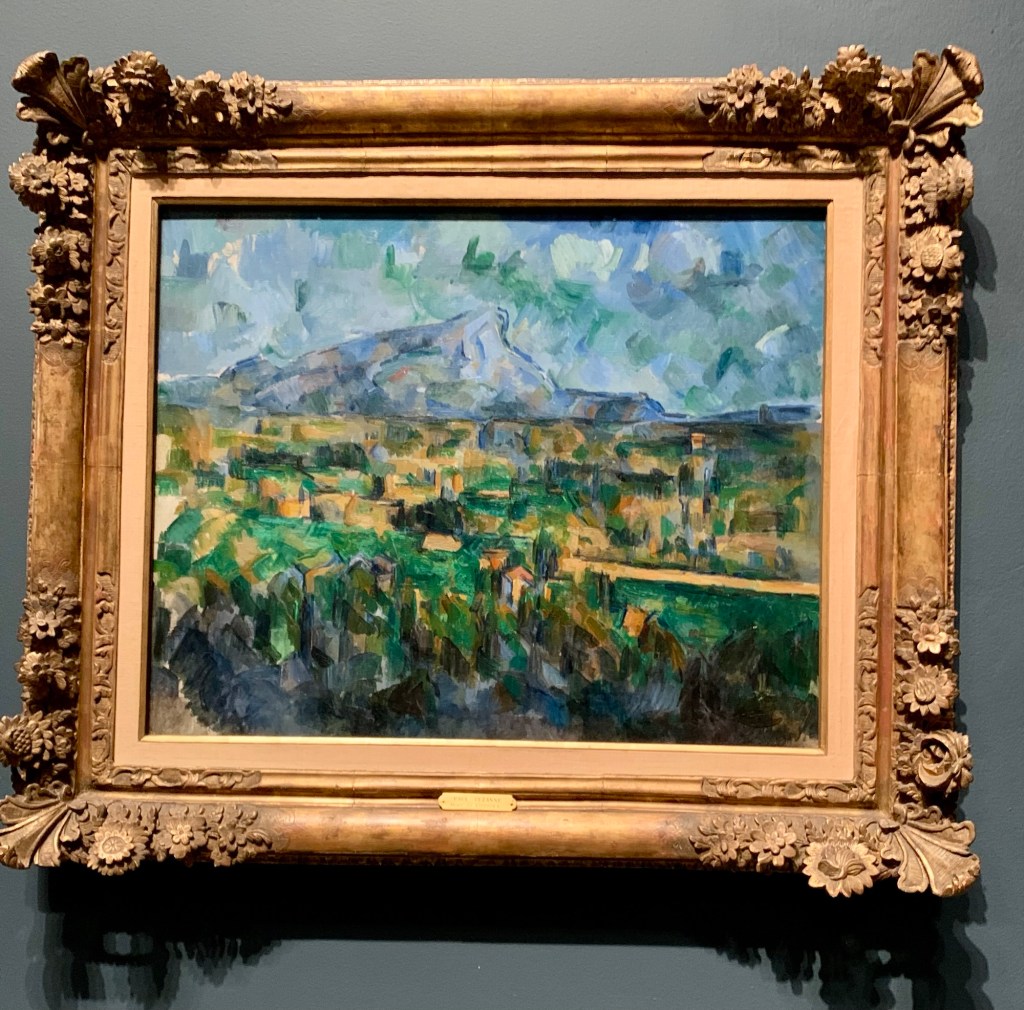
In a session of the Zollikon Seminars (May 1965), Heidegger introduces Cézanne’s landscape as a counterpoint of the hermeneutical circle of perception and calculative intuition. Heidegger writes quite succinctly: “For instance, a painting by Cézanne of Mont St. Victoire cannot be comprehended [erfassen] by calculation. Certainly, one could also conduct chemical research on such a picture. But if one would like to comprehend it as a work of art, one does not calculate, but sees it intuitively. Is the painting, therefore, something psychological, since we have just heard that the psychological is what can be comprehended intuitively? No, the painting is not something psychological. Obviously, the above-mentioned “simple principle” for distinguishing psyche and soma is not simple at all” [5]. This is so because for Heidegger the figure of the mountain (a figure among others) in Cézanne’s work is not the cause of the decision of painting; it is rather the ground (Grund) that orients a certain disposition towards the opening of any given form. One could say that the motif of the mountain is the ground that dispenses the relation to the excess or the inapparent while being entirely visible. 

As such, the activity of painting is not just a capacity or disposition that allows representation; on the contrary, the pictorial praxis qua praxis remains attached to the notion of truth as unconcealment and concealment in the hegemonic structure of Gestell and the objective sciences for which there is none. This allows to throw light into the rather underworked suggestion advanced by Badt that painting remains the last metaphysical activity of the arts, which does not presuppose understanding the “painterly” as a quality or autonomous sphere of human action, but rather an original gesture of presencing the non-presence, and in this way to remain in what I am willing to call the imperturbable.

It has been registered that at one point during the sessions at Le Thor, Heidegger also made the curious assertion that only Cézanne had taken a path towards thinking (in painting) similar to his own turning away from Western ontotheological dispensation into another beginning [6]. This might be because painting is neither the archaic residue of the human hand, nor the pictorial index of image; its fulfillment lies in the excessive proximity to truth that eternally reveals the permanence of the invisible. 

Notes 

1. Kurt Badt. The Art of Cezanne  (University of California Press, 1965), 181.

2. Hans Sedlmayr. Art in Crisis: The Lost Center (Transaction Publishers, 2007), 131.

3. Alberto Moreiras. Tiempo roto: vivir el antropoceno (Palinodia, 2024), 113.

4. Martin Heidegger. Four Seminars (Indiana University Press, 2003), 8.

5. Martin Heidegger. Zollikon Seminars (Northwestern University Press, 1987), 79.

6. Giorgio Agamben. Il tempo del pensiero (Giometti & Antonello, 2022), 57-60.

*Image: Mont Sainte-Victoire, by Paul Cézanne. Philadelphia Museum of Art. Photograph from personal archive.