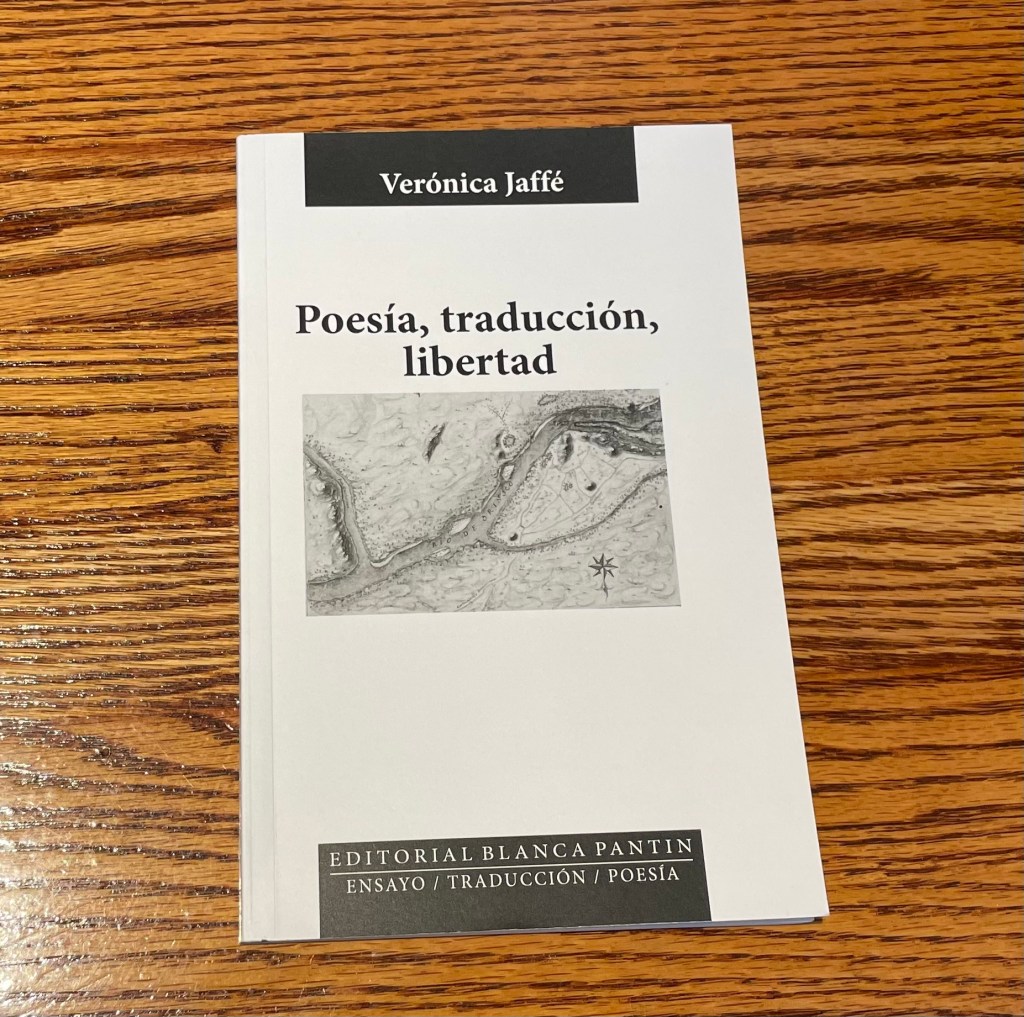
Verónica Jaffé’s most recent Poesía, traduccion, libertad (2024), which gathers some of the translations already contained in Fredrich Hölderlin: Cantos Hespéricos (La Laguna de Campona, 2016), features an introductory essay where she reflects on translating Hölderlin’s poetry from the German into her own creative visual renderings of Spanish. Reflecting on the difficult task, if not utterly impossible, of translating “Andenken” (in Spanish she opts for “Recuerdo” and not “Memoria”), Jaffé departs from an important observation that we must take into account here: the fact that this late hymn has been catalogued as a proemial composition. What does it mean that “Andenken” is to be read as a proem? As we know from the Ancient sources, the proem is an oratory prelude to the topic deployed in a text; in other words, it is the persuasive caesura of language before any argumentative exposition. Hence, the composition of the proem is something like the pure mirroring of language. This could explain why Hölderlin’s “Andenken” while prima facie about memory and thinking does not have a guiding thread to restrain it; it unfolds the enactment of its own recollection through the sayable.
If “Andenken” is a long proem – the space where the poem and proem absolutely coincide – then this means any translation must keep the poetic possibilities of oration in preamble, in path of preparation. Jaffé offers two distinct trans-creations of the famous poem’s last lines. The first reads thus: “Un mar que guarda los recuerdos / que da amores, que los toma / para que solo queden después / como tesoros / en quienes recuerden y en quienes escriban” [1]. In the second version, even more elaborate and idiosyncratic, Jaffé writes: “de pensar con todos / mis amores, es decir / pensar fijando / papel y lápiz / sobre tela / en memoria de todos mis muertos” [2]. It is noteworthy that the famous literal last lines of the “Andenken”, suspended in an enjambment, appeals to a canvas that is splattered with the memory of the dead. It seems of all the dead of the human race. What does it mean that the act of remembrance is the recollection of all the dead? Poetic imagination, if a testamentary document, appeals to the archaic where the living and the dead inhabit the world through image [3]. For Jaffé – but this also an intuition that Hölderlin shared in his pindaric translations – the beginning is not a previous stage, but in media res of the event of language.
The recollection of language within proem attests to the exilic dimension of language; the site where no one truly ever belongs to: “…la lengua en mi país que no me pertenece”, writes Jaffé [4]. This means that the authentic remembrance of language is not a national language, but always ex patria lingua, or a language outside the telluric fabric of the national community. Because we are always walking strangers in our own language, the contact with the dead repeatedly reemerges in the memorial grain of the voice.
As C.M. Bowra has noted, Pindar’s allusion to Memory takes place in the context of the Muses: “[the poet] invokes Memory because she embodies the accumulated wisdom of the past, and the Muses because they pass on this wisdom to him. What he asks from them is the ability to deal properly with what they give….men are blind if they do not pursue wisdom with the help of the Muses” [5]. If the “Andenken” should be read as a proem, this is because recollection is always fixed in the irreducible experience of our voice that recalls language from its beyond.
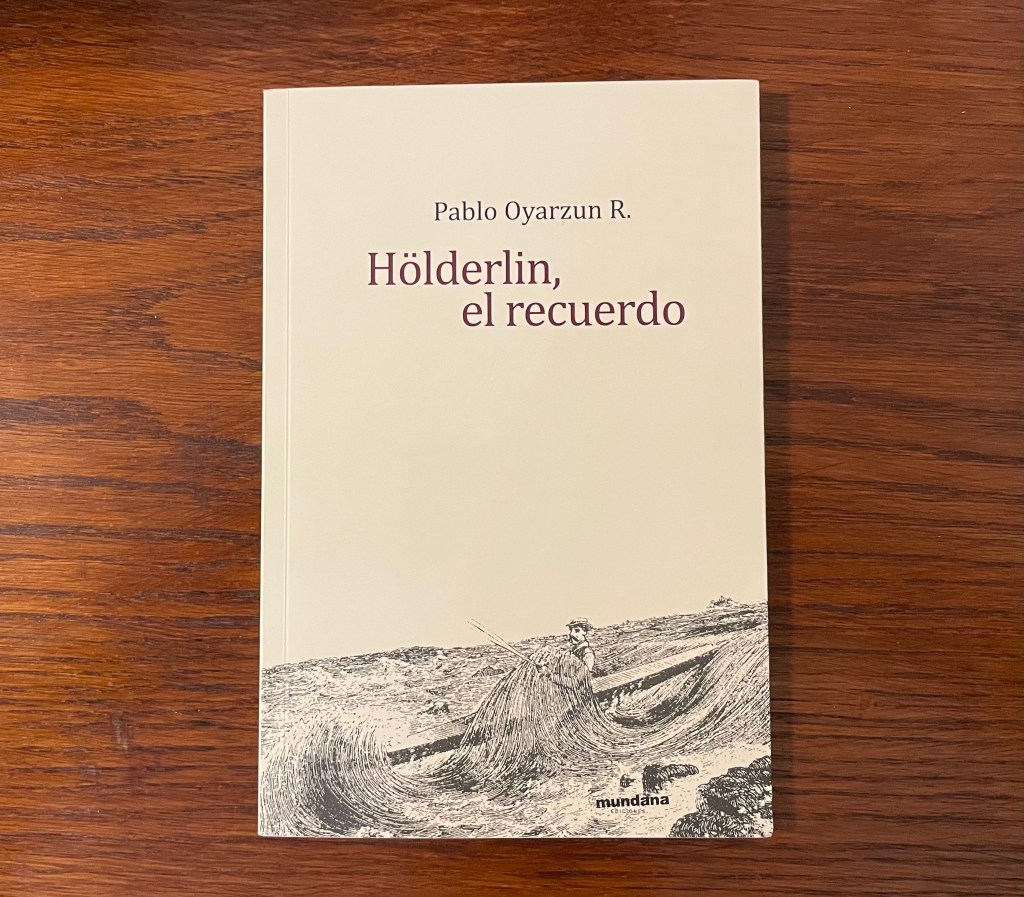
The concluding verses of Hölderlin’s “Andenken” (“Rembrance” or “Memoria”), “Yet what remains, the poets found” stands as one of the preeminent testaments of modern poetry, and in Heidegger’s famous characterization, as a declaration of the task of the poet. At least since the time of Stefan George and Max Kommerell, the figure of poet or Dichter, a hyperbolic figure of illumination and guidance caught in the net of poetry and philosophy, was already dependent on Hölderlin’s mysterious words. What remains in what the poet remembers and clears for foundation? What is the relationship between remembrance and what is ‘found’ or ‘established’? “Andenken / Remembrance” is a hymn from the late period, which means that it must be read in consistency with Höderlin’s poetological framework as it reaches its maximum degree of intensity in its declaration and deliverance. Pablo Oyarzun’s most recent Hölderlin, el recuerdo (Mudana ediciones, 2025) is a powerful and subtle contribution to the understanding of this poem that measures up to the task in its attention to lexicon and structure, metaphysical condensation, and the vortex of ‘memory’ that discloses the poem. One of the merits of Oyarzun’s philosophical hermeneutics, if we can call it that, resides in its refusal to incorporate philosophical doctrines to inform the major questions of the hymn; rather, he favors the very unfolding of the poem ramping its internal structure for possibilities (Oyarzun 18-19). Rereading “Remembrance” opens a path between philosophy and poetry in the dawn of the realization of metaphysics, whose price was paid by crushing the possible and the voice of the poem.
For Oyarzun the poet’s remembrance is that of appropriation of what is proper, and thus inappropriable, and to which the hymn can only ‘thank’ in the way of thinking as figure in the face of the unfathomable. Following Heidegger’s reading to a point, to give thanks is also to welcome and greet that lets humans and things be in their truth; since greeting always assumes otherness as foreign into presence (Oyarzun 29-30). And in presence life acquires texture, depth, singularization, but also conversation; a reminder that will control the rhythm of Hölderlin’s hymn. What is brought to presence, then, is neither a possession nor a legible inheritance, but the non-synthetizable modulation of what is proper in virtue of being absolutely alien (Oyarzun 34). What is recalled in this poem that remembers and thinks the unthinkable? Is it just a stage for Hölderlin to poetically transfigure his well known travels in Bordeaux? Oyarzun tells us that even if that is to be taken into account, the foreigner path is only essential as a way of homecoming, making the site (and song) into the hymn (Oyarzun 42). There is relation to the absolute other, but only as transitory to becoming and divine destiny in the world: “…el espíritu ama, porque precisamente así, ensa autoalienación puede transitar a lo otro que lo otro, es decir, apropiarse de lo propio […] el pensamiento del Ereignis está condicionado estructuralmente poesía ex-propiación, por ese retraimiento, distracción o retiro (Entzug), solo puede el cual se da lo propio (Oyarzun 54-55). Höderlin’s poem sings from the lacuna of its own expropriation of the abode. And that abode is ultimately the unworking of remembrance and memory that is defaced in being absolutely intimate and irreducible.
In order to elucidate the contours of this memory and its oblivion, Oyarzun follows Dieter Heinrich observation that: “este movimiento [of remembrance as transcendence] conocedor de su propio curso y a la vez desviado del mismo, aspirando a un conocimiento en que algo perdurable (lasting), con gratitud, reine aún en la superación – esto es remembranza” (Oyarzun 61). What is remembrance if not what unweaves time? It is not an actual faculty of human psychology, nor a spectral incorporation of a missing object; rather, it is the non-syntheizable partition between language and the wound of existence; a separation that is only redeemed in the way of remembrance that deposes an ideal recollection of missing facts in preparation for recomposition. Oyarzun’s reading will depend on clearing the notion of severability as a condition for remembering and forgetting as it makes an entry into the poem’s final verse about the “fixating eyes of love” (den Blick heften). Helena Cortés Gabaudán translates it as “y el amor también fija aplicadamente los ojos” [1]. “Y también”, “but also”, a conjunction of persistence that Oyarzun reads as an inexorable attachment to memory and separation, and the memory of separation (Oyarzun 68). Because there is no sliding towards remembrance without departure, coming into the presence welcomes the memory that, in that very moment, has transformed our souls.
Ultimately, for Oyarzun the vortex of Hölderlin’s “Andenken” is love understood as the supreme citation that enacts the place of both thanking and remembering: “Amar es recordar, frecuentar con el recuerdo (el pensamiento), lo amado, incluso allí donde lo amado está presente, porque así lo resguarda de la mera posesión y agradece su presencia. Amar es pensar-en, un modo, tal vez el más entrañable, de Andenken, amor” (Oyarzun 73-74). And this means that what remains and endures, as Adorno observed in his well known essay on parataxis in Hölderlin’s late poetry, is neither of the logical nor of the temporal indexes, but the event of language as originary creation and donation without contestation (Oyarzun 77). This is the instance where Hölderlin’s strange case of the divinization of the word – and this is the particularity of the hymn form, an element that is never teased out by Oyarzun – becomes absolute and intransigent. It is Höderlin’s absolute proximity with the classical world, but also its radical separation in the post-mythical world of dissenchantment. It can be said that that what endures ‘thanks’ the love of remembrance in its persistence of the word that does not allow history and the crisis of tradition: “en nombre de la cosa que queda, en la fragilidad de su tiempo, que es ese mismo quedar” (Oyarzun 79).
The poem becomes the verbal and sayable site where the poetizing resides, as well as the greeting and farewell of departure, just like the spectral sailors of the poem. What endures intimately can be called love as a form of the immemorial (Oyarzun 80). And that is because in inscribing, or holding on to the irreducible origin, poetics becomes the supreme form of love – the love in separation – of an expropriated language that welcomes us home in conversation with friends. This attests to the spirit of Hölderlin’s well known letter to his friend Böhlendorff in 1802: “A los artistas les hace falta la psyche entre amigos, el nacimiento del pensamiento en la conversación y la carta. De lo contrario, no gozamos de nada de esto para nosotros mismos” [2]. And this intoxicated love in language that departs from separation situates Hölderlin as radically different from the Chirstian agape and its bond of perfect unity for securing salvation (Colossians 3:14). A salvation that Hölderlin overcame in the drama of Empedocles, enacting the impossible incorporation of the aorgic physis through the writing of the tragic myth.
Now we are also able to understand why Hölderlin transited to the hymn as the supreme form of the poem; not because because it is the origin or its last stage, but a suspension of language retrieved is gathered in the two moments of salutation and farewell, celebration and lamentation [3]. The hymnal dimension of the poem becomes language as such, which Oyarzun calls the immemorial without ever alluding to the notion of hymn. Indeed, the love of remembrance only becomes possible as a disjointed factum of experience anchored in its abyssal noncorrespondence (Oyarzun 84). Thus, to remember is to love the caducity of life – “este ya no es la signatura indeleble del amor”, as beautifully expressed by Oyarzun – in a world in which the testament of language awaits no resurrection.
.
.
.
Notes
1. Friedrich Hölderlin. Poesía esencial (La Oficina, 2017), Trad. Helena Cortés, 129.
2. Friedrich Hölderlin. Correspondencia completa (Ediciones Hiperión, 1990), trads. Helena Cortés & Arturo Leyte, 554.
3. Nicoletta Di Vita, Il nome e la voce: Per una filosofia dell’inno (Neri Pozza, 2022), 246-247.
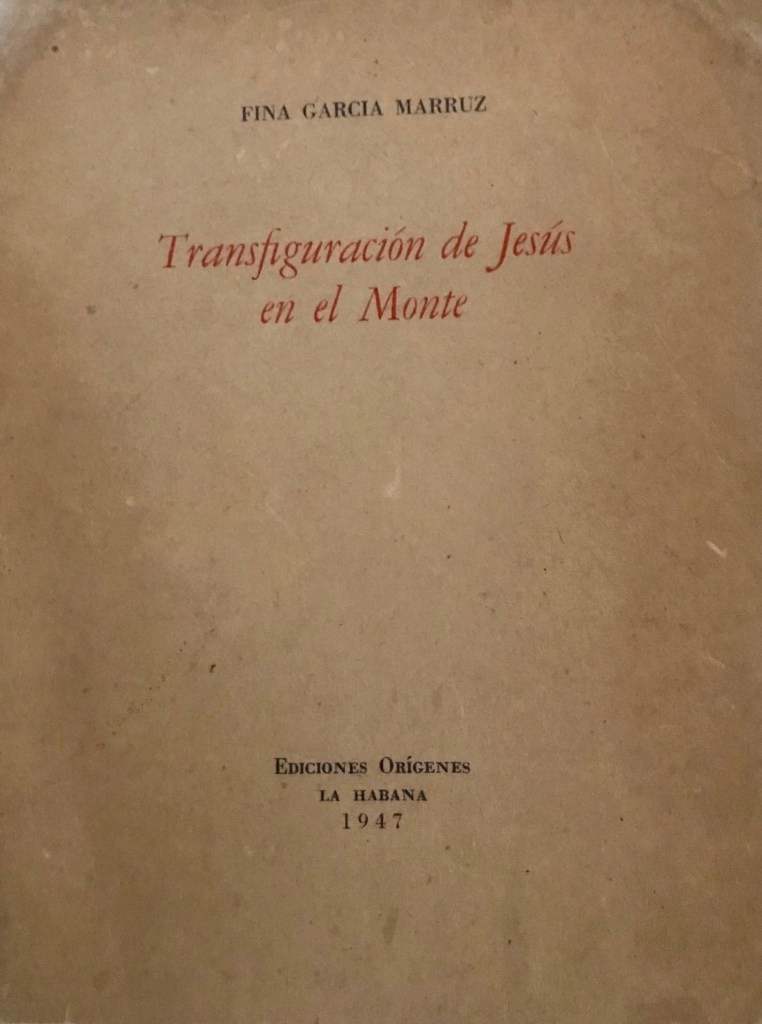
In 1947, the very young Cuban poet Fina García Marruz published the liturgical poem Transfiguración de Jesús en el Monte (Ediciones Orígenes, 1947), which stands in the modernist tradition series of attempts to probe the divine nature of language after the flight of gods and the triumph of the new secular jargons. If earlier in the century a well known Italian philosopher will predict that the international language of the future will be that of technical terms; the English Catholic poet David Jones, will reaffirm that we are “living in a world where the symbolic life (the life of the true cultures, of institutional religion and of all artists) is progressive eliminated – the technician is master. In a manner of speaking the priest and the artists are already in the catacombs, but separate catacombs – for the technician divides to rule” [1]. And if “liturgy” originally meant “public service” and the sphere of gestures, as suggested by Lubienska de Lenval, then Transfiguración has to be read, even into our days, as an attempt for language to measure to the transfiguration of revelation, in which the poem is a sacramental form that retracts language to possibilities of retaining communication.
In fact, Transfiguración de Jesús en el Monte, reinforcing the liturgical repetitions of an hymn and a sacred chant, enacts a flowing rhythm (“en tanto que”) that assesses the limits of the ineffable; a pure exteriority that is the negative or wound of language without ever being able to transcend it. In this sense, Marruz’s poem is only the poetic anabasis to the impossibility of a guided sacrament to organize interiority and visibility. Only the mystical can mediate between exteriority and the crisis of appearance. In an almost programmatic fashion, we read in the second part of the poem: “oh, difícilmente podríamos comprenderlo / Él se ha vuelto totalmente exterior como la luz; / Él ha rehusado la intimidad y se ha echado totalmente fuera de sí mismo” [2]. Transfiguration is the event that exiles oneself from the self (phygé), and in which language can generate contact with something other than its own conventions. This is why they [the witnesses and the martyrs] cannot provide an account about the transfigured revelation – just like anyone cannot truly provide a narrative, except by betraying the experience – except by their hearts as if being mysteriously called by a singular name (“ellos sienten que dentro de su corazón alguien / los ha llamado misteriosamente por su nombre”).
How can language disclose a sense of exteriority that is capable of moving past the autonomy of signification and self-referentiality of language? Can language befall into exteriority? Marruz provides an answer to this question, which can be taken as her contribution to the aporias of modern poetics: poetry can only attune to transfiguration as a cohabitual of a communicating being. In the year that the poem was published, Marruz also wrote in the winter issue of 1947 Orígenes a dense essay titled “Lo Exterior en la Poesía” (“The exterior in poetry) where she claims that “the heart of poem is always outside of it – it should not be that the poet can offer infinite variations of a secret self-possessed knowledge, but rather to rediscover the liturgy of the real; the extreme degree of visibility, which is also its great escape” [3]. What could the “liturgia de lo real” have meant for Marruz in 1947? Marruz does provide a clearcut theological definition of the exteriority as the “angelic”, which does corroborate the hymnological dimension of language, a transcendence between beings of the invisible. The liturgy of the real that defines the exteriority of the poetics of life does not entail a Romantic elevation by the Poet, but the effort to animate reality beyond an alienated monologue. This is why Marruz writes that “only a dialogue can realize an impossible communication, mystical, whenever it does take place in all of its purity” [4].
In 1947 Marruz went a step further than her fellow poets Gaztelu & Lezama Lima, who had defined transfiguration as a learning exercise of the potentia dei of the divine (“a todo transfigurarse sigue una suspension y el ejercicio del Monte era solo un aprendizaje”) [5]. Read side by side with Antelme’s Angel of Reims, one could very well say that for Marruz there is an event of transfiguration whenever transcendence delivers communication between beings, soul to soul; a relation that can one truly speak of the ungrounded and commencement. The liturgy clamored in language is not the memory of an original Adam severed from Nature, but the transfiguration of a linguistic relationship with the world. This might be the secret to Marruz last two verses: “como la infancia que acuña nuestro Rostro allí / donde no puede ser despertado”. If transfiguration also entails recapitulation, this means that this is not a process of forward becoming, but of retaining the atemporal detention that, like that of childhood, traces our silhouette as both figural and pure presence in the bushes of language.
.
.
Notes
1. David Jones. “Religion and the Muses” (1941), in Epoch and Artist (Faber&Faber, 1959), 134.
2. Fina García Marruz. Transfiguración de Jesús en el Monte (Orígenes, 1947), 6.
3. Fina García Marruz. “Lo Exterior en la Poesía”, 19.
3. Fina García Marruz. “Lo Exterior en la Poesía”, 22
4. Ángel Gaztelu & José Lezama Lima. Editorial: “Éxtasis de la Sustancia Destruida”, Nadie Parecía, Número IX, Nov, 1943, 1.
 Infrapolitical Reflections