Seeing in the dark. On Michael Lobel’s Van Gogh and the End of Nature (2024). by Gerardo Muñoz

Michael Lobel’s new monograph on Van Gogh’s work, Van Gogh and the End of Nature (Yale University Press, 2024) undertakes a systematic effort, brilliantly argued and researched, at showing the redeeming visual capacities of the nineteenth century painter towards the natural world. If we call it redeeming it is because in more than one way, Van Gogh, in the last three decades of the modernizing century, was painting at the threshold of nature that soon enough was assaulted by the copious designs of modern industrialization, energy production, and the application of its effective scientific techniques over all spheres of life. It is the final culmination of the disenchantment of the world, and so also the moment of great temptations, such as standing up against it through the metaphorization of the imago naturae in one last desperate attempt at salvation through a reified ideal representation. Lobel’s art historical work shows us along the way that Van Gogh’s situation was far more complex, and that a French critic’s quip that he merely “captured nature with a soul” in his pictures requires specification and analytical comprehension within the context of the century of steam (Lobel 2). 

In other words, Van Gogh is not a painter of a return to the conscience of the “Beautiful Soul” that has interiorized the exhaustion of artistic imagination; implicitly throughout Lobel’s monograph is the well grounded intuition that Van Gogh was an artist of the depth of vision without necessarily translation their specular commitment to the efficacy of realism. Immersed in his age as every artist obviously is, Van Gogh’s vision is mediated and conditioned by the effects of modernization that will severely affect the act of looking and gazing. This is not exclusively reduced to the new subject of labour production of the industrial age, although certainly there in his mining drawings, but also ecological transformations such as pollution, gaslight, geographical sites, the new chemistry of color pigments, and the tonality of human expressivity (the hues of a human face) in its new surroundings. Although there is no ambition in offering (or modifying) a theory of modernity in Lobel’s account of Van Gogh, one is reminded in the historical documentation the total and integral dimension of modernity in terms of its spatial totality: the essence of modernity was a revolution in the immanence of forms and perceptions that transcended the mere mechanization of the atmospheric designs.

Thus, when Van Gogh gazed at a peasant field and saw the isolated and orderly harvest he was simultaneously preferring the composition of the color palette of a painter that is now conscious of the material elements of his process of production (Lobel 9). But the colors return to the field, and this already provides us with a symptom of Van Gogh’s pictorial signature – which again runs implicitly throughout the book without ever coming to the forefront – about retaining the outlook towards nature and the natural world, which for the painter it becomes the enduring task to be resolved in manifold ways. But there is one way in which Van Gogh tries to tackle this drift to the infinite vanishing of nature: the capacity to move visually through space. To this end, Lobel does well to remind us that Van Gogh, perhaps more than any other artist of his time, was able to travel places thanks to the new rail system efficiently connecting regions and cities that made his work possible (Lobel 28). But besides the autobiographical standpoint, what is noteworthy is how Van Gogh trained his vision to capture industrial air pollution, trainlines, malformations of the land the end of Parisian Montmartre, and of course, the starry skies of Arles transformed by the new coal driven modern gas lamps. In all of these figural vistas, Van Gogh is always situated somewhere above the territory looking outwards, and in this way, attentive to the transformation of the exterior world; insisting whether there is any exteriority out there in the world at all (it does seem he thought there were).

Van Gogh prefigures as a painter of the eclipse of the world because it is a world in which the very notion of horizon (and thus of landscape) enters into a terminal crisis. Lobel brings to our attention Avenue de la Gare with Plane (1888) that captures this problem: here is a picture where the line of the horizon in the foreground mutates into the main PLM train line from Arles to Marseille (Lobel 33). The rail line cuts through the horizon becoming the new transcendental vector of progress; the axis of movement that carries the world forward. And yet there is something visually “earthly” in Van Gogh’s pictorial works that drives our gaze downwards; it is a symptom of its grounded vision, but also, for Lobel, of his tense relation with the temporal mobilization of modernity, as if seeking rest and detention (Lobel 43). What are the sources of this tension? Does it mean that it is never resolved? These are questions that are poorly tackled in Lobel’s book, and that remain attached strictly to art historical documentation and archival sources. But these are nonetheless fundamental questions de ayer y hoy, as the Spanish saying goes.

One could linger in the question of visual grounding in Van Gogh’s work – a perspective (although not just an optical question) that permeates his work, even when there is no outside field as a visual referent, such as the well known The Night Café (1888), where the billiard table seems to slide down towards the spectator, making the true and ultimate actor of the painting the intense and palpable wooden floor (Lobel 90). But the same could apply to the perspective of the Roi Canal or the starry skies over the Rhône, the examples abound. Is there something about vision and grounding that offers a point of entry into Van Gogh’s proposal to look into the cage of modernity one last time in order to find some non-space solace of the resting gaze? Could one argue that this “tension” – between horizontal closure and downwards grounding – his personal response to what T.J. Clark called when analyzing Pissarro, the “ongoing vileness of our epoch of transition”? [1]. It is hard to tell because, unlike Pissarro, Lobel tells us nothing about Van Gogh’s political views. 

However, we do know that at a young age Van Gogh wanted to pursue theological studies that he soon gave up for visual arts (Lobel 74). Could it be that his insistence towards the ground is resolutely theological, as if he wanted to retain the god of place (theos aisthetos) as the ungraspable region for extraction and production, the new axiological order of the industrial age? Lobel’s does well to cite Victor Hugo at the beginning of the second chapter “Earth” about the outskirts quarries and sewages of Montmartre: “a variety of those misshapen fungi from the underside of civilization” (Lobel 68). It all seems that even when he was not attending to capture the limits of Montmartre, the fields of Arles, or the domestic spaces, Van Gogh’s provokes a downward descension into the ground that invites any participating space. Looking at the vanishing world one last time needs a ground from which to stand and retain a sensible distance; that very distance that the nascent bourgeois world will effectively dissolve giving up on the cohabitation between life and nature into generic and massive alienation. 

The question of the ground perspective is also corroborated by Van Gogh’s interest in strong and emphatic hues for his picture, learning from the previous generation of artists that “all the colors that Impressionism has made fashionable are unstable” (Lobel 149). In other words, the effect of color for the Impressionists, including Seurat and Pissarro, is too dialectical, which means that the tension evolving from the ground is immediately resolved between color and form, the orderly and the interdependence of the composition for stable appearance. This allows us to consider that one of Van Gogh’s key signatures – his almost bombastic and expressive use of colors – have something intimate, and perhaps also secret, to the spatial-temporal closure of modernity and its contingencies. I do accept Lobel’s suggestion that Van Gogh seized the opportunity of new industrial non-natural hues in order to mitigate the coming lackluster world oriented towards production, extraction, and human survival. For Van Gogh color becomes the barrister to gaze firmly upon the fleeting temporization of the highly visible and transparent world of disenchantment and total organization.

But to say color is also an artifice or short for the insistence on light, which is not the light of the new immanent world, but certainly a painterly light that transcends immanence by insisting on the irrevocable character of places, arrangements, inhabitation, and contingency of phenomena. This is painting at its best against the vile epoch of transition, that has extended itself as the transition of the end of the modern epoch into our present. The ruins of Van Gogh’s industrial materials allow Michael Lobel to come full circle about Van Gogh’s inscription in the modern age (Lobel 153). But we should not let go of the idea that while materials do decompose and rot, the painter’s ultimate material utensil is nothing but light, and this means “a thinking of light, an image that is aware of the relation that light has with things. This matter is equally concrete”, as Monica Ferrando has recently advised [2]. Is not the descending lux the sensorial condition for disclosing the gradual proximity between vision and ground? It is with this exterior lighting as pictorial praxis that Van Gogh stood as a madman and a witness to the endless night of our disappearing our world.

Notes 

1. T.J. Clark. “We Field-Women”, Farewell to an idea: Episodes from a History of Modernism (Yale University Press, 1999), 109. 

2. Monica Ferrando. “From History to Anarchy: The Painting of Louis Comtois in the Thought of Reiner Schürmann”, Philosophy Today, Vol.68, Fall 2024, 875.

Vladimir Lossky’s third way. by Gerardo Muñoz

In his war diary Seven days on the roads of France June 1940 (2012), which recounts his itinerant vicissitudes in occupied France, the Russian theologian Vladimir Lossky makes an explicit case for the emergence of a third way beyond conservation and destruction, and its modern ideological avatars that led astray into the modern catastrophe; that is, the social revolution and conservative reaction cloaked under “traditionalism”. As it has been recently glossed, Lossky was not the only person from the East to be preoccupied with putting a halt to the eternal dialectical movement of destruction and conservation only fueling historical abstraction. Indeed, immediately in wake of the Russian Revolution, the poet Alexander Blok, in an epistolary exchange with Vladimir Mayakovsky, and anticipating the bewildering enthusiasm of the revolutionary energy, also demanded an effective exit from servitude so that “a third thing appears, equally dissimilar to construction and destruction” [1]. It matters little whether Lossky knew about Blok’s “third figure”, although it is at the same time impossible not to have it in mind when reading his own annotation in the June 16th entry of his diary, which does seem to offer a answer to Blok’s proposal:

“Nonetheless, revolutionaries are always in the wrong since, in their juvenile fervour for everything new, in their hopes for a better and a way of life built on justice they always base themselves on theories that are abstract and artificial, making a clean sweep of living tradition, which is after all, founded on the experience of centuries. Conservatives are always wrong, too…for in their desire to preservice ancient institutions that have withstood the test of time, they destroy the necessity of renewal and man’s yearning for a better way of life. Is there, then, a third way? Another destiny for society than of always being subject to the threat of revolutions which destroy life, or reactionary attitudes which mummify it? Or is this the inevitable fate of all terrestrial cities, the nature of their existence? In fact, only in the Church can we find both a Tradition that knows no revolution and at the same time, the impetus towards a new life that has no end. Which is why she is in possession of those infinite resources upon which may draw all who are called to govern the perishable cities of this world” [2]. 

It is no surprise that for both Blok and Lossky, the fundamental tension in the amphibology between conservation and rupture rests on the problem of “tradition”; given that, as Blok had also eloquently written in his letter to his fellow poet: “a breach with traditions is a tradition”. This is something that an artist like Kazimir Malevich understood well in his programmatic text about museums in the wake of the revolution (“On the Museum”, 1919): the turn into ashes of all the works of art altered their aura, but it left in place the topological frame and it still produced an image; in order words, the destructive artworks still demanded a museological space for storage, thus enacting new principles of the triumphant revolution. Understood in this sense, tradition is merely the retroactive accumulation of practices by the archē that orients its development retroactively from the point of view of the present with provisions towards the administration of the future. But, how did Lossky understand by the notion of “Tradition”? Rereading the fragment of his war diary entry, it would seem that this notion merely rests on the dogmatic transformations within the Church, and in this sense, a conceptual elucidation similar to the doctrinal exegesis not very different from John Henry Newman’s An essay on the development of Christian doctrine (1845). However, in his important essay “Tradition and Traditions”, Lossky attempts at defining the site and tension of the tradition, which he notes that in the language of theology it has been a term left vague and repeatedly undefined [3]. Lossky writes with sharp precision: “Tradition sometimes receives that of a teaching kept secret, not divulged, lest the mystery be profaned by the uninitiate” [4]. Thus, Tradition is the positive and textual scripture that registers the Word, but it is not exhausted in the positive scriptural authority. 

At the heart of Lossky’s argumentation about the theological meaning of Tradition, is the fact that it exceeds both textual sources and narrative mastery and transmission. In fact, the theology garment of Tradition belongs to the mystery of revelation shared in conspiracy, rumors or whispers [5]. And although, in his essay Lossky reaffirms himself that Tradition is the invisible intertwined with the Church – what keeps the “critical spirit of the institution” for the incorporation of new dogmatic definitions – it is nonetheless important to note that for the theologian, Tradition as “opposed to the reality of the word, it would be necessary to say that Tradition is Silence” [6]. In this sense, Tradition is that which is created and transmitted but that no one has the right nor the authority to speak through its incommunicable name. Is Tradition transmitted at all? If it is not through the written word, how can there be any continuity? This is the ultimate lacuna of the theological underpinning of Tradition for Lossky: Tradition can only be properly understood as the crafting of a “unique mode of receiving truth”; in order words, it names the contact between revelation and the witness who receives its ‘fullness of knowledge’, which far from mastering the totality, it points to “the external limit…the narrow door which leads to the knowledge of Truth” [7]. As Monica Ferrando has recently glossed from Plato’s philosophical corpus, any robust conception of Tradition should be understood as that which maintains an absolute inseparability between wonder and salvation, as well as bridging invention and received grace (charîs) [8]. One step at a time, we invent traditions whenever we are thinking through the abyss that separates our language from the inheritance bestowed upon us. Tradition moves in every ethical position of thought overcoming the pseudo-authorization of alienated and metaphorical knowledge of the past.

But if  the Church is no longer the institutional site for the keeping of the impossibility of the transmission and renewal of Tradition and revealed Truth – subsumed to the mysterium iniquitatis that works against the possibility of the rendition of the eternal life of a permanent vita nova  – it entails that one can still hold on to Lossky’s assertion that the task is to be attentive to the ossified expressions and reified appearances of Truth against the “living Spirit of Truth”. Hence, to insist on the restitution of the Church in our current predicament, would place us on the side of instrumentalized and subject-oriented salvation that turns away from the active kingdom that is the only passage from the world of the living to that of the dead. The traditionalists or integralists are incompetent representatives of the Tradition in this sense: as Von Balthasar once argued, they lack the humor and contact with the invisible to apprehend the mystery that arrives without solicitation, as pure depotentialization [9]. In a godless world of the secularized gnosis of political force – that is, after the fleeing of the gods – perhaps theology could only be understood as the path of Tradition of uncountable wonders and the event of speech that produces an unworldly sensation within this world. Tradition brings the world beyond its shape and legibility. In this sense, we are always participants of Truth that the world cannot retain, and thus keepers of an enduring secret that will ineluctably outlive us. 

Notes 

1. Philippe Theophanidis. “Alexander Blok: ‘A breach with traditions is a tradition'”, October 13, 2024: https://aphelis.net/breach-with-traditions-alexander-blok/ 

2. Vladimir Lossky. Seven days on the roads of France June 1940 (St. Vladimir’s Seminary Press, 2012), 54.

3. Vladimir Lossky. “Tradition and Traditions”, in In the image and likeness of God (St. Vladimir’s Seminary Press, 1974), 141.

4. Ibid., 144-145.

5. Ibid., 146.

6. Ibid., 150.

7. Ibid., 162. 

8. Monica Ferrando. “La libera grazie della tradizione”, in Un anno con Platone (Neri Pozza, 2024), 424.

9. Hans Urs Von Balthasar. The Office of Peter And the Structure of the Church (Ignatius Press, 2013), 403.

Living among the gods. On Monica Ferrando’s Arcadia Sacra (2024). by Gerardo Muñoz

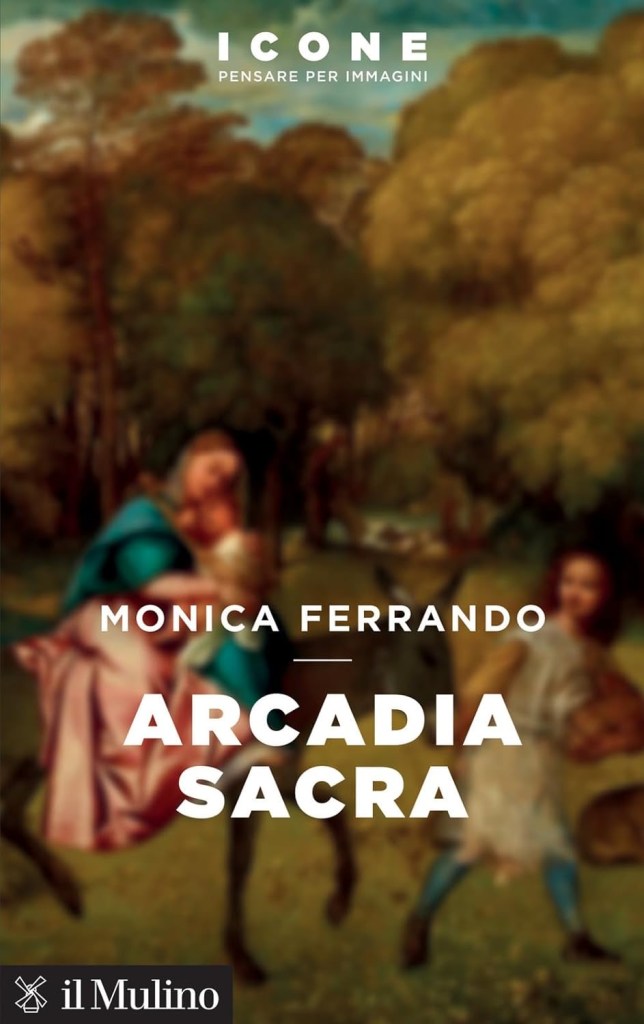
For anyone familiar with the delicate thought of Monica Ferrando, the short book just published, Arcadia Sacra (Il Molino, 2024), makes it impossible not to read it in light of her the two previous works, the ambitious Il regno errante (Neri Pozza, 2018) that reconstructs the political paradigm of the nomos of Arcadia, and L’elezione e la sua ombra: Il cantico tradito (2022), which brought to light the corrupted meaning of a theopoetic understanding of “election” and its appropriation by an effective economic theology apparatus that governs over the destiny of the modern edifice. Arcadia Sacra continues Ferrando’s highly original reconstruction of the unforgettable myth of Arcadia within the obscure setting of secular  modernization in which painting itself has come into crisis to the point of utter obsolescence. We might be the first epoch in the history of humanity (or even prehistoric, since painting goes back to the non-original origin of the caves, as Ferrando has argued) in which painting itself is lacking and almost non-existent [1]. And although Ferrando does not allude to the present directly, it goes without saying that by choosing as her focal point Titian’s early picture “The Flight into Egypt” (1508), the vision deployed in the essay can only speak to us as urgently, where the thematics confronted by the Renaissance of Venetian painting returns to our present in a fractured flash: imperial conflagration, unlimited deployment of force, usurpation of territory and  multiplication of legal checkpoints, and the accelerated disconnection between architecture and nature, color the ongoing devastation of the vantage point of the landscape now eclipsed by the radiant artificial confinements of the contemporary metropolitan designs.  

Already during his postwar years in the United States, Theodor Adorno observed how the unbounded sadness of the American landscape has nothing to do with an inhuman romantic sublime; it was rather that the landscape feels as if it bears no traces of the human hand [2]. If Americanism configures the long lasting night of planetary nihilism; this is so, not only due to capitalist subsumption and production of human life, but fundamentally because of the inherent obliviousness of the  landscape that forecloses dwelling in the world. But the myth of Arcadia, as Ferrando will insists, is no utopia nor crafted rhetoric (the bucolic genre as an aesthetic compensation to the normative grid of the social bond); it is also the question about the earthly ground of existence, and the necessary attunement with the things that have been domesticated into order of the metaphysics of idolatry and objectivity (Ferrando 28). In this sense, Arcadia does not name another world to come; it is a world that has been registered many times, reappearing whenever the hand reaches out in proximity as if caressing the landscape’s skin.

The mytho-poetical deployment of Arcadia returns amidst a world in conflagration, and for Ferrando this has fundamental political implications insofar as it shows a way out from the grammar at the service of force and political dominion of commanders and soldiers – which is always already exercised as legitimate to coerce and to become a tool for the regulation of abstract mediations – into the voice of poets, painters, and shepherds (Ferrando 51). Arcadia reveals that the human species is a ductile animal that can sense by the ability to touch and use. This is why Arcadia stands as a third space outside the political dichotomy of empire and republicanism, between the struggle of usurpation and conquest, and the techno-political administration of common goods of social distribution and institutional delegation. The abstract humanism of the Renaissance, as Heidegger once claimed alluding to Machiavelli’s political thought, is also the commencement of a specific political technology rooted in certainty and justification that can only conceive representation as the ground for the production of an “effective truth” [3]. The virtuous homini militari of the Italian city states anticipate the neutralization of force as legitimate rule that will prepare the stage of modern political realism based on fear and normative rule of law. The final efficacy of force is to transform the sense of the world into a mere object, as Weil clearly understood it in her essay on Homer’s Iliad. One of the key insights of Ferrando’s Arcadia Sacra (2024) is that it shows that, parallel to the revolution in political technologies taking place in Renaissance Humanism, the image of Arcadia was being rediscovered in treatises and paintings in order to remain faithful to a different attunement of the nomoi, in which the philosophy of history of sacrifice, endless civil wars, and destruction of the Earth do not constitute true destiny (Ferrando 14). In an exoteric way – and it is so, because the craft of the painter is, precisely, depiction and figuration of the nakedness of what appears before our vision-  painters like Titian, Veronese, and Bellini, became witnesses to the acquiescence of the nomos mousikos, which far from soliciting the conceptual density of a theory of Justice; it registered the preeminent condition of poetizing nature of  living in the vanishing world. Indeed, it was in the musical nomos where the soul could establish the communication between exteriority and interiority within the gleaming order of things. 

If Heidegger in The Origin of the Work of Art suggests that the erection of work occupies the open space of this clearing; Ferrando will thematize how Boccaccio’s understanding of the Earth as radiantly divine was drawing upon the tradition of Arcadia will emerge as the pictorial space of the artists to disclose the vibrant sense of a necessary freedom (Ferrando 43). This means that living among the gods is not reducible to panentheism, if understood as oppositional to monotheism; rather, it was the opening to the event that gathered forms of life,  creations,  affections, and territories. In other words, there will always be gods whenever the world is not enclosed into the homogenous surface of a unified planetarity. And is not painting the quasi-originary activity of human anthropogenesis (the event of being in the world as such) the  sensible evidence that negates any conceptual and political translation directed towards action and justification? After all, painting is, among other things, the business of depicting mute things, as Nicolas Poussin famously claimed. 

But muteness must be qualified and expanded, since Arcadia is no asylum or final refuge of man. Titian’s “The Flight into Egypt” depicts a rite of passage, but also opens to a set of rhythmic connected activities that lead to the landscape. Thus, as Monica Ferrando reminds us, building from her previous Il regno errante, Arcadia is also the material experimentation of acoustic energy; music, or the the nomos mousikos, no longer guided by the command of political service, directed by attunement of the lyre and the syrinx, will speak the unwritten language of the human soul. Painting and music convergence at the nonsite of permanent formlessness. And it is rhythmic music allowing improvisation and experimentation that reimagines a different conception of the polis; a transfiguration of political life, in which the principle of civility in all of its complexity (citizenship, objective transference and negation, civilizational fortitude) will no longer articulate the principal axis of the human commonwealth. Neither a source of higher natural law nor a mere expansion of positive norms, the nomos of Arcadia for Ferrando entails: “inalterabile a unire intimamente musica e legge, entrambe  ágrapha, non scritte, se non nel cuore. L’interdipendenza tra modi della musica e nomoi della città, che sarebbe vano interpretare secondo un rapporto causale, trova nella stessa parola nomos un compendio inesauribile, ribadito nella Politeia: «Non si introducono mai cambiamenti nei modi della musica senza che se ne introducano nei più importanti nomoi della polis” (Ferrando 54). The separation of law from music – as Ferrando will say for poetry and philosophy in later pages – will ultimately lead to the moral struggle towards the rise of the fictitious (and whoever can impose it through their effective hegemony) against the emergence of the “love of thought” (l’amore del pensiero) (Ferrando 57). In this sense, the moralization of justice and its conversion into a specific historical grammar (lex scripta in the juridical apparatus) will ground the order of the polis in which the human will be absolutely sacred so that the sacred nearness between existence and the world – the atopia where the promise of happiness can take place – will vanish forever. As Carlo Levi saw clearly during the postwar years, the rise of the political administration of fear will coincide with the decline of painting as the source of being in liberty within the senses [4]. And, in our days, the historical termination of secularization can only be felt like an unending glacial interregnum (it is no surprise that Disney’s epochal blockbuster is precisely a defense of alienation of a cold being in a Frozen castle) in which the prehistoric reminiscence of the garden can only appear as an afterthought or mere representation, always out of reach, and viciously grazed by wild beasts before our own eyes.  

But seeing is already an exercise in prefiguration of a world that returns where painting stands as the medium for a mediation between the formlessness and the soul. This is why, above all, pictorial space is a privileged surface from which to flee our condition of unworldly inmates of our times. In a certain way, painting does not just bring to bear truth against the regime of calamitous fictions; it is also bears witness, as Ferrando states towards a high moment of Arcadia Sacra (2024), to the rediscovery of a new mental space that revives the attunement to a state of the world no longer reduced to the depredatory practices of civilizational extraction and consented servitude (Ferrando 77). The tradition of painting is not just a collection of forms and artistic conventions, but the ongoing concert that facilitates our movement (and being moved) towards happiness.

This is the promise of the itinerant Mary’s passive and inclined face in Titian’s early masterpiece. It does not come to surprise that for Ferrando, the mother dwells among the gods of peace, in contrast to the figures of the commander or the inquisitorial or priestly judge that monitor an endless narrative of intra-species civil war (Ferrando 63). It should not go without saying that at the same time that some contemporary scholars in the face of a historical crisis of legitimation attempt to revive the aura of the homini militari, the precepts of the ragion di stato and the technical virtues of the charismatic Prince; it has been the work of Monica Ferrando, in fully in display in Arcadia Sacra (2024), that invites us to turn to the counters of eros of painting that, almost stubbornly, transmit to us the infinite possibilities of life among the green blades of grass in Pan’s spiritual land (Ferrando 82) [5]. The sacredness of Arcadia resides in this unbounded exteriority that thanks to the mystery of the mother, is always commencing; and, having achieved happiness, it wants to know nothing about bring the world to conclusion. Beneath the arcana imperii (Rome) and the bylaws of the polis (Athens), the landscape of Arcadia remains a harmonious passage of our cohabitation.   

Notes 

1. Monica Ferrando. “Editoriale”, De pictura 3, 2020: https://www.quodlibet.it/rivista/9788822011643 

2. Theodor W. Adorno. Minima Moralia: Reflections on a Damaged Life (Verso, 2005), 73.

3. Martin Heidegger. Acerca de Ernst Jünger (El Hilo de Ariadna, 2013), 113.

4. Carlo Levi. “Paura della pittura” (1942).

5. I am thinking here of the works of several American  historians of political thought and  legal scholars in recent years that have mobilized efforts to restore a “neoclassical”, Renaissance centered political tradition, as a response to the crisis of modern liberalism. The most prominent list includes, although it is not limited to James Hankins’ Virtue Politics: Soulcraft and Statecraft in Renaissance Italy (Harvard U Press, 2020), Harvey Mansfield’s Machiavelli’s Effectual Truth (Cambridge U Press, 2023), and Adrian Vermuele’s endorsement of Renaissance imperial categories such as Ragion di stato, Lex Regia and the tradition of the Mirror of Princes, see his “Sacramental Liberalism and Region di Stato” (2019) and “The Many and the Few: On the American Lex Regia” (2023). The pastiche of this neoclassical investment made possible by rhetorical and hermeneutical deployments of instrumentalized myth, it is something that I have taken note of in “¿Revival de la tradición legal clásica?” (2022). Drawing a parallel to this classical absorption in American political thought, one could say that this is a reiteration of what Monica Ferrando herself has analyzed in her chapter on German Romantic Neoclassicism and the Winckelmann aesthetic project in her L’elezione e la sua ombra. Il cantico tradito (Neri Pozza, 2022), except now that it lacks aesthetic meditations (there is no Dichter als Führer), thus culminating in the direct exercise of applied executive force. 

The political elite and the dead. by Gerardo Muñoz


Over the weekend, the Catalan journalist Enric Juliana interviewed Ramón Tamames, former member of the Spanish Communist Party (PCE) who embodies the living memory of the 1978 transition to democracy. Nowadays he is the main protagonist of the motion of confidence against the government coalition raised by the nationalist right-wing party Vox. There is no surprise (at least for those of us that follow closely the idas y venidas of Spanish politics) that a former member of the Communist Party makes amends with with the neo-sovereignist right. Even the Medieval jurist Bártolo de Sassoferrato centuries ago diagnosed that an epoch void of political authority, leads to a ‘monstrous form’ of arbitrary governance. This is not the place to analyze the cartoonish Vox-Tamames’ alliance. Rather, what generated a chilling effect while reading Juliana’s exchange was the moment when he asked about what he would have said to the communist prisoners in the Burgos correctional facilities in the aftermath of the Spanish Civil War. And, to this Tamames responded: “Están todos muertos”. They are all dead. It is a monstrous phrase voiced by a hyperbolic figure of the Spanish political elite. The answer is bold and lacerant because the message is stated without formal investidures or pathos: the dead are dead, and we own them nothing, since they are nothing. They are less than nothing.

It is no minor feature that historical communist parties during the twentieth century, in spite of the public and rhetorical monumentalization of their ‘heroic pantheon’, had little patience with the dead. This is why a motto in some socialist countries was, indeed, “los hombres mueren pero el Partido es Inmortal” (men died, but the Party is Immortal). So, by organizing immortality and the relation to the dead around the Party, historical communism was able to solve two problems at some: it was able to justify sacrifice in the name of a transcendent cause; and, at the same time, it introduced the dead corpse in Party as a government that kept operating even well beyond people had ceased to believe in it. I mention this because as a historical communist, Ramón Tamames is still embedded in this metaphysical enframing, only that now it takes different garments through a full erase of the dead that a posteriori justifies a concrete political action. 

I have underlined a few times already the fact that Tamames is a trained political elite, because his alignment with Vox is rooted in his alleged elite credentials. This is an important feature. I remember a few years ago that Mario Tronti told me, in a Weberian spirit, that a new epochal transformation of Western politics required the elaboration of an elite in possession of vocation and conviction. But this is, paradoxically, what Tamames has always stood for, regardless of his political commitments. The problem is that today the restitution of political elitism is not only insufficient, but it is also visibly catastrophic and opportunist. It is opportunist because it can only self-affirm itself as a supreme value in the world of the living, which necessarily entails killing, once again, the dead. Under this light one should reconsider what Carl Schmitt enigmatically writes in his Glossarium: “elite is that category which no one dares to write a sociology about” [1]. It seems, however, that the contrary is true: sociology is the predominant form of political elite, since its final aim is the reproduction of material social relations at the expense of the dead. As administrators of the public life of the city, the political elite must hide the cemeteries and the world of the dead away from the arcana of its public powers (this is very visible in Washington DC or Madrid). This void demands a  relation with the dead as a fictitious memory based on public memory, monumentalization, infinite naming, and cultural commodification in exchange for foreclosing the relation with the dead. This also explains why the epoch of high-secularization is fascinated with the investment of public memory and practices of memorialization which maintain the equilibrium and endurance of the society of the living against the dead. 

And isn’t Tamames’ depreciation of the dead just an expression of the attitude present during the high peak of the epidemic across Western metropolises? The corpses amassed in registrator hums outside hospitals in New York was a monstrous spectacle that bore witness to the disconnect between the living and the dead in the triumphant epoch of absolute immanence. What is important here, it seems to me, is that one cannot but expect this from a “political elite”; that is, a denegritation and blockage from a contact with the dead that is neither in the home nor in the city, but in the khora or the extra muros. Whenever this has been achieved, the political consequence has been, precisely, punitive acceleration, social death or expulsion. 

In a beautiful text written during the height of the epidemic controls, Monica Ferrando reminded us that the socratic philosophical ethos was not rooted in the space of the city, but rather in relation to the underworld that grants “freedom every time” [2]. In times gone awry, nothing is more urgent than to do away with the gatekeepers that keep society a total space of inmates, while making the whirling presence of the dead a silent echochamber between cemeteries, as a friend likes to put it. In a certain way, we are already dead, and it is only the fiction of political elitism (or the permanence of those that appeal to the “political elite”) that taxes death – and our dead – to the sensible modes that we relate with the mysterious and the unfathomable.

.

.

Notes 

1. Carl Schmitt. Glossarium: Anotaciones desde 1947 hasta 1958 (El Paseo Editorial, 2021), 351.

2. Monica Ferrando. “Terra Giustissima: sulle tracce dei morti”, Laboratorio Archeologia Filosofica, February, 2021: https://www.archeologiafilosofica.it/terra-giustissima-sulle-tracce-dei-morti/ 

On dispensationalism. Monica Ferrando’s L’elezione e la sua ombra: Il cantico tradito (2022). by Gerardo Muñoz

Monica Ferrando’s short but dense book L’elezione e la sua ombra: Il cantico tradito (Neri Pozza, 2022) refines our understanding of the secularization debate in the wake of the epochal crisis of modernity and planetary domination. For Ferrando this current domination is rooted in a specific retheologization that must be grasped at face value, no abstractions allowed. The force of theological domination, which has become a proper religious imperialism, expresses itself as a true corruptio optimi pessima, which Ferrando locates in a very precise intersection: the passage from the suppression of dilectio to an instrumental manifestation of electio that will culminate in the unleashed power to dominate not only the relation with the world, but the very existence of the species. If the Ancient covenant of early Judaism was a prophetic covenant with God, the force of predestination will suppress the mysterious relationship of blessed life to render a “selective process” of theological election [1]. It is only with the rise Protestantism, and Luther’s specific hermeneutical efforts to neutralize the messianic message of Paul’s Letters to Romans that election becomes the paradigm of a new government of the soul in this world, which will ultimately find its material legitimacy with the advent of the reproductive logic of capital. Implicitly building on the thesis of economic theology, for Ferrando the advent of the machine of election materializes in the theological reform that translates the universal salvation of the prophecy into a never before seen economy of the dispensing grace through wealth retribution for human labor [2].

The reformation based on dispensation (oikonomia) differed fundamentally from the Church’s idea of change rooted in the ius reformandi. As Gerhart Ladner shows, if the “idea of reform” up until modernity presupposed periods of spiritual reform through monastic experience in relation to wordly profane time, the apparatus of dispensation of election was oriented at securing an integral government rationality combining law, economy and subjective production without reminder [3]. In this light, the operation of the dispensation paradigm is twofold: on the one hand, it promotes an anti-Judaic operation of reducing Jews to a people of this world that will ultimately will be identified with political Zionism; and, on the other, it dismisses the coming of Christ as worthless, and in the best case as merely postponed [4]. For a reformed theologian like Karl Barth – at odds with the economic evangelism that ultimately triumphed in the United States and that now it extends across the global – there was only a ‘great dispensation’ putting end to the abstraction of value and the homogeneity of the time of production [5]. But more importantly for Ferrando, the triumph of the dispensatory paradigm entails a new fundamentalism of judgement based on “election” (in the broadest sense of value equity and competition) will appear as the only immanent force capable of considering every other religion and confession exterior to itself as “merely pagan and idolatrous” [6]. It would amount to the triumph of the self-made ‘gentleman’ over the outward message of Paul.

The dominance of dispensation meant a full convergence between salvation and profane economic life that will bring exteriority into a crisis in the deepest sense. This is why for the reformist mentality, its own modern image initiates the epoch of irreversibility; that is, the pure historical progress guided by the will of election and the work of grace as an exception to universal salvation. If the modern reform has been at times understood as the new regime of social pluralism and system of indirect separations (between Church and State, civil society and religion, the public and the private, etc) for Ferrando it is on the side of the theological presupposition where its most terrifying arcanum must be found: a dispensational theology whose main unity is the recurrent intrusion, training, modification, and discipline of the forum internum, that is, the administration of the consciousness of man. Whereas the felix culpa allowed for the mystery of repentance and universal salvation; the political meditation of election through accumulation and economic benefits will legitimize the new discourse on toleration, “liberty”, and even democracy as the distribution of surplus value. In this sense, Liberalism (with Locke and other thinkers of the English and Scottish Enlightenments) was born, as later understood by Carl Schmitt, with the structural weakness of “individual freedom” and maximized autonomy that will require the expanding checks of police and governmental penalties to cope with the production of effects. Of course, every deviation or movement that could put a halt to the fiction of election will find itself on the side of illegality, or turned into a remnant of a surreptitious past that must be overcome at all costs. This implied, as Ferrando reminds us, nothing less than a novel modification of the anthropogenesis of the human species.

It is one of Ferrando’s most daring and surprising tasks to show how the machine of election does not merely occupy the economic-political sphere, but that it will eventually also imply an aesthetic imperative in Northern European culture; specifically with the rise of German romantic response to the crisis of the Enlightenment and the question of “classicism” of the classical Greece. If according to Gianni Carchia the aesthetic dimension of modernity should be read as a compensatory answer to the futility of the romantic revolution in subjectivity; Ferrando’s complementation to the thesis brilliantly shows how this attempt was meant to fail at its original ground due to the mimetic appropriation and metaphorization of the Greek historical past in the aesthetics program of Winckleman and German Idealism (with the exception of Hölderlin’s fugitive position) [7]. The mimetic “hellenization” of German romanticism and its posterior afterlives (one thinks of the Stefan George Circle, and Max Kommerell’s Der Dichter als Führer) gave birth to a notion of “culture” that hinged upon the separation of the aesthetic and the religious spheres that had to sacrifice the appearance of beauty in order to attest for the dialectics of objective and subjective forms of the “Spirit”, and thus leading to the triumph of the grotesque and the aesthetic imperative of uniformity and museification. For Ferrando the German spirit of genialismus had as a mission the overcoming Latin, Mediterranean and Mesopotamian forms of life where the distinction between beauty and life never understood itself as a “culture” or objective project of enlightened intellectuals and artists on the mission to transform the contingency of poesis into the realization of the Idea [8].

Displacing this aesthetic dimension to the present, for Ferrando the intrinsic disconnect between appearance and substance of art’s truth emerges today in the predominant social morality of today’s global bourgeoisie: hypocrisy. It is in hypocrisy where today one can see the inflationary hegemony of discourse over the true organization of life that is proper to the dominant metropolitan class of the West, and its maddening obsession with identity politics or “race” oriented discourse as a moral inquisitorial abstraction (it is in this process that the notion of election appears in the least expected of places: sky color, language use, demands for inclusivity, and hyperconscious towards an invented past). The work of hypocrisy, in fact, appears as a secularized form of the dispensation paradigm that aims to normalize and domesticate every form of life that challenges its specular regime. This is why according to Ferrando – and I do not think she is incorrect in saying so – the possibility of art (especially that of “painting”), as the undisclosed of truth will disappear from human experience, as it has no place in the moral functionalism of ‘contemporary art’ nor in the discursive struggle over global communication and opinion battles (the so-called ‘cultural wars’) [9]. The aesthetic museification of the world liquidates the possibility of art’s truth. Paradoxically, in this new scenario everyone must declare himself “an artist” of their own emptiness: the nowhere men that stroll in the works of Robert Walser or Franz Kafka – who never declared themselves to be anything – in our present are flipped on their heads becoming informers of the regime of a universal politics of recognition and moral judgement [10]. These ‘bloomesque figures’ confirms in the last epochal dispensation of the Reformist revolution that the premises of subjective freedom, economic gain, and autonomy of value have culminated in a new aesthetic imperialism that is anthropological and rooted in the triumphant religion of immanence and the sacralization of ultimate values. The endgame has been dispensed in the creation of a “new man” through the sacrifice of every exteriority in man, that is, of the invisibility outside the fiction of his personality.

The paradigm that Ferrando is describing vis-a-vis the operative force of “election” is also one of profound irony, since the mechanism of predestination and election, by betraying prophetic dilectio (love), the “free election” of the moderns entails that everything can be elected at the expense of losing dilectio: the only path towards the mystery of life. This is what the epoch of irreversibility and the arrogance of historical progress has foreclosed and it is incapable of considering. But for Ferrando life remains an ethics, which she links to Eros, whose appeal to the law of the heart is neither religious nor political, but rather an instance to the disclosure of truth. As she beautifully writes towards the end of L’ elezione e la sua ombra (2022): “Occorre osservare che qui si tocca una sorta di grado zero teologico, che scivola nel mero «biologico» solo a patto di esautorare la sapienza della madre o, detto altrimenti, la sapienza come madre, custode di una legge non scritta, di un nomos del cuore, che non necessita di alcun mandato esterno per esercitare la conoscenza che gli è propria. Si apre insomma quello spazio, costantemente e variamente negato, ma imperturbabile, di cui solo la madre, in virtú di una sapienza propria della natura umana, può custodire la legge.” [11].

The foreclosure of the acoustic relation to prophecy documents the recurrent political interest in the subordination of music to the moral captivity of the reproduction of humanity [12]. On its reverse, the law of eros, prior to the moral domain of natural law and the authoritative domain of positive law, is the protection of the indestructible region of the human soul where no political, moral, or economic dispensation can exert its force. This is confirmed today by the monstrous techno-scientific interventions and dysphoric alterations in the life of children as the last utopia in the long dispensation of the anthropomorphism of capital legitimized by rhetorical force of an unending sermo homilis [13]. In this sense, what Ferrando accomplishes in this wonderful essay is to remind us that the event of theology remains outside the dominion of priests and bureaucrats and situated in the prophetic dimension of Eros (love) that guards the inclination towards beauty and the disposition to attune oneself to the prophecy of the world’s fulfillment [14]. Hence, it is not in the community or in an integralist Christian traditional family order where the sacred dimension of humanity can be retrieved; rather, for Ferrando it is in the non-knowledge reserved by the eros of the mother who never decides nor choses before law, whose nonverbal “tacit authenticity” (“tacita autenticità del legame materno”) unconceals a true experiential depth away from the the delirious cacophony of our world.

.

.

Notes 

1. Monica Ferrando’s L’ elezione e la sua ombra: Il cantico tradito (Neri Pozza, 2022), 8-9.

2. Ibid., 22.

3. Gerhart B. Ladner. The Idea of Reform: Its Impact on Christian Thought and Action in the Age of the Fathers (Harvard University Press, 1959).

4. Monica Ferrando. L’ elezione e la sua ombra: Il cantico tradito (2022), 24.

5. Karl Barth. “The Great Dispensation”, Interpretation, V.14, July 1960, 311.

6. Monica Ferrando L’ elezione e la sua ombra: Il cantico tradito (2022), 30.

7. Gianni Carchia. “Modernità anti-romantica”, in Il mito trasfigurato (Ernani Stamptore, 1984).

8. Monica Ferrando. L’ elezione e la sua ombra: Il cantico tradito (2022), 60.

9. Ibid., 91-92.

10. Ibid., 94.

11. Ibid., 106.

12. On the controversy of music as a tool to tame human’s passions, see John Finnis’ “Truth and Complexity: Notes on Music and Liberalism”, American Journal of Jurisprudence, Vol. 62, 2017, 119-124.

13. Gianni Carchia. “Eros y Logos: Peitho arcaica y retórica antigua”, in Retórica de lo sublime (Tecnos, 1990), 29.

14. Gianni Carchia. “Dialettica dell’immagine: note sull’estetica biblica e cristiana”, in Legittimazione dell’arte (Guida Editores, 1982), 21.