The well-established American Liberal historian of ideas, Mark Lilla, writes in his recent essay “The Once and the Now” an outlandish thesis: “the ideologies of modern fascism are all heirs to the Aeneid.” Any reasonable reaction should start not by disputing the content of such superficial assertion, but rather by raising the central question: what has taken place in America so that this level of intellectual putrefaction and conscious oblivion towards the past could take place, thus becoming permissible and reasonable? From where does the intellectual confidence emerge so that such a lethal rhetorical force can be deployed? At a high paced rate, the United States has become a beacon for an ongoing fascination over “fascism and anti-fascism” to the point of adapting an absolute form of parody in the “serious” forms of culture, academic production, and current event discussions.
Perhaps it is not that difficult to find an answer; and, one can say that once a culture repeatedly defines itself by the parameters of its parodic enactment is precisely a culture that has effectively ceased to exist. Carl Schmitt was up to something when he writes in Glossarium (an entry from 1953) that fascism after the war amounted to the ultimate victory of Stalinism over every other geopolitical actor in the Western world. The Cold War was also a battle for mimetic containment and pacification: the uttermost consummation to the highest case of metonymic endurance. The diffused “cultural war” in America in every symbolic dimensions of life (the media, the university, the political jargon, the legal profession, the community interaction, etc) shows that the victory has now reached definitive and unprecedented heights. It is true that fascism has always triggered a sort of libidinal drive – something that Susan Sontag knew well – in the societal attachment to symbolic production. In this sense there is little new here. But the novelty shows itself if one understands that the rhetoric of fascism has now become autonomous and sine qua non to cultural solvency into nihilism.
If Lilla’s remark caught my attention it is because it fully captures this transformation at the highest levels of the American elite. This transformation is nothing but the essence of Americanism as a fictive rhetorical parody of everything belonging to “Western culture”. This is why, regardless of ideological commitments (or precisely because of them), Americanism is in the business of an active forgetting of the West; while, at the same time, presuming credentials to be its most courageous defender. But it should be clear that Americanism’s defense of the West ultimately means the compulsive expansion of public opinion through a trivialization of the alienability of the past in its own ever-changing image.
In 1935, a short book appeared in Europe penned by Catholic intellectual Theodor Haecker that was entitled Virgil, Father of the West. This essay reminded its readers that culture in Virgil’s Aeneid and Georgics is best understood as the possibility of dwelling in the land through the cultivation of the Eros itself. In fact, Haecker will go on to write that the paradigm of Virgil’s Georgica should remain well into the end of the epoch as a solid commitment to the iustissima tellus against the “mysticism of the machine and the glorification of technology”. Almost a century after, Haecker’s hope in the possibility of cultivating homecoming has literally vanished. To any attentive observer it is clear that American intellectual elites have abdicated their commitment to iustissima tellus, while the marching orders of Americanism, driven by the artificial hells of the Metaverse and planetary conflagration, have already animated the flock through the gate leaving behind nothing but resilient and uninterrupted destruction.
In the short epilogue “Historical Background to the year of grace A.D. 499” to his novel Porius (1951), John Cowper Powys lays out a remarkable prophetic evaluation of a world fallen into a permanent catastrophic condition. Powys’ return to the sixth century in his novel departed from the fascinating fact that during the mid-fifth century there appears to be “an absolute blank” page about the history and culture of its people. And the only historical record proves that the central element was the Arthur’s commanding political dominion over the English territories. In these blank pages of history there are no tormented voices or traces of everyday existence, but the most absolute compacted pressure of barbarism and grandiose “crafty personal diplomacy” oriented by political rule. For Powys, this is the movement of abstract historical force that raises up the mirror of civilization and barbarism in the West.
However , this mirror is completely alien to any notion of happiness, imagination, and sensibility between the surviving human species. A world war had just concluded and atomic menace was the strange tune of daily life. But, in contrast to the triumphalist and historical narrative of postwar diplomatic theaters, Cowper Powys directs his vision (like Hölderlin and Pound before him with Greece and the Latin Mediterranean poets) to a prehistoric strata where language and sensation still had a chance against the civilizational collapse of the West. Againstboth civilization and barbarism, Powys prepares himself to drift away from something major, perhaps more even more catastrophic, which he never names directly in the Porious prologue, although he can unravel its essence in the last paragraph:
“As we contemplate the historic background to the autumn of the last year of the fifth century, it is impossible not to think of the background of human life from which we watch the first half of the twentieth century dissolve into the second half. As the old gods were departing then, so the old gods are departing now. And as the future was dark with the terrifying possibilities of human disaster then, so, today, are we confronted by the possibility of catastrophic world events compared with which those that Arthur and his Counsellor and his Horsemen contented against seem, as the Hebrew poet said, a “very little thing” [1]”.
It is thanks to the genius of Cowper Powys that the coming of catastrophe is understood not as another phase in world-history, but rather, as the opening of endless catastrophic world-events. Even before Martin Heidegger would define the essence of cybernetics as the consummation of the calculation of world events, Powys had already suspected that a stealth rationality towards calculation of events was the catastrophe that crossed the very line of the polarity of barbarism and civilization. The catastrophe of world-event consummation was hinged upon the total convergence of machine and humanity that would liquidate the free relation of the living in the world. As Powys had written in The Meaning of Culture (1930) decades prior: “Money and machines between them dominate the civilized world. Between them, the power of money and the power of the machine have distracted the minds of our western nations from those eternal aspects of life and nature, the contemplation of which engenders all noble and subtle thoughts” [2].
The ascent of atomic existence and the absolute dependency on administrative infrastructure to contain the world, will validate Powys’ astute observation about the ongoing catastrophe at a moment when its development was barely beginning to gain traction. And against futile political fictions, Powys was aware that in a civilization of collapse, political chatter becomes the only legible foul discourse: “Among other aspects of our destiny in this modern regime, the rumor of politics makes itself only too audible” [3]. The seriousness of this rumor has only deepened almost a century after.
.
.
Notes
1. John Cowper Powys. “Historical Background to the year of grace A.D. 499”, Porius (1952), xi.
2. John Cowper Powys. The Meaning of Culture (Jonathan Cape, 1932), 150.
There is something insufficient and risible in the attempt to isolate notions like “revolution” or “emancipation” from the total collapse of the grammar of politics. This insufficiency speaks to a rhetorical inflation which already at the turn of the twentieth century Carlo Michaelsteader identified with the attempt at securing the social bond at all costs. The rhetoric of “saving” (the revolution, emancipation, liberation: saving the subject) at bottom, only shows the simulacra of a redemptive movement of value at the heart of social exchange. And we also know that modern political revolutions were experiments in general socialization. Whether it is Saint-Just appealing to the laws of nature against the positive social contract in the wake of the French Revolution; or Lenin and the Bolsheviks more than a century later in their efforts to stage a utopia of production and classless society, the revolutionary horizon was ultimately about the production of the social bond and little else.
The dialectization between subject and the totality of the modes of production was realized in its reverse: the passage to a new temporal domination unto all sensual activities of life. This was expected given the premise: at the center of the genesis of political organization of the West is not the state, but rather the rhetorical structures of civility. That the last theoretical project of politics hinges on the so-called “rhetorical foundations” of society now comes full circle: the development of civilization in the open.
Of course, revolutionary and emancipatory imagination, except in rare occasions, has always been oblivious to the problem of civilization. And this is why Fordism and high Stalinism were perceived as civilizational projects that mirrored and competed against each other. In this sense, the civilizational rise never escaped the duality between politics and nihilism that is proper to the anxiety over order in the genesis of modern European public powers. This is also why early in revolutionary moments of triumph the excess of barbarism was never left behind, but rather it emerged as its siamese twin of the humanist enterprise. As Merleau-Ponty hinted in his old book Humanism and Terror (1947): “Even though our political life creates a civilization we can never renounce, does it not also cointan a fundamental disease?” [1]. This was Ponty in 1947, where the debris of the war was still in full display in major European cities. To some extent one could imagine not wanting to renounce civilization of such barbarism in the face of atomic disaster. But is this our predicament today? Obviously not, since, precisely the collapse of politics (and its main institutional forms such as positive law and political parties) also amounts to an ongoing crisis that is civilizational in nature.
It is not surprising that what emerges in front of us is a different typology than the one that Merleau-Ponty witnessed in 1947: it is no longer the piling of rubbish, but the rise of metropolitan paradises that organize the infrastructural regime of a contactless world. A decade later, written in the 1950s, Amadeo Bordiga will redefine the stakes of civilization: “…the vigorous coarseness of the barbarian peoples was less dire than the decadence of the masses in the capitalist epoch, the epoch that our enemies name as civilization – a word used well here, and in its proper sense, because it means the urban way of life, the way of life proper to the great amalgamated monsters of the bourgeois metropolises” [2]. Bordiga’s lucidity was capable of grasping that Fordismas the triumph of the utopia of capital now meant that civilization (now reduced as the allocation of exchange and distribution) became the central figure of nihilism. Perhaps Bordiga was too imprudent to call for the shadow of the civilized – that is, the barbarian – but his problem, I take it, is still ours to reflect upon.
.
.
Notes
1. Maurice Merleau-Ponty. Humanism and Terror (Beacon Press, 1969), xxxviii.
2. Amadeo Bordiga, “Specie umana e crosta terrestre”, in Drammi gialli e sinistre della moderna decadenza sociale (Iskra, 1978), 95. My translation.
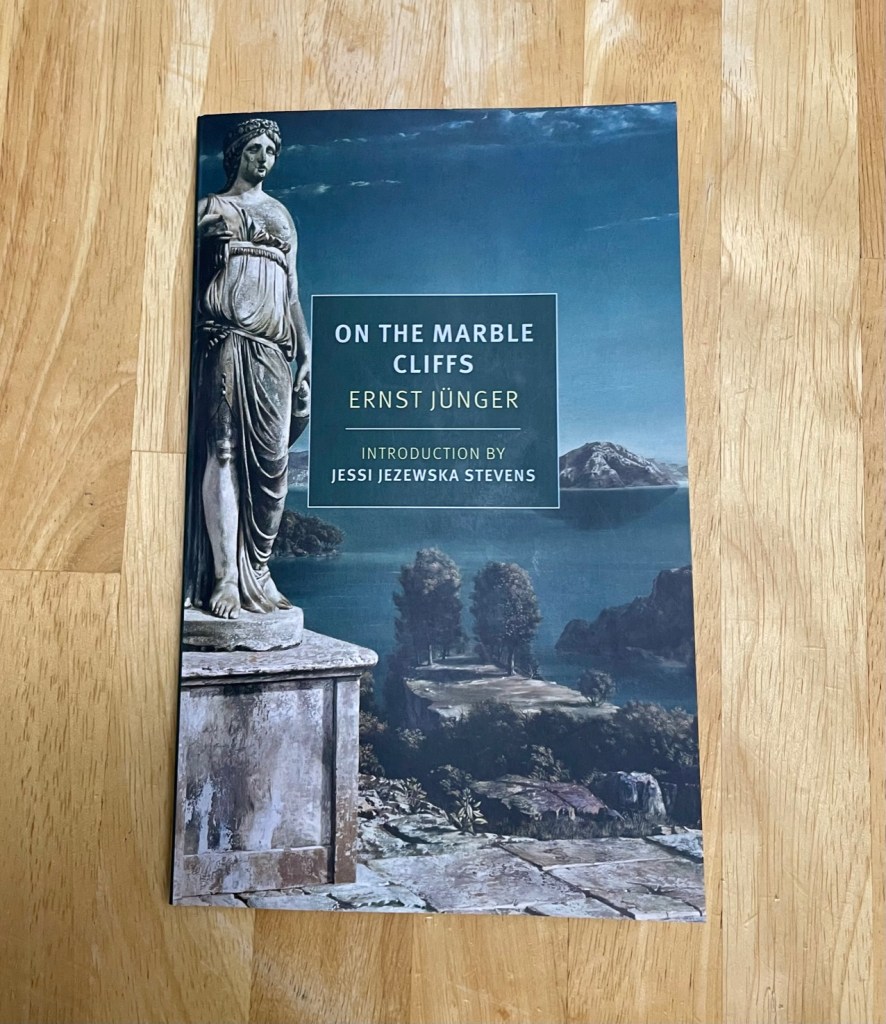
On the Marble Cliffs (1939), which appeared for the first time in Nazi Germany in 1939 (the new NYRB has just been published) offered a narrative of a thorough civilizational collapse of the West. I will side with many of the commentators that have reminded the readers that this novel doesn’t simply amount to an allegory of the rise of National Socialism or the reemergence of indirect powers of civil war in the European interwar years. By underlining “just”, I also mean to say that it is also very much about its epoch. Jünger was an insider of the German elite, and one of the most astute interpreters of his time as his theses on the dominion of the worker and the force of total mobilization were fully realized. It happens that On the Marble Cliffs introduces the civilizational collapse not through the allegorical reduction of the narrative procedure, but rather through a weaving, never truly resolved (much to Jünger’s own intentions), of temporalities that do not land in historical form. Circumventing the meanderings of a dreamlike stage and that of a thick and sensorial description, the novel diachronous movement resembles the stage of a vigil that retrospectively looks from page one at the advent of the disaster: “Only then do we recognize how fortunate we humans are to live from day to day in our small communities, under peaceful roofs, engaged in please conversation, and with the effective greetings morning and night. Alas, we always recognize too late that these simple things offered us a cornucopia of riches” (Jünger, 3). Granted, the vigil is an incomplete assessment of how (not so much as to why, which speaks to Jünger’s separation between his critico-politico essays and his narrative universe) the luminous community of brothers at Grand Marina entered the stage of destruction. During their peaceful time at Grand Marina, the brothers dedicate themselves to studying plants: a contemplative activity through an herbarium that becomes an exercise in clearing the mind and “draining time”. Botany has always stood as a minor activity to escape the realization of death, even if inevitable the cycle of temporal caducity.
But the ruinous time begins with the dominion of the Head Forester, an old governor of Mauretania region whose territorial ambitions are rooted in the domination of world affairs, and the willful defense of its doctrine Semper Vitrix (Jünger, 23). For those familiar with the worldview of Jünger, it is not surprising to find that domination does not begging at the original act of taking, but rather in the scheme of disposition that prepares the liquidation of the originary depth of the world’s opacity. Hence, imperii vitrix is always cartographical, and thus concerned with the the procedure of legible reduction: “For them [Mauretaninas] the world was reduced to a map like those thare engraved for amateour using little compasses and polished insutrmentions that are pleasing to hold. And so it seemed odd to come upon figures like the Head Forester in these clear, perfectly abstract realms freed of any shadows” (Jünger, 23). To dominate the world, one must first dominate over the ideals and images that unify a world. This is why Jünger, just a few years earlier in The Worker, had ended his treatise pointing at the passage from the classical social contract theories of social cohesion to the efficiency of planning of production in order to weaken any possible resistance [1]. This is another reason why On the Marble Cliffs fails at any allegorical instantiation, since allegory hinges upon the unfulfilled stage of historical consciousness, whereas Jünger levels his narrative with the metaphysical disposition that is accomplished in modernity. One could call this the triumph of nihilism and anarchy; the never-ending triumph of ‘barbarism and religion’ of the West since at least the Roman Empire to put in the terms of historian J.G.A. Pocock. This is the “line” of modernity, but it is also the line that is breached at the collapse of modernity staged Onthe Marble Cliffs.
Anarchy and nihilism – for Jünger these are for two routes for prompting a relation with the epochal collapse. More than clearcut positions to endorse, these are unbreachable counters of the limitless epoch. Jünger distinguishes them well through the character of Braquemart: “Suffice it to say that there is a profound difference between fully formed nihilism and unchecked anarchy. The outcome of the struggle will determine whether human settlements will become wasteland or virgin forest. With regards to Braquemart, he was marked by all the traits of full-fledged nihilism. His was a cold, rootless intelligence with a penchant for utopias…On seeing him, one inevitably thought of his master’s profound saying: “The desert grows – woe to him who carries the deserts within!” (Jünger, 76-77). The nihilist suffers from a rather coldness of intelligence, and what Jünger qualifies as the ill-fated adventure of the theorist, always unmatched with that of the pragmatist (Jünger, 78). Granted, everything depends on the internal capacities to react against the growing systematic devastation. On the other side, the anarchist cloaks his accomplice condition within the corruption of the law, where nothing is sacred. This is why the anarchist transforms the forest into an enclosed land for hunting and predatory practice where “cadavers left to rot in the fields spread pestilence, wiping out the herds. The downfall of order brings good to none” (Jünger, 62). On the Marble Cliffs is at times too emphatic with the reiteration of the order in opposition to terror: ‘Terror establishes its reign behind a mask of order” (Jünger, 38). And this speaks to National Socialism antipositivist attitudes to the rule of law, which Jünger seemed to have perceived clearly.
However, it is also true that Jünger’s insistence on order is not just about conservation in the abyss, but rather about how the civilizational collapse is expressed in the puncturing of indirect powers that will ultimately unify the anarchy of domination. To insist on nihilism means to de-hegemonize the indirect powers and factional domination against the visceral hatred of the gratitude of language and the mystery of beauty that burns the inside of demonic spirits (Jünger 39). The luminosity of Jünger’s style and symbolic nakedness speaks, in turn, to an attempt at a mythologization of beauty that emerges in a language devoid of parody. In this sense, Jünger displaces Gianni Carchia’s important thesis about the narrativization of the parody of mystery into the form in the bourgeois novel. Jünger’s beauty is mysterious because it exceeds signification and conceptual closure of the novel conflict, as what language does (or seems to do) on the line of nihilism. For Jünger the revocation of anarchy implies taking a distance from the subsumption of prose into narrative order. Thus, Jünger’s order is a primary order, one of retaining the reserves of sacred and the unfathomable character in the face of barbarism and the destruction of the world.
“We take leave more easily when things are in order” (Jünger, 59). This is the primary order of a plain state of the world, which does not presuppose the obsession with organization and management; it is what allows for the flourishing of contemplative life and the possibility of retreating to the density of the forest. But we know that this is, precisely, what comes crashing down in the rise of anarchy and nihilism, both working in tandem in modernity. Attaching oneself to primary order amounts to “concrete dreaming” at best, as the narrator says early in the book. And it is at this point that On the Marble Cliffs solves this conundrum: the idea of order must not be reduced to a nomos of the world, but rather the possibility of an outside from thinking that there is a finite and finished work of the world. This is where Jünger’s genius shines with usual intensity. It is the moment, towards the end, when the narrator admits: “the beauty of this world now enveloped, I saw, in the purple mantle of destruction” (Jünger, 102). The conflagration of the world, however, only undoes a new capacity for seeing thatwhich had remained in the dense fog of consciousness and aesthetics. In other words, the total collapse brings forth the unperishable element between existence and the world. Jünger achieves the highest point of condensation in this elaboration:
“The harvest of many years of labor fell prey to the element and with the house, our work returned to dust. We cannot count on seeing our work completed here below, and happy is the man whose will is not too painfully invested in his efforts. No house is built, no plan created, in which ruin is not the cornerstone, and what lives imperishably in us does not reside in our works. We perceived this truth in the flame, and its glow was not devoid of joy” (Jünger, 108).
This is not joy or appetite for destruction, but more a joy about what remains unperishable in every destructive act that realizes itself just so that everything could be renewed more or less the same. At the narrative level the unperishable of every work is the mystery that cannot be fully captured either by the deployment of historical allegory or by the mimetic translation of the work of narrative. On the Marble Cliffs remains stubbornly an open novel, but in a very precise sense: it gestures to the divergence between life and the world is barely touched parabolically at a distance. This is why the character of On the Marble Cliffs reaches the end by stressing “the sight of it [an old oak grove] made us feel at home…”(Jünger, 113). Whereas sight is an index of landscape, of seeing beyond the abyss. This is a condition for living among the dead once again. Perhaps this is why Jünger felt the need to record in his French war diaries that Pablo Picasso had asked him if the novel was based on a real landscape [2].
Only a painter that had witness the crisis of modern space (beginning with the “Blue Room” of 1900) could directly engage with the trope of the ‘marble cliff’: it is here that the altar of a sacrificial history and political domination turns into the site of theoria. Now the faculty of seeing grows outside of itself, “to manifest freedom in the face of danger” (Jünger, 117). On the Marble Cliffs is an invitation to this interior unperishable landscape that removes us from idle fictions in the face of anguish if only we do not turn our back to it (in the name of science or technology or new idols). Given that the desert of nihilism can only grow, I wonder how many today could even stand on the cliff. I fear that the effort of raising the head and looking beyond is already too much to ask.
.
.
Notes
1. Ernst Jünger. The Worker: Dominion and Form (Northwestern University Press, 2017), 173-178.
2. Ernst Jünger. A German Office in Occupied Paris: The War Journal 1941-1945 (Columbia University Press, 2019), 78.
The conservative journalist David French has recently reported an interesting empirical fact about the social reality in the United States: according to a recent Gallup survey that measures public confidence in American public institutions, there are two institutions defended and discredited by both left and right: those on the conservative right expressed confidence in the police (about 70% or so), and those on the progressive left expressed confidence in schools and higher education (about the same percentage). This is an interesting fact only for the reason that it reveals with immense clarity – very much against French’s political idealism of overcoming the caesura – the two effective vectors of American civil society: police and schooling. In fact, aside from their divergent emphasis, progressives and conservatives agree fundamentally that policing and schooling are the indispensable elements in this moment of civil society. Let’s call it the “high modernist moment of the metropolis”.
This is why to any attentive observer of American reality, police and schooling are so intertwined and mingled with each other that it becomes impossible to separate them, and not just because there is police presence on university campuses or because the police articulates a discourse of “community” and educational instruction in their daily practice. Police and Schools are two vectors in the structure of civil society in the wake of the collapse of modern politics. In other words, what emerges after the end of politics in America is the intersection between police and school as two intersecting poles that sustain, nurture, and reproduce the axiomatic organization of civil society.
The zone of convergence of police and school is culture. Now culture should not be understood as symbolic distribution of mass consumption and public goods, but more specifically as a flexible regime of adaptation whose proper end is the optimization of the civil order. Hence, the fascination and continuous arousal of “cultural battles” in the public spheres is nothing but empty chatter of the same end: the acceleration of techniques and symbolic amalgamations in a social roundup of self-governance. When Sir Ernest Barker defined the necessity of civility as the precondition of the commonwealth, he took for granted that culture was meant to maximize singular character and conduct [1]. On the contrary, today the maximization of culture presupposes a paideia that revokes every character in the name of a flattening conduct that must be adaptive to the ends of abstract civil organization of values. If civility for Barker was condensed in the figure of the “gentleman”, in contemporary America, the figure is the nowhereman: an all-capable human-species that must adapt to the latest marching order and its temporal justifications. In this context, the police and school are elevated from social institutions to productive vectors of civil cohabitation.
It is still striking today to read what theologian Karl Barth wrote in 1928: “In paradise there were no schools and no police. Similarly, and in view of its intensity we must say specifically there was no gentleman unseen, and all the more penetrating “they” of costumes” [2]. And for Barth, it is only in the wake of Romanticism – in this way confirming Gianni Carchia’s important thesis about the consolidation of a subjective romantic modernity – that the police and the school was unleashed against every costume and against everything that stood in its way. Social abstraction is incapable of grasping this stealth transformation. And it cannot see it due to the fact that romantic civility offers, in return, a fundamental oblivion: eternal security within a hellish reality. All things considered, this is also why the United States remains the beacon of endless optimism – while being a deadly playground. The vectors of policing and schooling grammar of force expulses any possible ethical notion of paradisal life.
.
.
Notes.
1. Ernest Barker. Traditions of Civility (Cambridge University Press, 1948), 137.
2. Karl Barth. Ethics (Wipf and Stock, 2013), 390.
Erich Unger’s Politics and Metaphysics (1921), published just a year before Political Theology (1922), fully captures the spirit of the epoch: it is the moment when politics becomes catastrophic; a vehicle for war conflagration, an instrument for the acceleration of technology, and the spatial fragmentation of civil society and state. The overcoming of man through technology meant a new ‘reality principle’ in which the species were forced to adapt to an abstract process of catastrophic metabolic regulation. Unger’s essay, thoroughly ignored at the time of its publication, was a product of what in Political Theology (1922) was labeled as the force of indirect immanent powers. And from his side, Walter Benjamin, in his preparatory notes for his essay on violence, made the obscure remark that Unger’s Politics and Metaphysics (1921) ultimately favored the ‘overcoming of capitalism’ through errancy (at times translated as “migration”, which has been recently corrected by Fenves & Ng’s critical edition of the “Critique of Violence”) [1]. Indeed, in his short tract, Unger called for a “non-catastrophic politics”, which he understood as coming to terms with the problem of metaphysical structuration and positionality, and for politics to have a chance a principle of exodus was needed. This goes to show why Schmitt reacted against this spirit of the epoch, going as far as to say that his “concept of the political ” was the unified response to a sentiment of a whole generation, as well as the detector of enemies of the political demarcation [2]. In contrast, for Unger modern political autonomy had collapsed, and catastrophe now expressed itself as a civilizational problem of living forms, and so it demanded a confrontation with the problem of unity and separation of politics and metaphysics.
Politics is not metaphysics, but it had to be confronted with it if a non-catastrophic politics is to be imagined. This meant a new conception of the problem of “life”, which in Unger’s speculative philosophy received its historicity from immanence through the temporality of the tragic. The psychic separation between metaphysics and politics (a politics of the subject and subjection) meant fundamentally a catastrophic politics, which Unger read against the backdrop of the Oskar Goldberg’s Hebrew speculative reversal as a new re-constitution of the people (Volk) outside the fixation of the state. All of this is connected to his previous work on the stateless dimension of the Hebrew people in a short tract entitled Die staatslose Bildung eines jüdischen Volkes (1922). For Unger, the Hebrew prophetic rulers were not just a form of government, but rather also of healers, practitioners of a “techné alupias” of psychic intensification in the business of instituting an autoregulation between the metaphysical and the political.
The contrast with Carl Schmitt’s position is, once again, illuminating to say the least: whereas the figure central to Schmitt’s juridical thinking is that of the Pauline Katechon, the restrainer against the apocalyptic catastrophe; for Unger, no stranger to theological myth, appealed to a Parakletos of a universal People (Volk), coming to one as a single consciousness against unreality. The theological drama that informed the positions of both Schmitt and Unger, recasted the problem of separation the central concern of a particular thinking in a time of constituent power (and its infrastructure in the principle of civil society). But whereas Schmitt’s Katechon depends on an institutional mediation conditioned by revelation and authority; Unger’s non-catastrophic politics evokes a ‘people’ emptied of patrimony as reservoir of new energies for the unification of reality against psychic imbalance. Against the “relentless forms of domination”, Unger did not appeal to institutional mediation of the moderns, but instead to the interiority of the species that, in turn, required a “political principle of exodus”:
“The principle of the exodus can end the civil war and represent the presupposition for the emergence of real political units, thus putting an end to those centrifugal tendencies which are lethal for any real synthesis. This principle of separation of communities operates an external delimitation of the Material to give rise to a possible real unity. It now considers establishing the basic regulatory principles of its internal structure.” [3]
The principle of exodus of politics meant, all things considered, the opening the metaphysical order of the possible against what was understood as domination of the species within the paradigm of civil war. It is telling that for Unger, like for Carl Schmitt, the true force to be confronted is that of the stasiological force, or nihilism, as the condition for the catastrophic politics in the perpetuity of separation during time of finality (Endgultigkeit) in historical transformation. For Unger this was no easy task, nor fully passive and open to gnostic reversal. On the contrary, it is connected to “a kind of intellectual orientation required of anything who might wish to understand this reflection” [4]. This is ultimately tied to Unger’s most enduring idea in Politics and Metaphysics (1922) – at least for some of us that look with suspicion anything that the contemporary has to offer today, or that has ever offered – which is the metapolitical universities, not mere supplementary communities against the politics of catastrophe, but rather practical forms of encounter, languages, and exercises in thought that return the dignity to the shipwrecked fragments in the field of immanence.
Unger knew very well that there was no absolute “exteriority”, and so the defense of a metapolitical university was offered not as a “new political unit” of intellectuals leading the masses, but something quite different: the encounter of a finality that is not knowledge but “the effective treatment of the concrete” elevating itself from mundane understanding of social knowledge [5]. This is no collective practice either, since the discriminatory point assumes the internal perspective of the instance of “intensification” [6]. And intensification is not executed from the coordinates immanence of the social but rather as a ‘possibility of an elevation (Steigerbarkeit) capable of returning to reality against a non-catastrophic politics. For Unger the notion of elevation – necessarily to destroy the compulsory mimesis and automatic recursiveness of subjection – is predicated as a path of innerness, “that is, in the inclusion of originally alien psychical factors within a single consciousness” [7]. The metapolitical universities were, hypothetically, hubs for the concrete practice of elevation vacant of any universal pretensions of unreality. Here Unger, like Schmitt, does not propose an exodus from politics, but rather an elevation to a coming politics whose mediation is neither annihilation nor exchange, but rather the imagination and concrete practice of organization. The question, of course, is whether the politics of exodus today has not also collapsed to the catastrophic (no longer an exception to it but immanent to the logic of equivalence), which means implies a relocation: the practice of the metapolitical university, mutatis mutandi, now presupposes an exodus from politics.
.
.
Notes
1. Peter Fenves & Julia Ng (eds.). Walter Benjamin: Toward The Critique of Violence: A Critical Edition (Stanford University Press, 2022), 92.
2. Carl Schmitt. Glossarium: Anotaciones desde 1947 hasta 1958 (El Paseo, 2019), 240.
3. Erich Unger. Politica e metafisica (Edizioni Cronopio, 2009), 87.
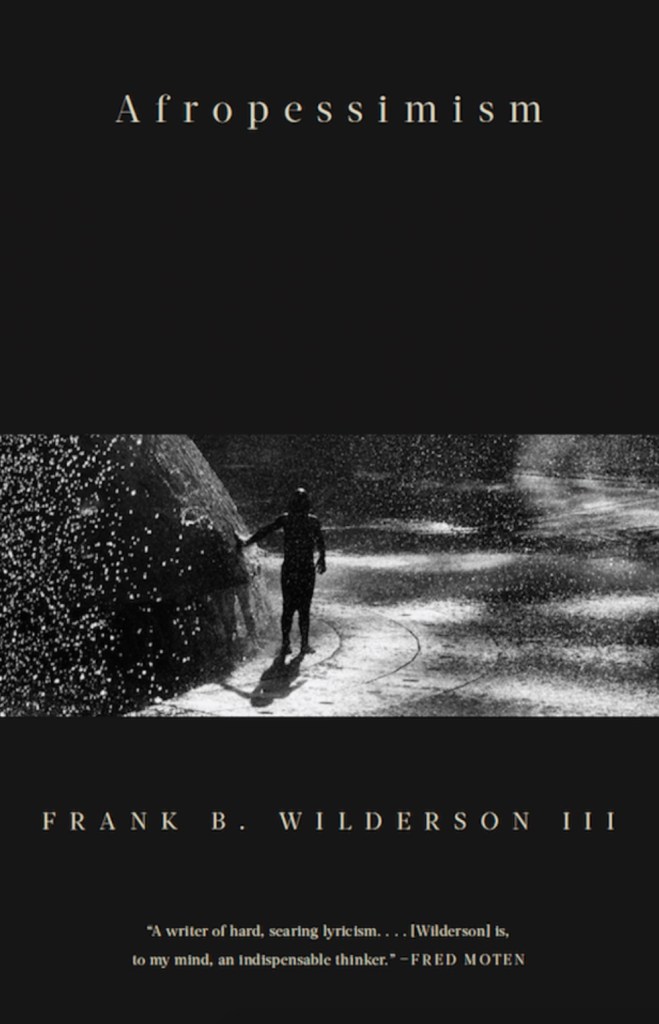
The publication of Frank Wilderson III’s Afropessimism (Liveright, 2020) marks an important break in contemporary thought, which has been seating comfortably for too long in the pieties of identity, culturalism, and politization. One of the most immediate effects of Afropessimism is how it unmasks the way in which identity and cultural hegemonic discourses, far from constituting a different horizon of the existing cliché, actually mitigate a spectacle of devices for the domestication of other possibilities of thought. Of course, some were aware of said spectacle, but now with Wilderson’s experiential writing the allure of subaltern subject position is finally destroyed from within. Wilderson’s account escapes two routes of the witness position: that of the personal memoir that contributes to a narrative of redemption; and on its reverse, that of testimonio, which in the postcolonial debates of the 1990s solicited a politics of alliance with the subaltern voice for a new politics of truth. In this sense, Wilderson’s Afropessimism is a post-hegemonic work through and through insofar as it destroys the hegemony of the citizen-subject of Liberalism, but also that of subaltern as a mere stock in the production of hegemony. As Wilderson claims early in the book “Black people embody a meta-aporia for political thought and action”, as such, Afropessimism is a radically unstable force that brings to bear the unthought of the most predomination critical paradigms of university discourse (Marxism, Postcolonial theory, feminism) as aggregation of politics of the subject (13-14).
Afropessimism is first and foremost a dislocation of the toolbox of critical of theory as always already complicit with the general movement of the imperial policing of thinking. The strategy is always the same when it comes to administrating a regime of reflexive order: posit a paradigm of a subject position and then mobilize it against other subjects. There is nothing radical about this validation; quite the contrary, it coincides with the arbitrary hierarchization of values proper to Liberalism’s current designs. Wilderson wants to destroy analogy just like he wants to be done with narrative of redemption, or ethical alliance since all of these are forms of reductions of the true experience of living at the “end of the world”. This is the apothegm from Fanon that creates the apocalyptic circuit in the book. What does it mean to live at the end of the world? This the vortex of Afropessimism, the atopic site that inscribes the existential conundrum of the Black form of life. The apocalyptic “end of the world” must be read as a concrete inhabitation of life, that is, “being at the end of the world entails Black folks at their best”, writes Wilderson (40). This entails that there is no world without Blacks, but Black experience is an incessant drift at the limit of the world as captured by the entrapment of Humanity. I take it that Wilderson means that “Afropessimism is Black folks at their best” in relation to a form of life at the level of experience that is not only constitutive of sociability, but that it also an intensity that rejects any domesticating efforts into a more “democratic” or “hegemonic” civil society. Under the rule of equivalent demands, where subjects and objects are exchanged (or camouflaged in the name of “Rights”), the Black can only constitute a “social death” that breaks any equilibrium, or that sustains the hylomorphism of its others (102). This goes to the heart of the articulation of hegemony, which for decades has been the leftist horizon of a good and democratic politics, but which for Wilderson amounts to the very logistics of the democratic plantation. In an important moment of the book, Wilderson argues against the theory of hegemony:
“In the solicitation of hegemony, so as to fortify and extend the interlocutory life of civil society, ultimately accommodate only the satiable demands and legible conflicts of civil society’s junior partners (such as immigrants, White women, the working class), but foreclose upon the insatiable demands and illegible antagonisms of Blacks. In short, whereas such coalitions and social movements cannot be called the outright handmaidens of anti- Blackness, their rhetorical structures, political desire, and their emancipatory horizon are bolstered by a life- affirming anti- Blackness; the death of Black desire.” (240)
There is no hegemony that is not conditioned by a non-subject, an abyss that marks the aggregation of their equivalent subjective demands. This is why the non-demand of the Black, who has nothing for exchange, remains at the limit of hegemony, or rather what I call a posthegemonic fissure, in which democratic desire and hegemonic articulation enter into an incommensurable zone. Given that blackness is the site of “social death…the first step toward the destruction if to assume one’s position and then burn the ship or the plantation from the inside out. However, as Black people we are often psychically unable and unwilling to assume this position. This is as understandable as it is impossible” (103). This is consistent with Wilderson’s label of Afropessimism as an aporetic meta-theoretical paradigm. The question of the possibility of an experiential exodus to an outside, and not just an internal limit to the metaphysics of Humanity is most definitely one question that one could raise about its “epistemological void” as parasitical to the infinite production of subjectivity (164). It is clear that by rejecting hegemony, Wilderson also has to give up any liberationist horizon at the service of a political project committed to Black emancipation. For Wilderson the legitimacy is somewhere else: “Afropessimism is not an ensemble of theoretical interventions that leads the struggle for Black liberation. One should think of it as a theory that is legitimate because it has secured a mandate from Black people at their best; which is to say, a mandate to speak the analysis and rage that most Black people are free only to whisper” (173). It is a rage that one could counterpose as the opposite of the subaltern politics of truth; in order words, it is a rage experienced against the “gratuitous violence” that divides the antagonism between a singular life and the world of the state of things and its people.
The vortex of Wilderson’s Afropessisism, however, is not just the rejection of hegemonic articulation or the benevolent solidarity as administrated domination, it is rather the emphasis of a new world caesura that he frames in this way: “…the essential antagonism is the antagonism between Blacks and the world: the centrality of Black people’s social death, the grammar of suffering of the slave…” (174). This essential conflict stages the antagonism at the level of the debates about the frontier of Humanism, for which the Black, insofar as it is a figure of the non-subject, already acts an archipolitics that frees the intensification of any politics of liberation now transfigured as a liberation from politics [1]. This archipolitics dwells in the intensification of a non-identity that is irreducible to any hegemonic fantasy that labors on solidarity, equivalency, unity, program, demand, projection. And why not, also against the democratic polity (insofar as democracy cannot be thought outside the jointing of two apparatuses of civil society renewal: citizenship and mobilization). This archipolitics of Afropessimism puts into crisis the general categories of modern political thought, I am also tempting to limit this claim to the very notion of democratic practice as previously defined. Here the “legitimacy” that Wilderson evokes is no longer at the level of a new democratic renewal – which is always within the spirit of the modern liberal design; indeed, recently some have made legitimacy and hegemony conceptual couples – but rather as a poking outside the democratic imagination, which ultimately feeds Black social death, even when sustained by the social contract of hegemonic alliances.
Is there something beyond the subjection to alliance? In other words, what if being at the “end of the world” is also the time to undue the mystification of solidarity in the name of friendship? I agree with Jon Beasley-Murray, also writing about Frank Wilderson III, that the idea should not be to win over friends, but rather to suggest that friendship is still possible flight [2]. I would go as far as to call friendship an event of thought. Indeed, friendship has no stories to tell and does not seek redemption; it also betrays normative ethics each and every time. This is not to say that there such a thing as an archipolitics of friendship, nor a political program for a friendship of community. We have enough of that in every community form. Perhaps if we accept the event of singular friendship, we can move beyond the logistics of antagonism and hostility that are constitutive of Humanity, but irreducible to the specie that confronts the destiny of the inhuman. As a great thinker of the twentieth century wrote: “there are infinite possibilities of inhumanity in each man. There is no external enemy; this is why the tragic exists. This simple maxim confirms the fundamental thought of Robert Antelme. The “no-man” in man, attentive to perfection is what allows the sedimentation of the concentration camps. […] Friendship for me is not a positive thing nor a value, but rather a state, a multiplication of death, of interrogation, a neutral site where I can sense the unknown, the site where difference only expands in the place of its contrary – in proximity to death” [3]. One question that must accompany Wilderson’s formative book is whether the “spirit of friendship” with inhuman can be something like solace without redemption at the end of the world. Friendship could be understood here as the marker for the disunification of forms of life outside the condition of hostility without falling into nihilism. At the point, perhaps psychological categories such as optimism or pessimism now lose their relevancy as forms of life realize that they are already dwelling at the of the end of the world.
Dionys Mascolo. En torno a un esfuerzo de memoria: sobre una carta de Robert Antelme. Madrid: Arena Libros, 2005. 57. The translation to English is mine.