The irreducible in language: a note on Robert Antelme’s L’espèce humaine (1947). by Gerardo Muñoz

At the outset of L’espéce humaine (1947), Robert Antelme discloses the difficulty between language and experience that lays at the heart of the book, and which is never thoroughly assumed at the level of form in the novel. L’espèce humaine (1947) is ultimately not an account about the impossibility of describing what took place in the camps; from the banal physical violence to the desperate hunger, from the microaggressions to the slightest movements and carnage of bodies in space; from the joyful smiles in the most miserable of scenario where the ultimate goal was for the human life to slowly rot; the sequence of actions engage in no struggle to bring to a crisis the level of representation. And Antelme goes into painstaking efforts to give us a full picture of what took place, only to never talk about it again in writing or in personal conversations as Marguerite Duras tells us [1]. So, what to make of Antelme’s initial affirmation in the “Forword” where he states that: “…during the first days after our return, I think we were all prey to a genuine delirium. We wanted at last to speak, to be heard. We were told that by itself our physical appearance was eloquent enough; but we had only just returned, with us brought back our memory of our experience, an experience that was still very much alive and we felt a frantic desire to describe it as such as it had been…[..]. No sooner would we begin to tell our story than we would be checking over it. And then, even to us, what we had to tell would start to seem unimaginable” [2]. The unimaginable for Antelme is a sort of threshold of language; a limit for the unrestricted, that is, for what could allow for an experiment of language after the catastrophe, or in the wake of the civilizational catastrophe that is consummated in the camp. 

This delirium and anxiety over language – to tell it now and how it happened and to tell “the world”, only to immediately acknowledge the impossible task of doing so – does not take place at the order of the narrative; it is first and foremost something that we get a glimpse of at the end of the book as the liberating soldiers enter the rubbled towns only to encounter the incontinence of the survivors “talk and talk, and pretty soon he isn’t listening anymore” [3]. At that moment, the face to face between human beings will follow “to a kind of infinite, untransmittable knowledge”, Antelme tells us [4]. But what type of untransmittable and nocturnal knowledge is Antelme referring to here? It is not about some ethical exigency of the defacement of experience through linguistic construction; it is rather the torrential and densely weight of description and events, that numbs and deposes language in the very mediation of its effective sayability. The experience of human suffering and domination is untransmittable not because there is a deficit in language or the effacement of representation; but, on the contrary, precisely because there an excess of language that flattens irreducible suffering to an anaphoric socialization of speech that tacitly accepts inhumanity at face value. And that socialized distribution of speech underserves suffering, in virtue of equalizing an expansive chatter that neutralizes in survival the inherent pain of the irreducible human species within the imposible ordeal of total annihilation. 

Antelme’s L’espéce humaine  is stubbornly nominalistic in its thick descriptions of things and events, and it wants to avoid metaphoric transports. He prefers to call things as he sees it and get to the thicket of things in the most nauseating of repetitions. In a way, the hellish atmosphere of the concentration camp resides in the slow moving degradation of human life deprived of the world. However, there is one moment where Antelme resorts to calling a situation ‘hell’; that is, precisely, to an account of the transparent use of language, the raw incontinence and commanding force towards exteriority, as if there is no longer a caesura or separation between being and language once enunciation has been homogenized as commanding force. This is a language without a secret or unsaid, moving against the outside of consciousness in the same depretatory form as the same administrative machinery that has lifeless bodies as its target. In this way, language being turned into the force of speech will not only foreclose itself to the world, but it will signal the very intangibility by virtue of the flattening of verbal communication as an immediate and furious call to an annihilation of appearance. Antelme writes in this admirable moment – one of those instances where description of the state of things is incepted by the negation of the very conditions that allow for the narrative order: 

“Degradation, and flabbiness of language. Mouths whence nothing any longer ever came that was ordered, or strong enough to last. A weakly woven cloth fraying to bits. Stencens succeeded one another, contradicted one another, expressed a kind of belched up wrtnessness; a bile of words. They were all jumbled together: the son of a bitch who’d done it, the wife left on her own, food, drink, the old lady’s tear, the fuck in the ass, and so on; the same mouth could say it all, one thing after the other. It came forth all by itself; it would be empty. It only stopped at night. Hell must be like that, a place where everything that’s said, everythat’s expressed, comes forth equalized with everything else, homogenized, like a drunkard’s puke” [5]. 

The incontinence of language at the limit of what can be said is a secondary hell; that is, the last contortion that the inhumanity of the human can offer outwards in order to outlive in a moment of minimal pleasure, since the absolute pain of a glacial existence has been deprived of any real contact with the world and things. It is a linguistic hell – the looping language of the camp, will only mirror also the linguistic codification that around the same years will be elevated to the paradigm of cybernetics and the regime of information theory – will now appear as a unified block of application, enforcement and extraction. Hence, we should take Antelme at his word: language has become “flabby”, and it is a “puke”. It is circulation without sense, as in the looping mechanics of the furnaces charted by the Nazi engineers that appears in the recent sequence of the film Zone of interest (2023). It is not that sayability loses it claim to the autonomy of its form before an event; it is also that by virtue of its own degradation against the erasure of events, it can only be unified, packed, homogenized and rendered into equivalence in the wake of the absolute triumph of the historical project of alienation and external objectivity.  

The passage of the old hymnal texture of language as solace and lamentation could only entail the conservation of communication, which for Theodor Adorno writing during the same years as Antelme (1946-1947) will deduce as the “techniques of insolence enabling each individual to spread around him the glacial atmosphere whose shelter he can thrive” [6]. That the experience of the camp for Antelme ultimately meant that the “executioner can kill a man but cannot change him into something else”, must be placed in tension with the epochal transformation of a hellish experience of language at the service of the nihilistic service of equivalence that unveils its purest semblance at the camp [7]. The unitary reduction between the “socialized Man” and the “deportee” enters into a proper focus that Antelme was able to grasp with uttermost honesty: “…that there is no inherent difference between the “normal” system of man’s exploitation and that of the camps. That the camps are simply a shepherd image of the more or less hidden hell in which most people still live” [8]. At the risk of an overtly mannerist claim, it seems to me that the kernel of Antelme’s intellectual effort is to withdraw from the condition of hell that is condensed in the block of ice fixated in the ruinous material of language [9]. Memory, experience, friendship, truth, writing, the soul – these are all tools to chip against the brute reification of the glacial subjection at the price of ultimate solitude. Is there anything else worth a shot? In the last pages of L’espéce humaine, Antelme returns to the question of “freedom”, only to claim that “to be free” implies to “say no to everything” – and could we also refuse the language as it declines into flabbiness, equivalence, and its putrid decline, as overflowing mountain of trash that covers up the ongoing pain of the human species? [10].  

Sure thing, the hölderlinean enduring and difficult task of the “free use of one’s own” appears here with some urgency as the requirement of traversing the attunement to pain. Antelme seems to have wanted to offer a negative theology to “forever starting anew”, in which the irreducible of human sayability is posited as the condition of the “only transcendence between beings” [11]. “To speak, in a word, is to seek the source of meaning in the prefix that the words exile, exodus, existence, exteriority, and estrangement are committed to unfolding in various modes of experience;  a prefix that for us designates distance and separation” [12]. Aren’t distance and separation two conditional criteria for grounding the irreducible? The habitation of the speaking being can harbor the contours of the unfathomable expression on the reverse of social tribulations, which is always the primal nomos of equivalence. Allowing the expansion of the irreducible as a the site of an ordinary accumulation of freedom preserves a sensible region for what takes place (“whatever happens”and is not this taking place the opening of the non-site of the chorá?) in a language attuned to the relentless event that has forever touched us. This is already the site of the unimaginable beyond and away from the language of survival that permeates everything in both times of peace and of war. 

Notes 

1. Marguerite Duras. El dolor (Alianza editorial, 2019 ), 71.

2. Robert Antelme. The Human Race (The Malboro Press, 1998), 3.

3. Ibid., 289.

4.Ibid., 290.

5.  Ibid., 135. 

6.  Theodor Adorno. Minima Moralia: Reflections from the damaged life (Verso, 2020), 33

7. Robert Antelme. The Human Race (The Malboro Press, 1998), 220.

8. Robert Antelme. “Poor Man – Proletarian – Deportee”, in On Robert Antelme’s The Human Race Essays and Commentary (The Marlboro Press, 2003), 22. Dionys Mascolo makes more or less the same claim in Autour d’un effort de mémoire: sur une lettre de Robert Antelme (1987) when speaking about the stratification of species in the camps and the division of classes in society: “l’intuition aveuglante de tous les survivants est celle d’avoir fait quant à eux, sous une forme extrême, cette expérience: que l’organisation de la société en classes telle que nous la vivons est déjà une image de la division de cette société en espèces, comme dans les camps”, 87.

9. Robert Antelme. “Revenge?”, in On Robert Antelme’s The Human Race Essays and Commentary (The Marlboro Press, 2003), 15.

10.  Robert Antelme. The Human Race (The Malboro Press, 1998), 291..

11. Robert Antelme. “The Smiling Angel: Rheims Cathedral”, in On Robert Antelme’s The Human Race Essays and Commentary (The Marlboro Press, 2003), 10. 

12. Maurice Blanchot. “The Indestructible”, in The Infinite Conversation (University of Minnesota Press, 1992). 

Cowper Powys on catastrophic world-events. by Gerardo Muñoz

In the short epilogue “Historical Background to the year of grace A.D. 499” to his novel Porius (1951), John Cowper Powys lays out a remarkable prophetic evaluation of a world fallen into a permanent catastrophic condition. Powys’ return to the sixth century in his novel departed from the fascinating fact that during the mid-fifth century there appears to be “an absolute blank” page about the history and culture of its people. And the only historical record proves that the central element was the Arthur’s commanding political dominion over the English territories. In these blank pages of history there are no tormented voices or traces of everyday existence, but the most absolute compacted pressure of barbarism and grandiose “crafty personal diplomacy” oriented by political rule. For Powys, this is the movement of abstract historical force that raises up the mirror of civilization and barbarism in the West.

However , this mirror is completely alien to any notion of happiness, imagination, and sensibility between the surviving human species. A world war had just concluded and atomic menace was the strange tune of daily life. But, in contrast to the triumphalist and historical narrative of postwar diplomatic theaters, Cowper Powys directs his vision (like Hölderlin and Pound before him with Greece and the Latin Mediterranean poets) to a prehistoric strata where language and sensation still had a chance against the civilizational collapse of the West. Against both civilization and barbarism, Powys prepares himself to drift away from something major, perhaps more even more catastrophic, which he never names directly in the Porious prologue, although he can unravel its essence in the last paragraph:

“As we contemplate the historic background to the autumn of the last year of the fifth century, it is impossible not to think of the background of human life from which we watch the first half of the twentieth century dissolve into the second half. As the old gods were departing then, so the old gods are departing now. And as the future was dark with the terrifying possibilities of human disaster then, so, today, are we confronted by the possibility of catastrophic world events compared with which those that Arthur and his Counsellor and his Horsemen contented against seem, as the Hebrew poet said, a “very little thing” [1]”.

It is thanks to the genius of Cowper Powys that the coming of catastrophe is understood not as another phase in world-history, but rather, as the opening of endless catastrophic world-events. Even before Martin Heidegger would define the essence of cybernetics as the consummation of the calculation of world events, Powys had already suspected that a stealth rationality towards calculation of events was the catastrophe that crossed the very line of the polarity of barbarism and civilization. The catastrophe of world-event consummation was hinged upon the total convergence of machine and humanity that would liquidate the free relation of the living in the world. As Powys had written in The Meaning of Culture (1930) decades prior: “Money and machines between them dominate the civilized world. Between them, the power of money and the power of the machine have distracted the minds of our western nations from those eternal aspects of life and nature, the contemplation of which engenders all noble and subtle thoughts” [2].

The ascent of atomic existence and the absolute dependency on administrative infrastructure to contain the world, will validate Powys’ astute observation about the ongoing catastrophe at a moment when its development was barely beginning to gain traction. And against futile political fictions, Powys was aware that in a civilization of collapse, political chatter becomes the only legible foul discourse: “Among other aspects of our destiny in this modern regime, the rumor of politics makes itself only too audible” [3]. The seriousness of this rumor has only deepened almost a century after.

.

.

Notes 

1. John Cowper Powys. “Historical Background to the year of grace A.D. 499”, Porius (1952), xi.

2. John Cowper Powys. The Meaning of Culture (Jonathan Cape, 1932), 150. 

3. Ibid., 302-303.

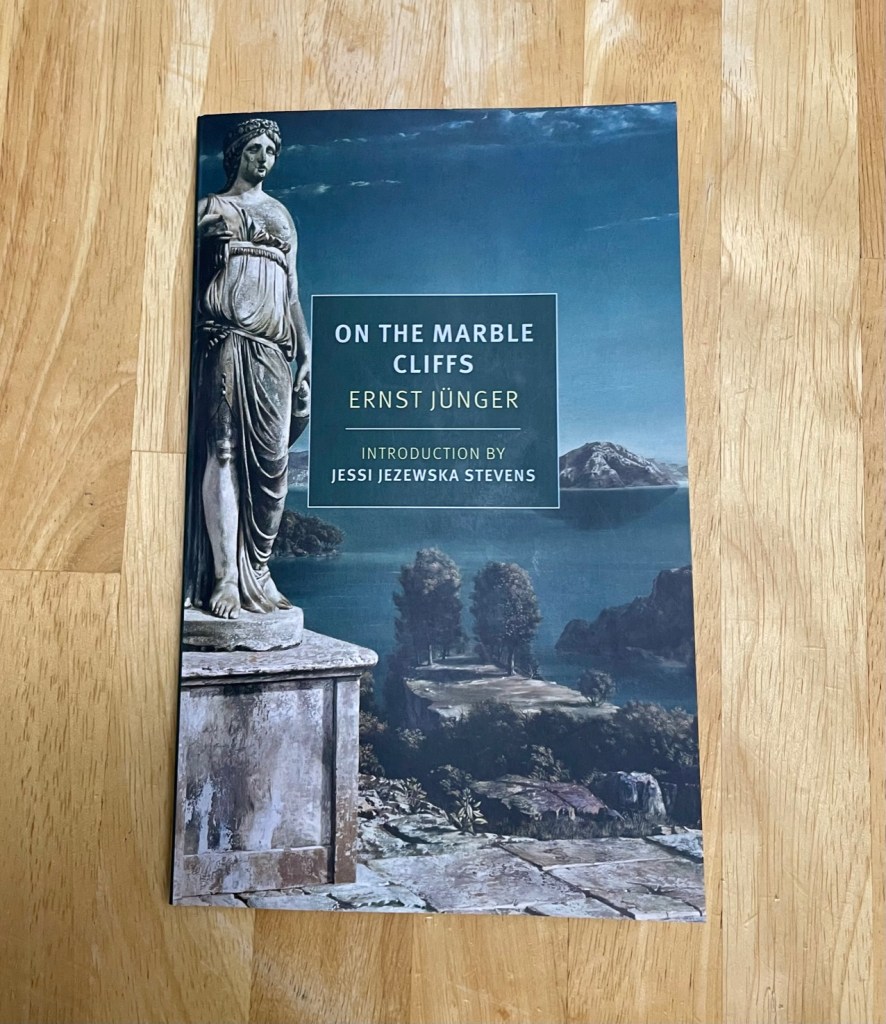
The unperishable. On Ernst Jünger’s On the Marble Cliffs (NYRB, 2023). by Gerardo Muñoz

On the Marble Cliffs (1939), which appeared for the first time in Nazi Germany in 1939 (the new NYRB has just been published) offered a narrative of a thorough civilizational collapse of the West. I will side with many of the commentators that have reminded the readers that this novel doesn’t simply amount to an allegory of the rise of National Socialism or the reemergence of indirect powers of civil war in the European interwar years. By underlining “just”, I also mean to say that it is also very much about its epoch. Jünger was an insider of the German elite, and one of the most astute interpreters of his time as his theses on the dominion of the worker and the force of total mobilization were fully realized. It happens that On the Marble Cliffs introduces the civilizational collapse not through the allegorical reduction of the narrative procedure, but rather through a weaving, never truly resolved (much to Jünger’s own intentions), of temporalities that do not land in historical form. Circumventing the meanderings of a dreamlike stage and that of a thick and sensorial description, the novel diachronous movement resembles the stage of a vigil that retrospectively looks from page one at the advent of the disaster: “Only then do we recognize how fortunate we humans are to live from day to day in our small communities, under peaceful roofs, engaged in please conversation, and with the effective greetings morning and night. Alas, we always recognize too late that these simple things offered us a cornucopia of riches” (Jünger, 3). Granted, the vigil is an incomplete assessment of how (not so much as to why, which speaks to Jünger’s separation between his critico-politico essays and his narrative universe) the luminous community of brothers at Grand Marina entered the stage of destruction. During their peaceful time at Grand Marina, the brothers dedicate themselves to studying plants: a contemplative activity through an herbarium that becomes an exercise in clearing the mind and “draining time”. Botany has always stood as a minor activity to escape the realization of death, even if inevitable the cycle of temporal caducity.

But the ruinous time begins with the dominion of the Head Forester, an old governor of Mauretania region whose territorial ambitions are rooted in the domination of world affairs, and the willful defense of its doctrine Semper Vitrix (Jünger, 23). For those familiar with the worldview of Jünger, it is not surprising to find that domination does not begging at the original act of taking, but rather in the scheme of disposition that prepares the liquidation of the originary depth of the world’s opacity. Hence, imperii vitrix is always cartographical, and thus concerned with the the procedure of legible reduction: “For them [Mauretaninas] the world was reduced to a map like those thare engraved for amateour using little compasses and polished insutrmentions that are pleasing to hold. And so it seemed odd to come upon figures like the Head Forester in these clear, perfectly abstract realms freed of any shadows” (Jünger, 23). To dominate the world, one must first dominate over the ideals and images that unify a world. This is why Jünger, just a few years earlier in The Worker, had ended his treatise pointing at the passage from the classical social contract theories of social cohesion to the efficiency of planning of production in order to weaken any possible resistance [1]. This is another reason why On the Marble Cliffs fails at any allegorical instantiation, since allegory hinges upon the unfulfilled stage of historical consciousness, whereas Jünger levels his narrative with the metaphysical disposition that is accomplished in modernity. One could call this the triumph of nihilism and anarchy; the never-ending triumph of ‘barbarism and religion’ of the West since at least the Roman Empire to put in the terms of historian J.G.A. Pocock. This is the “line” of modernity, but it is also the line that is breached at the collapse of modernity staged On the Marble Cliffs.

Anarchy and nihilism – for Jünger these are for two routes for prompting a relation with the epochal collapse. More than clearcut positions to endorse, these are unbreachable counters of the limitless epoch. Jünger distinguishes them well through the character of Braquemart: “Suffice it to say that there is a profound difference between fully formed nihilism and unchecked anarchy. The outcome of the struggle will determine whether human settlements will become wasteland or virgin forest. With regards to Braquemart, he was marked by all the traits of full-fledged nihilism. His was a cold, rootless intelligence with a penchant for utopias…On seeing him, one inevitably thought of his master’s profound saying: “The desert grows – woe to him who carries the deserts within!” (Jünger, 76-77). The nihilist suffers from a rather coldness of intelligence, and what Jünger qualifies as the ill-fated adventure of the theorist, always unmatched with that of the pragmatist (Jünger, 78). Granted, everything depends on the internal capacities to react against the growing systematic devastation. On the other side, the anarchist cloaks his accomplice condition within the corruption of the law, where nothing is sacred. This is why the anarchist transforms the forest into an enclosed land for hunting and predatory practice where “cadavers left to rot in the fields spread pestilence, wiping out the herds. The downfall of order brings good to none” (Jünger, 62). On the Marble Cliffs is at times too emphatic with the reiteration of the order in opposition to terror: ‘Terror establishes its reign behind a mask of order” (Jünger, 38). And this speaks to National Socialism antipositivist attitudes to the rule of law, which Jünger seemed to have perceived clearly.

However, it is also true that Jünger’s insistence on order is not just about conservation in the abyss, but rather about how the civilizational collapse is expressed in the puncturing of indirect powers that will ultimately unify the anarchy of domination. To insist on nihilism means to de-hegemonize the indirect powers and factional domination against the visceral hatred of the gratitude of language and the mystery of beauty that burns the inside of demonic spirits (Jünger 39). The luminosity of Jünger’s style and symbolic nakedness speaks, in turn, to an attempt at a mythologization of beauty that emerges in a language devoid of parody. In this sense, Jünger displaces Gianni Carchia’s important thesis about the narrativization of the parody of mystery into the form in the bourgeois novel. Jünger’s beauty is mysterious because it exceeds signification and conceptual closure of the novel conflict, as what language does (or seems to do) on the line of nihilism. For Jünger the revocation of anarchy implies taking a distance from the subsumption of prose into narrative order. Thus, Jünger’s order is a primary order, one of retaining the reserves of sacred and the unfathomable character in the face of barbarism and the destruction of the world.

“We take leave more easily when things are in order” (Jünger, 59). This is the primary order of a plain state of the world, which does not presuppose the obsession with organization and management; it is what allows for the flourishing of contemplative life and the possibility of retreating to the density of the forest. But we know that this is, precisely, what comes crashing down in the rise of anarchy and nihilism, both working in tandem in modernity. Attaching oneself to primary order amounts to “concrete dreaming” at best, as the narrator says early in the book. And it is at this point that On the Marble Cliffs solves this conundrum: the idea of order must not be reduced to a nomos of the world, but rather the possibility of an outside from thinking that there is a finite and finished work of the world. This is where Jünger’s genius shines with usual intensity. It is the moment, towards the end, when the narrator admits: “the beauty of this world now enveloped, I saw, in the purple mantle of destruction” (Jünger, 102). The conflagration of the world, however, only undoes a new capacity for seeing that which had remained in the dense fog of consciousness and aesthetics. In other words, the total collapse brings forth the unperishable element between existence and the world. Jünger achieves the highest point of condensation in this elaboration:

“The harvest of many years of labor fell prey to the element and with the house, our work returned to dust. We cannot count on seeing our work completed here below, and happy is the man whose will is not too painfully invested in his efforts. No house is built, no plan created, in which ruin is not the cornerstone, and what lives imperishably in us does not reside in our works. We perceived this truth in the flame, and its glow was not devoid of joy” (Jünger, 108).

This is not joy or appetite for destruction, but more a joy about what remains unperishable in every destructive act that realizes itself just so that everything could be renewed more or less the same. At the narrative level the unperishable of every work is the mystery that cannot be fully captured either by the deployment of historical allegory or by the mimetic translation of the work of narrative. On the Marble Cliffs remains stubbornly an open novel, but in a very precise sense: it gestures to the divergence between life and the world is barely touched parabolically at a distance. This is why the character of On the Marble Cliffs reaches the end by stressing “the sight of it [an old oak grove] made us feel at home…”(Jünger, 113). Whereas sight is an index of landscape, of seeing beyond the abyss. This is a condition for living among the dead once again. Perhaps this is why Jünger felt the need to record in his French war diaries that Pablo Picasso had asked him if the novel was based on a real landscape [2].

Only a painter that had witness the crisis of modern space (beginning with the “Blue Room” of 1900) could directly engage with the trope of the ‘marble cliff’: it is here that the altar of a sacrificial history and political domination turns into the site of theoria. Now the faculty of seeing grows outside of itself, “to manifest freedom in the face of danger” (Jünger, 117). On the Marble Cliffs is an invitation to this interior unperishable landscape that removes us from idle fictions in the face of anguish if only we do not turn our back to it (in the name of science or technology or new idols). Given that the desert of nihilism can only grow, I wonder how many today could even stand on the cliff. I fear that the effort of raising the head and looking beyond is already too much to ask.

.

.

Notes 

1. Ernst Jünger. The Worker: Dominion and Form (Northwestern University Press, 2017), 173-178.

2. Ernst Jünger. A German Office in Occupied Paris: The War Journal 1941-1945 (Columbia University Press, 2019), 78.