Painting and Paradise. by Gerardo Muñoz

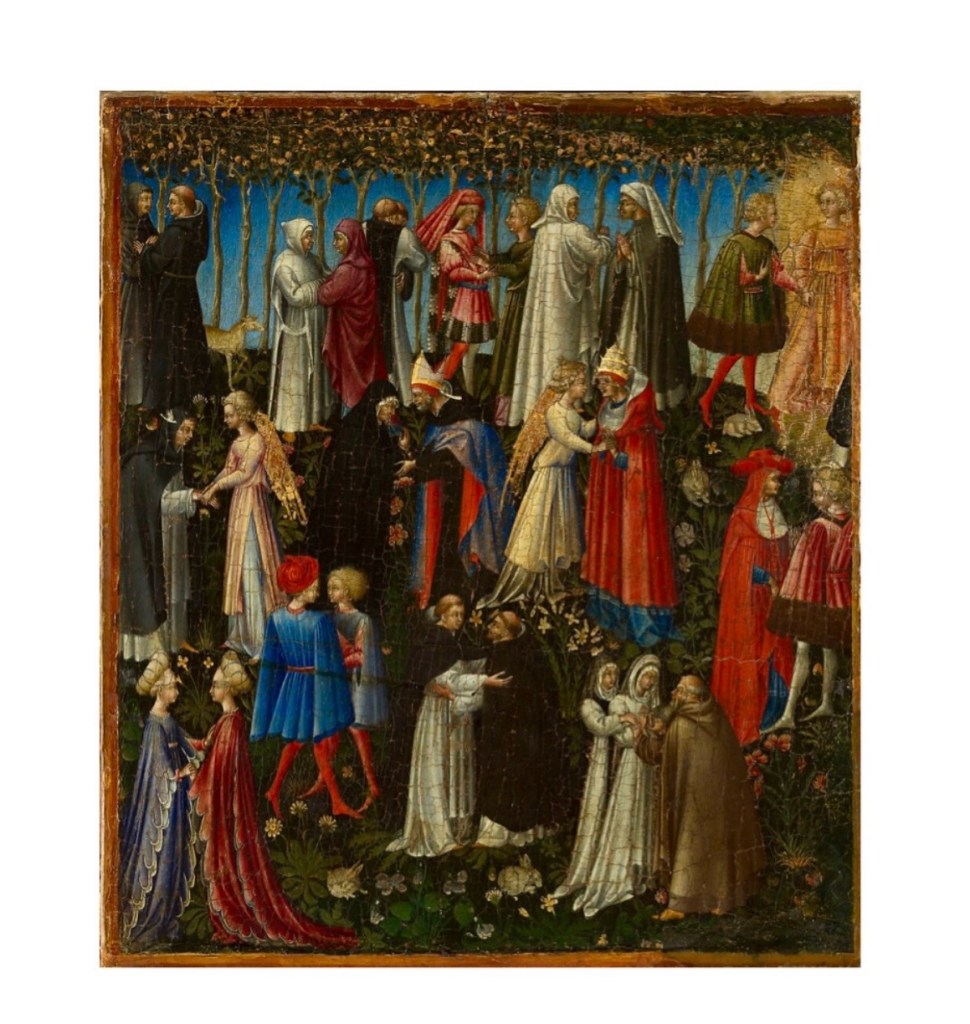
Giovanni di Paolo’s “Paradise” (1445) is a small scene once featured as a predella of an altarpiece from Siena’s San Dominica cathedral. Albeit its miniature proportions it is a striking image of Paradise that puts us in front of a choreography of encounters of the dead, as if the heaven was not a superior and separate stage of life in the cycle of salvation, but rather a continuous stretched territory that takes off where “this life” had left. In its rather simple and rhythmic composition, surrounded by citrus and vegetation, Di Paolo offers the viewer a state of paradise that is not about absolute bliss or bathed in irresistible enchantments, but rather something that in poverty reveals itself in proximity, literally face to face, with an other, perhaps a friend or lover. If we zigzag across the figures it is almost as if the picture would confirm Roberto Antelme’s intuition that “the only transcendence is the relation between beings”. And nothing else is the painterly texture of paradise. In this way, one can define the earthly paradise as a space where transcendence is dispensed because it primarily welcomes and senses otherness.

One of the striking details of the picture is precisely the positioning of the hands of each couple. Just take a second to gaze around them. These are hands that gesture towards a supreme affection; it is the hand that reciprocates and welcomes. It has been noted – for instance, in Berenson’s A Sienese Painter of the Franciscan Legend (1910), that Sienese painting of the fifteenth century introduced a new pictorial attention that manifested the coming to life of the spiritual. In Giovanni di Paolo’s Paradise the flickering hands, moving around the bodies, are perhaps signifying the initial touch of renewal between heaven and earth. In fact, it is almost as if the sliding of hands was the vehicle for the nongranular transition into the arrival of heaven. In a way of synthesis, one could say that paradise is always at the distance of the hand; which is why painting and happiness remain in an intimate dialogue regardless of themes or historical epochs.  

And one can ponder whether the absence of paradise from imagination in the wake of the absolute intrusion of hell in reality, is not precisely a world where the incommensurability between hand, nature, and language become indistinguishable; the transparency of sameness in an expansive totality well beyond reach. To be in nearness is not just an ethical transcendence between beings, but ultimately allowing a divine region to flourish for possible encounters. This is why Angelus Silesius says that “nothing exists except you and I, without both of us then god would not be god, and the heavens will cease to exist” [1]. Paradise is, as Di Paolo’s painting reveals, not the utopia to come in another time, but the  inconceivable place never fully detached from the experiences in this earth. As Karl Barth once wrote: “As the place of God in heaven is, of course, a place which is inconceivable to us. It cannot be compared with any other real or imaginary place. It is inaccessible. It cannot be explored or described or even indicated. All that can be affirmed concerning it is that it is a created place like earth itself and the accessible reality of earth which we can explore and describe or at least indicate; and that it is the place of God” [2].

This inconceivable place of God is the apocatastasis of what sorrounds us, of what has touched us, and of what we have touched; and this includes above all, the nexus of the living and the dead in a strenuous thought that gathers itself in what has loved. This space outlives the world of the living in order to express the divine that is, precisely, the unmediated appearance of each encounter. This means that painting paradise does not commission what a new life should look like as a way to overcome a previous existence of deficiencies and missed opportunities; what is recollected, and thus the only true apocatastasis, is a path to presence that knows neither end nor name. 

Notes 

1. Angelus Silesius. El peregrino querúbico (Ediciones Siruela, 2005), 2005.

2. Karl Barth. Church Dogmatics: The Doctrine of Creation, III (T&T Clark, 2010), 149.

*image. Giovanni di Paolo’s “Paradise” (1445), part of the Metropolitan Museum Collection.

Police and Schools: two vectors of American civility. by Gerardo Muñoz

The conservative journalist David French has recently reported an interesting empirical fact about the social reality in the United States: according to a recent Gallup survey that measures public confidence in American public institutions, there are two institutions defended and discredited by both left and right: those on the conservative right expressed confidence in the police (about 70% or so), and those on the progressive left expressed confidence in schools and higher education (about the same percentage). This is an interesting fact only for the reason that it reveals with immense clarity – very much against French’s political idealism of overcoming the caesura – the two effective vectors of American civil society: police and schooling. In fact, aside from their divergent emphasis, progressives and conservatives agree fundamentally that policing and schooling are the indispensable elements in this moment of civil society. Let’s call it the “high modernist moment of the metropolis”.

This is why to any attentive observer of American reality, police and schooling are so intertwined and mingled with each other that it becomes impossible to separate them, and not just because there is police presence on university campuses or because the police articulates a discourse of “community” and educational instruction in their daily practice. Police and Schools are two vectors in the structure of civil society in the wake of the collapse of modern politics. In other words, what emerges after the end of politics in America is the intersection between police and school as two intersecting poles that sustain, nurture, and reproduce the axiomatic organization of civil society.

The zone of convergence of police and school is culture. Now culture should not be understood as symbolic distribution of mass consumption and public goods, but more specifically as a flexible regime of adaptation whose proper end is the optimization of the civil order. Hence, the fascination and continuous arousal of “cultural battles” in the public spheres is nothing but empty chatter of the same end: the acceleration of techniques and symbolic amalgamations in a social roundup of self-governance. When Sir Ernest Barker defined the necessity of civility as the precondition of the commonwealth, he took for granted that culture was meant to maximize singular character and conduct [1]. On the contrary, today the maximization of culture presupposes a paideia that revokes every character in the name of a flattening conduct that must be adaptive to the ends of abstract civil organization of values. If civility for Barker was condensed in the figure of the “gentleman”, in contemporary America, the figure is the nowhereman: an all-capable human-species that must adapt to the latest marching order and its temporal justifications. In this context, the police and school are elevated from social institutions to productive vectors of civil cohabitation.

It is still striking today to read what theologian Karl Barth wrote in 1928: “In paradise there were no schools and no police. Similarly, and in view of its intensity we must say specifically there was no gentleman unseen, and all the more penetrating “they” of costumes” [2]. And for Barth, it is only in the wake of Romanticism – in this way confirming Gianni Carchia’s important thesis about the consolidation of a subjective romantic modernity – that the police and the school was unleashed against every costume and against everything that stood in its way. Social abstraction is incapable of grasping this stealth transformation. And it cannot see it due to the fact that romantic civility offers, in return, a fundamental oblivion: eternal security within a hellish reality. All things considered, this is also why the United States remains the beacon of endless optimism – while being a deadly playground. The vectors of policing and schooling grammar of force expulses any possible ethical notion of paradisal life.

.

.

Notes. 

1. Ernest Barker. Traditions of Civility (Cambridge University Press, 1948), 137.

2. Karl Barth. Ethics (Wipf and Stock, 2013), 390.

Afropessimism and infrapolitical friendship. by Gerardo Muñoz

Ángel Octavio Álvarez and I had the wonderful opportunity to have a brief exchange with Frank Wilderson III on Afropessimism (2020) for the weekly radial program Dublineses in Mexico. I am grateful to Wilderson for his time and generosity, since I am aware of his many speaking obligations around the book these past months. Because of time restrictions, both Angel and I did not get to ask Wilderson many questions. In my case, I felt that my last question did not come through in a clear away. In this note, I want to make an attempt to better articulate it here, not just for the sake clarification, but because I think it pushes the discussion forward; at least one of the possible paths of the discussion that Afropessimism elicits. At the end of my review, I asked whether it was possible for Black existence to imagine itself as a figure of friendship with the inhuman. I want to think of friendship as a “positive outside” of solidarity, which is a target in the book, in particular as it emerges in very concrete institutional contexts, such as the university and communitarian self-examination.

I agree with Wilderson that solidarity is always tendentially an apparatus that regulates “intra-communal narrative acts of transformation” (102). But to be committed to the narrative acts means that one is already subjected to its force, which essentially feeds off social death of black existence. In other words, solidary is the apparatus through which certain hylomorphic cohesion of the “Human” is organized and rendered legible. Essentially, this means that the transformative change always takes place at the level of the human (“a new man”, the ideal of Guevarism in the revolutionary imagination of the New Left) in virtue of disposing the inhuman. Humanity is essentially the somnambulism of the inhuman, as it cannot be otherwise. 

         There is production of Humanity through the different exercises of identification and demand – which ultimately entails the equivalence of singular sufferings – but there is also the side of the inhuman and social death in the world. Of course, the ultrapolitical question has been dominated by the metaphysical niceties of leninist reason: ‘what is to be done?’. But as Wilderson himself admits in the chapter on Stella (55-147), the ‘destructive act’ against the world that sustains social death is psychically unenabling and impossible (103). I take it that one of the things that Wilderson is pointing out here is that there is no “exodus” from the constraints of nihilism through sacrificial investment, nor by simple inversion of violence for the ends of liberation. There is also no exit through a narrative of redemption, or for that matter, any practice of narrativization of social death, which already amounts to the domestication in the other’s phantasmatic economy. 

But it is precisely here where the question of friendship emerges; since friendship is irreducible to alliance or subjective solidarity. Friendship is the sharing in thought that is always constitutive of the outside of the sayable. This is how Mascolo defines friendship: a sharing of thought that is suspicious of thinking as a mere “foam of things” [1]. Thought is the event of this encounter for which we are never prepared for. Assuming the unconditional function of thought frees a tonality of innocence that emerges without the compensatory excesses of original sin and guilt. Assuming one can traverse the theological apparatuses of the Christian tradition in his way – for which there is much archeological work to be done – could not one say that friendship is, in every case, the errancy of the afropessimist tonality? In other words, friendship is committed to the sacredness of the inhuman that in its proximity, it delimits an experience that is irreducible to normative ethics or political causes. 

Infrapolitical friendship has no demands and retracts from a “politics of care” (the intramural pole of global solidarity); rather, its inclination is contingent upon the unscripted cartography that provides life with a sense of destiny. This a joy in an inhospitable world. What friendship (philos) finds is also alien to the genus of the Human. Every friendship dwell in the unnarratable fabric of experience. It seems to me that this is one of the gestures of Afropessimism, which resists narrative from experience without exemplum. It is most definitely what emerges in the story about Stella.

Unlike love that demands amalgamating and redemptive competences, friendship is the hard look unto a broken world in which the existence of paradise (outside the apparatus of Human nature) is its aftertaste. This is not merely remembrance, but the passage from metatheory to the event of thought. But this is, after all, only a mere question for Wilderson.

*

Notes 

1. Dionys Mascolo. “L’amitié du non”, Lignes, 1990.