Decline and renaissancing. by Gerardo Muñoz

There is something to be said about the facticity of epochal decline, and the reiterated attempts to call for its overcoming. But both decline and renewal are so interconnected in the Western dispensation of community and institutional organization that any attempt to surpass only deepens and pushes onwards the pendular movement between rise and fall towards generic equilibrium and social stabilization. Oswald Spengler understood well that decline situates civilization at the center of Western internal historical development just as birth presupposes death; thus, civilization is merely the coagulation of vital energies to overcome the emergence of decline. The genesis of civilization into final decline should at least elicit a question to break this ongoing circularity: what does it mean to hold to decline without converting its minimal energy into the orientation of a new horizontal epoch? The end of growth (economic stagnation) realized in real subsumption and the autonomization of value also allows us to formulate the question in the following terms: what does it mean to seize the fall of the rate of profit affirming demobilization and the inoperative nature of life beyond its conversion into the movement of energetic production that characterized the epoch of production through the historical figure of the worker? 

Ultimately, this is a question about how to represent (or how to avoid representation) an ethical orientation of life. At the turn of the twentieth century, it was noted that the ethical bourgeois form of life was conditioned by the sense of “community upon all men” around utility of life’s functions subsumed by work, and work as the sole purpose and meaning of life. The definite character of modern social life can be said to compensate for decline for giving up the incommensurability of life forms; that is, what Lukács also called the temporality of the “genius, in the sense that [the genius] can never be measured against anything, whether interior or exterior” [1]. Confronting this very question at the threshold of the crisis of the transmission of forms in Antiquity, Bernard Berenson in The Arch of Constantine: the Decline of Form (1954) offers a distinct position: the moment for seizing decline should be a deliberate prospect of gazing backwards; a facilis descensus that will disclose something entirely different deprived of the race towards “newness” promised by temporal futurity and its social spheres rhetorically organized. In a remarkable moment of his book, Berenson writes that: “Except in unique moments like the fifth century in Hellas or some three thousand years earlier in Egypt and Sumeria, conscious, deliberate, purposeful art is constantly looking backwards – renaissancing – if I may be allowed this uncouth but necessary verb-striving to recapture some phase of its choice in the art of the past, or at least to model itself or draw inspiration from it” [2].

In other words, there is only “renaissancingif one is able to traverse the decline of the past in the fullest sense of its inheritance of its formal stratification. The perpetual infantilism of the modern ethical outlook is that it tries to claim its definite character in irreversibility in order to exit the downwards path of decline through abundance and vulgarity (and we know from Ruskin that vulgarity is one of the forms that death takes unto the living).

For Berenson there seems to be authentic renaissancing at the level of life forms – of that incommensurable generality of human concrete and practical creation – by holding on to epochal decline, and not through state cultural policies that have sedimented the disappearance of forms of art legitimized by a “critic that will discover a deep meaning, a strange beauty, a revelaning newness in what you have done” [3]. The vicious modern liquidation of the free interplaying creation of forms of life and their external model of appearances is paid with the ascension of the rhetorical utility that will alleviate, at least momentarily, the sentiment of the decline proper to the transmission of dissolution. Whatever redemption creation can offer in the muddled waters of decline, the modern autonomy of reified forms, pushing upwards towards “newness”, will separate the sensorial transformation of life to the homogenous representation of communitarian representative order that puts an end to mood and solitude.

What Berenson calls “renaissancing” of factical experience nourishes the unrealized instances of the tradition not towards the breakthrough of a historical epoch (something like a virtuous mythic age of “Renaissance”) that can be posited by way of general background principles nor through the enforcement of a common social morality; rather the incorporated memory of the past is transformed to its very end because in its liquidation “true life” beyond measure reemerges. Berenson will state quite enigmatically that “style cannot be manufactured by taking thought” independently [4]. This is what Hölderlin had in mind when in a moment of “The Fatherland in Decline” from his theory of the tragic and its passage of dissolution: “The new life, which was to dissolve and did in fact dissolve, is not actually the ideally old, the dissolution of which was necessary, exhibiting its peculiar character between being and nonbeing…thus dissolution, as necessary, when seen from the point of view of ideal remembrance” [5]. It is this remembrance of dissolution that reveals decline as a felicitous fall without judgment that brings the appearance of life outside the irreversibility of the modern historical progress that has accumulated the oblivion of possible worlds.

This is why Hölderlin will also claim in his “The Perspective from which we look at Antiquity” (1799) that the ‘general decline of all peoples’ is due to the inheritance of forms of “an almost boundless prior world, which we internalize either through learning or experience and exerts pressure on us” [6]. To take up decline in a serious way means that we proceed from the formlessness of life, and not from the mimetic drive that expresses, in the name of ‘originality and autonomy’, the civilizational alienation towards the most distant (Antiquity) and the most near (ethos). We can then say that in decline the most distant and the irreducible becoming allows the ascension of ethical life. In this way, we can authoritatively say that there is only hope and redemption in decline because new life flourishes in a time of prudens futuri temporis exitum (“Prudently the god covers the outcome of the future in dark night”) that will transcend itself by becoming into what ceases and ultimately is.

Notes 

1. Georg Lukács. “The Bourgeois Way of Life and Art for Art’s Sake”, in Soul and Form (Columbia University Press, 2010), 76. 

2. Bernard Berenson. The Arch of Constantine: the Decline of Form (1954), 36.

3. Ibid., 64.

4. Ibid., 22.

5. Friedrich Hölderlin. “The Fatherland in Decline”, in The Death of Empedocles (Suny Press, 2008), 154.

6. Friedrich Hölderlin. “The Perspective from which We Have to Look at Antiquity”, in Essays and Letters on Theory (Suny Press, 1988), 39-40.
Unelevated politics. by Gerardo Muñoz

In a fragment from 1919 entitled “World and Time”, written around the time of the elaboration of the essay on the question of violence, Walter Benjamin offers his most succinct definition of politics: “My definition of politics: the fulfillment of unelevated [ungesteigerten] humanness” [1]. The ontological reduction is compact, and the three terms in it are carefully chosen: fulfillment, unelevation, and humanness, which indicates a ‘preparation for a profane politics’ at the threshold of secularization and its negation in a new “spiritual ornamentation”, as he would claim in the notes of “Capitalism and Religion”. The stress on the refusal of “elevation” (gesteigerten), however, does bring to bear that Benjamin’s refusal of a political ontology constrained in subjective and objective representation, which is why in the same fragment he connects the abutting of politics to a “living-corporality” [Leiblichkeit] of the human species. To retract from the cycle of civilizational violence, politics had to be reformed from the groundlessness of the energy of the living.

Hence, for Benjamin there is a metapolitical condition or archipolitics that plays out in refusing “elevated humanity”, which for him was at the source of the romantic response to the impasse of the critical enlightenment, placing the subject of knowledge and its self-reflective faculty at the center of the developing self-rationalization of the spiritual transcendence of the world in this new critical religion: “…the ideal of humanity by rising up to…that very law which, joined to earlier laws, assures an approximation to the eternal ideal of humanity” [2]. Hence, neither trascendental representation nor spiritualized immanence of order could, but unelevation of the “human possibilities” (Menschhaftigkeit). But such possibilities could only be disclosed beyond the pretensions of spiritual elevations of a unified consciousness, as Erich Unger had proposed in his Politics and Metaphysics (1921) around the same time to enact a “politics of exodus” for a common psychosocial regeneration. 

Benjamin’s proximity and distance from Unger’s position could perhaps inform why instead of writing a promised book that was going to be entitled True Politics (Die Wahre Politik) – allegedly containing two chapters “The destitution of power” and “Teleology without ultimate goal” – evolved into the landmark essay “Towards the critique of violence”, in which the frame of domination and the ontology of politics was recasted as a mediation about the folding of secularized annihilating violence, substance intrinsic to the philosophy of history and indestructible life of the soul (“annihilating only in a relative sense…never absolute with regard to the soul of the living”) [3]. Thus, one could say that accounting for the groundwork of “politics” meant accepting the constitutive verticality cosigned to modern philosophy of history, and its bipolar schematism between moral principles and sacrificial production. If Peter Fenves’ assumption is correct, Benjamin was not only inscribing a distance from Unger, but, more importantly, from Kant’s Toward Eternal Peace who defined his “true politics” as dependent on moral determination: “The true politics can therefore not take a step without having already paid homage to morality, and although politics by itself is a difficult art, its union with morality is no art all, for as soon as the two struggle against each other, morality into two cuts the knot that politics cannot dissolve – The right of human beings must be held sacred [heilig], however great a sacrifice this may yet the dominant power” [4].

The Kantian liquidation of politics to morality is hyperbolic to the modern epoch and its crisis – the crisis and enmity against the concept of the political, Carl Schmitt would claim in Political Theology (1922) – rendering modern politics and legitimacy hollow; something that Benjamin had understood well he saw to retract from the question of “politics” to that of a critico-metaphysical exploration waged on morality “as nothing other than the refraction of action in knowability, something from the region of knowledge…Morality is not ethos” [5]. Elevation could only have meant the production of a subject of knowledge and the specific (technical) arrangement of knowledges for subjection. On the contrary, the ethos was the necessary condition no longer for any “coming politics”, but rather for the disclosure of “the coming world” [die kommende Welt] itself. This means that working through the redemption of the world solicits a reversal from morality to ethics only to later transform the conditions of politics.

Let us return to the definition of politics as “unelevated [ungesteigerten] humanness”. What defines “unelevation”? From the ethical point of view it conjoins with the notion of “inclination” [Neigung] that Benjamin favors because of its unconditional valance that disarms the cycle of violence of the human community and its willful hostilities. The inclination rejects the paradigm of force because it an erotic mediation, that is, an affection of donation and love beyond exchange [6]. But inclination is only possible through language, as Benjamin had expressed in his “concept of politics” in a letter to Martin Buber from 1916: “I understand the concept of politics in its broadest sense…in this sense, therefore, language is only one means of more or less suggestively laying the groundwork for the motives that determine the person’s actions in his heart of hearts. Only the intensive aiming of words into the core of intrinsic silence is truly effective action” [7].  

Thus, the suspended elevation of the subject and higher order meant that its persuasive purity allows the inception of the “divine” as a «teleology without a goal» validated by the suspension of judgement of appearance. The intensification of the unelevation opens life to an ethical demand of a “living corporality” that roams the world’s crust beyond depredation where the force of autonomy of social practices does not risks the world of life forms and the soul. Indeed, at this point Benjamin does join Unger’s cardinal thesis: “Overcoming capitalism through wandering”. Or as he wrote even earlier about Hölderlin’s poetics: “[In the world of Hölderlin], the living are always stretching of space, the plane spread out within which destiny extends itself…it already comprehends the fulfillment of destiny” [8]. A politics oriented pending dowards to “unelevation”, inhabits the ground level of co-existence and cultivation dismissing the ontological derivatives or principles (archein) of ‘politics’ in order to conquer every possible destiny in the lawless fulfillment of the world.

Notes 

1. Walter Benjamin. “World and Time”, in Walter Benjamin: Toward the Critique of Violence: A Critical Edition (Stanford University Press, 2021), 74. 

2. Walter Benjamin. “The Concept of Criticism in German Romanticism”, in  Selected Writings, Volume 1, 1913-1926 (Harvard University Press, 1996), 138. 

3. Walter Benjamin. “Toward the Critique of Violence”, in Walter Benjamin: Toward the Critique of Violence: A Critical Edition (Stanford University Press, 2021), 58. 

4. Peter Fenves. “Introduction”, in Walter Benjamin: Toward the Critique of Violence: A Critical Edition (Stanford University Press, 2021), 18-19. 

5. Walter Benjamin. “Ethics, Applied to History”, in Walter Benjamin: Toward the Critique of Violence: A Critical Edition (Stanford University Press, 2021), 74. 

6. Walter Benjamin. “On Kantian Ethics”, in Walter Benjamin: Toward the Critique of Violence: A Critical Edition (Stanford University Press, 2021), 71. 

7. Walter Benjamin. “Letter to Martin Buber” (1916), in The Correspondence of Walter Benjamin (University of Chicago Press, 1994),  79-80.

8. Walter Benjamin. “Two Poems by Fredrich Hölderlin”, in Selected Writings, Volume 1, 1913-1926 (Harvard University Press, 1996), 26. 

Humanity’s way out: antinomies of Elio Vittorini’s Uomini e no (1945). by Gerardo Muñoz

In an early review of Elio Vittorini’s Uomini e no (1945), Renato Poggioli noted that one of the important merits of the novel was that in spite of the authort’s political commitment, the narrative was “neither partisan nor ideological. I dare to say it is not political; the author even apologizes for this at the end of the volume” [1]. Poggioli, of course, is referring to Vittorini’s Postscript where he states, favoring a thin notion of the autonomy of art, that the end of art is to “seek in art the trace progress of humanity is altogether different from fighting for it upon the political and social terrain” [2]. This is enough evidence to bring to bear Vittorini’s humanist project grounded in a faith in the “progress of the human species” that he wrestled with throughout his life, and that he never really abandoned according to Franco Fortini [3]. Of course, Vittorini’s ‘progressivism’ is not bounded to ironclad guidelines of political economy and the science of a materialist history, rather his position is the attempt to flee from it, to undertake a different path in which humanity and inhumanity could enter into an improper and inconspicuous relationship towards presence. 

Here we can part ways with Poggioli’s suggestion that Uomini e no (1945) is not “sufficiently political” because the characters do not dare to make political slogans or identify themselves with a concrete political party line (the Communist Party that Vittorini himself identified with in spite of having written a non-political novel) during the underground resistance during the years of fascist domination in Milan during the interwar years. If Uomini e no (1945) drifts aways from engaging in a formal political identification to mobilize the narrative persuasion it is because for Vittorini there is an original struggle for “life” that necessarily precedes subjection and political action: it is the struggle of human species to confront the difficulty of its own inhuman threshold, which becomes necessary to account for in any materialist conception. The whole tension of the novel hinges on the unnerving formal composition of the narrative with the asphyxiating dread and angst of the character that embodies the existential the practice of an incarnated struggle beyond survival. 

However, what is beyond survival? What comes after the desert of a world that soon enough – in the words of Theodor Adorno at the height of the mid century – will turn human life into “mere functions within a monstrous social machine in which “life does not longer lives”…in which what grows is the scope of socialization and its functions. What I want to say is that liberty has become a mere pretext to enhance the ways of domination” [4]. If politics is the religion of modernity (political theology suturing the void with authority), the accumulation of liberty can only be understood as the moment of expansion and reproduction of effective domination. In a way, the metropolitan scenario in Uomini e no (1945) foreshadows the evolving historical epoch of this ‘monstrous socialization’ as a civil war or stasis, in which the mere survival of political struggle is proportional to the dispensation of death of humanity as the last dialectical movement of humanity against itself; that is, towards the concrete extinction of the human. For Vittorini the swerving black sun of fascism and political militancy (in its idealized version invested in the paradigm of sacrificial structure of history) can only amount to the realization of epochal nihilism and the fertilization of the expansive desert in the novel at the expense of sacrificing the erotic mediation with the world, which entails the liquidation of the sensibility external to human: “Love, in those deserts, is at its most squalid; it is not that life is absent from but the life it has is not alive. You are thirsty and have a chance to drink; there is water. You are hungry, you have a chance to eat; there’s bread. There is a spring and alms around, just the one you are looking for. But it  is only a mirage, it is not the thing itself” [5]. The fundamental question posed by Vittorini is never truly resolved by Uomini e no (1945): crossing the desert to achieve something like an erotic distance with the thing itself as ultimately the confirmation of one’s irreductible destiny. No doubt, there are moments where this emerges in strange ways, at the limit of narration and as a linguistic declaration. This is scripted through the exchange with the old lady Selva on happiness: “We work in order that men be happy. Isn’t that what we are working for?…Men need to be happy. Would there be any point to our clandestine newspapers? To our conspiracies?” [6]. 

Is happiness a subterfuge to return to the world, or is happiness, authentic non-compensatory happiness, the stimmung of life as it retreats from the delegated representations of civil society? The suspended dialectical closure at the level of form in Uomini e no (1945) provides a preliminary resolution to the question of happiness amidst wreckage; a collapse that speaks to Vittorini’s impossibility to bring into synthesis political action and existential authenticity. The narrative texture of Uomini e no (1945) is a preparatory exploration – showing the false exists in the meantime – towards the possible liberation of man’s passions, even against the premises of a reconciled ‘Humanity’ capable of leaving behind the antinomies of humanism and antihumanism at the service of the ‘communist way’. And we know that for Vittorini the commitment to ‘Communism’ was inscribed not in the idea or the organizational tactics but in the notion of the “way” (una via), capable of opening possibilities to counter the coercive efficacy of the administrative social apparatuses that turn historical progress into a totalizing desert [7].  How to do so – is there any legible index to the “via comunista”? As a novel Uomini e no is preparatory towards this retreat from the confusion of the inhumanity of the human on the one hand, and the total humanization of the world to deface the possibility of happiness and experience with the world itself. 

In this sense, Fortini is right in describing the lyricism of the novel as attuned to a funeral oration or song (“canto funebre”), which is also a prolonged farewell to the ideals of Vittorini himself as a moral humanist; that is, as someone committed to the ideals and abstraction of redemptive self-sacrificial christology and the self-serving autonomous action of the pardon as man’s last hope to absorb the inhuman kernel into the vita nova of a redeemed universal Humanity. And in fact, these are two “endings”’ of Uomini e no (1945): the self-immolation and sacrifice of the protagonist N2 waiting to confront the Nazi official Cane Nero, and the final sequence of the worker that refuses to murder a German soldier because he looked “sad” even when standing on occupied soil, even when he occupies the role of the protectorate of the nomos of the earth [8]. These are the novel two preparatory distinct actions in the dense fog of the interregnum: the Christological path of sacrifice of N2  – the sacrifice to end all sacrifices, which according to René Girard’s defines the advent of the Christian sacrificial  practice- seeks a last action of resistance holding on to “humanity’s internal weakness”, which carries the elevation of secularized mythic discharge of subjective martyrdom [9]. On the other, the milanese worker offers redemption as a form of secret forgiveness (without a justification and without a why) to the occupier, and in this way integrate the inhuman into the human species as the solution to the repeated rumination over the movement of struggle and resistance: “Why, without being in any way forced to do so, had they entered this duel to the death, and why did they continue to wage it?” [10]. 

In his early reading of Uomini e no (1945) Franco Fortini offered a thesis that I am tempted to call the domestication of the wolf argument; an inversion of Hobbesian anthropology and the Christian felix culpa in which struggle’s optimism will ultimately transfigure the internal wolf unto the human’s heart [11]. But we know that the homo homini lupi depends on a thick notion of anthropology, of the human’s unfathomable deficiency in relation to ‘object reality’ so that any domestication of the wolf within humanity is also an anthropological quest; perhaps the last “route” of negating humanism through substantive acts (sacrificial sacrifice and forgiveness) in the attempt to reconcile the wolf with man. But this is the very enterprise of civilizational techniques of adaptation proper to the tooling of political anthropology – that is, the domestication of the savage wolf entails its conversion to the passive dog. Could there be a way out to the final verdict of dialectical form beyond struggle, and the reconciliation of humanity with its negation? Perhaps this is only registered as the unthought in Vittorini’s Uomini e no (1945); an experience that prepares a return to the world through the conatus essendi, or  the preservation of each thing’s being as their are. This is registered in only instances of the novel in the backdrop of a landscape; indeed, outside the subject of self-reflection, and beyond the premises of radical evil proper to moral platitudes. And the moment reads like this in chapter CXXX: “The long dusty road, the drowsiness, the hay, the stitches where the cicadas were: everything that was, and that, along with everyone who is lost, still wants to be. And the sky filled with kites? The sky that was filled with kites” [12]. The perseverance of the conatus essendi puts to rest what the delegated forms that politics and morality have to offer as temporal substitutes for dragging the historical promise of humanism within epochal nihilism. 

In this suspended imagery of an arid landscape, Vittorini descends to the preservation of things as they open to their manifestation of another sense of freedom – no longer tied to the paradigm of historical liberation nor to the assumption of synthetic anthropological determinations to sooth pain – comes upwards, always silently, through the order of description outside the human. And is not in this description what Gianni Carchia would call “the non-human…a gesture of farewell to the idealist movement; a farewell to the exaltation of the human up to the highpoint of its explosion. The refusal to substitute the dead god for a human that in the depredatory scope of totality crosses every limit, every transcendence, and infinity” [13]? This transposition of this  proximity with this “other-than-humanity” ( what Humanity can no longer hold on to) is the secret to Vittorini’s infrapolitical impasse in Uomini e no (1945) that holds the key to his insistence on a notion of “freedom” against the subject incapable of overcoming itself in the face of the abstraction (morality) or ideological  reassurance (militancy) [14]. One could assume that the worker’s last line in Uomini e no (1945) – which also coincides with Vittorini’s mimetic repetition in his “Postscript” – in the form of a promise (‘I’ll learn better’) registers the final attempt to grasp what remains on the exterior fog of humanity: a notion of freedom that, in seeking ‘a way out’, insists in the possibilities of establishing contact with the world. Thus, the program of historical liberation can only be achieved against historical and civilizational fixation; traversing the polarity of humanity and inhumanity, and thus deposing the sublimated sentiment of pain that social domination can administer as an unending process of degenerated and moribound humanity as mere continuation of the fictive life.

Notes 

1. Renato Poggioli. “Review of Uomini e no by Elio Vittorini”, Books Abroad, Vol.20, N.4, 1946, 393.

2. Elio Vittorini. Men and not men (The Malboro Press, 1985), 199.

3. Franco Fortini. “Ma esisteva Vittorini?”, L’Expresso, 4, 2 febbraio 1986, 86.

4. Theodor Adorno & Max Horkheimer. “El mundo administrado o la crisis del individuo”, Pensamiento al margen: revista digital de ideas políticas, N.19, 2023, 200.

5. Elio Vittorini. Men and not men (The Malboro Press, 1985), 34.

6. Ibid., 13. 

7. Elio Vittorini. “El comunismo como vía”, in Diario en público (Gadir Editorial, 2008), 279.

8.  Elio Vittorini. Men and not men (The Malboro Press, 1985), 50.

9. René Girard. Sacrifice (Michigan State University Press, 2011), 65. 

10. Ibid.,  196.

11. Franco Fortini. “Che cosa può l’uomo: Uomini e no” (1945), in Saggi italiani (1987), 253.

12. Elio Vittorini. Men and not men (The Malboro Press, 1985),190. 

13. Gianni Carchia. “Glosa sull’umanismo”, L’erba voglio, N.29-30, 1977, 9.

15. Elio Vittorini. “La libertad es difícil” (1956), en Diario en público (Gadir Editorial, 2008), 382.

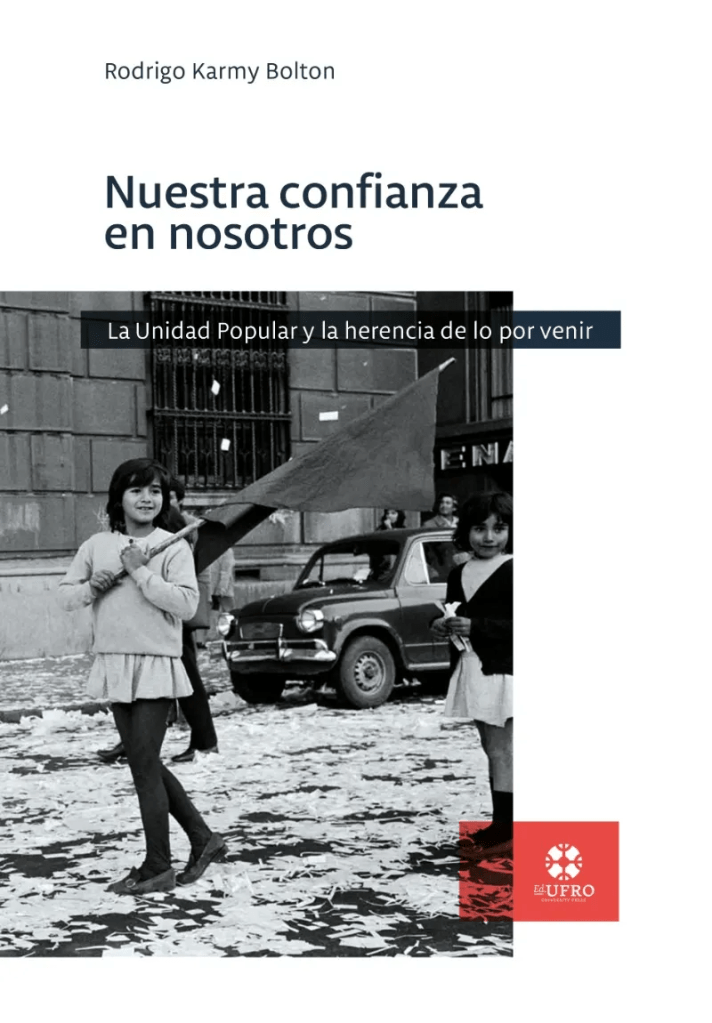
Three notes on Rodrigo Karmy’s Nuestra confianza en nosotros (2023). by Gerardo Muñoz

Transfiguration. Towards the end of Nuestra confianza en nosotros: la Unidad Popular y la herencia del por venir (Ufro, 2023), Rodrigo Karmy suggests that the experiential texture of Salvador Allende’s political years amounted to a sort of corporeal transfiguration of historical time, but also of the political subject within modern architectonics of the inter-state sovereign system. The death-martyrdom brought a new world into order, radically transforming the sense of historical assumptions and its immanent refutations and accelerations. For those of all that know Karmy’s philosophical investigations working through this intuition, it is impossible not to see that ‘transfiguration’ does not entail ‘sacrifice’, but rather it implies the figure of the martyr [1]. And we also know from Erik Peterson that martyrs are absolute witness to truth of an irrevocable event; in other words, those that transcend the core materiality of the mere opinions and matter-of-factness as to remain faithful to the unfathomable to a world brought to abrupt change (and at times, this means also despair). Karmy writes: 

“Se produce así una transfiguración radical de Allende que trastoca enteramente el juego de la teología política, tal como ha sido planteada bajo los avatares del fantasma portaliano: si en esta última, el cuerpo físico termina desmaterializado en un cuerpo institucional, tal como ocurrió con el devenir del general Pinochet,  en Allende termina desmaterializado en una potencia por venir (no en cuerpo institucional), aquello que Walter Benjamin llamaba lo «nunca sido»: «Siempre estaré junto a ustedes», dice el presidente usurpado por el golpismo esa triste mañana de septiembre” [2]. 

The truth of transfiguration – and in a sense every event of truth is always carried by the energy what is transfigured – marks the incommensurable distance between the eternal persistence of the word and the historical movement guided by the precepts of civilization. Whereas the political grammar organizes itself through an indiscriminate institutional corpus and a set of moral binding obligations upon its citizens; the truth of transfiguration is the keeper of the night of the soul that, like the myth of Er, signals the passage between the world of the living and the kingdom of the dead. When transfigured, the dead can become even more lively than those allegedly “alive”; where those alive become embodied and rigid statues or mummies. As such, the energy of transfiguration remains outside the cloisters of history and its memory sites, since its realization takes place whenever there is a drift outside and beyond the suturing of the world as mere stated and enclosed fact.

Voice.  The “we” (Nosotros) in Karmy’s thesis does not signal the constituent political unity of the People nor a partisan form that can exert force towards the inversion of the sedimented historical order. In his archeological endeavor, the ‘nosotros’ indexes a non-numerical instance through the vocative raises its own question to the past. This does not imply that there is a “collective voice” that must enact its point of annunciation through representation and mediated forms; the voice emerges as an exception to the grammaticalization of the constitutional order and its statuary production as expression of legislative will. The voice is the exteriority to every scheme of reproduction. But, what is a “voice”? Following Emilio Recabarren, Karmy connects the voice to the very act of creation: in other words, a voice to the truth implies the vocative of what has truly never been there before. Like the chorā, the voice is both at the reemergence of its origin and medium rather than substance; and this is why the voice, unlike the written language, cannot be subsumed to the reification of mimesis and generative substance [3]. The voice is what every time remains irreducible to the order of discourse difference, historiographical narrativity, and the original letter and spirit of the law. And even in traditions without “Constitutions”, law cannot escape its written and grammatical framework; this is why in Common Law, the Constitutional authority is supplanted by the historical absorption of habits, manners, and tradition into the force of legal codes and binding statutes. It is a high merit of Karmy’s Nuestra confianza (2023) to reminds us that the happiest moments (and perhaps the only moment worth saving, that infinitely returns against the grain of historical progress) of the revolutionary experiences of the twentieth century are to be found in the evocation of the voice and its popular music (something that can also be said of the Cuban Revolution, for instance). This esoteric orphic thread evidences the disjointed relation between the polis and the mythic transfiguration when facilitated by the prophetic overtones of the musical nomos in the genesis of the West [4]. Hence, whenever there is a voice, the suture of politics to the theology cannot amount to the continuous transaction upon the survival and agony of the living.

Freedom from revolution. Unlike the reverential or formalist accounts written for the fiftieth anniversary of the Chilean Unidad Popular, Karmy’s essay invites us to dwell about a political experience after its epochal exhaustion: the collapse of the horizon of the philosophy of history implies the internal implosion of the modern revolution’s infrastructure (constituent power, moral justice, militant subjectivity, sacrificial energy). For Karmy to arrive at a certain nearness to the well lighted tradition of the UP is to abandon once and for all the civilizational eon of sedentary political hegemony (“a revolution in world history” bringing about the age of the nomads to an end, claimed historian Edward Gibbon) that has now paved the way for the unlimited forms of planetary government exerted through the rationality of the management of population and the distribution of the economy [5].

The farewell to the revolution and its reverse – it is well known that De Maistre claimed in the wake of the French Revolution that the opposite of the revolution is not a counter-revolution, but what is all together contrarian to it – means to put a halt to the paradigm of force (positive and immanent hostility) that has oriented actions, expectations, passions, and even dreams taxed at the fictive illusions of an abstract Humanity devoid of any possibility of happiness in the world. It is only after we can leave behind the revolutionary metaphysical mimesis that a new sense of freedom could emerge away from the dominion of the land-surveyors of the Earth. Abandoning any clamors oriented towards the future, it is now for us to attune to the everlasting traditions that are unrelinquished to the endless rubble of time. 

Notes 

1. Rodrigo Karmy. “The Absolute Gift: Martyrdom as Destituent Power”, SAQ, 122, 2023, 157-170.

2. Rodrigo Karmy. Nuestra confianza en nosotros (Ufro, 2023), 183.

3. Ibid., 102.

4. Gianni Carchia. Orfismo e tragedia: Il mito trasfigurato (Quodlibet, 2019).